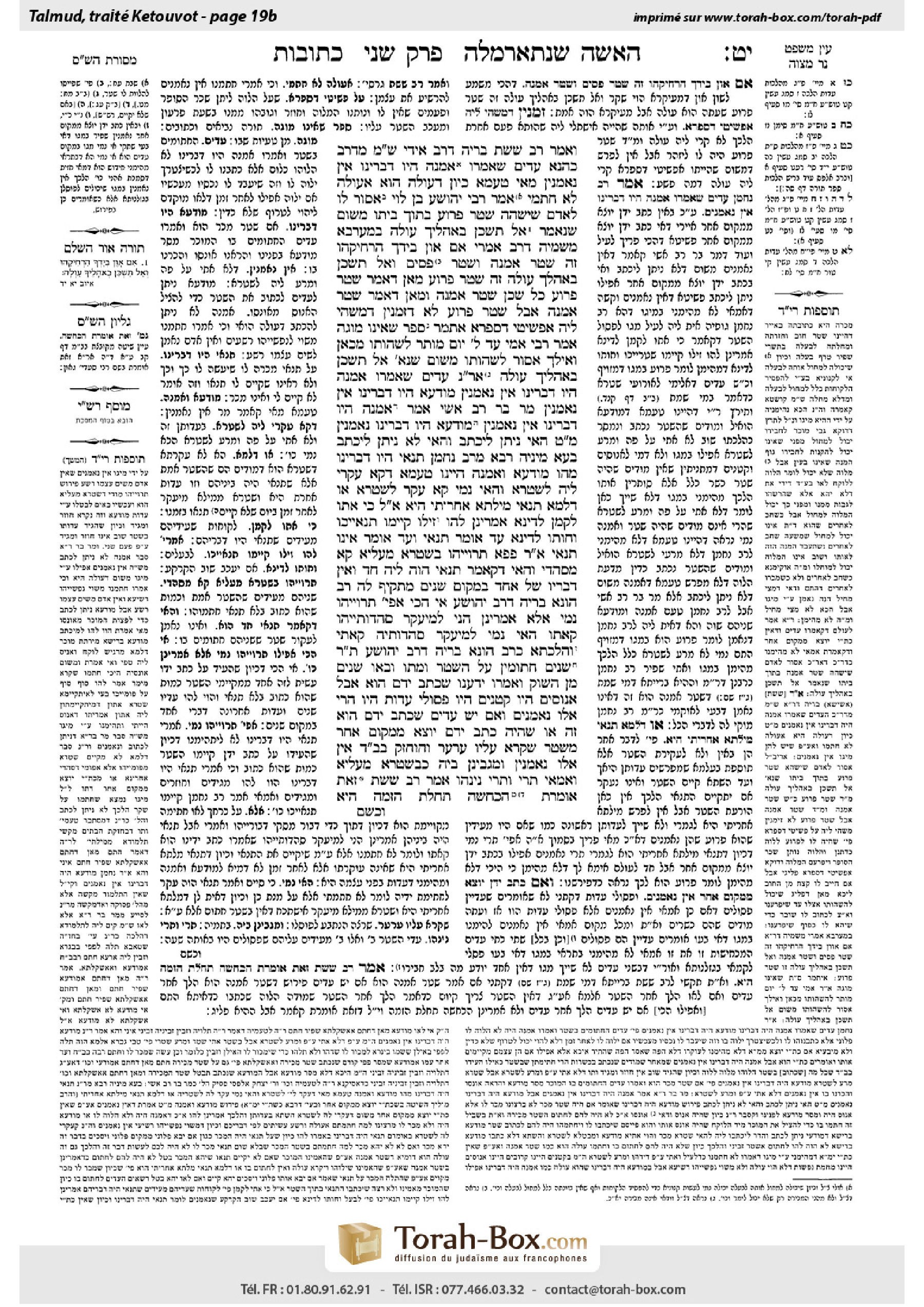
Ketubot 19b: Talmud study for Daf Yomi
Daf Yomi is the daily study of one Talmud folio. Explore 37 tractates with scans, Hebrew text, Sefaria English and AI-generated French translations where annotated.
Passage selection and English or AI-generated French translation are available where the scan has annotations. Daf Study is independent of Torah-Box and Sefaria.
Browse Ketubot · כתובות · All tractatesKetubot 19b text and translations
This page of Ketubot includes the Aramaic text, an English translation and an AI-generated French translation, alongside the scan above.
כתובות י״ט ב · Aramaic and Hebrew text
וְאָמַר רַב שֵׁשֶׁת בְּרֵיהּ דְּרַב אִידִי: שְׁמַע מִינַּהּ מִדְּרַב כָּהֲנָא, עֵדִים שֶׁאָמְרוּ ״אֲמָנָה הָיוּ דְּבָרֵינוּ״ — אֵין נֶאֱמָנִין. מַאי טַעְמָא? כֵּיוָן דְּעַוְלָה הוּא — אַעַוְלָה לָא חָתְמִי.
אָמַר רַבִּי יְהוֹשֻׁעַ בֶּן לֵוִי: אָסוּר לוֹ לָאָדָם שֶׁיְּשַׁהֶה שְׁטָר פָּרוּעַ בְּתוֹךְ בֵּיתוֹ, מִשּׁוּם שֶׁנֶּאֱמַר: ״אַל תַּשְׁכֵּן בְּאֹהָלֶיךָ עַוְלָה״. בְּמַעְרְבָא מִשְּׁמֵיהּ דְּרַב אָמְרִי: ״אִם אָוֶן בְּיָדְךָ הַרְחִיקֵהוּ״ — זֶה שְׁטַר אֲמָנָה וּשְׁטַר פַּסִּים. ״וְאַל תַּשְׁכֵּן בְּאֹהָלֶיךָ עַוְלָה״ — זֶה שְׁטָר פָּרוּעַ.
מַאן דְּאָמַר שְׁטָר פָּרוּעַ, כׇּל שֶׁכֵּן שְׁטַר אֲמָנָה. וּמַאן דְּאָמַר שְׁטַר אֲמָנָה — אֲבָל שְׁטָר פָּרוּעַ לָא, דְּזִמְנִין דִּמְשַׁהֵי לֵיהּ אַפְּשִׁיטֵי דְסָפְרָא.
אִתְּמַר: סֵפֶר שֶׁאֵינוֹ מוּגָּהּ, אָמַר רַבִּי אַמֵּי: עַד שְׁלֹשִׁים יוֹם מוּתָּר לְשַׁהוֹתוֹ, מִכָּאן וְאֵילָךְ אָסוּר לְשַׁהוֹתוֹ, מִשּׁוּם שֶׁנֶּאֱמַר: ״אַל תַּשְׁכֵּן בְּאֹהָלֶיךָ עַוְלָה״.
אָמַר רַב נַחְמָן: עֵדִים שֶׁאָמְרוּ אֲמָנָה הָיוּ דְּבָרֵינוּ — אֵין נֶאֱמָנִין. מוֹדָעָא הָיוּ דְּבָרֵינוּ — אֵין נֶאֱמָנִין. מָר בַּר רַב אָשֵׁי אָמַר: אֲמָנָה הָיוּ דְּבָרֵינוּ — אֵין נֶאֱמָנִין, מוֹדָעָא הָיוּ דְּבָרֵינוּ — נֶאֱמָנִין. מַאי טַעְמָא? הַאי — נִיתַּן לִיכָּתֵב. וְהַאי — לֹא נִיתַּן לִיכָּתֵב.
בְּעָא מִינֵּיהּ רָבָא מֵרַב נַחְמָן: תְּנַאי הָיוּ דְּבָרֵינוּ, מַהוּ? מוֹדָעָא וַאֲמָנָה, הַיְינוּ טַעְמָא — דְּקָא עָקְרִי לֵיהּ לִשְׁטָרָא, וְהַאי נָמֵי קָא עָקַר לִשְׁטָרָא. אוֹ דִלְמָא: תְּנַאי מִילְּתָא אַחֲרִיתִי הִיא? אֲמַר לֵיהּ: כִּי אָתוּ לְקַמַּן לְדִינָא, אָמְרִינַן לְהוּ: זִילוּ קַיִּימוּ תְּנָאַיְיכוּ וְחוּתוּ לְדִינָא.
עֵד אוֹמֵר ״תְּנַאי״, וְעֵד אוֹמֵר ״אֵינוֹ תְּנַאי״. אָמַר רַב פָּפָּא: תַּרְוַיְיהוּ בִּשְׁטָרָא מְעַלְּיָא קָא מַסְהֲדִי, וְהַאי דְּקָאָמַר: ״תְּנַאי״ — הָוֵה לֵיהּ חַד, וְאֵין דְּבָרָיו שֶׁל אֶחָד בִּמְקוֹם שְׁנַיִם.
מַתְקֵיף לַהּ רַב הוּנָא בְּרֵיהּ דְּרַב יְהוֹשֻׁעַ: אִי הָכִי, אֲפִילּוּ תַּרְוַיְיהוּ נָמֵי? אֶלָּא אָמְרִינַן: הָנֵי לְמִיעְקַר סָהֲדוּתַיְיהוּ קָאָתוּ, הַאי נָמֵי לְמִיעְקַר סָהֲדוּתֵיהּ קָאָתֵי: וְהִלְכְתָא כְּרַב הוּנָא בְּרֵיהּ דְּרַב יְהוֹשֻׁעַ.
תָּנוּ רַבָּנַן: שְׁנַיִם חֲתוּמִין עַל הַשְּׁטָר וּמֵתוּ, וּבָאוּ שְׁנַיִם מִן הַשּׁוּק וְאָמְרוּ: יָדַעְנוּ שֶׁכְּתַב יָדָם הוּא, אֲבָל אֲנוּסִים הָיוּ, קְטַנִּים הָיוּ, פְּסוּלֵי עֵדוּת הָיוּ — הֲרֵי אֵלּוּ נֶאֱמָנִים. וְאִם יֵשׁ עֵדִים שֶׁכְּתַב יָדָם הוּא זֶה, אוֹ שֶׁהָיָה כְּתַב יָדָם יוֹצֵא מִמָּקוֹם אַחֵר מִשְּׁטָר שֶׁקָּרָא עָלָיו עַרְעָר וְהוּחְזַק בְּבֵית דִּין — אֵין אֵלּוּ נֶאֱמָנִין.
וּמַגְבֵּינַן בֵּיהּ כְּבִשְׁטָרָא מְעַלְּיָא? וְאַמַּאי? תְּרֵי וּתְרֵי נִינְהוּ!
אָמַר רַב שֵׁשֶׁת, זֹאת אוֹמֶרֶת: הַכְחָשָׁה — תְּחִלַּת הֲזָמָה הִיא,
Ketubot 19b · English translation
And Rav Sheshet, son of Rav Idi, says: Conclude from the statement of Rav Kahana that witnesses who said: Our statement was a statement of trust, and the document we signed was a document of trust, are not deemed credible. What is the reason? Since that document is an injustice, they would not sign a document of injustice. Their contention that they signed the document would incriminate them and is therefore not accepted.
Rabbi Yehoshua ben Levi said: It is prohibited for a person to keep a repaid document within his house, due to the fact that the verse states: “And let not injustice dwell in your tents” (Job 11:14). Even if he does not use the document to collect payment, the concern is that it might fall into the hands of one who will use it illegally to collect payment. In the West, in Eretz Yisrael, they say in the name of Rav: With regard to the first half of the verse: “If iniquity be in your hand, put it far away” (Job 11:14), this is referring to a document of trust and a document of security [passim]. With regard to the second half of the verse: “And let not injustice dwell in your tents,” this is referring to a repaid document.
They note: With regard to the one who said that a repaid document is the injustice referred to in the verse, all the more so a document of trust is an injustice and may not be kept, as a document of trust is fundamentally false. And with regard to the one who said that a document of trust is the injustice referred to in the verse, however, with regard to a repaid document, perhaps it is permitted to keep it, as, at times people keep it and do not return it to the borrower. This is because in those cases it serves as security for the coins of the scribe, whose fee has not yet been paid by the borrower, who is legally responsible to pay the scribe for writing the document.
On a similar note it is stated, with regard to keeping items with potential to lead to transgression: With regard to a Torah scroll that is not proofread and therefore contains errors, Rabbi Ami says: It is permitted to keep it without emending the mistakes for up to thirty days, and from that time onward it is prohibited to keep it, as it is stated: “And let not injustice dwell in your tents” (Job 11:14).
§ Rav Naḥman said that witnesses who say: Our statement was a statement of trust and we signed a document of trust, are not deemed credible. Similarly, witnesses who said: Our statement was a statement accompanied by a declaration by the person who is rendered a debtor by this document that he was coerced into the agreement, thereby invalidating the document, are not deemed credible. Mar bar Rav Ashi said that witnesses who said: Our statement was a statement of trust, are not deemed credible, but witnesses who said: Our statement was a statement accompanied by a declaration, are deemed credible. What is the reason for the difference between the cases? This document, which was accompanied by a declaration, may be written, as it is written under duress. And this document of trust may not be written, as it is fundamentally unjust.
Rava raised a dilemma before Rav Naḥman: In a case where the witnesses say: Our statement was a conditional statement, i.e., they verify their signatures, but add that the transaction was contingent upon fulfillment of an unwritten condition, what is the ruling? Perhaps it is similar to the cases of a statement accompanied by a declaration and a statement of trust. In those latter cases, this is the reason that their statement is rejected, as in doing so they undermine the document, and in this case too, he undermines the document. Or perhaps a condition is a different matter, as it does not necessarily undermine the document. Rav Naḥman said to him: When people come before us for judgment in this latter case, we say to them: Go and fulfill your conditions, and then descend before us for judgment.
The Gemara asks: What is the ruling in a case where one witness says: There is a condition attached to the transaction and one witness says: There is no condition? Rav Pappa says: Both are testifying that it is a valid document, and that witness who says: There was a condition attached, is only one witness whose testimony challenges that validity. And the statement of one witness has no validity in a place where there are two witnesses.
Rav Huna, son of Rav Yehoshua, strongly objects to this: If it is so that testifying that there is a condition is considered to undermine the document, then even if both of the witnesses testify that there was a condition, their testimony should also not be accepted. Once they testified that the document is valid, they cannot give additional testimony that contradicts their original testimony. Rather, we say: These two witnesses are coming to undermine their testimony that the document is valid. These are not two separate testimonies, one that the document is valid and one with regard to the condition. Rather, the second testimony revokes the first. Similarly, this single witness is coming to undermine his testimony as well. Therefore, there is only one witness testifying that the document is valid. The Gemara concludes: The halakha is in accordance with the opinion of Rav Huna, son of Rav Yehoshua, and the testimony of even one witness who says that there was a condition attached to the transaction is accepted.
§ The Sages taught: If two witnesses were signatories on a document and they died, and two strangers from the marketplace came and said: We know that this is their handwriting, but they were coerced into signing the document, or if they said that they were minors when they signed the document, or if they said that they were disqualified witnesses when they signed the document, these strangers are deemed credible, as the mouth that prohibited and ratified the document is the mouth that permitted and undermined the document. However, if there are other witnesses who testify that it is their handwriting, or if their handwriting emerges from another place, from a document that one challenged and that was deemed valid in court, these witnesses from the marketplace are not deemed credible and their testimony does not undermine the validity of the document.
The Gemara asks: And if the testimony of these witnesses is not accepted, is that to say that we collect debts with that document as one would collect debts with a valid document? And why would that be the case? Aren’t the two signatories whose signatures were ratified and the two witnesses from the marketplace whose testimony invalidates the document contradictory witnesses? Therefore, the document cannot be used to collect payment.
Rav Sheshet said: That is to say that contradiction of their testimony is the first stage in rendering them false, conspiring witnesses, in the sense that certain restrictions that apply to the latter apply to the former as well.
Ketubot 19b · Traduction française (IA)
Rav Sheshet, fils de Rav Idi, dit : Déduis de la déclaration de Rav Kahana que des témoins qui disent : « Notre déclaration était une déclaration de confiance, et le document que nous avons signé était un document de confiance », ne sont pas crus. Pour quelle raison ? Puisqu’un tel document constitue une injustice, ils n’auraient pas signé un document injuste. Leur affirmation selon laquelle ils ont signé ce document les incriminerait ; elle n’est donc pas acceptée.
Rabbi Yehoshua ben Levi dit : Il est interdit à quelqu’un de conserver chez lui un document dont la dette a été remboursée, car il est dit : « Que l’injustice ne réside pas dans tes tentes » (Job 11,14). Même s’il ne se sert pas du document pour recouvrer le paiement, on craint qu’il ne tombe entre les mains de quelqu’un qui s’en servira illégalement pour recouvrer la dette. En Occident, en terre d’Israël, on dit au nom de Rav : La première moitié du verset, « Si l’iniquité est dans ta main, éloigne-la » (Job 11,14), fait référence à un document de confiance et à un document de garantie [passim]. La seconde moitié du verset, « Que l’injustice ne réside pas dans tes tentes », fait référence à un document dont la dette a été remboursée.
On fait remarquer : Pour celui qui a dit qu’un document dont la dette a été remboursée est l’injustice visée par le verset, à plus forte raison un document de confiance constitue une injustice et ne peut être conservé, puisqu’un tel document est fondamentalement mensonger. En revanche, pour celui qui a dit qu’un document de confiance est l’injustice visée par le verset, il se peut que la conservation d’un document dont la dette a été remboursée soit autorisée, car il arrive que des gens le conservent et ne le rendent pas à l’emprunteur. En effet, dans ces cas, il sert de garantie pour les honoraires du scribe, que l’emprunteur n’a pas encore payés, alors qu’il est légalement tenu de payer le scribe pour la rédaction du document.
Dans le même ordre d’idées, à propos de la conservation d’objets susceptibles de conduire à une transgression, il est dit : Concernant un rouleau de Torah qui n’a pas été vérifié et contient donc des erreurs, Rabbi Ami dit qu’il est permis de le conserver sans corriger les erreurs pendant trente jours au maximum ; au-delà, il est interdit de le conserver, comme il est dit : « Que l’injustice ne réside pas dans tes tentes » (Job 11,14).
§ Rav Naḥman dit que des témoins qui disent : « Notre déclaration était une déclaration de confiance et nous avons signé un document de confiance », ne sont pas crus. De même, des témoins qui disent que leur déclaration était accompagnée d’une déclaration de la personne que le document rend débitrice, selon laquelle celle-ci avait été contrainte à l’accord, invalidant ainsi le document, ne sont pas crus. Mar bar Rav Ashi dit que des témoins qui disent : « Notre déclaration était une déclaration de confiance », ne sont pas crus, mais que ceux qui disent : « Notre déclaration était accompagnée d’une déclaration », sont crus. Quelle est la raison de cette différence entre les cas ? Ce document, qui était accompagné d’une déclaration, peut être rédigé, car il est rédigé sous la contrainte. En revanche, ce document de confiance ne peut pas être rédigé, car il constitue fondamentalement une injustice.
Rava souleva un dilemme devant Rav Naḥman : dans le cas où les témoins disent : « Notre déclaration était une déclaration conditionnelle », c’est-à-dire qu’ils reconnaissent leurs signatures, mais ajoutent que la transaction dépendait de l’accomplissement d’une condition non écrite, quelle est la halakha ? Peut-être cela ressemble-t-il aux cas d’une déclaration accompagnée d’une déclaration et d’une déclaration de confiance. Dans ces derniers cas, leur déclaration est rejetée parce qu’ils portent ainsi atteinte au document ; ici aussi, ils portent atteinte au document. Ou peut-être une condition est-elle différente, car elle ne porte pas nécessairement atteinte au document. Rav Naḥman lui dit : Lorsque des gens se présentent devant nous pour être jugés dans ce dernier cas, nous leur disons : « Allez accomplir vos conditions, puis revenez comparaître devant nous pour être jugés. »
La Guemara demande : Quelle est la halakha dans le cas où un témoin dit qu’une condition était attachée à la transaction, tandis qu’un autre témoin dit qu’il n’y avait pas de condition ? Rav Pappa dit : Tous deux attestent que le document est valide, et le témoin qui dit qu’une condition y était attachée est un seul témoin dont le témoignage conteste cette validité. Or, le témoignage d’un seul témoin n’a pas de valeur là où il y a deux témoins.
Rav Huna, fils de Rav Yehoshua, s’y oppose vivement : si attester de l’existence d’une condition est considéré comme portant atteinte au document, alors, même si les deux témoins attestent qu’il y avait une condition, leur témoignage ne devrait pas non plus être accepté. Après avoir attesté que le document est valide, ils ne peuvent pas produire un témoignage supplémentaire qui contredit leur témoignage initial. Il faut plutôt dire que ces deux témoins cherchent à remettre en cause leur témoignage selon lequel le document est valide. Il ne s’agit pas de deux témoignages distincts, l’un attestant la validité du document et l’autre portant sur la condition ; le second témoignage annule le premier. De même, ce témoin unique cherche lui aussi à remettre en cause son témoignage. Il n’y a donc qu’un seul témoin qui atteste la validité du document. La Guemara conclut : La halakha suit l’opinion de Rav Huna, fils de Rav Yehoshua, et le témoignage même d’un seul témoin affirmant qu’une condition était attachée à la transaction est accepté.
§ Les Sages ont enseigné : Si deux témoins avaient signé un document et qu’ils sont morts, puis que deux inconnus du marché sont venus et ont dit : « Nous savons que c’est leur écriture, mais ils ont été contraints de signer le document », ou qu’ils ont dit que ces témoins étaient mineurs lorsqu’ils l’ont signé, ou encore qu’ils étaient des témoins inaptes à ce moment-là, ces inconnus sont crus, car la bouche qui a invalidé le document et l’a confirmé est celle qui l’a autorisé et remis en cause. Toutefois, s’il existe d’autres témoins qui attestent que c’est leur écriture, ou si leur écriture apparaît ailleurs, dans un document qu’une personne a contesté et qui a été validé par le tribunal, les témoins du marché ne sont pas crus et leur témoignage ne remet pas en cause la validité du document.
La Guemara demande : Et si le témoignage de ces témoins n’est pas accepté, cela signifie-t-il que nous recouvrons les dettes au moyen de ce document comme nous le ferions avec un document valide ? Pourquoi en serait-il ainsi ? Les deux signataires dont les signatures ont été confirmées et les deux témoins du marché dont le témoignage invalide le document ne sont-ils pas des témoins dont les dépositions se contredisent ? Par conséquent, le document ne peut pas servir à recouvrer le paiement.
Rav Sheshet dit : Cela signifie que la contradiction de leur témoignage constitue la première étape pour les qualifier de faux témoins conspirateurs, en ce sens que certaines restrictions qui s’appliquent à ces derniers s’appliquent également aux premiers.
Traduction française générée par IA à partir de l’édition anglaise de Sefaria. Vérifie toujours un passage avec le texte source.
Text from Sefaria: William Davidson Edition - Vocalized Aramaic (CC BY NC); William Davidson Edition - English (CC BY NC).