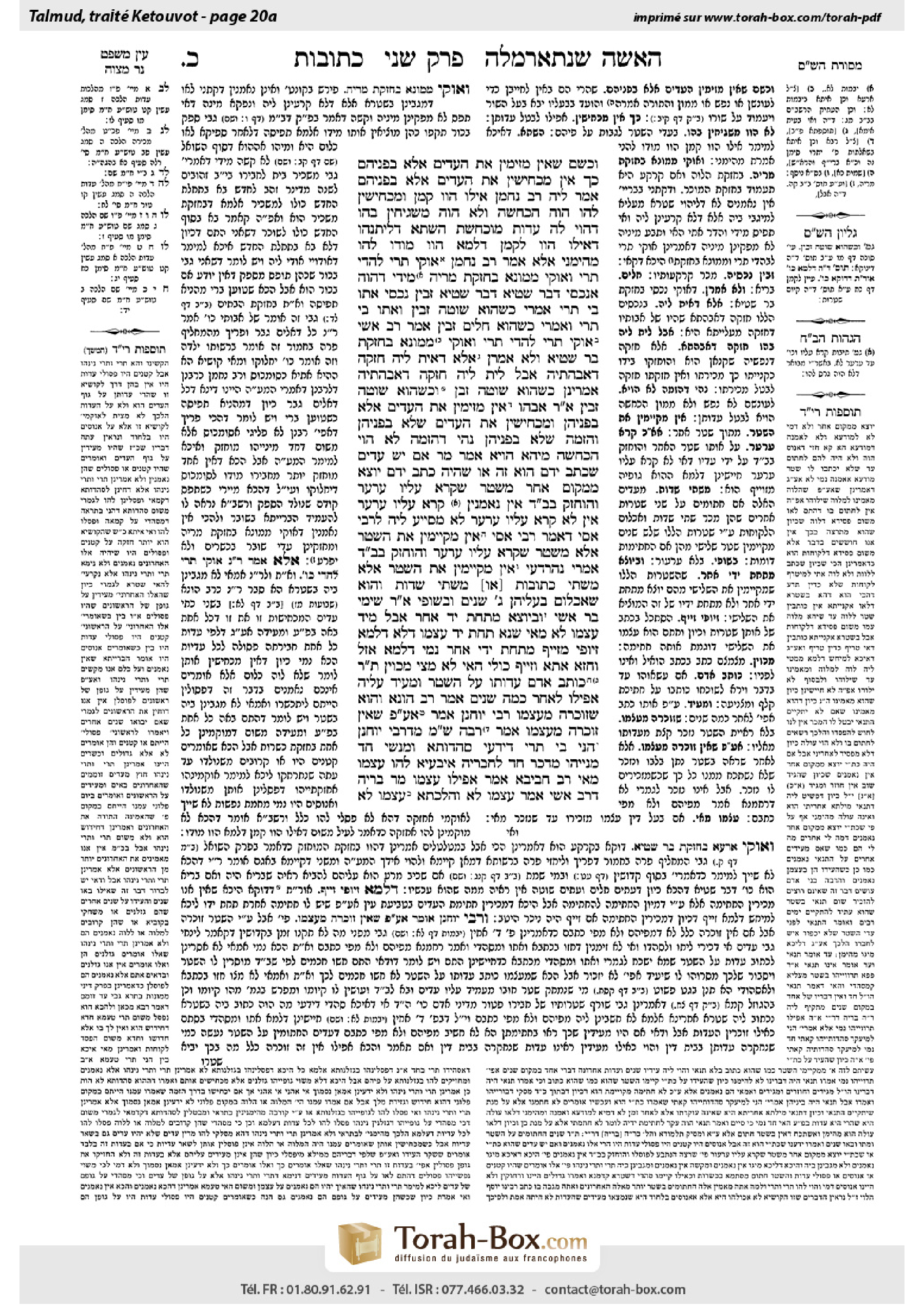
Ketubot 20a: Talmud study for Daf Yomi
Daf Yomi is the daily study of one Talmud folio. Explore 37 tractates with scans, Hebrew text, Sefaria English and AI-generated French translations where annotated.
Passage selection and English or AI-generated French translation are available where the scan has annotations. Daf Study is independent of Torah-Box and Sefaria.
Browse Ketubot · כתובות · All tractatesKetubot 20a text and translations
This page of Ketubot includes the Aramaic text, an English translation and an AI-generated French translation, alongside the scan above.
כתובות כ׳ א · Aramaic and Hebrew text
וּכְשֵׁם שֶׁאֵין מְזִימִּין אֶת הָעֵדִים אֶלָּא בִּפְנֵיהֶם, כָּךְ אֵין מַכְחִישִׁין אֶת הָעֵדִים אֶלָּא בִּפְנֵיהֶם.
אֲמַר לֵיהּ רַב נַחְמָן: אִילּוּ הֲווֹ קַמַּן וּמַכְחִישִׁין לְהוּ, הֲוָה הַכְחָשָׁה, וְלָא הֲוָה מַשְׁגִּיחִין בְּהוּ. דְּהָוְיָ[א] לַהּ עֵדוּת מוּכְחֶשֶׁת. הַשְׁתָּא דְּלֵיתַנְהוּ, דְּאִילּוּ הֲווֹ לְקַמַּן דִּלְמָא הֲווֹ מוֹדוּ לְהוּ, מְהֵימְנִי?!
אֶלָּא אָמַר רַב נַחְמָן: אוֹקֵי תְּרֵי לַהֲדֵי תְּרֵי, וְאוֹקֵי מָמוֹנָא בְּחֶזְקַת מָרֵיהּ, מִידֵּי דְּהָוֵה אַנִּכְסֵי דְּבַר שָׁטְיָא. דְּבַר שָׁטְיָא זַבֵּין נִכְסֵי. אֲתוֹ בֵּי תְרֵי, אָמְרִי: כְּשֶׁהוּא שׁוֹטֶה זַבֵּין, וַאֲתוֹ בֵּי תְרֵי וְאָמְרִי: כְּשֶׁהוּא חָלִים זַבֵּין.
אָמַר רַב אָשֵׁי: אוֹקֵי תְּרֵי לַהֲדֵי תְּרֵי, וְאוֹקִי מָמוֹנָא בְּחֶזְקַת בַּר שָׁטְיָא. וְלָא אֲמַרַן אֶלָּא דְּאִית לֵיהּ חֲזָקָה דַאֲבָהָתֵיהּ. אֲבָל לֵית לֵיהּ חֲזָקָה דַאֲבָהָתֵיהּ, אָמְרִינַן: כְּשֶׁהוּא שׁוֹטֶה זְבַן, וּכְשֶׁהוּא שׁוֹטֶה זַבֵּין.
אָמַר רַבִּי אֲבָהוּ: אֵין מְזִימִּין אֶת הָעֵדִים אֶלָּא בִּפְנֵיהֶן, וּמַכְחִישִׁין אֶת הָעֵדִים שֶׁלֹּא בִּפְנֵיהֶן. וַהֲזָמָה שֶׁלֹּא בִּפְנֵיהֶן, נְהִי דַּהֲזָמָה לָא הָוְיָא — הַכְחָשָׁה מִיהָא הָוְיָא.
אָמַר מָר: אִם יֵשׁ עֵדִים שֶׁכְּתַב יָדָם הוּא זֶה, אוֹ שֶׁהָיָה כְּתַב יָדָם יוֹצֵא מִמָּקוֹם אַחֵר, מִשְּׁטָר שֶׁקָּרָא עָלָיו עַרְעָר וְהוּחְזַק בְּבֵית דִּין — אֵין נֶאֱמָנִין. קָרָא עָלָיו עַרְעָר — אִין, לֹא קָרָא עָלָיו עַרְעָר — לָא, מְסַיַּיע לֵיהּ לְרַבִּי אַסִּי. דְּאָמַר רַבִּי אַסִּי: אֵין מְקַיְּימִין אֶת הַשְּׁטָר אֶלָּא מִשְּׁטָר שֶׁקָּרָא עָלָיו עַרְעָר וְהוּחְזַק בְּבֵית דִּין.
אָמְרִי נְהַרְדָּעֵי: אֵין מְקַיְּימִין אֶת הַשְּׁטָר אֶלָּא מִשְׁתֵּי כְּתוּבּוֹת, [אוֹ] מִשְּׁתֵּי שָׂדוֹת, וְהוּא שֶׁאֲכָלוּם בַּעֲלֵיהֶן שָׁלֹשׁ שָׁנִים, וּבְשׁוֹפִי.
אָמַר רַב שִׁימִי בַּר אָשֵׁי: וּבְיוֹצֵא מִתַּחַת יַד אַחֵר. אֲבָל מִיַּד עַצְמוֹ — לָא. מַאי שְׁנָא תַּחַת יַד עַצְמוֹ דְּלָא, דִּלְמָא זַיּוֹפֵי מְזַיֵּיף. מִתַּחַת יְדֵי אַחֵר נָמֵי: דִּלְמָא אֲזַל וַחֲזָא, אֲתָא וְזַיֵּיף! כּוּלֵּי הַאי לָא מָצֵי מְכַוֵּין.
תָּנוּ רַבָּנַן: כּוֹתֵב אָדָם עֵדוּתוֹ עַל הַשְּׁטָר, וּמֵעִיד עָלֶיהָ אֲפִילּוּ לְאַחַר כַּמָּה שָׁנִים. אָמַר רַב הוּנָא: וְהוּא שֶׁזּוֹכְרָהּ מֵעַצְמוֹ. רַבִּי יוֹחָנָן אָמַר: אַף עַל פִּי שֶׁאֵין זוֹכְרָהּ מֵעַצְמוֹ. אָמַר רַבָּה: שְׁמַע מִינַּהּ מִדְּרַבִּי יוֹחָנָן: הָנֵי בֵּי תְרֵי דְּיָדְעִי סָהֲדוּתָא וּמִנְּשֵׁי חַד מִנַּיְיהוּ, מַדְכַּר חַד לְחַבְרֵיהּ.
אִיבַּעְיָא לְהוּ: עַצְמוֹ, מַאי? רַב חֲבִיבָא אָמַר: אֲפִילּוּ עַצְמוֹ. מָר בְּרֵיהּ דְּרַב אָשֵׁי אָמַר: עַצְמוֹ לֹא. וְהִלְכְתָא עַצְמוֹ לֹא.
Ketubot 20a · English translation
And just as witnesses render other witnesses false, conspiring witnesses only in their presence, because with their testimony they render them liable to be punished, so too, witnesses contradict the testimony of other witnesses only in their presence. Since the signatories to the document are dead, their testimony cannot be contradicted.
Rav Naḥman said to Rav Sheshet: If the first pair of witnesses was before us and the second pair would contradict their testimony, that is contradiction, and we would not consider their testimony and would not collect money with the document, as it is contradicted testimony. Now that they are not before us, and in a case where if they were before us perhaps they would have admitted to the second witnesses that the testimony of the second witnesses is correct, are they deemed credible, and the document that they signed valid?
Rather, Rav Naḥman said in the case where the testimony of the first witnesses is contradicted not in their presence, the ruling is: Establish two witnesses against the two witnesses who contradict their testimony, thereby neutralizing both testimonies, and establish the money in the possession of its owner, just as it was in the case of the property of bar Shatya. As when bar Shatya, a man who suffered from periodic bouts of insanity, sold his property, two witnesses came and said: He sold it when he was insane; and two other witnesses came and said: He sold it when he was sane.
Rav Ashi said in that case: Establish two witnesses against the two witnesses who contradict the testimony of the first pair, and establish the money in the possession of bar Shatya. The Gemara notes: We say that the property remains in the possession of bar Shatya only when he has possession of the property based on the possession of his fathers. However, if he does not have possession of the property based on the possession of his fathers, but he acquired the property himself, we say: He purchased his properties when he was insane, and he sold them when he was insane. He does not have presumptive ownership of them. Therefore, the property remains in the possession of the person to whom bar Shatya sold it.
Rabbi Abbahu disagrees with the opinion of Rav Sheshet and says: Witnesses render other witnesses false, conspiring witnesses only in their presence, but witnesses contradict the testimony of other witnesses not in their presence. And with regard to rendering other witnesses false, conspiring witnesses not in their presence, although it is not effective in rendering them false, conspiring witnesses in the sense that they are punished for their false testimony, in any case, it is a contradiction of their testimony.
§ The Master said in the baraita cited previously: If there are other witnesses who testify that it is their handwriting, or if their handwriting emerges from another place, from a document that one challenged and that was deemed valid in court, these witnesses are not deemed credible. The Gemara infers: From a document that one challenged, yes, the signatures are authenticated and the testimony of the other witnesses is not accepted; however, if one did not challenge the document, no, the document cannot be used to authenticate their signatures. This supports the statement of Rabbi Asi, as Rabbi Asi said: One ratifies a document by authenticating the witnesses’ signatures only from a document that someone challenged and that was deemed valid in court.
The Sages of Neharde’a say: One ratifies a document by authenticating the witnesses’ signatures only from two marriage contracts or from the bills of sale for two fields that those witnesses signed. And those bills of sale are effective only in a case where their owner ate their produce for three years, the requisite period to establish presumptive ownership of the field, and in peace, undisturbed by protest. In that case we can rely on the signatures, and the documents are considered valid.
Rav Shimi bar Ashi said: Authentication of signatures by comparison to other documents can be accomplished specifically when the documents emerge from the possession of another. However, when the documents emerge from the possession of the litigant himself, no, they may not be used to authenticate the signatures. The Gemara asks: What is different in a case where the documents emerge from the possession of the litigant himself that they may not be used to authenticate the signatures? It is that perhaps while the documents were in his possession he learned how to copy the signatures and forged them. If so, also in a case where the documents emerge from the possession of another, perhaps he went and saw the signatures, and came back and forged them. The Gemara answers: In that case, he would not be able to accurately reproduce the signatures to that extent based on memory alone.
§ The Sages taught: A person may write his testimony in a document and testify on its basis even after several years have passed. Rav Huna said: And that is the halakha only if he remembers the testimony on his own and he uses the document merely to refresh his memory with regard to certain details. Rabbi Yoḥanan said: One may rely on that written testimony even if he does not remember the testimony by himself at all. Rabba said: Conclude from this statement of Rabbi Yoḥanan: With regard to these two witnesses who know testimony in a certain case, and one of them forgot the testimony, one witness may remind his fellow witness of the testimony, as according to Rabbi Yoḥanan, even if the witness remembers the testimony only by means of an external stimulus, the testimony is valid.
A dilemma was raised before the Sages: If the litigant himself reminds the witness of the testimony, what is the ruling? Rav Ḥaviva said: Even if the litigant himself reminds the witness, he may testify. Mar, son of Rav Ashi, said: If the litigant himself reminds the witness, he may not testify. And the Gemara concludes that the halakha is that if the litigant himself reminds the witness of the testimony, the witness may not testify, due to the concern that the litigant influenced the nature of his testimony.
Ketubot 20a · Traduction française (IA)
De même que des témoins ne peuvent faire de témoins des témoins conspirateurs qu’en leur présence, car leur témoignage les rend passibles d’une peine, de même des témoins ne peuvent contredire le témoignage d’autres témoins qu’en leur présence. Puisque les signataires du document sont morts, leur témoignage ne peut être contredit.
Rav Naḥman dit à Rav Sheshet : Si la première paire de témoins se trouvait devant nous et qu’une seconde paire contredisait leur témoignage, il y aurait contradiction ; nous ne tiendrions pas compte de leur témoignage et ne recouvrerions pas l’argent au moyen du document, puisque le témoignage est contredit. À présent qu’ils ne sont pas devant nous, alors que, s’ils l’étaient, ils auraient peut-être reconnu devant les seconds témoins que leur témoignage est exact, faut-il les croire et considérer comme valide le document qu’ils ont signé ?
Mais Rav Naḥman dit que, lorsque le témoignage des premiers témoins est contredit en leur absence, la règle est la suivante : établis deux témoins contre les deux témoins qui contredisent leur témoignage, neutralisant ainsi les deux témoignages, et laisse l’argent en possession de son propriétaire, comme dans le cas des biens de bar Shatya. En effet, lorsque bar Shatya, un homme sujet à des accès périodiques de folie, vendit ses biens, deux témoins vinrent dire : « Il les a vendus alors qu’il était fou » ; puis deux autres témoins vinrent dire : « Il les a vendus alors qu’il était sain d’esprit. »
Rav Ashi dit à ce sujet : établis deux témoins contre les deux témoins qui contredisent le témoignage de la première paire, et laisse l’argent en possession de bar Shatya. La Guemara relève : Nous disons que les biens restent en possession de bar Shatya uniquement lorsqu’il les détient en vertu de la possession de ses pères. En revanche, s’il ne les détient pas en vertu de la possession de ses pères, mais les a acquis lui-même, nous disons : il a acheté ses biens alors qu’il était fou et les a vendus alors qu’il était fou. Il n’en a pas la présomption de propriété. Les biens restent donc en possession de la personne à qui bar Shatya les a vendus.
Rabbi Abbahu est en désaccord avec l’opinion de Rav Sheshet et dit : Des témoins ne peuvent faire de témoins des témoins conspirateurs qu’en leur présence, mais ils peuvent contredire le témoignage d’autres témoins en leur absence. Quant au fait de faire de témoins des témoins conspirateurs en leur absence, bien que cela ne soit pas efficace pour les rendre passibles d’une peine pour leur faux témoignage, cela constitue néanmoins une contradiction de leur témoignage.
§ Le Maître a enseigné dans la baraïta citée précédemment : S’il existe d’autres témoins qui attestent que c’est bien leur écriture, ou si leur écriture apparaît ailleurs, dans un document qu’une personne a contesté et qui a été reconnu valide par le tribunal, ces témoins ne sont pas considérés comme crédibles. La Guemara en déduit : Dans le cas d’un document contesté, oui, les signatures sont authentifiées et le témoignage des autres témoins n’est pas accepté ; mais si personne n’a contesté le document, non, celui-ci ne peut servir à authentifier leurs signatures. Cela confirme la déclaration de Rabbi Asi, car Rabbi Asi a dit : On ne valide un document en authentifiant les signatures des témoins qu’à partir d’un document qu’une personne a contesté et qui a été reconnu valide par le tribunal.
Les Sages de Neharde’a disent : On ne valide un document en authentifiant les signatures des témoins qu’à partir de deux contrats de mariage ou des actes de vente de deux champs signés par ces témoins. Ces actes de vente ne sont recevables que si leur détenteur a joui des fruits des champs pendant trois ans, durée requise pour établir la présomption de propriété du champ, sans être troublé par une contestation. Dans ce cas, nous pouvons nous fier aux signatures et considérer les documents comme valides.
Rav Shimi bar Ashi dit : L’authentification de signatures par comparaison avec d’autres documents n’est possible que lorsque ceux-ci proviennent de la possession d’une autre personne. En revanche, lorsque les documents proviennent de la possession du plaideur lui-même, on ne peut pas les utiliser pour authentifier les signatures. La Guemara demande : Pourquoi les documents provenant de la possession du plaideur lui-même ne peuvent-ils pas servir à authentifier les signatures ? Parce qu’il se peut que, tant qu’ils étaient en sa possession, il ait appris à copier les signatures et les ait falsifiées. Si tel est le cas, même lorsque les documents proviennent de la possession d’une autre personne, il se peut qu’il soit allé voir les signatures, puis qu’il soit revenu les falsifier. La Guemara répond : Dans ce cas, il ne pourrait pas reproduire les signatures avec une telle précision en se fiant uniquement à sa mémoire.
§ Les Sages ont enseigné : Une personne peut consigner son témoignage dans un document et témoigner sur cette base, même après plusieurs années. Rav Huna dit : Cela n’est la halakha que si elle se souvient du témoignage par elle-même et n’utilise le document que pour se remémorer certains détails. Rabbi Yoḥanan dit : On peut s’appuyer sur ce témoignage écrit même si la personne ne se souvient absolument pas du témoignage par elle-même. Rabba dit : Déduis de cette déclaration de Rabbi Yoḥanan que, si deux témoins connaissent un témoignage dans une affaire donnée et que l’un d’eux l’a oublié, l’un peut rappeler à l’autre le témoignage ; car, selon Rabbi Yoḥanan, même si le témoin ne se souvient du témoignage qu’à la suite d’un stimulus extérieur, le témoignage est valide.
Une question fut posée aux Sages : Quelle est la règle si c’est le plaideur lui-même qui rappelle le témoignage au témoin ? Rav Ḥaviva dit : Même si c’est le plaideur lui-même qui le lui rappelle, le témoin peut témoigner. Mar, fils de Rav Ashi, dit : Si c’est le plaideur lui-même qui rappelle le témoignage au témoin, celui-ci ne peut pas témoigner. La Guemara conclut que la halakha est que, si le plaideur lui-même rappelle le témoignage au témoin, celui-ci ne peut pas témoigner, par crainte que le plaideur ait influencé la teneur de son témoignage.
Traduction française générée par IA à partir de l’édition anglaise de Sefaria. Vérifie toujours un passage avec le texte source.
Text from Sefaria: William Davidson Edition - Vocalized Aramaic (CC BY NC); William Davidson Edition - English (CC BY NC).