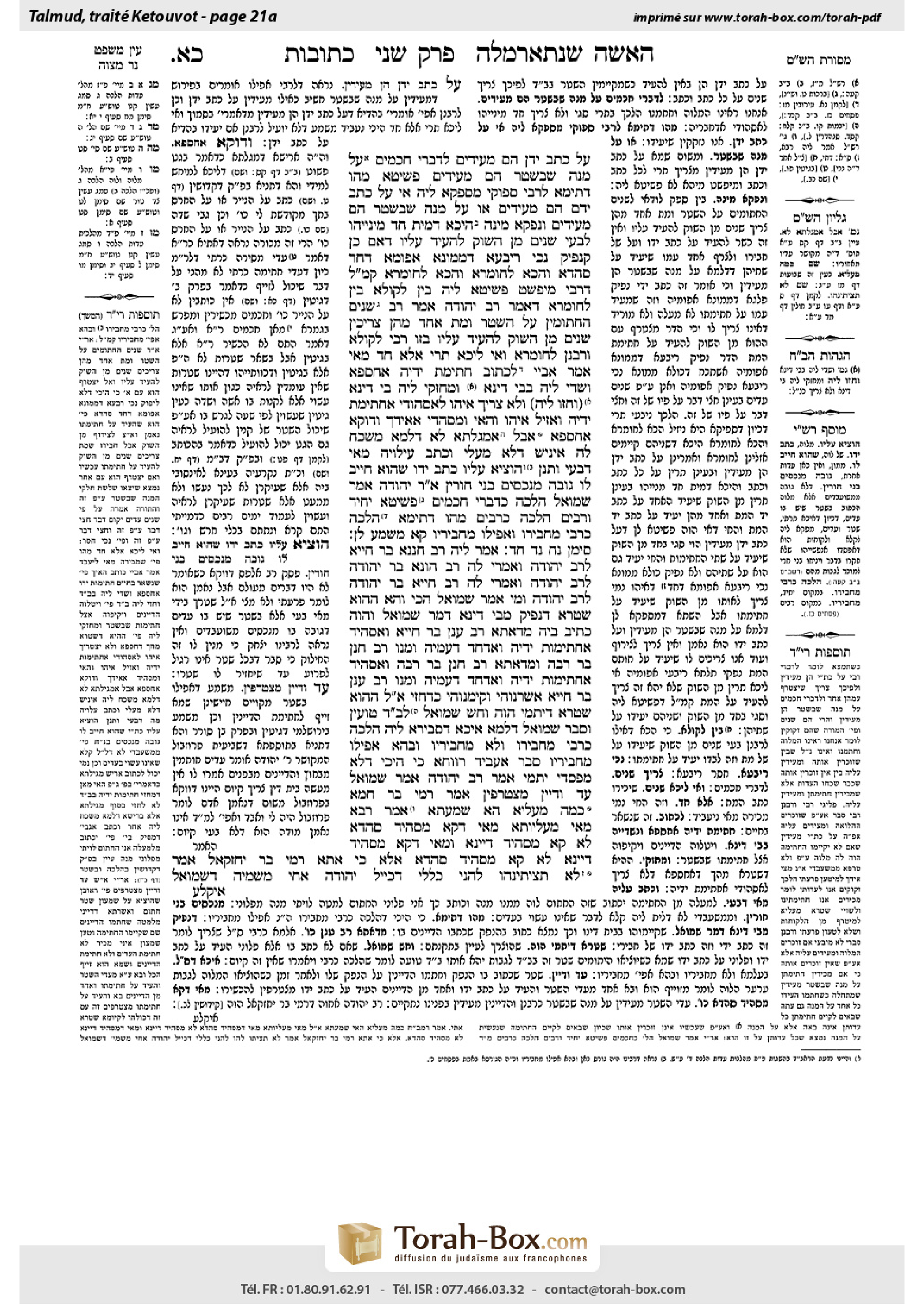
Ketubot 21a: Talmud study for Daf Yomi
Daf Yomi is the daily study of one Talmud folio. Explore 37 tractates with scans, Hebrew text, Sefaria English and AI-generated French translations where annotated.
Passage selection and English or AI-generated French translation are available where the scan has annotations. Daf Study is independent of Torah-Box and Sefaria.
Browse Ketubot · כתובות · All tractatesKetubot 21a text and translations
This page of Ketubot includes the Aramaic text, an English translation and an AI-generated French translation, alongside the scan above.
כתובות כ״א א · Aramaic and Hebrew text
עַל כְּתַב יָדָן הֵם מְעִידִים. לְדִבְרֵי חֲכָמִים, עַל מָנֶה שֶׁבַּשְּׁטָר הֵם מְעִידִים.
פְּשִׁיטָא? מַהוּ דְּתֵימָא לְרַבִּי סַפּוֹקֵי מְסַפְּקָא לֵיהּ אִי עַל כְּתַב יָדָם הֵם מְעִידִים, אוֹ עַל מָנֶה שֶׁבַּשְּׁטָר הֵם מְעִידִים.
וְנָפְקָא מִינַּהּ, הֵיכָא דְּמִית חַד מִינַּיְיהוּ, לִבְעֵי שְׁנַיִם מִן הַשּׁוּק לְהָעִיד עָלָיו.
דְּאִם כֵּן, קָנָפֵיק נְכֵי רִיבְעָא דְמָמוֹנָא אַפּוּמָּא דְּחַד סָהֲדָא.
וְהָכָא לְחוּמְרָא וְהָכָא לְחוּמְרָא.
קָא מַשְׁמַע לַן דְּרַבִּי מִיפְשָׁט פְּשִׁיטָא לֵיהּ, בֵּין לְקוּלָּא בֵּין לְחוּמְרָא. דְּאָמַר רַב יְהוּדָה אָמַר רַב: שְׁנַיִם הַחֲתוּמִין עַל הַשְּׁטָר וּמֵת אֶחָד מֵהֶן — צְרִיכִין שְׁנַיִם מִן הַשּׁוּק לְהָעִיד עָלָיו, בְּזוֹ רַבִּי לְקוּלָּא. וְרַבָּנַן לְחוּמְרָא.
וְאִי לֵיכָּא תְּרֵי אֶלָּא חַד, מַאי? אָמַר אַבָּיֵי: לִכְתּוֹב חֲתִימַת יְדֵיהּ אַחַסְפָּא, וְשָׁדֵי לֵיהּ בְּבֵי דִינָא, וּמַחְזְקִי לֵיהּ בֵּי דִינָא (וְחָזוּ לֵיהּ), וְלָא צָרִיךְ אִיהוּ לְאַסְהוֹדֵי אַחֲתִימַת יְדֵיהּ, וְאָזֵיל אִיהוּ וְהַאי, וּמַסְהֲדִי אַאִידַּךְ.
וְדַוְקָא אַחַסְפָּא, אֲבָל אַמְּגִלְּתָא לָא, דִּלְמָא מַשְׁכַּח לַהּ אִינִישׁ דְּלָא מְעַלֵּי וְכָתֵב עִילָּוֵיהּ מַאי דְּבָעֵי. וּתְנַן: הוֹצִיא עָלָיו כְּתַב יָדוֹ שֶׁהוּא חַיָּיב לוֹ — גּוֹבֶה מִנְּכָסִים בְּנֵי חוֹרִין.
אָמַר רַב יְהוּדָה אָמַר שְׁמוּאֵל: הֲלָכָה כְּדִבְרֵי חֲכָמִים. פְּשִׁיטָא! יָחִיד וְרַבִּים — הֲלָכָה כְּרַבִּים! מַהוּ דְּתֵימָא הֲלָכָה כְּרַבִּי מֵחֲבֵירוֹ, וַאֲפִילּוּ מֵחֲבֵירָיו, קָא מַשְׁמַע לַן.
סִימָן: נָח נָד חַד. אֲמַר לֵיהּ רַב חִנָּנָא בַּר חִיָּיא לְרַב יְהוּדָה, וְאָמְרִי לַהּ רַב הוּנָא בַּר יְהוּדָה לְרַב יְהוּדָה, וְאָמְרִי לַהּ רַב חִיָּיא בַּר יְהוּדָה לְרַב יְהוּדָה: וּמִי אָמַר שְׁמוּאֵל הָכִי?
וְהָא הָהוּא שְׁטָרָא דִּנְפַק מִבֵּי דִינָא דְּמָר שְׁמוּאֵל, וַהֲוָה כְּתִיב בֵּיהּ: מִדַּאֲתָא רַב עָנָן בַּר חִיָּיא וְאַסְהֵיד אַחֲתִימוּת יְדֵיהּ וְאַדְּחַד דְּעִמֵּיהּ, וּמַנּוּ — רַב חָנָן בַּר רַבָּה, וּמִדַּאֲתָא רַב חָנָן בַּר רַבָּה וְאַסְהֵיד אַחֲתִימוּת יְדֵיהּ וְאַדְּחַד דְּעִמֵּיהּ, וּמַנּוּ — רַב עָנָן בַּר חִיָּיא, אַשַּׁרְנוֹהִי וְקַיֵּמְנוֹהִי כְּדַחֲזֵי?
אֲמַר לֵיהּ: הָהוּא שְׁטָרָא דְיַתְמֵי הֲוָה, וְחַשׁ שְׁמוּאֵל לְבֵית דִּין טוֹעִין. וּסְבַר שְׁמוּאֵל דִּלְמָא אִיכָּא דִּסְבִירָא לֵיהּ: הֲלָכָה כְּרַבִּי מֵחֲבֵירוֹ וְלֹא מֵחֲבֵירָיו, וּבְהָא אֲפִילּוּ מֵחֲבֵירָיו, סְבַר: אֶעֱבֵיד רַוְוחָא כִּי הֵיכִי דְּלָא מַפְסְדִי יַתְמֵי.
אָמַר רַב יְהוּדָה אָמַר שְׁמוּאֵל: עֵד וְדַיָּין מִצְטָרְפִין.
אָמַר רָמֵי בַּר חָמָא: כַּמָּה מְעַלְּיָא הָא שְׁמַעְתָּא! אָמַר רָבָא: מַאי מְעַלְּיוּתָא? מַאי דְּקָא מַסְהֵיד סָהֲדָא לָא קָא מַסְהֵיד דַּיָּינָא, וּמַאי דְּקָא מַסְהֵיד דַּיָּינָא לָא קָא מַסְהֵיד סָהֲדָא!
אֶלָּא כִּי אֲתָא רָמֵי בַּר יְחֶזְקֵאל, אָמַר: לָא תְּצִיתִינְהוּ לְהָנֵי כְּלָלֵי דְּכָיֵיל יְהוּדָה אֲחִי מִשְּׁמֵיהּ דִּשְׁמוּאֵל.
Ketubot 21a · English translation
the witnesses are testifying about their handwriting and authenticating their own signatures. Therefore, if each witness testifies only with regard to his own handwriting, there is only one witness authenticating each signature. According to the Rabbis, the witnesses are testifying about the sum of one hundred dinars that is in the document and are not authenticating the signatures at all. Therefore, the testimony of the two witnesses who signed the document is sufficient to ratify the document.
The Gemara asks: That is obvious. No analysis is necessary to arrive at this explanation of the dispute. The Gemara answers: The analysis is necessary lest you say that according to Rabbi Yehuda HaNasi there is uncertainty whether they are testifying about their handwriting or whether the witnesses are testifying about the sum of one hundred dinars that is in the document, and due to the possibility that the purpose of the testimony is to authenticate their handwriting, he requires two witnesses for each signature.
And the practical difference between whether the opinion of Rabbi Yehuda HaNasi is based on certainty or uncertainty is in a case where one of the witnesses who signed the document died. If his opinion is based on certainty that they are testifying about the signatures, one other witness testifying to the authenticity of both signatures would suffice, as both that other witness and the surviving signatory would testify to authenticate each signature. However, if his opinion is based on uncertainty, let them require two other witnesses from the street to testify about the signature of the deceased witness.
That is due to the fact that if it is so that the witnesses are testifying about the sum of one hundred dinars that is in the document and only one other witness joined the surviving witness in testifying with regard to that signature, the result would be that the entire sum of money, less one-quarter, is collected based on the testimony of a single witness. The surviving signatory authenticates his signature and thereby facilitates collection of half the sum. In addition, his testimony together with the testimony of the witness from the street authenticating the signature of the deceased signatory facilitates collection of the other half. Based on the verse: “At the mouth of two witnesses…shall a matter be established” (Deuteronomy 19:15), each witness is responsible for half the sum.
And one would have thought that Rabbi Yehuda HaNasi would rule stringently here: When both signatories are alive they must add another witness with them to authenticate the signatures of the two witnesses, as perhaps they are testifying about their handwriting; and he would rule stringently here: When one of the signatories died they must add two witnesses, as perhaps the witnesses are testifying about the sum of one hundred dinars that is in the document.
Therefore, the Gemara teaches us that the matter was clear to Rabbi Yehuda HaNasi, that they are testifying about their handwriting, and he ruled accordingly both leniently, requiring only one additional witness when one of the signatories died, and stringently, requiring an additional witness when both signatories are alive. As Rav Yehuda said that Rav said: With regard to two witnesses who were signatories to a document and one of them died, they require two others from the street to testify about the signature of the one who died, and in this case, Rabbi Yehuda HaNasi rules leniently and requires only one additional witness, and the Rabbis rule stringently and require two additional witnesses.
The Gemara asks: And if there are not two witnesses capable of authenticating each signature, but only one, what can be done to ratify the document? Abaye said: Let the surviving witness write his signature on an earthenware shard and cast it into the court. And the court then ratifies the document by seeing that it is his signature. And then he does not need to testify and authenticate his signature. But he and this other witness go and testify to authenticate the other signature of the deceased witness. In that case, even according to the Rabbis, one additional witness is sufficient.
The Gemara notes: And he writes his signature for the purpose of comparison specifically on an earthenware shard, but not on parchment, due to the concern that perhaps an unscrupulous person will find it and write on it whatever he wants, e.g., the undersigned owes him money. And we learned in a mishna (Bava Batra 175b): If a creditor produced a document about another written in the other person’s handwriting, in which it is written that the other person owes him money, even if there are no witnesses he is obligated to pay, and the claimant may collect payment from unsold property. One can collect repayment of a loan that is documented on a promissory note signed by two witnesses even from the borrower’s land that was sold. With the document signed by the debtor, the creditor may collect payment from unsold property. Due to the potential for deceit with a signature on parchment, one provides a signature sample written on earthenware.
Rav Yehuda said that Shmuel said: The halakha is in accordance with the statement of the Rabbis in the mishna that each of the two signatories need testify only about his own signature to ratify the document. The Gemara asks: That is obvious, as the principle is: In a dispute between an individual Sage and multiple Sages, the halakha is ruled in accordance with the opinion of multiple Sages. The Gemara answers: Lest you say that just as there is a principle: The halakha is ruled in accordance with the opinion of Rabbi Yehuda HaNasi in disputes with his colleague, there is also a principle that the halakha is ruled in accordance with his opinion even when he disagrees with his multiple colleagues; therefore, Rav Yehuda teaches us that Shmuel said that the principle applies only to disputes with an individual colleague.
§ The Gemara provides a mnemonic for the names and patronyms of the amora’im associated with the statement cited below: Nun ḥet for Rav Ḥinnana bar Ḥiyya, nun dalet for Rav Huna bar Yehuda, and ḥet dalet for Rav Ḥiyya bar Yehuda. Rav Ḥinnana bar Ḥiyya said to Rav Yehuda, and some say it was Rav Huna bar Yehuda who said it to Rav Yehuda, and some say it was Rav Ḥiyya bar Yehuda who said it to Rav Yehuda: And did Shmuel say that the halakha is in accordance with the statement of the Rabbis?
But wasn’t there that document that emerged from the court of Master Shmuel, and it was written with regard to that document: From the fact that Rav Anan bar Ḥiyya came before the court and testified about his signature and about the signature of the one who signed the document with him, and who was that other signatory, Rav Ḥanan bar Rabba; and from the fact that Rav Ḥanan bar Rabba came before the court and testified about his signature and about the signature of the one who signed the document with him, and who was that other signatory, Rav Anan bar Ḥiyya; we certified and ratified this document as appropriate. If Shmuel ruled in accordance with the opinion of the Rabbis there would have been no need for each to testify about the signature of his fellow witness.
Rav Yehuda said to him: That was a document for the benefit of orphans, and Shmuel was concerned about the potential for an error of the court. And Shmuel thought: Perhaps there is a court that holds that in general, the halakha is ruled in accordance with the opinion of Rabbi Yehuda HaNasi in disputes with his colleague but not in disputes with his multiple colleagues, and in this case, the halakha is ruled in accordance with his opinion even in disputes with his multiple colleagues, and the court will not ratify the document if each witness testifies only about his own signature. Therefore he thought: I will perform ratification of the document in an expansive manner, in accordance with all opinions, to ensure that the orphans will not lose money to which they are entitled.
§ Rav Yehuda said that Shmuel said: If a document came before a court and the court ratified it, and then the document was produced in order to collect the debt, at which time the borrower contested its validity and claimed that it was forged, one witness who was a signatory on the document and a judge who ratified the document join together to testify that the document is valid.
Rami bar Ḥama said: How excellent is this halakha. Rava said: In what way is that excellence manifested? That which the witness testifies, i.e., authenticating his signature and confirming the incident that he witnessed, the judge does not testify, as the judge testifies that the document was ratified. And that which the judge testifies, the witness does not testify. There are not two witnesses testifying to either matter.
Rather, when Rami bar Yeḥezkel came, he said: Do not listen to those principles that my brother Rav Yehuda bar Yeḥezkel established in the name of Shmuel with regard to a witness and a judge joining together to testify.
Ketubot 21a · Traduction française (IA)
Les témoins attestent de leur écriture et authentifient leurs propres signatures. Par conséquent, si chaque témoin témoigne uniquement de sa propre écriture, il n’y a qu’un seul témoin pour authentifier chaque signature. Selon les Rabbins, les témoins attestent de la somme de cent dinars inscrite dans le document et n’authentifient pas du tout les signatures. Le témoignage des deux témoins qui ont signé le document suffit donc à le valider.
La Guemara demande : Cela va de soi. Aucune analyse n’est nécessaire pour parvenir à cette explication de la divergence. La Guemara répond : Cette analyse est nécessaire, de peur que tu ne dises que, selon Rabbi Yehouda HaNassi, on ne sait pas s’ils attestent de leur écriture ou si les témoins attestent de la somme de cent dinars inscrite dans le document, et que, vu la possibilité que leur témoignage vise à authentifier leur écriture, il exige deux témoins pour chaque signature.
La différence pratique entre une opinion de Rabbi Yehouda HaNassi fondée sur la certitude et une opinion fondée sur l’incertitude concerne le cas où l’un des témoins ayant signé le document est mort. Si son opinion repose sur la certitude qu’ils attestent des signatures, un autre témoin qui atteste de l’authenticité des deux signatures suffirait, car cet autre témoin et le signataire survivant attesteraient tous deux de l’authenticité de chaque signature. Cependant, si son opinion repose sur l’incertitude, qu’ils exigent deux autres témoins pris dans la rue pour attester de la signature du témoin décédé !
Cela tient au fait que, si les témoins attestent de la somme de cent dinars inscrite dans le document et qu’un seul autre témoin s’est joint au témoin survivant pour attester de cette signature, il en résulterait que la totalité de la somme, moins un quart, serait recouvrée sur la base du témoignage d’un seul témoin. Le signataire survivant authentifie sa signature et permet ainsi de recouvrer la moitié de la somme. En outre, son témoignage, associé à celui du témoin pris dans la rue qui authentifie la signature du signataire décédé, permet de recouvrer l’autre moitié. Selon le verset : « C’est par la bouche de deux témoins […] qu’une affaire sera établie » (Deutéronome 19, 15), chaque témoin est responsable de la moitié de la somme.
On aurait donc pu penser que Rabbi Yehouda HaNassi statuerait avec rigueur dans le cas suivant : lorsque les deux signataires sont en vie, ils doivent s’adjoindre un autre témoin pour authentifier les signatures des deux témoins, car il se peut qu’ils attestent de leur écriture. Et qu’il statuerait également avec rigueur dans le cas suivant : lorsque l’un des signataires est mort, ils doivent s’adjoindre deux témoins, car il se peut que les témoins attestent de la somme de cent dinars inscrite dans le document.
La Guemara nous enseigne donc que Rabbi Yehouda HaNassi était certain qu’ils attestaient de leur écriture, et qu’il a statué en conséquence, avec indulgence en n’exigeant qu’un seul témoin supplémentaire lorsque l’un des signataires était mort, et avec rigueur en exigeant un témoin supplémentaire lorsque les deux signataires étaient en vie. Car Rav Yehouda a dit au nom de Rav : lorsque deux témoins ont signé un document et que l’un d’eux est mort, il faut deux autres personnes prises dans la rue pour attester de la signature du défunt. Dans ce cas, Rabbi Yehouda HaNassi statue avec indulgence et n’exige qu’un seul témoin supplémentaire, tandis que les Rabbins statuent avec rigueur et en exigent deux.
La Guemara demande : Et s’il n’y a pas deux témoins capables d’authentifier chaque signature, mais seulement un, que peut-on faire pour valider le document ? Abayé dit : Que le témoin survivant inscrive sa signature sur un tesson de poterie et le jette au tribunal. Le tribunal valide alors le document en constatant qu’il s’agit de sa signature. Il n’a alors pas besoin de témoigner ni d’authentifier sa signature. Mais lui et cet autre témoin vont témoigner pour authentifier l’autre signature, celle du témoin décédé. Dans ce cas, même selon les Rabbins, un seul témoin supplémentaire suffit.
La Guemara précise qu’il inscrit sa signature à des fins de comparaison précisément sur un tesson de poterie, mais pas sur du parchemin, par crainte qu’un individu malhonnête ne le trouve et n’y inscrive ce qu’il veut, par exemple que le signataire lui doit de l’argent. Et nous avons appris dans une Michna (Bava Batra 175b) : si un créancier produit contre quelqu’un un document écrit de la main de cette personne, où il est indiqué qu’elle lui doit de l’argent, cette personne est tenue de payer même s’il n’y a pas de témoins, et le créancier peut recouvrer la somme sur les biens non vendus. Le remboursement d’un prêt consigné dans un billet signé par deux témoins peut être recouvré même sur les terres de l’emprunteur qui ont été vendues. Avec le document signé par le débiteur, le créancier peut recouvrer la somme sur les biens non vendus. En raison du risque de fraude lié à une signature sur parchemin, on fournit un échantillon de signature inscrit sur un tesson de poterie.
Rav Yehouda a dit au nom de Chmouel : la halakha suit l’avis des Rabbins dans la Michna, selon lequel chacun des deux signataires n’a besoin de témoigner que de sa propre signature pour valider le document. La Guemara demande : Cela va de soi, car le principe est le suivant : en cas de divergence entre un Sage isolé et plusieurs Sages, la halakha suit l’avis de la majorité. La Guemara répond : De peur que tu ne dises que, de même qu’il existe un principe selon lequel la halakha suit l’avis de Rabbi Yehouda HaNassi dans ses divergences avec un collègue, il existe également un principe selon lequel la halakha suit son avis même lorsqu’il est en désaccord avec plusieurs de ses collègues ; Rav Yehouda nous enseigne donc que, selon Chmouel, ce principe ne s’applique qu’aux divergences avec un collègue isolé.
§ La Guemara donne un moyen mnémotechnique pour les noms et les patronymes des amoraïm associés à la déclaration citée ci-dessous : noun-ḥet pour Rav Ḥinnana bar Ḥiyya, noun-dalet pour Rav Houna bar Yehouda, et ḥet-dalet pour Rav Ḥiyya bar Yehouda. Rav Ḥinnana bar Ḥiyya dit à Rav Yehouda — et certains disent que c’est Rav Houna bar Yehouda qui le lui dit, et d’autres encore que c’est Rav Ḥiyya bar Yehouda qui le lui dit : Chmouel a-t-il vraiment dit que la halakha suit l’avis des Rabbins ?
Mais n’y avait-il pas ce document qui émana du tribunal de maître Chmouel, au sujet duquel il était écrit : « Puisque Rav Anan bar Ḥiyya s’est présenté au tribunal et a témoigné de sa signature ainsi que de celle de celui qui avait signé le document avec lui — et cet autre signataire était Rav Ḥanan bar Rabba —, et puisque Rav Ḥanan bar Rabba s’est présenté au tribunal et a témoigné de sa signature ainsi que de celle de celui qui avait signé le document avec lui — et cet autre signataire était Rav Anan bar Ḥiyya —, nous avons certifié et validé ce document comme il se doit. » Si Chmouel avait statué conformément à l’avis des Rabbins, il n’aurait pas été nécessaire que chacun témoigne de la signature de l’autre témoin.
Rav Yehouda lui dit : il s’agissait d’un document établi au bénéfice d’orphelins, et Chmouel craignait que le tribunal ne commette une erreur. Chmouel se disait : peut-être existe-t-il un tribunal qui considère qu’en général la halakha suit l’avis de Rabbi Yehouda HaNassi dans ses divergences avec un collègue, mais non lorsqu’il est en désaccord avec plusieurs de ses collègues, et que, dans ce cas, la halakha suit son avis même lorsqu’il est en désaccord avec plusieurs de ses collègues ; ce tribunal ne validerait donc pas le document si chaque témoin ne témoignait que de sa propre signature. Il s’est donc dit : je vais faire valider le document de manière extensive, conformément à tous les avis, afin que les orphelins ne perdent pas l’argent auquel ils ont droit.
§ Rav Yehouda a dit au nom de Chmouel : si un document a été présenté à un tribunal et que celui-ci l’a validé, puis que le document est produit pour recouvrer la dette, et que l’emprunteur en conteste alors la validité en prétendant qu’il est falsifié, un témoin ayant signé le document et un juge qui l’a validé peuvent s’associer pour attester que le document est valide.
Rami bar Ḥama dit : Quelle excellente halakha ! Rava dit : En quoi cette excellence se manifeste-t-elle ? Le juge ne témoigne pas de ce dont témoigne le témoin, à savoir l’authenticité de sa signature et l’incident dont il a été témoin, car le juge atteste que le document a été validé. Et le témoin ne témoigne pas de ce dont témoigne le juge. Il n’y a pas deux témoins qui attestent de l’un ou l’autre de ces faits.
Cependant, lorsque Rami bar Yeḥezkel vint, il dit : N’écoutez pas les principes que mon frère Rav Yehouda bar Yeḥezkel a établis au nom de Chmouel concernant l’association d’un témoin et d’un juge pour témoigner.
Traduction française générée par IA à partir de l’édition anglaise de Sefaria. Vérifie toujours un passage avec le texte source.
Text from Sefaria: William Davidson Edition - Vocalized Aramaic (CC BY NC); William Davidson Edition - English (CC BY NC).