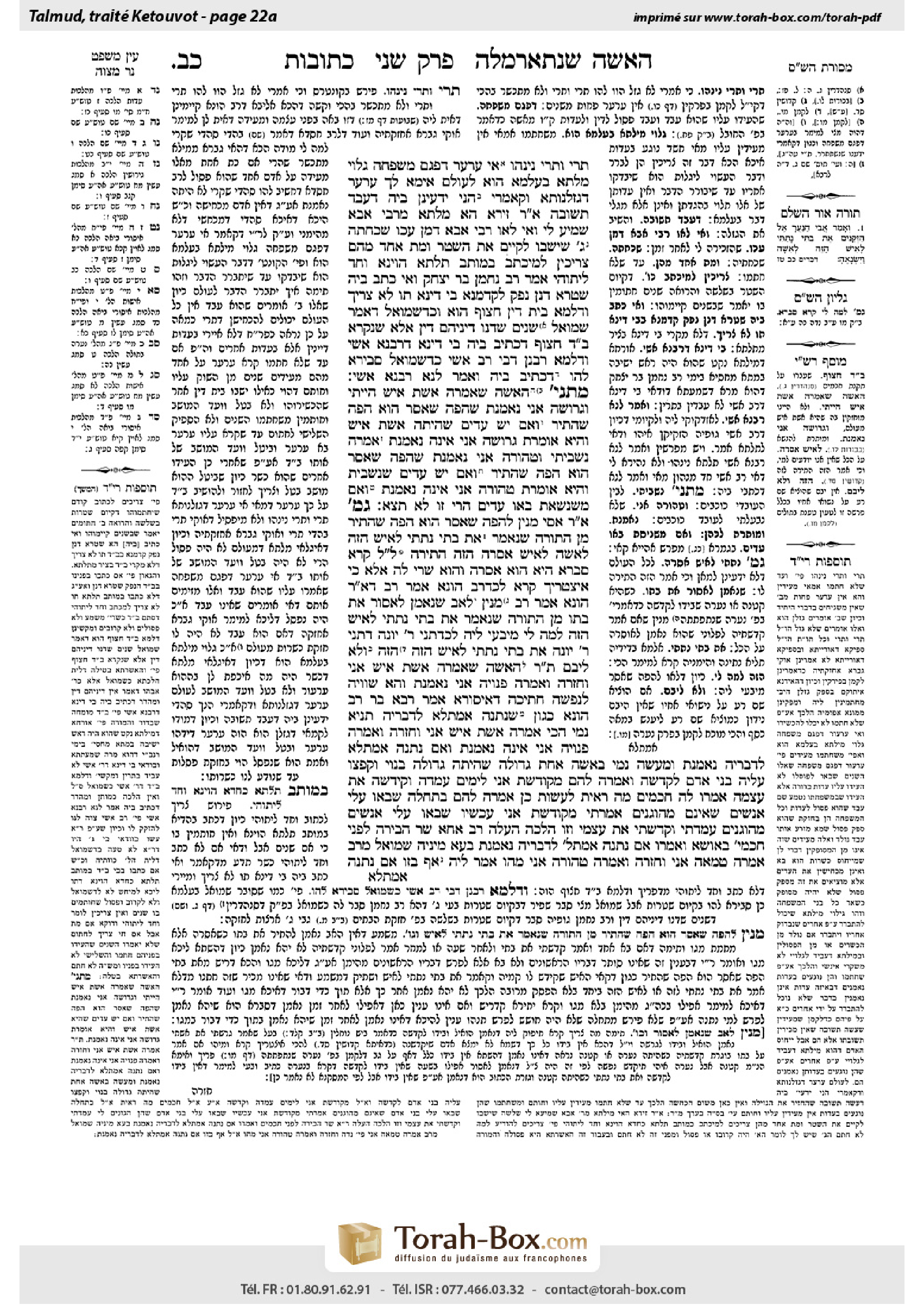
Ketubot 22a: Talmud study for Daf Yomi
Daf Yomi is the daily study of one Talmud folio. Explore 37 tractates with scans, Hebrew text, Sefaria English and AI-generated French translations where annotated.
Passage selection and English or AI-generated French translation are available where the scan has annotations. Daf Study is independent of Torah-Box and Sefaria.
Browse Ketubot · כתובות · All tractatesKetubot 22a text and translations
This page of Ketubot includes the Aramaic text, an English translation and an AI-generated French translation, alongside the scan above.
כתובות כ״ב א · Aramaic and Hebrew text
תְּרֵי וּתְרֵי נִינְהוּ. אִי עַרְעָר דִּפְגַם מִשְׁפָּחָה, גִּלּוּי מִלְּתָא בְּעָלְמָא הוּא. לְעוֹלָם אֵימָא לָךְ עַרְעָר דְּגַזְלָנוּתָא, וְקָאָמְרִי הָנֵי: יָדְעִינַן בֵּיהּ דַּעֲבַד תְּשׁוּבָה.
אָמַר רַבִּי זֵירָא: הָא מִלְּתָא מֵרַבִּי אַבָּא שְׁמִיעַ לִי, וְאִי לָאו רַבִּי אַבָּא דְּמִן עַכּוֹ, שְׁכַחְתַּהּ: שְׁלֹשָׁה שֶׁיָּשְׁבוּ לְקַיֵּים אֶת הַשְּׁטָר וּמֵת אֶחָד מֵהֶם — צְרִיכִין לְמִיכְתַּב: ״בְּמוֹתַב תְּלָתָא הֲוֵינָא, וְחַד לֵיתוֹהִי״.
אָמַר רַב נַחְמָן בַּר יִצְחָק: וְאִי כְּתַב בֵּיהּ: שְׁטָרָא דְּנַן נְפַק לִקְדָמַנָא בֵּי דִינָא — תּוּ לָא צְרִיךְ. וְדִלְמָא בֵּית דִּין חָצוּף הוּא, וּכְדִשְׁמוּאֵל. דְּאָמַר שְׁמוּאֵל: שְׁנַיִם שֶׁדָּנוּ, דִּינֵיהֶם דִּין, אֶלָּא שֶׁנִּקְרָא בֵּית דִּין חָצוּף.
דִּכְתִיב בֵּיהּ: ״בֵּי דִינָא דְּרַבַּנָא אָשֵׁי״. וְדִלְמָא רַבָּנַן דְּבֵי רַב אָשֵׁי כְּדִשְׁמוּאֵל סְבִירָא לְהוּ! דִּכְתִיב בֵּיהּ: ״וְאָמַר לַנָא רַבַּנָא אָשֵׁי״.
מַתְנִי׳ הָאִשָּׁה שֶׁאָמְרָה: ״אֵשֶׁת אִישׁ הָיִיתִי וּגְרוּשָׁה אֲנִי״ — נֶאֱמֶנֶת. שֶׁהַפֶּה שֶׁאָסַר, הוּא הַפֶּה שֶׁהִתִּיר. וְאִם יֵשׁ עֵדִים שֶׁהָיְתָה אֵשֶׁת אִישׁ, וְהִיא אוֹמֶרֶת: ״גְּרוּשָׁה אֲנִי״, אֵינָהּ נֶאֱמֶנֶת. אָמְרָה: ״נִשְׁבֵּיתִי, וּטְהוֹרָה אֲנִי״ — נֶאֱמֶנֶת. שֶׁהַפֶּה שֶׁאָסַר, הוּא הַפֶּה שֶׁהִתִּיר. וְאִם יֵשׁ עֵדִים שֶׁנִּשְׁבֵּית, וְהִיא אוֹמֶרֶת: ״טְהוֹרָה אֲנִי״ — אֵינָהּ נֶאֱמֶנֶת. וְאִם מִשֶּׁנִּשֵּׂאת בָּאוּ עֵדִים — הֲרֵי זוֹ לֹא תֵּצֵא.
גְּמָ׳ אָמַר רַב אַסִּי: מִנַּיִן לְהַפֶּה שֶׁאָסַר הוּא הַפֶּה שֶׁהִתִּיר מִן הַתּוֹרָה? שֶׁנֶּאֱמַר: ״אֶת בִּתִּי נָתַתִּי לָאִישׁ הַזֶּה לְאִשָּׁה״. ״לָאִישׁ״ — אָסְרָה, ״הַזֶּה״ — הִתִּירָה.
לְמָה לִי קְרָא? סְבָרָא הִיא: הוּא אַסְרַהּ, וְהוּא שָׁרֵי לַהּ! אֶלָּא כִּי אִיצְטְרִיךְ קְרָא, לְכִדְרַב הוּנָא אָמַר רַב. דְּאָמַר רַב הוּנָא אָמַר רַב: מִנַּיִן לָאָב שֶׁנֶּאֱמָן לֶאֱסוֹר אֶת בִּתּוֹ מִן הַתּוֹרָה, שֶׁנֶּאֱמַר: ״אֶת בִּתִּי נָתַתִּי לָאִישׁ״. ״הַזֶּה״ לְמָה לִי?
מִיבְּעֵי לֵיהּ לְכִדְתָנֵי רַבִּי יוֹנָה. דְּתָנֵי רַבִּי יוֹנָה: ״אֶת בִּתִּי נָתַתִּי לָאִישׁ הַזֶּה״. ״הַזֶּה״ — וְלֹא לַיָּבָם.
תָּנוּ רַבָּנַן: הָאִשָּׁה שֶׁאָמְרָה ״אֵשֶׁת אִישׁ אֲנִי״, וְחָזְרָה וְאָמְרָה ״פְּנוּיָה אֲנִי״ — נֶאֱמֶנֶת. וְהָא שַׁוְּויַהּ לְנַפְשַׁהּ חֲתִיכָה דְּאִיסּוּרָא? אָמַר רָבָא בַּר רַב הוּנָא: כְּגוֹן שֶׁנָּתְנָה אַמַּתְלָא לִדְבָרֶיהָ. תַּנְיָא נָמֵי הָכִי: אָמְרָה אֵשֶׁת אִישׁ אֲנִי, וְחָזְרָה וְאָמְרָה: פְּנוּיָה אֲנִי — אֵינָהּ נֶאֱמֶנֶת. וְאִם נָתְנָה אַמַּתְלָא לִדְבָרֶיהָ — נֶאֱמֶנֶת.
וּמַעֲשֶׂה נָמֵי בְּאִשָּׁה אַחַת גְּדוֹלָה שֶׁהָיְתָה גְּדוֹלָה בְּנוֹי, וְקָפְצוּ עָלֶיהָ בְּנֵי אָדָם לְקַדְּשָׁהּ. וְאָמְרָה לָהֶם: ״מְקוּדֶּשֶׁת אֲנִי״. לְיָמִים עָמְדָה וְקִידְּשָׁה אֶת עַצְמָהּ. אָמְרוּ לָהּ חֲכָמִים: מָה רָאִית לַעֲשׂוֹת כֵּן? אָמְרָה לָהֶם: בַּתְּחִלָּה שֶׁבָּאוּ עָלַי אֲנָשִׁים שֶׁאֵינָם מְהוּגָּנִים, אָמַרְתִּי: ״מְקוּדֶּשֶׁת אֲנִי״, עַכְשָׁיו שֶׁבָּאוּ עָלַי אֲנָשִׁים מְהוּגָּנִים, עָמַדְתִּי וְקִדַּשְׁתִּי אֶת עַצְמִי. וְזוֹ הֲלָכָה הֶעֱלָה רַב אַחָא שַׂר הַבִּירָה לִפְנֵי חֲכָמִים בְּאוּשָׁא, וְאָמְרוּ: אִם נָתְנָה אַמַּתְלָא לִדְבָרֶיהָ — נֶאֱמֶנֶת.
בְּעָא מִינֵּיהּ שְׁמוּאֵל מֵרַב: אָמְרָה ״טְמֵאָה אֲנִי״, וְחָזְרָה וְאָמְרָה ״טְהוֹרָה אֲנִי״, מַהוּ? אֲמַר לֵיהּ: אַף בְּזוֹ, אִם נָתְנָה
Ketubot 22a · English translation
the witnesses who testified that he is unfit and the judges who testified that he is fit are two witnesses and two witnesses who contradict them, and in that case, the allegation of theft is not completely eliminated. If it was a challenge based on an allegation of flawed lineage, e.g., he is a Canaanite slave and therefore unfit to serve as a judge, that is a mere revealing of a matter that will ultimately be revealed in any case and does not require actual testimony. Therefore, there is no conflict of interest preventing the judges from asserting his fitness after they signed. The Gemara concludes: Actually, I will say to you that it was a challenge based on an allegation of theft, and these judges say: We know about him that he repented and is now fit to serve as a judge. In that case, their testimony does not contradict the original testimony that he was guilty of theft.
§ Rabbi Zeira said: This matter, I heard from Rabbi Abba, and if it was not for Rabbi Abba of Akko, I would have forgotten it. With regard to a case of three judges who convened as a tribunal to ratify a document, and one of them died before signing the ratification, the surviving judges must emend the standard formula of the ratification and write: We were convened in a session of three judges, and one of the judges is no longer alive. In that way it is clear that although only two judges signed, the document was ratified by three judges.
Rav Naḥman bar Yitzḥak said: And if the judges wrote in the ratification: This document was produced before us, the court; they no longer need to add that they were three judges, as, when unmodified, the term court connotes a tribunal of three judges. The Gemara asks: And perhaps it was an impudent court, and that is in accordance with the opinion of Shmuel, as Shmuel said: Two judges who convened a tribunal and judged, their verdict is a binding verdict; however, because they contravened the rabbinic ordinance mandating that a court be comprised of three judges, they are called an impudent court. Therefore, writing: Before us, the court, does not rule out the possibility that the document was ratified by fewer than three judges.
The Gemara answers: It is clear that the document was ratified by the requisite three judges, as it is written in the ratification: Before us, the court of our teacher Rav Ashi, which presumably conforms to rabbinic protocol. The Gemara asks: And perhaps the Rabbis of the court of Rav Ashi hold in accordance with the opinion of Shmuel and they convened an impudent court, whose ruling is binding. The Gemara answers: It is clear, as it is written in the ratification: Before us, the court of our teacher Rav Ashi, and our teacher Rav Ashi said to us how to ratify the document.
MISHNA: With regard to a woman who said: I was a married woman and now I am a divorcée, she is deemed credible and permitted to remarry, as the mouth that prohibited and established that she was married is the mouth that permitted, and established that she is divorced. However, if there are witnesses that she was a married woman, and she says: I am a divorcée, she is not deemed credible. Similarly, with regard to a woman who said: I was taken captive but I am pure, as I was not raped in captivity, she is deemed credible and permitted to marry a priest, as the mouth that prohibited and established that she was taken captive is the mouth that permitted and established that she was not defiled. But if there are witnesses that she was taken captive, and she says: I am pure, she is not deemed credible. And if witnesses came after she married, this woman need not leave her husband.
GEMARA: Rav Asi said: From where in the Torah is the principle: The mouth that prohibited is the mouth that permitted, derived? It is derived as it is stated: “I gave my daughter to this man [la’ish hazeh] as a wife” (Deuteronomy 22:16). When the father said that he married her off “to the man [la’ish]” without revealing his identity, he rendered her forbidden to all men. When he then says “this [hazeh],” thereby identifying the man to whom he married her off, he renders her permitted to her husband.
The Gemara asks: Why do I need to derive this from the verse? It is based on logic: He rendered her forbidden and he rendered her permitted. Rather, where this verse is necessary, is in order to derive the halakha that Rav Huna said that Rav said, as Rav Huna said that Rav said: From where in the Torah is it derived that a father is deemed credible to render his daughter forbidden? It is derived as it is stated: “I gave my daughter to the man [la’ish]” (Deuteronomy 22:16). The Gemara asks: Why do I need the subsequent term “this [hazeh]”?
The Gemara explains: The verse is necessary to derive the halakha that Rabbi Yona taught; as Rabbi Yona taught in a baraita that in the verse: “I gave my daughter to this man,” written in the context of a husband slandering his wife, “this” is written to infer: The halakhot in this passage apply to a man who slanders his wife and not to the yavam, in the case of levirate marriage.
§ The Sages taught with regard to the woman who said: I am a married woman, and then said: I am unmarried, that she is deemed credible. The Gemara asks: But didn’t she render herself an entity of prohibition? When she said that she was married she rendered herself forbidden to all men. How then can she abrogate the prohibition? The Gemara answers that Rava bar Rav Huna said: It is referring to a case where she provided a rationale [amatla] for her initial statement and explained why she said that she was a married woman. That was also taught in a baraita with regard to the woman who said: I am a married woman, and then said: I am unmarried, that she is not deemed credible. And if she provided a rationale for her initial statement, she is deemed credible.
And there was also an incident involving an important woman who was outstanding in beauty, and many men were clamoring to betroth her. And she said to them: I am already betrothed. Sometime later she arose and betrothed herself to a man. The Sages said to her: What did you see that led you to do so? She said to them: Initially, when unscrupulous people approached me seeking to marry me, I said: I am betrothed. Now that scrupulous people approached me, I arose and betrothed myself to one of them. And the Gemara notes: This halakha was raised by Rav Aḥa Sar HaBira before the Sages in Usha, the seat of the Sanhedrin, and the Sages said: If she provided a rationale for her statement, she is deemed credible.
Shmuel raised a dilemma before Rav: If a woman said to her husband: I am ritually impure as I am menstruating, and then said: I am pure, what is the halakha? Is she permitted based on her latter statement, or did she render herself an entity of prohibition with her first statement and therefore remains forbidden? Rav said to him: Even in that case, if she provided a
Ketubot 22a · Traduction française (IA)
Les témoins qui ont attesté qu’il était inapte et les juges qui ont attesté qu’il était apte sont deux témoins, auxquels s’opposent deux autres témoins ; dans ce cas, l’accusation de vol n’est pas entièrement écartée. Si la contestation reposait sur une accusation de filiation irrégulière, par exemple qu’il était un esclave cananéen et donc inapte à exercer comme juge, il ne s’agissait que de révéler un fait qui, de toute façon, finirait par être révélé, et cela ne nécessite pas de témoignage proprement dit. Il n’y a donc aucun conflit d’intérêts qui empêcherait les juges d’affirmer qu’il est apte après avoir signé. La Guemara conclut : En réalité, je te dirai que la contestation reposait sur une accusation de vol, et que ces juges disent : « Nous savons qu’il s’est repenti et qu’il est maintenant apte à exercer comme juge. » Dans ce cas, leur témoignage ne contredit pas le témoignage initial selon lequel il était coupable de vol.
§ Rabbi Zeira dit : J’ai entendu cette halakha de Rabbi Abba et, si Rabbi Abba d’Akko n’avait pas été là, je l’aurais oubliée. Dans le cas de trois juges qui se sont réunis en tribunal pour authentifier un document, si l’un d’eux meurt avant d’avoir signé l’authentification, les juges survivants doivent modifier la formule habituelle de l’authentification et écrire : « Nous nous sommes réunis en séance à trois juges, et l’un des juges n’est plus en vie. » Ainsi, il est clair que, bien que seuls deux juges aient signé, le document a été authentifié par trois juges.
Rav Naḥman bar Yitzḥak dit : Si les juges ont écrit dans l’authentification : « Ce document a été présenté devant nous, le tribunal », ils n’ont plus besoin d’ajouter qu’ils étaient trois juges, car, sans autre précision, le terme « tribunal » désigne un tribunal de trois juges. La Guemara demande : Et peut-être s’agissait-il d’un tribunal insolent, conformément à l’opinion de Shmuel. En effet, Shmuel a dit : « Deux juges qui se réunissent en tribunal et rendent un jugement rendent un jugement contraignant ; toutefois, comme ils ont contrevenu à l’ordonnance rabbinique exigeant qu’un tribunal soit composé de trois juges, on les appelle un tribunal insolent. » Par conséquent, écrire « devant nous, le tribunal » n’exclut pas la possibilité que le document ait été authentifié par moins de trois juges.
La Guemara répond : Il est clair que le document a été authentifié par les trois juges requis, car l’authentification indique : « Devant nous, le tribunal de notre maître Rav Ashi », qui se conforme vraisemblablement au protocole rabbinique. La Guemara demande : Et peut-être les Sages du tribunal de Rav Ashi suivent-ils l’opinion de Shmuel et se sont-ils réunis en tribunal insolent, dont le jugement est contraignant. La Guemara répond : C’est clair, car l’authentification indique : « Devant nous, le tribunal de notre maître Rav Ashi », et notre maître Rav Ashi nous a indiqué comment authentifier le document.
MICHNA : À propos d’une femme qui dit : « J’étais mariée et maintenant je suis divorcée », elle est jugée digne de foi et autorisée à se remarier, car la même bouche qui l’a interdite et a établi qu’elle était mariée est celle qui l’autorise et établit qu’elle est divorcée. Toutefois, s’il y a des témoins attestant qu’elle était mariée et qu’elle dit : « Je suis divorcée », elle n’est pas jugée digne de foi. De même, à propos d’une femme qui dit : « J’ai été captive, mais je suis pure, car je n’ai pas été violée en captivité », elle est jugée digne de foi et autorisée à épouser un prêtre, car la même bouche qui l’a interdite et a établi qu’elle avait été captive est celle qui l’autorise et établit qu’elle n’a pas été souillée. Mais s’il y a des témoins attestant qu’elle a été captive et qu’elle dit : « Je suis pure », elle n’est pas jugée digne de foi. Et si des témoins se présentent après qu’elle s’est mariée, cette femme n’a pas à quitter son mari.
GUEMARA : Rav Asi dit : Où trouve-t-on dans la Torah le principe selon lequel la même bouche qui a interdit est celle qui a autorisé ? On le déduit de ce qui est écrit : « J’ai donné ma fille à cet homme [la’ish hazeh] pour épouse » (Deutéronome 22:16). Lorsque le père dit qu’il l’a mariée « à l’homme [la’ish] », sans révéler son identité, il la rend interdite à tous les hommes. Puis, lorsqu’il dit « cet homme [hazeh] », identifiant ainsi l’homme auquel il l’a mariée, il la rend permise à son mari.
La Guemara demande : Pourquoi faut-il déduire cela du verset ? Cela relève de la logique : il l’a interdite et il l’a autorisée. Le verset est plutôt nécessaire pour déduire la halakha que Rav Houna a rapportée au nom de Rav, car Rav Houna a rapporté au nom de Rav : « Où déduit-on dans la Torah qu’un père est jugé digne de foi lorsqu’il s’agit de rendre sa fille interdite ? » On le déduit de ce qui est écrit : « J’ai donné ma fille à l’homme [la’ish] » (Deutéronome 22:16). La Guemara demande : Pourquoi faut-il le terme suivant, « cet homme [hazeh] » ?
La Guemara explique : Le verset est nécessaire pour déduire la halakha enseignée par Rabbi Yona, car Rabbi Yona a enseigné dans une baraïta que, dans le verset « J’ai donné ma fille à cet homme », écrit dans le contexte d’un mari qui calomnie son épouse, le mot « cet » indique que les halakhot de ce passage s’appliquent à un homme qui calomnie son épouse et non au yavam, dans le cas d’un mariage léviratique.
§ Les Sages ont enseigné au sujet de la femme qui a dit : « Je suis mariée », puis a dit : « Je ne suis pas mariée », qu’elle est jugée digne de foi. La Guemara demande : Mais ne s’est-elle pas elle-même rendue interdite ? Lorsqu’elle a dit qu’elle était mariée, elle s’est rendue interdite à tous les hommes. Comment peut-elle alors lever cette interdiction ? La Guemara répond que Rava bar Rav Houna a dit : Il s’agit d’un cas où elle a fourni une justification [amatla] à sa première déclaration et expliqué pourquoi elle avait dit qu’elle était mariée. Cela a également été enseigné dans une baraïta au sujet de la femme qui a dit : « Je suis mariée », puis a dit : « Je ne suis pas mariée » : elle n’est pas jugée digne de foi. Mais si elle a fourni une justification à sa première déclaration, elle est jugée digne de foi.
Il y eut aussi un incident concernant une femme de haut rang, d’une beauté remarquable, que de nombreux hommes pressaient de les épouser. Elle leur dit : « Je suis déjà fiancée. » Quelque temps plus tard, elle se leva et se fiança à un homme. Les Sages lui dirent : « Qu’as-tu vu qui t’a amenée à agir ainsi ? » Elle leur répondit : « Au début, lorsque des hommes sans scrupules s’approchaient de moi pour m’épouser, je disais : “Je suis fiancée.” Maintenant que des hommes honnêtes se sont approchés de moi, je me suis levée et me suis fiancée à l’un d’eux. » La Guemara note : Cette halakha fut soumise par Rav Aḥa Sar HaBira aux Sages d’Ousha, siège du Sanhédrin, et les Sages dirent : « Si elle a fourni une justification à sa déclaration, elle est jugée digne de foi. »
Shmuel posa à Rav la question suivante : Si une femme dit à son mari : « Je suis rituellement impure, car j’ai mes règles », puis dit : « Je suis pure », quelle est la halakha ? Est-elle autorisée sur la base de sa dernière déclaration, ou s’est-elle elle-même rendue interdite par sa première déclaration et reste-t-elle donc interdite ? Rav lui dit : « Même dans ce cas, si elle a fourni une
Traduction française générée par IA à partir de l’édition anglaise de Sefaria. Vérifie toujours un passage avec le texte source.
Text from Sefaria: William Davidson Edition - Vocalized Aramaic (CC BY NC); William Davidson Edition - English (CC BY NC).