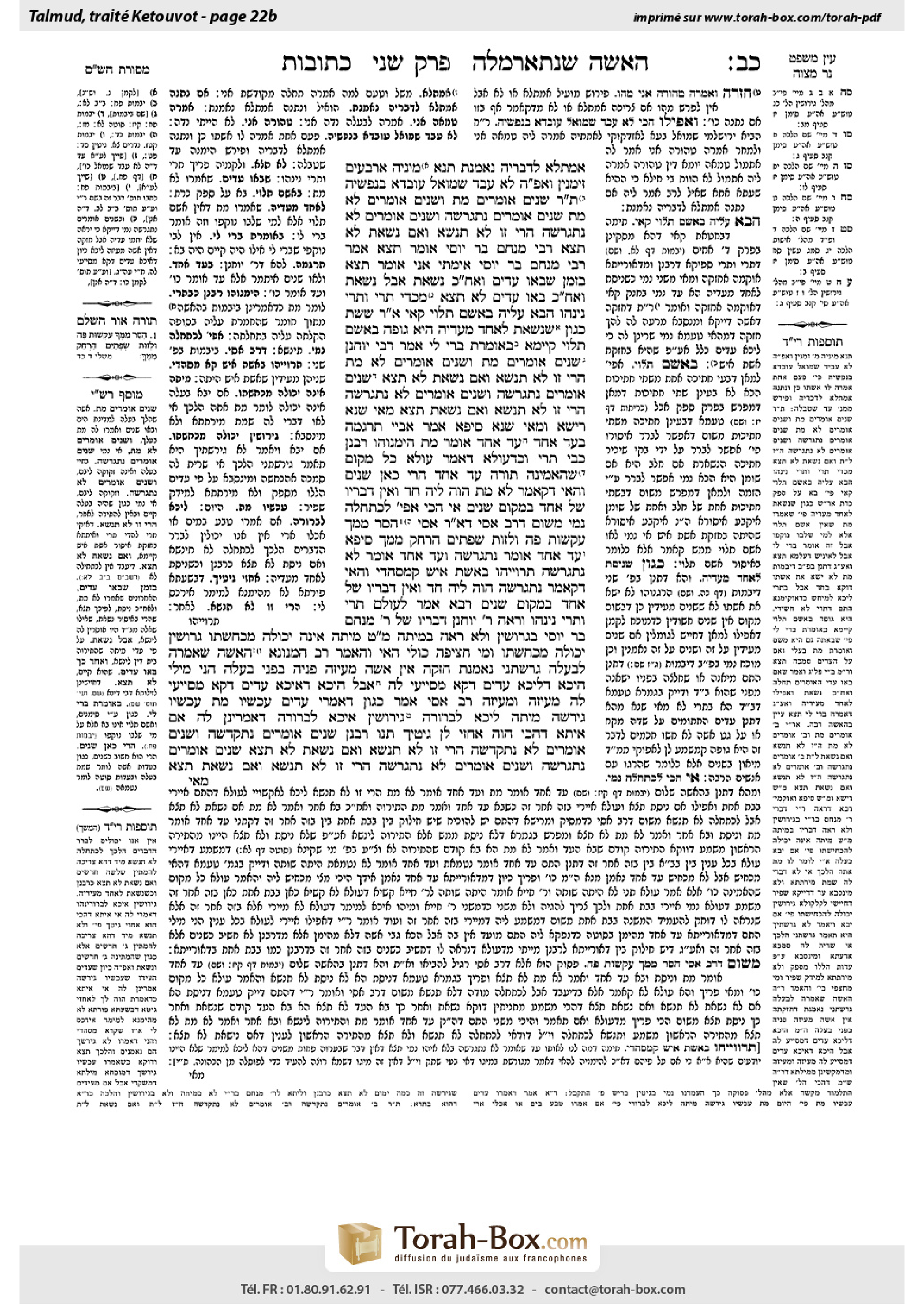
Ketubot 22b: Talmud study for Daf Yomi
Daf Yomi is the daily study of one Talmud folio. Explore 37 tractates with scans, Hebrew text, Sefaria English and AI-generated French translations where annotated.
Passage selection and English or AI-generated French translation are available where the scan has annotations. Daf Study is independent of Torah-Box and Sefaria.
Browse Ketubot · כתובות · All tractatesKetubot 22b text and translations
This page of Ketubot includes the Aramaic text, an English translation and an AI-generated French translation, alongside the scan above.
כתובות כ״ב ב · Aramaic and Hebrew text
אַמַּתְלָא לִדְבָרֶיהָ — נֶאֱמֶנֶת. תְּנָא מִינֵּיהּ אַרְבָּעִים זִימְנִין, וַאֲפִילּוּ הָכִי לָא עֲבַד שְׁמוּאֵל עוֹבָדָא בְּנַפְשֵׁיהּ.
תָּנוּ רַבָּנַן: שְׁנַיִם אוֹמְרִים ״מֵת״, וּשְׁנַיִם אוֹמְרִים ״לֹא מֵת״. שְׁנַיִם אוֹמְרִים ״נִתְגָּרְשָׁה״, וּשְׁנַיִם אוֹמְרִים ״לֹא נִתְגָּרְשָׁה״ — הֲרֵי זוֹ לֹא תִּנָּשֵׂא, וְאִם נִשֵּׂאת — לֹא תֵּצֵא. רַבִּי מְנַחֵם בַּר יוֹסֵי אוֹמֵר: תֵּצֵא. אָמַר רַבִּי מְנַחֵם בַּר יוֹסֵי: אֵימָתַי אֲנִי אוֹמֵר תֵּצֵא, בִּזְמַן שֶׁבָּאוּ עֵדִים, וְאַחַר כָּךְ נִשֵּׂאת. אֲבָל נִשֵּׂאת וְאַחַר כָּךְ בָּאוּ עֵדִים — לֹא תֵּצֵא.
מִכְּדֵי תְּרֵי וּתְרֵי נִינְהוּ, הַבָּא עָלֶיהָ בְּאָשָׁם תָּלוּי קָאֵי! אָמַר רַב שֵׁשֶׁת: כְּגוֹן שֶׁנִּשֵּׂאת לְאֶחָד מֵעֵדֶיהָ. הִיא גּוּפַהּ בְּאָשָׁם תָּלוּי קָיְימָא! בְּאוֹמֶרֶת: ״בָּרִי לִי״.
אָמַר רַבִּי יוֹחָנָן, שְׁנַיִם אוֹמְרִים: ״מֵת״, וּשְׁנַיִם אוֹמְרִים: ״לֹא מֵת״ — הֲרֵי זוֹ לֹא תִּנָּשֵׂא, וְאִם נִשֵּׂאת — לֹא תֵּצֵא. שְׁנַיִם אוֹמְרִים ״נִתְגָּרְשָׁה״, וּשְׁנַיִם אוֹמְרִים ״לֹא נִתְגָּרְשָׁה״ — הֲרֵי זוֹ לֹא תִּנָּשֵׂא, וְאִם נִשֵּׂאת — תֵּצֵא.
מַאי שְׁנָא רֵישָׁא וּמַאי שְׁנָא סֵיפָא? אָמַר אַבָּיֵי: תַּרְגְּמַהּ בְּעֵד אֶחָד. עֵד אֶחָד אוֹמֵר ״מֵת״, הֵימְנוּהוּ רַבָּנַן כְּבֵי תְרֵי, וְכִדְעוּלָּא. דְּאָמַר עוּלָּא: כׇּל מָקוֹם שֶׁהֶאֱמִינָה תּוֹרָה עֵד אֶחָד — הֲרֵי כָּאן שְׁנַיִם, וְהַאי דְּקָאָמַר ״לֹא מֵת״ — הָוֵה לֵיהּ חַד, וְאֵין דְּבָרָיו שֶׁל אֶחָד בִּמְקוֹם שְׁנַיִם.
אִי הָכִי, אֲפִילּוּ לְכַתְּחִלָּה נָמֵי! מִשּׁוּם דְּרַב אַסִּי. דְּאָמַר רַב אַסִּי: ״הָסֵר מִמְּךָ עִקְּשׁוּת פֶּה וּלְזוּת שְׂפָתַיִם הַרְחֵק מִמֶּךָּ״.
סֵיפָא, עֵד אֶחָד אוֹמֵר ״נִתְגָּרְשָׁה״, וְעֵד אֶחָד אוֹמֵר ״לֹא נִתְגָּרְשָׁה״, תַּרְוַיְיהוּ בְּאֵשֶׁת אִישׁ קָמַסְהֲדִי. וְהַאי דְּקָאָמַר נִתְגָּרְשָׁה — הָוֵה לֵיהּ חַד, וְאֵין דְּבָרָיו שֶׁל אֶחָד בִּמְקוֹם שְׁנַיִם.
רָבָא אָמַר: לְעוֹלָם תְּרֵי וּתְרֵי נִינְהוּ. וְרָאָה רַבִּי יוֹחָנָן דְּבָרָיו שֶׁל רַבִּי מְנַחֵם בַּר יוֹסֵי בְּגֵרוּשִׁין, וְלֹא רָאָה בְּמִיתָה. מַאי טַעְמָא? מִיתָה — אֵינָהּ יְכוֹלָה מַכְחַשְׁתּוֹ, גֵּרוּשִׁין — יְכוֹלָה מַכְחַשְׁתּוֹ.
וּמִי חֲצִיפָה כּוּלֵּי הַאי? וְהָאָמַר רַב הַמְנוּנָא: הָאִשָּׁה שֶׁאָמְרָה לְבַעְלָהּ ״גֵּרַשְׁתַּנִי״ — נֶאֱמֶנֶת. חֲזָקָה אֵין אִשָּׁה מְעִיזָּה פָּנֶיהָ בִּפְנֵי בַּעְלָהּ! הָנֵי מִילֵּי הֵיכָא דְּלֵיכָּא עֵדִים דְּקָא מְסַיְּיעִי לַהּ, אֲבָל הֵיכָא דְּאִיכָּא עֵדִים דְּקָא מְסַיְּיעִי לַהּ — מְעִיזָּה וּמְעִיזָּה.
רַב אַסִּי אָמַר: כְּגוֹן דְּאָמְרִי עֵדִים ״עַכְשָׁיו מֵת״, ״עַכְשָׁיו גֵּירְשָׁהּ״. מִיתָה לֵיכָּא לְבָרוּרַהּ. גֵּירוּשִׁין אִיכָּא לְבָרוּרַהּ, דְּאָמְרִינַן לָהּ: אִם אִיתָא דְּהָכִי הֲוָה, אַחֲזִי לַן גִּיטִּיךְ.
תָּנוּ רַבָּנַן: שְׁנַיִם אוֹמְרִים ״נִתְקַדְּשָׁה״, וּשְׁנַיִם אוֹמְרִים ״לֹא נִתְקַדְּשָׁה״ — הֲרֵי זוֹ לֹא תִּנָּשֵׂא, וְאִם נִשֵּׂאת לֹא תֵּצֵא. שְׁנַיִם אוֹמְרִים ״נִתְגָּרְשָׁה״, וּשְׁנַיִם אוֹמְרִים ״לֹא נִתְגָּרְשָׁה״ — הֲרֵי זו לֹא תִּנָּשֵׂא, וְאִם נִשֵּׂאת — תֵּצֵא.
Ketubot 22b · English translation
rationale for her statement, she is deemed credible. The Gemara relates: Shmuel learned this halakha from him forty times to ensure that he would not forget it, and even so, when confronted with a similar situation, Shmuel did not rely on that lenient ruling and did not take action with regard to himself and his wife.
§ The Sages taught that if two witnesses say: The husband died, and two witnesses say: He did not die; or if two witnesses say: This woman was divorced, and two witnesses say: She was not divorced, this woman may not remarry as there is no unequivocal testimony that she is unmarried. And if she remarried, she need not leave her husband. Rabbi Menaḥem bar Yosei says: She must leave her husband. And Rabbi Menaḥem bar Yosei said: When do I say that she must leave her husband? It is in a case where witnesses came to testify that she is still married and she remarried thereafter. However, if she remarried and the witnesses came thereafter, she need not leave her husband based on the uncertainty created by contradictory witnesses.
The Gemara asks: After all, they are two witnesses testifying that she is married and two witnesses testifying that she is not; how then can the ruling be that after remarrying she need not leave her husband? In that case, one who engages in intercourse with her stands liable to bring a guilt-offering for uncertainty. For any prohibition whose certain violation renders one liable to bring a sin-offering, its uncertain violation renders one liable to bring a guilt-offering for uncertainty. Rav Sheshet said: This is a case where she married one of her witnesses who testified that she is unmarried. As far as he is concerned, there is no uncertainty. The Gemara asks: She herself stands liable to bring a guilt-offering for uncertainty, as she has no independent knowledge whether her husband died. The Gemara answers that this is a case where she says: It is clear to me that he died.
§ Rabbi Yoḥanan said that if two witnesses say: The husband died, and two witnesses say: He did not die, this woman may not remarry. And if she remarried she need not leave her husband. If two witnesses say: This woman was divorced, and two witnesses say: She was not divorced, this woman may not remarry. And if she remarried she must leave her husband.
The Gemara asks: What is different in the first clause of Rabbi Yoḥanan’s statement, where, if she remarried, she need not leave her husband, and what is the different in the second clause, where, if she remarried, she must leave her husband? Abaye said: Interpret Rabbi Yoḥanan’s statement in a case where each testimony was given by one witness. If one witness says: The husband died, the Sages instituted an ordinance and accorded him credibility like that of two witnesses in order to enable his wife to remarry. And that is in accordance with the opinion of Ulla, as Ulla said: Wherever the Torah deemed one witness credible, his legal status there is that of two witnesses. And the legal status of that second witness who says: He did not die, is that of one witness, and the statement of one witness has no validity in a place where there is the testimony of two witnesses. Therefore, she need not leave her husband.
The Gemara asks: If so, that this is a case of the testimony of two witnesses against the testimony of one witness, it should be permitted for her to remarry even ab initio. The Gemara answers that she may not remarry ab initio due to the opinion of Rav Asi, as Rav Asi said that in any case of uncertainty, the verse “Remove from you a crooked mouth, and perverse lips put far from you” (Proverbs 4:24) applies. Although it is not a strictly prohibited action, it is, nevertheless, inappropriate.
In the latter clause of Rabbi Yoḥanan’s statement, where one witness says: This woman was divorced, and one witness says: She was not divorced, both of them are testifying that she was a married woman, and that witness who says: She was divorced, is one witness, and the statement of one witness has no validity in a place where there is the testimony of two witnesses. Therefore, even if she remarried she must leave her husband.
Rava explained the difference between the two cases in Rabbi Yoḥanan’s statement and said: Actually it is a case where they are two witnesses testifying that she is married and two testifying that she is not, and Rabbi Yoḥanan saw the statement of Rabbi Menaḥem bar Yosei as correct in the case of divorce but did not see it as correct in the case of death. What is the reason that he distinguishes between the two cases? In the case of death, if ultimately her husband returns alive, she is unable to deny that he is alive. Therefore, the woman’s decision to remarry is credible, as if she were not certain that he was dead, she would not have remarried. However, in the case of divorce, if her husband returns and claims that he did not divorce her, she is able to deny his claim. Therefore, her decision to remarry is suspect, and the Sages penalized her and established that she must leave her husband.
The Gemara asks: And is the woman impudent to that extent, that she would lie in the presence of her husband and claim that he divorced her? But didn’t Rav Hamnuna say with regard to a woman who said to her husband: You divorced me, she is deemed credible, as there is a presumption that a woman is not insolent in the presence of her husband? The Gemara answers: This statement that she is not insolent applies only in a case where there are no witnesses who are supporting her; however, in a case where there are witnesses who are supporting her, she would certainly be insolent.
Rav Asi explained the difference between the two cases in Rabbi Yoḥanan’s statement and said that it is a case where the witnesses say: He died now, or: He divorced her now. With regard to the husband’s death, there is no way to immediately clarify whether or not he is dead. With regard to divorce there is a way to immediately clarify whether or not he divorced her, as we say to the woman: If it is so that this is what happened, show us your bill of divorce. Since the testimony was that the divorce was now, it is not feasible that she lost the bill of divorce. If she fails to produce the bill of divorce, the witnesses that testify that she is divorced are apparently false witnesses. Therefore, even if she remarried she must leave her husband.
§ The Sages taught: In a case where two witnesses say: This woman was betrothed, and two witnesses say: She was not betrothed, this woman may not marry another, and if she remarried, she need not leave her husband. In a case where two witnesses say: This woman was divorced, and two witnesses say: She was not divorced, this woman may not remarry. And if she remarried, she must leave her husband.
Ketubot 22b · Traduction française (IA)
La raison de sa déclaration est qu’elle est considérée comme digne de foi. La Guemara rapporte que Chmouel apprit cette halakha auprès de lui quarante fois pour ne pas l’oublier ; malgré cela, lorsqu’il fut confronté à une situation semblable, Chmouel ne s’appuya pas sur cette décision indulgente et ne l’appliqua ni à lui-même ni à son épouse.
§ Les Sages ont enseigné : si deux témoins disent : « Le mari est mort », et que deux témoins disent : « Il n’est pas mort », ou si deux témoins disent : « Cette femme a été divorcée », et que deux témoins disent : « Elle n’a pas été divorcée », cette femme ne peut pas se remarier, car aucun témoignage sans équivoque n’établit qu’elle n’est plus mariée. Si elle s’est remariée, elle n’a pas besoin de quitter son mari. Rabbi Menaḥem bar Yosei dit : elle doit quitter son mari. Rabbi Menaḥem bar Yosei dit : Quand est-ce que je dis qu’elle doit quitter son mari ? C’est lorsque des témoins sont venus attester qu’elle est toujours mariée, puis qu’elle s’est remariée. En revanche, si elle s’est remariée et que les témoins ne sont venus qu’ensuite, elle n’a pas besoin de quitter son mari en raison de l’incertitude créée par les témoignages contradictoires.
La Guemara demande : Après tout, deux témoins attestent qu’elle est mariée et deux témoins attestent qu’elle ne l’est pas ; comment peut-on alors décider qu’après s’être remariée, elle n’a pas besoin de quitter son mari ? Dans ce cas, celui qui a des relations avec elle est passible d’apporter un sacrifice de culpabilité en cas de doute. Pour toute interdiction dont la transgression certaine rend passible d’un sacrifice expiatoire, une transgression incertaine rend passible d’un sacrifice de culpabilité en cas de doute. Rav Cheshet a dit : Il s’agit d’un cas où elle a épousé l’un des témoins qui attestent qu’elle n’est pas mariée. Pour lui, il n’y a aucune incertitude. La Guemara demande : Elle-même est passible d’apporter un sacrifice de culpabilité en cas de doute, puisqu’elle ne sait pas par elle-même si son mari est mort. La Guemara répond qu’il s’agit d’un cas où elle dit : « Je sais avec certitude qu’il est mort. »
§ Rabbi Yoḥanan a dit que si deux témoins disent : « Le mari est mort », et que deux témoins disent : « Il n’est pas mort », cette femme ne peut pas se remarier. Si elle s’est remariée, elle n’a pas besoin de quitter son mari. Si deux témoins disent : « Cette femme a été divorcée », et que deux témoins disent : « Elle n’a pas été divorcée », cette femme ne peut pas se remarier. Si elle s’est remariée, elle doit quitter son mari.
La Guemara demande : Quelle est la différence entre la première partie de la déclaration de Rabbi Yoḥanan, où, si elle s’est remariée, elle n’a pas besoin de quitter son mari, et la seconde partie, où, si elle s’est remariée, elle doit quitter son mari ? Abayé a dit : Il faut interpréter la déclaration de Rabbi Yoḥanan comme portant sur un cas où chaque témoignage émane d’un seul témoin. Si un témoin dit : « Le mari est mort », les Sages ont institué une ordonnance et lui ont accordé la même crédibilité qu’à deux témoins afin de permettre à son épouse de se remarier. Cela est conforme à l’opinion d’Oulla, car Oulla a dit : partout où la Torah considère un témoin comme digne de foi, son statut juridique est celui de deux témoins. Quant à l’autre témoin, qui dit : « Il n’est pas mort », son statut juridique est celui d’un seul témoin, et la déclaration d’un seul témoin n’a pas de valeur face au témoignage de deux témoins. Par conséquent, elle n’a pas besoin de quitter son mari.
La Guemara demande : Si tel est le cas, puisqu’il s’agit du témoignage de deux témoins contre celui d’un seul, elle devrait être autorisée à se remarier a priori. La Guemara répond qu’elle ne peut pas se remarier a priori en raison de l’opinion de Rav Assi, car Rav Assi a dit que, dans toute situation d’incertitude, s’applique le verset : « Éloigne de toi une bouche tortueuse, et tiens loin de toi des lèvres perverses » (Proverbes 4, 24). Même si l’acte n’est pas strictement interdit, il est néanmoins inapproprié.
Dans la seconde partie de la déclaration de Rabbi Yoḥanan, où un témoin dit : « Cette femme a été divorcée », et qu’un témoin dit : « Elle n’a pas été divorcée », les deux attestent qu’elle était mariée ; le témoin qui dit : « Elle a été divorcée » n’est donc qu’un seul témoin, et sa déclaration n’a pas de valeur face au témoignage de deux témoins. Par conséquent, même si elle s’est remariée, elle doit quitter son mari.
Rava a expliqué la différence entre les deux cas de la déclaration de Rabbi Yoḥanan et a dit : En réalité, il s’agit d’un cas où deux témoins attestent qu’elle est mariée et deux attestent qu’elle ne l’est pas. Rabbi Yoḥanan a jugé juste l’avis de Rabbi Menaḥem bar Yosei dans le cas du divorce, mais pas dans celui du décès. Pourquoi distingue-t-il ces deux cas ? Dans le cas du décès, si son mari revient finalement vivant, elle ne peut pas nier qu’il est vivant. Par conséquent, sa décision de se remarier est digne de foi : si elle n’était pas certaine qu’il était mort, elle ne se serait pas remariée. En revanche, dans le cas du divorce, si son mari revient et prétend qu’il ne l’a pas divorcée, elle peut nier son affirmation. Par conséquent, sa décision de se remarier est suspecte, et les Sages l’ont sanctionnée en statuant qu’elle doit quitter son mari.
La Guemara demande : La femme est-elle à ce point effrontée qu’elle mentirait en présence de son mari en prétendant qu’il l’a divorcée ? Pourtant, Rav Hamnouna n’a-t-il pas dit, à propos d’une femme qui dit à son mari : « Tu m’as divorcée », qu’elle est considérée comme digne de foi, car il existe une présomption selon laquelle une femme ne se montre pas insolente en présence de son mari ? La Guemara répond : Cette affirmation selon laquelle elle ne se montre pas insolente ne s’applique que lorsqu’aucun témoin ne la soutient ; mais lorsqu’il y a des témoins qui la soutiennent, elle se montrerait certainement insolente.
Rav Assi a expliqué la différence entre les deux cas de la déclaration de Rabbi Yoḥanan et a dit qu’il s’agit d’un cas où les témoins disent : « Il est mort à l’instant », ou : « Il l’a divorcée à l’instant ». Concernant la mort du mari, il n’y a aucun moyen de vérifier immédiatement s’il est mort ou non. En revanche, dans le cas du divorce, il est possible de vérifier immédiatement s’il l’a divorcée ou non, car nous disons à la femme : « Si c’est bien ce qui s’est passé, montre-nous ton acte de divorce. » Puisque les témoins ont affirmé que le divorce venait d’avoir lieu, il n’est pas plausible qu’elle ait perdu l’acte de divorce. Si elle ne produit pas l’acte de divorce, les témoins qui attestent qu’elle est divorcée sont apparemment de faux témoins. Par conséquent, même si elle s’est remariée, elle doit quitter son mari.
§ Les Sages ont enseigné : dans le cas où deux témoins disent : « Cette femme a été fiancée », et que deux témoins disent : « Elle n’a pas été fiancée », cette femme ne peut pas épouser un autre homme ; si elle s’est remariée, elle n’a pas besoin de quitter son mari. Dans le cas où deux témoins disent : « Cette femme a été divorcée », et que deux témoins disent : « Elle n’a pas été divorcée », cette femme ne peut pas se remarier. Si elle s’est remariée, elle doit quitter son mari.
Traduction française générée par IA à partir de l’édition anglaise de Sefaria. Vérifie toujours un passage avec le texte source.
Text from Sefaria: William Davidson Edition - Vocalized Aramaic (CC BY NC); William Davidson Edition - English (CC BY NC).