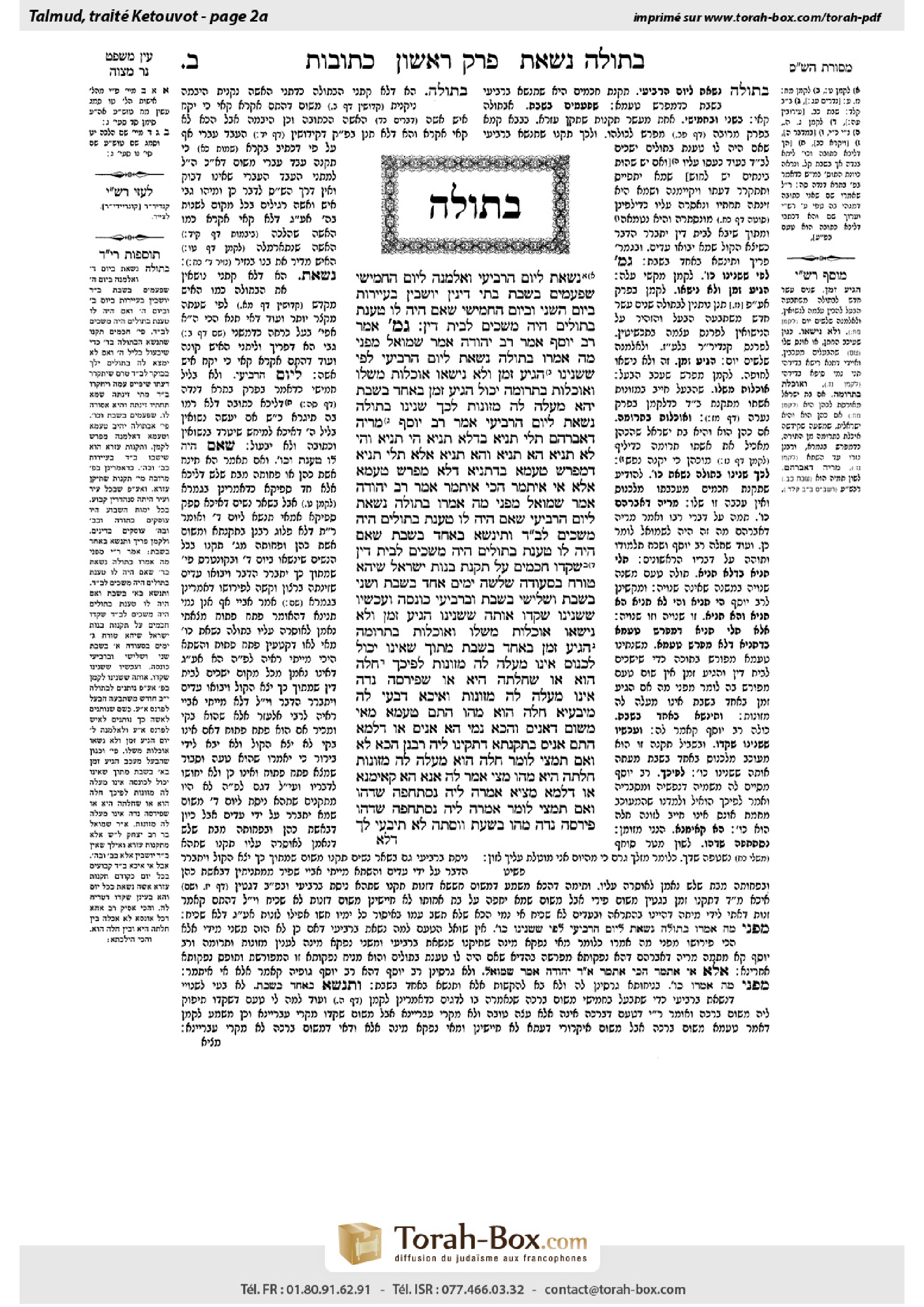
Ketubot 2a: Talmud study for Daf Yomi
Daf Yomi is the daily study of one Talmud folio. Explore 37 tractates with scans, Hebrew text, Sefaria English and AI-generated French translations where annotated.
Passage selection and English or AI-generated French translation are available where the scan has annotations. Daf Study is independent of Torah-Box and Sefaria.
Browse Ketubot · כתובות · All tractatesKetubot 2a text and translations
This page of Ketubot includes the Aramaic text, an English translation and an AI-generated French translation, alongside the scan above.
כתובות ב׳ א · Aramaic and Hebrew text
בְּתוּלָה נִשֵּׂאת לַיּוֹם הָרְבִיעִי וְאַלְמָנָה לַיּוֹם הַחֲמִישִׁי. שֶׁפַּעֲמַיִם בְּשַׁבָּת בָּתֵּי דִינִין יוֹשְׁבִין בָּעֲיָירוֹת: בַּיּוֹם הַשֵּׁנִי וּבַיּוֹם הַחֲמִישִׁי, שֶׁאִם הָיָה לוֹ טַעֲנַת בְּתוּלִים, הָיָה מַשְׁכִּים לְבֵית דִּין.
גְּמָ׳ אָמַר רַב יוֹסֵף אָמַר רַב יְהוּדָה אָמַר שְׁמוּאֵל: מִפְּנֵי מָה אָמְרוּ בְּתוּלָה נִשֵּׂאת לַיּוֹם הָרְבִיעִי? לְפִי שֶׁשָּׁנִינוּ: הִגִּיעַ זְמַן וְלֹא נִישְּׂאוּ — אוֹכְלוֹת מִשֶּׁלּוֹ, וְאוֹכְלוֹת בִּתְרוּמָה.
יָכוֹל הִגִּיעַ זְמַן בְּאֶחָד בְּשַׁבָּת יְהֵא מַעֲלֶה לָהּ מְזוֹנוֹת? לְכָךְ שָׁנִינוּ: בְּתוּלָה נִשֵּׂאת לַיּוֹם הָרְבִיעִי.
אָמַר רַב יוֹסֵף: מָרֵיהּ דְּאַבְרָהָם! תָּלֵי תַּנְיָא בִּדְלָא תַּנְיָא?! הֵי תַּנְיָא וְהֵי לָא תַּנְיָא? הָא תַּנְיָא וְהָא תַּנְיָא! אֶלָּא: תָּלֵי תַּנְיָא דִּמְפָרֵשׁ טַעְמָא בִּדְתַנְיָא דְּלָא מְפָרֵשׁ טַעְמָא.
אֶלָּא אִי אִיתְּמַר הָכִי אִיתְּמַר. אָמַר רַב יְהוּדָה אָמַר שְׁמוּאֵל: מִפְּנֵי מָה אָמְרוּ בְּתוּלָה נִשֵּׂאת לַיּוֹם הָרְבִיעִי? שֶׁאִם הָיָה לוֹ טַעֲנַת בְּתוּלִים — הָיָה מַשְׁכִּים לְבֵית דִּין. וְתִינָּשֵׂא בְּאֶחָד בְּשַׁבָּת, שֶׁאִם הָיָה לוֹ טַעֲנַת בְּתוּלִים הָיָה מַשְׁכִּים לְבֵית דִּין? שָׁקְדוּ חֲכָמִים עַל תַּקָּנַת בְּנוֹת יִשְׂרָאֵל, שֶׁיְּהֵא טוֹרֵחַ בִּסְעוּדָה שְׁלֹשָׁה יָמִים, אֶחָד בְּשַׁבָּת וְשֵׁנִי בַּשַּׁבָּת וּשְׁלִישִׁי בַּשַּׁבָּת, וּבָרְבִיעִי כּוֹנְסָהּ.
וְעַכְשָׁו שֶׁשָּׁנִינוּ ״שָׁקְדוּ״, אוֹתָהּ שֶׁשָּׁנִינוּ ״הִגִּיעַ זְמַן וְלֹא נִישְּׂאוּ, אוֹכְלוֹת מִשֶּׁלּוֹ וְאוֹכְלוֹת בִּתְרוּמָה״, הִגִּיעַ זְמַן בְּאֶחָד בְּשַׁבָּת, מִתּוֹךְ שֶׁאֵינוֹ יָכוֹל לִכְנוֹס — אֵינוֹ מַעֲלֶה לָהּ מְזוֹנוֹת.
לְפִיכָךְ: חָלָה הוּא אוֹ שֶׁחָלְתָה הִיא אוֹ שֶׁפֵּירְסָה נִדָּה — אֵינוֹ מַעֲלֶה לָהּ מְזוֹנוֹת.
וְאִיכָּא דְּבָעֵי לַהּ מִיבַּעְיָא: חָלָה הוּא, מַהוּ? הָתָם טַעְמָא מַאי — מִשּׁוּם דַּאֲנִיס, וְהָכָא נָמֵי הָא אֲנִיס. אוֹ דִּלְמָא: הָתָם אֲנִיס בְּתַקַּנְתָּא דְּתַקִּינוּ לֵיה רַבָּנַן, הָכָא לָא.
וְאִם תִּמְצֵי לוֹמַר חָלָה הוּא מַעֲלֶה לָהּ מְזוֹנוֹת: חָלְתָה הִיא, מַהוּ? מָצֵי אָמַר לַהּ: אֲנָא הָא קָאֵימְנָא, אוֹ דִלְמָא מָצְיָא אָמְרָה לֵיהּ: ״נִסְתַּחֲפָה שָׂדֵהוּ״.
וְאִם תִּמְצֵי לוֹמַר אָמְרָה לֵיהּ ״נִסְתַּחֲפָה שָׂדֵהוּ״ — פֵּירְסָה נִדָּה, מַהוּ?
בִּשְׁעַת וִוסְתָּהּ, לָא תִּיבְּעֵי לָךְ
Ketubot 2a · English translation
MISHNA: A virgin is married on Wednesday and a widow on Thursday. The reason for the former is that twice a week courts convene in the towns, on Monday and Thursday, so that if the husband had a claim concerning the bride’s virginity when consummating the marriage on Wednesday night, he would go early the next day to court and make his claim.
GEMARA: Rav Yosef said that Rav Yehuda said that Shmuel said: Due to what reason did they say that a virgin is married on Wednesday? It is because we learned in a mishna elsewhere (57a): If the time that the groom designated for the wedding arrived, and the wedding was postponed, and they were not married, the brides are entitled to eat from his food and, if he is a priest, eat teruma.
One might think that if the designated time arrived on Sunday, and the wedding was postponed, he would provide her sustenance beginning on Sunday. Therefore, we learned: A virgin is married on Wednesday. Until Wednesday, the designated time is not considered to have arrived, even if the original date was earlier in the week.
After citing the statements above, Rav Yosef said in astonishment: Lord of Abraham, Shmuel makes that which is taught dependent on that which is not taught, using the latter to explain the former. The Gemara asks: Which is taught and which is not taught? Both this mishna is taught and that mishna is taught. The Gemara answers: Rather, Shmuel makes the halakha that is taught in the mishna here, whose reason is explicit, dependent on a halakha that is taught in the later mishna, whose reason is not explicit. Citation of the later mishna contributed nothing to the understanding of the mishna here.
Rather, if it was stated, this is how it was stated: Rav Yehuda said that Shmuel said: Due to what reason did the Sages in the mishna say that a virgin is married on Wednesday? It is so that if the husband had a claim concerning the bride’s virginity, he would go early the next day to court and make his claim. The Gemara asks: But if that is the reason, let her marry on Sunday, as then too, if the husband had a claim concerning the bride’s virginity, he would go early the next day to court and make his claim. The Gemara answers: The Sages were assiduous in seeing to the well-being of Jewish women and instituted that the wedding take place on Wednesday, so that the groom would exert himself in arranging the wedding feast for three days: Sunday, Monday, and Tuesday, and on Wednesday, he marries her.
The Gemara continues: And now that we learned that the reason for the ruling in the mishna that a woman is married on Wednesday is that the Sages were assiduous in this matter, then with regard to that halakha, which we learned in the later mishna: If the time arrived and they were not married, the brides are entitled to eat from his food and eat teruma, one may conclude: If the time arrived on Sunday, since he is unable to marry her because he is busy preparing the wedding feast, he is not obligated to provide her sustenance until Wednesday.
Therefore, according to the same line of reasoning, if the husband fell ill, or if the bride fell ill, or in a case where she began to menstruate [peirsa nidda] and the wedding had to be postponed, he similarly need not provide her sustenance from the designated time, as he did not initiate the delay.
And there are those who raised it as a dilemma: If the groom fell ill, what is the ruling with regard to his obligation to provide her sustenance? There, in the case where the designated time arrived on Sunday, what is the reason that he is exempt? It is due to the fact that he was forced to postpone the wedding by circumstances beyond his control. And here too, isn’t he forced by circumstances beyond his control, and he should therefore be exempt? Or, perhaps there is a distinction between the cases. There, he was forced by an ordinance that was instituted by the Sages that a virgin marries on Wednesday, and they exempted him from providing for her until then. However, here, that is not the case. Therefore, despite the existence of circumstances beyond his control, he is not exempt from providing her sustenance due to his illness.
And if you say that if he fell ill, he provides her sustenance at the time designated for the wedding, then if she fell ill, what is the ruling? Can he say to her: I am standing here prepared to wed you, and if you are not prepared, it is not my fault? Or perhaps she can say to him that his field was inundated, i.e., her illness is tantamount to a natural disaster that befell him, and he must nevertheless provide for her.
And if you say that if she fell ill she can say to him that his field was inundated, if she became a menstruating woman and the wedding was postponed, what is the ruling? Is this too considered an unavoidable circumstance, like illness, and he must provide for her, or was this predictable?
If she began menstruating at the time of her set period [vista], do not raise the dilemma,
Ketubot 2a · Traduction française (IA)
Michna : Une vierge se marie le mercredi et une veuve le jeudi. La raison de la première règle est que les tribunaux siègent deux fois par semaine dans les villes, le lundi et le jeudi. Ainsi, si le mari avait une réclamation concernant la virginité de la mariée lors de la consommation du mariage, le mercredi soir, il pourrait se rendre tôt le lendemain au tribunal et faire valoir sa réclamation.
Guemara : Rav Yossef dit que Rav Yehouda dit que Chmouel dit : Pour quelle raison a-t-on dit qu’une vierge se marie le mercredi ? Parce que nous avons appris dans une autre Michna (57a) : Si le moment fixé par le fiancé pour le mariage est arrivé, mais que le mariage a été reporté et qu’ils ne se sont pas mariés, les fiancées ont le droit de se nourrir aux frais du fiancé et, s’il est prêtre, de manger de la terouma.
On pourrait penser que si le moment fixé est arrivé le dimanche et que le mariage a été reporté, il doit subvenir à ses besoins à partir du dimanche. C’est pourquoi nous avons appris : Une vierge se marie le mercredi. Jusqu’au mercredi, le moment fixé n’est pas considéré comme arrivé, même si la date initialement prévue était antérieure dans la semaine.
Après avoir cité les déclarations précédentes, Rav Yossef s’exclama avec étonnement : « Maître d’Abraham, Chmouel fait dépendre ce qui est enseigné de ce qui ne l’est pas, et se sert de ce dernier pour expliquer le premier. » La Guemara demande : Qu’est-ce qui est enseigné et qu’est-ce qui ne l’est pas ? Cette Michna-ci est enseignée, et cette autre Michna l’est aussi. La Guemara répond : En réalité, Chmouel fait dépendre la halakha enseignée dans la Michna ici, dont la raison est explicite, d’une halakha enseignée dans la Michna ultérieure, dont la raison n’est pas explicite. Citer la Michna ultérieure n’apportait rien à la compréhension de la Michna ici.
En réalité, si cette déclaration a été rapportée, voici comment elle l’a été : Rav Yehouda dit que Chmouel dit : Pour quelle raison les Sages ont-ils dit dans la Michna qu’une vierge se marie le mercredi ? Afin que, si le mari avait une réclamation concernant la virginité de la mariée, il puisse se rendre tôt le lendemain au tribunal et faire valoir sa réclamation. La Guemara demande : Mais, si telle est la raison, qu’elle se marie le dimanche ; alors aussi, si le mari avait une réclamation concernant la virginité de la mariée, il pourrait se rendre tôt le lendemain au tribunal et faire valoir sa réclamation. La Guemara répond : Les Sages se sont souciés du bien-être des femmes juives et ont institué que le mariage ait lieu le mercredi, afin que le fiancé s’emploie à préparer le festin de mariage pendant trois jours, le dimanche, le lundi et le mardi, puis l’épouse le mercredi.
La Guemara poursuit : Maintenant que nous avons appris que la raison de la règle énoncée dans la Michna, selon laquelle une femme se marie le mercredi, est que les Sages se sont souciés de cette question, on peut tirer la conclusion suivante concernant cette halakha, que nous avons apprise dans la Michna ultérieure : Si le moment fixé est arrivé et qu’ils ne se sont pas mariés, les fiancées ont le droit de se nourrir aux frais du fiancé et de manger de la terouma. Si le moment fixé est arrivé le dimanche, puisqu’il ne peut pas l’épouser parce qu’il est occupé à préparer le festin de mariage, il n’est pas tenu de subvenir à ses besoins avant le mercredi.
Par conséquent, selon le même raisonnement, si le mari tombe malade, si la mariée tombe malade, ou si elle commence à avoir ses règles [peirsa nidda] et que le mariage doit être reporté, il n’a pas non plus à subvenir à ses besoins à partir du moment fixé, puisqu’il n’est pas à l’origine du retard.
D’autres ont formulé la question sous forme de dilemme : Si le fiancé tombe malade, quelle est la règle concernant son obligation de subvenir à ses besoins ? Dans le cas où le moment fixé est arrivé le dimanche, pour quelle raison est-il exempté ? Parce qu’il a été contraint de reporter le mariage par des circonstances indépendantes de sa volonté. Ici aussi, n’est-il pas contraint par des circonstances indépendantes de sa volonté, de sorte qu’il devrait être exempté ? Ou peut-être y a-t-il une différence entre les cas. Là, il a été contraint par une ordonnance instituée par les Sages, selon laquelle une vierge se marie le mercredi, et ils l’ont exempté de subvenir à ses besoins jusque-là. Ici, cependant, ce n’est pas le cas. Par conséquent, malgré ces circonstances indépendantes de sa volonté, il n’est pas exempté de subvenir à ses besoins en raison de sa maladie.
Et si tu dis que, s’il tombe malade, il subvient à ses besoins au moment fixé pour le mariage, alors, s’il elle tombe malade, quelle est la règle ? Peut-il lui dire : « Je suis ici, prêt à t’épouser ; si tu n’es pas prête, ce n’est pas ma faute » ? Ou peut-être peut-elle lui dire que son champ a été inondé, c’est-à-dire que sa maladie équivaut à une catastrophe naturelle qui l’a frappé, et qu’il doit néanmoins subvenir à ses besoins.
Et si tu dis que, si elle tombe malade, elle peut lui dire que son champ a été inondé, quelle est la règle si elle a ses règles et que le mariage est reporté ? Cela est-il également considéré comme une circonstance indépendante de sa volonté, comme la maladie, de sorte qu’il doit subvenir à ses besoins, ou était-ce prévisible ?
Si elle commence à avoir ses règles au moment de son cycle habituel [vista], ne soulève pas le dilemme,
Traduction française générée par IA à partir de l’édition anglaise de Sefaria. Vérifie toujours un passage avec le texte source.
Text from Sefaria: William Davidson Edition - Vocalized Aramaic (CC BY NC); William Davidson Edition - English (CC BY NC).