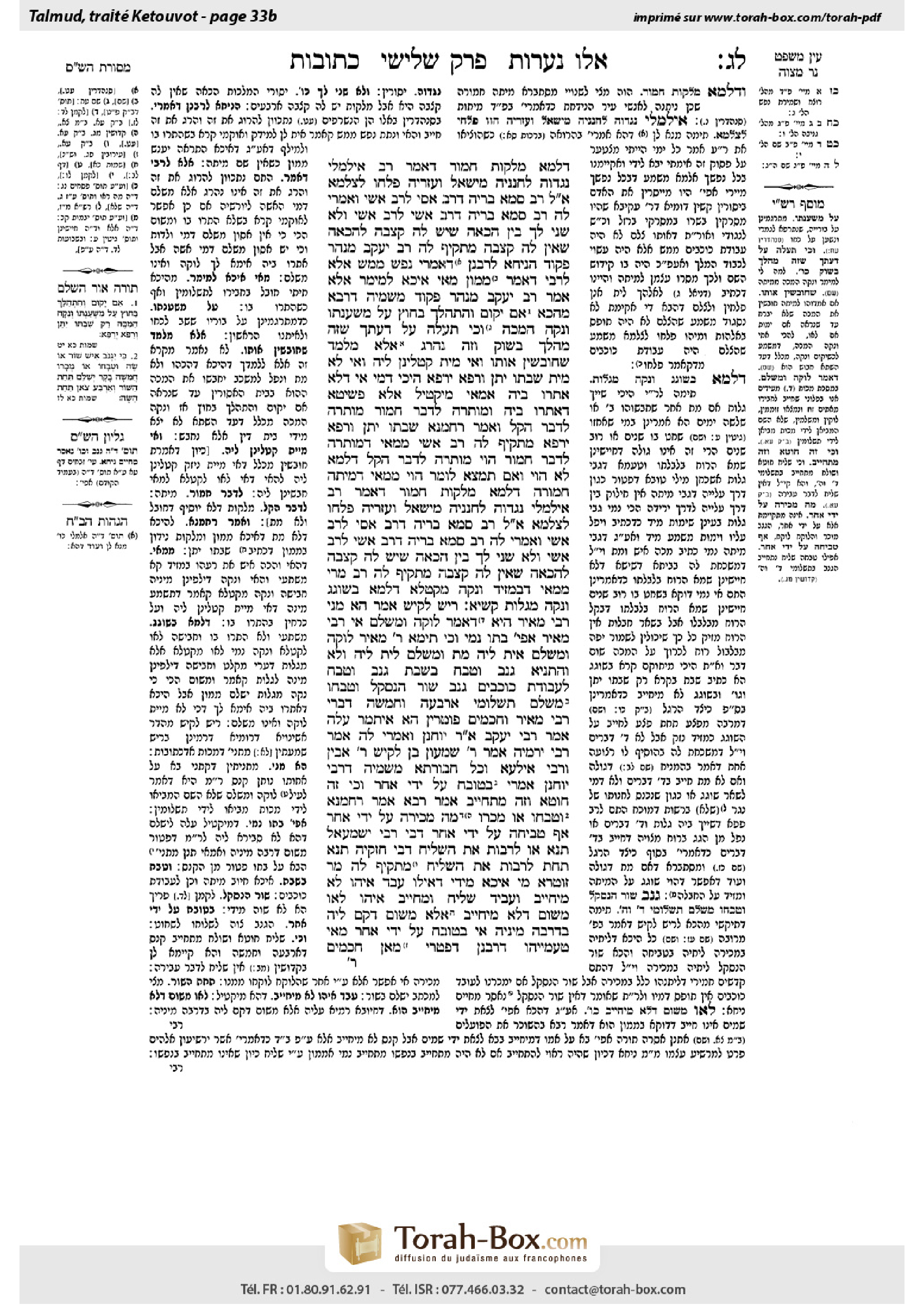
Ketubot 33b: Talmud study for Daf Yomi
Daf Yomi is the daily study of one Talmud folio. Explore 37 tractates with scans, Hebrew text, Sefaria English and AI-generated French translations where annotated.
Passage selection and English or AI-generated French translation are available where the scan has annotations. Daf Study is independent of Torah-Box and Sefaria.
Browse Ketubot · כתובות · All tractatesKetubot 33b text and translations
This page of Ketubot includes the Aramaic text, an English translation and an AI-generated French translation, alongside the scan above.
כתובות ל״ג ב · Aramaic and Hebrew text
דִּלְמָא מַלְקוֹת חָמוּר? דְּאָמַר רַב: אִילְמָלֵי נַגְּדוּהּ לַחֲנַנְיָה מִישָׁאֵל וַעֲזַרְיָה — פְּלַחוּ לְצַלְמָא! אֲמַר לֵיהּ רַב סַמָּא בְּרֵיהּ דְּרַב אַסִּי לְרַב אָשֵׁי, וְאָמְרִי לַהּ רַב סַמָּא בְּרֵיהּ דְּרַב אָשֵׁי לְרַב אָשֵׁי: וְלָא שָׁנֵי לָךְ בֵּין הַכָּאָה שֶׁיֵּשׁ לָהּ קִצְבָה לְהַכָּאָה שֶׁאֵין לָהּ קִצְבָה?
מַתְקֵיף לַהּ רַב יַעֲקֹב מִנְּהַר פְּקוֹד: הָנִיחָא לְרַבָּנַן דְּאָמְרִי נֶפֶשׁ מַמָּשׁ, אֶלָּא לְרַבִּי דְּאָמַר מָמוֹן, מַאי אִיכָּא לְמֵימַר?
אֶלָּא אָמַר רַב יַעֲקֹב מִנְּהַר פְּקוֹד מִשְּׁמֵיהּ דְּרָבָא, מֵהָכָא: ״אִם יָקוּם וְהִתְהַלֵּךְ בַּחוּץ עַל מִשְׁעַנְתּוֹ וְנִקָּה הַמַּכֶּה״, וְכִי תַּעֲלֶה עַל דַּעְתְּךָ שֶׁזֶּה מְהַלֵּךְ בַּשּׁוּק, וְזֶה נֶהֱרָג? אֶלָּא מְלַמֵּד שֶׁחוֹבְשִׁין אוֹתוֹ, וְאִי מָיֵת — קָטְלִינַן לֵיהּ, וְאִי לָא מָיֵת — ״שִׁבְתּוֹ יִתֵּן וְרַפֹּא יְרַפֵּא״.
הֵיכִי דָמֵי? אִי דְּלָא אַתְרוֹ בֵּיהּ — אַמַּאי מִיקְּטִיל! אֶלָּא פְּשִׁיטָא דְּאַתְרוֹ בֵּיהּ, וּמוּתְרֶה לְדָבָר חָמוּר, מוּתְרֶה לְדָבָר הַקַּל, וְאָמַר רַחֲמָנָא ״שִׁבְתּוֹ יִתֵּן וְרַפֹּא יְרַפֵּא״.
מַתְקֵיף לַהּ רַב אָשֵׁי: מִמַּאי דְּמוּתְרֶה לְדָבָר חָמוּר הָוֵי מוּתְרֶה לְדָבָר הַקַּל? דִּלְמָא לָא הָוֵי! וְאִם תִּמְצָא לוֹמַר הָוֵי, מִמַּאי דְּמִיתָה חֲמוּרָה? דִּלְמָא מַלְקוֹת חָמוּר? דְּאָמַר רַב: אִילְמָלֵי נַגְּדוּהּ לַחֲנַנְיָה מִישָׁאֵל וַעֲזַרְיָה, פְּלַחוּ לְצַלְמָא!
אֲמַר לֵיהּ רַב סַמָּא בְּרֵיהּ דְּרַב אַסִּי לְרַב אָשֵׁי, וְאָמְרִי לַהּ רַב סַמָּא בְּרֵיהּ דְּרַב אָשֵׁי לְרַב אָשֵׁי: וְלָא שָׁנֵי לָךְ בֵּין הַכָּאָה שֶׁיֵּשׁ לָהּ קִצְבָה לְהַכָּאָה שֶׁאֵין לָהּ קִצְבָה?
מַתְקֵיף לַהּ רַב מָרִי: מִמַּאי דִּבְמֵזִיד, ״וְנִקָּה״ — מִקְּטָלָא? דִּלְמָא בְּשׁוֹגֵג, ״וְנִקָּה״ — מִגָּלוּת? קַשְׁיָא.
רֵישׁ לָקִישׁ אָמַר: הָא מַנִּי — רַבִּי מֵאִיר הִיא, דְּאָמַר: לוֹקֶה וּמְשַׁלֵּם. אִי רַבִּי מֵאִיר — אֲפִילּוּ בִּתּוֹ נָמֵי!
וְכִי תֵּימָא: רַבִּי מֵאִיר, לוֹקֶה וּמְשַׁלֵּם — אִית לֵיהּ, מֵת וּמְשַׁלֵּם — לֵית לֵיהּ, וְלָא? וְהָתַנְיָא: גָּנַב וְטָבַח בְּשַׁבָּת, גָּנַב וְטָבַח לַעֲבוֹדָה זָרָה, גָּנַב שׁוֹר הַנִּסְקָל וּטְבָחוֹ — מְשַׁלֵּם תַּשְׁלוּמֵי אַרְבָּעָה וַחֲמִשָּׁה, דִּבְרֵי רַבִּי מֵאִיר, וַחֲכָמִים פּוֹטְרִין!
הָא אִיתְּמַר עֲלַהּ, אָמַר רַבִּי יַעֲקֹב אָמַר רַבִּי יוֹחָנָן, וְאָמְרִי לַהּ: אָמַר רַבִּי יִרְמְיָה אָמַר רַבִּי שִׁמְעוֹן בֶּן לָקִישׁ, רַבִּי אָבִין וְרַבִּי אִילְעָא וְכֹל חֲבוּרָתָא מִשְּׁמֵיהּ דְּרַבִּי יוֹחָנָן אָמְרִי: בְּטוֹבֵחַ עַל יְדֵי אַחֵר.
וְכִי זֶה חוֹטֵא וְזֶה מִתְחַיֵּיב? אָמַר רָבָא, אָמַר רַחֲמָנָא: ״וּטְבָחוֹ אוֹ מְכָרוֹ״, מָה מְכִירָה עַל יְדֵי אַחֵר, אַף טְבִיחָה עַל יְדֵי אַחֵר.
דְּבֵי רַבִּי יִשְׁמָעֵאל תָּנָא: ״אוֹ״ — לְרַבּוֹת אֶת הַשָּׁלִיחַ. דְּבֵי חִזְקִיָּה תָּנָא: ״תַּחַת״ — לְרַבּוֹת אֶת הַשָּׁלִיחַ.
מַתְקֵיף לַהּ מָר זוּטְרָא: מִי אִיכָּא מִידֵּי דְּאִילּוּ עֲבַד אִיהוּ לָא מִיחַיַּיב, וְעָבֵיד שְׁלִיחַ וּמִחַיַּיב? אִיהוּ, לָאו מִשּׁוּם דְּלָא מִיחַיַּיב, אֶלָּא מִשּׁוּם דְּקָם לֵיהּ בִּדְרַבָּה מִינֵּיהּ.
אִי בְּטוֹבֵחַ עַל יְדֵי אַחֵר, מַאי טַעְמַיְיהוּ דְּרַבָּנַן דְּפָטְרִי? מַאן חֲכָמִים —
Ketubot 33b · English translation
Perhaps the punishment of lashes is more severe, as Rav said: Had they flogged Hananiah, Mishael, and Azariah (see Daniel, chapter 3) instead of casting them into the fiery furnace, these three would have been induced to worship the graven image. Apparently, the punishment of lashes is more severe than death. Rav Samma, son of Rav Asi, said to Rav Ashi, and some say Rav Samma, son of Rav Ashi, said to Rav Ashi: And is there no difference to you between flogging that has a limit, e.g., forty lashes by Torah law, which is a less severe punishment, and flogging that does not have a limit, i.e., flogging administered to induce compliance, which is more severe?
With regard to the basic proof from the case of the two men quarreling, Rav Ya’akov from Nehar Pekod strongly objects to this. This works out well according to the opinion of the Rabbis, who said that the verse “And you shall give a soul for a soul” (Exodus 21:23) is referring to an actual life, and that if he caused the woman’s death he is executed. However, according to Rabbi Yehuda HaNasi, who said that if he did not intend to injure the woman he is not liable to be executed and instead pays money as indemnity for causing her death, what can be said? According to that opinion, there was no forewarning for lashes at all, and the only liability is payment for injuring another.
Rather, Rav Ya’akov from Nehar Pekod said in the name of Rava that the halakha that one pays and is not flogged is derived from here. With regard to one who struck another with a stone or his fist and did not kill him but caused him to be bedridden, it is written: “If he rises and walks outside with his staff, he who struck him is absolved” (Exodus 21:19). And could it enter your mind that this victim is walking in the marketplace and that aggressor is executed as a murderer? Rather, the verse teaches that one imprisons the aggressor while the injured party recuperates, and if he dies due to the blow he received, we kill him. And if he does not die and recovers, the aggressor’s punishment is based on the verse “His loss of livelihood he shall give, and he shall cause him to be thoroughly healed” (Exodus 21:19).
The Gemara elaborates: What are the circumstances? If the witnesses did not forewarn him, why is the offender killed if the victim dies? Rather, obviously it is a case where the witnesses forewarned him, and one who is forewarned for a severe matter, such as the potential death penalty, is also forewarned for the lesser matter of injuring another, for which he is liable to be flogged, and nevertheless the Merciful One states: “His loss of livelihood he shall give, and he shall cause him to be thoroughly healed.” Apparently, despite his liability to be flogged, he pays and is not flogged.
Rav Ashi strongly objects to this proof: First of all, with regard to your initial assumption, from where do you ascertain that one who is forewarned with regard to a severe matter is forewarned with regard to a lesser matter? Perhaps he is not considered forewarned with regard to the lesser matter. Furthermore, even if you say that one is in fact forewarned with regard to a lesser matter, from where do you ascertain that the death penalty is a more severe punishment than lashes? Perhaps the punishment of lashes is more severe, as Rav said: Had they flogged Hananiah, Mishael, and Azariah, instead of casting them into the fiery furnace, they would have been induced to worship the graven image. Apparently, the punishment of lashes is more severe than death.
Rav Samma, son of Rav Asi, said to Rav Ashi, and some say Rav Samma, son of Rav Ashi, said to Rav Ashi: And is there no difference to you between flogging that has a limit, e.g., forty lashes by Torah law, which is a less severe punishment, and flogging that does not have a limit, administered to induce compliance, which is more severe?
Rav Mari strongly objects to this proof that one pays and is not flogged: From where do you ascertain that this is referring to one who struck another intentionally, and that the verse “He who struck him shall be absolved” means that he shall be absolved of the death penalty? Perhaps the verse is referring to one who struck another unwittingly, and the verse means that he shall be absolved of exile? In that case, there would be no forewarning. Therefore, no proof may be cited from here that one who injures another pays and is not flogged. The Gemara concludes: This is difficult, and no proof may be cited from here.
§ The Gemara cites another resolution of the apparent contradiction between the mishna here, which obligates one who rapes his sister to pay a fine, and the mishna in Makkot, which rules him liable to be flogged. Reish Lakish said: In accordance with whose opinion is this mishna taught? It is in accordance with the opinion of Rabbi Meir, who said: One is flogged and pays. The Gemara asks: If the mishna is in accordance with the opinion of Rabbi Meir, even if one raped his daughter he should also be obligated to pay the fine. However, the mishna lists only those who raped women for whom one is liable to be punished for violating a prohibition or liable to receive karet, not those for whom one is liable to receive court-imposed execution.
And lest you say that Rabbi Meir is of the opinion that one is flogged and pays, but is not of the opinion that one dies by execution and pays; and isn’t he of the opinion that one who is executed pays? But isn’t it taught in a baraita: If one stole an animal and slaughtered it on Shabbat, or stole it and slaughtered it for idolatry, or stole an ox that was sentenced to be stoned, from which one may derive no benefit and is therefore worthless, and slaughtered it, he pays the owner a payment of four or five times the principal, as he would in any case of stealing and slaughtering an animal? This is the statement of Rabbi Meir. And the Rabbis exempt him from payment because he is liable to receive the death penalty for slaughtering on Shabbat or for idolatry. Apparently, Rabbi Meir maintains that one is obligated to pay even when he is liable to receive the death penalty.
The Gemara refutes this: Wasn’t it stated concerning this baraita that Rabbi Ya’akov said that Rabbi Yoḥanan said, and some say that Rabbi Yirmeya said that Rabbi Shimon ben Lakish said, that Rabbi Avin and Rabbi Ile’a and the entire group said in the name of Rabbi Yoḥanan: That case is referring to one who slaughters by means of another? The thief himself did not slaughter the animal; rather, it was his agent. Consequently, the thief pays because the capital crime was committed by his agent. Therefore, this source is unrelated to Rabbi Meir’s opinion with regard to the question of whether one is executed and pays.
The Gemara analyzes Rabbi Yoḥanan’s explanation: And does this agent sin and that thief is liable to pay four and five times the principal? This violates the principle: There is no agent for matters of transgression. The Gemara explains that this is a halakha unique to this case. Rava said that the Merciful One states: “If a man steal an ox or a sheep and slaughter it or sell it” (Exodus 21:37). Based on the juxtaposition of slaughter and sale, Rava continues: Just as sale is performed by means of another, as there is no sale without a buyer, so too, one is liable to be punished for slaughter by means of another. Although there is no agent for transgression, here there is a Torah decree that one is liable by means of another.
The Sages of the school of Rabbi Yishmael taught a different source for the halakha that one is liable for slaughter by means of an agent. It is written: “And slaughter it or sell it”; the term “or” comes to include an agent. The Sages of the school of Rabbi Ḥizkiyya taught a different proof from the same verse: “He shall pay…for an ox…for a sheep”; the term “for” comes to include an agent.
Mar Zutra strongly objects to this halakha. Is there any matter with regard to which if one performs it himself, he is not liable, and yet if his agent performs it he is liable? Had he slaughtered the animal himself on Shabbat he would have been exempt from payment. How, then, is he liable if he does so by means of an agent? The Gemara answers: He is exempt not due to the fact that he is not liable for the slaughter; rather, he is exempt due to the fact that he receives the greater of the two punishments, the death penalty, for his desecration of Shabbat. He is liable for both the slaughter and the desecration of Shabbat. In practice, he receives the more severe punishment. However, when he appoints an agent, there is no liability for the desecration of Shabbat, and therefore he must pay for the slaughter.
The Gemara returns to Rabbi Yoḥanan’s explanation of the baraita. If the baraita is referring to the case of one who slaughtered by means of another, what is the rationale for the opinion of the Rabbis, who exempt him from payment? As the thief did not perform a transgression for which he is liable to receive the death penalty, why is he exempt from payment for slaughtering the animal? The Gemara answers: Who are the Rabbis who disagree with Rabbi Meir in this case?
Ketubot 33b · Traduction française (IA)
Peut-être la peine de flagellation est-elle plus sévère, comme l’a dit Rav : si Hanania, Mishaël et Azaria (voir Daniel, chapitre 3) avaient été fouettés au lieu d’être jetés dans la fournaise ardente, ces trois hommes auraient été amenés à adorer la statue. Il semble donc que la flagellation soit une peine plus sévère que la mort. Rav Samma, fils de Rav Asi, dit à Rav Ashi — et certains disent que Rav Samma, fils de Rav Ashi, lui dit : « Ne fais-tu donc pas de différence entre une flagellation limitée, par exemple les quarante coups prévus par la Torah, qui constitue une peine moins sévère, et une flagellation sans limite, c’est-à-dire celle qui est administrée pour obtenir l’obéissance, qui est plus sévère ? »
Concernant la preuve de principe tirée du cas des deux hommes qui se querellent, Rav Ya’akov de Nehar Pekod soulève une objection catégorique. Cela convient à l’opinion des Sages, qui disent que le verset « Tu donneras vie pour vie » (Exode 21, 23) désigne une vie véritable et que, s’il a causé la mort de la femme, l’homme est exécuté. Mais que peut-on dire selon Rabbi Yehouda HaNassi, qui dit que si l’homme n’avait pas l’intention de blesser la femme, il n’est pas passible d’exécution et doit plutôt verser une indemnité pour avoir causé sa mort ? Selon cette opinion, il n’y a pas eu d’avertissement préalable en vue de la flagellation, et la seule obligation est le paiement pour avoir blessé autrui.
Rav Ya’akov de Nehar Pekod dit plutôt au nom de Rava que la halakha selon laquelle on paie sans être fouetté se déduit de ce passage. Au sujet de celui qui a frappé autrui avec une pierre ou son poing, sans le tuer mais en le contraignant à garder le lit, il est écrit : « S’il se relève et marche dehors avec sa canne, celui qui l’a frappé sera quitte » (Exode 21, 19). Peut-on imaginer que la victime se promène sur la place du marché et que l’agresseur soit exécuté comme meurtrier ? Le verset enseigne plutôt que l’on emprisonne l’agresseur pendant que le blessé se rétablit et que, si celui-ci meurt des suites du coup reçu, on tue l’agresseur. Mais s’il ne meurt pas et se rétablit, la peine de l’agresseur découle du verset : « Il paiera la perte de ses revenus et le fera complètement guérir » (Exode 21, 19).
La Guemara précise : dans quelles circonstances ? Si les témoins ne l’ont pas averti au préalable, pourquoi le coupable est-il tué si la victime meurt ? Il s’agit donc manifestement d’un cas où les témoins l’ont averti au préalable. Or, celui qui a été averti au sujet d’une affaire grave, comme la peine de mort encourue, a également été averti au sujet d’une affaire moins grave, celle de blesser autrui, pour laquelle il est passible de flagellation. Pourtant, le Miséricordieux dit : « Il paiera la perte de ses revenus et la fera complètement guérir. » Il semble donc que, bien qu’il soit passible de flagellation, il paie sans être fouetté.
Rav Ashi soulève une objection catégorique à cette preuve : tout d’abord, concernant votre hypothèse initiale, d’où savez-vous que celui qui a été averti au sujet d’une affaire grave l’a aussi été au sujet d’une affaire moins grave ? Peut-être n’est-il pas considéré comme averti au sujet de l’affaire moins grave. En outre, même si l’on admet qu’il a effectivement été averti au sujet de l’affaire moins grave, d’où savez-vous que la peine de mort est plus sévère que la flagellation ? Peut-être la flagellation est-elle plus sévère, comme l’a dit Rav : si Hanania, Mishaël et Azaria avaient été fouettés au lieu d’être jetés dans la fournaise ardente, ils auraient été amenés à adorer la statue. Il semble donc que la flagellation soit une peine plus sévère que la mort.
Rav Samma, fils de Rav Asi, dit à Rav Ashi — et certains disent que Rav Samma, fils de Rav Ashi, lui dit : « Ne fais-tu donc pas de différence entre une flagellation limitée, par exemple les quarante coups prévus par la Torah, qui constitue une peine moins sévère, et une flagellation sans limite, administrée pour obtenir l’obéissance, qui est plus sévère ? »
Rav Mari soulève une objection catégorique à cette preuve selon laquelle on paie sans être fouetté : d’où savez-vous qu’il s’agit de quelqu’un qui a frappé autrui intentionnellement et que le verset « celui qui l’a frappé sera quitte » signifie qu’il sera quitte de la peine de mort ? Peut-être le verset parle-t-il de quelqu’un qui a frappé autrui involontairement et signifie-t-il qu’il sera quitte de l’exil ? Dans ce cas, il n’y aurait pas eu d’avertissement préalable. On ne peut donc pas tirer de ce passage la preuve que celui qui blesse autrui paie sans être fouetté. La Guemara conclut : la difficulté demeure, et on ne peut tirer de preuve de ce passage.
§ La Guemara rapporte une autre résolution de la contradiction apparente entre la Michna ici, qui oblige celui qui viole sa sœur à payer une amende, et la Michna de Makkot, qui statue qu’il est passible de flagellation. Reish Lakish dit : selon l’opinion de qui cette Michna est-elle enseignée ? Selon celle de Rabbi Meïr, qui dit : on est fouetté et on paie. La Guemara demande : si la Michna suit l’opinion de Rabbi Meïr, celui qui a violé sa fille devrait lui aussi être tenu de payer l’amende. Pourtant, la Michna ne mentionne que ceux qui ont violé des femmes pour lesquelles on est passible d’une peine pour la transgression d’un interdit ou de karet, et non celles pour lesquelles on est passible de l’exécution judiciaire.
À moins de dire que Rabbi Meïr estime que l’on est fouetté et que l’on paie, mais qu’il n’estime pas que l’on puisse être exécuté et payer. Mais ne pense-t-il pas qu’une personne exécutée doit payer ? N’est-il pas enseigné dans une baraïta : si quelqu’un a volé un animal et l’a abattu le Chabbat, ou l’a volé et l’a abattu pour l’idolâtrie, ou a volé un bœuf condamné à être lapidé — dont on ne peut tirer aucun profit et qui est donc sans valeur — et l’a abattu, il paie au propriétaire quatre ou cinq fois le principal, comme dans tout cas de vol et d’abattage d’un animal. Telle est l’opinion de Rabbi Meïr. Les Sages l’exemptent du paiement, car il est passible de la peine de mort pour avoir abattu l’animal le Chabbat ou pour idolâtrie. Il semble donc que Rabbi Meïr soutienne que l’on est tenu de payer même lorsqu’on est passible de la peine de mort.
La Guemara réfute cette preuve : n’a-t-il pas été dit au sujet de cette baraïta que Rabbi Ya’akov a dit au nom de Rabbi Yoḥanan — et certains disent que Rav Yirmeya a dit au nom de Rabbi Shimon ben Lakish — que Rabbi Avin, Rabbi Ile’a et tout le groupe ont dit au nom de Rabbi Yoḥanan que ce cas concerne quelqu’un qui fait abattre l’animal par l’intermédiaire d’un autre ? Le voleur lui-même n’a pas abattu l’animal ; c’est son agent qui l’a fait. Par conséquent, le voleur paie, puisque le crime passible de la peine capitale a été commis par son agent. Cette source n’a donc aucun rapport avec l’opinion de Rabbi Meïr sur la question de savoir si l’on est exécuté et si l’on paie.
La Guemara examine l’explication de Rabbi Yoḥanan : l’agent commet-il une transgression tandis que ce voleur est tenu de payer quatre ou cinq fois le principal ? Cela enfreint le principe selon lequel il n’y a pas d’agent pour les transgressions. La Guemara explique qu’il s’agit d’une halakha propre à ce cas. Rava dit que le Miséricordieux déclare : « Si un homme vole un bœuf ou un mouton et l’abat ou le vend » (Exode 21, 37). S’appuyant sur le rapprochement entre l’abattage et la vente, Rava poursuit : de même que la vente s’effectue par l’intermédiaire d’un autre, car il n’y a pas de vente sans acheteur, de même, on est passible de la peine pour un abattage effectué par l’intermédiaire d’un autre. Bien qu’il n’y ait pas d’agent pour une transgression, la Torah a décrété ici que l’on est passible de la peine même lorsque l’acte est accompli par l’intermédiaire d’un autre.
Les Sages de l’école de Rabbi Yishmaël enseignaient une autre source pour la halakha selon laquelle on est passible de la peine lorsque l’abattage est accompli par un agent. Il est écrit : « et l’abat ou le vend » ; le terme « ou » vient inclure un agent. Les Sages de l’école de Rabbi Ḥizkiyya enseignaient une autre preuve tirée du même verset : « Il paiera… pour un bœuf… pour un mouton » ; le terme « pour » vient inclure un agent.
Mar Zutra soulève une objection catégorique à cette halakha : existe-t-il un cas où quelqu’un n’est pas passible de peine s’il accomplit lui-même un acte, mais l’est si son agent l’accomplit ? S’il avait abattu lui-même l’animal le Chabbat, il aurait été exempté du paiement. Comment peut-il donc être tenu de payer si l’acte est accompli par l’intermédiaire d’un agent ? La Guemara répond : il est exempté non pas parce qu’il n’est pas passible de peine pour l’abattage, mais parce qu’il reçoit la plus sévère des deux peines, la peine de mort, pour avoir profané le Chabbat. Il est passible à la fois pour l’abattage et pour la profanation du Chabbat ; en pratique, il reçoit la peine la plus sévère. Mais lorsqu’il désigne un agent, il n’est pas passible de peine pour la profanation du Chabbat ; il doit donc payer pour l’abattage.
La Guemara revient à l’explication de Rabbi Yoḥanan concernant la baraïta. Si la baraïta parle du cas de quelqu’un qui a fait abattre l’animal par l’intermédiaire d’un autre, quel est le raisonnement des Sages, qui l’exemptent du paiement ? Puisque le voleur n’a pas commis de transgression passible de la peine de mort, pourquoi est-il exempté du paiement pour l’abattage de l’animal ? La Guemara répond : qui sont les Sages qui sont en désaccord avec Rabbi Meïr dans ce cas ?
Traduction française générée par IA à partir de l’édition anglaise de Sefaria. Vérifie toujours un passage avec le texte source.
Text from Sefaria: William Davidson Edition - Vocalized Aramaic (CC BY NC); William Davidson Edition - English (CC BY NC).