Ketubot 34a: Talmud study for Daf Yomi
Daf Yomi is the daily study of one Talmud folio. Explore 37 tractates with scans, Hebrew text, Sefaria English and AI-generated French translations where annotated.
Passage selection and English or AI-generated French translation are available where the scan has annotations. Daf Study is independent of Torah-Box and Sefaria.
Browse Ketubot · כתובות · All tractatesKetubot 34a text and translations
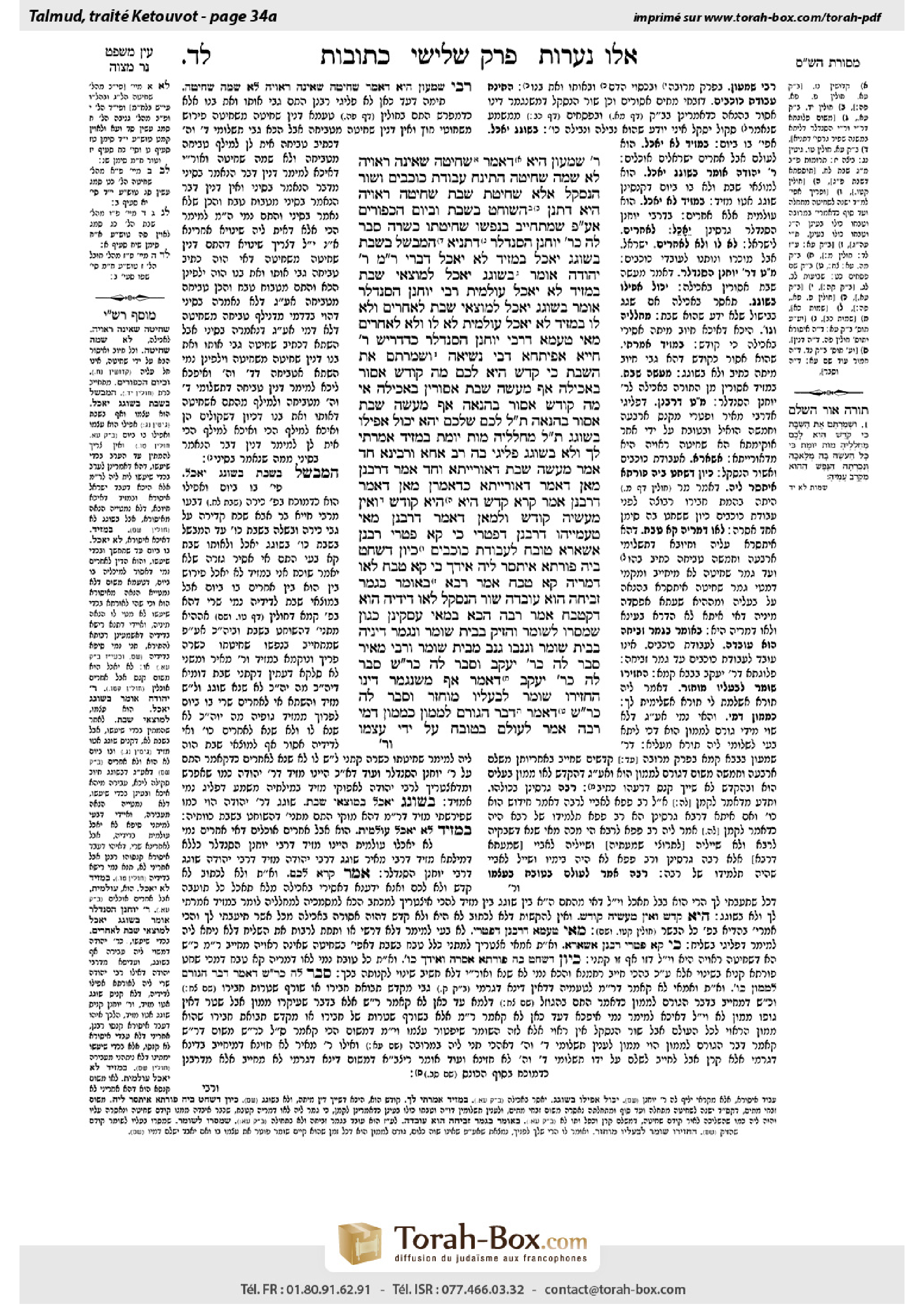
This page of Ketubot includes the Aramaic text, an English translation and an AI-generated French translation, alongside the scan above.
כתובות ל״ד א · Aramaic and Hebrew text
רַבִּי שִׁמְעוֹן הִיא, דְּאָמַר: שְׁחִיטָה שֶׁאֵינָהּ רְאוּיָה — לֹא שְׁמָהּ שְׁחִיטָה. הָתִינַח עֲבוֹדָה זָרָה וְשׁוֹר הַנִּסְקָל, אֶלָּא שְׁחִיטַת שַׁבָּת — שְׁחִיטָה רְאוּיָה הִיא! דִּתְנַן: הַשּׁוֹחֵט בְּשַׁבָּת וּבְיוֹם הַכִּפּוּרִים, אַף עַל פִּי שֶׁמִּתְחַיֵּיב בְּנַפְשׁוֹ — שְׁחִיטָתוֹ כְּשֵׁרָה!
סָבַר לַהּ כְּרַבִּי יוֹחָנָן הַסַּנְדְּלָר. דְּתַנְיָא: הַמְבַשֵּׁל בְּשַׁבָּת, בְּשׁוֹגֵג — יֹאכַל, בְּמֵזִיד — לֹא יֹאכַל, דִּבְרֵי רַבִּי מֵאִיר. רַבִּי יְהוּדָה אוֹמֵר: בְּשׁוֹגֵג — יֹאכַל לְמוֹצָאֵי שַׁבָּת, בְּמֵזִיד — לֹא יֹאכַל עוֹלָמִית. רַבִּי יוֹחָנָן הַסַּנְדְּלָר אוֹמֵר: בְּשׁוֹגֵג — יֵאָכֵל לְמוֹצָאֵי שַׁבָּת לַאֲחֵרִים וְלֹא לוֹ, בְּמֵזִיד — לֹא יֵאָכֵל עוֹלָמִית, לֹא לוֹ וְלֹא לַאֲחֵרִים.
מַאי טַעְמָא דְּרַבִּי יוֹחָנָן הַסַּנְדְּלָר? כִּדְדָרֵישׁ רַבִּי חִיָּיא אַפִּיתְחָא דְּבֵי נְשִׂיאָה: ״וּשְׁמַרְתֶּם אֶת הַשַּׁבָּת כִּי קֹדֶשׁ הִיא לָכֶם״, מָה קוֹדֶשׁ אָסוּר בַּאֲכִילָה — אַף מַעֲשֵׂה שַׁבָּת אֲסוּרִין בַּאֲכִילָה. אִי: מָה קוֹדֶשׁ אָסוּר בַּהֲנָאָה — אַף מַעֲשֵׂה שַׁבָּת אָסוּר בַּהֲנָאָה! תַּלְמוּד לוֹמַר: ״לָכֶם״ — שֶׁלָּכֶם יְהֵא.
יָכוֹל אֲפִילּוּ בְּשׁוֹגֵג? תַּלְמוּד לוֹמַר: ״מְחַלְּלֶיהָ מוֹת יוּמָת״, בְּמֵזִיד אָמַרְתִּי לְךָ, וְלֹא בְּשׁוֹגֵג.
פְּלִיגִי בַּהּ רַב אַחָא וְרָבִינָא, חַד אָמַר: מַעֲשֵׂה שַׁבָּת דְּאוֹרָיְיתָא, וְחַד אָמַר: דְּרַבָּנַן. מַאן דְּאָמַר דְּאוֹרָיְיתָא — כְּדַאֲמַרַן, מַאן דְּאָמַר דְּרַבָּנַן — אָמַר קְרָא: ״קֹדֶשׁ הִיא״, הִיא קוֹדֶשׁ, וְאֵין מַעֲשֶׂיהָ קוֹדֶשׁ.
וּלְמַאן דְּאָמַר דְּרַבָּנַן, מַאי טַעְמַיְיהוּ דְּרַבָּנַן דְּפָטְרִי? כִּי קָא פָּטְרִי רַבָּנַן אַשְּׁאָרָא.
טוֹבֵחַ לַעֲבוֹדָה זָרָה, כֵּיוָן דִּשְׁחַט בֵּיהּ פּוּרְתָּא — אִיתְּסַר לֵיהּ, אִידַּךְ כִּי קָא טָבַח, לָאו דְּמָרֵיהּ קָא טָבַח! אָמַר רָבָא: בְּאוֹמֵר בִּגְמַר זְבִיחָה הוּא עוֹבְדָהּ.
שׁוֹר הַנִּסְקָל, לָאו דִּידֵיהּ הוּא דְּקָטָבַח! אָמַר רַבָּה: הָכָא בְּמַאי עָסְקִינַן — כְּגוֹן שֶׁמְּסָרוֹ לְשׁוֹמֵר, וְהִזִּיק בְּבֵית שׁוֹמֵר, וְנִגְמַר דִּינוֹ בְּבֵית שׁוֹמֵר, וּגְנָבוֹ גַּנָּב מִבֵּית שׁוֹמֵר.
וְרַבִּי מֵאִיר, סָבַר לַהּ כְּרַבִּי יַעֲקֹב, וְסָבַר לַהּ כְּרַבִּי שִׁמְעוֹן. סָבַר לַהּ כְּרַבִּי יַעֲקֹב דְּאָמַר: אַף מִשֶּׁנִּגְמַר דִּינוֹ הֶחְזִירוֹ שׁוֹמֵר לִבְעָלָיו — מוּחְזָר. וְסָבַר לַהּ כְּרַבִּי שִׁמְעוֹן דְּאָמַר: דָּבָר הַגּוֹרֵם לְמָמוֹן — כְּמָמוֹן דָּמֵי.
רַבָּה אָמַר: לְעוֹלָם בְּטוֹבֵחַ עַל יְדֵי עַצְמוֹ,
Ketubot 34a · English translation
It is Rabbi Shimon, who said: The legal status of slaughter that is improper, in that it does not render the meat fit to be eaten, is not that of slaughter. Therefore, one is not liable for slaughter of the animal. The Gemara asks: This works out well with regard to idolatry and the ox that is stoned, as their slaughter is ineffective in rendering the meat fit to be eaten; however, the slaughter on Shabbat is a proper act of slaughter, as we learned in a mishna (Ḥullin 14a): In the case of one who slaughters an animal on Shabbat or on Yom Kippur, although he is liable to receive the death penalty for desecrating Shabbat, his slaughter is valid and the meat may be eaten.
The Gemara answers: The tanna of the baraita under discussion holds in accordance with the opinion of Rabbi Yoḥanan HaSandlar, as it is taught in a baraita:
With regard to one who cooks on Shabbat, if he did so unwittingly, he may eat the food he cooked; if he did so intentionally, he may not eat it at all. This is the statement of Rabbi Meir.
Rabbi Yehuda says: If he cooked unwittingly he may eat at the conclusion of Shabbat, as the Sages penalized even one who sinned unwittingly in that they prohibited him from deriving immediate benefit from the dish that he cooked; if he sinned intentionally, he may not eat from it ever.
Rabbi Yoḥanan HaSandlar says: If he did so unwittingly, the food may be eaten at the conclusion of Shabbat by others but not by him; if he did so intentionally, it may not be eaten ever, neither by him nor by other Jews. According to Rabbi Yoḥanan HaSandlar, food prepared by means of intentional desecration of Shabbat is unfit to be eaten. That is true with regard to cooking food on Shabbat and with regard to slaughtering an animal on Shabbat.
The Gemara asks: What is the rationale for the opinion of Rabbi Yoḥanan HaSandlar? The Gemara explains: It is as Rabbi Ḥiyya taught at the entrance to the house of the Nasi. It is written: “And you shall observe Shabbat, for it is sacred to you; he who profanes it shall be put to death” (Exodus 31:14); just as with regard to a sacred item consecrated to the Temple, eating it is prohibited, so too, with regard to food produced through action that desecrates Shabbat, eating it is prohibited. The Gemara asks: If so, perhaps the analogy should be extended to include the following: Just as with regard to a sacred item, deriving benefit from it is prohibited, so too, with regard to the product of an action that desecrates Shabbat, deriving benefit from it should be prohibited. The Gemara answers: The verse states: “It is sacred to you” (Exodus 31:14), indicating that it shall be yours in the sense that one may derive benefit from it.
The Gemara asks: Based on the analogy between actions that desecrate Shabbat and sacred items, one might have thought that even if the action was performed unwittingly it should be prohibited to eat its product, as is the case with regard to sacred items. Therefore, the verse states: “He who profanes it shall be put to death” (Exodus 31:14), indicating that it is with regard to one who desecrates Shabbat intentionally that I stated to you this analogy to sacred items, as the verse is clearly referring to one who is liable to receive the death penalty, and not with regard to one who desecrates Shabbat unwittingly, who is not executed.
The Gemara comments: Rav Aḥa and Ravina disagree with regard to this matter. One said: The product of an action that desecrates Shabbat is prohibited by Torah law, and one said that it is prohibited by rabbinic law. With regard to the one who said that it is prohibited by Torah law, it is as we said, that it is based on the verse interpreted by Rabbi Ḥiyya. And the one who said that it is prohibited by rabbinic law holds that the verse states: “It is sacred,” from which he infers: It is sacred, but the product of its actions is not sacred, and therefore, by Torah law it may be eaten.
The Gemara asks: And according to the one who said it is prohibited by rabbinic law, what is the rationale for the opinion of the Rabbis who exempt the thief from payment for the slaughter performed by his agent on Shabbat? By Torah law, the slaughter is valid. The Gemara answers: When the Rabbis exempt the thief from payment, it is with regard to the rest of the cases, i.e., one who slaughters for idolatry or an ox sentenced to stoning, not with regard to Shabbat.
The Gemara asks the following question with regard to Rabbi Meir’s opinion that one who slaughters for idolatry is liable to pay the owner for the animal. Once he slaughtered the animal a bit, at the very start of the act of slaughter, it is prohibited for him to derive benefit from the animal because it is an animal sacrificed to idolatry; and when he slaughters the rest, it is not the animal that belongs to its owner that he is slaughtering. Since it is prohibited to derive benefit from the animal, it has no value and there is no ownership. Rava said: It is referring to one who says, prior to the slaughter, that he is worshipping the idol only at the completion of the slaughter, and therefore the prohibition takes effect only then.
The Gemara asks the following question with regard to Rabbi Meir’s opinion that one who slaughters the ox that is stoned is liable to pay for the slaughter. Why is he liable? It is not the owner’s ox that he is slaughtering, since once the ox is sentenced to be stoned it is prohibited to derive benefit from it. Rabba said: With what are we dealing here? We are dealing with a case where the owners entrusted the ox to a bailee and the ox injured another person while in the bailee’s house, and it was sentenced to be stoned while in the bailee’s house, and the thief then stole it from the bailee’s house and slaughtered it.
And this solution is based on the fact that Rabbi Meir holds in accordance with the opinion of Rabbi Ya’akov and holds in accordance with the opinion of Rabbi Shimon. He holds in accordance with the opinion of Rabbi Ya’akov, who said: Even after the ox was sentenced to be stoned, if the bailee returned it to its owners, it is returned. Despite the fact that the ox is now worthless, as no benefit may be derived from it, since the bailee returned an ox that is physically intact the owner has no claim against him. And Rabbi Meir holds in accordance with the opinion of Rabbi Shimon, who said that the legal status of an object that effects monetary loss is like that of money. Even in the case of an object that is worthless, if its elimination causes monetary loss because it must be replaced, it is considered to have value. In this case, although the ox has no value in and of itself, slaughtering the animal prevents the bailee from returning it intact to the owner, requiring him to pay the owner the value of the ox before it was sentenced to be stoned. Consequently, the thief must reimburse the bailee, as the ox has value for the bailee.
Rabba said: Actually, contrary to Rabbi Yoḥanan’s explanation of the baraita, it is referring to one who slaughters the animal himself,
Ketubot 34a · Traduction française (IA)
Il s’agit de Rabbi Shimon, qui a dit que l’abattage impropre, en ce qu’il ne rend pas la viande propre à la consommation, n’a pas le statut d’un abattage. Par conséquent, on n’est pas passible pour avoir abattu l’animal. La Guemara demande : cela convient bien pour l’idolâtrie et pour le bœuf condamné à être lapidé, puisque leur abattage ne rend pas la viande propre à la consommation. Mais l’abattage accompli pendant Chabbat est un abattage valable, comme nous l’avons appris dans une Michna (Houllin 14a) : celui qui abat un animal pendant Chabbat ou Yom Kippour, bien qu’il soit passible de la peine de mort pour avoir profané Chabbat, son abattage est valide et la viande peut être consommée.
La Guemara répond : le tanna de la baraïta dont il est question suit l’opinion de Rabbi Yoḥanan HaSandlar, comme il est enseigné dans une baraïta : Celui qui fait cuire un aliment pendant Chabbat, s’il l’a fait par inadvertance, peut manger l’aliment qu’il a préparé ; s’il l’a fait intentionnellement, il ne peut en manger sous aucun prétexte. Telle est la déclaration de Rabbi Meïr. Rabbi Yehouda dit : s’il a fait cuire l’aliment par inadvertance, il peut le manger à la fin de Chabbat, car les Sages ont également sanctionné celui qui a péché par inadvertance en lui interdisant de tirer immédiatement profit du plat qu’il a préparé ; s’il a péché intentionnellement, il ne peut jamais en manger. Rabbi Yoḥanan HaSandlar dit : s’il l’a fait par inadvertance, d’autres peuvent manger l’aliment à la fin de Chabbat, mais pas lui ; s’il l’a fait intentionnellement, il ne peut jamais être consommé, ni par lui ni par les autres Juifs. Selon Rabbi Yoḥanan HaSandlar, un aliment préparé par une profanation intentionnelle de Chabbat est impropre à la consommation. Cela vaut aussi bien pour la cuisson d’un aliment pendant Chabbat que pour l’abattage d’un animal pendant Chabbat.
La Guemara demande : quel est le fondement de l’opinion de Rabbi Yoḥanan HaSandlar ? La Guemara explique : c’est ce que Rabbi Ḥiyya enseigna à l’entrée de la maison du Nassi. Il est écrit : « Vous observerez le Chabbat, car il est saint pour vous ; celui qui le profane sera mis à mort » (Exode 31:14). De même que, pour un objet saint consacré au Temple, il est interdit d’en manger, de même, pour un aliment produit par un acte qui profane Chabbat, il est interdit d’en manger. La Guemara demande : si tel est le cas, peut-être faut-il étendre l’analogie de la manière suivante : de même que, pour un objet saint, il est interdit d’en tirer profit, de même, pour le produit d’un acte qui profane Chabbat, il devrait être interdit d’en tirer profit. La Guemara répond : le verset dit : « Il est saint pour vous » (Exode 31:14), ce qui indique qu’il vous appartient, en ce sens que vous pouvez en tirer profit.
La Guemara demande : sur la base de l’analogie entre les actes qui profanent Chabbat et les objets saints, on aurait pu penser que, même si l’acte avait été accompli par inadvertance, il serait interdit de manger son produit, comme c’est le cas pour les objets saints. Le verset dit donc : « Celui qui le profane sera mis à mort » (Exode 31:14), ce qui indique que c’est à propos de celui qui profane intentionnellement Chabbat que je vous ai présenté cette analogie avec les objets saints, puisque le verset parle clairement de celui qui est passible de la peine de mort, et non de celui qui profane Chabbat par inadvertance, lequel n’est pas mis à mort.
La Guemara commente : Rav Aḥa et Ravina sont en désaccord à ce sujet. L’un dit que le produit d’un acte qui profane Chabbat est interdit par la Torah, et l’autre dit qu’il est interdit par décret rabbinique. Selon celui qui dit que c’est interdit par la Torah, c’est comme nous l’avons dit : cela repose sur le verset interprété par Rabbi Ḥiyya. Celui qui dit que c’est interdit par décret rabbinique considère que le verset dit : « Il est saint », d’où il déduit : il est saint, mais le produit de ses actes n’est pas saint ; par conséquent, selon la Torah, il peut être consommé.
La Guemara demande : et selon celui qui dit que c’est interdit par décret rabbinique, quel est le fondement de l’opinion des Sages qui dispensent le voleur de payer pour l’abattage accompli par son mandataire pendant Chabbat ? Selon la Torah, l’abattage est valide. La Guemara répond : lorsque les Sages dispensent le voleur de payer, cela concerne les autres cas, c’est-à-dire l’abattage pour l’idolâtrie ou celui d’un bœuf condamné à être lapidé, et non le cas de Chabbat.
La Guemara pose la question suivante au sujet de l’opinion de Rabbi Meïr, selon laquelle celui qui abat un animal pour l’idolâtrie doit indemniser son propriétaire. Dès qu’il a entamé l’abattage, ne serait-ce qu’un peu, au tout début de l’acte, il devient interdit de tirer profit de l’animal, car celui-ci est désormais consacré à l’idolâtrie ; et lorsqu’il abat le reste, il n’abat plus l’animal appartenant à son propriétaire. Puisqu’il est interdit d’en tirer profit, l’animal n’a aucune valeur et ne fait plus l’objet d’un droit de propriété. Rava dit : il s’agit de quelqu’un qui déclare, avant l’abattage, qu’il ne voue l’animal à l’idole qu’une fois l’abattage achevé ; l’interdit ne prend donc effet qu’à ce moment-là.
La Guemara pose la question suivante au sujet de l’opinion de Rabbi Meïr, selon laquelle celui qui abat le bœuf condamné à être lapidé est tenu de payer pour l’abattage. Pourquoi en est-il passible ? Ce n’est pas le bœuf du propriétaire qu’il abat, puisque, dès que le bœuf est condamné à être lapidé, il est interdit d’en tirer profit. Rabba dit : de quel cas s’agit-il ici ? D’un cas où les propriétaires ont confié le bœuf à un gardien, où le bœuf a blessé quelqu’un alors qu’il se trouvait chez le gardien, où il a été condamné à être lapidé alors qu’il s’y trouvait, puis où le voleur l’a dérobé chez le gardien et l’a abattu.
Cette solution repose sur le fait que Rabbi Meïr suit l’opinion de Rabbi Ya’akov et celle de Rabbi Shimon. Il suit l’opinion de Rabbi Ya’akov, qui a dit que, même après la condamnation du bœuf à être lapidé, si le gardien le rend à ses propriétaires, la restitution est valable. Bien que le bœuf ne vaille désormais plus rien, puisqu’il est interdit d’en tirer profit, le gardien ayant rendu un bœuf physiquement intact, le propriétaire ne peut rien réclamer contre lui. Rabbi Meïr suit aussi l’opinion de Rabbi Shimon, qui a dit qu’un objet dont la perte entraîne une dépense a le statut de l’argent. Même lorsqu’un objet ne vaut rien, si sa disparition entraîne une perte financière parce qu’il doit être remplacé, il est considéré comme ayant de la valeur. Dans ce cas, bien que le bœuf n’ait aucune valeur en lui-même, l’abattage de l’animal empêche le gardien de le rendre intact au propriétaire et l’oblige à payer à celui-ci la valeur du bœuf avant qu’il ne soit condamné à être lapidé. Par conséquent, le voleur doit indemniser le gardien, car le bœuf a de la valeur pour ce dernier.
Rabba dit : en réalité, contrairement à l’explication que Rabbi Yoḥanan donne de la baraïta, il s’agit de quelqu’un qui abat lui-même l’animal,
Traduction française générée par IA à partir de l’édition anglaise de Sefaria. Vérifie toujours un passage avec le texte source.
Text from Sefaria: William Davidson Edition - Vocalized Aramaic (CC BY NC); William Davidson Edition - English (CC BY NC).