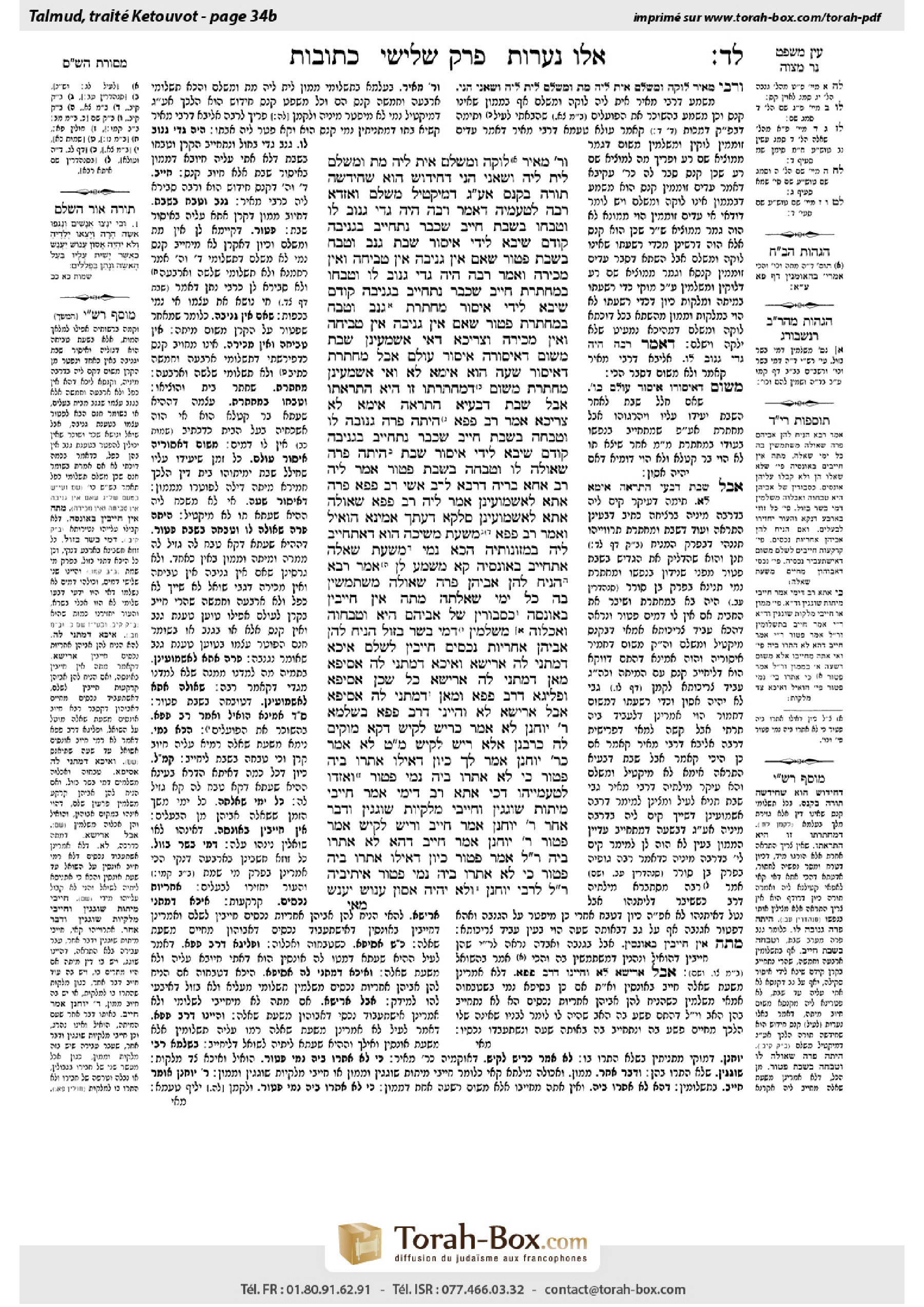
Ketubot 34b: Talmud study for Daf Yomi
Daf Yomi is the daily study of one Talmud folio. Explore 37 tractates with scans, Hebrew text, Sefaria English and AI-generated French translations where annotated.
Passage selection and English or AI-generated French translation are available where the scan has annotations. Daf Study is independent of Torah-Box and Sefaria.
Browse Ketubot · כתובות · All tractatesKetubot 34b text and translations
This page of Ketubot includes the Aramaic text, an English translation and an AI-generated French translation, alongside the scan above.
כתובות ל״ד ב · Aramaic and Hebrew text
וְרַבִּי מֵאִיר, לוֹקֶה וּמְשַׁלֵּם אִית לֵיהּ, מֵת וּמְשַׁלֵּם לֵית לֵיהּ. וְשָׁאנֵי הָנֵי, דְּחִידּוּשׁ הוּא שֶׁחִידְּשָׁה תּוֹרָה בִּקְנָס, אַף עַל גַּב דְּמִיקְּטִיל — מְשַׁלֵּם. וְאַזְדָּא רַבָּה לְטַעְמֵיהּ, דְּאָמַר רַבָּה: הָיָה גְּדִי גָּנוּב לוֹ, וּטְבָחוֹ בְּשַׁבָּת — חַיָּיב, שֶׁכְּבָר נִתְחַיֵּיב בִּגְנֵיבָה קוֹדֶם שֶׁיָּבֹא לִידֵי אִיסּוּר שַׁבָּת. גָּנַב וְטָבַח בְּשַׁבָּת — פָּטוּר, שֶׁאִם אֵין גְּנֵיבָה, אֵין טְבִיחָה וְאֵין מְכִירָה.
וְאָמַר רַבָּה: הָיָה גְּדִי גָּנוּב לוֹ וּטְבָחוֹ בַּמַּחְתֶּרֶת — חַיָּיב, שֶׁכְּבָר נִתְחַיֵּיב בִּגְנֵיבָה קוֹדֶם שֶׁיָּבֹא לִידֵי אִיסּוּר מַחְתֶּרֶת. גָּנַב וְטָבַח בַּמַּחְתֶּרֶת — פָּטוּר, שֶׁאִם אֵין גְּנֵיבָה, אֵין טְבִיחָה וְאֵין מְכִירָה.
וּצְרִיכָא. דְּאִי אַשְׁמְעִינַן שַׁבָּת — מִשּׁוּם דְּאִיסּוּרָהּ אִיסּוּר עוֹלָם. אֲבָל מַחְתֶּרֶת, דְּאִיסּוּר שָׁעָה הוּא — אֵימָא לָא. וְאִי אַשְׁמְעִינַן מַחְתֶּרֶת — מִשּׁוּם דְּמַחְתַּרְתּוֹ זוֹ הִיא הַתְרָאָתוֹ. אֲבָל שַׁבָּת, דְּבָעֲיָא הַתְרָאָה — אֵימָא לָא, צְרִיכָא.
אָמַר רַב פָּפָּא: הָיְתָה פָּרָה גְּנוּבָה לוֹ, וּטְבָחָהּ בְּשַׁבָּת — חַיָּיב, שֶׁכְּבָר נִתְחַיֵּיב בִּגְנֵיבָה קוֹדֶם שֶׁיָּבֹא לִידֵי אִיסּוּר שַׁבָּת. הָיְתָה פָּרָה שְׁאוּלָה לוֹ, וּטְבָחָהּ בְּשַׁבָּת — פָּטוּר. אֲמַר לֵיהּ רַב אַחָא בְּרֵיהּ דְּרָבָא לְרַב אָשֵׁי: רַב פָּפָּא, פָּרָה אֲתָא לְאַשְׁמוֹעִינַן?!
אֲמַר לֵיהּ: רַב פָּפָּא, שְׁאוּלָה אֲתָא לְאַשְׁמוֹעִינַן. סָלְקָא דַּעְתָּךְ אָמֵינָא, הוֹאִיל וְאָמַר רַב פָּפָּא: מִשְּׁעַת מְשִׁיכָה הוּא דְּאִתְחַיַּיב לֵיהּ בִּמְזוֹנוֹתֶיהָ, הָכָא נָמֵי: מִשְּׁעַת שְׁאֵלָה אִתְחַיַּיב בְּאוּנְסֶיהָ. קָא מַשְׁמַע לַן.
אָמַר רָבָא: הִנִּיחַ לָהֶן אֲבִיהֶן פָּרָה שְׁאוּלָה — מִשְׁתַּמְּשִׁין בָּהּ כׇּל יְמֵי שְׁאֵלָתָהּ, מֵתָה — אֵין חַיָּיבִין בְּאוֹנְסָהּ. כִּסְבוּרִין שֶׁל אֲבִיהֶם הִיא וּטְבָחוּהָ וַאֲכָלוּהָ — מְשַׁלְּמִין דְּמֵי בָשָׂר בְּזוֹל. הִנִּיחַ לָהֶן אֲבִיהֶן אַחְרָיוּת נְכָסִים — חַיָּיבִין לְשַׁלֵּם.
אִיכָּא דְּמַתְנֵי לַהּ אַרֵישָׁא, וְאִיכָּא דְּמַתְנֵי לַהּ אַסֵּיפָא. מַאן דְּמַתְנֵי לַהּ אַרֵישָׁא, כׇּל שֶׁכֵּן אַסֵּיפָא — וּפְלִיגָא דְּרַב פָּפָּא. וּמַאן דְּמַתְנֵי לַהּ אַסֵּיפָא, אֲבָל אַרֵישָׁא לָא — וְהַיְינוּ דְּרַב פָּפָּא.
בִּשְׁלָמָא רַבִּי יוֹחָנָן לָא אָמַר כְּרֵישׁ לָקִישׁ, דְּקָא מוֹקֵים לָהּ כְּרַבָּנַן. אֶלָּא רֵישׁ לָקִישׁ מַאי טַעְמָא לָא אָמַר כְּרַבִּי יוֹחָנָן? אָמַר לָךְ: כֵּיוָן דְּאִילּוּ אַתְרוֹ בֵּיהּ — פָּטוּר, כִּי לָא אַתְרוֹ בֵּיהּ — נָמֵי פָּטוּר.
וְאָזְדוּ לְטַעְמַיְיהוּ. דְּכִי אֲתָא רַב דִּימִי, אָמַר: חַיָּיבֵי מִיתוֹת שׁוֹגְגִין, וְחַיָּיבֵי מַלְקִיּוֹת שׁוֹגְגִין וְדָבָר אַחֵר — רַבִּי יוֹחָנָן אָמַר: חַיָּיב, וְרֵישׁ לָקִישׁ אָמַר: פָּטוּר. רַבִּי יוֹחָנָן אָמַר חַיָּיב — דְּהָא לָא אַתְרוֹ בֵּיהּ. רֵישׁ לָקִישׁ אָמַר פָּטוּר — כֵּיוָן דְּאִילּוּ אַתְרוֹ בֵּיהּ — פָּטוּר, כִּי לָא אַתְרוֹ בֵּיהּ — נָמֵי פָּטוּר.
אֵיתִיבֵיהּ רֵישׁ לָקִישׁ לְרַבִּי יוֹחָנָן: ״וְלֹא יִהְיֶה אָסוֹן עָנוֹשׁ יֵעָנֵשׁ״,
Ketubot 34b · English translation
and Rabbi Meir is of the opinion that one is flogged and pays, but is not of the opinion that one dies by execution and pays. And these halakhot are different, as it is a novel element that the Torah innovated with regard to the halakhic category of fines; although he is killed, he pays. And Rabba followed his line of reasoning stated elsewhere, as Rabba said: If one had a stolen kid in his possession that he had stolen previously, and he slaughtered it on Shabbat, he is liable to pay five times the principal for slaughtering the kid, as he was already liable for stealing before he came to violate the prohibition against performing labor on Shabbat. Although he slaughtered the goat on Shabbat, a capital crime, he is liable for the payment because it is a fine. However, if he stole the goat and slaughtered it on Shabbat, he is exempt from the payment of five times the principal as, if there is no payment for theft, due to his liability to receive the death penalty for desecrating Shabbat, and his obligation to repay the theft is not a fine, there is no liability for slaughter and there is no liability for sale.
And Rabba said: If one had a stolen kid in his possession that he had stolen previously, and he slaughtered it in the course of an act of burglary, he is liable to pay four or five times the principal, as he was already liable for theft before he came to violate the prohibition against burglary. However, if he stole and slaughtered an animal in the course of an act of burglary, he is exempt. Because the owner of the house is permitted to kill the burglar, the status of the burglar is tantamount to one liable to receive the death penalty. As, if there is no payment for theft, there is no liability for slaughter and there is no liability for sale. Rabba’s statements indicate that one pays the fines for slaughter or sale even if he is liable to receive the death penalty.
The Gemara comments: And it was necessary for Rabba to state this halakha with regard to both Shabbat and burglary; as, if he had taught us that one is exempt from payment only with regard to Shabbat, it is because Shabbat is severe since punishment for violation of its prohibition is an eternal prohibition, as whenever witnesses testify that one desecrated Shabbat, he can be executed. However, in the case of burglary, as punishment for violating its prohibition is transitory, e.g., it is permitted for the homeowner to kill the burglar only as long as the burglar remains on his property, say that he is not exempt from payment. And if he taught us the exemption only with regard to burglary, that would be because his burglary is his forewarning. Because he certainly intends to kill the homeowner, it is permitted for the homeowner to kill him without forewarning. In that respect, burglary is a severe prohibition and exempts one from payment. However, Shabbat, which requires forewarning, is a less severe prohibition, and in that case, say that one is not exempt from payment. Therefore, it was necessary for Rabba to state the exemption in both cases.
Rav Pappa said: If one had a stolen cow in his possession that he had stolen previously and he slaughtered it on Shabbat, he is liable to pay four or five times the principal as he was already liable for theft before he came to violate the prohibition of Shabbat. If a cow was lent to him and he slaughtered it on Shabbat, he is exempt from paying the fine. Rav Aḥa, son of Rava, said to Rav Ashi: Is Rav Pappa coming to teach us the case of a cow? In other words, what did Rav Pappa add that was not already clear from Rabba’s statement? The same principle applies with regard to both a kid and a cow. If one was liable to pay for the theft when he stole the animal, he is liable to pay the fine for slaughter as well, even if he is liable to receive the death penalty.
Rav Ashi said to him: Rav Pappa is coming to teach us the halakha with regard to a borrowed cow, as it could enter your mind to say that since Rav Pappa said: It is from the moment of pulling the animal into his domain that the borrower is obligated to provide the animal’s sustenance, then here too, from the moment of borrowing he is liable to pay for its unavoidable accidents. From that point, the animal is legally in his possession and therefore, even if he slaughtered the animal on Shabbat he should be liable. Therefore, he teaches us that one assumes liability for unavoidable accidents only when they actually occur, and if that is on Shabbat, he is exempt.
Rava said: If their father died and left them a borrowed cow, they may use it for the entire duration of the period for which it was borrowed. The right to use a borrowed article continues even after the borrower himself dies. However, if the cow died, they are not liable to pay for its unavoidable accident, as they did not borrow the animal themselves. Similarly, if they thought the cow was their father’s and they slaughtered it and ate it, they pay only a reduced assessment of the price of the meat. They are required to pay only for the benefit they received, not the damage they caused the owner. However, if their father left them property as a guarantee for return of the borrowed item, i.e., there was a lien on the father’s property during his lifetime, they are obligated to pay the entire sum of the damage.
The Gemara comments: Some teach this statement, that if the father left property as a guarantee his heirs are liable to pay the entire damage, with regard to the first clause of this halakha, and some teach it with regard to the latter clause. The Gemara elaborates: According to the one who teaches it with regard to the first clause, when the animal died, all the more so would he teach this halakha with regard to the latter clause, as since they slaughtered the animal they must pay full damages. And this approach differs with the opinion of Rav Pappa, who said that a borrower is liable for accidents only when the incident occurs. And according to the one who teaches it with regard to the latter clause, this halakha applies only when they slaughtered and ate it; however, with regard to the first clause, when it died, they would not be liable, as the tanna too maintains that liability for unavoidable accidents begins only when the incident occurs, not from when the cow was borrowed. And this is consistent with the ruling of Rav Pappa.
Several possible solutions were proposed to resolve the apparent contradiction between the mishna here that says that one who rapes his sister pays a fine and the mishna in Makkot that says that he is flogged. The Gemara comments: Granted, Rabbi Yoḥanan, who explains the mishna as referring to a case where he was not forewarned, did not state his opinion in accordance with the opinion of Reish Lakish, who explains that the mishna is in accordance with the opinion of Rabbi Meir, as he establishes the mishna in accordance with the opinion of the Rabbis, a preferable option, as that aligns the unattributed mishna with the halakha. However, what is the reason that Reish Lakish didn’t state his opinion in accordance with the opinion of Rabbi Yoḥanan? The Gemara answers: Reish Lakish could have said to you: Since if they forewarned him he is exempt from payment, when they did not forewarn him, he is exempt as well.
And Rabbi Yoḥanan and Reish Lakish each follow their standard lines of reasoning in this regard, as when Rav Dimi came from Eretz Yisrael to Babylonia, he said: With regard to those who unwittingly performed a transgression for which one is liable to receive the death penalty, or those who unwittingly performed a transgression for which one is liable to receive lashes, and that transgression also involved another matter, monetary payment, Rabbi Yoḥanan said: He is liable to pay; since he sinned unwittingly he did not receive the severe punishment. And Reish Lakish said he is exempt. The Gemara clarifies the rationales for their statements. Rabbi Yoḥanan said he is liable; since they did not forewarn him, he sinned unwittingly. Reish Lakish said he is exempt; since if they forewarned him he is exempt from payment, when they did not forewarn him, he is exempt as well.
Reish Lakish raised an objection to the opinion of Rabbi Yoḥanan from the following verse, which describes a case where two people fought and during their struggle they hurt a pregnant woman, causing her to miscarry: “And yet no harm follow, he shall be punished as imposed upon him by the woman’s husband” (Exodus 21:22).
Ketubot 34b · Traduction française (IA)
Et Rabbi Meïr estime que l’on reçoit la flagellation et que l’on paie, mais il n’estime pas que l’on puisse être exécuté et payer. Ces halakhot sont différentes, car la Torah a innové une règle exceptionnelle concernant la catégorie halakhique des amendes : même s’il est mis à mort, il paie. Rava suivait le raisonnement qu’il a exposé ailleurs, car Rava a dit : Si quelqu’un avait en sa possession un chevreau qu’il avait volé auparavant et qu’il l’a abattu pendant Chabbat, il est passible de payer quatre ou cinq fois le principal pour l’abattage du chevreau, puisqu’il était déjà passible pour le vol avant de transgresser l’interdiction de faire un travail pendant Chabbat. Bien qu’il ait abattu le chevreau pendant Chabbat, ce qui constitue un crime passible de la peine capitale, il est tenu de payer, car il s’agit d’une amende. En revanche, s’il a volé le chevreau et l’a abattu pendant Chabbat, il est dispensé de payer quatre ou cinq fois le principal, car, s’il n’y a pas de paiement pour le vol en raison de sa responsabilité pénale pour la profanation de Chabbat — et que son obligation de restituer l’objet volé ne constitue pas une amende —, il n’est responsable ni pour l’abattage ni pour la vente.
Et Rava a dit : Si quelqu’un avait en sa possession un chevreau qu’il avait volé auparavant et qu’il l’a abattu au cours d’un cambriolage, il est passible de payer quatre ou cinq fois le principal, puisqu’il était déjà passible pour le vol avant de transgresser l’interdiction de cambrioler. En revanche, s’il a volé et abattu un animal au cours d’un cambriolage, il est dispensé. Comme le propriétaire de la maison est autorisé à tuer le cambrioleur, celui-ci a le statut d’une personne passible de la peine de mort. En effet, s’il n’y a pas de paiement pour le vol, il n’est responsable ni pour l’abattage ni pour la vente. Les propos de Rava indiquent que l’on paie les amendes pour l’abattage ou la vente, même si l’on est passible de la peine de mort.
La Guemara fait remarquer : Rava devait énoncer cette halakha à la fois pour Chabbat et pour le cambriolage. En effet, s’il nous avait enseigné que l’on est dispensé de paiement uniquement dans le cas de Chabbat, cela aurait été parce que la transgression de Chabbat est grave : sa sanction est permanente, puisque chaque fois que des témoins attestent qu’une personne a profané Chabbat, elle peut être exécutée. En revanche, dans le cas du cambriolage, puisque la sanction liée à cette transgression est temporaire — par exemple, le propriétaire n’est autorisé à tuer le cambrioleur que tant que celui-ci se trouve sur sa propriété —, on aurait pu dire qu’il n’est pas dispensé de paiement. Et s’il nous avait enseigné la dispense uniquement dans le cas du cambriolage, cela aurait été parce que le cambriolage tient lieu d’avertissement. Comme le cambrioleur a certainement l’intention de tuer le propriétaire, celui-ci est autorisé à le tuer sans avertissement préalable. À cet égard, le cambriolage est une transgression grave et dispense du paiement. Mais Chabbat, qui requiert un avertissement préalable, est une transgression moins grave ; on aurait donc pu dire que, dans ce cas, on n’est pas dispensé de paiement. C’est pourquoi Rava devait énoncer la dispense dans les deux cas.
Rav Pappa a dit : Si quelqu’un avait en sa possession une vache qu’il avait volée auparavant et qu’il l’a abattue pendant Chabbat, il est passible de payer quatre ou cinq fois le principal, puisqu’il était déjà passible pour le vol avant de transgresser l’interdiction relative à Chabbat. Si une vache lui avait été prêtée et qu’il l’a abattue pendant Chabbat, il est dispensé de payer l’amende. Rav Aḥa, fils de Rava, dit à Rav Ashi : Rav Pappa vient-il nous enseigner le cas d’une vache ? Autrement dit, qu’a ajouté Rav Pappa qui n’était pas déjà évident d’après les propos de Rava ? Le même principe s’applique aussi bien à un chevreau qu’à une vache : si quelqu’un était passible pour le vol lorsqu’il a volé l’animal, il est également passible de l’amende pour l’abattage, même s’il est passible de la peine de mort.
Rav Ashi lui dit : Rav Pappa vient nous enseigner la halakha concernant une vache empruntée, car on aurait pu penser que, puisque Rav Pappa a dit que l’emprunteur est tenu d’assurer la subsistance de l’animal dès qu’il l’a tiré dans son domaine, ici aussi, il est responsable des accidents inévitables dès le moment de l’emprunt. À partir de ce moment, l’animal est juridiquement en sa possession et, par conséquent, même s’il l’abattait pendant Chabbat, il devrait en être tenu responsable. Rav Pappa nous enseigne donc que l’on n’assume la responsabilité des accidents inévitables qu’au moment où ils se produisent effectivement ; si cela arrive pendant Chabbat, il est dispensé.
Rava a dit : Si leur père est mort en leur laissant une vache empruntée, ils peuvent l’utiliser pendant toute la durée pour laquelle elle avait été empruntée. Le droit d’utiliser un objet emprunté se poursuit même après la mort de l’emprunteur lui-même. Toutefois, si la vache est morte, ils ne sont pas tenus de payer pour cet accident inévitable, puisqu’ils n’ont pas emprunté eux-mêmes l’animal. De même, s’ils pensaient que la vache appartenait à leur père, qu’ils l’ont abattue et mangée, ils ne paient qu’une estimation réduite du prix de la viande. Ils ne sont tenus de payer que la valeur du bénéfice qu’ils ont reçu, et non le dommage qu’ils ont causé au propriétaire. En revanche, si leur père leur a laissé des biens en garantie de la restitution de l’objet emprunté — c’est-à-dire si les biens du père étaient grevés d’un droit de gage de son vivant —, ils sont tenus de payer le montant intégral du dommage.
La Guemara fait remarquer : Certains enseignent cette déclaration — selon laquelle, si le père a laissé des biens en garantie, ses héritiers sont tenus de payer l’intégralité du dommage — à propos de la première partie de cette halakha, tandis que d’autres l’enseignent à propos de sa dernière partie. La Guemara développe : Selon celui qui l’enseigne à propos de la première partie, à plus forte raison l’enseignerait-il à propos de la dernière partie, car, puisqu’ils ont abattu l’animal, ils doivent payer la totalité des dommages. Cette approche diffère de l’opinion de Rav Pappa, qui a dit qu’un emprunteur n’est responsable des accidents qu’au moment où l’incident se produit. Selon celui qui l’enseigne à propos de la dernière partie, cette halakha ne s’applique que lorsqu’ils ont abattu et mangé l’animal ; en revanche, à propos de la première partie, lorsque l’animal est mort, ils ne seraient pas responsables, car le tanna estime lui aussi que la responsabilité des accidents inévitables ne commence qu’au moment où l’incident se produit, et non dès l’emprunt de la vache. Cela concorde avec la décision de Rav Pappa.
Plusieurs solutions possibles ont été proposées pour résoudre la contradiction apparente entre la Michna ici, qui dit que celui qui viole sa sœur paie une amende, et la Michna dans Makkot, qui dit qu’il reçoit la flagellation. La Guemara fait remarquer : Certes, Rabbi Yoḥanan, qui explique que la Michna traite d’un cas où il n’a pas reçu d’avertissement préalable, n’a pas exposé son opinion conformément à celle de Reish Lakish, qui explique que la Michna suit l’opinion de Rabbi Meïr, car il établit la Michna conformément à l’opinion des Rabbins, une option préférable puisqu’elle fait concorder la Michna anonyme avec la halakha. Mais pourquoi Reish Lakish n’a-t-il pas exposé son opinion conformément à celle de Rabbi Yoḥanan ? La Guemara répond : Reish Lakish aurait pu te dire : Puisqu’il est dispensé de paiement si on l’a averti, il en est également dispensé si on ne l’a pas averti.
Et Rabbi Yoḥanan et Reish Lakish suivent chacun leur raisonnement habituel à cet égard, car, lorsque Rav Dimi vint d’Eretz Israël en Babylonie, il dit : Au sujet de ceux qui ont commis par inadvertance une transgression passible de la peine de mort, ou une transgression passible de la flagellation, et dont la transgression entraînait également une autre conséquence, à savoir un paiement d’argent, Rabbi Yoḥanan a dit : Ils sont tenus de payer ; puisqu’ils ont péché par inadvertance, ils n’ont pas subi la peine la plus sévère. Reish Lakish a dit qu’ils sont dispensés. La Guemara précise les raisons de leurs propos. Rabbi Yoḥanan dit qu’ils sont tenus de payer : puisque personne ne les a avertis, ils ont péché par inadvertance. Reish Lakish dit qu’ils sont dispensés : puisqu’ils seraient dispensés de paiement si on les avait avertis, ils en sont également dispensés si on ne les a pas avertis.
Reish Lakish souleva une objection contre l’opinion de Rabbi Yoḥanan à partir du verset suivant, qui décrit le cas de deux hommes qui se battent et qui, au cours de leur lutte, blessent une femme enceinte, provoquant une fausse couche : « Mais s’il n’y a pas d’autre dommage, il sera condamné à payer ce que le mari de la femme lui imposera » (Exode 21, 22).
Traduction française générée par IA à partir de l’édition anglaise de Sefaria. Vérifie toujours un passage avec le texte source.
Text from Sefaria: William Davidson Edition - Vocalized Aramaic (CC BY NC); William Davidson Edition - English (CC BY NC).