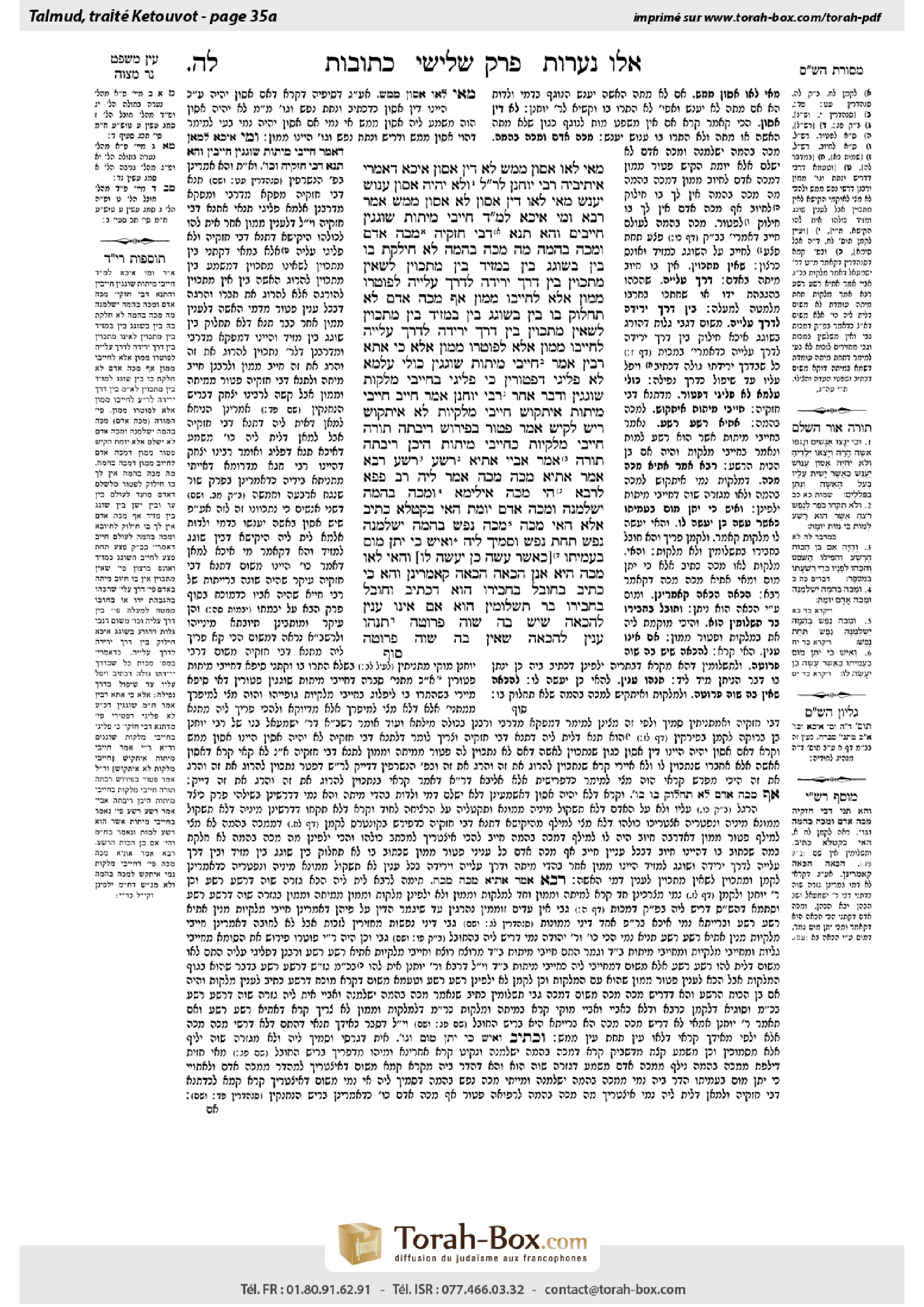
Ketubot 35a: Talmud study for Daf Yomi
Daf Yomi is the daily study of one Talmud folio. Explore 37 tractates with scans, Hebrew text, Sefaria English and AI-generated French translations where annotated.
Passage selection and English or AI-generated French translation are available where the scan has annotations. Daf Study is independent of Torah-Box and Sefaria.
Browse Ketubot · כתובות · All tractatesKetubot 35a text and translations
This page of Ketubot includes the Aramaic text, an English translation and an AI-generated French translation, alongside the scan above.
כתובות ל״ה א · Aramaic and Hebrew text
מַאי לָאו, אָסוֹן מַמָּשׁ! לָא, דִּין אָסוֹן. אִיכָּא דְּאָמְרִי, אֵיתִיבֵיהּ רַבִּי יוֹחָנָן לְרֵישׁ לָקִישׁ: ״וְלֹא יִהְיֶה אָסוֹן עָנוֹשׁ יֵעָנֵשׁ״, מַאי לָאו, דִּין אָסוֹן? לֹא, אָסוֹן מַמָּשׁ.
אָמַר רָבָא: וּמִי אִיכָּא לְמַאן דְּאָמַר חַיָּיבֵי מִיתוֹת שׁוֹגְגִין חַיָּיבִים? וְהָא תָּנָא דְּבֵי חִזְקִיָּה: ״מַכֵּה אָדָם״ וּ״מַכֵּה בְהֵמָה״ —
מָה מַכֵּה בְהֵמָה לֹא חִילַּקְתָּ בּוֹ בֵּין בְּשׁוֹגֵג בֵּין בְּמֵזִיד, בֵּין מִתְכַּוֵּין לְשֶׁאֵין מִתְכַּוֵּין, בֵּין דֶּרֶךְ יְרִידָה לְדֶרֶךְ עֲלִיָּיה לְפוֹטְרוֹ מָמוֹן, אֶלָּא לְחַיְּיבוֹ מָמוֹן — אַף מַכֵּה אָדָם לֹא תַּחְלוֹק בּוֹ בֵּין בְּשׁוֹגֵג בֵּין בְּמֵזִיד, בֵּין מִתְכַּוֵּין לְשֶׁאֵין מִתְכַּוֵּין, בֵּין דֶּרֶךְ יְרִידָה לְדֶרֶךְ עֲלִיָּיה — לְחַיְּיבוֹ מָמוֹן, אֶלָּא לְפוֹטְרוֹ מָמוֹן.
אֶלָּא, כִּי אֲתָא רָבִין אָמַר: חַיָּיבֵי מִיתוֹת שׁוֹגְגִין — כּוּלֵּי עָלְמָא לָא פְּלִיגִי דִּפְטוּרִין. כִּי פְּלִיגִי, בְּחַיָּיבֵי מַלְקוֹת שׁוֹגְגִין וְדָבָר אַחֵר. רַבִּי יוֹחָנָן אָמַר חַיָּיב: חַיָּיבֵי מִיתוֹת אִיתַּקּוּשׁ, חַיָּיבֵי מַלְקִיּוֹת לָא אִיתַּקּוּשׁ. רֵישׁ לָקִישׁ אָמַר פָּטוּר: בְּפֵירוּשׁ רִיבְּתָה תּוֹרָה חַיָּיבֵי מַלְקִיּוֹת כְּחַיָּיבֵי מִיתוֹת.
הֵיכָן רִיבְּתָה תּוֹרָה? אָמַר אַבָּיֵי: אָתְיָא ״רָשָׁע״ ״רָשָׁע״. רָבָא אָמַר אָתְיָא ״מַכֵּה״ ״מַכֵּה״. אֲמַר לֵיהּ רַב פָּפָּא לְרָבָא: הֵי ״מַכֵּה״? אִילֵימָא ״וּמַכֵּה בְהֵמָה יְשַׁלְּמֶנָּה וּמַכֵּה אָדָם יוּמָת״ — הַאי בִּקְטָלָא כְּתִיב! אֶלָּא הַאי ״מַכֵּה״: ״מַכֵּה נֶפֶשׁ בְּהֵמָה יְשַׁלְּמֶנָּה נֶפֶשׁ תַּחַת נָפֶשׁ״, וּסְמִיךְ לֵיהּ: ״וְאִישׁ כִּי יִתֵּן מוּם בַּעֲמִיתוֹ [כַּאֲשֶׁר עָשָׂה כֵּן יֵעָשֶׂה לּוֹ]״.
וְהַאי לָאו ״מַכֵּה״ הִיא! אֲנַן הַכָּאָה הַכָּאָה קָאָמְרִינַן. וְהָא כִּי כְּתִיב — בְּחוֹבֵל בַּחֲבֵירוֹ הוּא דִּכְתִיב, וְחוֹבֵל בַּחֲבֵירוֹ בַּר תַּשְׁלוּמִין הוּא! אִם אֵינוֹ עִנְיָן לְהַכָּאָה שֶׁיֵּשׁ בָּהּ שָׁוֶה פְּרוּטָה — תְּנֵהוּ עִנְיָן לְהַכָּאָה שֶׁאֵין בָּהּ שָׁוֶה פְּרוּטָה.
Ketubot 35a · English translation
Is this not referring to actual harm, i.e., the woman’s death? And the verse states that he pays only if she did not die, but if she died is he exempt, even if he was not forewarned? The Gemara answers: No, the verse can be explained to mean: If there is no sentence of harm. If the court does not actually sentence him to death, he pays the damages for the miscarried fetus. He is exempt from payment only if he is actually executed. Some say a different version of this exchange: Rabbi Yoḥanan raised an objection to the opinion of Reish Lakish: “And yet no harm follow, he shall be punished” (Exodus 21:22); is this not referring to a sentence of harm? The Gemara answers: No, the verse can be explained to mean: If there is no actual harm.
Rava said: Is there anyone who said that those who unwittingly performed a transgression for which one is liable to receive the death penalty are obligated to pay? But didn’t the Sage of the school of Ḥizkiyya teach: The verse speaks of one who smites a person, and the verse speaks of one who smites an animal. The two cases are juxtaposed in the verse “And one who smites an animal shall pay for it, and one who smites a person shall die” (Leviticus 24:21).
Just as in the case of one who smites an animal, you did not distinguish between one who did so unwittingly and one who did so intentionally, between one who acted with intent and one who acted with no intent, between one who smites in the course of a downward motion and one who smites in the course of an upward motion, and in all those cases it is not to exempt him from paying money but rather to obligate him to pay money; so too, in the case of one who smites a person, do not distinguish between one who did so unwittingly and one who did so intentionally, between one who acted with intent and one who acted with no intent, between one who smites in the course of a downward motion and one who smites in the course of an upward motion. In all those cases as well it is not to obligate him to pay money but rather to exempt him from paying money. The halakha in both cases is unconditional; when he smites an animal he is always liable to pay and when he smites a person he is always exempt from payment, regardless of whether or not he is actually executed.
Rather, when Ravin came from Eretz Yisrael to Babylonia, he said: With regard to those who unwittingly performed a transgression for which one is liable to receive the death penalty, everyone agrees that they are exempt, as per the derivation of the Sages of the school of Ḥizkiyya. When they disagree it is with regard to those who unwittingly performed a transgression for which one is liable to receive lashes, and another matter, for which he is liable to pay money. Rabbi Yoḥanan said that he is obligated to pay, as those liable to receive the death penalty are juxtaposed to cases of monetary payment and are unconditionally exempt from payment. However, those liable to receive lashes are not juxtaposed. Therefore, in the case of one who is liable to receive lashes, unless one is actually flogged, he is obligated to pay for the damage he inflicted. Reish Lakish said: He is exempt, as the Torah explicitly included those liable to receive lashes, like those liable to receive the death penalty, and unconditionally exempted them from payment.
The Gemara asks: Where did the Torah include those liable to be flogged? Abaye said: It is derived by means of a verbal analogy between the term wicked in the verse “That he is wicked and liable to die” (Numbers 35:31), and the term wicked in the verse “That he is wicked and liable to be flogged” (Deuteronomy 25:2). Rava said: It is derived by means of a verbal analogy between the term smites in one verse and the term smites in another verse. Rav Pappa said to Rava: To which term smites are you referring? If we say that it is the verse “And one who smites an animal shall pay for it, and one who smites a person shall die” (Leviticus 24:21), clearly that is not so, as that is written with regard to death. Smiting a person in that verse is referring to murder. Rather, it is to this term smites that Rava is referring: “And he who smites an animal shall pay for it, a life for a life” (Leviticus 24:18), and juxtaposed to it, it is written: “And a man who places a blemish upon his counterpart, as he has done so shall be done to him” (Leviticus 24:19). The verses liken those liable to receive lashes to those obligated to pay money, from which it is derived that those liable to receive lashes are exempt from payment.
The Gemara raises a difficulty: But this term that appears in the latter verse is “places a blemish,” not smites. How, then, can one derive a verbal analogy? The Gemara answers: This is not a verbal analogy based on identical terms; rather, it is based on identical concepts. We are saying that it is a verbal analogy between smiting an animal in the first verse and smiting a person in the latter verse. The Gemara asks: However, when the second verse is written, it is written with regard to one who injures another, and one who injures another is subject to payment and not to lashes. This undermines the proof, as lashes are not mentioned in either verse. The Gemara answers: If it is not a matter of smiting that causes damage equivalent to the value of a peruta, in which case he would pay and would not be flogged, apply it to the matter of smiting that causes damage that is not equivalent to the value of a peruta. Since in that case there is no payment for the injury, one is flogged for striking that blow.
Ketubot 35a · Traduction française (IA)
Cela ne désigne-t-il pas un dommage réel, c’est-à-dire la mort de la femme ? Or, le verset dit qu’il ne paie que si elle n’est pas morte. Mais s’il l’a tuée, en est-il exempt, même s’il n’avait pas été averti ? La Guemara répond : Non, le verset peut s’expliquer ainsi : « S’il n’y a pas de condamnation à mort ». Si le tribunal ne le condamne pas effectivement à mort, il paie les dommages causés par la fausse couche. Il n’est exempt de paiement que s’il est effectivement exécuté. Certains transmettent une autre version de cet échange : Rabbi Yoḥanan souleva une objection contre l’opinion de Reish Lakish : « Mais s’il n’en résulte aucun dommage, il sera puni » (Exode 21:22) ; cela ne désigne-t-il pas une condamnation à mort ? La Guemara répond : Non, le verset peut s’expliquer ainsi : « S’il n’y a pas de dommage réel ».
Rava dit : Quelqu’un a-t-il jamais soutenu que ceux qui commettent involontairement une transgression passible de la peine de mort sont tenus de payer ? Pourtant, le Sage de l’école de Ḥizkiyya n’a-t-il pas enseigné que le verset parle de celui qui frappe une personne et que le verset parle de celui qui frappe un animal ? Les deux cas sont juxtaposés dans le verset : « Celui qui frappe un animal en paiera le prix, et celui qui frappe une personne sera mis à mort » (Lévitique 24:21).
De même que, dans le cas de celui qui frappe un animal, vous n’avez pas distingué entre celui qui l’a fait involontairement et celui qui l’a fait intentionnellement, entre celui qui a agi avec intention et celui qui a agi sans intention, ni entre celui qui frappe dans un mouvement descendant et celui qui frappe dans un mouvement ascendant — et que, dans tous ces cas, la règle ne vise pas à l’exempter de paiement, mais au contraire à l’obliger à payer —, de même, dans le cas de celui qui frappe une personne, ne faites pas de distinction entre celui qui l’a fait involontairement et celui qui l’a fait intentionnellement, entre celui qui a agi avec intention et celui qui a agi sans intention, ni entre celui qui frappe dans un mouvement descendant et celui qui frappe dans un mouvement ascendant. Dans tous ces cas également, la règle ne vise pas à l’obliger à payer, mais au contraire à l’exempter de paiement. La halakha est absolue dans les deux cas : lorsqu’il frappe un animal, il est toujours tenu de payer, et lorsqu’il frappe une personne, il est toujours exempt de paiement, qu’il soit ou non effectivement exécuté.
Cependant, lorsque Ravin arriva de la terre d’Israël en Babylonie, il dit : Au sujet de ceux qui commettent involontairement une transgression passible de la peine de mort, tous sont d’accord qu’ils sont exempts, conformément à la déduction des Sages de l’école de Ḥizkiyya. Leur désaccord porte sur ceux qui commettent involontairement une transgression passible de la flagellation, ainsi qu’une autre transgression pour laquelle ils sont tenus de payer. Rabbi Yoḥanan dit qu’ils sont tenus de payer, car les cas passibles de la peine de mort sont juxtaposés aux cas impliquant un paiement d’argent et sont sans exception exempts de paiement. En revanche, les cas passibles de la flagellation ne sont pas juxtaposés. Par conséquent, celui qui est passible de la flagellation est tenu de payer les dommages qu’il a causés, à moins qu’il ne soit effectivement fouetté. Reish Lakish dit : Il est exempt, car la Torah a explicitement inclus ceux qui sont passibles de la flagellation au même titre que ceux qui sont passibles de la peine de mort, et les a exemptés sans exception de tout paiement.
La Guemara demande : Où la Torah a-t-elle inclus ceux qui sont passibles de la flagellation ? Abaye dit : Cela se déduit par analogie verbale entre le terme « méchant » dans le verset « qu’il est méchant et passible de mort » (Nombres 35:31) et le terme « méchant » dans le verset « qu’il est méchant et passible de flagellation » (Deutéronome 25:2). Rava dit : Cela se déduit par analogie verbale entre le terme « frappe » dans un verset et le terme « frappe » dans un autre verset. Rav Pappa dit à Rava : À quel terme « frappe » faites-vous référence ? Si nous disons qu’il s’agit du verset « Celui qui frappe un animal en paiera le prix, et celui qui frappe une personne sera mis à mort » (Lévitique 24:21), ce n’est manifestement pas le cas, car ce verset concerne la peine de mort. Celui qui frappe une personne dans ce verset désigne un meurtrier. Rava fait plutôt référence au terme « frappe » dans le verset : « Celui qui frappe un animal en paiera le prix, vie pour vie » (Lévitique 24:18), auquel est juxtaposé le verset : « Un homme qui inflige une blessure à son prochain, on lui fera comme il a fait » (Lévitique 24:19). Les versets assimilent ceux qui sont passibles de la flagellation à ceux qui sont tenus de payer une somme d’argent ; on en déduit que ceux qui sont passibles de la flagellation sont exempts de paiement.
La Guemara soulève une difficulté : Mais l’expression qui apparaît dans le verset suivant est « inflige une blessure », et non « frappe ». Comment peut-on alors établir une analogie verbale ? La Guemara répond : Il ne s’agit pas d’une analogie verbale fondée sur des termes identiques, mais sur des notions identiques. Il s’agit d’une analogie verbale entre le fait de frapper un animal dans le premier verset et celui de frapper une personne dans le verset suivant. La Guemara demande : Pourtant, le second verset, tel qu’il est formulé, concerne celui qui blesse autrui, et celui qui blesse autrui est passible d’un paiement, et non de la flagellation. Cela réfute la preuve, puisque la flagellation n’est mentionnée dans aucun des deux versets. La Guemara répond : Si cela ne concerne pas le coup qui cause un dommage d’une valeur équivalente à une perouta — auquel cas il paierait et ne serait pas fouetté —, appliquons-le au coup qui cause un dommage d’une valeur inférieure à une perouta. Dans ce cas, puisqu’il n’y a pas de paiement pour la blessure, il est fouetté pour ce coup.
Traduction française générée par IA à partir de l’édition anglaise de Sefaria. Vérifie toujours un passage avec le texte source.
Text from Sefaria: William Davidson Edition - Vocalized Aramaic (CC BY NC); William Davidson Edition - English (CC BY NC).