Ketubot 35b: Talmud study for Daf Yomi
Daf Yomi is the daily study of one Talmud folio. Explore 37 tractates with scans, Hebrew text, Sefaria English and AI-generated French translations where annotated.
Passage selection and English or AI-generated French translation are available where the scan has annotations. Daf Study is independent of Torah-Box and Sefaria.
Browse Ketubot · כתובות · All tractatesKetubot 35b text and translations
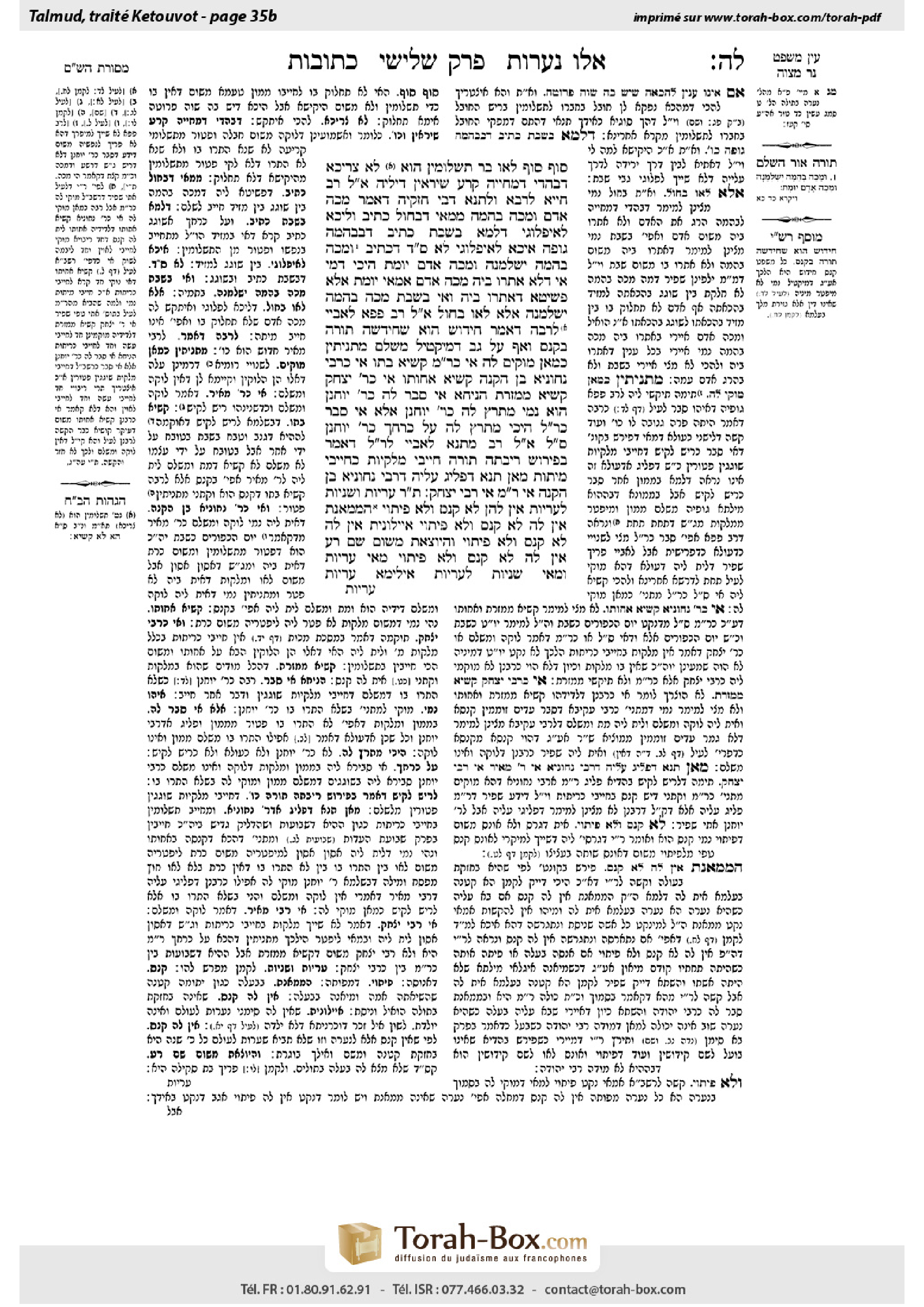
This page of Ketubot includes the Aramaic text, an English translation and an AI-generated French translation, alongside the scan above.
כתובות ל״ה ב · Aramaic and Hebrew text
סוֹף סוֹף לָאו בַּר תַּשְׁלוּמִין הוּא? לָא צְרִיכָא, דְּבַהֲדֵי דְּמַחְיֵיהּ, קְרַע שִׁירָאִין דִּילֵיהּ.
אֲמַר לֵיהּ רַב חִיָּיא לְרָבָא: וּלְתַנָּא דְּבֵי חִזְקִיָּה דְּאָמַר ״מַכֵּה אָדָם״ וּ״מַכֵּה בְהֵמָה״, מִמַּאי דִּבְחוֹל כְּתִיב וְלֵיכָּא לְאִיפְּלוֹגֵי, דִּלְמָא בְּשַׁבָּת כְּתִיב דְּבִבְהֵמָה גּוּפַהּ אִיכָּא לְאִיפְּלוֹגֵי!
לָא סָלְקָא דַּעְתָּךְ, דִּכְתִיב: ״וּמַכֵּה בְהֵמָה יְשַׁלְּמֶנָּה וּמַכֵּה אָדָם יוּמָת״. הֵיכִי דָמֵי? אִי דְּלָא אַתְרוֹ בֵּיהּ, מַכֵּה אָדָם אַמַּאי יוּמָת? אֶלָּא פְּשִׁיטָא דְּאַתְרוֹ בֵּיהּ. וְאִי בְּשַׁבָּת, מַכֵּה בְּהֵמָה יְשַׁלְּמֶנָּה?! אֶלָּא לָאו בְּחוֹל.
אֲמַר לֵיהּ רַב פָּפָּא לְאַבָּיֵי: לְרַבָּה דְּאָמַר חִידּוּשׁ הוּא שֶׁחִידְּשָׁה תּוֹרָה בִּקְנָס, וְאַף עַל גַּב דְּמִיקְּטִיל, מְשַׁלֵּם, מַתְנִיתִין כְּמַאן מוֹקֵים לַהּ? אִי כְּרַבִּי מֵאִיר, קַשְׁיָא בִּתּוֹ! אִי כְּרַבִּי נְחוּנְיָא בֶּן הַקָּנָה, קַשְׁיָא אֲחוֹתוֹ! אִי כְּרַבִּי יִצְחָק, קַשְׁיָא מַמְזֶרֶת!
הָנִיחָא אִי סָבַר לַהּ כְּרַבִּי יוֹחָנָן — הוּא נָמֵי מְתָרֵץ לַהּ כְּרַבִּי יוֹחָנָן. אֶלָּא אִי סָבַר כְּרֵישׁ לָקִישׁ, הֵיכִי מְתָרֵץ לַהּ? עַל כׇּרְחָךְ כְּרַבִּי יוֹחָנָן סְבִירָא לֵיהּ.
אֲמַר לֵיהּ רַב מַתְנָא לְאַבָּיֵי, לְרֵישׁ לָקִישׁ דְּאָמַר: בְּפֵירוּשׁ רִיבְּתָה תּוֹרָה חַיָּיבֵי מַלְקִיּוֹת כְּחַיָּיבֵי מִיתוֹת, מַאן תַּנָּא דִּפְלִיג עֲלֵיהּ דְּרַבִּי נְחוּנְיָא בֶּן הַקָּנָה? אִי רַבִּי מֵאִיר, אִי רַבִּי יִצְחָק.
תָּנוּ רַבָּנַן: עֲרָיוֹת וּשְׁנִיּוֹת לַעֲרָיוֹת — אֵין לָהֶן לֹא קְנָס וְלֹא פִּיתּוּי. הַמְמָאֶנֶת — אֵין לָהּ לֹא קְנָס וְלֹא פִּיתּוּי. אַיְילוֹנִית — אֵין לָהּ לֹא קְנָס וְלֹא פִּיתּוּי, וְהַיּוֹצֵאת מִשּׁוּם שֵׁם רָע — אֵין לָהּ לֹא קְנָס וְלֹא פִּיתּוּי.
מַאי ״עֲרָיוֹת״ וּמַאי ״שְׁנִיּוֹת לַעֲרָיוֹת״? אִילֵימָא ״עֲרָיוֹת״ —
Ketubot 35b · English translation
The Gemara raises a difficulty: Ultimately, one who injured another and is flogged is not subject to payment, as he inflicted damage worth less than a peruta. How then can a principle be derived that one who is liable to receive lashes does not pay even when he is not actually flogged? The Gemara answers: The juxtaposition of the verses is necessary only with regard to a situation where at the same time that he struck him he tore his silk. In that case, where he performed a transgression for which he is liable to be flogged and is also liable to pay damages, it is derived that he would be exempt from paying damages even if he is not actually flogged.
§ Rav Ḥiyya said to Rava: And according to the derivation of the tanna of the school of Ḥizkiyya, who said: The verse speaks of one who smites a person, and the verse speaks of one who smites an animal. From where does that tanna know that it is written with regard to a weekday and therefore there is no reason to distinguish between an unwitting and a purposeful sinner; perhaps this case is stated with regard to one who injured an animal on Shabbat, when concerning the animal itself there is reason to distinguish between one who did so unwittingly and one who did so intentionally. In the case of one who acted unwittingly, he is not liable to receive the death penalty and should therefore be obligated to pay, whereas one who acted intentionally is exempt from payment because he receives the death penalty for desecrating Shabbat. If so, there is no source to exempt from payment one who is not actually executed.
The Gemara answers: That notion should not enter your mind, as it is written: “And one who smites an animal shall pay for it, and one who smites a person shall die” (Leviticus 24:21). What are the circumstances discussed in this verse? If it is a case where the witnesses did not forewarn him, i.e., when one who smites a person is not forewarned, why should he be executed? There is no corporal punishment, neither lashes nor execution, without forewarning. Rather, it is obvious that they forewarned him. And if the verse is referring to one who sinned on Shabbat after forewarning, would one who smites an animal be obligated to pay for it? He is executed and certainly exempt from payment. Rather, isn’t the verse clearly referring to a case during the week?
§ Rav Pappa said to Abaye: According to Rabba, who said: It is a novel element that the Torah innovated with regard to the halakhic category of fine, and even though he is executed he pays the fine; in accordance with whose opinion does Rabba establish the mishna? If it is in accordance with the opinion of Rabbi Meir, it is difficult; why is he exempt if he raped his daughter? According to Rabba, Rabbi Meir is of the opinion that even one liable to receive the death penalty pays the fine. If it is in accordance with the opinion of Rabbi Neḥunya ben HaKana, it is difficult, as why does the mishna rule that he pays the fine for raping his sister? Rabbi Neḥunya holds that one liable to receive karet is exempt from the fine, like those liable to receive the death penalty. If the mishna is in accordance with the opinion of Rabbi Yitzḥak, who rules that lashes are not administered to those liable to receive karet and therefore they are obligated to pay the fine; however, one who is flogged is exempt from payment, it is difficult, as why did the mishna rule that he is obligated to pay the fine for raping a mamzeret, for which he is liable to receive lashes?
This works out well if Rabba holds in accordance with the opinion of Rabbi Yoḥanan, who says that one who did not receive forewarning is obligated to pay even if he performed a transgression for which he is liable to be flogged, as he can explain the mishna as well, in accordance with the opinion of Rabbi Yoḥanan, that he is obligated to pay in cases where there was no forewarning. However, if he holds in accordance with the opinion of Reish Lakish, that one who violated a prohibition for which one is liable to be flogged is exempt from payment even if he was not forewarned, how does he explain the mishna? The mishna does not correspond to any of the aforementioned opinions. The Gemara answers: You must say perforce that he holds in accordance with the opinion of Rabbi Yoḥanan in this regard.
Rav Mattana said to Abaye: According to Reish Lakish, who said that the Torah explicitly included those who are liable to receive lashes and accorded them legal status like those who are liable to receive the death penalty, unconditionally exempting them from payment; who is the tanna who disagrees with Rabbi Neḥunya ben HaKana and obligates one who is liable both to receive karet and to be flogged to pay, and the lashes do not exempt him from payment? The Gemara answers: He holds in accordance with either Rabbi Meir, who says that one who is liable to receive lashes is liable to pay a fine, or Rabbi Yitzḥak, who rules that those liable to receive karet are not flogged.
§ The Gemara turns its attention to a related issue. The Sages taught: Women who are forbidden relatives and secondary forbidden relatives receive neither payment of a fine for rape nor payment of a fine for seduction. Similarly, a girl who refuses to remain married to her husband receives neither payment of a fine for rape nor payment of a fine for seduction. Because she was married, she no longer has the presumptive status of a virgin. A sexually underdeveloped woman [ailonit] who will never reach puberty and therefore her legal status is not that of a young woman, receives neither payment of a fine for rape nor payment of a fine for seduction. And one who leaves her husband due to a bad reputation receives neither payment of a fine for rape nor payment of a fine for seduction.
The Gemara elaborates. What is the meaning of forbidden relatives, and what is the meaning of secondary forbidden relatives in the context of this baraita? If we say that forbidden relatives means
Ketubot 35b · Traduction française (IA)
La Guemara soulève une difficulté : en définitive, celui qui blesse autrui et est flagellé n’est pas tenu de payer, puisqu’il a causé un dommage d’une valeur inférieure à une perouta. Comment peut-on donc déduire le principe selon lequel celui qui est passible de flagellation ne paie pas, même s’il n’est pas effectivement flagellé ? La Guemara répond : le rapprochement des versets n’est nécessaire que dans le cas où, au moment même où il le frappait, il a déchiré son vêtement de soie. Dans ce cas, où il a commis une transgression passible de flagellation et est également tenu de payer des dommages, on en déduit qu’il serait dispensé de les payer même s’il n’est pas effectivement flagellé.
§ Rav Ḥiyya dit à Rava : selon la déduction du tanna de l’école de Ḥizkiyya, qui a dit que le verset parle de celui qui frappe une personne, tandis que l’autre verset parle de celui qui frappe un animal, d’où ce tanna sait-il que le texte concerne un jour de semaine, de sorte qu’il n’y a aucune raison de distinguer entre celui qui a péché par inadvertance et celui qui a péché intentionnellement ? Peut-être ce cas concerne-t-il celui qui a blessé un animal pendant Chabbat, situation où il y a lieu de distinguer, pour l’animal lui-même, entre celui qui l’a fait par inadvertance et celui qui l’a fait intentionnellement. Celui qui a agi par inadvertance n’est pas passible de la peine de mort et devrait donc être tenu de payer, tandis que celui qui a agi intentionnellement est dispensé de paiement, puisqu’il est passible de la peine de mort pour avoir profané Chabbat. Si tel est le cas, il n’y a aucune source permettant de dispenser de paiement celui qui n’est pas effectivement exécuté.
La Guemara répond : cette idée ne doit pas te venir à l’esprit, car il est écrit : « Celui qui frappe un animal le paiera, et celui qui frappe un homme sera mis à mort » (Lévitique 24,21). De quelles circonstances ce verset parle-t-il ? S’il s’agit d’un cas où les témoins ne l’ont pas averti, c’est-à-dire où celui qui frappe une personne n’a pas reçu d’avertissement préalable, pourquoi serait-il exécuté ? Il n’y a pas de châtiment corporel, qu’il s’agisse de flagellation ou de mise à mort, sans avertissement préalable. Il est donc évident qu’ils l’ont averti. Et si le verset se rapporte à quelqu’un qui a péché pendant Chabbat après avoir été averti, celui qui frappe un animal serait-il tenu de payer pour cela ? Il est exécuté et est donc certainement dispensé de paiement. Le verset ne concerne-t-il donc pas clairement un cas survenu pendant la semaine ?
§ Rav Pappa dit à Abaye : selon Rabba, qui a dit que la Torah a introduit une disposition nouvelle concernant la catégorie halakhique de l’amende, de sorte que même s’il est exécuté, il paie l’amende, de l’avis de qui Rabba explique-t-il la Michna ? S’il la rapporte à l’opinion de Rabbi Meir, cela pose difficulté : pourquoi est-il dispensé s’il a violé sa fille ? Selon Rabba, Rabbi Meir estime que même celui qui est passible de la peine de mort paie l’amende. S’il la rapporte à l’opinion de Rabbi Neḥunya ben HaKana, cela pose également difficulté : pourquoi la Michna statue-t-elle qu’il paie l’amende pour avoir violé sa sœur ? Rabbi Neḥunya soutient que celui qui est passible de karet est dispensé de l’amende, comme ceux qui sont passibles de la peine de mort. Si la Michna suit l’opinion de Rabbi Yitzḥak, selon laquelle ceux qui sont passibles de karet ne sont pas flagellés et sont donc tenus de payer l’amende, tandis que celui qui est flagellé est dispensé de paiement, cela pose difficulté : pourquoi la Michna statue-t-elle qu’il est tenu de payer l’amende pour avoir violé une mamzeret, acte passible de flagellation ?
Cela s’accorde bien si Rabba suit l’opinion de Rabbi Yoḥanan, qui dit que celui qui n’a pas reçu d’avertissement préalable est tenu de payer, même s’il a commis une transgression passible de flagellation. Il peut alors, lui aussi, expliquer la Michna conformément à l’opinion de Rabbi Yoḥanan : il est tenu de payer dans les cas où il n’y a pas eu d’avertissement préalable. Toutefois, s’il suit l’opinion de Reish Lakish, selon laquelle celui qui a enfreint une interdiction passible de flagellation est dispensé de paiement même s’il n’a pas reçu d’avertissement préalable, comment explique-t-il la Michna ? Celle-ci ne correspond à aucune des opinions mentionnées précédemment. La Guemara répond : il faut nécessairement dire qu’à cet égard, il suit l’opinion de Rabbi Yoḥanan.
Rav Mattana dit à Abaye : selon Reish Lakish, qui a dit que la Torah a explicitement inclus ceux qui sont passibles de flagellation et leur a conféré le même statut juridique qu’à ceux qui sont passibles de la peine de mort, les dispensant sans condition de paiement, qui est le tanna qui conteste Rabbi Neḥunya ben HaKana et oblige celui qui est à la fois passible de karet et de flagellation à payer, sans que la flagellation le dispense de paiement ? La Guemara répond : il suit soit l’opinion de Rabbi Meir, selon laquelle celui qui est passible de flagellation doit payer l’amende, soit celle de Rabbi Yitzḥak, selon laquelle ceux qui sont passibles de karet ne sont pas flagellés.
§ La Guemara aborde une question connexe. Les Sages ont enseigné : les femmes qui sont des parentes interdites et les parentes interdites de second degré ne reçoivent ni l’amende pour viol ni celle pour séduction. De même, une jeune fille qui refuse de rester mariée à son mari ne reçoit ni l’amende pour viol ni celle pour séduction. Puisqu’elle a été mariée, elle n’a plus le statut présumé de vierge. Une femme dont le développement sexuel est incomplet [ailonit], qui n’atteindra jamais la puberté et dont le statut juridique n’est donc pas celui d’une jeune fille, ne reçoit ni l’amende pour viol ni celle pour séduction. Celle qui quitte son mari en raison d’une mauvaise réputation ne reçoit ni l’amende pour viol ni celle pour séduction.
La Guemara développe la question. Que signifient « parentes interdites » et « parentes interdites de second degré » dans le contexte de cette baraïta ? Si nous disons que « parentes interdites » signifie
Traduction française générée par IA à partir de l’édition anglaise de Sefaria. Vérifie toujours un passage avec le texte source.
Text from Sefaria: William Davidson Edition - Vocalized Aramaic (CC BY NC); William Davidson Edition - English (CC BY NC).