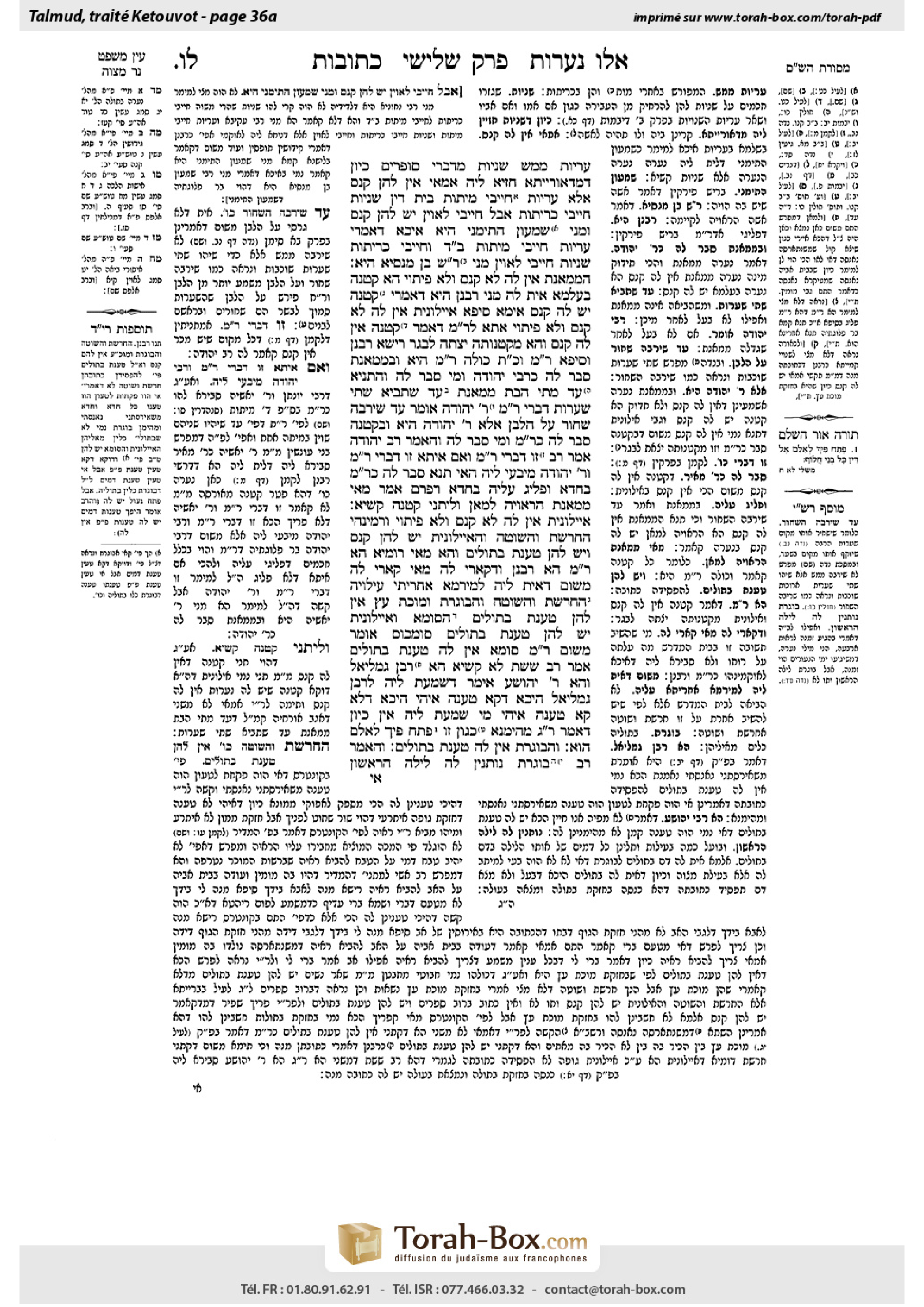
Ketubot 36a: Talmud study for Daf Yomi
Daf Yomi is the daily study of one Talmud folio. Explore 37 tractates with scans, Hebrew text, Sefaria English and AI-generated French translations where annotated.
Passage selection and English or AI-generated French translation are available where the scan has annotations. Daf Study is independent of Torah-Box and Sefaria.
Browse Ketubot · כתובות · All tractatesKetubot 36a text and translations
This page of Ketubot includes the Aramaic text, an English translation and an AI-generated French translation, alongside the scan above.
כתובות ל״ו א · Aramaic and Hebrew text
עֲרָיוֹת מַמָּשׁ, ״שְׁנִיּוֹת״ — מִדִּבְרֵי סוֹפְרִים, כֵּיוָן דְּמִדְּאוֹרָיְיתָא חַזְיָא לֵיהּ, אַמַּאי אֵין לָהֶן קְנָס? אֶלָּא: ״עֲרָיוֹת״ — חַיָּיבֵי מִיתוֹת בֵּית דִּין, ״שְׁנִיּוֹת״ — חַיָּיבֵי כָרֵיתוֹת. אֲבָל חַיָּיבֵי לָאוִין יֵשׁ לָהֶן קְנָס, וּמַנִּי שִׁמְעוֹן הַתִּימְנִי הִיא.
אִיכָּא דְּאָמְרִי ״עֲרָיוֹת״ — חַיָּיבֵי מִיתוֹת בֵּית דִּין וְחַיָּיבֵי כָרֵיתוֹת, ״שְׁנִיּוֹת״ — חַיָּיבֵי לָאוִין. מַנִּי — רַבִּי שִׁמְעוֹן בֶּן מְנַסְיָא הִיא.
הַמְמָאֶנֶת אֵין לָהּ לֹא קְנָס וְלֹא פִּיתּוּי. הָא קְטַנָּה בְּעָלְמָא — אִית לַהּ. מַנִּי — רַבָּנַן הִיא דְּאָמְרִי: קְטַנָּה יֵשׁ לָהּ קְנָס, אֵימָא סֵיפָא: אַיְילוֹנִית אֵין לָהּ לֹא קְנָס וְלֹא פִּיתּוּי. אֲתָאן לְרַבִּי מֵאִיר, דְּאָמַר: קְטַנָּה אֵין לָהּ קְנָס, וְהָא מִקַּטְנוּתָהּ יָצְתָה לְבֶגֶר. רֵישָׁא רַבָּנַן וְסֵיפָא רַבִּי מֵאִיר!
וְכִי תֵּימָא: כּוּלַּהּ רַבִּי מֵאִיר הִיא, וּבִמְמָאֶנֶת סָבַר לַהּ כְּרַבִּי יְהוּדָה. וּמִי סָבַר לַהּ? וְהָתַנְיָא: עַד מָתַי הַבַּת מְמָאֶנֶת — עַד שֶׁתָּבִיא שְׁתֵּי שְׂעָרוֹת, דִּבְרֵי רַבִּי מֵאִיר. רַבִּי יְהוּדָה אוֹמֵר: עַד שֶׁיִּרְבֶּה שָׁחוֹר עַל הַלָּבָן.
אֶלָּא: רַבִּי יְהוּדָה הִיא, וּבִקְטַנָּה סָבַר לַהּ כְּרַבִּי מֵאִיר. וּמִי סָבַר לַהּ? וְהָאָמַר רַב יְהוּדָה אָמַר רַב: זוֹ דִּבְרֵי רַבִּי מֵאִיר. וְאִם אִיתָא, ״זוֹ דִּבְרֵי רַבִּי מֵאִיר וְרַבִּי יְהוּדָה״ מִיבְּעֵי לֵיהּ! הַאי תַּנָּא סָבַר לַהּ כְּרַבִּי מֵאִיר בַּחֲדָא, וּפְלִיג עֲלֵיהּ בַּחֲדָא.
רַפְרָם אָמַר: מַאי ״מְמָאֶנֶת״ — הָרְאוּיָה לְמָאֵן. וְלִיתְנֵי קְטַנָּה! קַשְׁיָא.
אַיְילוֹנִית אֵין לָהּ לֹא קְנָס וְלֹא פִּיתּוּי. וּרְמִינְהִי: הַחֵרֶשֶׁת וְהַשּׁוֹטָה וְהָאַיְילוֹנִית — יֵשׁ לָהֶן קְנָס, וְיֵשׁ לָהֶן טַעֲנַת בְּתוּלִים. וְהָא, מַאי רוּמְיָא? הָא רַבִּי מֵאִיר, הָא רַבָּנַן! וּדְקָאָרֵי לַהּ, מַאי קָאָרֵי לַהּ!
מִשּׁוּם דְּאִית לֵיהּ לְמִירְמֵא אַחֲרִיתִי עִילָּוֵיהּ: הַחֵרֶשֶׁת וְהַשּׁוֹטָה וְהַבּוֹגֶרֶת ומוּכַּת עֵץ — אֵין לָהֶן טַעֲנַת בְּתוּלִים. הַסּוֹמָא וְאַיְילוֹנִית — יֵשׁ לָהֶן טַעֲנַת בְּתוּלִים. סוֹמְכוֹס אוֹמֵר מִשּׁוּם רַבִּי מֵאִיר: סוֹמָא אֵין לָהּ טַעֲנַת בְּתוּלִים.
אָמַר רַב שֵׁשֶׁת, לָא קַשְׁיָא: הָא רַבָּן גַּמְלִיאֵל, וְהָא רַבִּי יְהוֹשֻׁעַ. אֵימַר דְּשָׁמְעַתְּ לֵיהּ לְרַבָּן גַּמְלִיאֵל הֵיכָא דְּקָא טָעֲנָה אִיהִי, הֵיכָא דְּלָא קָא טָעֲנָה אִיהִי, מִי שָׁמְעַתְּ לֵיהּ? אִין, כֵּיוָן דְּאָמַר רַבָּן גַּמְלִיאֵל מְהֵימְנָא, כְּגוֹן זוֹ ״פְּתַח פִּיךָ לְאִלֵּם״ הוּא.
וְהַבּוֹגֶרֶת אֵין לָהּ טַעֲנַת בְּתוּלִים. וְהָאָמַר רַב: בּוֹגֶרֶת, נוֹתְנִין לָהּ לַיְלָה הָרִאשׁוֹן!
Ketubot 36a · English translation
actual forbidden relatives prohibited by Torah law, and secondary relatives means, as it does in most cases, relatives prohibited by rabbinic law, that cannot be, for since those secondary relatives are suitable for him to marry and are not prohibited by Torah law, why do they not receive a fine if they are raped or seduced? Rather, the meaning of these terms in this context is different: Forbidden relatives are those for which one is liable to receive a court-imposed death penalty; secondary relatives are those for which one is liable to receive karet, which are relatively less severe than those for which one is executed. However, those liable for violating regular prohibitions receive payment of a fine if they are raped or seduced. And according to whose opinion is the baraita taught? It is the opinion of Shimon HaTimni, who exempts from paying a fine only one who rapes a woman with whom betrothal is ineffective.
Some say that we can explain that forbidden relatives refers to all relatives with whom relations are forbidden by severe prohibitions, both those for which one is liable to death by the court and those for which he is liable to karet, and secondary relatives refers to those relatives with whom one who engages in relations is liable for violating regular prohibitions. According to this approach, whose opinion does this follow? It is that of Rabbi Shimon ben Menasya, who maintains that even a woman raped by a man forbidden to her by a regular prohibition is not entitled to the fine, despite the fact that betrothal is effective in that case.
§ The baraita stated: A girl who refuses to remain married to her husband receives neither payment of a fine for rape nor payment of a fine for seduction, because she was married and therefore lost her presumptive status as a virgin. The Gemara infers: But an ordinary minor girl has a fine for rape. If so, in accordance with whose opinion is the baraita taught? It is the opinion of the Rabbis, who say: A minor girl has a fine for rape. The Gemara asks: Say the latter clause of the baraita: A sexually underdeveloped woman [ailonit] has neither a fine for rape nor a fine for seduction, as she will not develop the signs of puberty and her legal status is that of a minor until she is twenty, at which point she assumes the status of a grown woman. In that halakha, the baraita comes to the opinion of Rabbi Meir, who said: A minor girl does not have a fine for rape, and the same is true for this ailonit, who emerged from her status as a minor at the age of twenty to the status of a grown woman, skipping the stage of a young woman. The first clause of the baraita is in accordance with the opinion of the Rabbis, and the latter clause is in accordance with the opinion of Rabbi Meir.
And if you say that the entire baraita is in accordance with the opinion of Rabbi Meir, and with regard to a girl who refuses to remain married Rabbi Meir holds in accordance with the opinion of Rabbi Yehuda, that not only a minor girl but a young woman may also end her marriage through refusal, and the baraita is referring to a young woman and not to a minor; but does he maintain that opinion? But isn’t it taught in a baraita that he disagrees with Rabbi Yehuda in this matter? It was taught: Until when can a girl refuse to remain married? Until she develops two pubic hairs, signs of puberty rendering her a young woman; this is the statement of Rabbi Meir. Rabbi Yehuda says: She can refuse until the area covered by the black pubic hairs is greater than the white skin of the genital area. That occurs approximately six months later, at which point she becomes a grown woman.
Rather, the Gemara suggests: The baraita is in accordance with the opinion of Rabbi Yehuda, and with regard to a minor girl, he holds in accordance with the opinion of Rabbi Meir, who says that a minor girl does not receive payment of a fine for rape, and therefore, an ailonit is not entitled to payment. The Gemara asks: But does he maintain that opinion? But didn’t Rav Yehuda say that Rav said with regard to the mishna below (40b), which states: Any case where there is the right of a father to effect the sale of his daughter as a Hebrew maidservant, i.e., when she is a minor, there is no fine if she is raped, this is the statement of Rabbi Meir? And if it is so that Rabbi Yehuda maintains that opinion, Rav should have said: This is the statement of Rabbi Meir and Rabbi Yehuda. Rather, this tanna of the baraita holds in accordance with the opinion of Rabbi Meir with regard to one halakha, that there is no fine for the rape of a minor, and disagrees with him with regard to one halakha, that a young woman may conclude her marriage through refusal.
Rafram said: This entire baraita is in accordance with the opinion of Rabbi Meir, and what is the meaning of the statement: With regard to a girl who refuses, there is neither a fine for rape nor a fine for seduction? It is referring to one who is fit to refuse, i.e., as long as she is a minor she is not entitled to the fine. The Gemara asks: And if that is the case, let the tanna simply teach the halakha with regard to a minor. Why teach a simple halakha in so convoluted a manner? The Gemara concludes: Indeed, this is difficult.
§ The baraita stated: An ailonit has neither a fine for rape nor a fine for seduction. And the Gemara raises a contradiction from a baraita: A deaf-mute, an imbecile, and an ailonit have a fine for rape and they have a claim concerning virginity. If one of these women married with the presumptive status of a virgin and received a corresponding marriage contract, her husband can cause her to lose her marriage contract by claiming that she was not a virgin. The Gemara rejects this argument: And what is the contradiction in this? It can be explained simply: This baraita, in which it was taught that the ailonit receives no fine, is in accordance with the opinion of Rabbi Meir; that baraita, in which it was taught that the ailonit receives a fine, is in accordance with the opinion of the Rabbis. The Gemara is puzzled: And as the resolution is so obvious, he who raised the contradiction, why did he raise it? The dispute between Rabbi Meir and the Rabbis in this matter is known.
The Gemara answers: He cited this baraita due to the fact that he has another baraita from which to raise as a contradiction to it: A deaf-mute, and an imbecile, and a grown woman, and a woman whose hymen was torn not in the course of sexual relations, do not have a claim concerning virginity, as they do not have the presumptive status of a virgin. However, a blind woman and an ailonit have a claim concerning virginity. Sumakhos says in the name of Rabbi Meir: A blind woman does not have a claim concerning virginity. The baraitot contradict each other with regard to the claim concerning virginity of a deaf-mute and an imbecile.
Rav Sheshet said: This is not difficult, as this baraita is in accordance with the opinion of Rabban Gamliel, who holds that a woman who, in response to a claim concerning her virginity, is believed if she says that she was raped after her betrothal and therefore does not lose her marriage contract. And that baraita is in accordance with the opinion of Rabbi Yehoshua, who says that a woman is not believed if she makes that claim, and therefore she loses her marriage contract. The Gemara asks: Say that you heard that Rabban Gamliel accepts her contention in a case where she claims that she was raped after the betrothal; however, in a case where she did not claim that that was the case, did you hear that he accepts her contention? The Gemara answers: Yes, since Rabban Gamliel said she is believed when she states that she was raped after betrothal, the deaf-mute and the imbecile are also believed even though they are unable to make the claim, as in a cases like that, it is a case of: “Open your mouth for the mute” (Proverbs 31:8). When a person lacks the capacity to proffer the claim on his own, the court makes the claim on her behalf.
§ The baraita stated: A grown woman does not have a claim concerning virginity because of changes as her body matures, her hymen is no longer completely intact. The Gemara asks: But didn’t Rav say: The Sages give a grown woman who had relations on her wedding night, the entire first night, during which she may have relations with her husband several times? Any blood seen during that night is attributed to the blood of her hymen, which is ritually pure, and not menstrual blood. Apparently, even a grown woman has her hymen intact.
Ketubot 36a · Traduction française (IA)
Il s'agit des parentes réellement interdites par la loi de la Torah, et les parentes secondaires désignent, comme c'est le cas dans la plupart des situations, les parentes interdites par la loi rabbinique. Cela ne peut pas être le sens ici, car ces parentes secondaires sont aptes au mariage et ne sont pas interdites par la loi de la Torah ; pourquoi donc ne reçoivent-elles pas une amende si elles sont violées ou séduites ? Plutôt, le sens de ces termes dans ce contexte est différent : les parentes interdites sont celles pour lesquelles on encourt la peine de mort infligée par le tribunal ; les parentes secondaires sont celles pour lesquelles on encourt la karet, qui est relativement moins sévère que la peine de mort. Cependant, ceux qui violent des interdictions ordinaires reçoivent le paiement d'une amende si la femme est violée ou séduite. Et selon l'avis de qui la baraïta est-elle enseignée ? C'est l'avis de Shimon HaTimni, qui exempte du paiement d'une amende uniquement celui qui viole une femme avec laquelle le mariage est inefficace.
Certains disent que l'on peut expliquer que les parentes interdites désignent toutes les parentes avec qui les relations sont interdites par des interdictions sévères, tant celles pour lesquelles on encourt la mort par le tribunal que celles pour lesquelles on encourt la karet, et que les parentes secondaires désignent les parentes avec qui celui qui engage des relations encourt la violation d'interdictions ordinaires. Selon cette approche, selon l'avis de qui cela suit-il ? C'est celui de Rabbi Shimon ben Menasya, qui soutient qu'une femme violée par un homme qui lui est interdit par une interdiction ordinaire n'a pas droit à l'amende, malgré le fait que le mariage soit efficace dans ce cas.
§ La baraïta a déclaré : Une fille qui refuse de rester mariée à son mari ne reçoit ni le paiement d'une amende pour viol ni le paiement d'une amende pour séduction, car elle était mariée et a donc perdu son statut présumé de vierge. La Guemara en déduit : Mais une mineure ordinaire a droit à une amende pour viol. Si c'est le cas, selon l'avis de qui la baraïta est-elle enseignée ? C'est l'avis des Sages, qui disent : Une mineure a droit à une amende pour viol. La Guemara demande : Disons que la dernière clause de la baraïta dit : Une femme sexuellement sous-développée [ailonit] n'a ni amende pour viol ni amende pour séduction, car elle ne développera pas les signes de la puberté et son statut légal est celui d'une mineure jusqu'à vingt ans, moment où elle assume le statut de femme adulte. Dans cette halakha, la baraïta suit l'avis de Rabbi Meir, qui a dit : Une mineure n'a pas droit à une amende pour viol, et il en va de même pour cette ailonit, qui est sortie de son statut de mineure à l'âge de vingt ans pour le statut de femme adulte, en sautant l'étape de jeune femme. La première clause de la baraïta est conforme à l'avis des Sages, et la dernière clause est conforme à l'avis de Rabbi Meir.
Et si vous dites que toute la baraïta est conforme à l'avis de Rabbi Meir, et qu'en ce qui concerne une fille qui refuse de rester mariée, Rabbi Meir suit l'avis de Rabbi Yehuda, selon lequel non seulement une mineure, mais aussi une jeune femme peut mettre fin à son mariage par le refus, et que la baraïta fait référence à une jeune femme et non à une mineure ; mais maintient-il cet avis ? N'est-il pas enseigné dans une baraïta qu'il est en désaccord avec Rabbi Yehuda sur cette question ? Il a été enseigné : Jusqu'à quand une fille peut-elle refuser de rester mariée ? Jusqu'à ce qu'elle développe deux poils pubiens, signes de la puberté qui en font une jeune femme ; c'est l'énoncé de Rabbi Meir. Rabbi Yehuda dit : Elle peut refuser jusqu'à ce que la zone couverte par les poils pubiens noirs soit plus grande que la peau blanche de la zone génitale. Cela se produit environ six mois plus tard, moment où elle devient une femme adulte.
Plutôt, la Guemara suggère : La baraïta est conforme à l'avis de Rabbi Yehuda, et en ce qui concerne une mineure, il suit l'avis de Rabbi Meir, qui dit qu'une mineure ne reçoit pas le paiement d'une amende pour viol, et par conséquent, une ailonit n'a pas droit au paiement. La Guemara demande : Mais maintient-il cet avis ? N'est-ce pas Rav Yehuda qui a dit que Rav a dit au sujet de la Michna ci-dessous (40b), qui déclare : Dans tout cas où le père a le droit d'effectuer la vente de sa fille comme servante hébraïque, c'est-à-dire lorsqu'elle est mineure, il n'y a pas d'amende si elle est violée, c'est l'énoncé de Rabbi Meir ? Et si c'est ainsi que Rabbi Yehuda maintient cet avis, Rav aurait dû dire : C'est l'énoncé de Rabbi Meir et de Rabbi Yehuda. Plutôt, ce tanna de la baraïta suit l'avis de Rabbi Meir en ce qui concerne une halakha, à savoir qu'il n'y a pas d'amende pour le viol d'une mineure, et est en désaccord avec lui en ce qui concerne une halakha, à savoir qu'une jeune femme peut conclure son mariage par le refus.
Rafram a dit : Cette baraïta entière est conforme à l'avis de Rabbi Meir. Et quel est le sens de l'énoncé : « En ce qui concerne une fille qui refuse, il n'y a ni amende pour viol ni amende pour séduction » ? Il s'agit d'une personne apte à refuser, c'est-à-dire qu'aussi longtemps qu'elle est mineure, elle n'a pas droit à l'amende. La Guemara demande : Et si c'est le cas, que le tanna enseigne simplement la halakha concernant une mineure. Pourquoi enseigner une halakha simple d'une manière si contournée ? La Guemara conclut : En effet, cela est difficile.
§ La baraïta a déclaré : Une ailonit n'a ni amende pour viol ni amende pour séduction. Et la Guemara soulève une contradiction à partir d'une baraïta : Une sourde-muette, une idiote et une ailonit ont droit à une amende pour viol et elles ont une réclamation concernant la virginité. Si l'une de ces femmes s'est mariée avec le statut présumé de vierge et a reçu un contrat de mariage correspondant, son mari peut lui faire perdre son contrat de mariage en affirmant qu'elle n'était pas vierge. La Guemara rejette cet argument : Et quelle est la contradiction ici ? Cela peut être expliqué simplement : Cette baraïta, dans laquelle il a été enseigné que l'ailonit ne reçoit pas d'amende, est conforme à l'avis de Rabbi Meir ; cette baraïta, dans laquelle il a été enseigné que l'ailonit reçoit une amende, est conforme à l'avis des Sages. La Guemara est perplexe : Et comme la résolution est si évidente, celui qui a soulevé la contradiction, pourquoi l'a-t-il soulevée ? Le désaccord entre Rabbi Meir et les Sages sur cette question est connu.
La Guemara répond : Il a cité cette baraïta en raison du fait qu'il possède une autre baraïta à partir de laquelle il peut soulever une contradiction à son égard : Un sourd-muet, un imbécile, une femme adulte et une femme dont l'hymen a été déchiré non pas au cours de relations sexuelles, n'ont pas de prétention concernant la virginité, car ils ne possèdent pas le statut présumé de vierge. Cependant, une femme aveugle et une ailonit ont une prétention concernant la virginité. Sumakhos dit au nom de Rabbi Meïr : Une femme aveugle n'a pas de prétention concernant la virginité. Les baraïtot se contredisent mutuellement quant à la prétention concernant la virginité d'un sourd-muet et d'un imbécile.
Rav Chéchet a dit : Ce n'est pas difficile, car cette baraïta est conforme à l'opinion de Rabban Gamliel, qui soutient qu'une femme qui, en réponse à une allégation concernant sa virginité, est crue si elle déclare qu'elle a été violée après ses fiançailles et ne perd donc pas son contrat de mariage. Et cette autre baraïta est conforme à l'opinion de Rabbi Yéhoucha, qui dit qu'une femme n'est pas crue si elle formule cette allégation, et perd donc son contrat de mariage. La Guemara demande : Dis que tu as entendu que Rabban Gamliel accepte sa défense dans un cas où elle prétend avoir été violée après les fiançailles ; cependant, dans un cas où elle n'a pas prétendu que c'était le cas, as-tu entendu qu'il accepte sa défense ? La Guemara répond : Oui, car Rabban Gamliel a dit qu'elle est crue lorsqu'elle déclare avoir été violée après les fiançailles, le sourd-muet et l'imbécile sont également crus, même s'ils ne sont pas en mesure de formuler l'allégation, car dans des cas comme celui-ci, il s'agit de : « Ouvre ta bouche pour le muet » (Proverbes 31:8). Lorsqu'une personne manque de la capacité de formuler l'allégation par elle-même, le tribunal formule l'allégation en son nom.
§ La baraïta a déclaré : Une femme adulte n'a pas de prétention concernant la virginité, car, à mesure que son corps mûrit, des changements s'opèrent et son hymen n'est plus complètement intact. La Guemara demande : Mais Rav n'a-t-il pas dit : Les Sages considèrent que, pour une femme adulte qui a des rapports la première nuit de son mariage — cette première nuit entière, au cours de laquelle elle peut avoir des rapports avec son mari plusieurs fois —, tout sang observé pendant cette nuit est attribué au sang de son hymen, qui est rituellement pur, et non au sang menstruel. Apparemment, même une femme adulte a son hymen intact.
Traduction française générée par IA à partir de l’édition anglaise de Sefaria. Vérifie toujours un passage avec le texte source.
Text from Sefaria: William Davidson Edition - Vocalized Aramaic (CC BY NC); William Davidson Edition - English (CC BY NC).