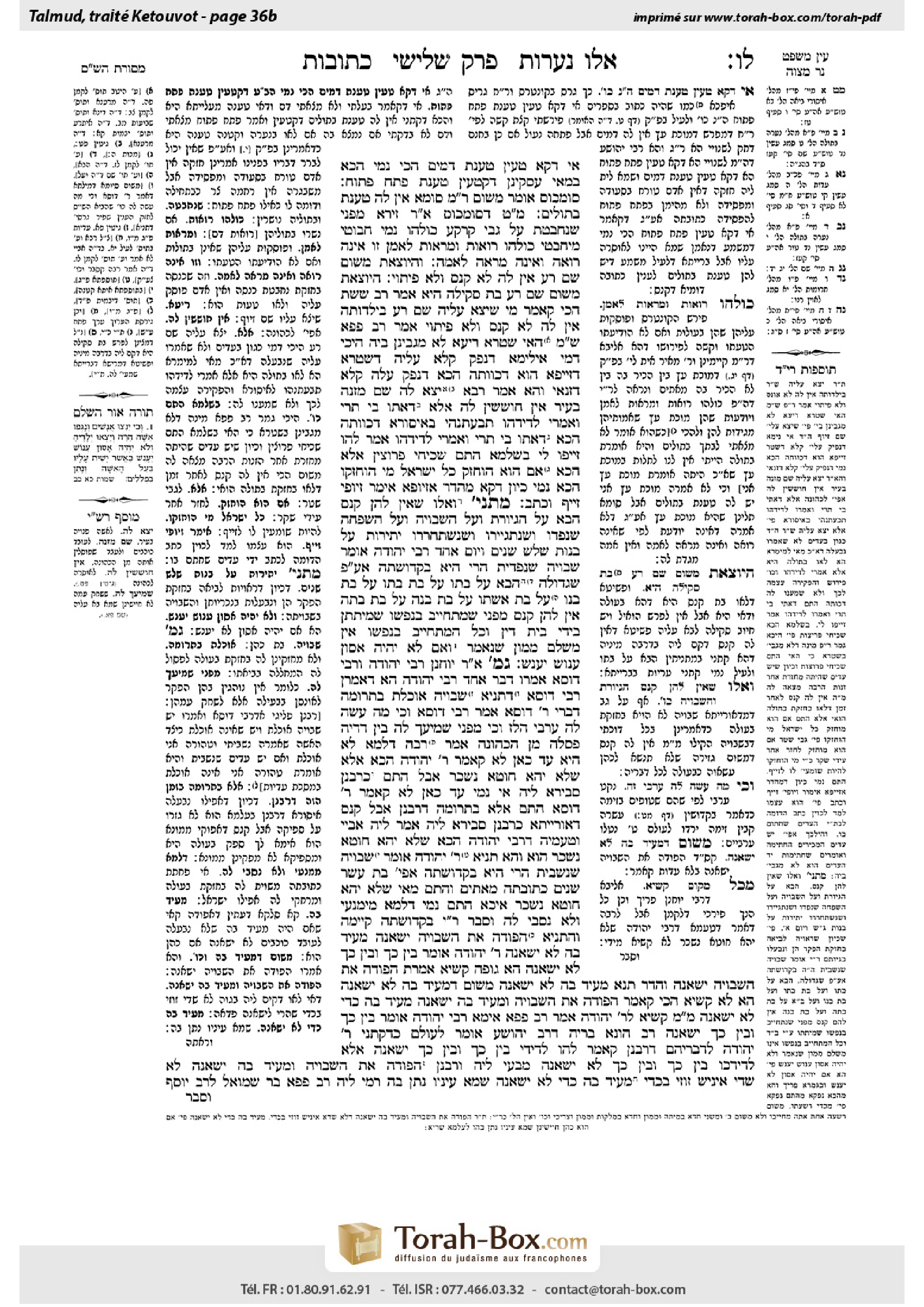
Ketubot 36b: Talmud study for Daf Yomi
Daf Yomi is the daily study of one Talmud folio. Explore 37 tractates with scans, Hebrew text, Sefaria English and AI-generated French translations where annotated.
Passage selection and English or AI-generated French translation are available where the scan has annotations. Daf Study is independent of Torah-Box and Sefaria.
Browse Ketubot · כתובות · All tractatesKetubot 36b text and translations
This page of Ketubot includes the Aramaic text, an English translation and an AI-generated French translation, alongside the scan above.
כתובות ל״ו ב · Aramaic and Hebrew text
אִי דְּקָא טָעֵין טַעֲנַת דָּמִים — הָכִי נָמֵי. הָכָא בְּמַאי עָסְקִינַן — דְּקָטָעֵין טַעֲנַת פֶּתַח פָּתוּחַ.
סוֹמְכוֹס אוֹמֵר מִשּׁוּם רַבִּי מֵאִיר: סוֹמָא אֵין לָהּ טַעֲנַת בְּתוּלִים. מַאי טַעְמָא דְּסוֹמְכוֹס? אָמַר רַבִּי זֵירָא: מִפְּנֵי שֶׁנֶּחְבֶּטֶת עַל גַּבֵּי קַרְקַע. כּוּלְּהוּ נָמֵי חַבּוֹטֵי מִיחַבְּטִי? כּוּלְּהוּ, רוֹאוֹת וּמַרְאוֹת לְאִמָּן. זוֹ, אֵינָהּ רוֹאָה וְאֵינָהּ מַרְאָה לְאִמָּהּ.
וְהַיּוֹצֵאת מִשּׁוּם שֵׁם רָע אֵין לָהּ לֹא קְנָס וְלֹא פִּיתּוּי. הַיּוֹצֵאת מִשּׁוּם שֵׁם רָע — בַּת סְקִילָה הִיא! אָמַר רַב שֵׁשֶׁת: הָכִי קָאָמַר: מִי שֶׁיָּצָא עָלֶיהָ שֵׁם רַע בְּיַלְדוּתָהּ — אֵין לָהּ לֹא קְנָס וְלֹא פִּיתּוּי.
אָמַר רַב פָּפָּא, שְׁמַע מִינַּהּ: הַאי שְׁטָרָא רִיעָא לָא מַגְבֵּינַן בֵּיהּ. הֵיכִי דָמֵי? אִילֵּימָא דִּנְפַק קָלָא עֲלֵיהּ דִּשְׁטָרָא (דְּ)זַיְיפָא הוּא, דִּכְווֹתַהּ הָכָא, דִּנְפַק עֲלַהּ קָלָא דְּזַנַּאי, וְהָא אָמַר רָבָא: יָצָא לָהּ שֵׁם מְזַנָּה בָּעִיר — אֵין חוֹשְׁשִׁין לָהּ.
אֶלָּא דַּאֲתוֹ בֵּי תְרֵי וְאָמְרִי: לְדִידְהוּ תְּבַעְתַּנְהִי בְּאִיסּוּרָא. דִּכְווֹתַהּ הָכָא: דַּאֲתוֹ בֵּי תְרֵי וְאָמְרִי: לְדִידְהוּ אֲמַר לְהוּ: ״זַיִּיפוּ לִי״. בִּשְׁלָמָא הָתָם — שְׁכִיחִי פְּרוּצִין. אֶלָּא הָכָא, אִם הוּא הוּחְזַק, כׇּל יִשְׂרָאֵל מִי הוּחְזְקוּ? הָכָא נָמֵי: כֵּיוָן דְּקָא מְהַדַּר אַזִּיּוּפָא, אֵימַר, זַיּוֹפֵי זַיֵּיף וּכְתַב.
מַתְנִי׳ וְאֵלּוּ שֶׁאֵין לָהֶן קְנָס: הַבָּא עַל הַגִּיּוֹרֶת וְעַל הַשְּׁבוּיָה וְעַל הַשִּׁפְחָה שֶׁנִּפְדּוּ וְשֶׁנִּתְגַּיְּירוּ וְשֶׁנִּשְׁתַּחְרְרוּ, יְתֵירוֹת עַל בְּנוֹת שָׁלֹשׁ שָׁנִים וְיוֹם אֶחָד. רַבִּי יְהוּדָה אוֹמֵר: שְׁבוּיָה שֶׁנִּפְדֵּית — הֲרֵי הִיא בִּקְדוּשָּׁתָהּ, אַף עַל פִּי שֶׁגְּדוֹלָה.
הַבָּא עַל בִּתּוֹ, עַל בַּת בִּתּוֹ, עַל בַּת בְּנוֹ, עַל בַּת אִשְׁתּוֹ, עַל בַּת בְּנָהּ, עַל בַּת בִּתָּהּ — אֵין לָהֶן קְנָס, מִפְּנֵי שֶׁמִּתְחַיֵּיב בְּנַפְשׁוֹ, שֶׁמִּיתָתָן בִּידֵי בֵּית דִּין. וְכׇל הַמִּתְחַיֵּיב בְּנַפְשׁוֹ אֵין מְשַׁלֵּם מָמוֹן, שֶׁנֶּאֱמַר: ״וְאִם לֹא יִהְיֶה אָסוֹן עָנוֹשׁ יֵעָנֵשׁ״.
גְּמָ׳ אָמַר רַבִּי יוֹחָנָן: רַבִּי יְהוּדָה וְרַבִּי דּוֹסָא אָמְרוּ דָּבָר אֶחָד. רַבִּי יְהוּדָה — הָא דַּאֲמַרַן. רַבִּי דּוֹסָא, דְּתַנְיָא: שְׁבוּיָה — אוֹכֶלֶת בִּתְרוּמָה, דִּבְרֵי רַבִּי דּוֹסָא. אָמַר רַבִּי דּוֹסָא: וְכִי מָה עָשָׂה לָהּ עַרְבִי הַלָּז? וְכִי מִפְּנֵי שֶׁמִּיעֵךְ לָהּ בֵּין דַּדֶּיהָ, פְּסָלָהּ מִן הַכְּהוּנָּה?
אָמַר רַבָּה: דִּלְמָא לָא הִיא, עַד כָּאן לָא קָאָמַר רַבִּי יְהוּדָה הָכָא, אֶלָּא שֶׁלֹּא יְהֵא חוֹטֵא נִשְׂכָּר? אֲבָל הָתָם — כְּרַבָּנַן סְבִירָא לֵיהּ. אִי נָמֵי: עַד כָּאן לָא קָאָמַר רַבִּי דּוֹסָא הָתָם, אֶלָּא בִּתְרוּמָה דְּרַבָּנַן. אֲבָל קְנָס דְּאוֹרָיְיתָא — כְּרַבָּנַן סְבִירָא לֵיהּ.
אֲמַר לֵיהּ אַבָּיֵי: וְטַעְמֵיהּ דְּרַבִּי יְהוּדָה הָכָא, שֶׁלֹּא יְהֵא חוֹטֵא נִשְׂכָּר הוּא? וְהָא תַּנְיָא, רַבִּי יְהוּדָה אוֹמֵר: שְׁבוּיָה שֶׁנִּשְׁבֵּית — הֲרֵי הִיא בִּקְדוּשָּׁתָהּ, אֲפִילּוּ בַּת עֶשֶׂר שָׁנִים — כְּתוּבָּתָהּ מָאתַיִם. וְהָתָם מַאי ״שֶׁלֹּא יְהֵא חוֹטֵא נִשְׂכָּר״ אִיכָּא? הָתָם נָמֵי, דִּלְמָא מִימַּנְעִי וְלָא נָסְבִי לַהּ.
וְסָבַר רַבִּי יְהוּדָה בִּקְדוּשְׁתַּהּ קָיְימָה? וְהָתַנְיָא: הַפּוֹדֶה אֶת הַשְּׁבוּיָה — יִשָּׂאֶנָּה. מֵעִיד בָּהּ — לֹא יִשָּׂאֶנָּה. רַבִּי יְהוּדָה אוֹמֵר: בֵּין כָּךְ וּבֵין כָּךְ לֹא יִשָּׂאֶנָּה! הָא גּוּפַהּ קַשְׁיָא, אָמְרַתְּ: הַפּוֹדֶה אֶת הַשְּׁבוּיָה — יִשָּׂאֶנָּה, וַהֲדַר תְּנָא: מֵעִיד בָּהּ — לֹא יִשָּׂאֶנָּה. מִשּׁוּם דְּמֵעִיד בָּהּ לֹא יִשָּׂאֶנָּה?!
הָא לָא קַשְׁיָא, הָכִי קָאָמַר: הַפּוֹדֶה אֶת הַשְּׁבוּיָה וּמֵעִיד בָּהּ — יִשָּׂאֶנָּה, מֵעִיד בָּהּ כְּדִי — לֹא יִשָּׂאֶנָּה.
מִכׇּל מָקוֹם קַשְׁיָא לְרַבִּי יְהוּדָה! אָמַר רַב פָּפָּא, אֵימָא: רַבִּי יְהוּדָה אוֹמֵר: בֵּין כָּךְ וּבֵין כָּךְ יִשָּׂאֶנָּה. רַב הוּנָא בְּרֵיהּ דְּרַב יְהוֹשֻׁעַ אוֹמֵר: לְעוֹלָם כִּדְקָתָנֵי, רַבִּי יְהוּדָה לְדִבְרֵיהֶם דְּרַבָּנַן קָאָמַר לְהוּ: לְדִידִי — בֵּין כָּךְ וּבֵין כָּךְ יִשָּׂאֶנָּה, אֶלָּא לְדִידְכוּ — בֵּין כָּךְ וּבֵין כָּךְ לֹא יִשָּׂאֶנָּה מִבְּעֵי לֵיהּ!
וְרַבָּנַן: הַפּוֹדֶה אֶת הַשְּׁבוּיָה וּמֵעִיד בָּהּ יִשָּׂאֶנָּה — לָא שָׁדֵי אִינִישׁ זוּזֵי בִּכְדִי. מֵעִיד בָּהּ כְּדִי לֹא יִשָּׂאֶנָּה — שֶׁמָּא עֵינָיו נָתַן בָּהּ.
רָמֵי לֵיהּ רַב פָּפָּא בַּר שְׁמוּאֵל לְרַב יוֹסֵף:
Ketubot 36b · English translation
The Gemara answers: If he proffers a claim that there was no blood after consummating the marriage, indeed he can cause her to lose her marriage contract with that claim. However, with what are we dealing here in the baraita? We are dealing with one who proffers a claim that he encountered an open entrance, i.e., there was no hymen. As the hymen of an adult woman is no longer completely intact, the claim is of no consequence.
The baraita continues: Sumakhos says in the name of Rabbi Meir: A blind woman does not have a claim concerning virginity. The Gemara asks: What is the rationale for the statement of Sumakhos? Rabbi Zeira said: Due to the fact that a blind woman is struck by falling onto the ground, causing her hymen to break. The Gemara asks: All girls tend to be struck by falling onto the ground as well; what is unique about blind girls? The Gemara answers: When all of the other girls fall, they see the blood flow and show it to their mother. The mother would then examine them and discover that her hymen was broken. This blind girl does not see the flow of blood and therefore does not show it too her mother. Due to that possibility, the man who married the blind woman must have considered the likelihood that her hymen is not intact, and therefore he cannot make a claim concerning virginity.
§ The previous baraita concluded: And one who leaves her husband due to a bad reputation has neither a fine for rape nor a fine for seduction. The initial understanding is that the baraita is referring to a young betrothed woman who leaves her husband because she committed adultery. The Gemara asks: One who leaves her husband due to a bad reputation is subject to stoning as an adulteress; clearly she is not entitled to the fine. Rav Sheshet said: This is what the baraita is saying: One about whom a bad reputation emerged in her youth that she engaged in sexual relations has neither a fine for rape nor a fine for seduction, as the assumption is that she is no longer a virgin.
Rav Pappa said: Conclude from it with regard to this tainted document whose authenticity was compromised that we do not collect a debt with it. The Gemara asks: What are the circumstances? If you say that a rumor emerged about it that it is a forged document, and in the corresponding case here, the case of a bad reputation, that a rumor emerged about her that she engaged in promiscuous sexual relations; but didn’t Rava say: If a rumor emerged about a woman in a town as one who engaged in promiscuous sexual relations, one need not be concerned about it? The assumption is that it is insubstantial, as a reputation based on rumor is disregarded.
Rather, it is that two witnesses came and said: She propositioned us to engage in forbidden relations, and in the corresponding case here with regard to a document, it is a case where two people came and said that he said to us: Forge a document for me. The Gemara asks: Granted, there, in the case of the rumor of promiscuity, immoral men are common, and even if they refused her, presumably she found someone willing to engage in relations with her. However, here, with regard to forgery, even if he assumed presumptive status as one seeking a forgery, do all the Jewish people assume presumptive status as forgers? Why is the assumption that the document was forged? The Gemara answers: Here too, since he is actively seeking a forgery, say that he forged the document and wrote it. Even if others are not suspected of cooperating with him, there is suspicion with regard to the document. Therefore, the case of the tainted document and the woman with a bad reputation are comparable.
MISHNA: And these are the cases of young women who do not have a fine paid to their fathers when they are raped or seduced: One who has intercourse with a convert or with a captive woman or with a gentile maidservant, who were redeemed, converted, or emancipated when they were more than three years and one day old, as presumably they are no longer virgins. Rabbi Yehuda says: A captive woman who was redeemed remains in her state of sanctity even though she is an adult, as it cannot be stated that she certainly engaged in intercourse.
The mishna resumes its list of the cases of young women who are not entitled to a fine when raped or seduced by the following men: In the case of one who engages in intercourse with his daughter, with his daughter’s daughter, with his son’s daughter, with his wife’s daughter, with her son’s daughter, or with her daughter’s daughter; they do not receive payment of a fine. That is due to the fact that he is liable to receive the death penalty, and that their death penalty is administered by the court, and anyone who is liable to receive the death penalty does not pay money, as it is stated: “And yet no harm follow, he shall be punished” (Exodus 21:22). This verse indicates that if a woman dies and the one who struck her is liable to receive the death penalty, he is exempt from payment.
GEMARA: Rabbi Yoḥanan said: Rabbi Yehuda and Rabbi Dosa said one and the same thing with regard to a captive woman. The statement of Rabbi Yehuda is that which we said in the mishna. The statement of Rabbi Dosa is as it is taught in a baraita: A captive daughter or wife of a priest, who was redeemed, partakes of teruma; this is the statement of Rabbi Dosa. In explanation, Rabbi Dosa said: And what did this Arab who took her captive do to her? And due to the fact that he lasciviously squeezed between her breasts, did he render her unfit to marry into the priesthood? Although he may have taken liberties with her, there is no concern that he had relations with her.
Rabba said: Perhaps that is not so, and their opinions differ. Perhaps Rabbi Yehuda states his opinion only here with regard to payment of a fine, so that the sinner will not profit through exemption from the fine because this girl was taken captive in her youth. However, there, with regard to teruma, he holds in accordance with the opinion of the Rabbis, and she is unfit to marry a priest. Alternatively, there is another distinction between their opinions. Perhaps Rabbi Dosa stated his opinion only there, with regard to teruma whose legal status today is by rabbinic law, and therefore he rules leniently. However, with regard to payment of a fine, which is mandated by Torah law, he holds in accordance with the opinion of the Rabbis, and the rapist is exempt from payment based on the principle: The burden of proof is incumbent upon the claimant, and she cannot prove that her captors did not engage in intercourse with her and that she is a virgin.
Abaye said to Rabba: And is the rationale for the opinion of Rabbi Yehuda here, in the case of a fine, to ensure that the sinner will not profit? But isn’t it taught in a baraita that Rabbi Yehuda says: A captive woman who was taken captive remains in her state of sanctity with the presumptive status of a virgin? Even if she was in captivity when she was ten years old, her marriage contract is two hundred dinars. And there, in that case, what relevance is there for the rationale: To ensure that the sinner will not profit? That baraita refers to a marriage contract and no transgression is involved. The Gemara answers: There too, Rabbi Yehuda issues the same ruling for a different reason. She receives the marriage contract of a virgin because if she didn’t, perhaps men would refrain and not marry her, due to their suspicion that her captors violated her.
The Gemara asks: And does Rabbi Yehuda maintain that a captive woman remains in her state of sanctity? But isn’t it taught in a baraita: One who redeems a captive may marry her, even if he is a priest, but if he testifies that she did not engage in sexual relations while in captivity, he may not marry her? Rabbi Yehuda says: Both in this case, where he redeemed her, and in that case, where he testified, he may not marry her, lest she was violated and rendered unfit to marry a priest. The Gemara comments: This baraita itself is difficult. On the one hand you said: One who redeems a captive may marry her, and then it was taught: If he testifies that she did not engage in sexual relations while in captivity, he may not marry her. Is that to say that due to the fact that he also testifies that she was not violated he may not marry her?
The Gemara answers: This is not difficult, as this is what the baraita is saying: One who redeems a captive woman and testifies that she was not violated may marry her. However, if he only testifies that she was not violated he may not marry her.
With regard to the apparent contradiction between the two statements of Rabbi Yehuda, the Gemara says: In any case, this baraita is difficult according to Rabbi Yehuda, as contrary to his earlier statement, he states that a captive woman does not retain the presumptive status of a virgin. Rav Pappa said: Emend the text and say that Rabbi Yehuda says: Both in this case and in that case he may marry her. Rav Huna, son of Rav Yehoshua, says: Actually, do not emend the baraita and learn it as it was taught. In the baraita, Rabbi Yehuda spoke to them according to the statement of the Rabbis. According to my opinion, that the presumptive status of a redeemed captive woman is that of a virgin, both in this case and in that case he may marry her. However, according to your opinion that there is concern lest she was violated, the halakha should be that both in this case and in that case he may not marry her.
The Gemara asks: And how do the Rabbis explain their ruling? They explain: One who redeems a captive woman and testifies that she was not violated may marry her, as a person does not throw away money for nothing. If he paid the ransom to redeem her, he must be certain that she is a virgin. One who only testifies that she was not violated may not marry her, lest he had his eye on her to marry her and is prepared to lie to facilitate that marriage.
Rav Pappa bar Shmuel raised a contradiction before Rav Yosef:
Ketubot 36b · Traduction française (IA)
La Guemara répond : S'il avance l'argument qu'il n'y a pas eu de sang après la consommation du mariage, il peut effectivement faire perdre son contrat de mariage à la femme par cet argument. Cependant, avec quoi avons-nous affaire ici dans la baraïta ? Nous avons affaire à celui qui avance l'argument qu'il a rencontré une entrée ouverte, c'est-à-dire qu'il n'y avait pas de hymen. Comme l'hymen d'une femme adulte n'est plus complètement intact, cet argument n'a aucune conséquence.
La baraïta continue : Sumakhos dit au nom de Rabbi Meïr : Une femme aveugle n'a pas de prétention concernant la virginité. La Guemara demande : Quelle est la raison de l'affirmation de Sumakhos ? Rabbi Zeïra a dit : En raison du fait qu'une femme aveugle est sujette à tomber au sol, ce qui provoque la rupture de son hymen. La Guemara demande : Toutes les jeunes filles sont également sujettes à tomber au sol ; qu'est-ce qui est unique chez les jeunes filles aveugles ? La Guemara répond : Lorsque toutes les autres jeunes filles tombent, elles voient le flux de sang et le montrent à leur mère. La mère les examinerait alors et découvrirait que leur hymen était rompu. Cette jeune fille aveugle ne voit pas le flux de sang et ne le montre donc pas à sa mère. En raison de cette possibilité, l'homme qui a épousé la femme aveugle a dû considérer la probabilité que son hymen n'est pas intact, et par conséquent, il ne peut pas faire de prétention concernant la virginité.
§ La baraïta précédente a conclu : Et celle qui quitte son mari en raison d'une mauvaise réputation n'a droit ni à une amende pour viol ni à une amende pour séduction. La compréhension initiale est que la baraïta fait référence à une jeune femme fiancée qui quitte son mari parce qu'elle a commis l'adultère. La Guemara demande : Celle qui quitte son mari en raison d'une mauvaise réputation est soumise au lapidement en tant qu'adultère ; clairement, elle n'a pas droit à l'amende. Rav Chéchet a dit : C'est ce que dit la baraïta : Celle au sujet de laquelle une mauvaise réputation est apparue dans sa jeunesse, selon laquelle elle a eu des relations sexuelles, n'a droit ni à une amende pour viol ni à une amende pour séduction, car on suppose qu'elle n'est plus vierge.
Rav Pappa a dit : Concluez-en, à propos de ce document entaché dont l'authenticité a été compromise, que nous ne recouvrons pas une dette avec lui. La Guemara demande : Quelles sont les circonstances ? Si vous dites qu'un bruit a couru à son sujet selon lequel c'est un document falsifié, et dans le cas correspondant ici, le cas d'une mauvaise réputation, qu'un bruit a couru à son sujet selon lequel elle a eu des relations sexuelles promiscues ; mais n'est-ce pas Rava qui a dit : Si un bruit a couru à propos d'une femme dans une ville selon laquelle elle a eu des relations sexuelles promiscues, on n'a pas à s'en inquiéter ? L'hypothèse est que c'est sans fondement, car une réputation basée sur le bruit est ignorée.
Plutôt, il s'agit du cas où deux témoins sont venus et ont dit : Elle nous a proposé d'entretenir des relations interdites. Et dans le cas correspondant ici, concernant un document, il s'agit du cas où deux personnes sont venues et ont dit : Il nous a dit : Falsifiez-moi un document. La Guemara demande : Accorde, là, dans le cas du bruit de promiscuité, les hommes immoraux sont courants, et même s'ils l'ont refusée, on peut présumer qu'elle a trouvé quelqu'un disposé à entretenir des relations avec elle. Cependant, ici, concernant la falsification, même s'il est présumé être celui qui cherche une falsification, tous les Juifs sont-ils présumés être des falsificateurs ? Pourquoi présume-t-on que le document a été falsifié ? La Guemara répond : Ici aussi, puisqu'il cherche activement une falsification, on peut dire qu'il a falsifié le document et l'a écrit. Même si d'autres ne sont pas soupçonnés de coopérer avec lui, il y a suspicion concernant le document. Par conséquent, le cas du document entaché et celui de la femme à la mauvaise réputation sont comparables.
MICHNA : Et voici les cas de jeunes femmes pour lesquelles aucune amende n'est payée à leurs pères lorsqu'elles sont violées ou séduites : Celle qui a des relations avec un converti, avec une femme captive ou avec une servante non juive, qui ont été rachetées, converties ou émancipées lorsqu'elles avaient plus de trois ans et un jour, car on présume qu'elles ne sont plus vierges. Rabbi Yehuda dit : Une femme captive qui a été rachetée reste dans son état de sainteté, même si elle est adulte, car on ne peut pas affirmer qu'elle a certainement eu des relations.
La Michna reprend sa liste des cas de jeunes femmes qui n'ont pas droit à une amende lorsqu'elles sont violées ou séduites par les hommes suivants : dans le cas de celui qui a des relations avec sa fille, avec la fille de sa fille, avec la fille de son fils, avec la fille de sa femme, avec la fille du fils de celle-ci, ou avec la fille de la fille de celle-ci ; elles ne reçoivent pas le paiement d'une amende. Cela est dû au fait qu'il est passible de la peine de mort, et que leur peine de mort est administrée par le tribunal, et quiconque est passible de la peine de mort ne paie pas d'argent, car il est dit : « Et pourtant, si aucun dommage ne survient, il sera puni » (Exode 21:22). Ce verset indique que si une femme meurt et que celui qui l'a frappée est passible de la peine de mort, il est exempté du paiement.
GUEMARA : Rabbi Yoḥanan a dit : Rabbi Yehuda et Rabbi Dosa ont dit la même chose concernant une femme captive. L'affirmation de Rabbi Yehuda est celle que nous avons dite dans la Michna. L'affirmation de Rabbi Dosa est telle qu'elle est enseignée dans une baraïta : Une fille ou une épouse de prêtre captive, qui a été rachetée, participe à la terouma ; c'est l'affirmation de Rabbi Dosa. En explication, Rabbi Dosa a dit : Et qu'a fait cet Arabe qui l'a prise captive ? Et en raison du fait qu'il l'a pressée lascivement entre ses seins, l'a-t-il rendue inapte à se marier dans le sacerdoce ? Bien qu'il ait pu se permettre des libertés avec elle, il n'y a pas d'inquiétude qu'il ait eu des relations avec elle.
Rabba a dit : Peut-être n'en est-il pas ainsi, et leurs avis diffèrent. Peut-être Rabbi Yehuda énonce-t-il son avis uniquement ici, en ce qui concerne le paiement d'une amende, afin que le coupable ne profite pas de l'exemption de l'amende du fait que cette fille a été capturée dans sa jeunesse. Cependant, là, en ce qui concerne la terouma, il est d'accord avec l'avis des Sages, et elle n'est pas apte à épouser un prêtre. Ou bien, il y a une autre distinction entre leurs avis. Peut-être Rabbi Dosa énonce-t-il son avis uniquement là, en ce qui concerne la terouma dont le statut juridique actuel est par loi rabbinique, et par conséquent il tranche avec indulgence. Cependant, en ce qui concerne le paiement d'une amende, qui est prescrit par la loi de la Torah, il est d'accord avec l'avis des Sages, et le violeur est exempté du paiement sur la base du principe : La charge de la preuve incombe au demandeur, et elle ne peut pas prouver que ses ravisseurs n'ont pas eu de rapports sexuels avec elle et qu'elle est vierge.
Abaye a dit à Rabba : Et la raison de l'avis de Rabbi Yehuda ici, dans le cas d'une amende, est-elle de s'assurer que le coupable ne profite pas ? Mais n'est-il pas enseigné dans une baraïta que Rabbi Yehuda dit : Une femme captive qui a été capturée reste dans son état de sainteté avec le statut présumé de vierge ? Même si elle était en captivité lorsqu'elle avait dix ans, son contrat de mariage est de deux cents dinars. Et là, dans ce cas, quelle est la pertinence de la raison : S'assurer que le coupable ne profite pas ? Cette baraïta se réfère à un contrat de mariage et aucune transgression n'est impliquée. La Guemara répond : Là aussi, Rabbi Yehuda émet le même jugement pour une autre raison. Elle reçoit le contrat de mariage d'une vierge parce que, si elle ne le recevait pas, peut-être les hommes s'abstiendraient et ne l'épouseraient pas, en raison de leur soupçon que ses ravisseurs l'ont violée.
La Guemara demande : Rabbi Yehuda soutient-il qu'une femme captive reste dans son état de sainteté ? Mais n'est-il pas enseigné dans une baraïta : Celui qui rachète une captive peut l'épouser, même s'il est un Cohen, mais s'il témoigne qu'elle n'a pas eu de relations sexuelles pendant sa captivité, il ne peut pas l'épouser ? Rabbi Yehuda dit : Tant dans ce cas, où il l'a rachetée, que dans celui où il a témoigné, il ne peut pas l'épouser, de peur qu'elle ait été violée et rendue inapte à épouser un Cohen. La Guemara commente : Cette baraïta elle-même est difficile. D'une part, vous avez dit : Celui qui rachète une captive peut l'épouser, et ensuite il est enseigné : S'il témoigne qu'elle n'a pas eu de relations sexuelles pendant sa captivité, il ne peut pas l'épouser. Est-ce à dire que, du fait qu'il témoigne également qu'elle n'a pas été violée, il ne peut pas l'épouser ?
La Guemara répond : Ce n'est pas difficile, car c'est ce que la baraïta dit : Celui qui rachète une femme captive et témoigne qu'elle n'a pas été violée peut l'épouser. Cependant, s'il ne fait que témoigner qu'elle n'a pas été violée, il ne peut pas l'épouser.
Concernant la contradiction apparente entre les deux déclarations de Rabbi Yehuda, la Guemara dit : Dans tous les cas, cette baraïta pose problème selon Rabbi Yehuda, car, contrairement à sa déclaration antérieure, il affirme qu'une femme captive ne conserve pas le statut présumé de vierge. Rav Pappa a dit : Corrigez le texte et lisez que Rabbi Yehuda dit : Tant dans ce cas que dans celui-là, il peut l'épouser. Rav Huna, fils de Rav Yehoshua, dit : En réalité, ne corrigez pas la baraïta et apprenez-la telle qu'elle a été enseignée. Dans la baraïta, Rabbi Yehuda leur a répondu selon l'avis des Sages. Selon mon avis, que le statut présumé d'une femme captive rachetée est celui d'une vierge, tant dans ce cas que dans celui-là, il peut l'épouser. Cependant, selon votre avis, qu'il y a une crainte qu'elle ait été violée, la halakha devrait être que tant dans ce cas que dans celui-là, il ne peut pas l'épouser.
La Guemara demande : Et comment les Sages expliquent-ils leur décision ? Ils expliquent : Celui qui rachète une femme captive et témoigne qu'elle n'a pas été violée peut l'épouser, car une personne ne jette pas son argent pour rien. S'il a payé la rançon pour la racheter, il doit être certain qu'elle est vierge. Celui qui ne fait que témoigner qu'elle n'a pas été violée ne peut pas l'épouser, de peur qu'il ait eu l'œil sur elle pour l'épouser et soit prêt à mentir pour faciliter ce mariage.
Rav Pappa bar Shmuel a soulevé une contradiction devant Rav Yosef :
Traduction française générée par IA à partir de l’édition anglaise de Sefaria. Vérifie toujours un passage avec le texte source.
Text from Sefaria: William Davidson Edition - Vocalized Aramaic (CC BY NC); William Davidson Edition - English (CC BY NC).