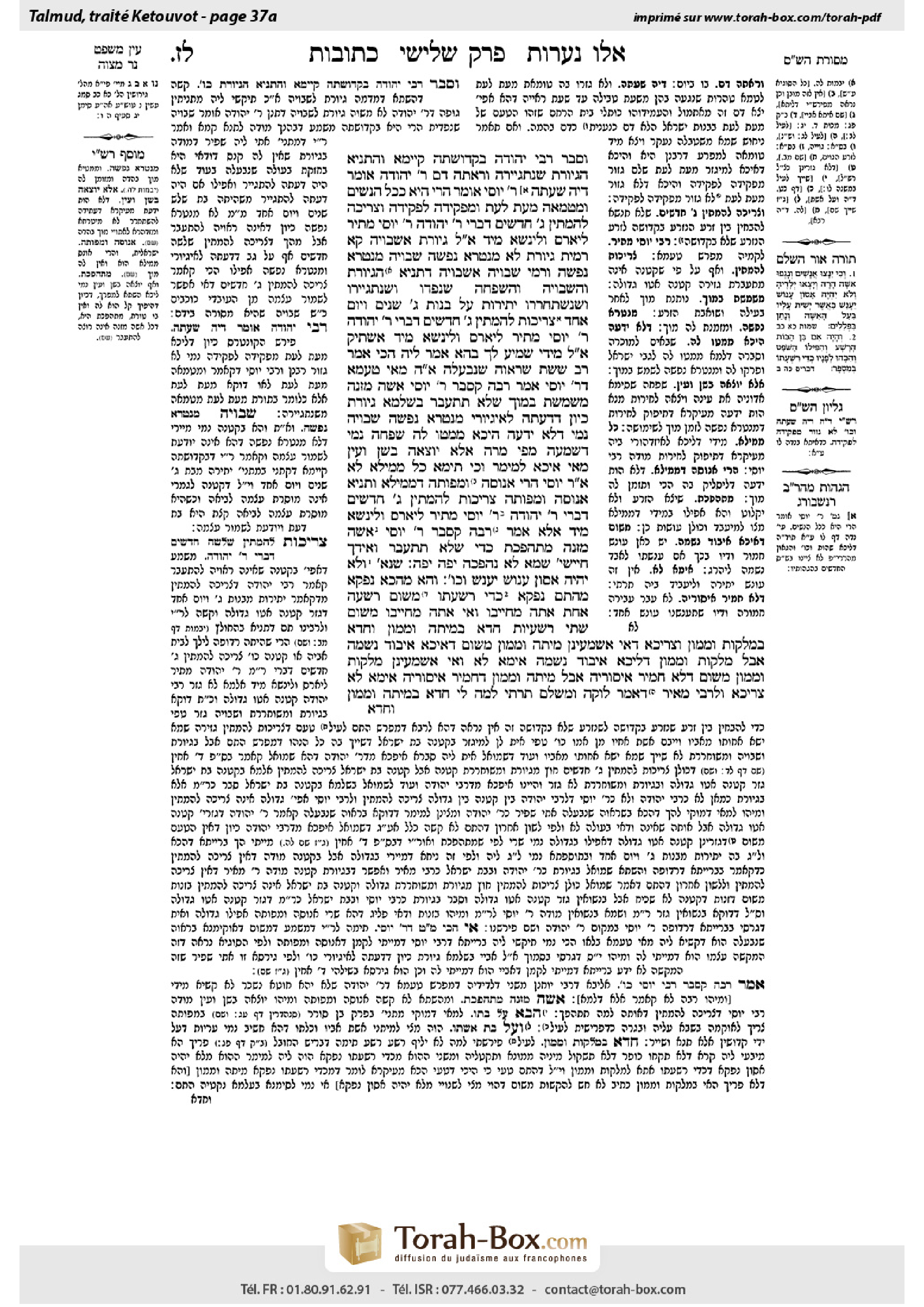
Ketubot 37a: Talmud study for Daf Yomi
Daf Yomi is the daily study of one Talmud folio. Explore 37 tractates with scans, Hebrew text, Sefaria English and AI-generated French translations where annotated.
Passage selection and English or AI-generated French translation are available where the scan has annotations. Daf Study is independent of Torah-Box and Sefaria.
Browse Ketubot · כתובות · All tractatesKetubot 37a text and translations
This page of Ketubot includes the Aramaic text, an English translation and an AI-generated French translation, alongside the scan above.
כתובות ל״ז א · Aramaic and Hebrew text
וְסָבַר רַבִּי יְהוּדָה בִּקְדוּשְׁתַּהּ קָיְימָא? וְהָתַנְיָא: הַגִּיּוֹרֶת שֶׁנִּתְגַּיְּירָה וְרָאֲתָה דָּם, רַבִּי יְהוּדָה אוֹמֵר: דַּיָּהּ שְׁעָתָהּ. רַבִּי יוֹסֵי אוֹמֵר: הֲרֵי הִיא כְּכׇל הַנָּשִׁים, וּמְטַמְּאָה מֵעֵת לְעֵת, וּמִפְּקִידָה לִפְקִידָה.
וּצְרִיכָה לְהַמְתִּין שְׁלֹשָׁה חֳדָשִׁים, דִּבְרֵי רַבִּי יְהוּדָה. רַבִּי יוֹסֵי מַתִּיר לֵיאָרֵס וְלִינָּשֵׂא מִיָּד. אֲמַר לֵיהּ: גִּיּוֹרֶת אַשְּׁבוּיָהּ קָא רָמֵית? גִּיּוֹרֶת לָא מְנַטְּרָא נַפְשַׁהּ, שְׁבוּיָה מְנַטְּרָא נַפְשַׁהּ.
וּרְמִי שְׁבוּיָה אַשְּׁבוּיָהּ, דְּתַנְיָא: הַגִּיּוֹרֶת וְהַשְּׁבוּיָה וְהַשִּׁפְחָה שֶׁנִּפְדּוּ וְשֶׁנִּתְגַּיְּירוּ וְשֶׁנִּשְׁתַּחְרְרוּ יְתֵירוֹת עַל בְּנוֹת שָׁלֹשׁ שָׁנִים וְיוֹם אֶחָד — צְרִיכוֹת לְהַמְתִּין שְׁלֹשָׁה חֳדָשִׁים, דִּבְרֵי רַבִּי יְהוּדָה, רַבִּי יוֹסֵי מַתִּיר לֵיאָרֵס וְלִינָּשֵׂא מִיָּד. אִשְׁתִּיק.
אֲמַר לֵיהּ: מִידֵּי שְׁמִיעַ לָךְ בְּהָא? אֲמַר לֵיהּ: הָכִי אָמַר רַב שֵׁשֶׁת, שֶׁרָאוּהָ שֶׁנִּבְעֲלָה. אִי הָכִי מַאי טַעְמָא דְּרַבִּי יוֹסֵי? אָמַר רַבָּה, קָסָבַר רַבִּי יוֹסֵי: אִשָּׁה מְזַנָּה מְשַׁמֶּשֶׁת בְּמוֹךְ, שֶׁלֹּא תִּתְעַבֵּר.
בִּשְׁלָמָא גִּיּוֹרֶת, כֵּיוָן דְּדַעְתַּהּ לְאִיגַּיּוֹרֵי מְנַטְּרָא נַפְשַׁהּ. שְׁבוּיָה נָמֵי, דְּלָא יָדְעָה הֵיכָא מַמְטוּ לָהּ. שִׁפְחָה נָמֵי, דְּשָׁמְעָה מִפִּי מָרַהּ. אֶלָּא יוֹצְאָה בְּשֵׁן וָעַיִן, מַאי אִיכָּא לְמֵימַר?
וְכִי תֵּימָא כֹּל מִמֵּילָא לָא אָמַר רַבִּי יוֹסֵי, הֲרֵי אֲנוּסָה וּמְפוּתָּה, דְּמִמֵּילָא, וְתַנְיָא: אֲנוּסָה וּמְפוּתָּה צְרִיכוֹת לְהַמְתִּין שְׁלֹשָׁה חֳדָשִׁים, דִּבְרֵי רַבִּי יְהוּדָה. רַבִּי יוֹסֵי מַתִּיר לֵיאָרֵס וְלִינָּשֵׂא מִיָּד!
אֶלָּא אָמַר רַבָּה: קָסָבַר רַבִּי יוֹסֵי: אִשָּׁה מְזַנָּה מִתְהַפֶּכֶת כְּדֵי שֶׁלֹּא תִּתְעַבֵּר. וְאִידַּךְ? חָיְישִׁינַן שֶׁמָּא לֹא נֶהֶפְכָה יָפֶה יָפֶה.
שֶׁנֶּאֱמַר וְלֹא יִהְיֶה אָסוֹן עָנוֹשׁ יֵעָנֵשׁ וְכוּ׳. וְהָא מֵהָכָא נָפְקָא? מֵהָתָם נָפְקָא: ״כְּדֵי רִשְׁעָתוֹ״, מִשּׁוּם רִשְׁעָה אַחַת אַתָּה מְחַיְּיבוֹ, וְאִי אַתָּה מְחַיְּיבוֹ מִשּׁוּם שְׁתֵּי רִשְׁעָיוֹת!
חֲדָא בְּמִיתָה וּמָמוֹן, וַחֲדָא בְּמַלְקוֹת וּמָמוֹן. וּצְרִיכָא: דְּאִי אַשְׁמְעִינַן מִיתָה וּמָמוֹן, מִשּׁוּם דְּאִיכָּא אִיבּוּד נְשָׁמָה, אֲבָל מַלְקוֹת וּמָמוֹן, דְּלֵיכָּא אִיבּוּד נְשָׁמָה, אֵימָא לָא.
וְאִי אַשְׁמְעִינַן מַלְקוֹת וּמָמוֹן, מִשּׁוּם דְּלָא חֲמִיר אִיסּוּרֵיהּ. אֲבָל מִיתָה וּמָמוֹן, דַּחֲמִיר אִיסּוּרֵיהּ, אֵימָא לָא. צְרִיכָא.
וּלְרַבִּי מֵאִיר דְּאָמַר לוֹקֶה וּמְשַׁלֵּם, תַּרְתֵּי לְמָה לִי? חֲדָא בְּמִיתָה וּמָמוֹן,
Ketubot 37a · English translation
And does Rabbi Yehuda maintain that a captive woman remains in her state of sanctity? But isn’t it taught in a baraita: With regard to a female convert who converted and saw the flow of menstrual blood on that same day, Rabbi Yehuda says: Deeming her impure from the hour that she saw the menstrual flow is sufficient for her. There is no decree of retroactive impurity on objects that she touched earlier, due to the concern that the blood flow might have started earlier. Rabbi Yosei says: Her legal status is like that of all of the Jewish women, and she therefore transmits impurity retroactively for a twenty-four hour period following her conversion, or from examination to examination, i.e., from the last time she examined herself.
And a convert is required to wait three months after her conversion before marrying a Jew, due to the concern that she is pregnant, leading to confusion whether the child was conceived before or after her conversion; this is the statement of Rabbi Yehuda. Rabbi Yosei permits her to be betrothed and to be married immediately. Clearly, Rabbi Yehuda is concerned that she engaged in sexual relations prior to her conversion. Rav Yosef said to Rav Pappa bar Shmuel: Are you raising a contradiction from the halakha of a convert to that of a captive woman? A convert does not protect herself from engaging in sexual relations before conversion, whereas a captive protects herself, as she is conscious of the sanctity of the Jewish people and does not want to be violated.
And Rav Pappa bar Shmuel raised a contradiction from one halakha with regard to a captive to another halakha with regard to a captive, as it is taught in a baraita: The convert, or the captive woman or the gentile maidservant, who were redeemed, converted, or emancipated when they were more than three years and one day old, are required to wait three months before marrying; this is the statement of Rabbi Yehuda. Rabbi Yosei permits these women to be betrothed and to be married immediately. Apparently, Rabbi Yehuda is concerned that she engaged in sexual relations prior to her redemption, contradicting his opinion here. Rav Yosef was silent, unable to respond.
Later, Rav Yosef said to him: Have you heard anything with regard to this matter? Rav Pappa bar Shmuel said to him: This is what Rav Sheshet said: Rabbi Yehuda is referring to a captive whom witnesses saw engage in intercourse. The Gemara asks: If so, what is the rationale for the ruling of Rabbi Yosei that she may marry immediately? Shouldn’t he be concerned lest she is pregnant? Rabba said: Rabbi Yosei holds that a woman who engages in promiscuous sexual relations has relations with a contraceptive resorbent at the entrance of her womb, so that she will not become pregnant.
The Gemara asks: Granted, a convert uses the resorbent; since it is her intention to convert, she protects herself from pregnancy. A captive too uses the resorbent because she does not know where they are taking her, and she does not want to become pregnant. A maidservant uses the resorbent too, as she heard from her master that he intends to free her, and she seeks to avoid confusion with regard to the lineage of her offspring. However, with regard a maidservant who emerges from slavery with the extraction by her master of her tooth or her eye, what is there to say? She has no advance knowledge that she will be freed and therefore would not take precautions to avoid becoming pregnant, and Rav Sheshet explained that this is a case where she was seen engaging in sexual relations.
And if you say that with regard to any situation that occurs on its own, without advance knowledge, Rabbi Yosei concedes to Rabbi Yehuda and did not say that it is permitted for her to marry immediately, that cannot be so. There is the case of a raped or seduced woman, which happens on its own without advance knowledge, and it is taught in a baraita: A raped woman and a seduced woman must wait three months before marrying; this is the statement of Rabbi Yehuda; Rabbi Yosei permits these women to be betrothed and to be married immediately.
Rather, Rabba said: The rationale for the ruling of Rabbi Yosei is not because the woman uses a contraceptive resorbent that she inserts before engaging in relations. Rather, Rabbi Yosei holds: A woman who engages in promiscuous sexual relations turns over at the conclusion of the sexual act so that she will not become pregnant. Therefore, even if she engaged in unplanned sexual relations, she can take steps afterward to prevent unwanted pregnancy. The Gemara asks: And how does the other tanna, Rabbi Yehuda respond to this contention? The Gemara answers: We are concerned lest the semen remain in her womb because she did not turn over properly, and she will become pregnant.
§ The mishna states that one liable to receive the death penalty is exempt from payment, as it is stated: “And yet no harm follow, he shall be punished, etc.” (Exodus 21:22). The Gemara asks: And is this principle derived from here? Actually, it is derived from there: “And to be beaten before his face according to the measure of his iniquity” (Deuteronomy 25:2). From the term: His iniquity, it is inferred: You can hold one who performs one action liable for one iniquity, i.e., punishment for violating one prohibition, but you do not hold him liable for two iniquities, i.e., punishments for violating two prohibitions.
The Gemara answers: One of these derivations, from the verse “And yet no harm follow” is stated with regard to one who performed an action for which he is liable to receive the death penalty and to pay money, and the liability to be executed exempts him from payment. And one of these derivations, from the verse “According to the measure of his iniquity,” is stated with regard to one who performed an action for which he is liable to receive lashes and to pay money, and he receives only one punishment. The Gemara elaborates: And both derivations are necessary, as if the Torah taught us this halakha only with regard to death and money, one would assert that the exemption from payment is due to the fact that there is loss of life, the ultimate punishment, leaving no room for additional punishment; however, in the case of lashes and money, where there is no loss of life, say no, there is no exemption and he is flogged and pays.
And if the Torah taught us this halakha only with regard to lashes and money, one would assert that the exemption from payment is due to the fact that the prohibition that he violated is not severe, as it is punishable by lashes, and for violating a prohibition that is not severe one does not receive two punishments. However, with regard to death and money, where the prohibition that he violated is severe, say no, he is not exempt from receiving two punishments. Therefore, it was necessary for the Torah to teach both derivations.
The Gemara asks: And according to Rabbi Meir, who said that one is flogged and pays in cases where he violated a prohibition punishable by both, why do I require two derivations teaching that one does not receive the death penalty and pay? The Gemara answers: One derivation is with regard to death and money, exempting one liable to be executed from payment,
Ketubot 37a · Traduction française (IA)
Rabbi Yehuda maintient-il qu'une femme captive demeure dans son état de sainteté ? Mais n'est-il pas enseigné dans une baraïta : Concernant une femme convertie qui s'est convertie et a vu l'écoulement menstruel ce même jour, Rabbi Yehuda dit : Considérer qu'elle est impure à partir de l'heure où elle a vu l'écoulement menstruel suffit pour elle. Il n'y a pas de décret d'impureté rétroactive sur les objets qu'elle a touchés plus tôt, en raison de la crainte que l'écoulement de sang n'ait commencé plus tôt. Rabbi Yosei dit : Son statut juridique est celui de toutes les femmes juives, et elle transmet donc l'impureté rétroactivement pour une période de vingt-quatre heures suivant sa conversion, ou d'examen à examen, c'est-à-dire depuis la dernière fois où elle s'est examinée.
Et une convertie est tenue d'attendre trois mois après sa conversion avant d'épouser un Juif, en raison de la crainte qu'elle soit enceinte, ce qui entraînerait une confusion quant à savoir si l'enfant a été conçu avant ou après sa conversion ; c'est l'avis de Rabbi Yehuda. Rabbi Yosei lui permet d'être fiancée et d'être mariée immédiatement. Évidemment, Rabbi Yehuda craint qu'elle ait eu des relations sexuelles avant sa conversion. Rav Yosef dit à Rav Pappa bar Shmuel : Élevez-vous une contradiction à partir de la halakha d'une convertie pour celle d'une femme captive ? Une convertie ne se protège pas contre l'engagement dans des relations sexuelles avant la conversion, alors qu'une captive se protège, car elle est consciente de la sainteté du peuple juif et ne veut pas être violée.
Et Rav Pappa bar Shmuel a soulevé une contradiction d'une halakha concernant une captive à une autre halakha concernant une captive, car il est enseigné dans une baraïta : La convertie, ou la femme captive, ou la servante non juive, qui ont été rachetées, converties ou émancipées alors qu'elles avaient plus de trois ans et un jour, sont tenues d'attendre trois mois avant de se marier ; c'est l'avis de Rabbi Yehuda. Rabbi Yosei permet à ces femmes d'être fiancées et mariées immédiatement. Apparemment, Rabbi Yehuda craint qu'elle ait eu des relations sexuelles avant son rachat, ce qui contredit son avis ici. Rav Yosef se tut, incapable de répondre.
Plus tard, Rav Yosef lui dit : As-tu entendu quelque chose à ce sujet ? Rav Pappa bar Shmuel lui dit : Voici ce que Rav Sheshet a dit : Rabbi Yehuda fait référence à une captive que des témoins ont vue s'engager dans des rapports. La Guemara demande : Si c'est le cas, quelle est la raison de l'avis de Rabbi Yosei selon lequel elle peut se marier immédiatement ? Ne devrait-il pas craindre qu'elle soit enceinte ? Rabba dit : Rabbi Yosei soutient qu'une femme qui s'adonne à des relations sexuelles promiscues utilise un résorbant contraceptif à l'entrée de son utérus, afin qu'elle ne devienne pas enceinte.
La Guemara demande : Certes, une convertie utilise le résorbant ; puisque son intention est de se convertir, elle se protège de la grossesse. Une captive utilise aussi le résorbant, car elle ne sait pas où on l'emmène et ne veut pas devenir enceinte. Une servante utilise également le résorbant, car elle a entendu de son maître qu'il a l'intention de la libérer, et elle cherche à éviter toute confusion quant à la filiation de sa descendance. Cependant, concernant une servante qui sort de l'esclavage par l'extraction de sa dent ou de son œil par son maître, que peut-on dire ? Elle n'a pas de connaissance préalable de sa libération et ne prendrait donc pas de précautions pour éviter de devenir enceinte, et Rav Cheshet a expliqué que c'est un cas où elle a été vue s'engageant dans des relations sexuelles.
Et si vous dites que, dans toute situation qui se produit d'elle-même, sans connaissance préalable, Rabbi Yosei concède à Rabbi Yehuda et n'a pas dit qu'il lui est permis de se marier immédiatement, cela ne peut pas être le cas. Il y a le cas d'une femme violée ou séduite, qui se produit d'elle-même sans connaissance préalable, et il est enseigné dans une baraïta : Une femme violée et une femme séduite doivent attendre trois mois avant de se marier ; c'est l'avis de Rabbi Yehuda ; Rabbi Yosei permet à ces femmes d'être fiancées et mariées immédiatement.
Au contraire, Rabba a dit : La raison de l'avis de Rabbi Yosei n'est pas que la femme utilise un résorbant contraceptif qu'elle insère avant d'avoir des relations. Au contraire, Rabbi Yosei soutient : Une femme qui s'adonne à des relations sexuelles promiscues se retourne à la fin de l'acte sexuel afin de ne pas tomber enceinte. Par conséquent, même si elle a eu des relations sexuelles non planifiées, elle peut prendre des mesures par la suite pour prévenir une grossesse non désirée. La Guemara demande : Et comment l'autre tanna, Rabbi Yehuda, répond-il à cette objection ? La Guemara répond : Nous craignons que le sperme ne reste dans son utérus parce qu'elle ne s'est pas retournée correctement, et qu'elle devienne enceinte.
§ La Michna énonce que celui qui est passible de la peine de mort est exempté du paiement, car il est écrit : « Et s'il n'y a pas de dommage, il sera puni, etc. » (Exode 21:22). La Guemara demande : Et ce principe est-il dérivé d'ici ? En réalité, il est dérivé de là : « Et il sera frappé devant sa face selon la mesure de son iniquité » (Deutéronome 25:2). Du terme : Son iniquité, il est inféré : Vous pouvez tenir celui qui commet un acte responsable d'une iniquité, c'est-à-dire de la punition pour la violation d'une interdiction, mais vous ne le tenez pas responsable de deux iniquités, c'est-à-dire de punitions pour la violation de deux interdictions.
La Guemara répond : L'une de ces déductions, tirée du verset « Et pourtant, aucun mal ne suivra », est énoncée à propos de celui qui a commis un acte pour lequel il est passible de la peine de mort et du paiement d'une somme d'argent, et la responsabilité d'être exécuté l'exonère du paiement. Et l'une de ces déductions, tirée du verset « Selon la mesure de son iniquité », est énoncée à propos de celui qui a commis un acte pour lequel il est passible de coups de fouet et du paiement d'une somme d'argent, et il ne reçoit qu'une seule punition. La Guemara précise : Et les deux déductions sont nécessaires, car si la Torah nous avait enseigné cette halakha uniquement à propos de la mort et de l'argent, on pourrait affirmer que l'exonération du paiement est due au fait qu'il y a perte de vie, la punition ultime, ne laissant aucune place à une punition supplémentaire ; cependant, dans le cas des coups de fouet et de l'argent, où il n'y a pas de perte de vie, on dirait : non, il n'y a pas d'exonération et il est fouetté et paie.
Et si la Torah nous avait enseigné cette halakha uniquement à propos des coups de fouet et de l'argent, on pourrait affirmer que l'exonération du paiement est due au fait que l'interdiction qu'il a violée n'est pas grave, car elle est punie par des coups de fouet, et pour la violation d'une interdiction qui n'est pas grave, on ne reçoit pas deux punitions. Cependant, à propos de la mort et de l'argent, où l'interdiction qu'il a violée est grave, on dirait : non, il n'est pas exonéré de recevoir deux punitions. Par conséquent, il était nécessaire que la Torah enseigne les deux déductions.
La Guemara demande : Et selon Rabbi Meïr, qui a dit qu'on est fouetté et qu'on paie dans les cas où l'on a violé une interdiction passible des deux, pourquoi ai-je besoin de deux déductions enseignant qu'on ne reçoit pas la peine de mort et qu'on ne paie pas ? La Guemara répond : Une déduction est à propos de la mort et de l'argent, exonérant celui qui est passible d'exécution du paiement,
Traduction française générée par IA à partir de l’édition anglaise de Sefaria. Vérifie toujours un passage avec le texte source.
Text from Sefaria: William Davidson Edition - Vocalized Aramaic (CC BY NC); William Davidson Edition - English (CC BY NC).