Ketubot 38a: Talmud study for Daf Yomi
Daf Yomi is the daily study of one Talmud folio. Explore 37 tractates with scans, Hebrew text, Sefaria English and AI-generated French translations where annotated.
Passage selection and English or AI-generated French translation are available where the scan has annotations. Daf Study is independent of Torah-Box and Sefaria.
Browse Ketubot · כתובות · All tractatesKetubot 38a text and translations
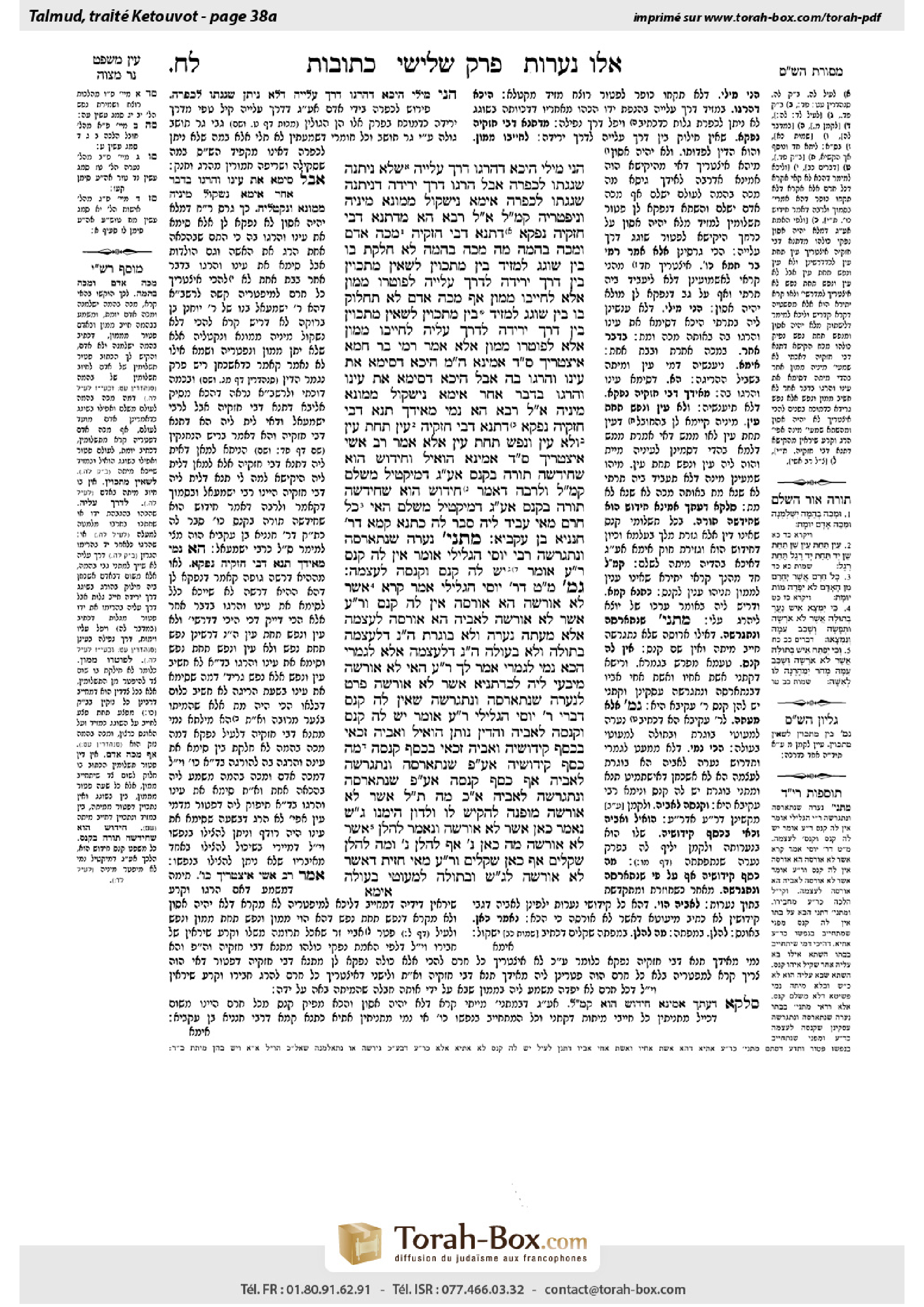
This page of Ketubot includes the Aramaic text, an English translation and an AI-generated French translation, alongside the scan above.
כתובות ל״ח א · Aramaic and Hebrew text
הָנֵי מִילֵּי, הֵיכָא דַּהֲרָגוֹ דֶּרֶךְ עֲלִיָּיה, שֶׁלֹּא נִיתְּנָה שִׁגְגָתוֹ לְכַפָּרָה. אֲבָל הֲרָגוֹ דֶּרֶךְ יְרִידָה, דְּנִיתְּנָה שִׁגְגָתוֹ לְכַפָּרָה, אֵימָא: נִישְׁקוֹל מָמוֹנָא מִינֵּיהּ וְנִיפְטְרֵיהּ, קָא מַשְׁמַע לַן.
אֲמַר לֵיהּ רָבָא: הָא מִדְּתַנָּא דְּבֵי חִזְקִיָּה נָפְקָא. דְּתָנָא דְּבֵי חִזְקִיָּה: ״מַכֵּה אָדָם״ וּ״מַכֵּה בְהֵמָה״.
מָה מַכֵּה בְהֵמָה לֹא חִלַּקְתָּ בּוֹ בֵּין שׁוֹגֵג לְמֵזִיד, בֵּין מִתְכַּוֵּין לְשֶׁאֵין מִתְכַּוֵּין, בֵּין דֶּרֶךְ יְרִידָה לְדֶרֶךְ עֲלִיָּיה — לְפוֹטְרוֹ מָמוֹן אֶלָּא לְחַיְּיבוֹ מָמוֹן. אַף מַכֵּה אָדָם לֹא תַּחְלוֹק בּוֹ בֵּין שׁוֹגֵג לְמֵזִיד, בֵּין מִתְכַּוֵּין לְשֶׁאֵין מִתְכַּוֵּין, בֵּין דֶּרֶךְ יְרִידָה לְדֶרֶךְ עֲלִיָּה — לְחַיְּיבוֹ מָמוֹן אֶלָּא לְפוֹטְרוֹ מָמוֹן.
אֶלָּא אָמַר רָמֵי בַּר חָמָא, אִיצְטְרִיךְ: סָלְקָא דַּעְתָּךְ אָמֵינָא, הָנֵי מִילֵּי הֵיכָא דְּסִימֵּא אֶת עֵינוֹ וַהֲרָגוֹ בָּהּ. אֲבָל הֵיכָא דְּסִימֵּא אֶת עֵינוֹ וַהֲרָגוֹ בְּדָבָר אַחֵר, אֵימָא נִישְׁקוֹל מָמוֹנָא מִינֵּיהּ. אֲמַר לֵיהּ רָבָא: הָא נָמֵי מֵאִידַּךְ תַּנָּא דְּבֵי חִזְקִיָּה נָפְקָא. דְּתָנָא דְּבֵי חִזְקִיָּה: ״עַיִן תַּחַת עַיִן״, וְלֹא עַיִן וְנֶפֶשׁ תַּחַת עַיִן.
אֶלָּא אָמַר רַב אָשֵׁי: אִיצְטְרִיךְ. סָלְקָא דַּעְתָּךְ אָמֵינָא הוֹאִיל וְחִידּוּשׁ הוּא שֶׁחִידְּשָׁה תּוֹרָה בִּקְנָס, אַף עַל גַּב דְּמִיקְּטִיל מְשַׁלֵּם, קָא מַשְׁמַע לַן. וּלְרַבָּה דְּאָמַר חִידּוּשׁ הוּא שֶׁחִידְּשָׁה תּוֹרָה בִּקְנָס, אַף עַל גַּב דְּמִיקְּטִיל מְשַׁלֵּם, הַאי ״כׇּל חֵרֶם״ מַאי עָבֵיד לֵיהּ? סָבַר לַהּ כְּתַנָּא קַמָּא דְּרַבִּי חֲנַנְיָא בֶּן עֲקַבְיָא.
מַתְנִי׳ נַעֲרָה שֶׁנִּתְאָרְסָה וְנִתְגָּרְשָׁה — רַבִּי יוֹסֵי הַגְּלִילִי אוֹמֵר: אֵין לָהּ קְנָס. רַבִּי עֲקִיבָא אוֹמֵר: יֵשׁ לָהּ קְנָס, וּקְנָסָהּ לְעַצְמָהּ.
גְּמָ׳ מַאי טַעְמָא דְּרַבִּי יוֹסֵי הַגְּלִילִי — אָמַר קְרָא: ״אֲשֶׁר לֹא אוֹרָשָׂה״, הָא אוֹרָסָה — אֵין לָהּ קְנָס. וְרַבִּי עֲקִיבָא? ״אֲשֶׁר לֹא אוֹרָשָׂה״ — לְאָבִיהָ, הָא אוֹרְסָה — לְעַצְמָהּ.
אֶלָּא מֵעַתָּה, ״נַעֲרָה״ וְלֹא בּוֹגֶרֶת, הָכִי נָמֵי דִּלְעַצְמָהּ? ״בְּתוּלָה״ וְלֹא בְּעוּלָה, הָכִי נָמֵי דִּלְעַצְמָהּ? אֶלָּא לִגְמָרֵי, הָכָא נָמֵי לִגְמָרֵי!
אָמַר לָךְ רַבִּי עֲקִיבָא: הַאי ״לָא אוֹרָשָׂה״ מִיבְּעֵי לֵיהּ לְכִדְתַנְיָא: ״אֲשֶׁר לֹא אוֹרָשָׂה״ — פְּרָט לְנַעֲרָה שֶׁנִּתְאָרְסָה וְנִתְגָּרְשָׁה, שֶׁאֵין לָהּ קְנָס, דִּבְרֵי רַבִּי יוֹסֵי הַגְּלִילִי. רַבִּי עֲקִיבָא אוֹמֵר: יֵשׁ לָהּ קְנָס, וּקְנָסָהּ לְאָבִיהָ. וְהַדִּין נוֹתֵן: הוֹאִיל וְאָבִיהָ זַכַּאי בְּכֶסֶף קִידּוּשֶׁיהָ, וְאָבִיהָ זַכַּאי בְּכֶסֶף קְנָסָהּ. מָה כֶּסֶף קִידּוּשֶׁיהָ, אַף עַל פִּי שֶׁנִּתְאָרְסָה וְנִתְגָּרְשָׁה — לְאָבִיהָ, אַף כֶּסֶף קְנָסָהּ, אַף עַל פִּי שֶׁנִּתְאָרְסָה וְנִתְגָּרְשָׁה — לְאָבִיהָ.
אִם כֵּן, מָה תַּלְמוּד לוֹמַר: ״אֲשֶׁר לֹא אוֹרָשָׂה״ — מוּפְנֶה, לְהַקִּישׁ לוֹ וְלָדוּן הֵימֶנּוּ גְּזֵירָה שָׁוָה: נֶאֱמַר כָּאן ״אֲשֶׁר לֹא אוֹרָשָׂה״, וְנֶאֱמַר לְהַלָּן ״אֲשֶׁר לֹא אוֹרָשָׂה״. מָה כָּאן חֲמִשִּׁים — אַף לְהַלָּן חֲמִשִּׁים, וּמָה לְהַלָּן שְׁקָלִים — אַף כָּאן שְׁקָלִים.
וְרַבִּי עֲקִיבָא, מַאי חָזֵית דַּ״אֲשֶׁר לֹא אוֹרָשָׂה״ לִגְזֵירָה שָׁוָה, וּ״בְתוּלָה״ לְמַעוֹטֵי בְּעוּלָה?
Ketubot 38a · English translation
this principle, that one cannot pay in lieu of execution, applies only when one intentionally killed him in an upward motion, for which no atonement is designated in the Torah for its unwitting performance. However, with regard to one who intentionally killed him in a downward motion, for which atonement, i.e., exile, is designated in the Torah for its unwitting performance, say: Let us take money from him and exempt him. Therefore, the phrase “any ḥerem” teaches us that even in that case there is no payment in lieu of execution.
Rava said to him: That principle is derived from that which the Sage of the school of Ḥizkiyya taught, as the Sage of the school of Ḥizkiyya taught: The verse juxtaposes the cases of one who smites a person, and one who smites an animal (Leviticus 24:21).
Just as in the case of one who smites an animal, you did not distinguish between one who did so unwittingly and one who did so intentionally; between one who acted with intent and one who acted with no intent; between one who smites in the course of a downward motion and one who smites in the course of an upward motion; and in all those cases it is not to exempt him from paying money but rather to obligate him to pay money; so too in the case of one who smites a person: Do not distinguish between one who did so unwittingly and one who did so intentionally; between one who acted with intent and one who acted with no intent; between one who smites in the course of a downward motion and one who smites in the course of an upward motion; and in all those cases it is not to obligate him to pay money but rather to exempt him from paying money. Apparently, one who kills another in any manner is exempt from payment, and therefore no additional verse is required to derive that principle.
Rather, Rami bar Ḥama said that the phrase “any ḥerem” (Leviticus 27:29) is necessary, as it might enter your mind to say that this halakha, that one who is liable to be executed is exempt from payment, applies only in a case where one blinded another’s eye and killed him with that same blow. However, in a case where one blinded another’s eye and killed him by means of a different blow, say: Let us take money from him to pay the damage inflicted to the eye. Therefore, the verse teaches that this is not the case. Rava said to him: This case of one who blinded another’s eye and killed him is also derived from that which another tanna of the school of Ḥizkiyya taught, as the Sage of the school of Ḥizkiyya taught that the verse states: “An eye for an eye” (Exodus 21:24), from which it may be inferred, but not an eye and a life for an eye. When he gives his life for killing another while blinding him, he need not pay the worth of the eye as well.
Rather, after the Gemara rejected the above explanations, Rav Ashi said: The phrase “any ḥerem” is nonetheless necessary, as it might enter your mind to say: Since it is a novel element that the Torah introduced with regard to the payment of a fine, which is not payment for any damage caused but is a Torah decree, in that case, even though he is killed he pays the fine. Therefore, the verse teaches us that one who is executed is exempt from payment of the fine. The Gemara asks: And according to Rabba, who said that this is indeed the halakha: Since it is a novel element that the Torah introduced with regard to the payment of a fine, even though he is killed he pays the fine, what does he do with this phrase: “Any ḥerem”? The Gemara answers: Rabba holds with regard to this matter in accordance with the opinion of the first tanna, who disagrees with Rabbi Ḥananya ben Akavya and explains that the phrase “Any ḥerem” teaches that the vow one takes to donate the valuation of one being taken to his execution is not binding.
MISHNA: With regard to a young woman who was betrothed and divorced, and then raped, Rabbi Yosei HaGelili says: She does not receive payment of a fine for her rape. Rabbi Akiva says: She receives payment of a fine for her rape and her fine is paid to herself, not her father, as since she was betrothed and divorced she is no longer subject to her father’s authority.
GEMARA: What is the rationale for the opinion of Rabbi Yosei HaGelili? It is as the verse states: “If a man finds a young woman who is a virgin who was not betrothed” (Deuteronomy 22:28), from which it may be inferred: If she was betrothed she does not have a fine for rape. The Gemara asks: And how does Rabbi Akiva explain this verse? The Gemara answers that the verse states: If it is a young woman who was not betrothed, the fine is paid to her father, from which it may be inferred: If she was betrothed, the fine is paid to the betrothed woman herself.
The Gemara asks: But if that is so, that the inference from the verse is that the fine is levied on one who rapes a young woman and not on one who rapes a grown woman, so too, there is the halakha in the latter case that the fine is paid to the grown woman herself. Similarly, with regard to the inference that the fine is levied on one who rapes a virgin and not on one who rapes a non-virgin, so too, there is the halakha that in the latter case the fine is paid to the non-virgin herself. A distinction of that kind has never been encountered. Rather, with regard to a grown woman and a non-virgin, the rapist is completely exempt from paying the fine; here too, with regard to a betrothed woman, the rapist is completely exempt from paying the fine.
The Gemara answers: Rabbi Akiva could have said to you that this verse: “Who was not betrothed,” is required by him to teach another halakha that is taught in a different baraita. “Who was not betrothed” (Deuteronomy 22:28) comes to exclude a young woman who was betrothed and divorced and establish that she does not receive payment of a fine for her rape; this is the statement of Rabbi Yosei HaGelili. Rabbi Akiva says: She receives payment of a fine for her rape, and her fine goes to her father, contrary to the ruling attributed to Rabbi Akiva in the mishna. And ostensibly, no verse is required to derive this halakha, as logic dictates that it is so: Since her father is entitled to the money of her betrothal if she is betrothed before she becomes a grown woman, and likewise her father is entitled to the money of her fine; just as the money of her subsequent betrothal as a young woman, even though she was betrothed and divorced, is paid to her father, so too, the money of her fine, although she was betrothed and divorced, is paid to her father.
If so, and the halakha can be logically inferred, why does the verse state: “Who was not betrothed”? This verse is free, as it is superfluous in its own context, and it is written to liken another case to it, and to derive from it a verbal analogy: It is stated here with regard to a woman who was raped: “Who was not betrothed,” and it is stated below: “And if a man seduce a virgin who was not betrothed” (Exodus 22:15). Just as here, with regard to rape, the Torah specifies that the payment is fifty silver pieces (Deuteronomy 22:29), so too below, with regard to seduction, the payment is fifty. And just as below, with regard to seduction, the payment is in shekels, as it is written: “He shall weigh [yishkol] money” (Exodus 22:16), so too here, the payment is in shekels.
The Gemara asks: And Rabbi Akiva, what did you see that led you to utilize the phrase: “Who was not betrothed” for a verbal analogy, and the term “virgin” to exclude a non-virgin from the fine?
Ketubot 38a · Traduction française (IA)
Ce principe, selon lequel on ne peut pas payer à la place de subir l’exécution, ne s’applique que lorsqu’il l’a tué intentionnellement d’un mouvement ascendant, cas pour lequel la Torah ne prévoit aucune expiation en cas d’acte involontaire. Mais, s’agissant de celui qui l’a tué intentionnellement d’un mouvement descendant, cas pour lequel la Torah prévoit une expiation — à savoir l’exil — en cas d’acte involontaire, disons : « Prenons-lui de l’argent et exemptons-le. » C’est pourquoi l’expression « tout ḥerem » nous enseigne que, même dans ce cas, aucun paiement ne peut se substituer à l’exécution.
Rava lui dit : Ce principe se déduit de ce qu’enseigna le Sage de l’école de Ḥizkiyya, car celui-ci enseigna : Le verset met en parallèle le cas de celui qui frappe une personne et celui de celui qui frappe un animal (Lévitique 24,21).
De même que, dans le cas de celui qui frappe un animal, vous n’avez pas distingué entre celui qui l’a fait involontairement et celui qui l’a fait intentionnellement, entre celui qui a agi avec intention et celui qui a agi sans intention, ni entre celui qui frappe d’un mouvement descendant et celui qui frappe d’un mouvement ascendant — et que, dans tous ces cas, il ne s’agit pas de l’exempter du paiement, mais au contraire de l’obliger à payer —, de même, dans le cas de celui qui frappe une personne, ne distinguez pas entre celui qui l’a fait involontairement et celui qui l’a fait intentionnellement, entre celui qui a agi avec intention et celui qui a agi sans intention, ni entre celui qui frappe d’un mouvement descendant et celui qui frappe d’un mouvement ascendant ; dans tous ces cas, il ne s’agit pas de l’obliger à payer, mais au contraire de l’exempter du paiement. Apparemment, celui qui tue autrui de quelque manière que ce soit est exempt de paiement ; aucun verset supplémentaire n’est donc nécessaire pour établir ce principe.
Rami bar Ḥama dit plutôt que l’expression « tout ḥerem » (Lévitique 27,29) est nécessaire, car on aurait pu penser que cette halakha — selon laquelle celui qui est passible d’exécution est exempt de paiement — ne s’applique que dans le cas où il a crevé l’œil d’un homme et l’a tué du même coup. Mais, dans le cas où il lui a crevé l’œil et l’a tué d’un autre coup, disons : « Prenons-lui de l’argent pour indemniser le dommage causé à l’œil. » Le verset enseigne que ce n’est pas le cas. Rava lui dit : Le cas de celui qui a crevé l’œil d’un homme et l’a tué se déduit lui aussi de ce qu’enseigna un autre tanna de l’école de Ḥizkiyya. En effet, le Sage de l’école de Ḥizkiyya enseigna que le verset dit : « Œil pour œil » (Exode 21,24), ce dont on peut déduire : mais non un œil et une vie pour un œil. Lorsqu’il donne sa vie pour avoir tué autrui en lui crevant l’œil, il n’a pas à payer en plus la valeur de l’œil.
Après que la Guemara eut rejeté les explications précédentes, Rav Ashi dit plutôt : L’expression « tout ḥerem » est néanmoins nécessaire, car on aurait pu penser : puisque le paiement d’une amende est une innovation introduite par la Torah — il ne s’agit pas d’indemniser un dommage causé, mais d’un décret de la Torah —, même s’il est exécuté, il paie l’amende. Le verset nous enseigne donc que celui qui est exécuté est exempt du paiement de l’amende. La Guemara demande : Et selon Rabba, qui a dit que telle est effectivement la halakha, à savoir que, puisque le paiement d’une amende est une innovation introduite par la Torah, même s’il est exécuté, il paie l’amende, que fait-il de cette expression : « Tout ḥerem » ? La Guemara répond : Rabba suit sur ce point l’opinion du premier tanna, qui conteste celle de Rabbi Ḥananya ben Akavya et explique que l’expression « tout ḥerem » enseigne que le vœu par lequel on s’engage à donner la valeur estimée d’une personne conduite à son exécution n’est pas valable.
MICHNA : Au sujet d’une jeune fille qui a été fiancée puis divorcée, et qui a ensuite été violée, Rabbi Yosei HaGelili dit : Elle ne reçoit pas l’amende pour viol. Rabbi Akiva dit : Elle reçoit l’amende pour viol, et celle-ci lui est versée à elle, et non à son père, car, ayant été fiancée puis divorcée, elle n’est plus soumise à l’autorité de son père.
GUEMARA : Quel est le fondement de l’opinion de Rabbi Yosei HaGelili ? Le verset dit : « Si un homme trouve une jeune fille vierge qui n’a pas été fiancée » (Deutéronome 22,28), ce dont on peut déduire : si elle a été fiancée, elle n’a pas droit à l’amende pour viol. La Guemara demande : Comment Rabbi Akiva explique-t-il ce verset ? La Guemara répond que le verset dit : si c’est une jeune fille qui n’a pas été fiancée, l’amende est versée à son père ; on peut en déduire que, si elle a été fiancée, l’amende est versée à la jeune fille elle-même.
La Guemara demande : Mais si tel est le cas, si l’on déduit du verset que l’amende est imposée à celui qui viole une jeune fille, et non à celui qui viole une femme adulte, il devrait également en résulter que, dans ce dernier cas, l’amende est versée à la femme adulte elle-même. De même, si l’on déduit que l’amende est imposée à celui qui viole une vierge, et non à celui qui viole une femme qui n’est pas vierge, il devrait également en résulter que, dans ce dernier cas, l’amende est versée à cette femme elle-même. On n’a jamais rencontré une telle distinction. Au contraire, dans le cas d’une femme adulte ou d’une femme qui n’est pas vierge, le violeur est entièrement exempt du paiement de l’amende ; ici aussi, dans le cas d’une femme fiancée, le violeur est entièrement exempt du paiement de l’amende.
La Guemara répond : Rabbi Akiva aurait pu te dire que, pour lui, le verset « qui n’a pas été fiancée » sert à enseigner une autre halakha, rapportée dans une autre baraïta. L’expression « qui n’a pas été fiancée » (Deutéronome 22,28) vient exclure une jeune fille qui a été fiancée puis divorcée et établir qu’elle ne reçoit pas l’amende pour viol ; telle est la déclaration de Rabbi Yosei HaGelili. Rabbi Akiva dit : Elle reçoit l’amende pour viol, et celle-ci revient à son père, contrairement à la décision attribuée à Rabbi Akiva dans la Michna. Or, apparemment, aucun verset n’est nécessaire pour déduire cette halakha, car la logique l’impose : puisque son père a droit à l’argent de ses fiançailles si elle est fiancée avant de devenir une femme adulte, et que son père a également droit à l’argent de son amende, de même que l’argent de ses fiançailles ultérieures, alors qu’elle est encore une jeune fille, est versé à son père, bien qu’elle ait été fiancée puis divorcée, l’argent de son amende est lui aussi versé à son père, bien qu’elle ait été fiancée puis divorcée.
Si tel est le cas, et que la halakha peut être déduite par raisonnement, pourquoi le verset dit-il : « qui n’a pas été fiancée » ? Cette expression est libre, car elle est superflue dans son contexte, et elle est écrite pour assimiler un autre cas à celui-ci et en tirer une analogie verbale : il est dit ici, au sujet d’une femme violée, « qui n’a pas été fiancée », et il est dit plus loin : « Et si un homme séduit une vierge qui n’a pas été fiancée » (Exode 22,15). De même qu’ici, dans le cas du viol, la Torah précise que le paiement est de cinquante pièces d’argent (Deutéronome 22,29), de même, plus loin, dans le cas de la séduction, le paiement est de cinquante. Et de même que, plus loin, dans le cas de la séduction, le paiement est en sicles, comme il est écrit : « Il pèsera [yishkol] de l’argent » (Exode 22,16), de même ici, le paiement est en sicles.
La Guemara demande : Et Rabbi Akiva, pourquoi as-tu choisi d’utiliser l’expression « qui n’a pas été fiancée » pour une analogie verbale, et le terme « vierge » pour exclure du paiement de l’amende une femme qui n’est pas vierge ?
Traduction française générée par IA à partir de l’édition anglaise de Sefaria. Vérifie toujours un passage avec le texte source.
Text from Sefaria: William Davidson Edition - Vocalized Aramaic (CC BY NC); William Davidson Edition - English (CC BY NC).