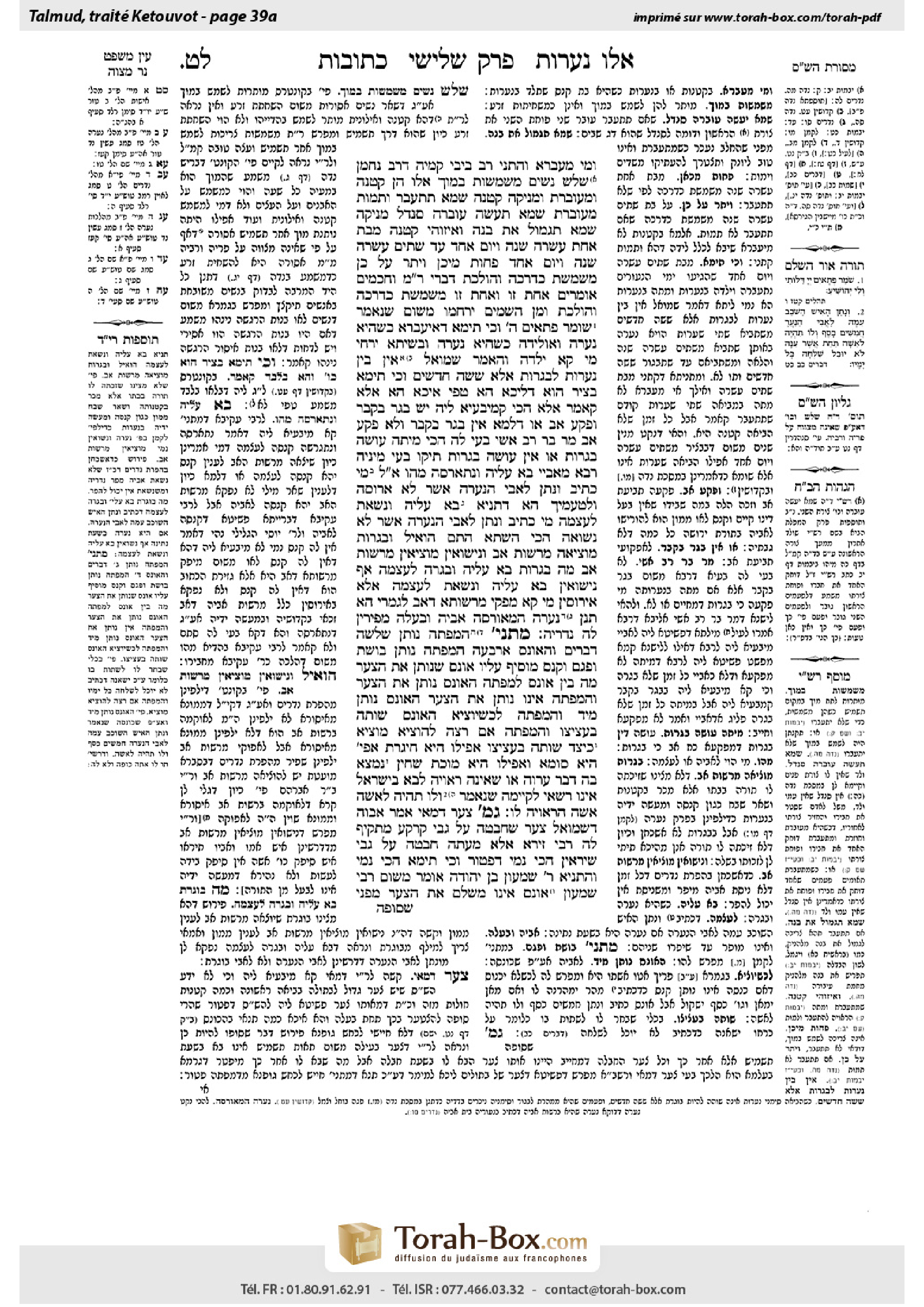
Ketubot 39a: Talmud study for Daf Yomi
Daf Yomi is the daily study of one Talmud folio. Explore 37 tractates with scans, Hebrew text, Sefaria English and AI-generated French translations where annotated.
Passage selection and English or AI-generated French translation are available where the scan has annotations. Daf Study is independent of Torah-Box and Sefaria.
Browse Ketubot · כתובות · All tractatesKetubot 39a text and translations
This page of Ketubot includes the Aramaic text, an English translation and an AI-generated French translation, alongside the scan above.
כתובות ל״ט א · Aramaic and Hebrew text
וּמִי מִעַבְּרָא? וְהָתָנֵי רַב בִּיבִי קַמֵּיהּ דְּרַב נַחְמָן: שָׁלֹשׁ נָשִׁים מְשַׁמְּשׁוֹת בְּמוֹךְ, אֵלּוּ הֵן: קְטַנָּה, וּמְעוּבֶּרֶת, וּמְנִיקָה. קְטַנָּה — שֶׁמָּא תִּתְעַבֵּר וְתָמוּת, מְעוּבֶּרֶת — שֶׁמָּא תַּעֲשֶׂה עוּבָּרָהּ סַנְדָּל, מְנִיקָה — שֶׁמָּא תִּגְמוֹל אֶת בְּנָהּ.
וְאֵיזוֹהִי קְטַנָּה — מִבַּת אַחַת עֶשְׂרֵה שָׁנָה וְיוֹם אֶחָד עַד שְׁתֵּים עֶשְׂרֵה שָׁנָה וְיוֹם אֶחָד. פָּחוֹת מִיכֵּן וְיָתֵר עַל כֵּן מְשַׁמֶּשֶׁת כְּדַרְכָּהּ וְהוֹלֶכֶת, דִּבְרֵי רַבִּי מֵאִיר. וַחֲכָמִים אוֹמְרִים: אַחַת זוֹ וְאַחַת זוֹ מְשַׁמֶּשֶׁת כְּדַרְכָּהּ וְהוֹלֶכֶת, וּמִן הַשָּׁמַיִם יְרַחֵמוּ, מִשּׁוּם שֶׁנֶּאֱמַר: ״שׁוֹמֵר פְּתָאִים ה׳״!
וְכִי תֵּימָא דְּאִיעַבַּרָא כְּשֶׁהִיא נַעֲרָה, וְאוֹלִידָה כְּשֶׁהִיא נַעֲרָה. וּבְשִׁיתָּא יַרְחֵי מִי קָא יָלְדָה? וְהָאָמַר שְׁמוּאֵל: אֵין בֵּין נַעֲרוּת לְבַגְרוּת אֶלָּא שִׁשָּׁה חֳדָשִׁים. וְכִי תֵּימָא: בְּצִיר הוּא דְּלֵיכָּא, הָא טְפֵי — אִיכָּא, הָא ״אֶלָּא״ קָאָמַר!
אֶלָּא, הָכִי קָמִיבַּעְיָא לֵיהּ: יֵשׁ בֶּגֶר בַּקֶּבֶר וּפָקַע אָב, אוֹ דִלְמָא: אֵין בֶּגֶר בַּקֶּבֶר, וְלָא פָּקַע אָב? מָר בַּר רַב אָשֵׁי בָּעֵי לַהּ הָכִי: מִיתָה עוֹשָׂה בַּגְרוּת, אוֹ אֵין עוֹשָׂה בַּגְרוּת? תֵּיקוּ.
בְּעָא מִינֵּיהּ רָבָא מֵאַבָּיֵי: בָּא עָלֶיהָ וְנִתְאָרְסָה, מַהוּ? אֲמַר לֵיהּ, מִי כְּתִיב: ״וְנָתַן לַאֲבִי הַנַּעֲרָה אֲשֶׁר לֹא אֲרוּסָה״? וּלְטַעְמָיךְ, הָא דְּתַנְיָא: בָּא עָלֶיהָ וְנִשֵּׂאת, לְעַצְמָהּ: מִי כְּתִיב ״וְנָתַן לַאֲבִי הַנַּעֲרָה אֲשֶׁר לֹא נְשׂוּאָה״?
הָכִי הַשְׁתָּא?! הָתָם, הוֹאִיל וּבַגְרוּת מוֹצִיאָה מֵרְשׁוּת אָב, וְנִישּׂוּאִין מוֹצִיאִין מֵרְשׁוּת אָב, מָה בַּגְרוּת בָּא עָלֶיהָ וּבָגְרָה — לְעַצְמָהּ, אַף נִישּׂוּאִין בָּא עָלֶיהָ וְנִשֵּׂאת — לְעַצְמָהּ. אֶלָּא אֵירוּסִין, מִי קָא מַפְּקִי מֵרְשׁוּתָא דְּאָב לִגְמָרֵי? הָא תְּנַן: נַעֲרָה הַמְאוֹרָסָה אָבִיהָ וּבַעְלָהּ מְפִירִין לָהּ נְדָרֶיהָ.
מַתְנִי׳ הַמְפַתֶּה נוֹתֵן שְׁלֹשָׁה דְּבָרִים, וְהָאוֹנֵס אַרְבָּעָה. הַמְפַתֶּה נוֹתֵן בּוֹשֶׁת וּפְגָם וּקְנָס, מוֹסִיף עָלָיו אוֹנֵס שֶׁנּוֹתֵן אֶת הַצַּעַר. מָה בֵּין אוֹנֵס לִמְפַתֶּה: הָאוֹנֵס נוֹתֵן אֶת הַצַּעַר, וְהַמְפַתֶּה אֵינוֹ נוֹתֵן אֶת הַצַּעַר. הָאוֹנֵס נוֹתֵן מִיָּד, וְהַמְפַתֶּה לִכְשֶׁיּוֹצִיא. הָאוֹנֵס שׁוֹתֶה בַּעֲצִיצוֹ, וְהַמְפַתֶּה, אִם רָצָה לְהוֹצִיא — מוֹצִיא.
כֵּיצַד שׁוֹתֶה בַּעֲצִיצוֹ: אֲפִילּוּ הִיא חִיגֶּרֶת, אֲפִילּוּ הִיא סוֹמָא, וַאֲפִילּוּ הִיא מוּכַּת שְׁחִין. נִמְצָא בָּהּ דְּבַר עֶרְוָה, אוֹ שֶׁאֵינָהּ רְאוּיָה לָבֹא בְּיִשְׂרָאֵל — אֵינוֹ רַשַּׁאי לְקַיְּימָהּ, שֶׁנֶּאֱמַר: ״וְלוֹ תִהְיֶה לְאִשָּׁה״, אִשָּׁה הָרְאוּיָה לוֹ.
גְּמָ׳ צַעַר דְּמַאי? אָמַר אֲבוּהּ דִּשְׁמוּאֵל: צַעַר שֶׁחֲבָטָהּ עַל גַּבֵּי קַרְקַע. מַתְקֵיף לַהּ רַבִּי זֵירָא: אֶלָּא מֵעַתָּה, חֲבָטָהּ עַל גַּבֵּי שִׁירָאִין, הָכִי נָמֵי דְּפָטוּר? וְכִי תֵּימָא הָכִי נָמֵי — וְהָתַנְיָא, רַבִּי שִׁמְעוֹן בֶּן יְהוּדָה אוֹמֵר מִשּׁוּם רַבִּי שִׁמְעוֹן: אוֹנֵס אֵינוֹ מְשַׁלֵּם אֶת הַצַּעַר — מִפְּנֵי
Ketubot 39a · English translation
Rava’s dilemma is based on the assumption that a rape victim is able to conceive before she is a grown woman. The Gemara asks: And can a minor conceive? But didn’t Rav Beivai teach a baraita before Rav Naḥman: It is permitted for three women to engage in relations with a contraceptive resorbent. These are they: A minor, and a pregnant woman, and a nursing woman. The baraita elaborates: A minor may do so lest she conceive and die; a pregnant woman, lest her existing fetus be crushed by another fetus and assume the shape of a sandal fish if she conceives a second time; and a nursing woman, lest she conceive, causing her milk to spoil, which will lead her to wean her son prematurely, endangering his health.
And the baraita further states: What is a minor girl? A minor girl is a girl from eleven years and one day old until twelve years and one day old. If she was less than that age or more than that age, she proceeds and engages in relations in her usual manner; this is the statement of Rabbi Meir. And the Rabbis say: Both this woman and that woman, i.e., in the cases of all these women, she proceeds and engages in relations in her usual manner, and from Heaven they will have mercy and prevent any mishap, due to the fact that it is stated: “The Lord preserves the simple” (Psalms 116:6). Apparently, a minor is unable to conceive.
And if you say that she conceived when she was a young woman, twelve years old, and gave birth when she was a young woman, and died before she reached the status of a grown woman, can a woman give birth in six months after conception? But didn’t Shmuel say: There are only six months between becoming a young woman and becoming a grown woman? And if you say that Shmuel is saying that it is less than six months that there is not transition from young woman to grown woman status; however, more than six months there is transition, as different women develop differently, and therefore she could conceive and give birth while she is a young woman, that is not so, as Shmuel said: Only, indicating that the period is neither less nor more than six months.
Rather, Rava’s dilemma is unrelated to whether or not her son inherits the fine payment. This is his dilemma: Is there achievement of grown-woman status in the grave and therefore the right of the father to receive payment of the fine lapsed; and since there is no one claiming the payment, the rapist need not pay? Or perhaps there is no achievement of grown-woman status in the grave, and the right of the father did not lapse. Mar bar Rav Ashi raised the dilemma in this manner: Does death effect grown-woman status or does it not effect grown-woman status? No resolution was found for this dilemma, and the Gemara concludes that the dilemma stands unresolved.
On a similar note, Rava inquired of Abaye: If he forcibly had intercourse with a young woman and she was later betrothed, what is the halakha? Abaye said to him: Is it written: And he shall give to the father of the young woman who is not betrothed? Actually it is written: “If a man finds a young woman…who was not betrothed” (Deuteronomy 22:28), which indicates that the determining factor is whether she was betrothed before the rape and not whether she is engaged at the moment of payment. Rava asked him: And according to your reasoning, that which was taught in a baraita: If he forcibly had intercourse with a young woman and she later married, the fine is paid to her, not to her father. There too, ask: Is it written: And he shall give to the father of the young woman who is not married? Even though the verse does not address the moment of payment, if she married the fine is paid to her.
Abaye retorted: How can these cases be compared? There, in the case of marriage, there is reason to diverge from the plain meaning of the verse, as grown-woman status removes her from the authority of the father and marriage removes her from the authority of the father. Just as with regard to grown-woman status, if he forcibly had intercourse with her and she became a grown woman, the fine is paid to her, as it is written: “And he shall give to the father of the young woman” (Deuteronomy 22:29); so too, with regard to marriage, if he forcibly had intercourse with her and she later married, the fine is paid to her. However, with regard to betrothal, does it remove her from the authority of the father entirely? Didn’t we learn in a mishna (Nedarim 66b): With regard to a betrothed young woman, her father and her husband together nullify her vows? Apparently, betrothal does not remove her entirely from her father’s authority, and therefore, the halakha with regard to betrothal cannot be derived from the halakha with regard to grown-woman status. Therefore, Rava’s question is not difficult.
MISHNA: The seducer gives the father of his victim three things, and the rapist gives the father four. The mishna specifies: The seducer gives the father payments for humiliation, degradation, and the fine. A rapist adds an addition to his payments, as he also gives payment for the pain. What are the differences between the halakha of a rapist and that of a seducer? The rapist gives payment for the pain, and the seducer does not give payment for the pain. The rapist gives payment immediately, and the seducer does not pay those payments immediately but only when he releases her. The rapist drinks from his vessel [atzitzo], i.e., marries the woman he raped, perforce, and the seducer, if he wishes to release her, he releases her.
The mishna clarifies: How does the rapist drink from his vessel? Even if the woman he raped is lame, even if she is blind, and even if she is afflicted with boils, he is obligated to marry her and may not divorce her. However, if a matter of licentiousness is found in her, e.g., if she committed adultery, or if she is unfit to enter the Jewish people, e.g., if she is a mamzeret, he is not permitted to sustain her as his wife, as it is stated: “And to him she shall be as a wife” (Deuteronomy 22:29), from which it is inferred that she must be a woman who is legally suitable for him.
GEMARA: The mishna taught that a rapist pays for the pain that he caused. The Gemara asks: For what pain is he obligated to pay? Shmuel’s father said: It is for the pain that he caused when he slammed her onto the ground while raping her. Rabbi Zeira strongly objects to this: But if what you say is so, if he slammed her onto silk, so too is the halakha that he is exempt from payment for pain? And if you say indeed that it is so, but isn’t it taught in a baraita that Rabbi Shimon ben Yehuda says in the name of Rabbi Shimon: A rapist does not pay for the pain due to the fact
Ketubot 39a · Traduction française (IA)
Le dilemme de Rava repose sur l’hypothèse qu’une victime de viol peut concevoir avant d’atteindre le statut de femme adulte. La Guemara demande : Une mineure peut-elle concevoir ? Rav Beivai n’a-t-il pas enseigné une baraïta devant Rav Naḥman : Il est permis à trois femmes d’avoir des rapports en utilisant un pessaire contraceptif. Lesquelles ? Une mineure, une femme enceinte et une femme qui allaite. La baraïta précise : Une mineure peut le faire de peur qu’elle ne conçoive et ne meure ; une femme enceinte, de peur que le fœtus qu’elle porte ne soit écrasé par un autre fœtus et ne prenne la forme d’un poisson-sandale si elle conçoit une seconde fois ; et une femme qui allaite, de peur qu’elle ne conçoive, ce qui altérerait son lait et l’amènerait à sevrer son fils prématurément, mettant ainsi sa santé en danger.
La baraïta ajoute : Qu’est-ce qu’une jeune fille mineure ? C’est une jeune fille âgée de onze ans et un jour jusqu’à douze ans et un jour. Si elle est plus jeune ou plus âgée, elle peut avoir des rapports de la manière habituelle ; telle est l’opinion de Rabbi Meïr. Les Sages disent : Dans les deux cas, c’est-à-dire pour chacune de ces femmes, elle peut avoir des rapports de la manière habituelle, et le Ciel aura pitié d’elles et les préservera de tout malheur, car il est dit : « Le Seigneur protège les simples » (Psaumes 116, 6). Il semble donc qu’une mineure soit incapable de concevoir.
Et si tu dis qu’elle a conçu alors qu’elle était une jeune fille, à douze ans, qu’elle a accouché alors qu’elle était encore une jeune fille et qu’elle est morte avant d’atteindre le statut de femme adulte, une femme peut-elle accoucher six mois après la conception ? Shmuel n’a-t-il pas dit qu’il n’y a que six mois entre le moment où elle devient une jeune fille et celui où elle devient une femme adulte ? Et si tu dis que Shmuel veut dire qu’il n’y a pas de passage du statut de jeune fille à celui de femme adulte avant six mois, mais qu’au-delà de six mois ce passage s’effectue, puisque les femmes ne se développent pas toutes au même rythme, et qu’elle pourrait donc concevoir et accoucher alors qu’elle est encore une jeune fille, ce n’est pas le cas : Shmuel a dit « seulement », indiquant que cette période n’est ni inférieure ni supérieure à six mois.
En réalité, le dilemme de Rava ne concerne pas la question de savoir si son fils hérite ou non du paiement de l’amende. Voici son dilemme : Le statut de femme adulte s’acquiert-il dans la tombe, de sorte que le droit du père à percevoir l’amende s’éteint et que, faute de réclamant, le violeur n’a pas à payer ? Ou bien le statut de femme adulte ne s’acquiert-il pas dans la tombe, et le droit du père ne s’éteint-il donc pas ? Mar bar Rav Ashi formula le dilemme ainsi : La mort confère-t-elle le statut de femme adulte ou non ? Aucune réponse n’ayant été trouvée, la Guemara conclut que le dilemme demeure sans solution.
Dans le même ordre d’idées, Rava demanda à Abaye : S’il a violé une jeune fille et qu’elle s’est ensuite fiancée, quelle est la halakha ? Abaye lui répondit : Est-il écrit : « Il donnera au père de la jeune fille qui n’est pas fiancée » ? Or, il est en réalité écrit : « Si un homme trouve une jeune fille… qui n’était pas fiancée » (Deutéronome 22, 28), ce qui indique que le critère est de savoir si elle était fiancée avant le viol, et non si elle l’est au moment du paiement. Rava lui demanda : Selon ton raisonnement, à propos de ce qui a été enseigné dans une baraïta — s’il a violé une jeune fille et qu’elle s’est ensuite mariée, l’amende lui est versée à elle, et non à son père — il faudrait également demander : Est-il écrit : « Il donnera au père de la jeune fille qui n’est pas mariée » ? Bien que le verset ne traite pas du moment du paiement, si elle s’est mariée, l’amende lui est versée à elle.
Abaye rétorqua : Comment peut-on comparer ces cas ? Dans le cas du mariage, il y a une raison de s’écarter du sens littéral du verset : le statut de femme adulte la soustrait à l’autorité de son père, tout comme le mariage la soustrait à son autorité. De même que, lorsqu’elle atteint le statut de femme adulte après avoir été violée, l’amende lui est versée à elle, comme il est écrit : « Il donnera au père de la jeune fille » (Deutéronome 22, 29), de même, si elle se marie après avoir été violée, l’amende lui est versée à elle. Mais les fiançailles la soustraient-elles entièrement à l’autorité de son père ? N’avons-nous pas appris dans une Michna (Nedarim 66b) : Pour une jeune fille fiancée, son père et son mari annulent ensemble ses vœux ? Il semble que les fiançailles ne la soustraient pas entièrement à l’autorité de son père ; la halakha relative aux fiançailles ne peut donc pas être déduite de celle relative au statut de femme adulte. La question de Rava ne présente donc pas de difficulté.
MICHNA : Le séducteur verse au père de sa victime trois paiements, et le violeur lui en verse quatre. La Michna précise : Le séducteur verse au père les paiements pour l’humiliation, l’atteinte à la dignité et l’amende. Le violeur ajoute un paiement supplémentaire : il paie également pour la douleur. Quelles sont les différences entre la halakha du violeur et celle du séducteur ? Le violeur paie pour la douleur, tandis que le séducteur ne paie pas pour la douleur. Le violeur paie immédiatement, tandis que le séducteur ne verse ces paiements qu’au moment où il la libère. Le violeur boit dans son propre récipient [atzitzo], c’est-à-dire qu’il épouse de force la femme qu’il a violée ; quant au séducteur, s’il souhaite la libérer, il le fait.
La Michna précise : Comment le violeur boit-il dans son propre récipient ? Même si la femme qu’il a violée est boiteuse, aveugle ou couverte de furoncles, il est tenu de l’épouser et ne peut pas la répudier. Toutefois, si un comportement licencieux est découvert chez elle, par exemple si elle a commis un adultère, ou si elle n’est pas apte à intégrer le peuple juif, par exemple si elle est une mamzeret, il ne lui est pas permis de la garder pour épouse, comme il est dit : « Elle sera sa femme » (Deutéronome 22, 29), ce dont on déduit qu’elle doit être une femme qu’il est légalement autorisé à épouser.
GUEMARA : La Michna enseigne que le violeur paie pour la douleur qu’il a causée. La Guemara demande : Pour quelle douleur est-il tenu de payer ? Le père de Shmuel dit : Pour la douleur qu’il lui a causée en la plaquant au sol pendant le viol. Rabbi Zeira s’y oppose vivement : Mais si ce que tu dis est vrai, s’il l’a plaquée sur de la soie, est-il également dispensé de payer pour la douleur ? Et si tu dis que c’est effectivement le cas, une baraïta n’enseigne-t-elle pas que Rabbi Shimon ben Yehuda dit au nom de Rabbi Shimon : Un violeur ne paie pas pour la douleur, parce que
Traduction française générée par IA à partir de l’édition anglaise de Sefaria. Vérifie toujours un passage avec le texte source.
Text from Sefaria: William Davidson Edition - Vocalized Aramaic (CC BY NC); William Davidson Edition - English (CC BY NC).