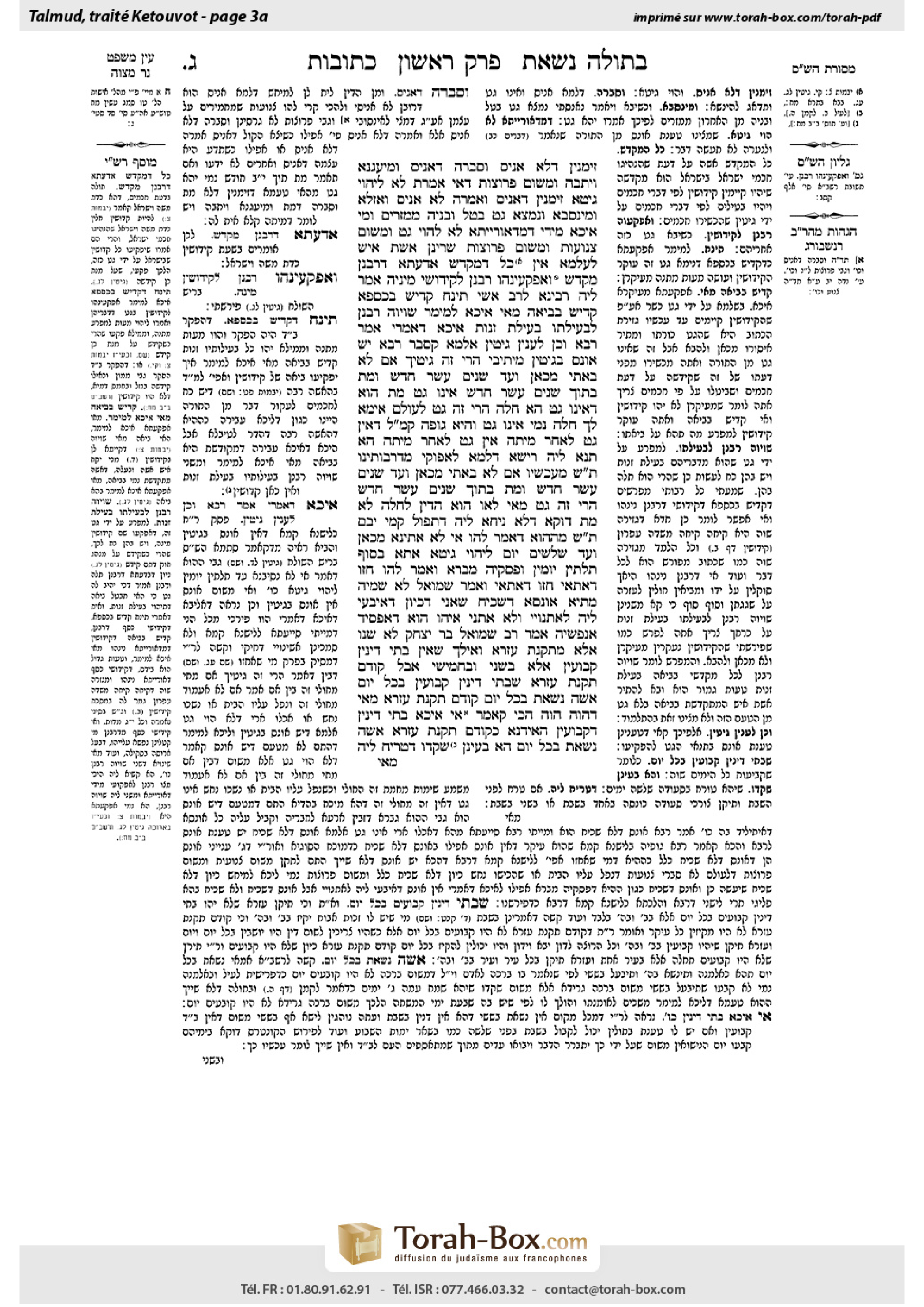
Ketubot 3a: Talmud study for Daf Yomi
Daf Yomi is the daily study of one Talmud folio. Explore 37 tractates with scans, Hebrew text, Sefaria English and AI-generated French translations where annotated.
Passage selection and English or AI-generated French translation are available where the scan has annotations. Daf Study is independent of Torah-Box and Sefaria.
Browse Ketubot · כתובות · All tractatesKetubot 3a text and translations
This page of Ketubot includes the Aramaic text, an English translation and an AI-generated French translation, alongside the scan above.
כתובות ג׳ א · Aramaic and Hebrew text
זִימְנִין דְּלָא אֲנִיס וְסָבְרָה דַּאֲנִיס, וּמִיעַגְּנָא וְיָתְבָה. וּמִשּׁוּם פְּרוּצוֹת — דְּאִי אָמְרַתְּ לָא לֶיהֱוֵי גִּיטָּא, זִימְנִין דַּאֲנִיס וְאָמְרָה לָא אֲנִיס, וְאָזְלָא וּמִינַּסְבָא, וְנִמְצָא גֵּט בָּטֵל וּבָנֶיהָ מַמְזֵרִים.
וּמִי אִיכָּא מִידֵּי דְּמִדְּאוֹרָיְיתָא לָא לֶהֱוֵי גֵּט, וּמִשּׁוּם צְנוּעוֹת וּמִשּׁוּם פְּרוּצוֹת שָׁרִינַן אֵשֶׁת אִישׁ לְעָלְמָא?!
אִין, כׇּל דִּמְקַדֵּשׁ אַדַּעְתָּא דְּרַבָּנַן מְקַדֵּשׁ, וְאַפְקְעִינְהוּ רַבָּנַן לְקִידּוּשֵׁי מִינֵּיהּ.
אֲמַר לֵיהּ רָבִינָא לְרַב אָשֵׁי: תִּינַח קַדֵּישׁ בְּכַסְפָּא. קַדֵּישׁ בְּבִיאָה מַאי אִיכָּא לְמֵימַר? שַׁוְּיוּהּ רַבָּנַן לִבְעִילָתוֹ בְּעִילַת זְנוּת.
אִיכָּא דְּאָמְרִי: אָמַר רָבָא, וְכֵן לְעִנְיַן גִּיטִּין. אַלְמָא קָסָבַר רָבָא יֵשׁ אוֹנֶס בְּגִיטִּין.
מֵיתִיבִי: ״הֲרֵי זֶה גִּיטֵּיךְ אִם לֹא בָּאתִי מִכָּאן וְעַד שְׁנֵים עָשָׂר חֹדֶשׁ״, וּמֵת בְּתוֹךְ שְׁנֵים עָשָׂר חֹדֶשׁ — אֵינוֹ גֵּט. מֵת הוּא דְּאֵינוֹ גֵּט, הָא חָלָה — הֲרֵי זֶה גֵּט!
לְעוֹלָם אֵימָא לָךְ חָלָה נָמֵי אֵינוֹ גֵּט, וְהִיא גּוּפַהּ קָא מַשְׁמַע לַן: דְּאֵין גֵּט לְאַחַר מִיתָה.
אֵין גֵּט לְאַחַר מִיתָה הָא תְּנָא לֵיהּ רֵישָׁא! דִּלְמָא לְאַפּוֹקֵי מִדְּרַבּוֹתֵינוּ.
תָּא שְׁמַע: ״מֵעַכְשָׁיו אִם לֹא בָּאתִי מִכָּאן וְעַד שְׁנֵים עָשָׂר חֹדֶשׁ״, וּמֵת בְּתוֹךְ שְׁנֵים עָשָׂר חֹדֶשׁ — הֲרֵי זֶה גֵּט. מַאי לָאו, הוּא הַדִּין לְחָלָה! לָא, מֵת דַּוְקָא, דְּלָא נִיחָא לֵיהּ דְּתִפּוֹל קַמֵּי יָבָם.
תָּא שְׁמַע מֵהָהוּא דַּאֲמַר לְהוּ ״אִי לָא אָתֵינָא מִכָּאן וְעַד שְׁלֹשִׁים יוֹם לֶיהֱוֵי גִּיטָּא״, אֲתָא בְּסוֹף תְּלָתִין יוֹמִין וּפַסְקֵיהּ מַבָּרָא, וַאֲמַר לְהוּ: ״חֲזוֹ דַּאֲתַאי! חֲזוֹ דַּאֲתַאי!״ וַאֲמַר שְׁמוּאֵל: לָא שְׁמֵיהּ מַתְיָא!
אוּנְסָא דִּשְׁכִיחַ — שָׁאנֵי, דְּכֵיוָן דְּאִיבְּעִי לֵיהּ לְאַתְנוֹיֵי וְלָא אַתְנִי, אִיהוּ הוּא דְּאַפְסֵיד אַנַּפְשֵׁיהּ.
אָמַר רַב שְׁמוּאֵל בַּר יִצְחָק: לֹא שָׁנוּ אֶלָּא מִתַּקָּנַת עֶזְרָא וְאֵילָךְ, שֶׁאֵין בָּתֵּי דִינִין קְבוּעִין אֶלָּא בְּשֵׁנִי וּבַחֲמִישִׁי. אֲבָל קוֹדֶם תַּקָּנַת עֶזְרָא, שֶׁבָּתֵּי דִינִין קְבוּעִין בְּכׇל יוֹם — אִשָּׁה נִשֵּׂאת בְּכׇל יוֹם.
קוֹדֶם תַּקָּנַת עֶזְרָא? מַאי דַהֲוָה הֲוָה! הָכִי קָאָמַר: אִי אִיכָּא בָּתֵּי דִינִין דִּקְבוּעִין הָאִידָּנָא כְּקוֹדֶם תַּקָּנַת עֶזְרָא — אִשָּׁה נִשֵּׂאת בְּכׇל יוֹם.
הָא בָּעִינַן שָׁקְדוּ! דִּטְרִיחַ לֵיהּ.
Ketubot 3a · English translation
then sometimes, where he was not detained unavoidably but he fulfilled the condition willingly to effect the divorce, and the wife thinks that he was detained unavoidably, she will sit deserted, forever unable to remarry. And the concern due to licentious women is, as, if you said: Let it not be a bill of divorce, then sometimes, when he was detained unavoidably and she thinks that he was not detained unavoidably, she goes and remarries. And the result will be that the bill of divorce is void, and her children from the second marriage will be mamzerim, products of an adulterous relationship.
The Gemara questions the following premise: By Torah law, a condition that is unfulfilled due to circumstances beyond one’s control is considered fulfilled, and it is merely by rabbinic ordinance that it is deemed unfulfilled: And is there a matter where by Torah law it is not a bill of divorce, but due to virtuous women and due to licentious women we permit a married woman to others?
The Gemara answers: Yes, it is within the authority of the Sages to institute an ordinance freeing the woman from the marriage, as anyone who betroths a woman, betroths her contingent upon the agreement of the Sages, and in certain cases, such as those mentioned above, the Sages invalidated his betrothal retroactively.
Ravina said to Rav Ashi: That works out well if he betrothed her with money, as in that case, the courts could declare the money ownerless, and one cannot betroth a woman with money that is not his. However, if he betrothed her with intercourse, what can be said? Rav Ashi answered: The Sages rendered his intercourse licentious intercourse.
Some say, to the contrary, that Rava said: Just as with regard to postponement of a wedding due to circumstances beyond his control, the groom is not obligated to provide sustenance for his betrothed, the same is true with regard to the matter of bills of divorce. The Gemara concludes that apparently Rava maintains: Unavoidable circumstances have legal standing with regard to bills of divorce.
The Gemara raises an objection from a mishna (Gittin 76b): With regard to one who said to his wife: This is your bill of divorce if I do not return from now until the conclusion of twelve months, and he died within those twelve months, the document is not a bill of divorce. The Gemara infers: If he died, that is when it is not a bill of divorce, since a divorce cannot take effect posthumously. However, in cases involving other circumstances beyond his control, e.g., if he fell ill and therefore did not return, it is a bill of divorce and it does take effect.
The Gemara answers: Actually, I will say to you that in the case where one falls ill it is also not a bill of divorce, and death is merely an example of circumstances beyond one’s control. And the fact that the mishna cited that example itself teaches us that there is no bill of divorce posthumously.
The Gemara asks: Does it come to teach that there is no bill of divorce posthumously? Wasn’t it already taught in the first clause of that mishna? The Gemara answers: Perhaps it was necessary for the first clause to mention specifically the case of death, to exclude the opinion of our Rabbis.
Come and hear an additional proof from the latter clause of that mishna: If one said: This is your bill of divorce from now if I have not returned from now until the conclusion of twelve months, and he died within those twelve months, then this document is a bill of divorce. What, is it not that the same is true if his failure to return is due to the fact that he fell ill? The Gemara rejects that proof. The divorce takes effect specifically in the case where he died, and he wrote the bill of divorce because he was not amenable to have his wife happen before her yavam, his brother, for levirate marriage if he had no children. However, in cases where that is not a consideration, if other circumstances beyond his control caused the condition to be fulfilled, his intention is that the bill of divorce will not take effect.
Come and hear an additional proof from the case of a certain man who said to the agents with whom he entrusted the bill of divorce: If I do not return from now until thirty days have passed, let this be a bill of divorce. He came at the end of thirty days, before the deadline passed, but was prevented from crossing the river by the ferry that was located on the other side of the river, so he did not come within the designated time. He said to the people across the river: See that I have come, see that I have come. Shmuel said: It is not considered to be a return. Apparently, even if the condition was fulfilled due to circumstances beyond his control, the condition is considered fulfilled.
The Gemara rejects that proof: Perhaps unavoidable circumstances that are common and could be anticipated, e.g., the ferry being located at the other side of the river, are different, since he should have stipulated that exception when giving his wife the bill of divorce. And since he did not stipulate it, he brought the failure upon himself.
§ Rav Shmuel bar Yitzḥak said: The Sages teach that this halakha that a virgin is married on Wednesday is in effect only from the institution of the ordinance of Ezra that courts are in regular session only on Monday and Thursday. However, prior to the institution of the ordinance of Ezra, when courts were in regular session every day, a woman was married on any day of the week.
The Gemara asks: Prior to the institution of the ordinance of Ezra? What was in the past was in the past. There are no halakhic ramifications to that statement. The Gemara answers: This is what Rav Shmuel bar Yitzḥak is saying: If there are courts in regular daily session today, as they were prior to the institution of the ordinance of Ezra, a woman is married on any day of the week.
The Gemara asks: Don’t we require the additional reason that a virgin is married on Wednesday because the Sages were assiduous in seeing to the well-being of Jewish women and made certain that the groom would have several days to prepare for the wedding feast prior to the wedding? The Gemara answers: This is referring to a case where he already exerted himself and prepared everything before Shabbat, so the feast will be prepared even if the wedding is Sunday or Monday.
Ketubot 3a · Traduction française (IA)
Alors, parfois, lorsqu’il n’a pas été empêché par des circonstances indépendantes de sa volonté, mais qu’il a volontairement rempli la condition afin que le divorce prenne effet, et que sa femme pense qu’il a été empêché par de telles circonstances, elle restera abandonnée, sans jamais pouvoir se remarier. La crainte liée aux femmes débauchées est la suivante : si l’on dit que ce n’est pas un acte de divorce, il arrivera parfois que, lorsqu’il a été empêché par des circonstances indépendantes de sa volonté et que sa femme pense qu’il ne l’a pas été, elle aille se remarier. Il en résultera que l’acte de divorce sera nul et que ses enfants issus du second mariage seront des mamzerim, fruits d’une relation adultère.
La Guemara remet en question la prémisse suivante : selon la Torah, une condition qui n’est pas remplie en raison de circonstances indépendantes de la volonté de la personne est considérée comme remplie ; ce n’est qu’en vertu d’un décret rabbinique qu’elle est réputée non remplie. Se peut-il qu’une chose ne soit pas un acte de divorce selon la Torah, mais que, par égard pour les femmes vertueuses et les femmes débauchées, nous permettions à une femme mariée d’épouser d’autres hommes ?
La Guemara répond : Oui, les Sages ont autorité pour instituer un décret qui libère la femme du lien conjugal, car quiconque se fiance avec une femme le fait sous réserve de l’accord des Sages ; dans certains cas, comme ceux mentionnés précédemment, les Sages ont annulé rétroactivement ses fiançailles.
Ravina dit à Rav Ashi : Cela s’entend s’il l’a fiancée avec de l’argent, car dans ce cas, les tribunaux peuvent déclarer l’argent sans propriétaire, et on ne peut pas fiancer une femme avec de l’argent qui ne nous appartient pas. Mais s’il l’a fiancée par un rapport sexuel, que peut-on dire ? Rav Ashi répondit : Les Sages ont donné à son rapport sexuel le statut d’un rapport sexuel illicite.
Certains disent, au contraire, que Rava a dit : De même que, lorsqu’un mariage est reporté en raison de circonstances indépendantes de la volonté du fiancé, celui-ci n’est pas tenu de subvenir aux besoins de sa fiancée, il en va de même en matière d’actes de divorce. La Guemara conclut qu’apparemment, Rava estime que les circonstances indépendantes de la volonté de la personne ont une portée juridique en matière d’actes de divorce.
La Guemara soulève une objection à partir d’une Michna (Gittin 76b) : Celui qui dit à sa femme : « Ceci est ton acte de divorce si je ne reviens pas d’ici à la fin des douze mois », puis meurt au cours de ces douze mois : le document n’est pas un acte de divorce. La Guemara en déduit que c’est lorsqu’il meurt que le document n’est pas un acte de divorce, puisqu’un divorce ne peut prendre effet après la mort. En revanche, dans les cas où d’autres circonstances indépendantes de sa volonté interviennent, par exemple s’il tombe malade et ne revient donc pas, le document est un acte de divorce et celui-ci prend effet.
La Guemara répond : En réalité, je peux te dire que, dans le cas où il tombe malade, le document n’est pas non plus un acte de divorce ; la mort n’est qu’un exemple de circonstances indépendantes de la volonté de la personne. Si la Michna a précisément cité cet exemple, c’est pour nous enseigner qu’un acte de divorce ne peut prendre effet après la mort.
La Guemara demande : Est-ce pour enseigner qu’un acte de divorce ne peut prendre effet après la mort ? Cela n’était-il pas déjà enseigné dans la première partie de cette Michna ? La Guemara répond : Il était peut-être nécessaire que la première partie mentionne précisément le cas de la mort, afin d’exclure l’opinion de nos rabbins.
Viens et entends une preuve supplémentaire tirée de la dernière partie de cette Michna : Si quelqu’un dit : « Ceci est ton acte de divorce à compter de maintenant si je ne suis pas revenu d’ici à la fin des douze mois », puis meurt au cours de ces douze mois, ce document est un acte de divorce. N’est-ce pas que la même règle s’applique si son absence est due au fait qu’il est tombé malade ? La Guemara écarte cette preuve. Le divorce prend effet précisément dans le cas où il est mort, car il avait rédigé l’acte de divorce parce qu’il ne voulait pas que, s’il n’avait pas d’enfants, sa femme soit soumise au yiboum avec son yavam, son frère. En revanche, lorsque cela n’entre pas en considération, si d’autres circonstances indépendantes de sa volonté ont entraîné la réalisation de la condition, son intention est que l’acte de divorce ne prenne pas effet.
Viens et entends une preuve supplémentaire tirée du cas d’un certain homme qui dit aux agents auxquels il avait confié l’acte de divorce : « Si je ne reviens pas d’ici à l’expiration de trente jours, que ceci soit un acte de divorce. » Il arriva à la fin des trente jours, avant l’échéance, mais le passeur, qui se trouvait sur l’autre rive du fleuve, l’empêcha de traverser ; il ne revint donc pas dans le délai fixé. Il dit aux personnes qui se trouvaient de l’autre côté du fleuve : « Voyez, je suis venu ! Voyez, je suis venu ! » Chmouel dit : Cela n’est pas considéré comme un retour. Apparemment, même si la condition a été réalisée en raison de circonstances indépendantes de sa volonté, elle est considérée comme réalisée.
La Guemara écarte cette preuve : Il se peut que les circonstances indépendantes de la volonté de la personne qui sont courantes et prévisibles, par exemple le fait que le passeur se trouve sur l’autre rive du fleuve, soient différentes, puisqu’il aurait dû prévoir cette éventualité lorsqu’il a confié l’acte de divorce à sa femme. Comme il ne l’a pas fait, il a lui-même provoqué son absence.
§ Rav Shmuel bar Yitzḥak dit : Les Sages enseignent que cette halakha, selon laquelle une vierge se marie le mercredi, n’est en vigueur que depuis l’institution du décret d’Ezra, selon lequel les tribunaux siègent régulièrement le lundi et le jeudi. Mais avant l’institution du décret d’Ezra, lorsque les tribunaux siégeaient régulièrement chaque jour, une femme se mariait n’importe quel jour de la semaine.
La Guemara demande : Avant l’institution du décret d’Ezra ? Ce qui s’est passé appartient au passé. Cette déclaration n’a aucune incidence halakhique. La Guemara répond : Voici ce que dit Rav Shmuel bar Yitzḥak : si, de nos jours, les tribunaux siègent régulièrement chaque jour, comme avant l’institution du décret d’Ezra, une femme se marie n’importe quel jour de la semaine.
La Guemara demande : N’avons-nous pas besoin de la raison supplémentaire selon laquelle une vierge se marie le mercredi parce que les Sages veillaient avec diligence au bien-être des femmes juives et s’assuraient que le fiancé disposerait de plusieurs jours avant le mariage pour préparer le festin nuptial ? La Guemara répond : Cela concerne un cas où il avait déjà fait les préparatifs et tout préparé avant Chabbat ; le festin sera donc prêt même si le mariage a lieu un dimanche ou un lundi.
Traduction française générée par IA à partir de l’édition anglaise de Sefaria. Vérifie toujours un passage avec le texte source.
Text from Sefaria: William Davidson Edition - Vocalized Aramaic (CC BY NC); William Davidson Edition - English (CC BY NC).