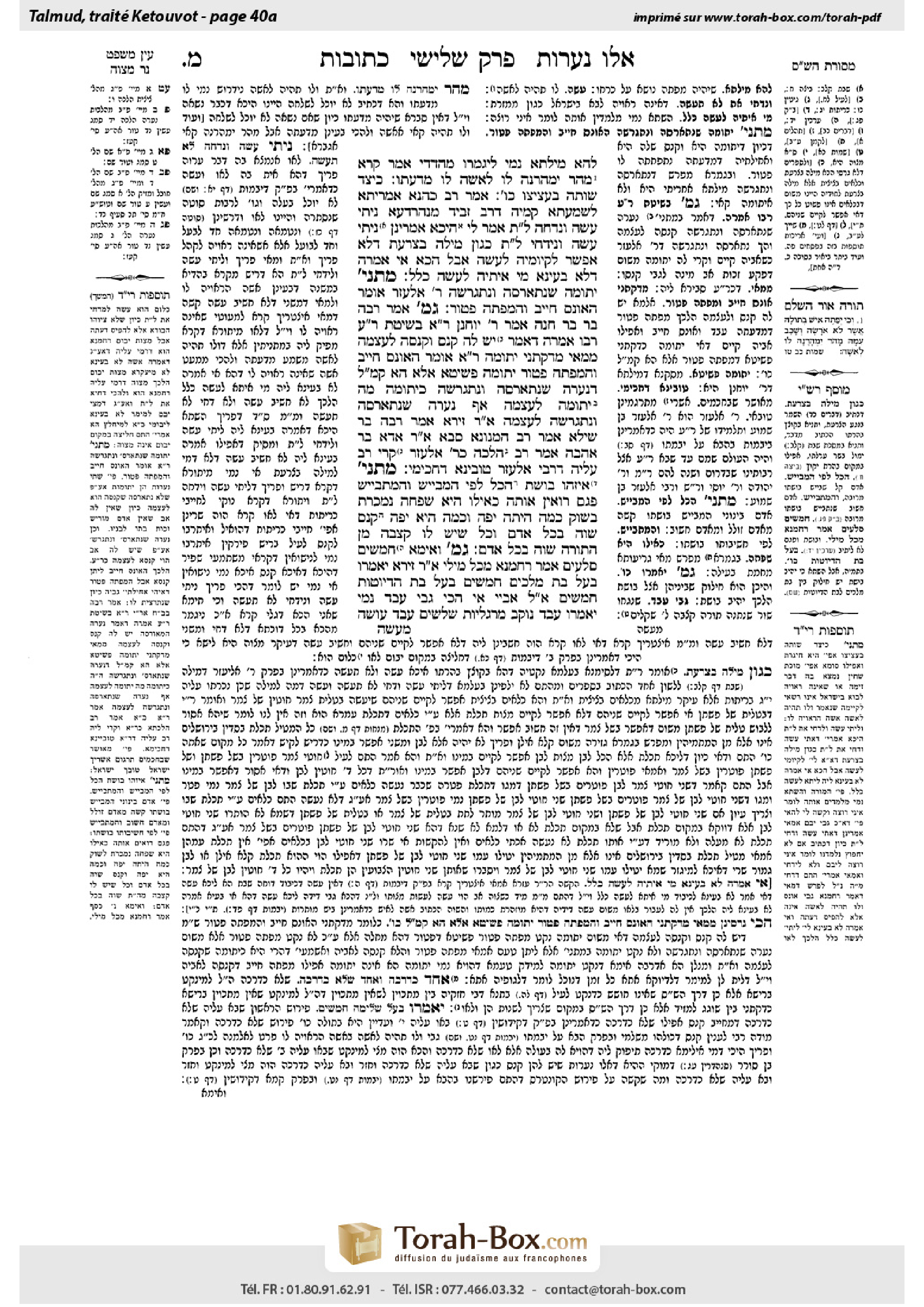
Ketubot 40a: Talmud study for Daf Yomi
Daf Yomi is the daily study of one Talmud folio. Explore 37 tractates with scans, Hebrew text, Sefaria English and AI-generated French translations where annotated.
Passage selection and English or AI-generated French translation are available where the scan has annotations. Daf Study is independent of Torah-Box and Sefaria.
Browse Ketubot · כתובות · All tractatesKetubot 40a text and translations
This page of Ketubot includes the Aramaic text, an English translation and an AI-generated French translation, alongside the scan above.
כתובות מ׳ א · Aramaic and Hebrew text
לְהָא מִילְּתָא נָמֵי לִיגְמְרוּ מֵהֲדָדֵי! אָמַר קְרָא: ״מָהֹר יִמְהָרֶנָּה לּוֹ לְאִשָּׁה״, ״לוֹ״ — מִדַּעְתּוֹ.
כֵּיצַד שׁוֹתֶה בַּעֲצִיצוֹ כּוּ׳. אָמַר רַב כָּהֲנָא: אַמְרִיתַהּ לִשְׁמַעְתָּא קַמֵּיהּ דְּרַב זְבִיד מִנְּהַרְדְּעָא: נֵיתֵי עֲשֵׂה וְנִדְחֵה לֹא תַעֲשֶׂה!
אָמַר לִי: הֵיכָא אָמְרִינַן נֵיתֵי עֲשֵׂה וְנִידְחֵי לֹא תַעֲשֶׂה — כְּגוֹן מִילָה בְּצָרַעַת, דְּלָא אֶפְשָׁר לְקַיּוֹמֵיהּ לַעֲשֵׂה. אֲבָל הָכָא, אִי אָמְרָה דְּלָא בָּעֵינָא, מִי אִיתֵיהּ לַעֲשֵׂה כְּלָל?
מַתְנִי׳ יְתוֹמָה שֶׁנִּתְאָרְסָה וְנִתְגָּרְשָׁה, רַבִּי אֶלְעָזָר אוֹמֵר: הָאוֹנֵס — חַיָּיב, וְהַמְפַתֶּה — פָּטוּר.
גְּמָ׳ אָמַר רַבָּה בַּר בַּר חָנָה אָמַר רַבִּי יוֹחָנָן: רַבִּי אֶלְעָזָר בְּשִׁיטַת רַבִּי עֲקִיבָא רַבּוֹ אֲמָרָהּ, דְּאָמַר: יֵשׁ לָהּ קְנָס וּקְנָסָהּ לְעַצְמָהּ. מִמַּאי — מִדְּקָתָנֵי: יְתוֹמָה, רַבִּי אֶלְעָזָר אוֹמֵר: הָאוֹנֵס חַיָּיב, וְהַמְפַתֶּה פָּטוּר.
יְתוֹמָה, פְּשִׁיטָא? אֶלָּא הָא קָא מַשְׁמַע לַן דְּנַעֲרָה שֶׁנִּתְאָרְסָה וְנִתְגָּרְשָׁה, כִּיתוֹמָה. מָה יְתוֹמָה — לְעַצְמָהּ, אַף נַעֲרָה שֶׁנִּתְאָרְסָה וְנִתְגָּרְשָׁה — לְעַצְמָהּ.
אָמַר רַבִּי זֵירָא אָמַר רַבָּה בַּר שֵׁילָא אָמַר רַב הַמְנוּנָא סָבָא אָמַר רַב אַדָּא בַּר אַהֲבָה אָמַר רַב: הֲלָכָה כְּרַבִּי אֶלְעָזָר. קָרֵי רַב עֲלֵיהּ דְּרַבִּי אֶלְעָזָר: ״טוּבְיָנָא דְחַכִּימֵי״.
מַתְנִי׳ אֵיזֶהוּ בּוֹשֶׁת? הַכֹּל לְפִי הַמְבַיֵּישׁ וְהַמִּתְבַּיֵּישׁ. פְּגָם — רוֹאִין אוֹתָהּ כְּאִילּוּ הִיא שִׁפְחָה נִמְכֶּרֶת בַּשּׁוּק, כַּמָּה הָיְתָה יָפָה, וְכַמָּה הִיא יָפָה. קְנָס — שָׁוֶה בְּכׇל אָדָם, וְכֹל שֶׁיֵּשׁ לוֹ קִצְבָה מִן הַתּוֹרָה — שָׁוֶה בְּכׇל אָדָם.
גְּמָ׳ וְאֵימָא: חֲמִשִּׁים סְלָעִים אָמַר רַחֲמָנָא, מִכֹּל מִילֵּי! אָמַר רַבִּי זֵירָא יֹאמְרוּ: בָּעַל בַּת מְלָכִים חֲמִשִּׁים, בָּעַל בַּת הֶדְיוֹטוֹת חֲמִשִּׁים?! אֲמַר לֵיהּ אַבָּיֵי: אִי הָכִי, גַּבֵּי עֶבֶד נָמֵי, יֹאמְרוּ: עֶבֶד נוֹקֵב מַרְגָּלִיּוֹת — שְׁלֹשִׁים, עֶבֶד עוֹשֶׂה
Ketubot 40a · English translation
for this matter too, marrying the woman against his will, let them be derived from each other. Rav Ashi replied that the verse says with regard to a seducer: “He shall pay a dowry for her to be a wife to him” (Exodus 22:15); “to him” means in accordance with his will.
§ The mishna continues: How does the rapist drink from his vessel? The mishna proceeds to explain that he is obligated to marry her despite the physical flaws she might have. However, if the marriage is prohibited, either due to the fact that she committed adultery or due to her flawed lineage, he is not obligated to marry her, and therefore he may not marry her. Rav Kahana said: I stated this halakha before Rav Zevid of Neharde’a, and I asked him: Let the positive mitzva: “And to him she shall be as a wife” (Deuteronomy 22:29), come and override the prohibition of marriage to a woman who is forbidden to him, according to the principle that positive mitzvot override prohibitions.
He said to me: Where do we say the principle that a positive mitzva comes and overrides a prohibition? It is in a case where one performs circumcision of a foreskin afflicted with leprosy. Although there is a prohibition against removing leprous skin, the positive mitzva of circumcision overrides that prohibition, as it is not possible to fulfill the positive mitzva without violating the prohibition. However, here, in the case of the rapist, if she says: I do not want him as a husband, is there a positive mitzva at all? Since in that case the mitzva need not be performed, as it is negated when the woman refuses to marry him, it does not override the prohibition.
MISHNA: With regard to an orphan who was betrothed and divorced, Rabbi Elazar says: One who rapes her is obligated to pay the fine, as she is a virgin young woman, and one who seduces her is exempt from payment. Because she is an orphan, or because she was betrothed and divorced, she is independent, and by consenting to the seduction she forgoes her right to the fine.
GEMARA: Rabba bar bar Ḥana said that Rabbi Yoḥanan said: Rabbi Elazar stated his opinion in accordance with the opinion of Rabbi Akiva, his teacher, as with regard to a young woman who was betrothed and divorced and then raped, Rabbi Akiva said in an earlier mishna: She is entitled to a fine for rape and her fine is paid to her. Rabbi Yosei HaGelili says: She is not entitled to a fine for rape. And from where do we know that Rabbi Elazar’s opinion corresponds to the opinion of his teacher? From the fact that the mishna teaches with regard to an orphan that Rabbi Elazar says: One who rapes her is obligated to pay the fine and one who seduces her is exempt from payment.
The Gemara asks: An orphan? That is obvious, as she has no father and is not subject to the authority of anyone else. Clearly the seducer is exempt from payment because she was complicit. Rather, this is what the mishna is teaching us: That the legal status of a young woman who was betrothed and divorced, even if her father is alive, is like that of an orphan: Just as with regard to an orphan, payment of the fine is to her, so too, with regard to a young woman who was betrothed and divorced, payment of the fine is to her.
Rabbi Zeira said that Rabba bar Sheila said that Rav Hamnuna the Elder said that Rav Adda bar Ahava said that Rav said: The halakha is in accordance with the opinion of Rabbi Elazar. Rav would exclaim about Rabbi Elazar: He is the happiest of the Sages, as he held that the halakha was ruled in accordance with his opinion in many instances.
MISHNA: What is humiliation? How is the payment for humiliation during rape or seduction assessed? It is all based on the one who humiliated and the one who was humiliated. The price will vary depending on the lineage of the family of the rape victim and the nature of the attacker. How is her degradation assessed? One considers her as though she were a maidservant sold in the marketplace, and assesses how much she was worth beforehand and how much she is currently worth, after the rape or seduction. The sum of the fine is equal for all people, and the principle is: Any payment that has a fixed sum by Torah law is equal for all people, regardless of the lineage and the physical state of the attacker or the victim.
GEMARA: The Gemara asks: And say that the Merciful One said that the payment is fifty sela from all these matters, i.e., the fine, degradation, humiliation, and pain. Rabbi Zeira said: That cannot be, as they will say: If one who engaged in forced intercourse with a daughter of kings pays a sum of fifty sela, does one who engaged in forced intercourse with the daughter of commoners [hedyotot] also pay fifty sela? Abaye said to him: This is not a decisive argument, as if so, with regard to a Canaanite slave killed by an ox, the Torah says that the owner of the ox pays the master of the slave thirty sela. There too, they will say: For a slave who pierces precious pearls [margaliyyot], a valuable skill, the fine is thirty sela, and for a slave who performs
Ketubot 40a · Traduction française (IA)
pour cette affaire également, marier la femme contre sa volonté, qu'ils soient dérivés l'un de l'autre. Rav Ashi a répondu que le verset dit à propos du séducteur : « Il paiera une dot pour elle afin qu'elle soit sa femme » (Exode 22:15) ; « à lui » signifie conformément à sa volonté.
§ La Michna continue : Comment le violeur boit-il de son vase ? La Michna procède à l'explication qu'il est obligé de l'épouser malgré les défauts physiques qu'elle pourrait avoir. Cependant, si le mariage est interdit, soit en raison du fait qu'elle a commis l'adultère, soit en raison de son lignage défectueux, il n'est pas obligé de l'épouser, et par conséquent il ne peut pas l'épouser. Rav Kahana a dit : J'ai énoncé cette halakha devant Rav Zevid de Neharde'a, et je lui ai demandé : Que la mitsva positive : « Et elle lui appartiendra comme femme » (Deutéronome 22:29), vienne annuler l'interdiction de mariage avec une femme qui lui est interdite, selon le principe que les mitsvot positives annulent les interdictions.
Il m'a dit : Où disons-nous le principe qu'une mitsva positive vient annuler une interdiction ? C'est dans le cas où l'on pratique la circoncision d'un prépuce atteint de lèpre. Bien qu'il y ait une interdiction de retirer la peau lèpreuse, la mitsva positive de circoncision annule cette interdiction, car il n'est pas possible d'accomplir la mitsva positive sans violer l'interdiction. Cependant, ici, dans le cas du violeur, si elle dit : Je ne veux pas de lui comme époux, y a-t-il une mitsva positive du tout ? Puisque dans ce cas la mitsva n'a pas besoin d'être accomplie, car elle est annulée lorsque la femme refuse de l'épouser, elle n'annule pas l'interdiction.
MICHNA : Concernant une orpheline qui a été fiancée puis divorcée, Rabbi Elazar dit : Celui qui la viole est obligé de payer l'amende, car elle est une jeune vierge, et celui qui la séduit est exempt de paiement. Parce qu'elle est orpheline, ou parce qu'elle a été fiancée puis divorcée, elle est indépendante, et en consentant à la séduction, elle renonce à son droit à l'amende.
GUEMARA : Rabba bar bar Ḥana a dit que Rabbi Yoḥanan a dit : Rabbi Elazar a énoncé son avis conformément à l'avis de Rabbi Akiva, son maître, car concernant une jeune femme qui a été fiancée puis divorcée et ensuite violée, Rabbi Akiva a dit dans une Michna antérieure : Elle a droit à une amende pour viol et son amende lui est payée. Rabbi Yosei HaGelili dit : Elle n'a pas droit à une amende pour viol. Et d'où savons-nous que l'avis de Rabbi Elazar correspond à l'avis de son maître ? Du fait que la Michna enseigne, concernant une orpheline, que Rabbi Elazar dit : Celui qui la viole est obligé de payer l'amende et celui qui la séduit est exempt de paiement.
La Guemara demande : Une orpheline ? C'est évident, car elle n'a pas de père et n'est soumise à l'autorité de personne. Évidemment, le séducteur est exempt de paiement parce qu'elle a été complice. Plutôt, c'est ce que la Michna nous enseigne : Que le statut juridique d'une jeune femme qui a été fiancée puis divorcée, même si son père est en vie, est celui d'une orpheline : Tout comme, concernant une orpheline, le paiement de l'amende lui revient, de même, concernant une jeune femme qui a été fiancée puis divorcée, le paiement de l'amende lui revient.
Rabbi Zeira a dit que Rabba bar Sheila a dit que Rav Hamnuna l'Ancien a dit que Rav Adda bar Ahava a dit que Rav a dit : La halakha est conforme à l'avis de Rabbi Elazar. Rav s'exclamait à propos de Rabbi Elazar : Il est le plus heureux des Sages, car la halakha a été tranchée conformément à son avis dans de nombreux cas.
MICHNA : Qu'est-ce que l'humiliation ? Comment évaluer l'indemnisation pour l'humiliation lors d'un viol ou d'une séduction ? Tout dépend de celui qui a humilié et de celui qui a été humilié. Le montant varie selon le lignage de la famille de la victime du viol et la condition de l'agresseur. Comment évaluer sa dégradation ? On la considère comme si elle était une servante vendue sur le marché, et on évalue combien elle valait auparavant et combien elle vaut actuellement, après le viol ou la séduction. Le montant de l'amende est identique pour tous, et le principe est le suivant : Toute indemnisation dont le montant est fixé par la Torah écrite est identique pour tous, quel que soit le lignage et l'état physique de l'agresseur ou de la victime.
GUEMARA : La Guemara demande : Peut-on dire que le Tout-Puissant a déclaré que l'indemnisation est de cinquante sela pour l'ensemble de ces éléments, à savoir l'amende, la dégradation, l'humiliation et la douleur ? Rabbi Zeira a dit : Cela ne peut pas être, car ils diront : Si celui qui a eu des rapports forcés avec une fille de rois paie une somme de cinquante sela, celui qui a eu des rapports forcés avec la fille de gens ordinaires [hedyotot] paie-t-il aussi cinquante sela ? Abaye lui a dit : Ce n'est pas un argument décisif, car si c'était le cas, concernant un esclave cananéen tué par un bœuf, la Torah dit que le propriétaire du bœuf paie au maître de l'esclave trente sela. Là aussi, ils diront : Pour un esclave qui perce des perles précieuses [margaliyyot], une compétence précieuse, l'amende est de trente sela, et pour un esclave qui exécute
Traduction française générée par IA à partir de l’édition anglaise de Sefaria. Vérifie toujours un passage avec le texte source.
Text from Sefaria: William Davidson Edition - Vocalized Aramaic (CC BY NC); William Davidson Edition - English (CC BY NC).