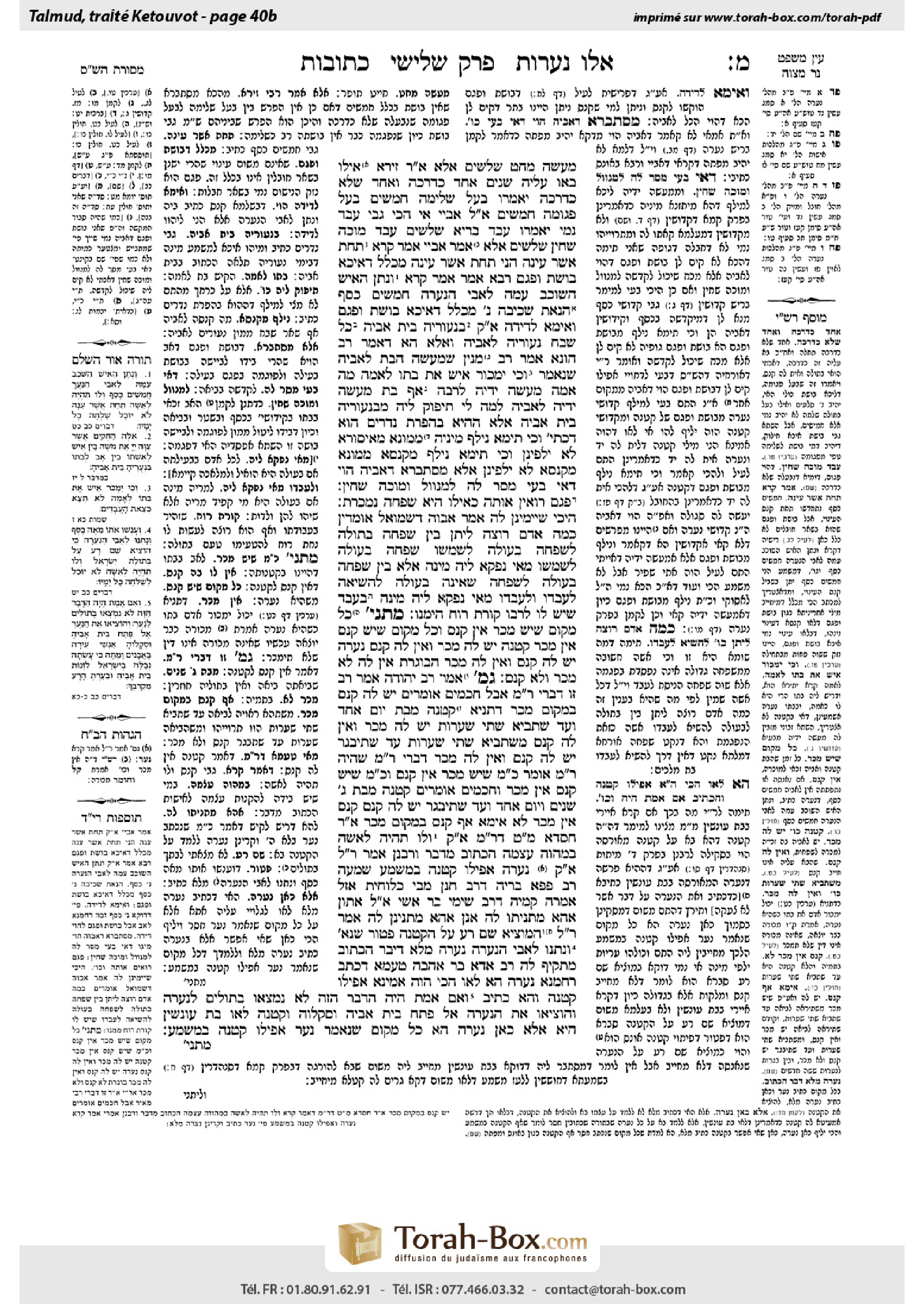
Ketubot 40b: Talmud study for Daf Yomi
Daf Yomi is the daily study of one Talmud folio. Explore 37 tractates with scans, Hebrew text, Sefaria English and AI-generated French translations where annotated.
Passage selection and English or AI-generated French translation are available where the scan has annotations. Daf Study is independent of Torah-Box and Sefaria.
Browse Ketubot · כתובות · All tractatesKetubot 40b text and translations
This page of Ketubot includes the Aramaic text, an English translation and an AI-generated French translation, alongside the scan above.
כתובות מ׳ ב · Aramaic and Hebrew text
מַעֲשֵׂה מַחַט — שְׁלֹשִׁים?!
אֶלָּא אָמַר רַבִּי זֵירָא: אִילּוּ בָּאוּ עָלֶיהָ שְׁנַיִם, אֶחָד כְּדַרְכָּהּ, וְאֶחָד שֶׁלֹּא כְּדַרְכָּהּ, יֹאמְרוּ: בָּעַל שְׁלֵימָה — חֲמִשִּׁים, בָּעַל פְּגוּמָה — חֲמִשִּׁים? אֲמַר לֵיהּ אַבָּיֵי: אִי הָכִי, גַּבֵּי עֶבֶד נָמֵי, יֹאמְרוּ: עֶבֶד בָּרִיא — שְׁלֹשִׁים, עֶבֶד מוּכֵּה שְׁחִין — שְׁלֹשִׁים?!
אֶלָּא אָמַר אַבָּיֵי, אָמַר קְרָא: ״תַּחַת אֲשֶׁר עִינָּהּ״, הָנֵי תַּחַת אֲשֶׁר עִינָּהּ, מִכְּלָל דְּאִיכָּא בּוֹשֶׁת וּפְגָם. רָבָא אָמַר, אָמַר קְרָא: ״וְנָתַן הָאִישׁ הַשּׁוֹכֵב עִמָּהּ לַאֲבִי הַנַּעֲרָה חֲמִשִּׁים כָּסֶף״. הֲנָאַת שְׁכִיבָה חֲמִשִּׁים, מִכְּלָל דְּאִיכָּא בּוֹשֶׁת וּפְגָם.
וְאֵימָא לְדִידַהּ? אָמַר קְרָא: ״בִּנְעוּרֶיהָ בֵּית אָבִיהָ״, כׇּל שֶׁבַח נְעוּרֶיהָ — לְאָבִיהָ.
וְאֶלָּא הָא דְּאָמַר רַב הוּנָא אָמַר רַב: מִנַּיִן שֶׁמַּעֲשֵׂה הַבַּת לְאָבִיהָ, שֶׁנֶּאֱמַר: ״וְכִי יִמְכּוֹר אִישׁ אֶת בִּתּוֹ לְאָמָה. מָה אָמָה, מַעֲשֵׂה יָדֶיהָ לְרַבָּהּ — אַף בַּת, מַעֲשֵׂה יָדֶיהָ לְאָבִיהָ. לְמָה לִי? תִּיפּוֹק לֵיהּ מִ״בִּנְעוּרֶיהָ בֵּית אָבִיהָ״! אֶלָּא, הַהִיא בַּהֲפָרַת נְדָרִים הוּא דִּכְתִיב.
וְכִי תֵּימָא נֵילַף מִינֵּיהּ, מָמוֹנָא מֵאִיסּוּרָא לָא יָלְפִינַן. וְכִי תֵּימָא נֵילַף מִקְּנָסָא, מָמוֹנָא מִקְּנָסָא לָא יָלְפִינַן. אֶלָּא מִסְתַּבְּרָא דְּאָבִיהָ הָוֵי, דְּאִי בָּעֵי מָסַר לַהּ לִמְנֻוּוֹל וּמוּכֵּה שְׁחִין.
פְּגָם, רוֹאִין אוֹתָהּ כְּאִילּוּ הִיא שִׁפְחָה נִמְכֶּרֶת. הֵיכִי שָׁיְימִינַן לַהּ? אָמַר אֲבוּהּ דִּשְׁמוּאֵל: אוֹמְדִין כַּמָּה אָדָם רוֹצֶה לִיתֵּן בֵּין שִׁפְחָה בְּתוּלָה לְשִׁפְחָה בְּעוּלָה לְשַׁמְּשׁוֹ.
מַאי נָפְקָא לֵיהּ מִינַּהּ? אֶלָּא בֵּין שִׁפְחָה בְּעוּלָה לְשִׁפְחָה שֶׁאֵינָהּ בְּעוּלָה, לְהַשִּׂיאָה לְעַבְדּוֹ. וּלְעַבְדּוֹ מַאי נָפְקָא לֵיהּ מִינַּהּ? בְּעֶבֶד שֶׁיֵּשׁ לוֹ לְרַבּוֹ קוֹרַת רוּחַ הֵימֶנּוּ.
מַתְנִי׳ כׇּל מָקוֹם שֶׁיֵּשׁ מֶכֶר — אֵין קְנָס. וְכׇל מָקוֹם שֶׁיֵּשׁ קְנָס — אֵין מֶכֶר. קְטַנָּה — יֵשׁ לָהּ מֶכֶר, וְאֵין לָהּ קְנָס. נַעֲרָה — יֵשׁ לָהּ קְנָס, וְאֵין לָהּ מֶכֶר. הַבּוֹגֶרֶת — אֵין לָהּ לֹא מֶכֶר וְלֹא קְנָס.
גְּמָ׳ אָמַר רַב יְהוּדָה אָמַר רַב: זוֹ דִּבְרֵי רַבִּי מֵאִיר, אֲבָל חֲכָמִים אוֹמְרִים: יֵשׁ לָהּ קְנָס בִּמְקוֹם מֶכֶר. דְּתַנְיָא: קְטַנָּה מִבַּת יוֹם אֶחָד וְעַד שֶׁתָּבִיא שְׁתֵּי שְׂעָרוֹת — יֵשׁ לָהּ מֶכֶר וְאֵין לָהּ קְנָס. מִשֶּׁתָּבִיא שְׁתֵּי שְׂעָרוֹת עַד שֶׁתִּיבְגַּר — יֵשׁ לָהּ קְנָס וְאֵין לָהּ מֶכֶר, דִּבְרֵי רַבִּי מֵאִיר. שֶׁהָיָה רַבִּי מֵאִיר אוֹמֵר: כׇּל מָקוֹם שֶׁיֵּשׁ מֶכֶר — אֵין קְנָס, וְכׇל מָקוֹם שֶׁיֵּשׁ קְנָס — אֵין מֶכֶר. וַחֲכָמִים אוֹמְרִים: קְטַנָּה מִבַּת שָׁלֹשׁ שָׁנִים וְיוֹם אֶחָד וְעַד שֶׁתִּיבְגַּר — יֵשׁ לָהּ קְנָס.
קְנָס אִין, מֶכֶר לָא?! אֵימָא: אַף קְנָס בִּמְקוֹם מֶכֶר. אָמַר רַב חִסְדָּא: מַאי טַעְמָא דְּרַבִּי מֵאִיר? אָמַר קְרָא: ״וְלוֹ תִּהְיֶה לְאִשָּׁה״ — בִּמְהַוָּה עַצְמָהּ הַכָּתוּב מְדַבֵּר. וְרַבָּנַן? אָמַר רֵישׁ לָקִישׁ, אָמַר קְרָא: ״נַעֲרָ״, אֲפִילּוּ קְטַנָּה בַּמַּשְׁמָע.
שַׁמְעַהּ רַב פָּפָּא בְּרֵיהּ דְּרַב חָנָן מִבֵּי כְלוֹחִית, אֲזַל אַמְרַהּ קַמֵּיהּ דְּרַב שִׁימִי בַּר אָשֵׁי. אֲמַר לֵיהּ: אַתּוּן, אַהָא מַתְנִיתוּ לַהּ. אֲנַן, אַהָא מַתְנֵינַן לָהּ, אָמַר רֵישׁ לָקִישׁ: הַמּוֹצִיא שֵׁם רַע עַל הַקְּטַנָּה — פָּטוּר, שֶׁנֶּאֱמַר: ״וְנָתְנוּ לַאֲבִי הַנַּעֲרָה״, ״נַעֲרָה״ מָלֵא דִּיבֵּר הַכָּתוּב.
מַתְקֵיף לַהּ רַב אַדָּא בַּר אַהֲבָה: טַעְמָא דִּכְתַב רַחֲמָנָא ״נַעֲרָה״, הָא לָאו הָכִי, הֲוָה אָמֵינָא אֲפִילּוּ קְטַנָּה? וְהָא כְּתִיב: ״וְאִם אֱמֶת הָיָה הַדָּבָר הַזֶּה לֹא נִמְצְאוּ בְתוּלִים לַנַּעֲרָה. וְהוֹצִיאוּ אֶת הַנַּעֲרָה אֶל פֶּתַח בֵּית אָבִיהָ וּסְקָלוּהָ״, וּקְטַנָּה לָאו בַּת עוֹנָשִׁין הִיא! אֶלָּא: כָּאן נַעֲרָה, הָא כׇּל מָקוֹם שֶׁנֶּאֱמַר ״נַעֲרָ״ — אֲפִילּוּ קְטַנָּה בַּמַּשְׁמָע.
Ketubot 40b · English translation
the needlecraft of a tailor, a common, less valuable skill, is the fine also thirty sela? Rather, just as with regard to the slaves, the sum is not dependent on the standing of the victim, so too with regard to a woman who was raped.
Rather, Rabbi Zeira said a different proof: Had two men engaged in forced intercourse with her, one vaginal intercourse, and one anal intercourse, they will say: If one who engaged in forced intercourse with an untainted virgin pays fifty sela, does one who engaged in forced intercourse with her when she is tainted, i.e., after she has engaged in anal intercourse, also pay fifty sela? Apparently, the fifty sela is the fixed sum of the fine, while the rest of the payment varies on a case-by-case basis. Abaye said to him: This too is no proof, as if so, with regard to a slave as well, they will say if one whose ox gored a healthy slave pays thirty sela, does one whose ox gored a slave afflicted with boils also pay thirty sela?
Rather, Abaye said a different proof. The verse says: “Fifty shekels of silver…because he tormented her” (Deuteronomy 22:29); these fifty sela are the fine paid because he tormented her. From which it may be inferred that there are the additional payments of humiliation and degradation beyond that sum mentioned in the verse. Rava said an alternative proof. The verse says: “And the man who lay with her shall give to the father of the young woman fifty shekels of silver” (Deuteronomy 22:29). For the pleasure of lying with her he pays fifty sela; from which it may be inferred that there are the additional payments of humiliation and degradation, beyond payment of the fine.
The Gemara asks: And say that these additional payments are paid to her? The Gemara answers that the verse says: “Between a father and his daughter, being in her young womanhood, in her father’s house” (Numbers 30:17), from which it is derived that all profits of her young womanhood go to her father.
The Gemara asks: However, with regard to that which Rav Huna said that Rav said: From where is it derived that the handiwork of the daughter goes to her father? It is as it is stated: “And if a man sells his daughter as a maidservant” (Exodus 21:7), juxtaposing his daughter to a maidservant: Just as a maidservant, her handiwork belongs to her master, as she was sold for that purpose; so too a daughter, her handiwork goes to her father. Why do I need this complicated proof? Let him derive it directly from the verse “Being in her young womanhood, in her father’s house.” Rather, this cannot be derived from that verse because that verse is written with regard to the nullification of vows. A young woman is subject to her father’s authority with regard to her vows, which he has the right to nullify. The matter of monetary rights is not addressed in that verse.
And if you say: Let us derive monetary matters from vows, i.e., just as she is subject to her father’s authority with regard to vows the same is true with regard to monetary matters, we do not derive monetary matters from ritual matters. And if you say: Let us derive that her father receives payment from the halakha of a fine, i.e., just as the fine is paid to her father, as explicitly stated in the Torah, so too, other payments are also paid to her father, we do not derive monetary matters from fines. The payment of a fine is a novel element decreed by the Torah and cannot serve as a paradigm for standard monetary matters. Rather, the Gemara explains that it is reasonable that the payments of humiliation and degradation are paid to her father, as if he wished to do so he could give her hand in marriage to a repulsive man or one afflicted with boils, thereby humiliating her. Since her humiliation is under his control, payment for her humiliation is similarly his.
The mishna continues: How is her degradation assessed? One considers her as though she were a maidservant sold in the marketplace, and assesses how much she would have been worth beforehand and how much she would be worth currently. The Gemara asks: How do we assess her value? Shmuel’s father said: One estimates the difference between how much a person is willing to give to purchase a virgin maidservant and how much he is willing to give to purchase a non-virgin maidservant to serve him.
The Gemara asks: With regard to a non-virgin maidservant to serve him; if he purchases her for service, what difference is there to him whether or not she is a virgin? Rather, the difference between a maidservant who engaged in intercourse and a maidservant who did not engage in intercourse is with regard to how much one is willing to marry her to his slave. The Gemara further asks: And with regard to marrying her to his slave, what difference is there to him whether or not she is a virgin? The Gemara answers: It is with regard to a slave from whom his master has a sense of satisfaction, and he seeks a virgin for the slave in order to reciprocate. The difference between the price that the master is willing to pay for each of the maidservants is the degradation that the offender pays the victim.
MISHNA: Any place where there is sale by a father of his minor daughter as a Hebrew maidservant, there is no fine if she is raped. And any place where there is a fine, when a young woman is raped; there is no sale by the father. The Gemara specifies: A minor is subject to sale by her father, and she is not entitled to a fine if she is raped. A young woman is entitled to a fine if she is raped and is not subject to sale. A grown woman is neither subject to sale nor entitled to a fine.
GEMARA: Rav Yehuda said that Rav said: This halakha in the mishna is the statement of Rabbi Meir, but the Rabbis say: She is entitled to a fine even where there is a sale, as it is taught in a baraita: A minor girl, from one day old until she grows two pubic hairs, is subject to sale and is not entitled to a fine. From when she grows two pubic hairs and becomes a young woman until she matures into a grown woman, she is entitled to a fine and she is not subject to sale; this is the statement of Rabbi Meir, as Rabbi Meir would state the principle: Any place where there is a sale there is no fine, and any place where there is a fine there is no sale. And the Rabbis say: A minor girl from the age of three years and one day until she matures into a grown woman is entitled to a fine.
The Gemara questions the statement of the Rabbis in the baraita with regard to a girl more than three years of age: A fine, yes, but sale, no? Do the Rabbis maintain that a father cannot sell his minor daughter as a Hebrew maidservant? Rather, emend the text and say: She is even entitled to a fine where she is subject to sale. Rav Ḥisda said: What is the rationale for the opinion of Rabbi Meir? It is as the verse says with regard to a rapist: “And the man who lay with her shall give to the father of the young woman fifty sela, and to him she shall be as a wife” (Deuteronomy 22:29). The verse is speaking with regard to one halakhically competent to marry by herself, which means she must be a young woman. The Gemara asks: And what is the rationale for the opinion of the Rabbis? Reish Lakish said that the verse says “young woman [na’ara]”; however, although the term is pronounced na’ara, it is written as na’ar, without the letter heh, and even a minor girl is indicated by that term.
The Gemara relates: Rav Pappa, son of Rav Ḥanan, from a place called Bei Keloḥit, heard this halakha and went and said it before Rav Shimi bar Ashi. Rav Shimi said to him: You teach this statement concerning that matter. We, based on our traditions, teach it concerning this matter, as Reish Lakish said: One who slanders a minor girl, falsely claiming that she was not a virgin on the wedding night, is exempt from paying the fine, as it is stated: “And they shall give them to the father of the young woman [na’ara]” (Deuteronomy 22:19). The verse spoke of na’ara, not only pronounced but written in full, indicating that this payment is in effect only with regard to a young woman, not a minor girl. However, in places where the term is written na’ar, even a minor girl would be included.
Rav Adda bar Ahava strongly objects to this: The reason is that the Merciful One writes “na’ara” with a heh. Is that to say that if that were not the case I would have said that this halakha applies even to a minor girl? How is that possible? But isn’t it written: “And if this matter was true, that the hymen of this young woman was not found intact; then they shall remove the young woman to the entrance of her father’s house and stone her” (Deuteronomy 22:20–21). And this verse clearly refers to a young woman old enough to be punished, as a minor is not subject to punishment. Rather, here, with regard to the payment of a slanderer, the verse speaks of a na’ara, written with a heh, and a minor is excluded. This is a paradigm from which it may be inferred that in any place that it is stated “na’ara” without a heh, even a minor girl is indicated.
Ketubot 40b · Traduction française (IA)
L'artisanat d'un tailleur, une compétence courante et de moindre valeur, est-il également de trente sela ? Plutôt, de même qu'en ce qui concerne les esclaves, la somme ne dépend pas du statut de la victime, de même en ce qui concerne une femme violée.
Plutôt, Rabbi Zeïra a avancé une autre preuve : Si deux hommes ont eu des rapports forcés avec elle, l'un par voie vaginale et l'autre par voie anale, on dira : Si celui qui a eu des rapports forcés avec une vierge intacte paie cinquante sela, celui qui a eu des rapports forcés avec elle alors qu'elle est souillée, c'est-à-dire après qu'elle a eu des rapports anaux, paie-t-il également cinquante sela ? Apparemment, les cinquante sela constituent l'amende fixe, tandis que le reste du paiement varie d'un cas à l'autre. Abaye lui a dit : Cela non plus n'est pas une preuve, car si c'était le cas, en ce qui concerne un esclave également, on dirait : Si celui dont le taureau a écorné un esclave en bonne santé paie trente sela, celui dont le taureau a écorné un esclave atteint de furoncles paie-t-il également trente sela ?
Plutôt, Abaye a avancé une autre preuve. Le verset dit : « Cinquante shekels d'argent… parce qu'il l'a déshonorée » (Deutéronome 22:29) ; ces cinquante sela sont l'amende payée parce qu'il l'a déshonorée. On peut en déduire qu'il existe des paiements supplémentaires pour l'humiliation et la dégradation au-delà de la somme mentionnée dans le verset. Rava a avancé une preuve alternative. Le verset dit : « Et l'homme qui a couché avec elle donnera au père de la jeune femme cinquante shekels d'argent » (Deutéronome 22:29). Pour le plaisir de coucher avec elle, il paie cinquante sela ; on peut en déduire qu'il existe des paiements supplémentaires pour l'humiliation et la dégradation, au-delà du paiement de l'amende.
La Guemara demande : Peut-on dire que ces paiements supplémentaires sont versés à elle-même ? La Guemara répond que le verset dit : « Entre un père et sa fille, étant dans sa jeunesse, dans la maison de son père » (Nombres 30:17), d'où il est déduit que tous les profits de sa jeunesse reviennent à son père.
La Guemara demande : Cependant, en ce qui concerne ce que Rav Houna a dit au nom de Rav : D'où est-il déduit que le travail manuel de la fille revient à son père ? C'est comme il est écrit : « Et si un homme vend sa fille comme servante » (Exode 21:7), juxtaposant sa fille à une servante : De même qu'une servante, dont le travail manuel appartient à son maître, car elle a été vendue à cette fin ; de même une fille, dont le travail manuel revient à son père. Pourquoi ai-je besoin de cette déduction compliquée ? Qu'il la déduise directement du verset « Étant dans sa jeunesse, dans la maison de son père ». Plutôt, cela ne peut pas être déduit de ce verset parce que ce verset est écrit en ce qui concerne l'annulation des vœux. Une jeune femme est soumise à l'autorité de son père en ce qui concerne ses vœux, qu'il a le droit d'annuler. La question des droits financiers n'est pas abordée dans ce verset.
Et si vous dites : Déduisons les questions monétaires des vœux, c'est-à-dire de même qu'elle est soumise à l'autorité de son père en ce qui concerne les vœux, il en est de même en ce qui concerne les questions monétaires, nous ne déduisons pas les questions monétaires des questions rituelles. Et si vous dites : Déduisons que son père reçoit le paiement de la halakha de l'amende, c'est-à-dire de même que l'amende est payée à son père, comme explicitement énoncé dans la Torah, de même les autres paiements sont également payés à son père, nous ne déduisons pas les questions monétaires des amendes. Le paiement d'une amende est un élément nouveau décrété par la Torah et ne peut pas servir de paradigme pour les questions monétaires standard. Plutôt, la Guemara explique qu'il est raisonnable que les paiements pour l'humiliation et la dégradation soient payés à son père, car s'il le souhaitait, il pourrait la marier à un homme répugnant ou atteint de furoncles, l'humiliant ainsi. Puisque son humiliation est sous son contrôle, le paiement pour son humiliation lui revient également.
La Michna continue : Comment évalue-t-on sa dégradation ? On la considère comme si elle était une servante vendue sur le marché, et on évalue combien elle valait auparavant et combien elle vaut actuellement. La Guemara demande : Comment évaluons-nous sa valeur ? Le père de Chmouël a dit : On estime la différence entre ce qu'une personne est disposée à donner pour acheter une servante vierge et ce qu'elle est disposée à donner pour acheter une servante non vierge pour le servir.
La Guemara demande : En ce qui concerne une servante non vierge destinée à le servir, s'il l'achète pour le service, quelle différence y a-t-il pour lui qu'elle soit vierge ou non ? En réalité, la différence entre une servante qui a eu des rapports sexuels et une servante qui n'en a pas eu concerne le montant que l'on est disposé à payer pour la marier à son esclave. La Guemara demande encore : Et en ce qui concerne le fait de la marier à son esclave, quelle différence y a-t-il pour lui qu'elle soit vierge ou non ? La Guemara répond : Cela concerne un esclave dont le maître tire une certaine satisfaction, et il cherche une vierge pour cet esclave afin de lui rendre la pareille. La différence entre le prix que le maître est disposé à payer pour chacune des servantes correspond à la dégradation que l'agresseur paie à la victime.
MICHNA : En tout lieu où il y a vente par un père de sa fille mineure comme servante hébraïque, il n'y a pas d'amende si elle est violée. Et en tout lieu où il y a une amende, lorsqu'une jeune femme est violée, il n'y a pas de vente par le père. La Guemara précise : Une mineure est soumise à la vente par son père, et elle n'a pas droit à une amende si elle est violée. Une jeune femme a droit à une amende si elle est violée et n'est pas soumise à la vente. Une femme adulte n'est ni soumise à la vente ni a droit à une amende.
La Guemara rapporte : Rav Yehouda a dit que Rav a dit : Cette halakha de la Michna est l'opinion de Rabbi Meïr, mais les Sages disent : Elle a droit à une amende même s'il y a vente, comme il est enseigné dans une baraïta : Une fille mineure, de un jour jusqu'à ce qu'elle ait deux poils pubiens, est soumise à la vente et n'a pas droit à une amende. À partir du moment où elle a deux poils pubiens et devient une jeune fille (na'ara) jusqu'à ce qu'elle devienne une femme adulte, elle a droit à une amende et n'est pas soumise à la vente ; c'est l'opinion de Rabbi Meïr, car Rabbi Meïr énonce le principe : En tout lieu où il y a vente, il n'y a pas d'amende, et en tout lieu où il y a amende, il n'y a pas de vente. Et les Sages disent : Une fille mineure, de trois ans et un jour jusqu'à ce qu'elle devienne une femme adulte, a droit à une amende.
La Guemara interroge l'opinion des Sages dans la baraïta concernant une fille de plus de trois ans : Une amende, oui, mais la vente, non ? Les Sages soutiennent-ils qu'un père ne peut pas vendre sa fille mineure comme servante hébraïque ? Il faut plutôt corriger le texte et dire : Elle a droit à une amende même si elle est soumise à la vente. Rav Hîsda a dit : Quelle est la raison de l'opinion de Rabbi Meïr ? C'est comme le verset le dit à propos d'un violeur : « Et l'homme qui a couché avec elle donnera au père de la jeune fille cinquante sèla, et elle lui appartiendra comme épouse » (Deutéronome 22:29). Le verset parle d'une personne ayant la capacité juridique de se marier elle-même, ce qui signifie qu'elle doit être une jeune fille (na'ara). La Guemara demande : Et quelle est la raison de l'opinion des Sages ? Reïch Lakich a dit que le verset dit « jeune fille [na'ara] » ; cependant, bien que le terme soit prononcé na'ara, il est écrit na'ar, sans la lettre he, et même une fille mineure est désignée par ce terme.
La Guemara rapporte : Rav Pappa, fils de Rav Ḥanan, d'un lieu appelé Bei Keloḥit, a entendu cette halakha et est allé la réciter devant Rav Shimi bar Ashi. Rav Shimi lui a dit : Vous enseignez cette déclaration concernant cette affaire. Nous, d'après nos traditions, l'enseignons concernant cette autre affaire, comme Reish Lakish l'a dit : Celui qui calomnie une fille mineure, en affirmant faussement qu'elle n'était pas vierge la nuit de noces, est exempté de payer l'amende, car il est écrit : « Et ils la donneront au père de la jeune fille [na'ara] » (Deutéronome 22:19). Le verset a parlé de na'ara, non seulement prononcé mais écrit en entier, indiquant que ce paiement n'est en vigueur que pour une jeune fille, et non pour une fille mineure. Cependant, dans les lieux où le terme est écrit na'ar, même une fille mineure serait incluse.
Rav Adda bar Ahava objecte fortement à cela : La raison est que le Tout-Puissant écrit « na'ara » avec un he. Est-ce à dire que si ce n'était pas le cas, j'aurais dit que cette halakha s'applique même à une fille mineure ? Comment cela est-il possible ? Mais n'est-il pas écrit : « Et si cette chose est vraie, que la membrane de cette jeune fille n'a pas été trouvée intacte ; alors ils amèneront la jeune fille à l'entrée de la maison de son père et ils la lapideront » (Deutéronome 22:20-21). Et ce verset fait clairement référence à une jeune fille assez âgée pour être punie, car un mineur n'est pas soumis à la punition. Plutôt, ici, concernant le paiement par un calomniateur, le verset parle d'une na'ara, écrite avec un he, et un mineur est exclu. C'est un paradigme à partir duquel on peut inférer qu'en tout lieu où il est dit « na'ara » sans he, même une fille mineure est désignée.
Traduction française générée par IA à partir de l’édition anglaise de Sefaria. Vérifie toujours un passage avec le texte source.
Text from Sefaria: William Davidson Edition - Vocalized Aramaic (CC BY NC); William Davidson Edition - English (CC BY NC).