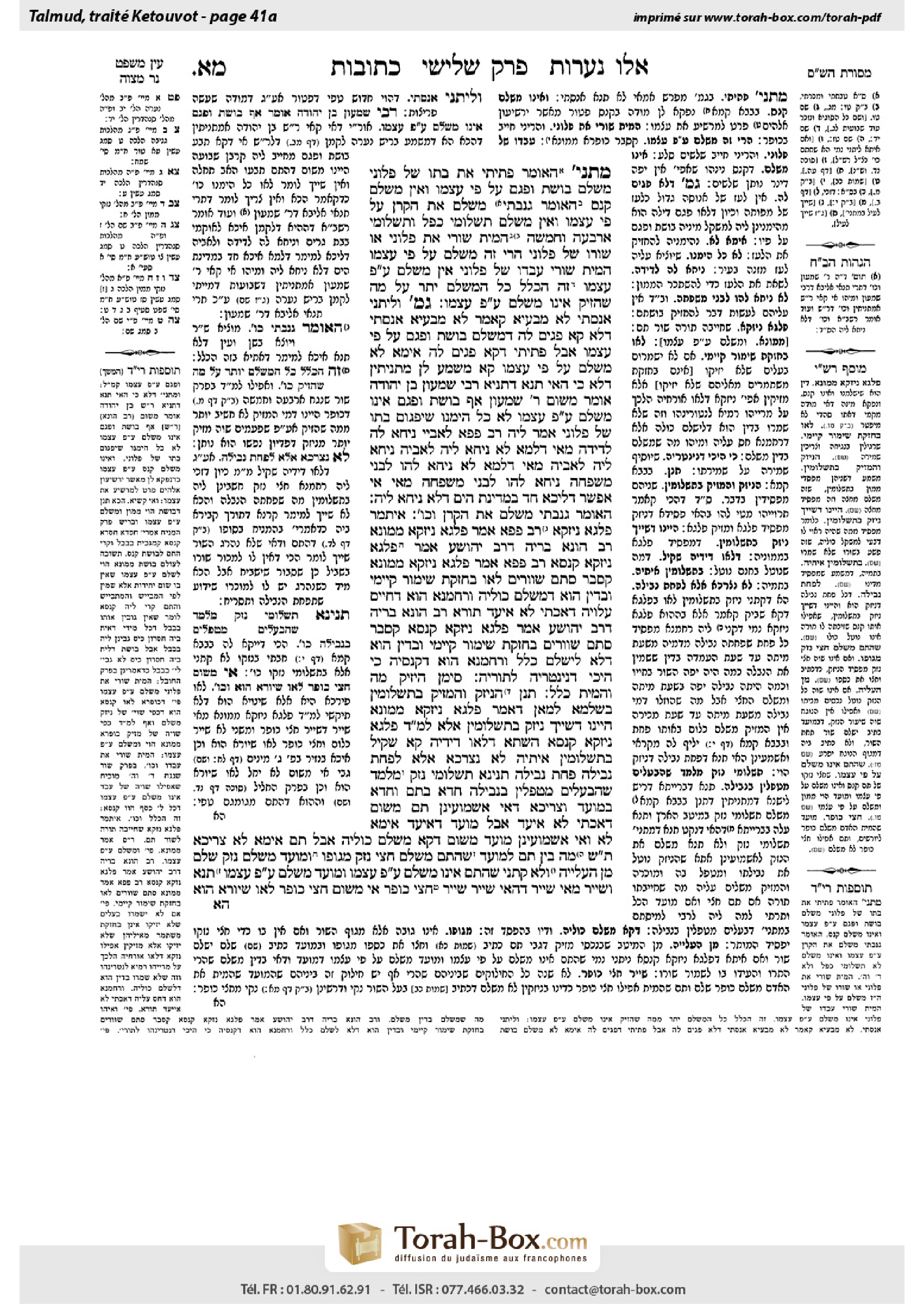
Ketubot 41a: Talmud study for Daf Yomi
Daf Yomi is the daily study of one Talmud folio. Explore 37 tractates with scans, Hebrew text, Sefaria English and AI-generated French translations where annotated.
Passage selection and English or AI-generated French translation are available where the scan has annotations. Daf Study is independent of Torah-Box and Sefaria.
Browse Ketubot · כתובות · All tractatesKetubot 41a text and translations
This page of Ketubot includes the Aramaic text, an English translation and an AI-generated French translation, alongside the scan above.
כתובות מ״א א · Aramaic and Hebrew text
מַתְנִי׳ הָאוֹמֵר: ״פִּתִּיתִי אֶת בִּתּוֹ שֶׁל פְּלוֹנִי״ — מְשַׁלֵּם בּוֹשֶׁת וּפְגָם עַל פִּי עַצְמוֹ, וְאֵין מְשַׁלֵּם קְנָס. הָאוֹמֵר: ״גָּנַבְתִּי״ — מְשַׁלֵּם אֶת הַקֶּרֶן עַל פִּי עַצְמוֹ, וְאֵין מְשַׁלֵּם תַּשְׁלוּמֵי כֶפֶל וְתַשְׁלוּמֵי אַרְבָּעָה וַחֲמִשָּׁה. ״הֵמִית שׁוֹרִי אֶת פְּלוֹנִי״, אוֹ ״שׁוֹרוֹ שֶׁל פְּלוֹנִי״ — הֲרֵי זֶה מְשַׁלֵּם עַל פִּי עַצְמוֹ. ״הֵמִית שׁוֹרִי עַבְדּוֹ שֶׁל פְּלוֹנִי״ — אֵין מְשַׁלֵּם עַל פִּי עַצְמוֹ. זֶה הַכְּלָל: כׇּל הַמְשַׁלֵּם יָתֵר עַל מַה שֶּׁהִזִּיק — אֵינוֹ מְשַׁלֵּם עַל פִּי עַצְמוֹ.
גְּמָ׳ וְלִיתְנֵי ״אָנַסְתִּי״! לָא מִבַּעְיָא קָאָמַר: לָא מִבַּעְיָא ״אָנַסְתִּי״, דְּלָא קָא פָּגֵים לַהּ, דִּמְשַׁלֵּם בּוֹשֶׁת וּפְגָם עַל פִּי עַצְמוֹ, אֲבָל ״פִּתִּיתִי״, דְּקָא פָּגֵים לַהּ, אֵימָא: לָא מְשַׁלֵּם עַל פִּי עַצְמוֹ — קָא מַשְׁמַע לַן.
מַתְנִיתִין דְּלָא כִּי הַאי תַּנָּא, דְּתַנְיָא: רַבִּי שִׁמְעוֹן בֶּן יְהוּדָה אוֹמֵר מִשּׁוּם רַבִּי שִׁמְעוֹן: אַף בּוֹשֶׁת וּפְגָם אֵינוֹ מְשַׁלֵּם עַל פִּי עַצְמוֹ — לֹא כׇּל הֵימֶנּוּ שֶׁיִּפְגּוֹם בִּתּוֹ שֶׁל פְּלוֹנִי.
אֲמַר לֵיהּ רַב פָּפָּא לְאַבָּיֵי: נִיחָא לַהּ לְדִידַהּ, מַאי? דִּלְמָא לָא נִיחָא לֵיהּ לְאָבִיהָ. נִיחָא לֵיהּ לְאָבִיהָ, מַאי? דִּלְמָא לָא נִיחָא לְהוּ לִבְנֵי מִשְׁפָּחָה. נִיחָא לְהוּ לִבְנֵי מִשְׁפָּחָה, מַאי? אִי אֶפְשָׁר דְּלֵיכָּא חַד בִּמְדִינַת הַיָּם דְּלָא נִיחָא לֵיהּ.
הָאוֹמֵר גָּנַבְתִּי מְשַׁלֵּם אֶת הַקֶּרֶן וְכוּ׳. אִיתְּמַר, פַּלְגָא נִיזְקָא, רַב פָּפָּא אָמַר: פַּלְגָא נִיזְקָא — מָמוֹנָא. רַב הוּנָא בְּרֵיהּ דְּרַב יְהוֹשֻׁעַ אָמַר: פַּלְגָא נִיזְקָא — קְנָסָא.
רַב פָּפָּא אָמַר פַּלְגָא נִיזְקָא מָמוֹנָא, קָסָבַר: סְתָם שְׁוָורִים לָאו בְּחֶזְקַת שִׁימּוּר קָיְימִי. וּבְדִין הוּא דִּמְשַׁלֵּם כּוּלֵּיהּ, וְרַחֲמָנָא הוּא דְּחָיֵיס עִלָּוֵיהּ, דְּאַכַּתִּי לָא אִיַּעַד תּוֹרָא. רַב הוּנָא בְּרֵיהּ דְּרַב יְהוֹשֻׁעַ אָמַר פַּלְגָא נִיזְקָא קְנָסָא, קָסָבַר: סְתָם שְׁוָורִים בְּחֶזְקַת שִׁימּוּר קָיְימִי. וּבְדִין הוּא דְּלָא לִישַׁלֵּם כְּלָל, וְרַחֲמָנָא הוּא דְּקַנְסֵיהּ, כִּי הֵיכִי דְּנִינְטְרֵיהּ לְתוֹרֵיהּ.
סִימָן: הִיזִּיק, מָה, וְהֵמִית, כְּלָל. תְּנַן: הַנִּיזָּק וְהַמַּזִּיק בְּתַשְׁלוּמִין. בִּשְׁלָמָא לְמַאן דְּאָמַר פַּלְגָא נִיזְקָא מָמוֹנָא, הַיְינוּ דְּשָׁיֵיךְ נִיזָּק בְּתַשְׁלוּמִין. אֶלָּא לְמַאן דְּאָמַר פַּלְגָא נִיזְקָא קְנָסָא, הַשְׁתָּא דְּלָאו דִּידֵיהּ קָא שָׁקֵיל, בְּתַשְׁלוּמִין אִיתֵיהּ?!
לֹא נִצְרְכָה אֶלָּא לִפְחַת נְבֵילָה. פְּחַת נְבֵילָה, תְּנֵינָא: תַּשְׁלוּמֵי נֶזֶק — מְלַמֵּד שֶׁהַבְּעָלִים מִטַּפְּלִין בַּנְּבֵילָה!
חֲדָא בְּתָם וַחֲדָא בְּמוּעָד. וּצְרִיכָא, דְּאִי אַשְׁמוֹעִינַן תָּם: מִשּׁוּם דְּאַכַּתִּי לָא אִיַּעַד, אֲבָל מוּעָד דְּאִיַּעַד — אֵימָא לָא. וְאִי אַשְׁמוֹעִינַן מוּעָד: מִשּׁוּם דְּקָא מְשַׁלֵּם כּוּלֵּיהּ, אֲבָל תָּם — אֵימָא לָא. צְרִיכָא.
תָּא שְׁמַע: מָה בֵּין תָּם לְמוּעָד, שֶׁהַתָּם מְשַׁלֵּם חֲצִי נֶזֶק מִגּוּפוֹ, וּמוּעָד מְשַׁלֵּם נֶזֶק שָׁלֵם מִן הָעֲלִיָּיה. וְלָא קָתָנֵי שֶׁהַתָּם אֵינוֹ מְשַׁלֵּם עַל פִּי עַצְמוֹ, וּמוּעָד מְשַׁלֵּם עַל פִּי עַצְמוֹ.
תְּנָא וְשַׁיַּיר: מַאי שַׁיֵּיר דְּהַאי שַׁיַּיר! שַׁיַּיר חֲצִי כוֹפֶר. אִי מִשּׁוּם חֲצִי כוֹפֶר — לָאו שִׁיּוּרָא הוּא,
Ketubot 41a · English translation
MISHNA: One who says: I seduced the daughter of so-and-so, pays compensation for humiliation and degradation based on his own admission, but does not pay the fine. Similarly, one who says: I stole, pays the principal, the value of the stolen goods, based on his own admission, but does not pay the double payment and the payment four and five times the principal for the slaughter or sale of the sheep or ox that he stole. Likewise if he confessed: My ox killed so-and-so, or: My ox killed an ox belonging to so-and-so, this owner pays based on his own admission. However, if he said: My ox killed a slave belonging to so-and-so, he does not pay based on his own admission as that payment is a fine. This is the principle: Anyone who pays more than what he damaged, the payments are fines and therefore he does not pay based on his own admission. He pays only based on the testimony of others.
GEMARA: The Gemara asks: And let the tanna teach this halakha with regard to one who said: I raped the daughter of so-and-so. Why did the mishna cite the case of seduction? The Gemara answers: The tanna is speaking employing the style: It is not necessary. It is not necessary for the mishna to cite the case of one who says: I raped her, where he does not tarnish her reputation and merely incriminates himself, as it is obvious that he pays compensation for humiliation and degradation based on his own admission. However, in the case of one who says: I seduced her, where he tarnishes her reputation as he testifies that she willingly engaged in relations with him, and he is not deemed credible to do so, say that he does not pay based on his own admission. Therefore, the mishna teaches us that even in the case of seduction he pays compensation for humiliation and degradation based on his own admission.
The Gemara comments: The mishna is not in accordance with the opinion of this tanna, as it is taught in a baraita: Rabbi Shimon ben Yehuda says in the name of Rabbi Shimon: Even the payments of humiliation and degradation, he does not pay them based on his own admission as it is not within his power to tarnish the reputation of the daughter of so-and-so based merely on his confession. Consequently, unless his account is corroborated by the testimony of others, his admission that she was complicit in her seduction is rejected.
Rav Pappa said to Abaye: According to Rabbi Shimon, if she herself is amenable to his claim, and admits that his version of the events is accurate, what is the halakha? Is he exempt from payments of humiliation and degradation in that case as well? Abaye responded: Perhaps her father is not amenable to his daughter’s reputation being tarnished. We therefore do not rely on his statement even in this case. Rav Pappa continued: If her father is also amenable to his claim, what is the halakha? Abaye responded: Perhaps her other family members are not amenable, as the reputation of the entire family would be tarnished. Rav Pappa asked: If the family members too are amenable, what is the halakha? Abaye answered: Even if all the local relatives are amenable, it is impossible that there will not be at least one relative in a country overseas who is not amenable to his claim.
The mishna continues. One who says: I stole, pays the principal, but does not pay the double payment and the payment four and five times the principal. It is stated that amora’im disagreed with regard to the payment of half the damage that the owner of an innocuous ox, which was not yet witnessed goring a person or an ox three times, must pay to the owner of the ox that he gored. Rav Pappa said: Half the damage is considered a payment of money, compensation for the damage caused. Rav Huna, son of Rav Yehoshua, said that half the damage is considered payment of a fine.
The Gemara elaborates. Rav Pappa said: Half the damage is considered a payment of money, as he maintains: Standard oxen do not exist in the presumptive status of safety, and therefore are likely to cause damage. And by right, the owner should pay the entire damage caused by his animal, and it is the Merciful One that has compassion on him, as his ox is not yet forewarned until it has gored a person or an animal three times. Fundamentally, the payment is for damage that the animal caused. Rav Huna, son of Rav Yehoshua, said that half the damage is payment of a fine, as he maintains: Standard oxen exist in the presumptive status of safety, and are not dangerous. And by right, the owner should not pay at all, as the ox goring could not have been anticipated, and therefore the owner bears no responsibility. And it is the Merciful One that penalized him so that he would guard his ox. The sum that he pays is a fine.
The Gemara provides a mnemonic for the proofs cited with regard to this dispute: Damaged; what; and killed; principle. We learned in a mishna that if an innocuous ox gored and killed another’s ox, both the damaged and the damager share in the payments. Granted, according to the one who said that half the damage is a payment of money; that is how the damaged party shares in the payments. By right, the owner of the dead ox should be compensated for his entire loss. However, since the ox that gored his ox was innocuous, the owner of the gored ox bears half the costs. The mishna characterizes him as sharing in the payments. However, according to he who said that half the damage is payment of a fine, by right, the injured party himself is entitled to nothing. Now, the owner takes half the damage that by right is not his; can he be characterized as sharing in the payments?
The Gemara answers: This halakha is necessary only for the degradation of the carcass. Initially, half the damage is assessed by calculating the difference between the value of a living ox and the value of its carcass when the owner of the ox that gored the other ox stands trial. The degradation in the value of the carcass from when it was gored until the owner is able to sell it is borne by the owner of the carcass. The owner thereby shares in the payment, as he loses that sum. The Gemara asks: We already learned the halakha with regard to the degradation of the carcass in a baraita in Bava Kamma (10b) in which it is taught that the passage in the mishna: I have become liable to pay payments of damage, teaches that the owners tend to the carcass and bear the costs of its degradation.
The Gemara answers: One of these halakhot is with regard to an innocuous ox and one is with regard to a forewarned ox. The Gemara adds: And it is necessary to teach both halakhot, as if the mishna had taught us only with regard to an innocuous ox, one would understand that its owner is treated with leniency and the owner of the carcass bears the cost of degradation due to the fact that the ox has not yet been forewarned; however, with regard to a forewarned ox, that was forewarned, say no, the owner of the carcass does not bear the cost of degradation. And if the mishna had taught us only with regard to a forewarned ox, one would understand that its owner is treated with leniency and the owner of the carcass bears the cost of degradation due to the fact that he pays for the entire damage, and therefore, the relatively insignificant cost of degradation is overlooked. However, with regard to an innocuous ox, say no, since the owner pays only half the damage, he must bear the cost of degradation. Therefore, it was necessary to state the halakha in both cases. Therefore, there is no proof from this mishna whether half the damage is payment of money or payment of a fine.
The Gemara continues. Come and hear an additional proof from a baraita: What is the difference between an innocuous and a forewarned ox? The difference is that the owner of an innocuous ox pays half of the damage from its body. Compensation for the damage may be collected only from the body of the ox that gored another ox. If the ox that gored another ox is worth less than half the damage, e.g., if an inexpensive ox killed an expensive one, the injured party receives less than half the damage. And the owner of a forewarned ox pays the entire damage from the owner’s property, and the value of the ox that gored another ox has no effect on the payment. The tanna did not teach an additional difference that the owner of an innocuous ox does not pay based on his own admission and the owner of a forewarned ox pays based on his own admission. Apparently, the half damage is a payment of money and not a fine.
The Gemara refutes this claim: This baraita is no proof, as the tanna taught some cases and omitted others and did not list all the differences between innocuous and forewarned oxen. The Gemara asks: What else did he omit that he omitted this? The failure to include an item in a list can be deemed insignificant only if it is one of at least two omissions. If there is only one omission, apparently it was omitted advisedly. The Gemara replies: He omitted the halakha of the half ransom as well. If a forewarned ox killed a person, its owner pays a ransom, and if an innocuous ox killed a person, the owner does not pay even half the ransom. The Gemara rejects this claim: If it is due to the half ransom that the failure to list the difference with regard to payment based on one’s own admission is insignificant, it is not an omission.
Ketubot 41a · Traduction française (IA)
MICHNA : Celui qui dit : « J’ai séduit la fille d’Untel » paie, sur la base de son propre aveu, une indemnité pour l’humiliation et l’atteinte à sa réputation, mais ne paie pas l’amende. De même, celui qui dit : « J’ai volé » paie le principal, c’est-à-dire la valeur du bien volé, sur la base de son propre aveu, mais ne paie ni le double ni le quadruple ou le quintuple du principal pour l’abattage ou la vente du mouton ou du bœuf qu’il a volé. De même, s’il avoue : « Mon bœuf a tué Untel » ou : « Mon bœuf a tué le bœuf d’Untel », le propriétaire paie sur la base de son propre aveu. En revanche, s’il dit : « Mon bœuf a tué l’esclave d’Untel », il ne paie pas sur la base de son propre aveu, car ce paiement est une amende. Voici le principe : tout paiement supérieur au montant du dommage causé constitue une amende ; par conséquent, on ne paie pas sur la base de son propre aveu, mais seulement sur la foi du témoignage d’autrui.
GUEMARA : La Guemara demande : Et que le tanna enseigne la halakha concernant celui qui dit : « J’ai violé la fille d’Untel » ! Pourquoi la Michna cite-t-elle le cas de la séduction ? La Guemara répond : Le tanna emploie la tournure « il n’est pas nécessaire ». Il n’était pas nécessaire que la Michna cite le cas de celui qui dit : « Je l’ai violée », puisqu’il ne porte pas atteinte à sa réputation et ne fait que s’incriminer lui-même ; il est donc évident qu’il paie, sur la base de son propre aveu, une indemnité pour l’humiliation et l’atteinte à sa réputation. En revanche, dans le cas de celui qui dit : « Je l’ai séduite », il porte atteinte à sa réputation, car il témoigne qu’elle a eu des relations avec lui de son plein gré, et il n’est pas jugé digne de foi à cet égard. On aurait donc pu dire qu’il ne paie pas sur la base de son propre aveu. C’est pourquoi la Michna nous enseigne que, même dans le cas de la séduction, il paie, sur la base de son propre aveu, une indemnité pour l’humiliation et l’atteinte à sa réputation.
La Guemara fait remarquer : La Michna n’est pas conforme à l’opinion de ce tanna, car il est enseigné dans une baraïta : Rabbi Shimon ben Yehouda dit au nom de Rabbi Shimon : Même les indemnités pour l’humiliation et l’atteinte à la réputation, il ne les paie pas sur la base de son propre aveu, car il n’a pas le pouvoir de porter atteinte à la réputation de la fille d’Untel en se fondant uniquement sur sa confession. Par conséquent, à moins que son récit ne soit corroboré par le témoignage d’autrui, son aveu selon lequel elle a consenti à la séduction est rejeté.
Rav Pappa dit à Abaye : Selon Rabbi Shimon, si elle-même accepte sa déclaration et reconnaît que sa version des faits est exacte, quelle est la halakha ? Est-il également exempt, dans ce cas, des indemnités pour l’humiliation et l’atteinte à la réputation ? Abaye répondit : Peut-être son père n’accepte-t-il pas que la réputation de sa fille soit ternie. Nous ne nous fondons donc pas sur sa déclaration, même dans ce cas. Rav Pappa poursuivit : Si son père aussi accepte sa déclaration, quelle est la halakha ? Abaye répondit : Peut-être les autres membres de sa famille ne l’acceptent-ils pas, puisque la réputation de toute la famille serait ternie. Rav Pappa demanda : Si les membres de la famille l’acceptent eux aussi, quelle est la halakha ? Abaye répondit : Même si tous les proches du lieu l’acceptent, il est impossible qu’il n’y ait pas au moins un parent vivant dans un pays lointain qui n’accepte pas sa déclaration.
La Michna poursuit : Celui qui dit : « J’ai volé » paie le principal, mais ne paie ni le double ni le quadruple ou le quintuple du principal. Il est rapporté que les amoraïm sont en désaccord au sujet du paiement de la moitié du dommage que doit verser le propriétaire d’un bœuf inoffensif — qui n’a pas encore été reconnu comme ayant encorné une personne ou un animal à trois reprises — au propriétaire du bœuf qu’il a encorné. Rav Pappa dit : La moitié du dommage est considérée comme un paiement d’argent, une indemnisation du dommage causé. Rav Houna, fils de Rav Yehochoua, dit que la moitié du dommage est considérée comme le paiement d’une amende.
La Guemara développe. Rav Pappa dit que la moitié du dommage est considérée comme un paiement d’argent, car, selon lui, les bœufs ordinaires ne sont pas présumés inoffensifs et sont donc susceptibles de causer des dommages. En droit, le propriétaire devrait payer la totalité du dommage causé par son animal ; mais le Miséricordieux a eu compassion de lui, puisque son bœuf n’est pas encore averti avant d’avoir encorné une personne ou un animal à trois reprises. Fondamentalement, le paiement indemnise le dommage causé par l’animal. Rav Houna, fils de Rav Yehochoua, dit que la moitié du dommage est un paiement d’amende, car, selon lui, les bœufs ordinaires sont présumés inoffensifs et ne sont pas dangereux. En droit, le propriétaire ne devrait rien payer, car l’encornement du bœuf ne pouvait être prévu et le propriétaire n’en porte donc pas la responsabilité. Mais le Miséricordieux lui a imposé une amende afin qu’il surveille son bœuf. La somme qu’il paie est une amende.
La Guemara fournit un moyen mnémotechnique pour les preuves citées à propos de ce désaccord : dommage ; quoi ; tué ; principe. Nous avons appris dans une Michna que si un bœuf inoffensif encorne et tue le bœuf d’autrui, la victime comme l’auteur du dommage participent aux paiements. C’est compréhensible selon celui qui dit que la moitié du dommage est un paiement d’argent : voilà en quoi la victime participe aux paiements. En droit, le propriétaire du bœuf mort devrait être indemnisé pour la totalité de sa perte. Toutefois, puisque le bœuf qui a encorné le sien était inoffensif, le propriétaire du bœuf encorné supporte la moitié des frais. La Michna dit qu’il participe aux paiements. En revanche, selon celui qui dit que la moitié du dommage est le paiement d’une amende, la victime elle-même n’a, en droit, droit à rien. Or, le propriétaire reçoit la moitié du dommage, qui ne lui revient pas en droit ; peut-on dire qu’il participe aux paiements ?
La Guemara répond : Cette halakha n’est nécessaire qu’au sujet de la dépréciation de la carcasse. Au départ, la moitié du dommage est évaluée en calculant la différence entre la valeur d’un bœuf vivant et celle de sa carcasse au moment où le propriétaire du bœuf qui a encorné l’autre bœuf comparaît en justice. La dépréciation de la carcasse entre le moment où le bœuf a été encorné et celui où son propriétaire peut la vendre est à la charge du propriétaire de la carcasse. Celui-ci participe ainsi au paiement, puisqu’il perd cette somme. La Guemara demande : Nous avons déjà appris la halakha concernant la dépréciation de la carcasse dans une baraïta de Baba Kama (10b), où il est enseigné que le passage de la Michna : « Je suis devenu redevable du paiement des dommages », enseigne que les propriétaires s’occupent de la carcasse et supportent les frais liés à sa dépréciation.
La Guemara répond : L’une de ces halakhot concerne un bœuf inoffensif et l’autre un bœuf averti. La Guemara ajoute : Il est nécessaire d’enseigner les deux halakhot. Si la Michna nous avait enseigné uniquement le cas d’un bœuf inoffensif, on aurait compris que son propriétaire bénéficie d’un traitement indulgent et que le propriétaire de la carcasse supporte le coût de la dépréciation parce que le bœuf n’a pas encore été averti. Mais, concernant un bœuf averti, qui a été averti, on aurait pu dire que non : le propriétaire de la carcasse ne supporte pas le coût de la dépréciation. Et si la Michna nous avait enseigné uniquement le cas d’un bœuf averti, on aurait compris que son propriétaire bénéficie d’un traitement indulgent et que le propriétaire de la carcasse supporte le coût de la dépréciation parce qu’il paie la totalité du dommage, et que le coût relativement faible de la dépréciation est donc négligé. Mais, concernant un bœuf inoffensif, on aurait pu dire que non : puisque son propriétaire ne paie que la moitié du dommage, il doit supporter le coût de la dépréciation. Il était donc nécessaire d’énoncer la halakha dans les deux cas. Par conséquent, cette Michna ne prouve pas si la moitié du dommage est un paiement d’argent ou le paiement d’une amende.
La Guemara poursuit : Viens et entends une preuve supplémentaire tirée d’une baraïta : quelle est la différence entre un bœuf inoffensif et un bœuf averti ? La différence est que le propriétaire d’un bœuf inoffensif paie la moitié du dommage prélevée sur le corps de l’animal. L’indemnisation du dommage ne peut être prélevée que sur le corps du bœuf qui en a encorné un autre. Si le bœuf qui en a encorné un autre vaut moins que la moitié du dommage — par exemple, si un bœuf de faible valeur en a tué un de grande valeur —, la victime reçoit moins de la moitié du dommage. Quant au propriétaire d’un bœuf averti, il paie la totalité du dommage sur ses biens, et la valeur du bœuf qui a encorné l’autre n’a aucune incidence sur le paiement. Le tanna n’a pas enseigné une autre différence : le propriétaire d’un bœuf inoffensif ne paie pas sur la base de son propre aveu, tandis que le propriétaire d’un bœuf averti paie sur la base de son propre aveu. Apparemment, la moitié du dommage est un paiement d’argent et non une amende.
La Guemara réfute cette affirmation : cette baraïta ne constitue pas une preuve, car le tanna a enseigné certains cas et en a omis d’autres, sans énumérer toutes les différences entre les bœufs inoffensifs et les bœufs avertis. La Guemara demande : Qu’a-t-il donc omis d’autre pour avoir omis cela ? L’absence d’un élément dans une liste ne peut être considérée comme insignifiante que s’il y a au moins deux omissions. S’il n’y en a qu’une, cela indique apparemment qu’il l’a omise délibérément. La Guemara répond : Il a également omis la halakha de la demi-rançon. Si un bœuf averti tue une personne, son propriétaire paie une rançon, tandis que si un bœuf inoffensif tue une personne, son propriétaire ne paie même pas la moitié de la rançon. La Guemara rejette cette réponse : si c’est la demi-rançon qui rend insignifiante l’absence de la différence concernant le paiement sur la base de son propre aveu, alors il ne s’agit pas d’une omission.
Traduction française générée par IA à partir de l’édition anglaise de Sefaria. Vérifie toujours un passage avec le texte source.
Text from Sefaria: William Davidson Edition - Vocalized Aramaic (CC BY NC); William Davidson Edition - English (CC BY NC).