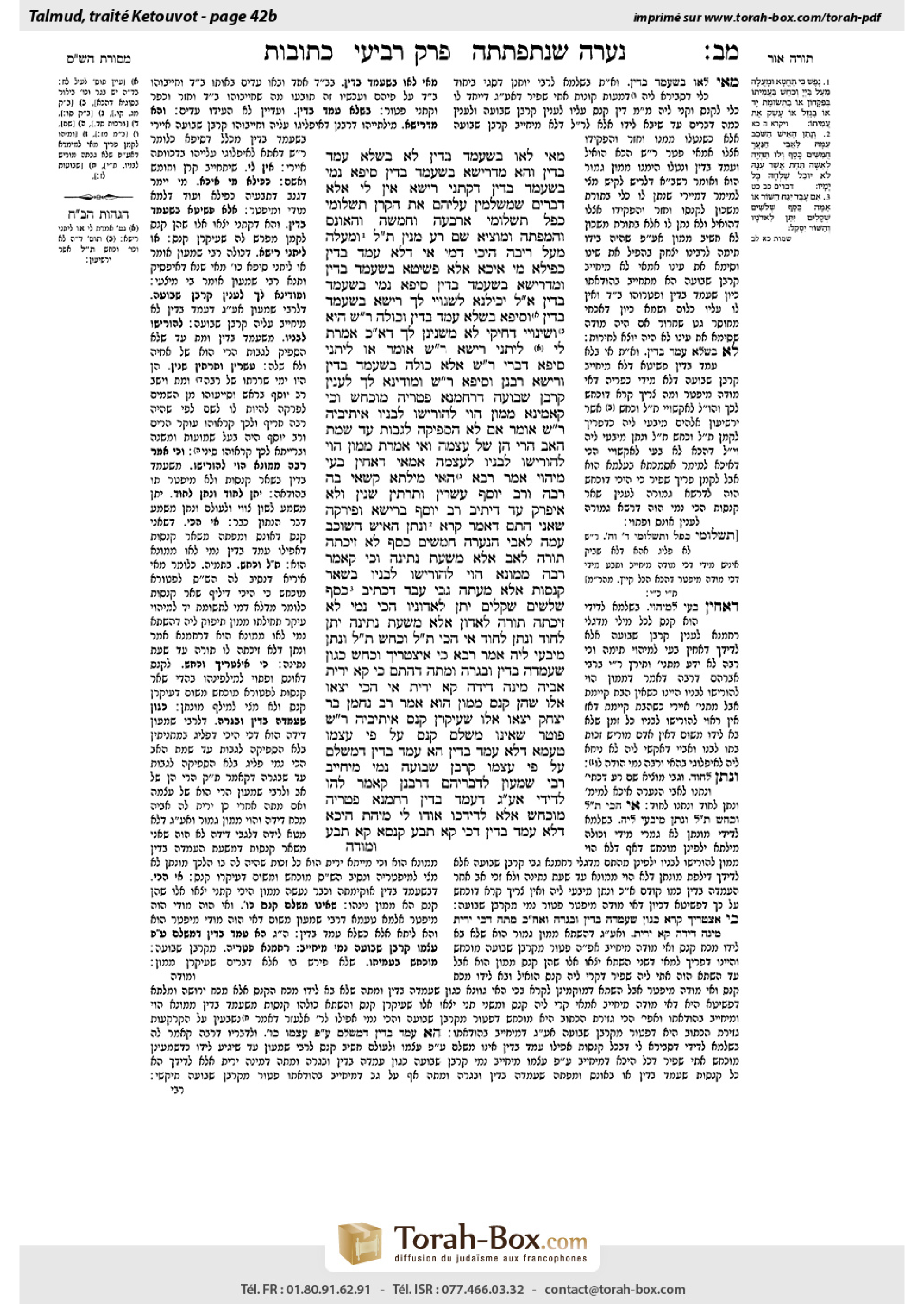
Ketubot 42b: Talmud study for Daf Yomi
Daf Yomi is the daily study of one Talmud folio. Explore 37 tractates with scans, Hebrew text, Sefaria English and AI-generated French translations where annotated.
Passage selection and English or AI-generated French translation are available where the scan has annotations. Daf Study is independent of Torah-Box and Sefaria.
Browse Ketubot · כתובות · All tractatesKetubot 42b text and translations
This page of Ketubot includes the Aramaic text, an English translation and an AI-generated French translation, alongside the scan above.
כתובות מ״ב ב · Aramaic and Hebrew text
מַאי לָאו בְּשֶׁעָמַד בַּדִּין! לָא, בְּשֶׁלֹּא עָמַד בַּדִּין.
וְהָא מִדְּרֵישָׁא בְּשֶׁעָמַד בַּדִּין, סֵיפָא נָמֵי בְּשֶׁעָמַד בַּדִּין. דְּקָתָנֵי רֵישָׁא: אֵין לִי אֶלָּא דְּבָרִים שֶׁמְּשַׁלְּמִין עֲלֵיהֶם אֶת הַקֶּרֶן. תַּשְׁלוּמֵי כֶפֶל, תַּשְׁלוּמֵי אַרְבָּעָה וַחֲמִשָּׁה, וְהָאוֹנֵס וְהַמְפַתֶּה וּמוֹצִיא שֵׁם רַע, מִנַּיִן — תַּלְמוּד לוֹמַר: ״וּמָעֲלָה מַעַל״, רִיבָּה.
הֵיכִי דָמֵי? אִי דְּלֹא עָמַד בַּדִּין, כְּפֵילָא מִי אִיכָּא? אֶלָּא פְּשִׁיטָא בְּשֶׁעָמַד בַּדִּין. וּמִדְּרֵישָׁא בְּשֶׁעָמַד בַּדִּין, סֵיפָא נָמֵי בְּשֶׁעָמַד בַּדִּין!
אֲמַר לֵיהּ, יָכֵילְנָא לְשַׁנּוֹיֵי לָךְ: רֵישָׁא בְּשֶׁעָמַד בַּדִּין, וְסֵיפָא בְּשֶׁלֹּא עָמַד בַּדִּין, וְכוּלַּהּ רַבִּי שִׁמְעוֹן הִיא. וְשִׁינּוּיֵי דְּחִיקֵי לָא מְשַׁנֵּינַן לָךְ. דְּאִם כֵּן אָמְרַתְּ לִי: לִיתְנֵי רֵישָׁא ״רַבִּי שִׁמְעוֹן אוֹמֵר״, אוֹ לִיתְנֵי סֵיפָא ״דִּבְרֵי רַבִּי שִׁמְעוֹן״.
אֶלָּא: כּוּלַּהּ בְּשֶׁעָמַד בַּדִּין, וְרֵישָׁא רַבָּנַן וְסֵיפָא רַבִּי שִׁמְעוֹן.
וּמוֹדֵינָא לָךְ לְעִנְיַן קׇרְבַּן שְׁבוּעָה דְּרַחֲמָנָא פַּטְרֵיהּ, מִ״וְּכִחֵשׁ״.
וְכִי קָאָמֵינָא מָמוֹן הָוֵי — לְהוֹרִישׁוֹ לְבָנָיו.
אֵיתִיבֵיהּ, רַבִּי שִׁמְעוֹן אוֹמֵר: אִם לֹא הִסְפִּיקָה לִגְבּוֹת עַד שֶׁמֵּת הָאָב — הֲרֵי הֵן שֶׁל עַצְמָהּ. וְאִי אָמְרַתְּ מָמוֹן הָוֵי לְהוֹרִישׁוֹ לְבָנָיו, לְעַצְמָהּ אַמַּאי? דְּאַחִין בָּעֵי מִיהְוֵי!
אָמַר רָבָא: הַאי מִילְּתָא קְשַׁאי בַּהּ רַבָּה וְרַב יוֹסֵף עֶשְׂרִין וְתַרְתֵּין שְׁנִין וְלָא אִיפְּרַק, עַד דִּיתֵיב רַב יוֹסֵף בְּרֵישָׁא וּפָירְקַהּ: שָׁאנֵי הָתָם, דְּאָמַר קְרָא: ״וְנָתַן הָאִישׁ הַשּׁוֹכֵב עִמָּהּ לַאֲבִי הַנַּעֲרָה חֲמִשִּׁים כֶּסֶף״, לֹא זִיכְּתָה תּוֹרָה לָאָב אֶלָּא מִשְּׁעַת נְתִינָה.
וְכִי קָאָמַר רַבָּה מָמוֹנָא הָוֵי לְהוֹרִישׁוֹ לְבָנָיו — בִּשְׁאָר קְנָסוֹת.
אֶלָּא מֵעַתָּה גַּבֵּי עֶבֶד, דִּכְתִיב: ״כֶּסֶף שְׁלֹשִׁים שְׁקָלִים יִתֵּן לַאדוֹנָיו״, הָכִי נָמֵי לֹא זִיכְּתָה תּוֹרָה לָאָדוֹן אֶלָּא מִשְּׁעַת נְתִינָה?! ״יִתֵּן״ לְחוּד, ״וְנָתַן״ לְחוּד.
אִי הָכִי, תַּלְמוּד לוֹמַר: ״וְכִחֵשׁ״? תַּלְמוּד לוֹמַר: ״וְנָתַן״ מִיבְּעֵי לֵיהּ!
אָמַר רָבָא: כִּי אִיצְטְרִיךְ ״וְכִחֵשׁ״ — כְּגוֹן שֶׁעָמְדָה בַּדִּין, וּבָגְרָה וּמֵתָה. דְּהָתָם, כִּי קָא יָרֵית אָבִיהָ — מִינַּהּ דִּידַהּ קָא יָרֵית.
אִי הָכִי, ״יָצְאוּ אֵלּוּ שֶׁהֵן קְנָס״, מָמוֹן הוּא! אָמַר רַב נַחְמָן בַּר יִצְחָק: יָצְאוּ אֵלּוּ שֶׁעִיקָּרָן קְנָס.
אֵיתִיבֵיהּ: רַבִּי שִׁמְעוֹן פּוֹטֵר, שֶׁאֵינוֹ מְשַׁלֵּם קְנָס עַל פִּי עַצְמוֹ. טַעְמָא דְּלֹא עָמַד בַּדִּין, הָא עָמַד בַּדִּין, דִּמְשַׁלֵּם עַל פִּי עַצְמוֹ, קׇרְבַּן שְׁבוּעָה נָמֵי מִיחַיַּיב!
רַבִּי שִׁמְעוֹן לְדִבְרֵיהֶם דְּרַבָּנַן קָאָמַר לְהוּ: לְדִידִי, אַף עַל גַּב דְּעָמַד בַּדִּין — רַחֲמָנָא פַּטְרֵיהּ מִ״וְּכִחֵשׁ״. אֶלָּא לְדִידְכוּ, אוֹדוֹ לִי מִיהַת הֵיכָא דְּלֹא עָמַד בַּדִּין, דְּכִי קָא תָּבַע, קְנָסָא קָא תָּבַע,
Ketubot 42b · English translation
What, is it not referring to a case where he has stood trial, and yet Rabbi Shimon does not render him liable for the oath as the payment was originally a fine? Rabba refutes this argument: No, that baraita is referring to a situation where he has not stood trial.
Abaye persists: But from the fact that the first clause of the baraita deals with one who has stood trial, it follows that the latter clause also deals with one who has stood trial. As the baraita teaches in its first clause: I have derived the halakha only for matters for which one pays the principal. With regard to the payments that are double the principal, and payments that are four and five times the principal, and those of the rapist, and the seducer, and the defamer, from where is it derived that all these are included in the liability to bring an offering for falsely taking an oath on a deposit? The verse states: “If anyone sin and commit a trespass [ma’ala ma’al]” (Leviticus 5:21). The doubled usage of the word trespass serves to amplify and include any false oath taken in denial of monetary liability.
Abaye analyzes this statement: What are the circumstances? If this is referring to a situation when he has not stood trial, is there double payment in that case? Everyone agrees that one who admits his guilt is exempt from the double payment, and yet this obligation is mentioned in the baraita. Rather, it is obvious that the baraita is referring to a case where it is claimed that he has already stood trial and was declared liable to pay the double payment, and the accused individual denies this claim. Abaye summarizes his question: And from the fact that the first clause of this baraita deals with one who has stood trial, the latter clause also deals with one who has stood trial, and even so Rabbi Shimon does not deem him liable to bring an offering for his oath.
Rabba said to him: I could answer you that the first clause deals with one who is accused of already having stood trial and been deemed liable, and the latter clause deals with one who has not stood trial, and this entire baraita is in accordance with the opinion of Rabbi Shimon. According to this answer, Rabbi Shimon concedes that after one has been deemed liable in court, the double payment attains the status of a regular monetary obligation rather than a fine, and therefore in the first case in the baraita he is liable to bring an offering and a payment for his admission. But I will not answer you a far-fetched answer, for if it is so, that the entire baraita represents the opinion of Rabbi Shimon, you could say to me: Let the tanna of the baraita either teach explicitly in the first clause: Rabbi Shimon says, or let him teach in the latter clause: This is the statement of Rabbi Shimon.
Rabba continued: Rather, I will say that the entire baraita is referring to one who has stood trial, and as for the difference in halakha, the first clause is in accordance with the opinion of the Rabbis, who deem one liable to bring the offering of an oath in a case where the plaintiff says that the defendant stood trial, was found liable, and swore falsely. And the latter clause represents the opinion of Rabbi Shimon, who exempts one who confesses from bringing the offering of an oath.
And I concede to you, Abaye, with regard to the liability to bring an offering for falsely taking an oath on a deposit, that the Merciful One exempts him from this offering here, based upon the verse “And deal falsely with his neighbor in a matter of a deposit,” (Leviticus 5:21), which indicates that one is liable to bring an offering only if he lied about a claim that was originally a monetary obligation.
And when I say that Rabbi Shimon maintains that after one is declared liable in court his obligation to pay is considered a regular monetary payment rather than a fine, that is not to say that he is liable to bring an offering for falsely denying a monetary claim, but rather to say that the recipient of the payment bequeaths it to his sons. Unlike a fine, which does not pass by inheritance to one’s heirs, this is classified as a regular monetary payment. Consequently, if the perpetrator was deemed liable in court and ordered to pay the father of the girl he raped or seduced, and the father died before receiving payment, his sons inherit the right to that payment.
Abaye raised an objection to this last point from the mishna. Rabbi Shimon says: If the daughter did not manage to collect the payments before the father died, they belong to her. And if you say that this fine is a monetary payment to the extent that one can bequeath it to his sons after the trial, why does the money belong to her? Since the trial has taken place, it should be the property of the brothers by inheritance from their father, as it is already considered a regular monetary obligation that is owed to the father.
Rava said: This matter was difficult for Rabba and Rav Yosef for twenty-two years without resolution, until Rav Yosef sat at the head of the academy and resolved it in the following manner: There, in the case of a rape, it is different, as the verse states: “And the man who laid with her shall give the young woman’s father fifty shekels of silver” (Deuteronomy 22:29), from which it is inferred: The Torah entitled the father to this money only from the time of giving. Consequently, if the father dies before receiving the money, he does not bequeath his right to the money to his sons. Instead, the daughter is considered to take her father’s place as the plaintiff, because she was the victim, and the money is paid to her.
And when Rabba said that the fine imposed by a court is considered a regular monetary obligation with regard to one’s ability to bequeath it to his sons, he was not referring to this particular case of a rapist or seducer, but only to other fines, which do have the status of regular monetary obligations after the court delivers its verdict.
The Gemara asks: However, if that is so, that the verb “give” is explained in this manner, with regard to an ox that killed a slave, where it is written: “He shall give to their master thirty shekels of silver” (Exodus 21:32), so too will you say that the Torah entitled the master only from the time of giving? The Gemara answers: “Shall give [yiten],” is distinct, and “shall give [venatan],” is distinct. The first expression, which is stated with regard to an ox that killed a slave, does not indicate that the recipient acquires the right to the money only from the moment it is given, whereas the formulation employed in the case of rape does indicate that this is the case.
The Gemara raises a difficulty: If so, that the main source for this halakha is the phrase “shall give [venatan],” when it was taught in the baraita that a man who rapes or seduces a woman is not liable to bring the offering for a false oath in denial of a monetary claim, rather than saying that this is derived from the fact that the verse states “and deal falsely,” he should have said that it is derived from the fact that the verse states “shall give,” as this is the phrase that teaches that the payment is considered a fine even after he has stood trial.
In answer to this question, Rava said: When it was necessary to cite a proof from “and deal falsely,” it was with regard to a situation where the young woman’s case was brought to trial, and the court ruled in her favor, and she reached majority and subsequently died before the money was paid. The reason that “and deal falsely” is necessary in that case is because there, when the father inherits, it is from her that he inherits.
The Gemara raises another difficulty: If so, the language of the baraita: Excluding these, as they are a fine, is inaccurate, as it is a regular monetary payment, not a fine. In answer to this question, Rav Naḥman bar Yitzḥak said that this phrase means: Excluding these, as they are originally a fine, and it is only once the court orders the man to pay that they are viewed as regular monetary payments.
Abaye raised an objection to this explanation of the opinion of Rabbi Shimon, based upon the mishna in Shevuot cited above (42a), which states: Rabbi Shimon exempts him, as he does not pay a fine on his own admission. The Gemara infers: The reason that he is not liable to bring a guilt-offering is because he has not stood trial. However, if he has stood trial and been found guilty, in which case he pays on his own admission when he later admits that he was already convicted in court, he should also be liable to bring an offering if he denies that he was convicted in court and takes an oath to that effect. This contradicts the claim that, according to Rabbi Shimon, even after one is convicted in court, the payment is still considered a fine.
The Gemara answers: Rabbi Shimon stated his opinion to them in accordance with the statement of the Rabbis themselves, as follows: According to my opinion, although he has stood trial, the Merciful One exempts him from the offering, as derived from the verse: “And deal falsely with his neighbor in a matter of a deposit” (Leviticus 5:21), which indicates that he is liable only for a claim that originally concerned a regular monetary payment. However, according to your opinion, you should at least concede to me in a case where he has not stood trial, that when one claims the money, he claims a fine and not a regular monetary payment.
Ketubot 42b · Traduction française (IA)
Quoi ? Cela ne désigne-t-il pas un cas où il a été jugé, et où pourtant Rabbi Shimon ne le rend pas passible de l’offrande liée au serment, puisque le paiement était à l’origine une amende ? Rabba réfute cet argument : Non, cette baraïta parle d’une situation où il n’a pas été jugé.
Abayé insiste : Mais puisque la première partie de la baraïta traite de quelqu’un qui a été jugé, il s’ensuit que la dernière partie traite elle aussi de quelqu’un qui a été jugé. En effet, la baraïta enseigne dans sa première partie : Je n’ai déduit la halakha que pour les cas où l’on paie le principal. D’où déduit-on que les paiements correspondant au double du principal, ceux correspondant à quatre ou cinq fois le principal, ainsi que ceux dus par le violeur, le séducteur et le diffamateur, sont tous inclus dans l’obligation d’apporter une offrande pour avoir prêté un faux serment au sujet d’un dépôt ? Le verset dit : « Si quelqu’un commet une faute et agit perfidement [ma’ala ma’al] » (Lévitique 5, 21). La répétition du terme « perfidement » sert à élargir la portée du texte et à inclure tout faux serment prêté pour nier une obligation pécuniaire.
Abayé analyse cette déclaration : De quelles circonstances s’agit-il ? Si elle concerne une situation où il n’a pas été jugé, y a-t-il alors paiement du double ? Tout le monde s’accorde à dire que celui qui reconnaît sa culpabilité est exempté du paiement du double, et pourtant cette obligation est mentionnée dans la baraïta. Il est donc évident que la baraïta parle d’un cas où l’on prétend qu’il a déjà été jugé et condamné à payer le double, et où l’accusé nie cette affirmation. Abayé résume sa question : Puisque la première partie de cette baraïta traite de quelqu’un qui a été jugé, la dernière partie traite elle aussi de quelqu’un qui a été jugé ; et pourtant Rabbi Shimon ne le considère pas comme tenu d’apporter une offrande pour son serment.
Rabba lui dit : Je pourrais te répondre que la première partie traite de quelqu’un que l’on accuse d’avoir déjà été jugé et condamné, tandis que la dernière partie traite de quelqu’un qui n’a pas été jugé, et que toute cette baraïta suit l’opinion de Rabbi Shimon. Selon cette réponse, Rabbi Shimon reconnaît qu’une fois qu’une personne a été déclarée redevable par le tribunal, le paiement du double acquiert le statut d’une obligation pécuniaire ordinaire plutôt que d’une amende ; par conséquent, dans le premier cas de la baraïta, elle est tenue d’apporter une offrande et de faire un paiement à la suite de son aveu. Mais je ne te donnerai pas une réponse tirée par les cheveux : car, si toute la baraïta exprimait l’opinion de Rabbi Shimon, tu pourrais me dire : Que le tanna de la baraïta enseigne explicitement dans la première partie : « Rabbi Shimon dit », ou qu’il enseigne dans la dernière partie : « Telle est la déclaration de Rabbi Shimon ».
Rabba poursuivit : Je dirai plutôt que toute la baraïta parle de quelqu’un qui a été jugé. Quant à la différence de halakha, la première partie suit l’opinion des Rabbins, qui considèrent qu’une personne est tenue d’apporter l’offrande liée au serment lorsque le demandeur affirme que le défendeur a été jugé, déclaré redevable et a prêté un faux serment. La dernière partie, elle, représente l’opinion de Rabbi Shimon, qui exempte celui qui avoue d’apporter l’offrande liée au serment.
Et je te concède, Abayé, en ce qui concerne l’obligation d’apporter une offrande pour avoir prêté un faux serment au sujet d’un dépôt, que le Miséricordieux l’exempte ici de cette offrande, en se fondant sur le verset : « et agit perfidement envers son prochain au sujet d’un dépôt » (Lévitique 5, 21), qui indique qu’on n’est tenu d’apporter une offrande que si l’on a menti au sujet d’une réclamation qui portait à l’origine sur une obligation pécuniaire.
Et lorsque je dis que, selon Rabbi Shimon, une fois qu’une personne a été déclarée redevable par le tribunal, son obligation de payer est considérée comme un paiement pécuniaire ordinaire plutôt que comme une amende, je ne veux pas dire qu’elle est tenue d’apporter une offrande pour avoir faussement nié une réclamation pécuniaire ; je veux dire que le bénéficiaire du paiement peut le transmettre à ses fils par héritage. À la différence d’une amende, qui ne passe pas à ses héritiers par succession, ce paiement est classé comme une obligation pécuniaire ordinaire. Par conséquent, si l’auteur de la faute a été déclaré redevable par le tribunal et condamné à payer le père de la jeune fille qu’il a violée ou séduite, et si le père meurt avant d’avoir reçu le paiement, ses fils héritent du droit à ce paiement.
Abayé soulève une objection à ce dernier point à partir de la Michna. Rabbi Shimon dit : Si la fille n’a pas réussi à percevoir les paiements avant la mort de son père, ils lui reviennent. Or, si tu dis que cette amende est un paiement pécuniaire au point qu’on puisse la transmettre à ses fils par héritage après le procès, pourquoi l’argent lui revient-il ? Puisque le procès a eu lieu, il devrait appartenir aux frères par héritage de leur père, puisqu’il est déjà considéré comme une obligation pécuniaire ordinaire due au père.
Rava dit : Cette question a embarrassé Rabba et Rav Yossef pendant vingt-deux ans sans qu’ils parviennent à la résoudre, jusqu’à ce que Rav Yossef prenne la tête de l’académie et la résolve de la manière suivante : Dans le cas d’un viol, la situation est différente, car le verset dit : « L’homme qui a couché avec elle donnera au père de la jeune fille cinquante sicles d’argent » (Deutéronome 22, 29), ce dont on déduit que la Torah n’a conféré au père un droit sur cet argent qu’au moment où celui-ci lui est versé. Par conséquent, si le père meurt avant de recevoir l’argent, il ne transmet pas à ses fils son droit sur cet argent. C’est plutôt la fille qui est considérée comme prenant la place de son père en tant que demanderesse, puisqu’elle est la victime, et l’argent lui est versé.
Et lorsque Rabba a dit qu’une amende imposée par un tribunal est considérée comme une obligation pécuniaire ordinaire en ce qui concerne la possibilité de la transmettre à ses fils par héritage, il ne parlait pas de ce cas particulier du violeur ou du séducteur, mais uniquement d’autres amendes, qui acquièrent effectivement le statut d’obligations pécuniaires ordinaires après que le tribunal a rendu son verdict.
La Guemara demande : Cependant, si tel est le cas, si le verbe « donner » s’interprète de cette manière, au sujet du bœuf qui a tué un esclave, à propos duquel il est écrit : « Il donnera à leur maître trente sicles d’argent » (Exode 21, 32), diras-tu également que la Torah n’a conféré un droit au maître qu’au moment où le paiement est versé ? La Guemara répond : « Il donnera [yiten] » est une formulation distincte de « il donnera [venatan] ». La première expression, employée au sujet du bœuf qui a tué un esclave, n’indique pas que le bénéficiaire n’acquiert le droit à l’argent qu’au moment où il le reçoit, tandis que la formulation employée dans le cas du viol indique bien que tel est le cas.
La Guemara soulève une difficulté : Si tel est le cas, si la source principale de cette halakha est l’expression « il donnera [venatan] », lorsque la baraïta enseigne qu’un homme qui viole ou séduit une femme n’est pas tenu d’apporter l’offrande pour avoir prêté un faux serment en niant une créance pécuniaire, elle aurait dû dire que cela se déduit de l’expression « il donnera », plutôt que de dire que cela se déduit du fait que le verset dit « et agit perfidement », car c’est cette expression qui enseigne que le paiement est considéré comme une amende même après qu’il a été jugé.
Pour répondre à cette question, Rava dit : Il était nécessaire de citer une preuve tirée de l’expression « et agit perfidement » dans le cas où l’affaire de la jeune fille a été portée devant le tribunal, où le tribunal a statué en sa faveur, puis où elle a atteint sa majorité et est morte ensuite, avant le paiement de l’argent. Dans ce cas, l’expression « et agit perfidement » est nécessaire parce que, lorsque le père hérite, c’est de sa fille qu’il hérite.
La Guemara soulève une autre difficulté : Si tel est le cas, la formulation de la baraïta — « à l’exclusion de ces cas, puisqu’il s’agit d’une amende » — est inexacte, car il s’agit d’un paiement pécuniaire ordinaire, et non d’une amende. Pour répondre à cette question, Rav Naḥman bar Yitzḥak dit que cette expression signifie : « à l’exclusion de ces cas, puisqu’il s’agit à l’origine d’une amende » ; ce n’est qu’une fois que le tribunal ordonne à l’homme de payer qu’ils sont considérés comme des paiements pécuniaires ordinaires.
Abayé soulève une objection à cette explication de l’opinion de Rabbi Shimon, en s’appuyant sur la Michna de Chevouot citée plus haut (42a), qui dit : Rabbi Shimon l’exempte, car il ne paie pas d’amende sur son propre aveu. La Guemara en déduit que la raison pour laquelle il n’est pas tenu d’apporter un sacrifice de culpabilité est qu’il n’a pas été jugé. Mais s’il a été jugé et déclaré coupable — auquel cas il paie de son propre aveu lorsqu’il reconnaît par la suite qu’il a déjà été condamné par le tribunal —, il devrait également être tenu d’apporter une offrande s’il nie avoir été condamné par le tribunal et prête un serment en ce sens. Cela contredit l’affirmation selon laquelle, selon Rabbi Shimon, même après une condamnation par le tribunal, le paiement reste considéré comme une amende.
La Guemara répond : Rabbi Shimon leur a présenté son opinion en se fondant sur la déclaration des Rabbins eux-mêmes, comme suit : Selon mon opinion, bien qu’il ait été jugé, le Miséricordieux l’exempte de l’offrande, comme on le déduit du verset : « et agit perfidement envers son prochain au sujet d’un dépôt » (Lévitique 5, 21), qui indique qu’il n’est tenu que pour une réclamation qui portait à l’origine sur un paiement pécuniaire ordinaire. Mais selon votre opinion, vous devriez au moins me concéder que, dans un cas où il n’a pas été jugé, lorsqu’on réclame l’argent, on réclame une amende et non un paiement pécuniaire ordinaire.
Traduction française générée par IA à partir de l’édition anglaise de Sefaria. Vérifie toujours un passage avec le texte source.
Text from Sefaria: William Davidson Edition - Vocalized Aramaic (CC BY NC); William Davidson Edition - English (CC BY NC).