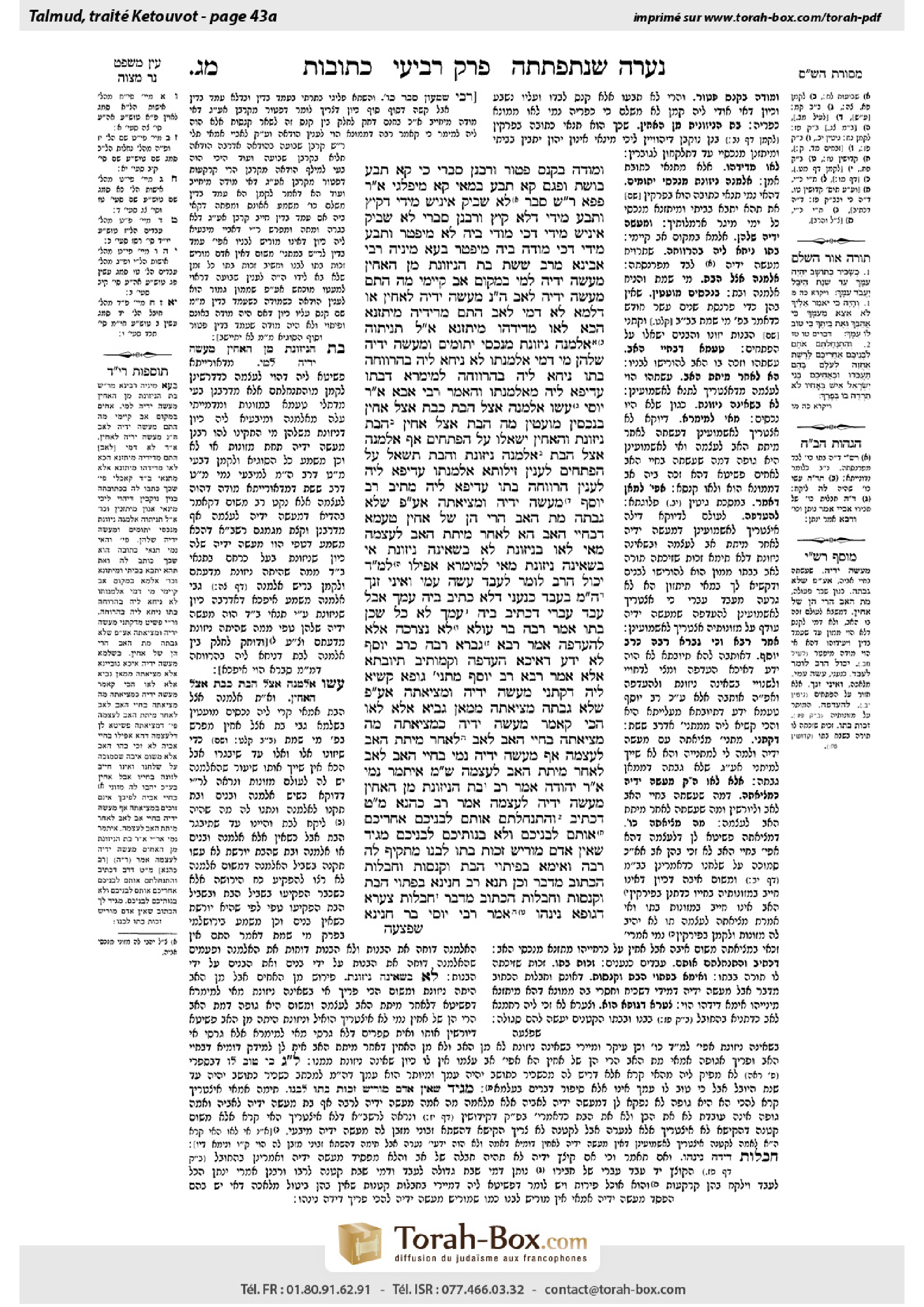
Ketubot 43a: Talmud study for Daf Yomi
Daf Yomi is the daily study of one Talmud folio. Explore 37 tractates with scans, Hebrew text, Sefaria English and AI-generated French translations where annotated.
Passage selection and English or AI-generated French translation are available where the scan has annotations. Daf Study is independent of Torah-Box and Sefaria.
Browse Ketubot · כתובות · All tractatesKetubot 43a text and translations
This page of Ketubot includes the Aramaic text, an English translation and an AI-generated French translation, alongside the scan above.
כתובות מ״ג א · Aramaic and Hebrew text
וּמוֹדֶה בִּקְנָס פָּטוּר. וְרַבָּנַן סָבְרִי, כִּי קָא תָבַע — בּוֹשֶׁת וּפְגָם קָא תָבַע.
בְּמַאי קָא מִיפַּלְגִי? אָמַר רַב פָּפָּא, רַבִּי שִׁמְעוֹן סָבַר: לָא שָׁבֵיק אִינִישׁ מִידֵּי דְּקִיץ, וְתָבַע מִידֵּי דְּלָא קִיץ. וְרַבָּנַן סָבְרִי: לָא שָׁבֵיק אִינִישׁ מִידֵּי דְּכִי מוֹדֵי בֵּיהּ לָא מִיפְּטַר, וְתָבַע מִידֵּי דְּכִי מוֹדֵה בֵּיהּ מִיפְּטַר.
בְּעָא מִינֵּיהּ רַבִּי אֲבִינָא מֵרַב שֵׁשֶׁת: בַּת הַנִּיזּוֹנֶת מִן הָאַחִין — מַעֲשֵׂה יָדֶיהָ לְמִי?
בִּמְקוֹם אָב קָיְימִי, מָה הָתָם — מַעֲשֵׂה יָדֶיהָ לָאָב, הָכָא נָמֵי — מַעֲשֵׂה יָדֶיהָ לָאַחִין, אוֹ דִלְמָא: לָא דָּמֵי לְאָב. הָתָם — מִדִּידֵיהּ מִיתַּזְנָא, הָכָא — לָאו מִדִּידְהוּ מִיתַּזְנָא.
אֲמַר לֵיהּ, תְּנֵיתוּהָ: אַלְמָנָה נִיזּוֹנֶת מִנִּכְסֵי יְתוֹמִים וּמַעֲשֵׂה יָדֶיהָ שֶׁלָּהֶן.
מִי דָּמֵי? אַלְמְנָתוֹ, לָא נִיחָא לֵיהּ בְּהַרְוָוחָה. בִּתּוֹ, נִיחָא לֵיהּ בְּהַרְווֹחָה.
לְמֵימְרָא דְּבִתּוֹ עֲדִיפָא לֵיהּ מֵאַלְמְנָתוֹ? וְהָאָמַר רַבִּי אַבָּא אָמַר רַבִּי יוֹסֵי: עָשׂוּ אַלְמָנָה אֵצֶל הַבַּת כַּבַּת אֵצֶל אַחִין בִּנְכָסִין מוּעָטִין,
מָה הַבַּת אֵצֶל אַחִין — הַבַּת נִיזּוֹנֶת, וְהָאַחִין יִשְׁאֲלוּ עַל הַפְּתָחִים, אַף אַלְמָנָה אֵצֶל הַבַּת — אַלְמָנָה נִיזּוֹנֶת, וְהַבַּת תִּשְׁאַל עַל הַפְּתָחִים. לְעִנְיַן זִילוּתָא — אַלְמְנָתוֹ עֲדִיפָא לֵיהּ. לְעִנְיַן הַרְוָוחָה — בִּתּוֹ עֲדִיפָא לֵיהּ.
מֵתִיב רַב יוֹסֵף: מַעֲשֵׂה יָדֶיהָ וּמְצִיאָתָהּ, אַף עַל פִּי שֶׁלֹּא גָּבְתָה — מֵת הָאָב הֲרֵי הֵן שֶׁל אַחִין. טַעְמָא דִּבְחַיֵּי הָאָב, הָא לְאַחַר מִיתַת הָאָב — לְעַצְמָהּ. מַאי לָאו בְּנִיזּוֹנֶת? לָא, בְּשֶׁאֵינָהּ נִיזּוֹנֶת.
אִי בְּשֶׁאֵינָהּ נִיזּוֹנֶת, מַאי לְמֵימְרָא? אֲפִילּוּ לְמַאן דְּאָמַר יָכוֹל הָרַב לוֹמַר לָעֶבֶד ״עֲשֵׂה עִמִּי וְאֵינִי זָנָךְ״. הָנֵי מִילֵּי בְּעֶבֶד כְּנַעֲנִי, דְּלָא כְּתִיב בֵּיהּ ״עִמָּךְ״.
אֲבָל עֶבֶד עִבְרִי דִּכְתִיב בֵּיהּ ״עִמָּךְ״ — לֹא. כׇּל שֶׁכֵּן בִּתּוֹ!
אָמַר רַבָּה בַּר עוּלָּא: לֹא נִצְרְכָה אֶלָּא לְהַעֲדָפָה. אָמַר רָבָא: גַּבְרָא רַבָּה כְּרַב יוֹסֵף לָא יָדַע דְּאִיכָּא הַעֲדָפָה, וְקָמוֹתֵיב תְּיוּבְתָּא?
אֶלָּא אָמַר רָבָא: רַב יוֹסֵף מַתְנִיתִין גּוּפָא קַשְׁיָא לֵיהּ. דְּקָתָנֵי: מַעֲשֵׂה יָדֶיהָ וּמְצִיאָתָהּ, אַף עַל פִּי שֶׁלֹּא גָּבְתָה. מְצִיאָתָהּ מִמַּאן גָּבְיָא?
אֶלָּא לָאו, הָכִי קָאָמַר: מַעֲשֵׂה יָדֶיהָ כִּמְצִיאָתָהּ, מָה מְצִיאָתָהּ בְּחַיֵּי הָאָב — לָאָב, לְאַחַר מִיתַת הָאָב — לְעַצְמָהּ, אַף מַעֲשֵׂה יָדֶיהָ נָמֵי: בְּחַיֵּי הָאָב — לָאָב, לְאַחַר מִיתַת הָאָב — לְעַצְמָהּ. שְׁמַע מִינַּהּ.
אִיתְּמַר נָמֵי, אָמַר רַב יְהוּדָה אָמַר רַב: בַּת הַנִּיזּוֹנֶת מִן הָאַחִין, מַעֲשֵׂה יָדֶיהָ לְעַצְמָהּ. אָמַר רַב כָּהֲנָא: מַאי טַעְמָא — דִּכְתִיב: ״וְהִתְנַחַלְתֶּם אוֹתָם לִבְנֵיכֶם אַחֲרֵיכֶם״. ״אוֹתָם לִבְנֵיכֶם״, וְלֹא בְּנוֹתֵיכֶם לִבְנֵיכֶם. מַגִּיד שֶׁאֵין אָדָם מוֹרִישׁ זְכוּת בִּתּוֹ לִבְנוֹ.
מַתְקֵיף לַהּ רַבָּה: וְאֵימָא בְּפִיתּוּי הַבַּת וּקְנָסוֹת וַחֲבָלוֹת הַכָּתוּב מְדַבֵּר. וְכֵן תָּנָא רַב חֲנִינָא: בְּפִתּוּי הַבַּת וּקְנָסוֹת וַחֲבָלוֹת הַכָּתוּב מְדַבֵּר!
חֲבָלוֹת, צַעֲרָא דְגוּפָא נִינְהוּ. אָמַר רַבִּי יוֹסֵי בַּר חֲנִינָא:
Ketubot 43a · English translation
And the principle is that one who admits that he is liable to pay a fine is exempt. Since the man would not have been liable to pay even if he had admitted his guilt, his denial of guilt is not considered a denial of monetary liability, and even if he swears falsely that he is not liable, he still does not become liable to bring an offering. And the Rabbis hold that when the father claims payment in court, it is the compensation for the humiliation and degradation that he claims. His main focus is not on the fine, and therefore the denial refers to a regular monetary claim.
The Gemara asks: If this explanation is correct, with regard to what do the tanna’im disagree? Rav Pappa said: Rabbi Shimon holds that a person does not leave aside something that is fixed, e.g., a fine, and claim something that is not fixed, e.g., the compensation for humiliation and degradation, which need to be assessed by the court. Consequently, a claim of rape is essentially a demand for the fine. And conversely, the Rabbis hold that a person does not leave aside something that, if the defendant admits to it, he is not exempt from payment, e.g., humiliation and degradation, and claim something that, if the defendant admits to it, he is exempt from payment. Consequently, they contend that the lawsuit is mainly focused on the compensation for the humiliation and degradation.
§ Rabbi Avina raised a dilemma before Rav Sheshet: With regard to a daughter who is sustained by her brothers, i.e., an orphan whose brothers provide her with her sustenance from their father’s estate, in accordance with the stipulation in the marriage contract between their parents that requires the father to pay for his daughter’s sustenance from his property, to whom do her earnings belong?
Rabbi Avina explains the sides of the dilemma. One might say that the brothers stand in place of the father: Just as there, if their father is alive, her earnings go to the father, here too her earnings go to the brothers. Or perhaps this is not similar to the case of a living father. Why not? Because there, she is sustained from his own property, and therefore he is entitled to receive her earnings, whereas here, she is not sustained from their possessions but from the estate of their father, and consequently they should not receive her earnings.
Rav Sheshet said to him: You already learned the answer to this dilemma from a mishna (Ketubot 81a): A widow is sustained from the property of the orphans, and her earnings are theirs. This indicates that although a widow receives her sustenance from the estate of her deceased husband, in accordance with the stipulations of the marriage contract, the orphans are nevertheless entitled to her earnings. The same reasoning should apply to an orphan sustained by her brothers.
The Gemara refutes this argument: Are the two situations comparable? In the case of his widow, the deceased is not necessarily amenable to her living in comfort. Consequently, she is entitled only to the minimum guaranteed to her in the marriage contract, while her earnings go to his heirs. Conversely, with regard to his daughter, he is amenable and is interested in her living in comfort, and therefore he allows her to retain her earnings so that she can have the extra money.
The Gemara asks: Is that to say that the welfare of his daughter is more preferable to him than that of his widow? But didn’t Rabbi Abba say that Rabbi Yosei said: The Sages established the halakha of a widow with regard to the daughter, who is also entitled to sustenance from the estate, like the halakha of a daughter with regard to the brothers in a case of a small estate that is insufficient for the livelihoods of both the girl and her brothers?
Rabbi Abba explains: Just as in the case of a daughter with regard to the brothers, the halakha is that the daughter is sustained from the father’s estate, and if the brothers have nothing to eat they must go and beg for charity at people’s doors, so too, in the case of a widow with regard to the daughter, the widow is sustained and the daughters beg for charity at people’s doors. This indicates that a man is more concerned for his widow than his daughter. The Gemara explains: The two cases are not comparable. With regard to degradation, one’s widow is preferable to him, i.e., if one of them must be forced to go around requesting handouts, a man would rather it be his daughter than his widow. By contrast, with regard to comfort, the comfort of his daughter is more preferable to him than that of his widow.
Rav Yosef raised an objection to Rav Sheshet’s conclusion that the orphan girl’s earnings belong to the brothers, from the mishna: With regard to her earnings and the lost items that she has found, although she has not collected them, if the father died, they belong to her brothers. Rav Yosef infers: The reason for this halakha is that she acquired her earnings in her father’s lifetime, which indicates that the money she earns after the father’s death belongs to her. What, is it not referring even to a daughter who is sustained from his estate? The Gemara refutes this claim: No, it deals with a daughter who is not sustained from his property but who sustains herself through her own earnings.
The Gemara asks: If the mishna is speaking of one who is not sustained from his estate, what is the purpose of stating this? It is obvious that this is the halakha, as even according to the one who said that a master can say to his slave: Work for me but I will not feed you, i.e., a master is not legally obligated to provide sustenance to his slave, this applies only to a Canaanite slave, with regard to whom it is not written in the Torah: “With you,” and therefore his master is not obligated to feed him.
However, in the case of a Hebrew slave, as it is written with regard to him: “With you” (Deuteronomy 15:16), which indicates that he is entitled to live with his master as an equal, the master may not compel the slave to serve him unless he feeds him. All the more so concerning his daughter, it cannot be the case that this young woman has to work and give her wages to the brothers if they are not obligated to sustain her at the same time.
Rabba bar Ulla said: It is necessary only for the surplus. The mishna is not implying that the brothers can take her earnings produced after the father's death and not sustain her, leaving her with nothing. Rather, the question concerns a young woman whose earnings provide her with more than she needs for her sustenance, leaving her with a surplus. It is this surplus that belongs to her, and not to her brothers. Rava said in response to Rabba bar Ulla’s explanation: Is it possible that a man as great as Rav Yosef does not know that there is an explanation according to which the implied case of the mishna is referring to the surplus, and in his ignorance he raises a refutation against Rav Sheshet? This certainly cannot be the case.
Rather, Rava said: The mishna itself poses a difficulty to the opinion of Rav Sheshet, and this difficulty led Rav Yosef to his conclusion. This is as the mishna teaches: Her earnings and the lost items that she has found, although she has not collected them. Rava analyzes this statement: With regard to items that she has found, from whom does she collect them? The concept of collecting is inappropriate in this case.
Rather, is it not the case that this is what the mishna said: Her earnings are like items she has found: Just as items she has found in her father’s lifetime belong to her father, and after the father’s death they belong to her, so too, the same rule applies to her earnings as well: In the father’s lifetime, they go to the father, and after the father’s death they belong to her, even when she is sustained from the inheritance. The Gemara concludes: We can learn from this inference that the mishna deals with her earnings themselves, not their surplus, in contrast to the interpretation of Rav Sheshet.
This halakha was also stated by amora’im, as Rav Yehuda said that Rav said: In the case of a daughter who is sustained by the brothers, her earnings nevertheless belong to her. Rav Kahana said: What is the reason for this? As it is written with regard to slaves: “And you may make them an inheritance for your sons after you” (Leviticus 25:46), from which it is inferred: It is them, slaves alone, that you bequeath to your sons, and you do not bequeath your daughters to your sons. This verse teaches that a man does not bequeath a right that he has over his daughter to his son. All the rights a man possesses over his daughter are personal rights, which are not transferable by inheritance.
Rabba strongly objects to this explanation that the verse is referring to a man’s rights to his daughter’s earnings: But one can say that the verse is speaking of the fine that a father is paid in the case of the seduction of his daughter, and the fines paid to him if she is raped, and compensation due to him for injuries that she suffered, and the verse indicates that these rights are not bequeathed to his heirs. And Rav Ḥanina likewise explicitly taught that the verse is speaking of payments a father is paid in the case of the seduction of his daughter, and the fines due to him if she is raped, and compensation for injuries she has suffered.
The Gemara questions this interpretation: With regard to injuries, they are the result of her bodily pain, and the guiding principle is that any compensation for a daughter’s physical pain does not belong to her father, who merely keeps it in trust for her. If so, the category of injuries should not have been included in this list. Rabbi Yosei bar Ḥanina said:
Ketubot 43a · Traduction française (IA)
Et le principe est que celui qui reconnaît être passible d’une amende en est exempté. Puisque cet homme n’aurait pas été passible de la payer même s’il avait reconnu sa culpabilité, son déni n’est pas considéré comme le déni d’une obligation pécuniaire ; même s’il jure faussement qu’il n’est pas tenu de payer, il n’est donc pas tenu d’apporter un sacrifice. Les Sages, quant à eux, considèrent que lorsque le père réclame un paiement devant le tribunal, il réclame une indemnisation pour l’humiliation et l’atteinte à la dignité. L’amende n’est pas l’objet principal de sa demande ; le déni porte donc sur une créance pécuniaire ordinaire.
La Guemara demande : Si cette explication est juste, sur quoi porte le désaccord entre les tannaïm ? Rav Pappa dit : Rabbi Shimon estime qu’on ne délaisse pas une somme fixe, par exemple une amende, pour réclamer une somme indéterminée, par exemple une indemnisation pour l’humiliation et l’atteinte à la dignité, qui doit être évaluée par le tribunal. Par conséquent, une plainte pour viol constitue essentiellement une demande d’amende. À l’inverse, les Sages estiment qu’on ne délaisse pas une somme dont l’accusé ne serait pas exempté s’il la reconnaissait, par exemple une indemnisation pour l’humiliation et l’atteinte à la dignité, pour réclamer une somme dont il serait exempté s’il la reconnaissait. Ils soutiennent donc que le procès porte principalement sur l’indemnisation pour l’humiliation et l’atteinte à la dignité.
§ Rabbi Avina souleva une question devant Rav Sheshet : concernant une fille entretenue par ses frères, c’est-à-dire une orpheline dont les frères pourvoient à l’entretien grâce aux biens de leur père, conformément à la clause du contrat de mariage de leurs parents qui oblige le père à assurer l’entretien de sa fille sur ses biens, à qui reviennent ses gains ?
Rabbi Avina expose les deux aspects de la question. On pourrait dire que les frères prennent la place du père : de même que, lorsque leur père est vivant, ses gains reviennent au père, de même, ici, ses gains reviennent aux frères. Ou peut-être le cas n’est-il pas comparable à celui d’un père vivant. Pourquoi ? Parce que, dans ce cas, elle est entretenue sur ses biens à lui, et il a donc droit à ses gains ; ici, en revanche, elle n’est pas entretenue sur leurs biens, mais sur la succession de leur père, si bien qu’ils ne devraient pas recevoir ses gains.
Rav Sheshet lui dit : Tu as déjà appris la réponse à cette question dans une Michna (Ketoubot 81a) : une veuve est entretenue sur les biens des orphelins, et ses gains leur reviennent. Cela indique que, bien qu’une veuve soit entretenue sur la succession de son défunt mari, conformément aux clauses du contrat de mariage, les orphelins ont néanmoins droit à ses gains. Le même raisonnement devrait s’appliquer à une orpheline entretenue par ses frères.
La Guemara réfute cet argument : les deux situations sont-elles comparables ? Dans le cas de sa veuve, le défunt ne tient pas nécessairement à ce qu’elle vive dans le confort. Elle n’a donc droit qu’au minimum garanti par le contrat de mariage, tandis que ses gains reviennent aux héritiers. En revanche, concernant sa fille, il tient à son bien-être et souhaite qu’elle vive dans le confort ; il lui permet donc de conserver ses gains afin qu’elle dispose de cet argent supplémentaire.
La Guemara demande : Cela signifie-t-il qu’il préfère le bien-être de sa fille à celui de sa veuve ? Pourtant, Rabbi Abba a dit au nom de Rabbi Yosei : les Sages ont établi, concernant une veuve qui a elle aussi droit à un entretien sur la succession, une halakha semblable à celle qui s’applique à une fille dans le cas d’une petite succession, insuffisante pour assurer la subsistance de la fille et de ses frères.
Rabbi Abba explique : de même que, dans le cas d’une fille face à ses frères, la halakha veut que la fille soit entretenue sur la succession de son père et que, si ses frères n’ont rien à manger, ils doivent aller mendier de porte en porte, de même, dans le cas d’une veuve face à la fille, la veuve est entretenue et les filles mendient de porte en porte. Cela indique qu’un homme se soucie davantage de sa veuve que de sa fille. La Guemara explique : les deux cas ne sont pas comparables. Pour ce qui est de l’humiliation, sa veuve lui est préférable, c’est-à-dire que, si l’une d’elles doit être contrainte d’aller demander l’aumône, un homme préfère que ce soit sa fille plutôt que sa veuve. En revanche, pour ce qui est du confort, il préfère celui de sa fille à celui de sa veuve.
Rav Yosef souleva une objection à la conclusion de Rav Sheshet, selon laquelle les gains de l’orpheline reviennent à ses frères, à partir de la Michna : ses gains et les objets perdus qu’elle a trouvés, si elle ne les a pas encore récupérés au moment de la mort de son père, reviennent à ses frères. Rav Yosef en déduit que cette halakha s’explique par le fait qu’elle avait acquis ses gains du vivant de son père, ce qui indique que l’argent qu’elle gagne après la mort de son père lui revient. La Michna ne parle-t-elle pas même d’une fille entretenue sur sa succession ? La Guemara réfute cette affirmation : non, elle parle d’une fille qui n’est pas entretenue sur ses biens, mais subvient à ses besoins grâce à ses propres gains.
La Guemara demande : Si la Michna parle d’une fille qui n’est pas entretenue sur sa succession, pourquoi le préciser ? La halakha est évidente, car même selon celui qui affirme qu’un maître peut dire à son esclave : « Travaille pour moi, mais je ne te nourrirai pas », c’est-à-dire qu’un maître n’est pas légalement tenu d’entretenir son esclave, cela ne s’applique qu’à un esclave cananéen, à propos duquel il n’est pas écrit dans la Torah : « avec toi » ; son maître n’est donc pas tenu de le nourrir.
En revanche, concernant un esclave hébreu, puisqu’il est écrit à son sujet : « avec toi » (Deutéronome 15:16), ce qui indique qu’il a le droit de vivre avec son maître sur un pied d’égalité, le maître ne peut pas le contraindre à le servir sans le nourrir. À plus forte raison, concernant sa fille, il ne peut être question que cette jeune fille soit obligée de travailler et de remettre ses gains à ses frères si ceux-ci ne sont pas tenus de l’entretenir en même temps.
Rabba bar Ulla dit : cela concerne uniquement le surplus. La Michna ne signifie pas que les frères peuvent prendre les gains qu’elle a produits après la mort de son père sans l’entretenir, la laissant ainsi sans rien. Il s’agit plutôt d’une jeune fille dont les gains dépassent ses besoins d’entretien, de sorte qu’il reste un surplus. C’est ce surplus qui lui revient, et non à ses frères. Rava répondit à l’explication de Rabba bar Ulla : Est-il possible qu’un homme aussi éminent que Rav Yosef ignore qu’on peut expliquer que le cas implicite de la Michna concerne le surplus et qu’il réfute Rav Sheshet par ignorance ? Cela ne peut certainement pas être le cas.
Rava dit plutôt : la Michna elle-même soulève une difficulté contre l’opinion de Rav Sheshet, et c’est cette difficulté qui a conduit Rav Yosef à sa conclusion. En effet, la Michna enseigne : « Ses gains et les objets perdus qu’elle a trouvés, si elle ne les a pas encore récupérés. » Rava analyse cette formulation : concernant les objets qu’elle a trouvés, auprès de qui doit-elle les récupérer ? La notion de récupération est inappropriée dans ce cas.
Ne faut-il pas plutôt comprendre que la Michna dit ceci : ses gains sont comparables aux objets qu’elle a trouvés. De même que les objets qu’elle a trouvés du vivant de son père reviennent à son père, et qu’après la mort de celui-ci ils lui reviennent, de même la règle s’applique aussi à ses gains : du vivant de son père, ils reviennent au père, et après sa mort, ils lui reviennent, même lorsqu’elle est entretenue sur la succession. La Guemara conclut : on peut déduire de cette interprétation que la Michna parle de ses gains eux-mêmes, et non de leur surplus, contrairement à l’explication de Rav Sheshet.
Cette halakha a également été énoncée par les amoraïm, car Rav Yehuda a dit au nom de Rav : dans le cas d’une fille entretenue par ses frères, ses gains lui reviennent néanmoins. Rav Kahana dit : quelle en est la raison ? Car il est écrit, au sujet des esclaves : « Vous pourrez les transmettre en héritage à vos fils après vous » (Lévitique 25:46). On en déduit que ce sont eux, les esclaves seulement, que vous transmettez à vos fils, et que vous ne transmettez pas vos filles à vos fils. Ce verset enseigne qu’un homme ne transmet pas à son fils, par héritage, le droit qu’il détient sur sa fille. Tous les droits qu’un homme possède sur sa fille sont personnels et ne sont pas transmissibles par héritage.
Rabba s’oppose vivement à cette explication selon laquelle le verset porte sur les droits d’un homme aux gains de sa fille : on pourrait dire que le verset parle de l’amende versée à un père en cas de séduction de sa fille, des amendes qui lui sont dues si elle est violée, ainsi que de l’indemnisation qui lui revient pour les blessures qu’elle a subies ; le verset indique que ces droits ne se transmettent pas à ses héritiers. Rav Ḥanina a lui aussi enseigné explicitement que le verset parle des paiements versés à un père en cas de séduction de sa fille, des amendes qui lui sont dues si elle est violée, ainsi que de l’indemnisation pour les blessures qu’elle a subies.
La Guemara met en question cette interprétation : les blessures résultent de la douleur physique qu’elle a subie, et le principe directeur est que toute indemnisation pour la douleur physique d’une fille ne revient pas à son père, qui ne la détient qu’en dépôt pour elle. Dès lors, la catégorie des blessures n’aurait pas dû figurer dans cette liste. Rabbi Yosei bar Ḥanina dit :
Traduction française générée par IA à partir de l’édition anglaise de Sefaria. Vérifie toujours un passage avec le texte source.
Text from Sefaria: William Davidson Edition - Vocalized Aramaic (CC BY NC); William Davidson Edition - English (CC BY NC).