Ketubot 43b: Talmud study for Daf Yomi
Daf Yomi is the daily study of one Talmud folio. Explore 37 tractates with scans, Hebrew text, Sefaria English and AI-generated French translations where annotated.
Passage selection and English or AI-generated French translation are available where the scan has annotations. Daf Study is independent of Torah-Box and Sefaria.
Browse Ketubot · כתובות · All tractatesKetubot 43b text and translations
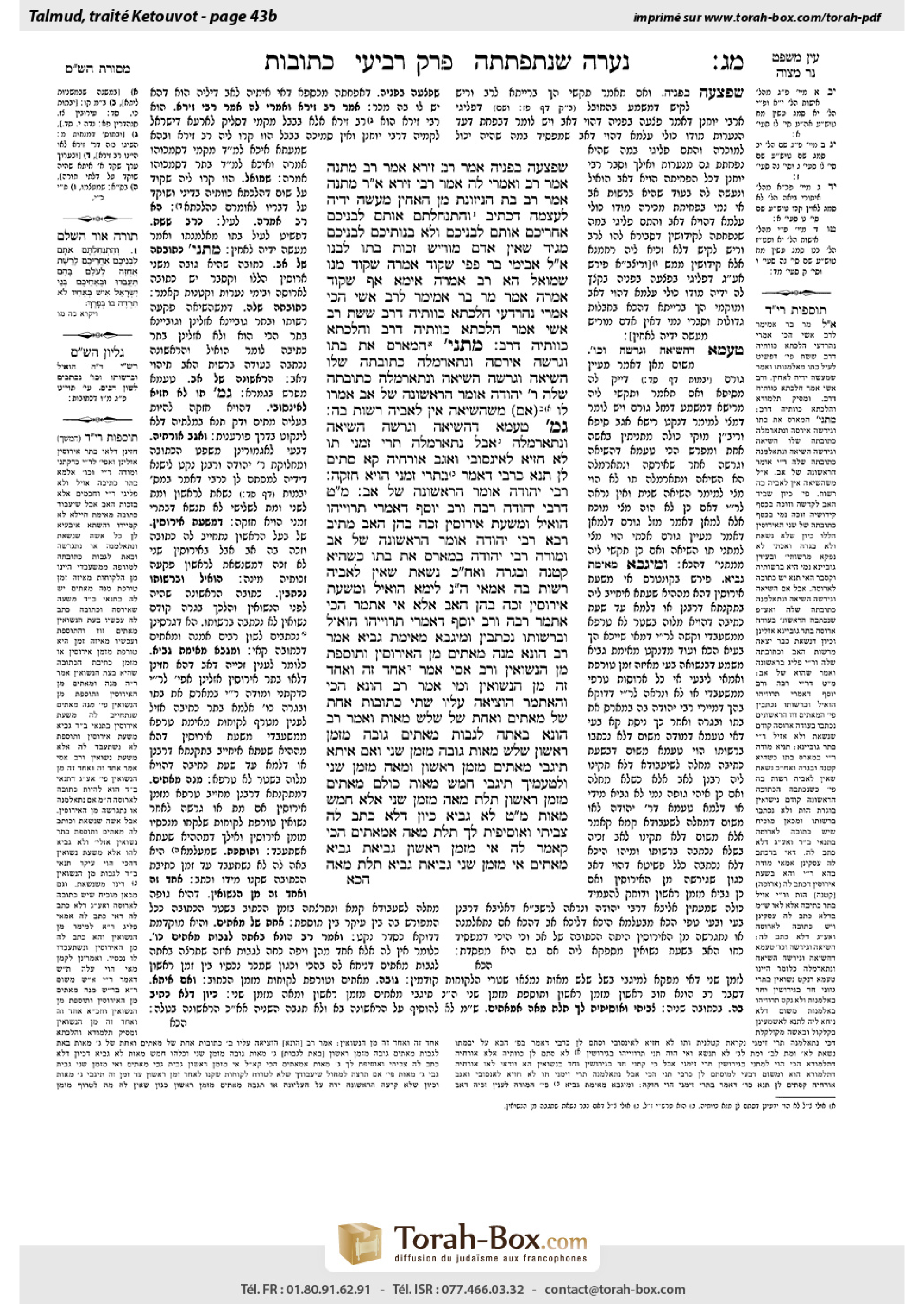
This page of Ketubot includes the Aramaic text, an English translation and an AI-generated French translation, alongside the scan above.
כתובות מ״ג ב · Aramaic and Hebrew text
שֶׁפְּצָעָהּ בְּפָנֶיהָ. אָמַר רַב זֵירָא אָמַר רַב מַתְנָה אָמַר רַב, וְאָמְרִי לַהּ, אָמַר רַבִּי זֵירָא אָמַר רַב מַתְנָה אָמַר רַב: בַּת הַנִּיזּוֹנֶת מִן הָאַחִין מַעֲשֵׂה יָדֶיהָ לְעַצְמָהּ, דִּכְתִיב: ״וְהִתְנַחַלְתֶּם אוֹתָם לִבְנֵיכֶם אַחֲרֵיכֶם״. ״אוֹתָם לִבְנֵיכֶם״, וְלֹא בְּנוֹתֵיכֶם לִבְנֵיכֶם. מַגִּיד שֶׁאֵין אָדָם מוֹרִישׁ זְכוּת בִּתּוֹ לִבְנוֹ.
אֲמַר לֵיהּ אֲבִימִי בַּר פַּפֵּי: שָׁקוּד אַמְרַהּ. שָׁקוּד מַנּוּ? שְׁמוּאֵל, הָא רַב אַמְרַהּ! אֵימָא: אַף שָׁקוּד אַמְרַהּ. אָמַר מָר בַּר אַמֵּימָר לְרַב אָשֵׁי: הָכִי אָמְרִי נְהַרְדָּעֵי: הִלְכְתָא כְּווֹתֵיהּ דְּרַב שֵׁשֶׁת. רַב אָשֵׁי אָמַר: הִלְכְתָא כְּווֹתֵיהּ דְּרַב, וְהִלְכְתָא כְּווֹתֵיהּ דְּרַב.
מַתְנִי׳ הַמְאָרֵס אֶת בִּתּוֹ וְגֵרְשָׁהּ, אֵירְסָהּ וְנִתְאַרְמְלָה — כְּתוּבָּתָהּ שֶׁלּוֹ. הִשִּׂיאָהּ וְגֵרְשָׁהּ, הִשִּׂיאָהּ וְנִתְאַרְמְלָה — כְּתוּבָּתָהּ שֶׁלָּהּ. רַבִּי יְהוּדָה אוֹמֵר: הָרִאשׁוֹנָה שֶׁל אָב. אָמְרוּ לוֹ: אִם מִשֶּׁהִשִּׂיאָהּ, אֵין לְאָבִיהָ רְשׁוּת בָּהּ.
גְּמָ׳ טַעְמָא דְּהִשִּׂיאָהּ וְגֵרְשָׁהּ, הִשִּׂיאָהּ וְנִתְאַרְמְלָה, אֲבָל נִתְאַרְמְלָה תְּרֵי זִמְנֵי — תּוּ לָא חַזְיָא לְאִינְּסוֹבֵי. וְאַגַּב אוֹרְחֵיהּ קָא סָתֵים לַן תַּנָּא כְּרַבִּי, דְּאָמַר: בִּתְרֵי זִמְנֵי הָוְיָא חֲזָקָה.
רַבִּי יְהוּדָה אוֹמֵר: הָרִאשׁוֹנָה שֶׁל אָב. מַאי טַעְמָא דְּרַבִּי יְהוּדָה? רַבָּה וְרַב יוֹסֵף דְּאָמְרִי תַּרְוַיְיהוּ: הוֹאִיל וּמִשְּׁעַת אֵירוּסִין זָכָה בָּהֶן הָאָב.
מֵתִיב רָבָא, רַבִּי יְהוּדָה אוֹמֵר: הָרִאשׁוֹנָה שֶׁל אָב. וּמוֹדֶה רַבִּי יְהוּדָה בִּמְאָרֵס אֶת בִּתּוֹ כְּשֶׁהִיא קְטַנָּה וּבָגְרָה, וְאַחַר כָּךְ נִשֵּׂאת, שֶׁאֵין לְאָבִיהָ רְשׁוּת בָּהּ. אַמַּאי? הָכָא נָמֵי לֵימָא: הוֹאִיל וּמִשְּׁעַת אֵירוּסִין זָכָה בָּהֶן הָאָב.
אֶלָּא, אִי אִתְּמַר, הָכִי אִתְּמַר: רַבָּה וְרַב יוֹסֵף דְּאָמְרִי תַּרְוַיְיהוּ: הוֹאִיל וּבִרְשׁוּתוֹ נִכְתָּבִין.
וּמִיגְבָּא, מֵאֵימַת גָּבְיָא?
אָמַר רַב הוּנָא: מָנֶה מָאתַיִם מִן הָאֵירוּסִין, וְתוֹסֶפֶת מִן הַנִּשּׂוּאִין. וְרַב אַסִּי אָמַר: אֶחָד זֶה וְאֶחָד זֶה מִן הַנִּשּׂוּאִין.
וּמִי אָמַר רַב הוּנָא הָכִי? וְהָאִתְּמַר: הוֹצִיאָה עָלָיו שְׁתֵּי כְּתוּבּוֹת, אַחַת שֶׁל מָאתַיִם, וְאַחַת שֶׁל שְׁלֹשׁ מֵאוֹת. וְאָמַר רַב הוּנָא: בָּאתָה לִגְבּוֹת מָאתַיִם — גּוֹבָה מִזְּמַן רִאשׁוֹן, שְׁלֹשׁ מֵאוֹת — גּוֹבָה מִזְּמַן שֵׁנִי.
וְאִם אִיתָא, תִּיגְבֵּי מָאתַיִם מִזְּמַן רִאשׁוֹן, וּמֵאָה מִזְּמַן שֵׁנִי.
וּלְטַעְמָיךְ, תִּיגְבֵּי חֲמֵשׁ מֵאוֹת כּוּלָּם? מָאתַיִם מִזְּמַן רִאשׁוֹן, תְּלָת מְאָה מִזְּמַן שֵׁנִי!
אֶלָּא חֲמֵשׁ מֵאוֹת מַאי טַעְמָא לָא גָּבְיָא? כֵּיוָן דְּלָא כָּתַב לָהּ: ״צְבֵיתִי וְאוֹסֵיפִית לָךְ תְּלָת מְאָה אַמָּאתַיִם״. הָכִי קָאָמַר לַהּ: אִי מִזְּמַן רִאשׁוֹן גָּבְיַאתְּ — גְּבַאי מָאתַיִם, אִי מִזְּמַן שֵׁנִי גָּבְיַאתְּ — גְּבַאי תְּלָת מְאָה
Ketubot 43b · English translation
We are dealing with a case when he injured her in her face, and therefore he must also pay for the loss of her value, a sum that belongs to her father. Rav Zeira said that Rav Mattana said that Rav said, and some say Rabbi Zeira said that Rav Mattana said that Rav said: With regard to a daughter who is sustained by the brothers, her earnings belong to her, as it is written: “And you may make them an inheritance for your sons after you” (Leviticus 25:46), which indicates: It is them, slaves, that you bequeath to your sons, and not your daughters to your sons. This verse teaches that a man does not bequeath a right that he has over his daughter to his son.
Avimi bar Pappi said to Rabbi Zeira: Shakud said this halakha. The Gemara asks: Who is Shakud? This is a nickname for Shmuel. The Gemara asks: Didn’t Rav say it? The Gemara answers: One should say that Avimi bar Pappi meant that even Shakud said it, i.e., Shmuel also agreed with this ruling. Mar bar Ameimar said to Rav Ashi: The Sages of Neharde’a say as follows: The halakha is in accordance with the opinion of Rav Sheshet, that brothers who are sustaining their sister are entitled to her earnings. Rav Ashi said: The halakha is in accordance with the opinion of Rav, that her earnings belong to her. The Gemara concludes: And the halakha is in accordance with the opinion of Rav.
MISHNA: One who betroths his minor daughter to a man, and the man subsequently divorces her, and her father then betroths her to another, and she is widowed, the payment specified in her marriage contract, even from her second husband, is his, i.e., it belongs to the father. However, if her father married her off and her husband divorced her, and her father then married her to another man and she was widowed, even the payment specified in her marriage contract from her first marriage is hers. Rabbi Yehuda says that the payment specified in the first marriage contract belongs to the father. They said to him: If it was after he married her off, even the first time, her father no longer has authority over her.
GEMARA: The Gemara infers from the language of the mishna: The reason is that he married her off, and the husband divorced her, and he married her off to another man, and she was widowed. However, if she was widowed twice she is no longer fit to be married, due to the concern that she is the cause of her husbands’ early demise. The Gemara comments: And the tanna incidentally teaches an unattributed opinion in accordance with the opinion of Rabbi Yehuda HaNasi, who said that presumption is established by two occasions. Consequently, she is already considered a danger after two husbands have passed away, as opposed to the opinion that three incidents are required to establish a presumption.
§ The mishna taught that Rabbi Yehuda says the payment specified in the first marriage contract belongs to the father. The Gemara asks: What is the reason of Rabbi Yehuda? The Gemara explains that Rabba and Rav Yosef both say: Since the father is entitled to the payments of the marriage contract from the time of her betrothal, when the first husband obligated himself to pay her marriage contract, as the girl was under her father’s authority at the time, the father receives the money. Although the money is actually paid only after the girl was married and divorced, at which time she is under her own jurisdiction, her father acquired his right to the marriage contract from the time of her betrothal, when she was under his authority.
Rava raised an objection from a baraita: Rabbi Yehuda says that the payment specified in the first marriage contract belongs to her father. And Rabbi Yehuda concedes in the case of one who betroths his daughter when she is a minor, and she matures and subsequently marries, that her father no longer has authority over her once she becomes an adult, and he does not retain his rights to her marriage contract. According to the above explanation, why does Rabbi Yehuda agree in that case? Here too, let him say: Since the father is entitled to the payment of her marriage contract from the time of her betrothal, he receives the payment even if she married after she reached majority.
Rather, if this statement was stated, it was stated as follows: Rabba and Rav Yosef both say: Since the amounts of the marriage contract are written under his authority, as the marriage contract is drafted right before the marriage, at which point the girl was still under her father’s jurisdiction, he is therefore entitled to the money. This explains why the ruling is different if she reached majority before her marriage. In this case, the marriage contract was written when she was no longer under her father’s jurisdiction, and therefore her father is not entitled to the payment of her marriage contract.
And now that it has been established that even according to the opinion of Rabbi Yehuda, the rights to a marriage contract are determined based upon the time of marriage and not the time of betrothal, despite the fact that its sum is fixed at that time, the Gemara asks: From when does the husband’s property become liened to ensure collection of his wife’s marriage contract? Does the monetary claim take effect at the time of betrothal, so that there is a lien on any property he owned at that time, or is there a lien only on property that the husband owned at the time of marriage?
Rav Huna said: With regard to the one hundred dinars for a non-virgin and the two hundred for a virgin, the basic sums of a marriage contract instituted by the Sages, she has a lien on her husband’s property from the time of the betrothal, as she acquired this amount when she was betrothed, but with regard to the addition, i.e., additional sums of money stipulated by the husband himself, the wife’s lien on his property takes effect only from the time of the marriage. And Rav Asi said: The lien for both this and that take effect only from the time of their marriage.
The Gemara asks: And did Rav Huna actually say this, that a woman has a lien on her husband’s property from the time of betrothal with regard to payment of the one hundred or two hundred dinars that constitute the main sum of her marriage contract? But wasn’t it stated that amora’im discussed the case of a woman who produced against her husband, upon their divorce, two marriage contracts, written at different times, one of two hundred dinars and the other one of three hundred? And Rav Huna said: Since she can claim only one marriage contract, if she came to collect the first sum of two hundred dinars, she can collect that amount even from property her husband sold after the first point in time, when this marriage contract was written, and if she wishes to collect the one worth three hundred dinars, she can collect from property her husband sold after the second point in time.
The Gemara explains the difficulty: And if it is so, that Rav Huna maintains that the lien for the basic sum and the addition can be ascribed to different dates, let her collect two hundred dinars from property sold after the first point in time, as she was already entitled to the basic sum of her marriage contract from that day, and she can collect the additional one hundred dinars from property sold after the second point in time.
The Gemara refutes this argument: And even according to your reasoning, let her collect the entire five hundred dinars, the sum of both marriage contracts. She should be able to collect two hundred from property sold after the first point in time and three hundred from property sold after the second stipulated time.
Rather, what is the reason that she may not collect the entire sum of five hundred dinars? Since he did not write to her in the second marriage contract: I chose to add to the payment of your marriage contract, and therefore I am writing a contract for three hundred dinars in addition to the first two hundred dinars, it is apparent that this is what he meant to say to her by writing a second marriage contract: If you collect from property sold after the first point in time, you may collect two hundred dinars; if you collect from property sold after the second point in time, you may collect three hundred dinars.
Ketubot 43b · Traduction française (IA)
Il s’agit d’un cas où il l’a blessée au visage ; il doit donc également payer pour la perte de sa valeur, somme qui revient à son père. Rav Zeira a dit que Rav Mattana a dit que Rav a dit — et certains disent que Rabbi Zeira a dit que Rav Mattana a dit que Rav a dit : Quant à une fille entretenue par ses frères, ses revenus lui appartiennent, comme il est écrit : « Vous pourrez les laisser en héritage à vos fils après vous » (Lévitique 25,46). Cela indique que ce sont les esclaves que vous transmettez en héritage à vos fils, et non vos filles. Ce verset enseigne qu’un homme ne transmet pas à son fils le droit qu’il détient sur sa fille.
Avimi bar Pappi dit à Rabbi Zeira : « Shakud a enseigné cette halakha. » La Guemara demande : Qui est Shakud ? C’est un surnom de Shmuel. La Guemara demande : Rav ne l’a-t-il pas enseignée ? La Guemara répond : Il faut comprendre qu’Avimi bar Pappi voulait dire que Shakud aussi l’a enseignée, c’est-à-dire que Shmuel aussi était d’accord avec cette décision. Mar bar Ameimar dit à Rav Ashi : « Les Sages de Neharde’a disent ce qui suit : la halakha est conforme à l’opinion de Rav Sheshet, selon laquelle les frères qui entretiennent leur sœur ont droit à ses revenus. » Rav Ashi dit : « La halakha est conforme à l’opinion de Rav, selon laquelle ses revenus lui appartiennent. » La Guemara conclut : la halakha est conforme à l’opinion de Rav.
Michna : Si un homme fiance sa fille mineure à un homme, que celui-ci la répudie ensuite, puis que son père la fiance à un autre et qu’elle devient veuve, le montant inscrit dans son contrat de mariage, même celui dû par son second mari, revient à son père. Cependant, si son père l’a mariée et que son mari la répudie, puis que son père la marie à un autre homme et qu’elle devient veuve, même le montant inscrit dans son contrat de mariage lors de sa première union lui revient. Rabbi Yehouda dit que le montant inscrit dans le premier contrat de mariage revient au père. On lui dit : dès lors qu’il l’a mariée, ne serait-ce qu’une première fois, son père n’a plus d’autorité sur elle.
Guemara : La Guemara déduit de la formulation de la Michna que le motif est qu’il l’a mariée, que son mari l’a répudiée, puis qu’il l’a mariée à un autre homme et qu’elle est devenue veuve. Toutefois, si elle est devenue veuve deux fois, elle n’est plus apte à se marier, car on craint qu’elle ne soit la cause de la mort prématurée de ses maris. La Guemara remarque : le tanna enseigne incidemment une opinion anonyme conforme à celle de Rabbi Yehouda HaNassi, qui a dit qu’une présomption est établie par deux occurrences. Par conséquent, elle est déjà considérée comme présentant un danger après la mort de deux maris, contrairement à l’opinion selon laquelle trois événements sont nécessaires pour établir une présomption.
§ La Michna enseigne que Rabbi Yehouda dit que le montant inscrit dans le premier contrat de mariage revient au père. La Guemara demande : Quelle est la raison de Rabbi Yehouda ? La Guemara explique que Rabba et Rav Yosef disent tous deux : puisque le père a droit aux sommes du contrat de mariage dès le moment des fiançailles, lorsque le premier mari s’est engagé à lui verser le montant de son contrat de mariage — car la fille était alors sous l’autorité de son père —, c’est le père qui reçoit l’argent. Bien que l’argent ne soit effectivement versé qu’après que la fille s’est mariée puis a été répudiée, alors qu’elle est sous sa propre autorité, son père a acquis son droit au montant du contrat de mariage dès le moment des fiançailles, où elle était sous son autorité.
Rava soulève une objection à partir d’une baraïta : Rabbi Yehouda dit que le montant inscrit dans le premier contrat de mariage revient à son père. Rabbi Yehouda reconnaît que, dans le cas où un homme fiance sa fille alors qu’elle est mineure, puis qu’elle atteint la majorité et se marie ensuite, son père n’a plus d’autorité sur elle dès qu’elle devient majeure et ne conserve pas ses droits sur son contrat de mariage. Selon l’explication précédente, pourquoi Rabbi Yehouda est-il d’accord dans ce cas ? Ici aussi, qu’il dise : puisque le père a droit au montant de son contrat de mariage dès le moment des fiançailles, il le reçoit même si elle s’est mariée après avoir atteint la majorité.
Mais plutôt, si cette déclaration a été formulée, elle l’a été ainsi : Rabba et Rav Yosef disent tous deux : puisque les sommes du contrat de mariage sont inscrites sous son autorité — le contrat étant rédigé juste avant le mariage, alors que la fille était encore sous l’autorité de son père —, l’argent lui revient donc. Cela explique pourquoi la décision diffère si elle a atteint la majorité avant son mariage. Dans ce cas, le contrat de mariage a été rédigé alors qu’elle n’était plus sous l’autorité de son père ; son père n’a donc pas droit au montant de son contrat de mariage.
Et maintenant qu’il a été établi que, même selon l’opinion de Rabbi Yehouda, les droits au montant du contrat de mariage sont déterminés en fonction du moment du mariage et non de celui des fiançailles, bien que ce montant soit fixé à ce moment-là, la Guemara demande : à partir de quand les biens du mari sont-ils grevés d’un privilège garantissant le recouvrement du contrat de mariage de son épouse ? La créance pécuniaire prend-elle effet au moment des fiançailles, de sorte que les biens qu’il possédait alors sont grevés d’un privilège, ou seuls les biens que le mari possédait au moment du mariage le sont-ils ?
Rav Huna a dit : pour les cent dinars dus à une non-vierge et les deux cents dus à une vierge, sommes de base du contrat de mariage instituées par les Sages, elle a un privilège sur les biens de son mari à partir du moment des fiançailles, car elle a acquis ce montant lorsqu’elle a été fiancée. En revanche, pour le supplément, c’est-à-dire les sommes supplémentaires stipulées par le mari lui-même, le privilège de l’épouse sur ses biens ne prend effet qu’à partir du mariage. Rav Asi a dit : le privilège, tant pour l’un que pour l’autre, ne prend effet qu’à partir du mariage.
La Guemara demande : Rav Huna a-t-il réellement dit cela, à savoir qu’une femme a un privilège sur les biens de son mari dès le moment des fiançailles pour le paiement des cent ou des deux cents dinars qui constituent le montant de base de son contrat de mariage ? Or, n’a-t-il pas été rapporté que des amoraïm ont discuté du cas d’une femme qui, lors de son divorce, a présenté contre son mari deux contrats de mariage rédigés à des moments différents, l’un de deux cents dinars et l’autre de trois cents ? Rav Huna a dit : puisqu’elle ne peut réclamer qu’un seul contrat de mariage, si elle choisit de recouvrer les deux cents dinars du premier contrat, elle peut percevoir ce montant même sur les biens que son mari a vendus après la première date, celle où ce contrat a été rédigé ; et si elle souhaite recouvrer les trois cents dinars, elle peut les percevoir sur les biens que son mari a vendus après la seconde date.
La Guemara explique la difficulté : si tel est le cas, et que Rav Huna soutient que le privilège relatif au montant de base et celui relatif au supplément peuvent être rattachés à des dates différentes, qu’elle recouvre deux cents dinars sur les biens vendus après la première date, puisqu’elle avait déjà droit, à partir de ce jour-là, au montant de base de son contrat de mariage, et qu’elle recouvre les cent dinars supplémentaires sur les biens vendus après la seconde date.
La Guemara réfute cet argument : même selon ton raisonnement, qu’elle recouvre la totalité des cinq cents dinars, somme des deux contrats de mariage. Elle devrait pouvoir recouvrer deux cents dinars sur les biens vendus après la première date et trois cents sur ceux vendus après la seconde date convenue.
Mais alors, pourquoi ne peut-elle pas recouvrer la totalité des cinq cents dinars ? Puisqu’il ne lui a pas écrit dans le second contrat de mariage : « J’ai choisi d’ajouter une somme au montant de ton contrat de mariage et, par conséquent, je rédige un contrat de trois cents dinars en plus des deux cents premiers », il est évident que voici ce qu’il a voulu lui dire en rédigeant un second contrat de mariage : « Si tu recouvres sur les biens vendus après la première date, tu peux percevoir deux cents dinars ; si tu recouvres sur les biens vendus après la seconde date, tu peux percevoir trois cents dinars. »
Traduction française générée par IA à partir de l’édition anglaise de Sefaria. Vérifie toujours un passage avec le texte source.
Text from Sefaria: William Davidson Edition - Vocalized Aramaic (CC BY NC); William Davidson Edition - English (CC BY NC).