Ketubot 44a: Talmud study for Daf Yomi
Daf Yomi is the daily study of one Talmud folio. Explore 37 tractates with scans, Hebrew text, Sefaria English and AI-generated French translations where annotated.
Passage selection and English or AI-generated French translation are available where the scan has annotations. Daf Study is independent of Torah-Box and Sefaria.
Browse Ketubot · כתובות · All tractatesKetubot 44a text and translations
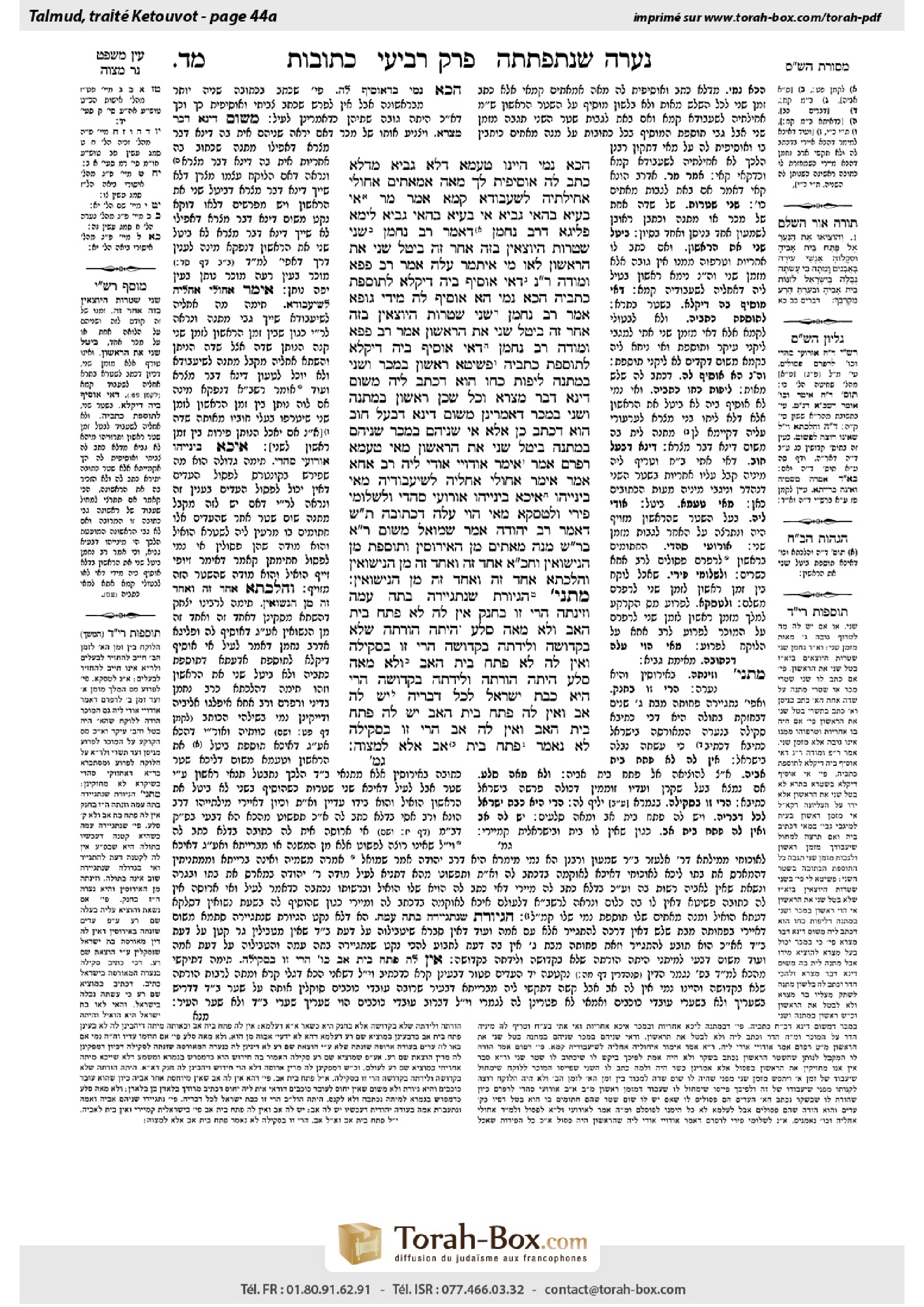
This page of Ketubot includes the Aramaic text, an English translation and an AI-generated French translation, alongside the scan above.
כתובות מ״ד א · Aramaic and Hebrew text
הָכָא נָמֵי הַיְינוּ טַעְמָא דְּלָא גָּבְיָא, מִדְּלָא כְּתַב לַהּ ״אוֹסֵיפִית לִךְ מֵאָה אַמָּאתַיִם״, אַחוֹלֵי אַחֵילְתֵּיהּ לְשִׁעְבּוּדָא קַמָּא.
אָמַר מָר: אִי בָּעֲיָא — בְּהַאי גָּבְיָא, אִי בָּעֲיָא — בְּהַאי גָּבְיָא. לֵימָא פְּלִיגָא דְּרַב נַחְמָן? דְּאָמַר רַב נַחְמָן: שְׁנֵי שְׁטָרוֹת הַיּוֹצְאִין בְּזֶה אַחַר זֶה — בִּיטֵּל שֵׁנִי אֶת הָרִאשׁוֹן.
לָאו מִי אִיתְּמַר עֲלַהּ, אָמַר רַב פָּפָּא: וּמוֹדֶה רַב נַחְמָן דְּאִי אוֹסֵיף בֵּיהּ דִּיקְלָא, לְתוֹסֶפֶת כַּתְבֵיהּ. הָכָא נָמֵי, הָא אוֹסֵיף לַהּ מִידֵּי!
גּוּפָא. אָמַר רַב נַחְמָן: שְׁנֵי שְׁטָרוֹת הַיּוֹצְאִין בְּזֶה אַחַר זֶה — בִּיטֵּל שֵׁנִי אֶת הָרִאשׁוֹן. אָמַר רַב פָּפָּא: וּמוֹדֶה רַב נַחְמָן דְּאִי אוֹסֵיף בֵּיהּ דִּיקְלָא — לְתוֹסֶפֶת כַּתְבֵיהּ. פְּשִׁיטָא רִאשׁוֹן בְּמֶכֶר וְשֵׁנִי בְּמַתָּנָה, לְיַפּוֹת כֹּחוֹ הוּא דִּכְתַב לֵיהּ — מִשּׁוּם דִּינָא דְּבַר מִצְרָא.
וְכׇל שֶׁכֵּן רִאשׁוֹן בְּמַתָּנָה וְשֵׁנִי בְּמֶכֶר, דְּאָמְרִינַן מִשּׁוּם דִּינָא דְּבַעַל חוֹב הוּא דִּכְתַב כֵּן.
אֶלָּא אִי שְׁנֵיהֶם בְּמֶכֶר שְׁנֵיהֶם בְּמַתָּנָה בִּיטֵּל שֵׁנִי אֶת הָרִאשׁוֹן. מַאי טַעְמָא? רַפְרָם אָמַר: אֵימַר אוֹדוֹיֵי אוֹדִי לֵיהּ. רַב אַחָא אָמַר: אֵימַר אַחוֹלֵי אַחְלֵיהּ לְשִׁיעְבּוּדֵיהּ.
מַאי בֵּינַיְיהוּ? אִיכָּא בֵּינַיְיהוּ: אוֹרוֹעֵי סָהֲדֵי.
וּלְשַׁלּוֹמֵי פֵּירֵי וּלְטַסְקָא.
מַאי הָוֵי עֲלַהּ דִּכְתוּבָּה? תָּא שְׁמַע, דְּאָמַר רַב יְהוּדָה אָמַר שְׁמוּאֵל מִשּׁוּם רַבִּי אֶלְעָזָר בְּרַבִּי שִׁמְעוֹן: מָנֶה מָאתַיִם מִן הָאֵירוּסִין, וְתוֹסֶפֶת מִן הַנִּישּׂוּאִין.
וַחֲכָמִים אוֹמְרִים: אֶחָד זֶה וְאֶחָד זֶה מִן הַנִּישּׂוּאִין. וְהִלְכְתָא: אֶחָד זֶה וְאֶחָד זֶה מִן הַנִּישּׂוּאִין.
מַתְנִי׳ הַגִּיּוֹרֶת שֶׁנִּתְגַּיְּירָה בִּתָּהּ עִמָּהּ וְזִינְּתָה — הֲרֵי זוֹ בְּחֶנֶק, אֵין לָהּ לֹא פֶּתַח בֵּית הָאָב, וְלֹא מֵאָה סֶלַע.
הָיְתָה הוֹרָתָהּ שֶׁלֹּא בִּקְדוּשָּׁה וְלֵידָתָהּ בִּקְדוּשָּׁה — הֲרֵי זוֹ בִּסְקִילָה, וְאֵין לָהּ לֹא פֶּתַח בֵּית הָאָב, וְלֹא מֵאָה סֶלַע. הָיְתָה הוֹרָתָהּ וְלֵידָתָהּ בִּקְדוּשָּׁה, הֲרֵי הִיא כְּבַת יִשְׂרָאֵל לְכׇל דְּבָרֶיהָ.
יֵשׁ לָהּ אָב וְאֵין לָהּ פֶּתַח בֵּית הָאָב, יֵשׁ לָהּ פֶּתַח בֵּית הָאָב וְאֵין לָהּ אָב — הֲרֵי זוֹ בִּסְקִילָה. לֹא נֶאֱמַר פֶּתַח בֵּית אָב אֶלָּא לְמִצְוָה.
Ketubot 44a · English translation
Here too, this is the reasoning for the ruling that she does not collect the additional one hundred dinars from the second stipulated time, as he did not write to her in the second marriage contract: I added one hundred dinars to your original marriage contract of two hundred dinars. Evidently, he did not add to the existing marriage contract. Rather, she forgave her rights to the first marriage contract, including the lien on his property from the date it was written, in order to accept the second marriage document.
§ After clarifying Rav Huna’s opinion, the Gemara turns its attention to a more general issue, connected to his last statement. The Master, i.e., Rav Huna, said, as indicated in the above discussion, that if she wishes she can collect the sum specified in this marriage contract, and if she wishes she can collect the sum specified in that marriage contract. The Gemara asks: Shall we say that this opinion disagrees with that of Rav Naḥman? As Rav Naḥman said: With regard to two documents that pertain to the same issue and that are produced one after the other, e.g., a pair of documents that ascribe the transfer of ownership over a particular field to different times, the second, later document nullifies the first. Here too, the second marriage contract should negate the first one entirely.
The Gemara refutes this suggestion: Was it not stated with regard to this halakha of Rav Naḥman that Rav Pappa said: And Rav Naḥman concedes that if he added so much as a palm tree in the second document, this shows that he wrote it as an addition, and therefore the second document does not cancel the first, but adds to its sum? Here too, he added something for her, as the sum of money specified in the second marriage contract is larger than that specified in the first.
§ Since the Gemara has mentioned the statement of Rav Naḥman, it discusses this matter itself: Rav Naḥman said: With regard to two documents that are produced one after the other, the second nullifies the first. Rav Pappa said: And Rav Naḥman concedes that if he added a palm tree to it, he wrote it as an addition. The Gemara analyzes this halakha in detail. It is obvious that if the first document was a document of a sale, and the second stated that the same field was given as a gift, the second document does not negate the first, as he wrote the additional document of a gift to improve the rights of the recipient due to the halakha of one whose field borders the field of his neighbor.
And all the more so, this is the halakha if he wrote the first document as a gift and the second in the form of a sale, as we say it was due to the halakha of a creditor that he wrote it in this way. Out of concern that his creditor might come and snatch the field from the recipient and leave him without redress, he writes a document of sale for the recipient, so that he can return and collect this sum from him.
Rather, Rav Naḥman meant that if both of them were documents of sale or both of them were documents of gifts, the second nullifies the first. The Gemara asks: What is the reason for this halakha? Amora’im argued over this matter. Rafram said: Say that the recipient of the field admitted to him that the first document was invalid, e.g., it was forged, and he therefore wrote a second, valid document. Rav Aḥa said: Say that the recipient forgave him his lien from the date of the first document. Consequently, if the seller’s creditors collect this field as payment for the debt owed to them, which necessitates the seller reimbursing the buyer for the purchase price of the field, the buyer has a lien only on property owned by the seller from the time of the second document.
The Gemara asks: What is the practical difference between these two explanations? The Gemara explains: The practical difference between them involves several cases. First, there is the issue of whether this serves to impair the reliability of the witnesses: According to Rafram, who assumes that the first document was of questionable validity, the witnesses who signed on that document are likewise under suspicion, and therefore their testimony and signature in other cases are of questionable value.
And there is also a difference with regard to paying for the produce of the property between the dates specified in the two documents. According to Rafram, the transfer of ownership did not take place at the date specified in the first document. Consequently, the recipient of the field must compensate the original owner for the field’s produce that he consumed between the two dates. According to Rav Aḥa, the transfer of ownership took place at the time specified in the first document. And finally, there is a difference with regard to the payment of the land tax [taska]. If the first document was invalid, the previous owner must pay all taxes due during the period between the two documents.
§ The above discussion came in the wake of the dispute between Rav Huna and Rav Asi with regard to whether the lien on a husband’s property to ensure payment of his wife’s marriage contract applies from the time of betrothal or the time of marriage. The Gemara returns to that issue. What halakhic conclusion was reached about this matter of a marriage contract? The Gemara responds: Come and hear the following ruling, as Rav Yehuda said that Shmuel said in the name of Rabbi Elazar, son of Rabbi Shimon: The lien on his property with regard to the one hundred dinars or two hundred dinars that comprise the basic sum of a marriage contract applies from the time of the betrothal, and the lien with regard to the additional sum applies from the time of the marriage.
And the Rabbis say: The lien with regard to both this and that takes effect only from the time of the marriage. The Gemara concludes: And the halakha is that with regard to both this and that, the lien takes effect from the time of the marriage, in accordance with the majority opinion of the Rabbis.
MISHNA: In the case of a female convert whose daughter converted with her and later, as a young woman, the daughter engaged in licentious sexual relations when she was betrothed, she is executed by strangulation, not stoning, the method of execution that would be employed had she been born Jewish. She has neither the halakha of being executed at the entrance to her father’s house, as in the case of a woman who was born Jewish who committed this crime, nor does she receive one hundred sela if her husband defamed her by falsely claiming that she had committed adultery. The reason is that the verses state “Israel” (Deuteronomy 22:19, 21) with regard to these halakhot, indicating that these halakhot apply only to those born as Jews.
However, if the daughter’s conception occurred when her mother was not yet in a state of sanctity, i.e., when she was still a gentile, but her birth took place when her mother was in a state of sanctity, as her mother converted during her pregnancy, this daughter is punishable by stoning if she committed adultery as a betrothed young woman. However, she has neither the halakha of being executed at the entrance to her father’s house, nor the right to one hundred sela if it turns out that her husband defamed her. If her conception and birth occurred when her mother was in a state of sanctity, i.e., after she converted, she is like a regular Jewish woman in all matters.
If a young woman who is betrothed commits adultery and she has a father but does not have an entrance to her father’s house, i.e., if her father does not possess a house of his own, or if she has an entrance to her father’s house but does not have a father, as he has passed away, she is nevertheless executed via stoning, as the requirement that she is to be executed at the entrance to her father’s house is stated only for a mitzva but it is not an indispensable requirement.
Ketubot 44a · Traduction française (IA)
Ici aussi, telle est la raison de la décision selon laquelle elle ne perçoit pas les cent dinars supplémentaires prévus dans le second contrat de mariage : dans ce contrat, il ne lui a pas écrit : « J’ai ajouté cent dinars à ton contrat de mariage initial de deux cents dinars. » De toute évidence, il n’a pas ajouté cette somme au contrat de mariage existant. Elle a plutôt renoncé à ses droits découlant du premier contrat de mariage, y compris au privilège sur ses biens à compter de la date de sa rédaction, afin d’accepter le second acte de mariage.
§ Après avoir clarifié l’opinion de Rav Houna, la Guemara se penche sur une question plus générale, liée à sa dernière déclaration. Le Maître, c’est-à-dire Rav Houna, a dit, comme cela ressort de la discussion précédente, que si elle le souhaite, elle peut percevoir la somme indiquée dans ce contrat de mariage ou, si elle le souhaite, celle indiquée dans l’autre contrat de mariage. La Guemara demande : Faut-il en conclure que cette opinion est en désaccord avec celle de Rav Naḥman ? Car Rav Naḥman a dit : Lorsque deux actes portant sur une même affaire sont produits l’un après l’autre — par exemple, deux actes qui attribuent le transfert de propriété d’un même champ à des dates différentes —, le second acte, plus récent, annule le premier. Ici aussi, le second contrat de mariage devrait entièrement annuler le premier.
La Guemara réfute cette suggestion : N’a-t-il pas été enseigné, au sujet de cette halakha de Rav Naḥman, que Rav Pappa a dit : Rav Naḥman reconnaît que si l’on a ajouté ne serait-ce qu’un palmier dans le second acte, cela montre qu’il a été rédigé comme un ajout ; par conséquent, le second acte n’annule pas le premier, mais augmente la somme qui y est stipulée. Ici aussi, il lui a ajouté quelque chose, puisque la somme indiquée dans le second contrat de mariage est supérieure à celle du premier.
§ Puisque la Guemara a mentionné la déclaration de Rav Naḥman, elle examine cette question en elle-même : Rav Naḥman a dit que, lorsque deux actes sont produits l’un après l’autre, le second annule le premier. Rav Pappa a dit : Rav Naḥman reconnaît que si l’on y a ajouté un palmier, cela signifie que l’acte a été rédigé comme un ajout. La Guemara analyse cette halakha en détail. Il est évident que si le premier acte était un acte de vente et que le second stipulait que le même champ était donné en cadeau, le second acte n’annule pas le premier, car il a rédigé l’acte de donation supplémentaire afin d’améliorer les droits du bénéficiaire en vertu de la halakha du voisin dont le champ jouxte celui de son voisin.
À plus forte raison, telle est la halakha s’il a rédigé le premier acte sous la forme d’une donation et le second sous celle d’une vente, car nous disons qu’il l’a rédigé ainsi en raison de la halakha relative à un créancier. Craignant que son créancier ne vienne saisir le champ au détriment du bénéficiaire et ne le laisse sans recours, il rédige pour celui-ci un acte de vente afin que, si le créancier saisit le champ, le bénéficiaire puisse se retourner contre lui et recouvrer cette somme.
Rav Naḥman voulait plutôt dire que si les deux actes sont des actes de vente ou si les deux sont des actes de donation, le second annule le premier. La Guemara demande : Quelle est la raison de cette halakha ? Les Amoraïm ont divergé à ce sujet. Rafram a dit : On peut supposer que le bénéficiaire du champ a reconnu devant lui que le premier acte était invalide, par exemple qu’il était falsifié ; il a donc rédigé un second acte valide. Rav Aḥa a dit : On peut supposer que le bénéficiaire a renoncé à son privilège à compter de la date du premier acte. Par conséquent, si les créanciers du vendeur saisissent ce champ en paiement de la dette qui leur est due — ce qui oblige le vendeur à rembourser à l’acheteur le prix d’achat du champ —, l’acheteur ne bénéficie d’un privilège que sur les biens que le vendeur possédait à partir de la date du second acte.
La Guemara demande : Quelle est la différence pratique entre ces deux explications ? La Guemara explique que plusieurs cas les distinguent. Premièrement, il y a la question de savoir si cela porte atteinte à la fiabilité des témoins : selon Rafram, qui suppose que le premier acte était de validité douteuse, les témoins qui l’ont signé sont eux aussi suspects ; leurs témoignages et leurs signatures dans d’autres affaires sont donc de valeur douteuse.
Il y a également une différence concernant le paiement des produits du bien pour la période comprise entre les dates indiquées dans les deux actes. Selon Rafram, le transfert de propriété n’a pas eu lieu à la date indiquée dans le premier acte. Par conséquent, le bénéficiaire du champ doit indemniser l’ancien propriétaire pour les produits du champ qu’il a consommés entre ces deux dates. Selon Rav Aḥa, le transfert de propriété a eu lieu à la date indiquée dans le premier acte. Enfin, il y a une différence concernant le paiement de la taxe foncière [taska]. Si le premier acte était invalide, l’ancien propriétaire doit payer toutes les taxes dues pendant la période comprise entre les deux actes.
§ La discussion précédente faisait suite au désaccord entre Rav Houna et Rav Assi sur la question de savoir si le privilège sur les biens du mari garantissant le paiement du contrat de mariage de son épouse prend effet à partir des fiançailles ou du mariage. La Guemara revient sur cette question. Quelle conclusion halakhique a-t-on tirée au sujet du contrat de mariage ? La Guemara répond : Viens et entends l’enseignement suivant, car Rav Yehouda a dit que Chemouel a dit au nom de Rabbi Elazar, fils de Rabbi Chim’on : Le privilège sur ses biens concernant les cent ou les deux cents dinars qui constituent le montant de base du contrat de mariage prend effet à partir des fiançailles, tandis que le privilège concernant la somme supplémentaire prend effet à partir du mariage.
Et les Rabbins disent : Le privilège concernant aussi bien l’une que l’autre somme ne prend effet qu’à partir du mariage. La Guemara conclut : La halakha est que, pour l’une comme pour l’autre somme, le privilège prend effet à partir du mariage, conformément à l’opinion majoritaire des Rabbins.
MICHNA : Dans le cas d’une femme convertie dont la fille s’est convertie avec elle et qui, plus tard, alors qu’elle était une jeune fille, a eu des relations sexuelles illicites pendant ses fiançailles, la fille est exécutée par strangulation, et non par lapidation, mode d’exécution qui aurait été appliqué si elle était née juive. Elle n’est soumise ni à la halakha selon laquelle elle doit être exécutée à l’entrée de la maison de son père, comme une femme née juive qui aurait commis ce crime, ni au versement de cent séla si son mari l’a diffamée en prétendant faussement qu’elle avait commis un adultère. La raison en est que les versets emploient le terme « Israël » (Deutéronome 22, 19 et 21) à propos de ces halakhot, indiquant qu’elles s’appliquent uniquement à celles qui sont nées juives.
Toutefois, si la fille a été conçue alors que sa mère n’était pas encore en état de sainteté, c’est-à-dire lorsqu’elle était encore non juive, mais qu’elle est née alors que sa mère était en état de sainteté, celle-ci s’étant convertie pendant sa grossesse, la fille est passible de lapidation si elle commet un adultère alors qu’elle est une jeune fille fiancée. Cependant, elle n’est soumise ni à la halakha selon laquelle elle doit être exécutée à l’entrée de la maison de son père, ni au droit de recevoir cent séla s’il s’avère que son mari l’a diffamée. Si elle a été conçue et est née alors que sa mère était en état de sainteté, c’est-à-dire après la conversion de sa mère, elle est en tous points semblable à une femme juive ordinaire.
Si une jeune fille fiancée commet un adultère et qu’elle a un père mais pas d’entrée à la maison de son père, c’est-à-dire si son père ne possède pas de maison, ou si elle a une entrée à la maison de son père mais n’a pas de père, celui-ci étant décédé, elle est néanmoins exécutée par lapidation. En effet, l’obligation de l’exécuter à l’entrée de la maison de son père n’est énoncée qu’au titre d’une mitsva, et non comme une condition indispensable.
Traduction française générée par IA à partir de l’édition anglaise de Sefaria. Vérifie toujours un passage avec le texte source.
Text from Sefaria: William Davidson Edition - Vocalized Aramaic (CC BY NC); William Davidson Edition - English (CC BY NC).