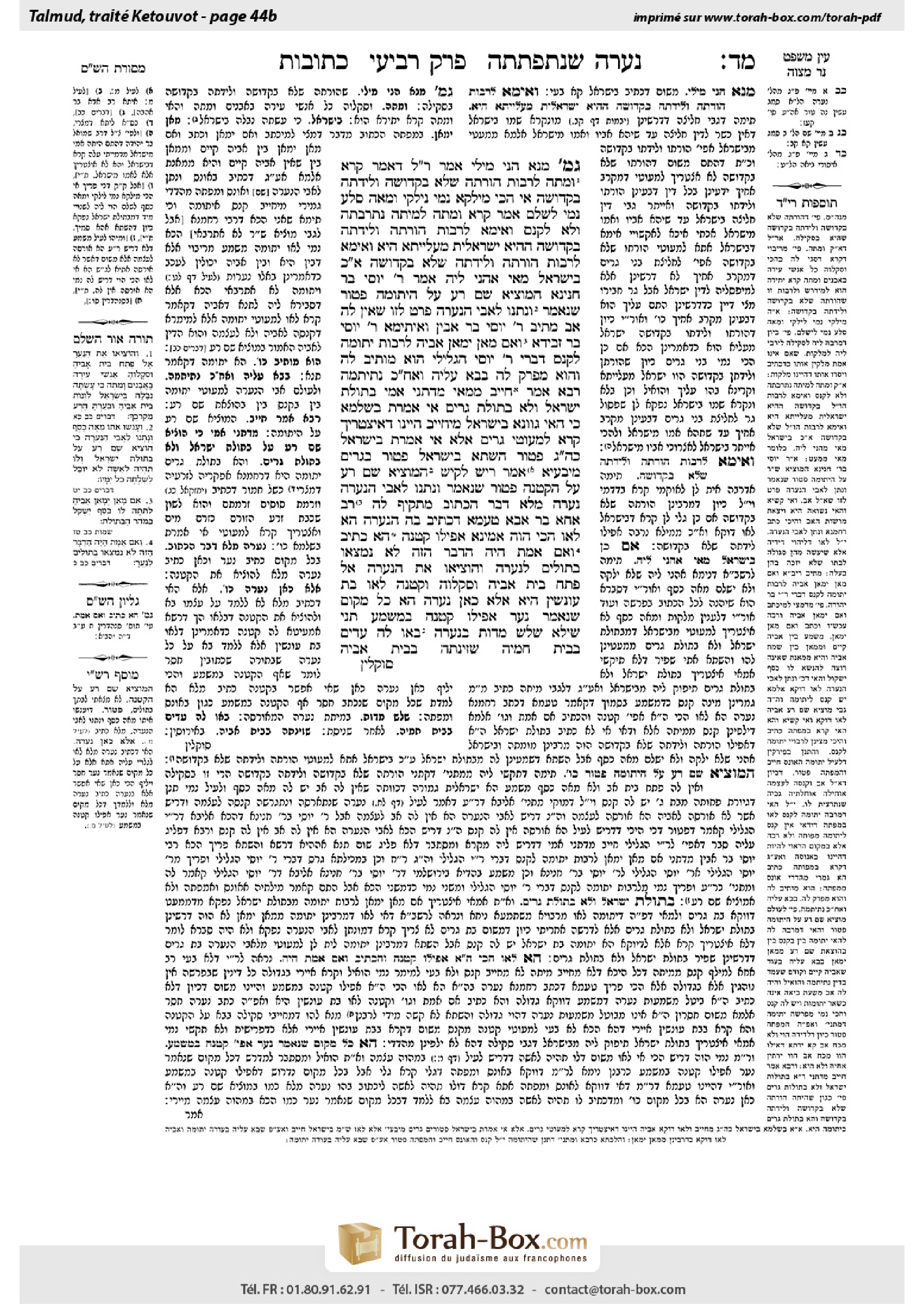
Ketubot 44b: Talmud study for Daf Yomi
Daf Yomi is the daily study of one Talmud folio. Explore 37 tractates with scans, Hebrew text, Sefaria English and AI-generated French translations where annotated.
Passage selection and English or AI-generated French translation are available where the scan has annotations. Daf Study is independent of Torah-Box and Sefaria.
Browse Ketubot · כתובות · All tractatesKetubot 44b text and translations
This page of Ketubot includes the Aramaic text, an English translation and an AI-generated French translation, alongside the scan above.
כתובות מ״ד ב · Aramaic and Hebrew text
גְּמָ׳ מְנָא הָנֵי מִילֵּי? אָמַר רֵישׁ לָקִישׁ, דְּאָמַר קְרָא ״וָמֵתָה״, לְרַבּוֹת הוֹרָתָהּ שֶׁלֹּא בִּקְדוּשָּׁה וְלֵידָתָהּ בִּקְדוּשָּׁה.
אִי הָכִי מִילְקָא נָמֵי נִילְקֵי, וּמֵאָה סֶלַע נָמֵי לְשַׁלֵּם! אָמַר קְרָא ״וָמֵתָה״ — לְמִיתָה נִתְרַבְּתָה וְלֹא לִקְנָס. וְאֵימָא לְרַבּוֹת הוֹרָתָהּ וְלֵידָתָהּ בִּקְדוּשָּׁה? הָהִיא יִשְׂרְאֵלִית מְעַלַּיְיתָא הִיא.
וְאֵימָא לְרַבּוֹת הוֹרָתָהּ וְלֵידָתָהּ שֶׁלֹּא בִּקְדוּשָּׁה! אִם כֵּן, ״בְּיִשְׂרָאֵל״ מַאי אַהֲנִי לֵיהּ.
אָמַר רַבִּי יוֹסֵי בַּר חֲנִינָא: הַמּוֹצִיא שֵׁם רַע עַל הַיְּתוֹמָה פָּטוּר, שֶׁנֶּאֱמַר: ״וְנָתְנוּ לַאֲבִי הַנַּעֲרָה״ — פְּרָט לְזוֹ שֶׁאֵין לָהּ אָב.
מֵתִיב רַבִּי יוֹסֵי בַּר אָבִין, וְאִיתֵּימָא רַבִּי יוֹסֵי בַּר זְבִידָא: ״וְאִם מָאֵן יְמָאֵן אָבִיהָ״ — לְרַבּוֹת יְתוֹמָה לִקְנָס, דִּבְרֵי רַבִּי יוֹסֵי הַגְּלִילִי.
הוּא מוֹתֵיב לַהּ וְהוּא מְפָרֵק לַהּ: בָּבָא עָלֶיהָ וְאַחַר כָּךְ נִתְיַתְּמָה.
רָבָא אָמַר: חַיָּיב. מִמַּאי — מִדְּתָנֵי אַמֵּי: בְּתוּלַת יִשְׂרָאֵל, וְלֹא בְּתוּלַת גֵּרִים.
אִי אָמְרַתְּ בִּשְׁלָמָא כִּי הַאי גַוְונָא בְּיִשְׂרָאֵל מִיחַיַּיב, הַיְינוּ דְּאִיצְטְרִיךְ קְרָא לְמַעוֹטֵי גֵּרִים. אֶלָּא אִי אָמְרַתְּ בְּיִשְׂרָאֵל כְּהַאי גַוְונָא פָּטוּר, הַשְׁתָּא בְּיִשְׂרָאֵל פָּטוּר, בְּגֵרִים מִיבַּעְיָא?!
אָמַר רֵישׁ לָקִישׁ: הַמּוֹצִיא שֵׁם רַע עַל הַקְּטַנָּה — פָּטוּר, שֶׁנֶּאֱמַר: ״וְנָתְנוּ לַאֲבִי הַנַּעֲרָה״, ״נַעֲרָה״ מָלֵא דִּבֵּר הַכָּתוּב.
מַתְקֵיף לַהּ רַב אַחָא בַּר אַבָּא: טַעְמָא דִּכְתִיב בַּהּ ״הַנַּעֲרָה״, הָא לָאו הָכִי הֲוָה אָמֵינָא אֲפִילּוּ קְטַנָּה?! הָא כְּתִיב: ״וְאִם אֱמֶת הָיָה הַדָּבָר הַזֶּה לֹא נִמְצְאוּ בְתוּלִים לַנַּעֲרָה. וְהוֹצִיאוּ אֶת הַנַּעֲרָה אֶל פֶּתַח בֵּית אָבִיהָ וּסְקָלוּהָ״, וּקְטַנָּה לָאו בַּת עוֹנָשִׁין הִיא!
אֶלָּא: כָּאן ״נַעֲרָה״, הָא כׇּל מָקוֹם שֶׁנֶּאֱמַר ״נַעֲרָ״ — אֲפִילּוּ קְטַנָּה בַּמַּשְׁמָע.
תָּנֵי שֵׁילָא: שָׁלֹשׁ מִדּוֹת בַּנַּעֲרָה: בָּאוּ לָהּ עֵדִים בְּבֵית חָמִיהָ שֶׁזִּינְּתָה בְּבֵית אָבִיהָ —
Ketubot 44b · English translation
GEMARA: Since the rulings of the mishna are based on the principle that the special halakhot of a betrothed young woman who committed adultery apply only to a woman who was born Jewish, the Gemara questions the halakha that a woman who was conceived when her mother was a gentile but born when her mother was Jewish is executed via stoning: From where are these matters derived? Reish Lakish said: As the verse states: “And the men of her city shall stone her with stones that she die” (Deuteronomy 22:21). The phrase “that she die” is superfluous and comes to include one whose conception occurred when her mother was not yet in a state of sanctity but her birth took place when her mother was in a state of sanctity.
The Gemara asks: If so, if the verse equates her to a regular Jewish woman, let her husband also be flogged if he defames her, and let him also pay the one hundred sela. The Gemara answers that the verse states: “That she die” (Deuteronomy 22:21), which indicates that she was included with regard to the death penalty but not with regard to the fine. The Gemara asks another question: Say that this verse comes to include only a girl whose conception and birth both occurred when her mother was in a state of sanctity. The Gemara responds: That girl is a full-fledged Jewish woman, and there is no difference between her and any other Jewish woman.
The Gemara asks a question from the opposite perspective: And say that the verse comes to include even one whose conception and birth both occurred when her mother was not in a state of sanctity. The Gemara answers: If so, the phrase “in Israel” (Deuteronomy 22:21), what purpose does it serve? This expression indicates that this halakha applies only to a woman who was born Jewish.
§ Rabbi Yosei bar Ḥanina said: The defamer of an orphan girl is exempt, as it is stated: “And they shall fine him a hundred shekels of silver, and give them to the father of the young woman” (Deuteronomy 22:19), which excludes this one who does not have a father.
Rabbi Yosei bar Avin, and some say it was Rabbi Yosei bar Zevida, raised an objection to this from the following baraita: The verse states with regard to a seduced young woman: “If her father utterly refuse [ma’en yima’en] to give her to him, he shall pay money according to the dowry of virgins” (Exodus 22:16). The double phrase “utterly refuse [ma’en yima’en]” comes to include an orphan for the fine, i.e., if she does not have a father and she herself refuses to marry her seducer, he must pay her the fine. This is the statement of Rabbi Yosei HaGelili. This proves that the fact that the girl does not have a father does not exempt her seducer from paying the fine.
The Gemara states that Rabbi Yosei bar Avin raised the objection and he resolved it: Rabbi Yosei HaGelili refers to one who had intercourse with her and afterward was orphaned. Since she had a father when the incident occurred, he is obligated to pay her the fine.
Rava said, in contrast to Rabbi Yosei bar Ḥanina, that one who defames an orphan is obligated to pay the fine. From where does he learn this? He learns this from the fact that Ami taught that the fine applies to one who defamed “a virgin of Israel” (Deuteronomy 22:19) and does not apply to one who defamed a virgin who is a convert.
Rava elaborates: Granted, if you say that in a case like this, where a woman has no father, with regard to a woman who was born as a Jew, he is obligated to pay, that is why it was necessary for the verse to exclude converts. Every convert is considered like an orphan, as the familial connection with her parents is severed upon her conversion, and therefore it is as though she did not have a father. However, if you say that in a case like this involving a woman born as a Jew he is exempt, now if in a case involving a woman born as a Jew he is exempt, is it necessary to derive from a verse that converts are not entitled to the fine? The fact that there is such a derivation in the case of converts indicates that in the case of a Jewish-born orphan, the defamer must pay a fine.
§ Reish Lakish said: The defamer of a minor girl is exempt, as it is stated: “And give them to the father of the young woman [na’ara]” (Deuteronomy 22:19). The word na’ara is written in full, with the letter heh at the end, whereas elsewhere in the Torah it is written without the heh. This indicates that the verse was speaking of a female who has fully attained the status of a young woman, rather than a minor who has not yet reached the state of being a young woman.
Rav Aḥa bar Abba strongly objects to this: Is it correct that the reason is that it is written with regard to her “na’ara” in full, but if that were not so, I would say that even a minor is included in this halakha? Isn’t it written: “But if this matter is true, that the tokens of virginity were not found in this young woman, then they shall bring out the young woman to the entrance to her father’s house and the men of her city shall stone her” (Deuteronomy 22:20–21)? And since a minor is not eligible for punishment, this verse evidently is referring to a young woman, not a minor, and therefore there is no need for the aforementioned exposition.
Rather, the verse should be understood as follows: Here, where it is evident that the Torah is referring to a young woman, it writes na’ara with a heh, from which it may be inferred that wherever it is stated na’ara without a heh at the end, it indicates that the verse is referring even to a minor girl. The term na’ara without a heh is referring to both a minor and a young woman and excludes only an adult woman.
Sheila taught in a baraita: There are three different circumstances with regard to a young woman who has been defamed. If witnesses came to testify about her when she was in her father-in-law’s house, i.e., after she was married, and stated that she committed adultery in her father’s house, when she was betrothed,
Ketubot 44b · Traduction française (IA)
GUEMARA : Puisque les décisions de la Michna reposent sur le principe que les règles particulières applicables à une jeune fille juive fiancée qui a commis l’adultère ne concernent qu’une femme née juive, la Guemara s’interroge sur la halakha selon laquelle une femme conçue alors que sa mère était non juive, mais née après que sa mère était devenue juive, est exécutée par lapidation : de quelle source ces règles sont-elles déduites ? Reish Lakish a dit : Le verset dit : « Les hommes de sa ville la lapideront avec des pierres, et elle mourra » (Deutéronome 22,21). L’expression « et elle mourra » est superflue et vient inclure celle qui fut conçue alors que sa mère n’était pas encore dans un état de sainteté, mais qui naquit alors que sa mère était dans un état de sainteté.
La Guemara demande : Si tel est le cas, si le verset l’assimile à une femme juive ordinaire, que son mari soit également flagellé s’il la calomnie et qu’il paie aussi les cent sela. La Guemara répond que le verset dit : « et elle mourra » (Deutéronome 22,21), ce qui indique qu’elle a été incluse pour ce qui est de la peine de mort, mais pas pour l’amende. La Guemara pose une autre question : Disons que ce verset vient inclure seulement une jeune fille conçue et née alors que sa mère était dans un état de sainteté. La Guemara répond : Cette jeune fille est une femme juive à part entière, et il n’y a aucune différence entre elle et toute autre femme juive.
La Guemara pose une question en sens inverse : Disons que le verset vient inclure même celle qui fut conçue et naquit alors que sa mère n’était pas dans un état de sainteté. La Guemara répond : Dans ce cas, à quoi sert l’expression « en Israël » (Deutéronome 22,21) ? Cette expression indique que cette halakha ne s’applique qu’à une femme née juive.
§ Rabbi Yosei bar Ḥanina a dit : Celui qui calomnie une jeune fille orpheline est exempt, comme il est dit : « Ils lui imposeront une amende de cent sicles d’argent et les donneront au père de la jeune fille » (Deutéronome 22,19), ce qui exclut celle qui n’a pas de père.
Rabbi Yosei bar Avin — certains disent qu’il s’agissait de Rabbi Yosei bar Zevida — a soulevé une objection à partir de la baraïta suivante : Le verset dit, au sujet d’une jeune fille séduite : « Si son père refuse catégoriquement [ma’en yima’en] de la donner à cet homme, il lui paiera une somme correspondant à la dot des vierges » (Exode 22,16). La répétition « refuse catégoriquement [ma’en yima’en] » vient inclure une orpheline dans la loi de l’amende : autrement dit, si elle n’a pas de père et qu’elle-même refuse d’épouser celui qui l’a séduite, il doit lui payer l’amende. Telle est la déclaration de Rabbi Yosei HaGelili. Cela prouve que le fait que la jeune fille n’ait pas de père n’exempte pas celui qui l’a séduite du paiement de l’amende.
La Guemara précise que Rabbi Yosei bar Avin a soulevé l’objection et y a répondu : Rabbi Yosei HaGelili parle d’un homme qui a eu des rapports avec elle, puis elle est devenue orpheline. Puisqu’elle avait un père au moment des faits, il est tenu de lui payer l’amende.
Rava a dit, à l’inverse de Rabbi Yosei bar Ḥanina, que celui qui calomnie une orpheline est tenu de payer l’amende. De quelle source le déduit-il ? Il le déduit du fait qu’Ami a enseigné que l’amende s’applique à celui qui a calomnié « une vierge d’Israël » (Deutéronome 22,19), mais pas à celui qui a calomnié une vierge convertie.
Rava précise : Il est logique que, si l’on dit que dans un cas comme celui-ci, où une femme n’a pas de père, l’homme est tenu de payer lorsqu’il s’agit d’une femme née juive, le verset ait dû exclure les converties. Toute convertie est considérée comme une orpheline, puisque le lien familial avec ses parents est rompu lors de sa conversion, et c’est donc comme si elle n’avait pas de père. Cependant, si l’on dit que, dans un cas comme celui-ci concernant une femme née juive, l’homme est exempt, alors, s’il est exempt dans le cas d’une femme née juive, est-il nécessaire de déduire d’un verset que les converties n’ont pas droit à l’amende ? Le fait qu’une telle déduction existe dans le cas des converties indique que, dans le cas d’une orpheline née juive, celui qui la calomnie doit payer l’amende.
§ Reish Lakish a dit : Celui qui calomnie une jeune fille mineure est exempt, comme il est dit : « et les donner au père de la jeune fille [na’ara] » (Deutéronome 22,19). Le mot na’ara est écrit en entier, avec un heh final, alors qu’ailleurs dans la Torah il est écrit sans heh final. Cela indique que le verset parle d’une jeune fille ayant pleinement atteint le statut de jeune femme, et non d’une mineure qui n’a pas encore atteint ce statut.
Rav Aḥa bar Abba s’y oppose vivement : Est-il juste de dire que la raison est que le mot « na’ara » est écrit en entier à son sujet, mais que, si ce n’était pas le cas, je dirais qu’une mineure est également incluse dans cette halakha ? N’est-il pas écrit : « Mais si cette accusation est fondée, si les signes de virginité n’ont pas été trouvés chez cette jeune fille, alors ils feront sortir la jeune fille à l’entrée de la maison de son père, et les hommes de sa ville la lapideront » (Deutéronome 22,20-21) ? Or, puisqu’une mineure ne peut pas être punie, ce verset parle manifestement d’une jeune fille, et non d’une mineure ; il n’est donc pas nécessaire de recourir à l’exégèse mentionnée précédemment.
Il faut plutôt comprendre le verset ainsi : Ici, où il est évident que la Torah parle d’une jeune femme, le mot na’ara est écrit avec un heh ; on peut en déduire que partout où le mot na’ara est écrit sans heh final, le verset désigne même une jeune fille mineure. Le terme na’ara sans heh désigne à la fois une mineure et une jeune femme, et exclut seulement une femme adulte.
Sheila a enseigné dans une baraïta : Il existe trois situations différentes concernant une jeune fille qui a été calomniée. Si des témoins se sont présentés pour témoigner à son sujet alors qu’elle se trouvait dans la maison de son beau-père, c’est-à-dire après son mariage, et ont déclaré qu’elle avait commis l’adultère dans la maison de son père, lorsqu’elle était fiancée,
Traduction française générée par IA à partir de l’édition anglaise de Sefaria. Vérifie toujours un passage avec le texte source.
Text from Sefaria: William Davidson Edition - Vocalized Aramaic (CC BY NC); William Davidson Edition - English (CC BY NC).