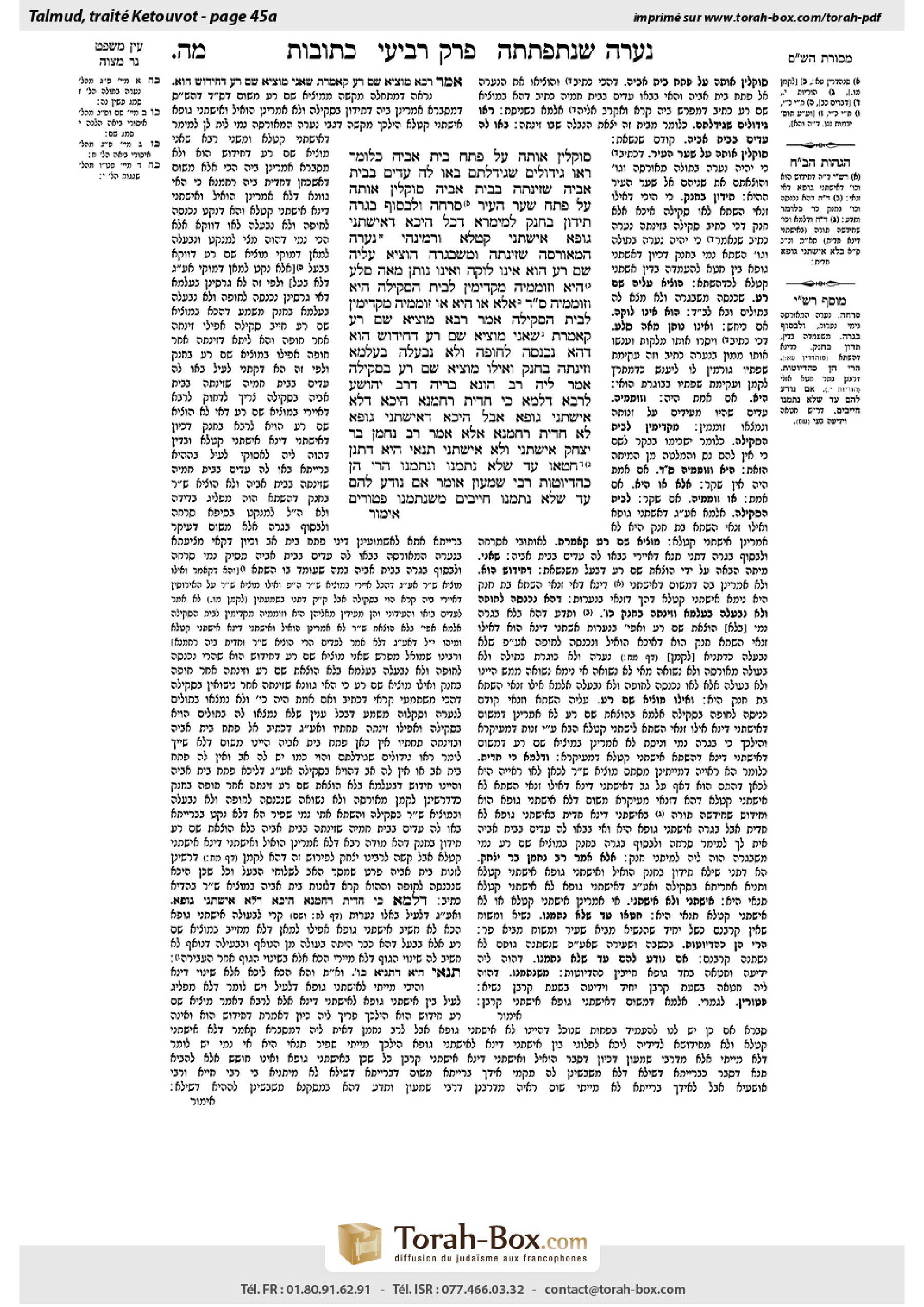
Ketubot 45a: Talmud study for Daf Yomi
Daf Yomi is the daily study of one Talmud folio. Explore 37 tractates with scans, Hebrew text, Sefaria English and AI-generated French translations where annotated.
Passage selection and English or AI-generated French translation are available where the scan has annotations. Daf Study is independent of Torah-Box and Sefaria.
Browse Ketubot · כתובות · All tractatesKetubot 45a text and translations
This page of Ketubot includes the Aramaic text, an English translation and an AI-generated French translation, alongside the scan above.
כתובות מ״ה א · Aramaic and Hebrew text
סוֹקְלִין אוֹתָהּ עַל פֶּתַח בֵּית אָבִיהָ, כְּלוֹמַר: רְאוּ גִּידּוּלִים שֶׁגִּידַּלְתֶּם. בָּאוּ לָהּ עֵדִים בְּבֵית אָבִיהָ שֶׁזִּינְּתָה בְּבֵית אָבִיהָ — סוֹקְלִין אוֹתָהּ עַל פֶּתַח שַׁעַר הָעִיר. סָרְחָה וּלְבַסּוֹף בָּגְרָה — תִּידּוֹן בְּחֶנֶק.
לְמֵימְרָא דְּכֹל הֵיכָא דְּאִישְׁתַּנִּי גּוּפָא אִישְׁתַּנִּי קְטָלָא? וּרְמִינְהִי: נַעֲרָה הַמְאוֹרָסָה שֶׁזִּינְּתָה, וּמִשֶּׁבָּגְרָה הוֹצִיא עָלֶיהָ שֵׁם רַע הוּא אֵינוֹ לוֹקֶה, וְאֵינוֹ נוֹתֵן מֵאָה סֶלַע, הִיא וְזוֹמְמֶיהָ מַקְדִּימִין לְבֵית הַסְּקִילָה.
הִיא וְזוֹמְמֶיהָ סָלְקָא דַּעְתָּךְ?! אֶלָּא: אוֹ הִיא אוֹ זוֹמְמֶיהָ מַקְדִּימִין לְבֵית הַסְּקִילָה.
אָמַר רָבָא: מוֹצִיא שֵׁם רַע קָאָמְרַתְּ? שָׁאנֵי מוֹצִיא שֵׁם רַע דְּחִידּוּשׁ הוּא, דְּהָא נִכְנְסָה לְחוּפָּה וְלֹא נִבְעֲלָה, בְּעָלְמָא, וְזִינְּתָה — בְּחֶנֶק, וְאִילּוּ מוֹצִיא שֵׁם רַע — בִּסְקִילָה.
אֲמַר לֵיהּ רַב הוּנָא בְּרֵיהּ דְּרַב יְהוֹשֻׁעַ לְרָבָא: דִּלְמָא כִּי חַדֵּית רַחֲמָנָא הֵיכָא דְּלָא אִישְׁתַּנִּי גּוּפָא, אֲבָל הֵיכָא דְּאִישְׁתַּנִּי גּוּפָא, לָא חַדֵּית רַחֲמָנָא!
אֶלָּא אָמַר רַב נַחְמָן בַּר יִצְחָק: אִישְׁתַּנִּי וְלָא אִישְׁתַּנִּי, תַּנָּאֵי הִיא, דִּתְנַן: חָטְאוּ עַד שֶׁלֹּא נִתְמַנּוּ, וְנִתְמַנּוּ, הֲרֵי הֵן כְּהֶדְיוֹטוֹת.
רַבִּי שִׁמְעוֹן אוֹמֵר: אִם נוֹדַע לָהֶם עַד שֶׁלֹּא נִתְמַנּוּ — חַיָּיבִים, מִשֶּׁנִּתְמַנּוּ — פְּטוּרִים.
Ketubot 45a · English translation
one stones her at the entrance to her father’s house, as though to say: See what you have brought up. If witnesses came to testify about her when she was in her father’s house, i.e., when she was betrothed, and testified that she committed adultery in her father’s house, one stones her at the entrance to the gate of the city. If she went astray and sinned when she was a young woman and subsequently reached majority, i.e., she became a grown woman, she is sentenced to strangulation, which is the punishment for a grown woman who committed adultery.
The Gemara asks with regard to this halakha: Is that to say that in any case where her body has changed after her sin, the manner in which she is put to death changes as well? The Gemara raises a contradiction from the following baraita: If there is a betrothed young woman who allegedly committed adultery, and after she reached majority she married and her husband defamed her, accusing her of having committed adultery during the period of betrothal, he is not flogged and does not give the one hundred sela if she is proven innocent, as these punishments are limited to one who defames a young woman (Deuteronomy 22:19). However, if she is guilty, she and her conspiring witnesses are brought early in the morning to the place of stoning. This proves that although her body changed between the time of the sin and the time of her punishment, she is stoned nevertheless.
The Gemara digresses to analyze the last clause of this baraita: Can it enter your mind to say that both she and her conspiring witnesses, i.e., witnesses who falsely testified that she committed adultery, are executed? If the witnesses who testified against her were telling the truth and she sinned, only she is liable to be stoned, and if the court discovers that they were false, conspiring witnesses, then they are stoned and she is exempt. Rather, the text of the baraita should be emended so that it reads: Either she or her conspiring witnesses are brought early in the morning to the place of stoning.
In answer to the contradiction, Rava said: A defamer, you said? A defamer is different as it is a novel halakha. Certain aspects of this case do not apply to other halakhot as, generally, if a woman who entered the wedding canopy and did not yet have intercourse with her husband subsequently committed adultery, she is executed by strangulation, which is the punishment for a married woman who committed adultery. However, in the case of a defamer, if the woman is guilty she is executed by stoning, despite the fact that if she would commit the sin in her current state, as a married woman, she would be executed via strangulation. This proves that in the case of defamation, the method of execution is determined by the time when the sin was committed, although her status has since changed.
Rav Huna, son of Rav Yehoshua, said to Rava: Perhaps when the Merciful One introduced the novelty of the halakha of a defamer, it was applied only to a case where her body has not changed and she is still a young woman. However, in a case where her body has changed and she has become a grown woman, the Merciful One did not introduce the novelty of this halakha, and she is liable to strangulation just as she would be liable to strangulation if she had committed the sin as a grown woman.
Rather, Rav Naḥman bar Yitzḥak said: This question of whether the method of her execution changes or does not change if her body has changed is a dispute between tanna’im, as we learned in a mishna (Horayot 10a), with regard to the special offering of a High Priest or a king who sinned unwittingly (see Leviticus 4:3–12, 22–26): If they sinned before they were appointed, and they were subsequently appointed, and they became aware of their transgression only after their appointment, they are like commoners. They must bring a female sheep or goat, like any ordinary individual who sinned, rather than the bull brought by a High Priest who has sinned or the male goat brought by a king who has sinned.
Rabbi Shimon says: If their sin became known to them before they were appointed, even if they did not bring their offering before they were appointed, they are liable to bring the offering of a commoner. However, if their sin became known to them after they were appointed, they are entirely exempt from bringing an offering as their change in status necessitates a corresponding change in their offering, and therefore their first obligation is entirely nullified. This shows that according to Rabbi Shimon, a change in status retroactively affects one’s liability for a transgression he committed in his previous status. A similar halakha should apply in the case of a betrothed young woman who committed adultery and reached majority before her sin became known.
Ketubot 45a · Traduction française (IA)
On la lapide à l’entrée de la maison de son père, comme pour dire : « Voyez ce que vous avez élevé. » Si des témoins viennent témoigner contre elle alors qu’elle se trouve dans la maison de son père, c’est-à-dire lorsqu’elle est fiancée, et déclarent qu’elle a commis un adultère dans la maison de son père, on la lapide à l’entrée de la porte de la ville. Si elle s’est égarée et a péché alors qu’elle était jeune fille, puis a atteint la majorité, c’est-à-dire qu’elle est devenue adulte, elle est condamnée à la strangulation, peine infligée à une femme adulte ayant commis un adultère.
La Guemara interroge cette halakha : Faut-il en conclure que chaque fois que le corps d’une femme change après qu’elle a péché, son mode d’exécution change également ? La Guemara soulève une contradiction à partir de la baraïta suivante : Si une jeune fille fiancée est accusée d’avoir commis un adultère et qu’après avoir atteint la majorité elle se marie, puis que son mari la diffame en l’accusant d’avoir commis un adultère pendant ses fiançailles, il n’est pas flagellé et ne verse pas les cent séla si elle est reconnue innocente, car ces peines ne s’appliquent qu’à celui qui diffame une jeune fille (Deutéronome 22:19). Toutefois, si elle est coupable, elle ou les témoins conspirateurs sont conduits tôt le matin au lieu de la lapidation. Cela prouve que, bien que son corps ait changé entre le moment du péché et celui de la peine, elle est néanmoins lapidée.
La Guemara s’écarte du sujet pour analyser la dernière clause de cette baraïta : Peut-on imaginer qu’elle et les témoins conspirateurs, c’est-à-dire les témoins ayant faussement déclaré qu’elle avait commis un adultère, soient tous exécutés ? Si les témoins qui ont témoigné contre elle disaient la vérité et qu’elle a péché, seule elle est passible de la lapidation ; si le tribunal découvre qu’ils ont menti et sont des témoins conspirateurs, ils sont lapidés et elle est exemptée. Il faut donc corriger le texte de la baraïta ainsi : soit elle, soit les témoins conspirateurs sont conduits tôt le matin au lieu de la lapidation.
Pour répondre à la contradiction, Rava dit : Tu parles d’un diffamateur ? Le cas du diffamateur est différent, car il relève d’une halakha novatrice. Certains aspects de ce cas ne s’appliquent pas aux autres halakhot : en règle générale, si une femme est entrée sous le dais nuptial sans avoir encore eu de rapports avec son mari, puis commet un adultère, elle est exécutée par strangulation, peine infligée à une femme mariée ayant commis un adultère. Cependant, dans le cas d’un diffamateur, si la femme est coupable, elle est exécutée par lapidation, bien que, si elle commettait le péché dans son état actuel, en tant que femme mariée, elle serait exécutée par strangulation. Cela prouve que, dans le cas d’une diffamation, le mode d’exécution est déterminé par le moment où le péché a été commis, même si son statut a changé depuis.
Rav Houna, fils de Rav Yehochoua, dit à Rava : Peut-être que, lorsque le Miséricordieux a introduit cette nouveauté dans la halakha du diffamateur, elle ne s’appliquait qu’au cas où le corps de la femme n’avait pas changé et où elle était encore une jeune fille. En revanche, si son corps a changé et qu’elle est devenue adulte, le Miséricordieux n’a pas introduit cette nouveauté dans la halakha ; elle est donc passible de strangulation, tout comme elle le serait si elle avait commis le péché en étant adulte.
Rav Naḥman bar Yitzḥak dit plutôt : La question de savoir si le mode d’exécution change ou non lorsque le corps de la femme a changé fait l’objet d’une controverse entre tannaïm, comme nous l’avons appris dans une Michna (Horayot 10a), à propos de l’offrande particulière d’un grand prêtre ou d’un roi ayant péché involontairement (voir Lévitique 4:3–12, 22–26) : s’ils ont péché avant d’être nommés, qu’ils ont ensuite été nommés et qu’ils n’ont pris conscience de leur transgression qu’après leur nomination, ils sont traités comme des gens ordinaires. Ils doivent apporter une brebis ou une chèvre femelle, comme tout particulier ayant péché, plutôt que le taureau apporté par un grand prêtre ayant péché ou le bouc apporté par un roi ayant péché.
Rabbi Chimon dit : Si leur péché leur a été révélé avant leur nomination, même s’ils n’ont pas apporté leur offrande avant celle-ci, ils sont tenus d’apporter l’offrande d’un particulier. En revanche, si leur péché leur a été révélé après leur nomination, ils sont entièrement exemptés d’apporter une offrande, car le changement de leur statut exige un changement correspondant de leur offrande ; leur obligation initiale est donc entièrement annulée. Cela montre que, selon Rabbi Chimon, un changement de statut modifie rétroactivement la responsabilité d’une personne pour une transgression commise sous son statut antérieur. Une halakha analogue devrait s’appliquer au cas d’une jeune fille fiancée qui a commis un adultère et atteint la majorité avant que son péché ne soit connu.
Traduction française générée par IA à partir de l’édition anglaise de Sefaria. Vérifie toujours un passage avec le texte source.
Text from Sefaria: William Davidson Edition - Vocalized Aramaic (CC BY NC); William Davidson Edition - English (CC BY NC).