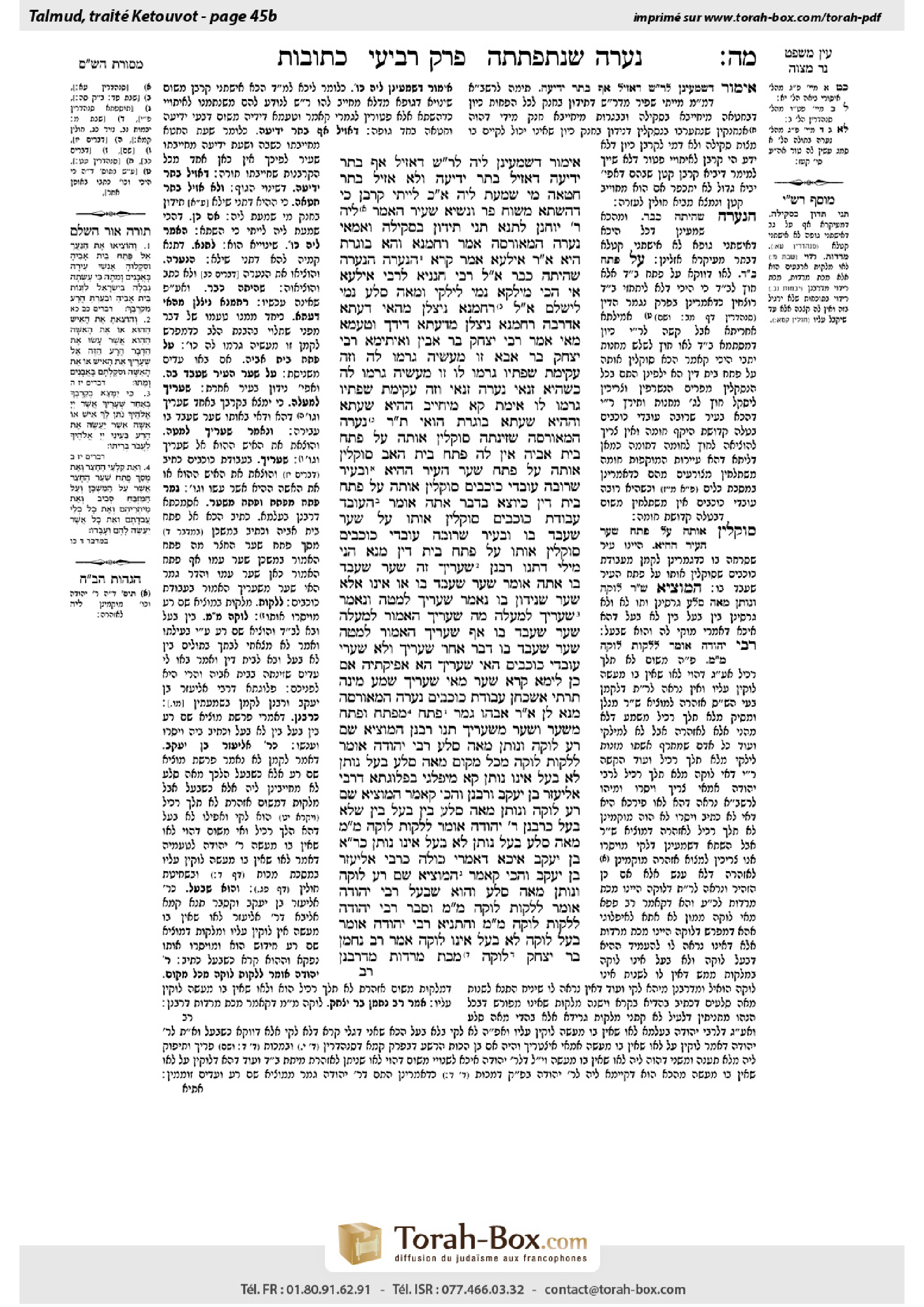
Ketubot 45b: Talmud study for Daf Yomi
Daf Yomi is the daily study of one Talmud folio. Explore 37 tractates with scans, Hebrew text, Sefaria English and AI-generated French translations where annotated.
Passage selection and English or AI-generated French translation are available where the scan has annotations. Daf Study is independent of Torah-Box and Sefaria.
Browse Ketubot · כתובות · All tractatesKetubot 45b text and translations
This page of Ketubot includes the Aramaic text, an English translation and an AI-generated French translation, alongside the scan above.
כתובות מ״ה ב · Aramaic and Hebrew text
אֵימוֹר דְּשָׁמְעִינַן לֵיהּ לְרַבִּי שִׁמְעוֹן דְּאָזֵיל אַף בָּתַר יְדִיעָה, דְּאָזֵיל בָּתַר יְדִיעָה וְלָא אָזֵיל בָּתַר חֶטְאָה מִי שָׁמְעַתְּ לֵיהּ? אִם כֵּן — לַיְיתֵי קׇרְבָּן כִּי דְּהַשְׁתָּא: מָשׁוּחַ פַּר, וְנָשִׂיא שָׂעִיר!
הָאָמַר לֵיהּ רַבִּי יוֹחָנָן לְתַנָּא: תְּנִי, תִּידּוֹן בִּסְקִילָה. וְאַמַּאי? ״נַעֲרָה הַמְאוֹרָסָה״ אָמַר רַחֲמָנָא וְהָא בּוֹגֶרֶת הִיא! אָמַר רַבִּי אִילְעָא, אָמַר קְרָא: ״הַנַּעֲרָה״ — הַנַּעֲרָה שֶׁהָיְתָה כְּבָר.
אֲמַר לֵיהּ רַבִּי חֲנַנְיָא לְרַבִּי אִילְעָא: אִי הָכִי מִילְקָא נָמֵי לִילְקֵי, וּמֵאָה סֶלַע נָמֵי לִישַׁלֵּם! אֲמַר לֵיהּ: רַחֲמָנָא נַיצְּלַן מֵהַאי דַּעְתָּא: אַדְּרַבָּה, רַחֲמָנָא נַיצְּלַן מִדַּעְתָּא דִּידָךְ.
וְטַעְמָא מַאי? אָמַר רַבִּי יִצְחָק בַּר אָבִין, וְאִיתֵּימָא רַבִּי יִצְחָק בַּר אַבָּא: זוֹ מַעֲשֶׂיהָ גָּרְמוּ לָהּ, וְזֶה עֲקִימַת שְׂפָתָיו גָּרְמוּ לוֹ. זוֹ מַעֲשֶׂיהָ גָּרְמוּ לָהּ, (כְּשֶׁהִיא) [כִּי] זַנַּאי — [כְּשֶׁהִיא] נַעֲרָה זַנַּאי. וְזֶה עֲקִימַת שְׂפָתָיו גָּרְמוּ לוֹ, אֵימַת קָא מִיחַיַּיב? הָהִיא שַׁעְתָּא, וְהָהִיא שַׁעְתָּא בּוֹגֶרֶת הֲוַאי.
תָּנוּ רַבָּנַן: נַעֲרָה הַמְאוֹרָסָה שֶׁזִּינְּתָה — סוֹקְלִין אוֹתָהּ עַל פֶּתַח בֵּית אָבִיהָ. אֵין לָהּ פֶּתַח בֵּית הָאָב, סוֹקְלִין אוֹתָהּ עַל פֶּתַח שַׁעַר הָעִיר הַהִיא. וּבְעִיר שֶׁרוּבָּהּ גּוֹיִם — סוֹקְלִין אוֹתָהּ עַל פֶּתַח בֵּית דִּין. כַּיּוֹצֵא בַּדָּבָר אַתָּה אוֹמֵר: הָעוֹבֵד עֲבוֹדָה זָרָה — סוֹקְלִין אוֹתוֹ עַל שַׁעַר שֶׁעָבַד בּוֹ, וּבְעִיר שֶׁרוּבָּהּ גּוֹיִם — סוֹקְלִין אוֹתוֹ עַל פֶּתַח בֵּית דִּין.
מְנָא הָנֵי מִילֵּי? דְּתָנוּ רַבָּנַן: ״שְׁעָרֶיךָ״, זֶה שַׁעַר שֶׁעָבַד בּוֹ. אַתָּה אוֹמֵר שַׁעַר שֶׁעָבַד בּוֹ, אוֹ אֵינוֹ אֶלָּא שַׁעַר שֶׁנִּידּוֹן בּוֹ?
נֶאֱמַר ״שְׁעָרֶיךָ״ לְמַטָּה, וְנֶאֱמַר ״שְׁעָרֶיךָ״ לְמַעְלָה. מָה ״שְׁעָרֶיךָ״ הָאָמוּר לְמַעְלָה — שַׁעַר שֶׁעָבַד בּוֹ, אַף ״שְׁעָרֶיךָ״ הָאָמוּר לְמַטָּה — שַׁעַר שֶׁעָבַד בּוֹ.
דָּבָר אַחֵר: ״שְׁעָרֶיךָ״, וְלֹא שַׁעֲרֵי גוֹיִם. הַאי ״שְׁעָרֶיךָ״, הָא אַפֵּיקְתֵּיהּ? אִם כֵּן, לֵימָא קְרָא ״שַׁעַר״, מַאי ״שְׁעָרֶיךָ״? שְׁמַע מִינַּהּ תַּרְתֵּי.
אַשְׁכְּחַן עֲבוֹדָה זָרָה, נַעֲרָה הַמְאוֹרָסָה מְנָא לַן?
אָמַר רַבִּי אֲבָהוּ: גָּמַר ״פֶּתַח״ מִ״פֶּתַח״, וּ״פֶתַח״ מִ״שַּׁעַר״, וְ״שַׁעַר״ מִ״שְּׁעָרֶיךָ״.
תָּנוּ רַבָּנַן: הַמּוֹצִיא שֵׁם רַע לוֹקֶה וְנוֹתֵן מֵאָה סֶלַע. רַבִּי יְהוּדָה אוֹמֵר: לִלְקוֹת — לוֹקֶה מִכׇּל מָקוֹם, מֵאָה סֶלַע, בָּעַל — נוֹתֵן, לֹא בָּעַל — אֵינוֹ נוֹתֵן.
קָא מִיפַּלְגִי בִּפְלוּגְתָּא דְּרַבִּי אֱלִיעֶזֶר בֶּן יַעֲקֹב וְרַבָּנַן. וְהָכִי קָאָמַר: הַמּוֹצִיא שֵׁם רַע — לוֹקֶה וְנוֹתֵן מֵאָה סֶלַע, בֵּין בָּעַל בֵּין שֶׁלֹּא בָּעַל, כְּרַבָּנַן. רַבִּי יְהוּדָה אוֹמֵר: לִלְקוֹת — לוֹקֶה מִכׇּל מָקוֹם, מֵאָה סֶלַע, בָּעַל — נוֹתֵן, לֹא בָּעַל — אֵינוֹ נוֹתֵן, כְּרַבִּי אֱלִיעֶזֶר בֶּן יַעֲקֹב.
אִיכָּא דְּאָמְרִי: כּוּלַּהּ כְּרַבִּי אֱלִיעֶזֶר בֶּן יַעֲקֹב. וְהָכִי קָאָמַר: הַמּוֹצִיא שֵׁם רַע — לוֹקֶה וְנוֹתֵן מֵאָה סֶלַע, וְהוּא שֶׁבָּעַל. רַבִּי יְהוּדָה אוֹמֵר: לִלְקוֹת — לוֹקֶה מִכׇּל מָקוֹם.
וְסָבַר רַבִּי יְהוּדָה לִלְקוֹת לוֹקֶה מִכׇּל מָקוֹם? וְהָתַנְיָא, רַבִּי יְהוּדָה אוֹמֵר: בָּעַל — לוֹקֶה, לֹא בָּעַל — אֵינוֹ לוֹקֶה! אָמַר רַב נַחְמָן בַּר יִצְחָק: לוֹקֶה מַכַּת מַרְדּוּת מִדְּרַבָּנַן.
Ketubot 45b · English translation
The Gemara questions this comparison: Say that we heard that Rabbi Shimon follows even the awareness, i.e., Rabbi Shimon takes into consideration the time when the sin became known to the High Priest or king, and maintains that he cannot bring the offering of a commoner. However, did you hear him say that he follows the time of the awareness and does not follow the time of the sin? If so, let him bring the offering that befits his current status: One anointed to be the High Priest brings a bullock, and a prince, i.e., a king, offers a goat. Consequently, there is no proof that, according to Rabbi Shimon, if the sin of a betrothed young woman became known after she reached majority, she is sentenced to strangulation like a grown woman.
The Gemara responds: Nevertheless, this issue is subject to a dispute. Didn’t Rabbi Yoḥanan say to the tanna, i.e., the Sage who would recite statements of tanna’im before him and who recited Sheila’s ruling with regard to a betrothed young woman: Teach that she is sentenced to stoning rather than strangulation? The Gemara questions Rabbi Yoḥanan’s statement: But why? The Merciful One says: A betrothed young woman, but this one is a grown woman. Rabbi Ile’a said: The verse states: The young woman, in reference to the young woman that she already was at the time of her sin, despite the fact that she now has a different status.
Rabbi Ḥanina said to Rabbi Ile’a: If so, if her status is determined according to the time of her transgression, let the husband who defames her also be flogged, and let him also pay the one hundred sela if his claim turns out to have been unfounded. Rabbi Ile’a said to him: May the Merciful One save us from following this opinion, as your argument is illogical. Rabbi Ḥanina replied: On the contrary, may the Merciful One save us from your opinion, as yours is the baseless opinion.
The Gemara asks: And what is the reason that she is considered a young woman with regard to stoning but a grown woman when it comes to the fine? Rabbi Yitzḥak bar Avin said, and some say this answer was given by Rabbi Yitzḥak bar Abba: With regard to this one, i.e., the woman, who sinned, her act of adultery caused her punishment, whereas that one, i.e., the husband who wrongfully defamed his wife, the twisting of his lips caused his punishment, i.e., he sinned by speaking. He elaborates: This one, her action caused her punishment. When she committed adultery, she was a young woman who committed adultery, and she is sentenced accordingly. And that one, the twisting of his lips caused his punishment. When does he become liable? At that time when he defamed her, and at that time his wife was a grown woman.
§ The Sages taught in a baraita: In the case of a betrothed young woman who committed adultery, one stones her at the entrance to her father’s house. If she does not have an entrance to her father’s house, one stones her at the entrance to the gate of that city. And in a city that is mostly populated by gentiles, where she cannot be stoned at the city entrance, one stones her at the entrance to the court. In a similar manner, you say: With regard to one who engaged in idol worship, one stones him at the entrance to the gate where he worshipped, and in a city that is mostly inhabited by gentiles one stones him at the entrance to the court.
The Gemara asks: From where are these matters derived, that one stones an idol worshipper in the place where he worshipped? As the Sages taught: It states with regard to one who worshipped an idol: “Then you shall bring forth that man or that women who have done this evil thing, to your gates…and you shall stone them with stones that they die” (Deuteronomy 17:5). “Your gates,” this is the gate where he worshipped idolatry. The offender is taken there to be stoned. Do you say it is the gate where he worshipped, or perhaps it is only the gate where he was sentenced, i.e., the gate of the court?
The Gemara answers: It is stated “your gates” below, in that verse, and is stated “your gates” above, in this verse: “If there is found in the midst of you, within any of your gates…a man or woman who does that which is evil in the sight of the Lord your God, in transgressing His covenant” (Deuteronomy 17:2). Just as “your gates” stated above is referring to the gate where he worshipped, so too the phrase “your gates” stated below, with regard to execution, means the gate where he worshipped idols.
Alternatively, the idol worshipper is executed at “your gates,” and not at the gates of gentiles. The Gemara asks: This term, “your gates,” you have already used it to indicate that he is stoned at the gate of the city where he worshipped idols. How, then, can you derive another halakha from this expression? The Gemara answers: If so, if it teaches only one halakha, let the verse say only the word gate. For what reason does it state “your gates”? This indicates that the verse is referring to the gates of cities inhabited by Jews, and therefore one can conclude two conclusions from it.
The Gemara asks: We found a source that indicates that in a case of idolatrous worship, the perpetrator is stoned at the gate of the city where he committed his sin. From where do we derive that a betrothed young woman who is not stoned at the entrance to her father’s house is stoned at the gate of the city?
Rabbi Abbahu said: One derives this by verbal analogy, as follows: The meaning of the term “entrance” (Deuteronomy 22:21), stated with regard to a betrothed woman who committed adultery, is derived from the term “entrance” that appears with regard to the Tabernacle, in the verse “The entrance of the gate of the courtyard” (Numbers 4:26); and the meaning of this usage of the term entrance is derived from the term “gate,” which appears in the same phrase; and the meaning of this usage of the term “gate” is derived from the term “your gates” stated with regard to idolatry. This teaches that a young woman who was betrothed and committed adultery is executed at the gate of the city, similar to one who engaged in idol worship.
§ The Sages taught in a baraita: One who defames his wife is flogged and gives one hundred sela. Rabbi Yehuda says: As for flogging, he is flogged in any case. However, with regard to the one hundred sela, if he defamed her after he had intercourse with her, he gives the money. If he did not yet have intercourse with her, he does not give her this sum.
The Gemara comments: These tanna’im disagree with regard to the dispute between Rabbi Eliezer ben Ya’akov and the Rabbis, and this is what the first tanna is saying: The defamer is flogged and gives one hundred sela, whether he had intercourse with his wife or whether he did not have intercourse with her, in accordance with the opinion of the Rabbis. Rabbi Yehuda says: As for flogging, he is flogged in any case, but with regard to the one hundred sela, if he had intercourse he gives the money, whereas if he did not have intercourse he does not give it to her. This is in accordance with the opinion of Rabbi Eliezer ben Ya’akov, that the halakha of a defamer applies only to a husband who had relations with his wife.
There are those who say that this entire baraita is in accordance with the opinion of Rabbi Eliezer ben Ya’akov, and this is what the baraita is saying: The defamer is flogged and gives one hundred sela, but this applies only if he previously had intercourse with his wife. Rabbi Yehuda says: As for flogging, he is flogged in any case, as only the fine is dependent on the couple having previously had intercourse.
The Gemara asks: And does Rabbi Yehuda hold that with regard to flogging, he is flogged in any case? But isn’t it taught in a baraita that Rabbi Yehuda says: If he had intercourse with his wife before he defamed her, he is flogged; but if he did not have intercourse with his wife before he defamed her, he is not flogged? In answer to this question, Rav Naḥman bar Yitzḥak said: When Rabbi Yehuda said that he is flogged even if he had not yet had intercourse with his wife, he was referring to lashes for rebelliousness [mardut], which apply by rabbinic law. Since he lied, defamed his wife, and endangered her life by accusing her of a sin that carries the death penalty, the court punishes him, but this punishment does not apply by Torah law.
Ketubot 45b · Traduction française (IA)
La Guemara remet en question cette comparaison : disons que nous avons entendu que Rabbi Shimon tient compte même du moment où le grand prêtre ou le roi a pris connaissance du péché, et qu’il estime qu’il ne peut pas apporter le sacrifice d’un particulier. Mais l’avons-nous entendu dire qu’il tient compte du moment où le péché a été découvert et non du moment où il a été commis ? Si tel était le cas, qu’il apporte le sacrifice correspondant à son statut actuel : celui qui a été oint pour devenir grand prêtre apporte un taureau, et un prince, c’est-à-dire un roi, offre un bouc. Par conséquent, rien ne prouve que, selon Rabbi Shimon, si le péché d’une jeune fille fiancée est découvert après qu’elle a atteint la majorité, elle soit condamnée à l’étranglement comme une femme adulte.
La Guemara répond : néanmoins, cette question fait l’objet d’un désaccord. Rabbi Yoḥanan n’a-t-il pas dit au tanna, c’est-à-dire au Sage qui récitait devant lui des enseignements de tannaïm et qui lui avait rapporté la décision de Sheila au sujet d’une jeune fille fiancée : « Enseigne qu’elle est condamnée à la lapidation plutôt qu’à l’étranglement » ? La Guemara s’interroge sur la déclaration de Rabbi Yoḥanan : mais pourquoi ? Le Miséricordieux dit : « une jeune fille fiancée », alors que celle-ci est une femme adulte. Rabbi Ile’a a dit : le verset dit « la jeune fille », en référence à celle qu’elle était au moment de son péché, bien qu’elle ait maintenant un statut différent.
Rabbi Ḥanina dit à Rabbi Ile’a : si tel est le cas, si son statut est déterminé selon le moment de sa transgression, que le mari qui la diffame soit lui aussi flagellé et qu’il paie également les cent séla si son accusation s’avère infondée. Rabbi Ile’a lui dit : Que le Miséricordieux nous préserve de suivre cette opinion, car ton raisonnement est illogique. Rabbi Ḥanina répondit : Au contraire, que le Miséricordieux nous préserve de ton opinion, car la tienne est sans fondement.
La Guemara demande : pourquoi est-elle considérée comme une jeune fille pour ce qui est de la lapidation, mais comme une femme adulte pour ce qui est de l’amende ? Rabbi Yitzḥak bar Avin a dit, et certains disent que cette réponse a été donnée par Rabbi Yitzḥak bar Abba : dans le cas de celle-ci, c’est-à-dire la femme qui a péché, son acte d’adultère a entraîné sa punition ; tandis que dans le cas de celui-là, c’est-à-dire le mari qui a diffamé à tort sa femme, c’est le tort causé par ses paroles qui a entraîné sa punition, autrement dit, il a péché par la parole. Il développe : pour celle-ci, son acte a entraîné sa punition. Lorsqu’elle a commis l’adultère, elle était une jeune fille qui commettait l’adultère, et elle est condamnée en conséquence. Pour celui-là, le tort causé par ses paroles a entraîné sa punition. Quand devient-il passible ? Au moment où il l’a diffamée ; or, à ce moment-là, sa femme était une femme adulte.
§ Les Sages ont enseigné dans une baraïta : dans le cas d’une jeune fille fiancée qui a commis l’adultère, on la lapide à l’entrée de la maison de son père. Si elle n’a pas d’entrée donnant sur la maison de son père, on la lapide à l’entrée de la porte de cette ville. Et, dans une ville dont la population est majoritairement non juive, où elle ne peut pas être lapidée à l’entrée de la ville, on la lapide à l’entrée du tribunal. De même, dit-on : celui qui a pratiqué l’idolâtrie est lapidé à l’entrée de la porte où il l’a pratiquée ; et, dans une ville majoritairement non juive, on le lapide à l’entrée du tribunal.
La Guemara demande : d’où tire-t-on ces règles, selon lesquelles on lapide un idolâtre à l’endroit où il a pratiqué l’idolâtrie ? Car les Sages ont enseigné : au sujet de celui qui a pratiqué l’idolâtrie, il est dit : « Alors tu feras sortir cet homme ou cette femme qui a commis cette mauvaise action, à tes portes… et tu les lapideras avec des pierres, et ils mourront » (Deutéronome 17, 5). « À tes portes » désigne la porte où il a pratiqué l’idolâtrie. On l’y conduit pour le lapider. Dis-tu que cela désigne la porte où il a pratiqué l’idolâtrie, ou peut-être cela désigne-t-il seulement la porte où il a été jugé, c’est-à-dire la porte du tribunal ?
La Guemara répond : l’expression « à tes portes » apparaît plus bas, dans ce verset, et plus haut, dans ce verset : « S’il se trouve au milieu de toi, dans l’une de tes portes… un homme ou une femme qui fait ce qui est mal aux yeux de l’Éternel ton Dieu, en transgressant son alliance » (Deutéronome 17, 2). De même que l’expression « à tes portes », dans le passage précédent, désigne la porte où il a pratiqué l’idolâtrie, de même l’expression « à tes portes », dans le passage suivant, au sujet de l’exécution, désigne la porte où il a pratiqué l’idolâtrie.
Autre possibilité : l’idolâtre est exécuté « à tes portes », et non aux portes des non-Juifs. La Guemara demande : tu as déjà utilisé l’expression « à tes portes » pour indiquer qu’il est lapidé à la porte de la ville où il a pratiqué l’idolâtrie. Comment peux-tu donc tirer une autre halakha de cette expression ? La Guemara répond : si le verset n’enseignait qu’une seule halakha, il aurait simplement dit « porte ». Pourquoi dit-il « à tes portes » ? Cela indique que le verset parle des portes de villes habitées par des Juifs ; on peut donc en tirer deux conclusions.
La Guemara demande : nous avons trouvé une source indiquant que, dans le cas d’une pratique idolâtre, le coupable est lapidé à la porte de la ville où il a commis son péché. D’où déduit-on qu’une jeune fille fiancée qui n’est pas lapidée à l’entrée de la maison de son père est lapidée à la porte de la ville ?
Rabbi Abbahu a dit : on le déduit par une analogie verbale, de la manière suivante : le sens du terme « entrée » (Deutéronome 22, 21), employé à propos d’une jeune fille fiancée qui a commis l’adultère, est déduit du terme « entrée » qui apparaît au sujet du Tabernacle, dans le verset « l’entrée de la porte du parvis » (Nombres 4, 26) ; le sens de cet emploi du terme « entrée » est ensuite déduit du terme « porte », qui apparaît dans la même expression ; et le sens de cet emploi du terme « porte » est déduit de l’expression « à tes portes », employée au sujet de l’idolâtrie. Cela enseigne qu’une jeune fille fiancée qui a commis l’adultère est exécutée à la porte de la ville, comme celui qui a pratiqué l’idolâtrie.
§ Les Sages ont enseigné dans une baraïta : celui qui diffame sa femme est flagellé et verse cent séla. Rabbi Yehuda dit : pour ce qui est de la flagellation, il est flagellé dans tous les cas. Toutefois, en ce qui concerne les cent séla, s’il l’a diffamée après avoir eu des relations avec elle, il verse l’argent. S’il n’a pas encore eu de relations avec elle, il ne lui verse pas cette somme.
La Guemara fait remarquer : ces tannaïm sont en désaccord au sujet de la controverse entre Rabbi Eliezer ben Ya’akov et les Rabbins. Voici ce que dit le premier tanna : celui qui diffame est flagellé et verse cent séla, qu’il ait eu ou non des relations avec sa femme, conformément à l’opinion des Rabbins. Rabbi Yehuda dit : pour ce qui est de la flagellation, il est flagellé dans tous les cas ; mais, concernant les cent séla, s’il a eu des relations avec elle, il verse l’argent, tandis que s’il n’en a pas eu, il ne le lui verse pas. Cela correspond à l’opinion de Rabbi Eliezer ben Ya’akov, selon laquelle la halakha relative au mari qui diffame sa femme ne s’applique que s’il a eu des relations avec elle.
Certains disent que toute cette baraïta est conforme à l’opinion de Rabbi Eliezer ben Ya’akov, et que voici ce qu’enseigne la baraïta : celui qui diffame est flagellé et verse cent séla, mais cela ne s’applique que s’il a eu auparavant des relations avec sa femme. Rabbi Yehuda dit : pour ce qui est de la flagellation, il est flagellé dans tous les cas, puisque seule l’amende dépend du fait que le couple ait eu auparavant des relations.
La Guemara demande : Rabbi Yehuda estime-t-il vraiment que, pour ce qui est de la flagellation, il est flagellé dans tous les cas ? N’est-il pas enseigné dans une baraïta que Rabbi Yehuda dit : s’il a eu des relations avec sa femme avant de la diffamer, il est flagellé ; mais s’il n’a pas eu de relations avec elle avant de la diffamer, il n’est pas flagellé ? Pour répondre à cette question, Rav Naḥman bar Yitzḥak a dit : lorsque Rabbi Yehuda a déclaré qu’il est flagellé même s’il n’avait pas encore eu de relations avec sa femme, il parlait de coups pour rébellion [mardut], qui relèvent du droit rabbinique. Puisqu’il a menti, diffamé sa femme et mis sa vie en danger en l’accusant d’un péché passible de la peine de mort, le tribunal le punit, mais cette peine ne relève pas de la Torah.
Traduction française générée par IA à partir de l’édition anglaise de Sefaria. Vérifie toujours un passage avec le texte source.
Text from Sefaria: William Davidson Edition - Vocalized Aramaic (CC BY NC); William Davidson Edition - English (CC BY NC).