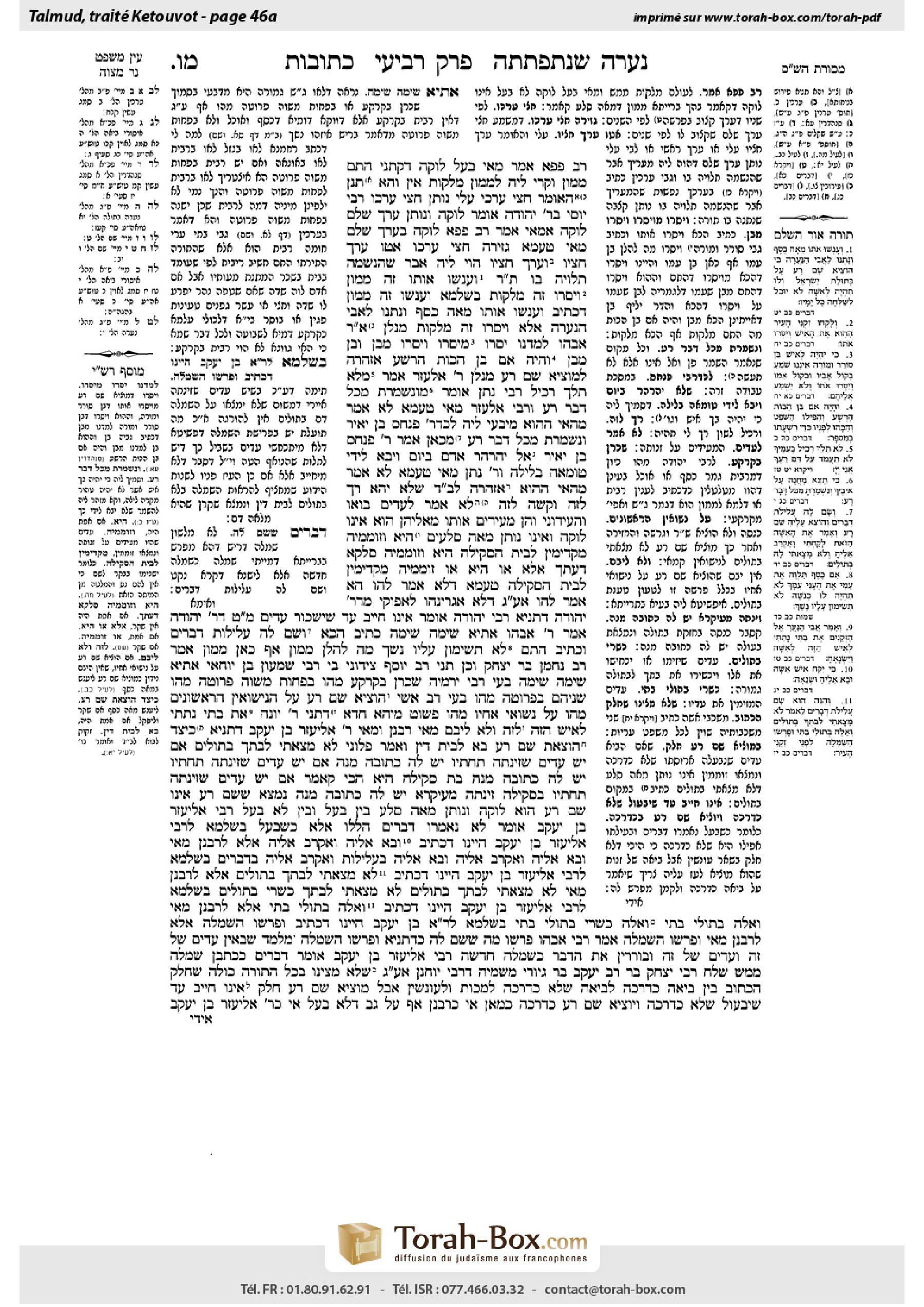
Ketubot 46a: Talmud study for Daf Yomi
Daf Yomi is the daily study of one Talmud folio. Explore 37 tractates with scans, Hebrew text, Sefaria English and AI-generated French translations where annotated.
Passage selection and English or AI-generated French translation are available where the scan has annotations. Daf Study is independent of Torah-Box and Sefaria.
Browse Ketubot · כתובות · All tractatesKetubot 46a text and translations
This page of Ketubot includes the Aramaic text, an English translation and an AI-generated French translation, alongside the scan above.
כתובות מ״ו א · Aramaic and Hebrew text
רַב פָּפָּא אָמַר: מַאי ״בָּעַל לוֹקֶה״ דְּקָתָנֵי הָתָם — מָמוֹן. וְקָרֵי לֵיהּ לְמָמוֹן מַלְקוֹת? אִין, וְהָא תְּנַן: ״הָאוֹמֵר חֲצִי עֶרְכִּי עָלַי״ — נוֹתֵן חֲצִי עֶרְכּוֹ. רַבִּי יוֹסֵי בְּרַבִּי יְהוּדָה אוֹמֵר: לוֹקֶה וְנוֹתֵן עֵרֶךְ שָׁלֵם. לוֹקֶה אַמַּאי? אָמַר רַב פָּפָּא: לוֹקֶה בְּעֵרֶךְ שָׁלֵם.
מַאי טַעְמָא — גְּזֵירָה ״חֲצִי עֶרְכּוֹ״ אַטּוּ ״עֵרֶךְ חֶצְיוֹ״. וְ״עֵרֶךְ חֶצְיוֹ״ הָוֵי לֵיהּ אֵבֶר שֶׁהַנְּשָׁמָה תְּלוּיָה בּוֹ.
תָּנוּ רַבָּנַן: ״וְעָנְשׁוּ אוֹתוֹ״ — זֶה מָמוֹן, ״וְיִסְּרוּ״ — זֶה מַלְקוֹת.
בִּשְׁלָמָא ״וְעָנְשׁוּ״ זֶה מָמוֹן, דִּכְתִיב ״וְעָנְשׁוּ אוֹתוֹ מֵאָה כֶסֶף וְנָתְנוּ לַאֲבִי הַנַּעֲרָה״. אֶלָּא ״וְיִסְּרוּ״ זֶה מַלְקוֹת — מְנָלַן?
אָמַר רַבִּי אֲבָהוּ: לָמַדְנוּ ״יִסְּרוּ״ מִ״יִּסְּרוּ״, וְ״יִסְּרוּ״ מִ״בֵּן״, וּ״בֵן״ מִ״בִּן״ — ״וְהָיָה אִם בִּן הַכּוֹת הָרָשָׁע״.
אַזְהָרָה לְמוֹצִיא שֵׁם רַע מְנָלַן? רַבִּי אֶלְעָזָר אָמַר: מִ״לֹּא תֵלֵךְ רָכִיל״. רַבִּי נָתָן אוֹמֵר: מִ״וְּנִשְׁמַרְתָּ מִכֹּל דָּבָר רָע״.
וְרַבִּי אֶלְעָזָר מַאי טַעְמָא לָא אָמַר מֵהַאי? הָהוּא מִיבְּעֵי לֵיהּ לְכִדְרַבִּי פִּנְחָס בֶּן יָאִיר. ״וְנִשְׁמַרְתָּ מִכֹּל דָּבָר רָע״, מִכָּאן אָמַר רַבִּי פִּנְחָס בֶּן יָאִיר: אַל יְהַרְהֵר אָדָם בַּיּוֹם וְיָבֹא לִידֵי טוּמְאָה בַּלַּיְלָה.
וְרַבִּי נָתָן מַאי טַעְמָא לָא אָמַר מֵהַאי? הָהוּא: אַזְהָרָה לְבֵית דִּין שֶׁלֹּא יְהֵא רַךְ לָזֶה וְקָשֶׁה לָזֶה.
לֹא אָמַר לְעֵדִים ״בּוֹאוּ וְהַעִידוּנִי״, וְהֵן מְעִידִים אוֹתוֹ מֵאֲלֵיהֶן — הוּא אֵינוֹ לוֹקֶה, וְאֵינוֹ נוֹתֵן מֵאָה סְלָעִים. הִיא וְזוֹמְמֶיהָ מַקְדִּימִין לְבֵית הַסְּקִילָה.
הִיא וְזוֹמְמֶיהָ סָלְקָא דַּעְתָּךְ?! אֶלָּא: אוֹ הִיא אוֹ זוֹמְמֶיהָ מַקְדִּימִין לְבֵית הַסְּקִילָה.
טַעְמָא דְּלָא אֲמַר לְהוּ, הָא אֲמַר לְהוּ, אַף עַל גַּב דְּלָא אַגְרִינְהוּ. לְאַפּוֹקֵי מִדְּרַבִּי יְהוּדָה. דְּתַנְיָא, רַבִּי יְהוּדָה אוֹמֵר: אֵינוֹ חַיָּיב עַד שֶׁיִּשְׂכּוֹר עֵדִים.
מַאי טַעְמָא דְּרַבִּי יְהוּדָה? אָמַר רַבִּי אֲבָהוּ: אַתְיָא ״שִׂימָה״ ״שִׂימָה״. כְּתִיב הָכָא: ״וְשָׂם לָהּ עֲלִילוֹת דְּבָרִים״, וּכְתִיב הָתָם: ״לֹא תְשִׂימוּן עָלָיו נֶשֶׁךְ״, מָה לְהַלָּן מָמוֹן, אַף כָּאן מָמוֹן.
אָמַר רַב נַחְמָן בַּר יִצְחָק, וְכֵן תָּנֵי רַב יוֹסֵף צִידוֹנִי בֵּי רַבִּי שִׁמְעוֹן בֶּן יוֹחַאי: אָתְיָא ״שִׂימָה״ ״שִׂימָה״.
בָּעֵי רַבִּי יִרְמְיָה: שְׂכָרָן בְּקַרְקַע, מַהוּ? בְּפָחוֹת מִשָּׁוֶה פְּרוּטָה, מַהוּ? שְׁנֵיהֶם בִּפְרוּטָה, מַהוּ?
בָּעֵי רַב אָשֵׁי: הוֹצִיא שֵׁם רַע עַל הַנִּישּׂוּאִין הָרִאשׁוֹנִים, מַהוּ? עַל נִשּׂוּאֵי אָחִיו, מַהוּ?
פְּשׁוֹט מִיהָא חֲדָא. דְּתָנֵי רַבִּי יוֹנָה: ״אֶת בִּתִּי נָתַתִּי לָאִישׁ הַזֶּה״. לְזֶה — וְלֹא לַיָּבָם.
מַאי רַבָּנַן וּמַאי רַבִּי אֱלִיעֶזֶר בֶּן יַעֲקֹב? דְּתַנְיָא: כֵּיצַד הוֹצָאַת שֵׁם רַע? בָּא לְבֵית דִּין, וְאָמַר: פְּלוֹנִי, לֹא מָצָאתִי לְבִתְּךָ בְּתוּלִים. אִם יֵשׁ עֵדִים שֶׁזִּינְּתָה תַּחְתָּיו — יֵשׁ לָהּ כְּתוּבָּה מָנֶה.
אִם יֵשׁ עֵדִים שֶׁזִּינְּתָה תַּחְתָּיו יֵשׁ לָהּ כְּתוּבָּה מָנֶה?! בַּת סְקִילָה הִיא! הָכִי קָאָמַר: אִם יֵשׁ עֵדִים שֶׁזִּינְּתָה תַּחְתָּיו — בִּסְקִילָה. זִינְּתָה מֵעִיקָּרָא, יֵשׁ לָהּ כְּתוּבָּה מָנֶה.
נִמְצָא (שֶׁ)שֵּׁם רַע [שֶׁ]אֵינוֹ שֵׁם רַע — הוּא לוֹקֶה וְנוֹתֵן מֵאָה סֶלַע, בֵּין בָּעַל וּבֵין לֹא בָּעַל. רַבִּי אֱלִיעֶזֶר בֶּן יַעֲקֹב אוֹמֵר: לֹא נֶאֶמְרוּ דְּבָרִים הַלָּלוּ אֶלָּא כְּשֶׁבָּעַל. בִּשְׁלָמָא לְרַבִּי אֱלִיעֶזֶר בֶּן יַעֲקֹב, הַיְינוּ דִּכְתִיב: ״וּבָא אֵלֶיהָ״, ״וָאֶקְרַב אֵלֶיהָ״,
אֶלָּא לְרַבָּנַן, מַאי ״וּבָא אֵלֶיהָ״, ״וָאֶקְרַב אֵלֶיהָ״? ״וּבָא אֵלֶיהָ״ — בַּעֲלִילוֹת, ״וָאֶקְרַב אֵלֶיהָ״ — בִּדְבָרִים.
בִּשְׁלָמָא לְרַבִּי אֱלִיעֶזֶר בֶּן יַעֲקֹב הַיְינוּ דִּכְתִיב: ״לֹא מָצָאתִי לְבִתְּךָ בְּתוּלִים״. אֶלָּא לְרַבָּנַן, מַאי ״לֹא מָצָאתִי לְבִתְּךָ בְּתוּלִים״! לֹא מָצָאתִי לְבִתְּךָ כְּשֵׁרֵי בְתוּלִים.
בִּשְׁלָמָא לְרַבִּי אֱלִיעֶזֶר בֶּן יַעֲקֹב, הַיְינוּ דִּכְתִיב ״וְאֵלֶּה בְּתוּלֵי בִתִּי״. אֶלָּא לְרַבָּנַן, מַאי ״וְאֵלֶּה בְּתוּלֵי בִתִּי״? וְאֵלֶּה כְּשֵׁרֵי בְּתוּלֵי בִתִּי.
בִּשְׁלָמָא לְרַבִּי אֱלִיעֶזֶר בֶּן יַעֲקֹב, הַיְינוּ דִּכְתִיב: ״וּפָרְשׂוּ הַשִּׂמְלָה״. אֶלָּא לְרַבָּנַן, מַאי ״וּפָרְשׂוּ הַשִּׂמְלָה״?
אָמַר רַבִּי אֲבָהוּ: פָּרְשׂוּ מַה שֶּׁשָּׂם לָהּ. כִּדְתַנְיָא: ״וּפָרְשׂוּ הַשִּׂמְלָה״, מְלַמֵּד שֶׁבָּאִין עֵדִים שֶׁל זֶה וְעֵדִים שֶׁל זֶה, וּבוֹרְרִין אֶת הַדָּבָר כְּשִׂמְלָה חֲדָשָׁה. רַבִּי אֱלִיעֶזֶר בֶּן יַעֲקֹב אוֹמֵר: דְּבָרִים כִּכְתָבָן, שִׂמְלָה מַמָּשׁ.
שָׁלַח רַבִּי יִצְחָק בַּר רַב יַעֲקֹב בַּר גִּיּוֹרֵי מִשְּׁמֵיהּ דְּרַבִּי יוֹחָנָן: אַף עַל גַּב שֶׁלֹּא מָצִינוּ בְּכׇל הַתּוֹרָה כּוּלָּהּ שֶׁחִלֵּק הַכָּתוּב בֵּין בִּיאָה כְּדַרְכָּהּ לְבִיאָה שֶׁלֹּא כְּדַרְכָּהּ לְמַכּוֹת וְלָעוֹנָשִׁין, אֲבָל מוֹצִיא שֵׁם רַע חִלֵּק: אֵינוֹ חַיָּיב עַד שֶׁיִּבְעוֹל שֶׁלֹּא כְּדַרְכָּהּ, וְיוֹצִיא שֵׁם רַע כְּדַרְכָּהּ.
כְּמַאן? אִי כְּרַבָּנַן, אַף עַל גַּב דְּלָא בָּעַל. אִי כְּרַבִּי אֱלִיעֶזֶר בֶּן יַעֲקֹב,
Ketubot 46a · English translation
Rav Pappa said: What of the statement that is taught there, in the baraita, that it is only if he had intercourse with her that he is flogged? It is referring to the money of the fine. The Gemara asks: And does one call monetary payment flogging? The Gemara answers: Yes, and we learned in a baraita: One who says: Half my valuation is upon me, he gives half his valuation, in accordance with the sum fixed by the Torah according to sex and age (see Leviticus 27:2–3). Rabbi Yosei, son of Rabbi Yehuda, says: He is flogged and gives his full valuation. The Sages inquired: Why is he flogged? What transgression did he commit? Rav Pappa said: He is flogged by having to pay a full valuation. This proves that monetary payment can be referred to as flogging.
The Gemara clarifies: What is the reason of Rabbi Yosei, son of Rabbi Yehuda? It is a rabbinic decree in the case of one who vows to donate half of his valuation, due to a case where one vowed the valuation of half of himself. And one who vows to donate the valuation of half of himself has effectively vowed to donate the valuation of a limb upon which his life depends, e.g., his head or heart, in which case it is as though he vowed to donate his entire valuation. Consequently, even one who vows to donate half of his valuation must donate his entire valuation.
§ The Gemara continues to discuss the halakhot of the defamer. The Sages taught the following baraita, based upon the following verses: “And the Elders of that city shall take the man and chastise him. And they shall fine him a hundred shekels of silver, and give them to the father of the young woman” (Deuteronomy 22:18–19). “And they shall fine [ve’anshu] him”; this is referring to money. “And chastise him”; this is referring to flogging.
The Gemara asks: Granted, with regard to the phrase “and they fine [ve’anshu] him,” although the word ve’anshu can refer to any punishment, in this case it is referring to money, as it is written: And they shall fine him a hundred shekels of silver, and give them to the father of the young woman. However, with regard to the statement of the baraita that: “And chastise him”; this is referring to flogging, from where do we derive this?
Rabbi Abbahu said: We learned the meaning of the word chastise in the case of a defamer by verbal analogy from the word chastise stated in the verse “if a man have a stubborn and rebellious son [ben], that will not listen to the voice of his father or the voice of his mother, and though they chastise him, will not listen to them” (Deuteronomy 21:18). And the implication of the word chastise in that verse is derived from the word son that appears in the same verse. And the implication of the word son [ben] with regard to a rebellious son is derived from the word bin in the verse “Then it shall be if the wicked man deserve [bin] to be flogged” (Deuteronomy 25:2).
The Gemara asks: From where do we derive the warning, i.e., the prohibition that serves as the source for the flogging for a defamer? Rabbi Elazar says that the prohibition is derived from the verse “You shall not go up and down as talebearer” (Leviticus 19:16). Rabbi Natan says that it is derived from: “Then you shall keep yourself from every evil thing [davar ra]” (Deuteronomy 23:10), which is expounded to mean dibbur ra, evil speech.
The Gemara asks: And what is the reason that Rabbi Elazar did not state that it is derived from this verse quoted by Rabbi Natan? The Gemara answers: He requires that verse for the statement of Rabbi Pineḥas ben Yair, as it was taught: “Then you shall keep yourself from every evil thing”; from here Rabbi Pineḥas ben Yair said: A person should not think impure thoughts by day and thereby come by night to the impurity of an emission.
The Gemara asks the reverse question: And what is the reason that Rabbi Natan did not state that it is derived from that verse cited by Rabbi Elazar? The Gemara answers: Rabbi Natan explains that verse, which includes the term talebearer [rakhil], as a warning to the court that it should not be soft to [rakh la] this litigant and harsh to that one, but it must treat both sides as equals.
§ The Gemara cites another statement that deals with a defamer: If the husband did not say to witnesses: Come and testify for me that my wife committed adultery, but they testify for him of their own accord and are subsequently discovered to be liars, the husband is not flogged and does not give the one hundred sela, as he did not harm her. She and her conspiring witnesses are brought early to the place of stoning.
The Gemara asks: Does it enter your mind to say that she and her conspiring witnesses are stoned? If she is liable to be stoned, they are not conspiring witnesses, and conversely, if they are conspiring witnesses, they are stoned and she is exempt. Rather, this must mean: Either she or her conspiring witnesses are brought early to the place of stoning. If they were telling the truth, she is stoned. If they conspired and offered false testimony, they are liable to be stoned.
The Gemara infers from the baraita that the reason the husband is not flogged or fined is that the husband did not tell them to testify, but if he told them to testify, although he did not hire them but merely persuaded them to testify that his wife had committed adultery as a betrothed woman, he is flogged and must pay the fine. This serves to exclude the opinion of Rabbi Yehuda, as it is taught in a baraita that Rabbi Yehuda says: The husband is liable to the punishments of a defamer only if he hired witnesses.
The Gemara asks: What is the reason of Rabbi Yehuda? Nowhere does the Torah explicitly state that the husband hired false witnesses. The Gemara answers that Rabbi Abbahu said: It is derived by a verbal analogy between the term placing, written with regard to a defamer, and the term placing, written with regard to the prohibition against charging interest. It is written here, with regard to a defamer: “And he place wanton charges against her” (Deuteronomy 22:14), and it is written there: “Neither shall you place upon him interest” (Exodus 22:24). Just as below, with regard to interest, the verse is referring to money, so too here, in the case of a defamer, it is referring to money, thereby indicating that the husband paid money in order to substantiate his false accusation.
Rav Naḥman bar Yitzḥak said: Rav Yosef Tzidoni likewise taught in the school of Rabbi Shimon ben Yoḥai: It is derived from the verbal analogy between the term placing, written with regard to a defamer, and the term placing, written with regard to the prohibition against charging interest.
Rabbi Yirmeya raised a dilemma: According to the opinion of Rabbi Yehuda, if the husband hired the false witnesses with land instead of money, what is the halakha? If he hired them with less than the value of a peruta, what is the halakha? If he hired both witnesses with a peruta, what is the halakha? Since this halakha is derived from the case of interest, perhaps, like the prohibition against charging interest, it applies only with regard to money, rather than land, and only with money that is greater than the value of a peruta.
Similarly, Rav Ashi raised a dilemma concerning a defamer: If he defamed his wife with regard to their first marriage, what is the halakha? In other words, if a man married a woman, divorced her, remarried her, and subsequently defamed her by claiming that she had committed adultery during the period of betrothal before their first marriage, what is the halakha? Similarly, if he performed levirate marriage and then defamed her with regard to his brother’s marriage to her, what is the halakha?
The Gemara comments: Resolve at least one of these dilemmas, as Rabbi Yona taught that the verse “And the father of the young woman shall say to the Elders: I gave my daughter to this man” (Deuteronomy 22:16) serves to emphasize: I gave her to this man and not to the yavam, i.e., the brother of the original husband. Consequently, if one defames his yevama with regard to her original marriage to his brother, the unique halakhot of defamation do not apply.
§ In the course of the previous discussion, the Gemara mentioned a dispute between the Rabbis and Rabbi Eliezer ben Ya’akov. The Gemara asks: What is the opinion of the Rabbis and what is the opinion of Rabbi Eliezer ben Ya’akov, referred to above (45b)? As it is taught in a baraita: How does the case of defamation proceed? It involves a situation where the husband came to the court and said to the father: So-and-so, I have not found indications of your daughter’s virginity. If there are witnesses who testify that she committed adultery under his authority, i.e., while betrothed to him, she has a marriage contract of one hundred dinars.
The Gemara interrupts its citation of the baraita, as this last statement is very surprising: If there are witnesses who testify that she committed adultery under his authority, does she have a marriage contract of one hundred dinars? She is punished by stoning. The Gemara explains that this is what the tanna said: If there are witnesses who testify that she committed adultery under his authority, she is liable to receive the punishment of stoning. However, if she engaged in licentious sexual relations at the outset, before her betrothal, when she was still a single woman, she is merely guilty of deceiving her husband with regard to her virginity, and therefore she has a marriage contract of one hundred dinars, which is the standard marriage contract of a non-virgin.
The Gemara resumes its quotation of the baraita: If it was discovered that the bad name is not a bad name, i.e., the husband’s accusation was false, he is flogged and gives her father one hundred sela, whether he had intercourse with her or whether he had not had intercourse with her. Rabbi Eliezer ben Ya’akov says: These matters were stated only in a case where he had intercourse with his wife before defaming her. The Gemara asks: Granted, according to the opinion of Rabbi Eliezer ben Ya’akov, this is as it is written: “If a man take a wife and go in unto her” (Deuteronomy 22:13), and: “And when I came near to her, I did not find in her the tokens of virginity” (Deuteronomy 22:14), as both expressions refer to sexual intercourse.
However, according to the opinion of the Rabbis, what is the meaning of the phrases “and go in unto her,” and “and when I came near to her,” if the couple never engaged in intercourse? The Gemara explains that, according to the Rabbis, “and go in unto her” is referring to the wanton charges the husband leveled against his wife; “and when I came near to her” means that he came near with words, not intercourse.
The Gemara asks: Granted, according to the opinion of Rabbi Eliezer ben Ya’akov, this is as it is written: “I did not find in your daughter the tokens of virginity” (Deuteronomy 22:17), as Rabbi Eliezer ben Ya’akov claims that the husband had relations with her and discovered that she was not a virgin. However, according to the opinion of the Rabbis, what is the meaning of “I did not find in your daughter the tokens of virginity,” if they did not have intercourse? The Gemara answers: The Rabbis explain that he means: I did not find for your daughter the fitness of virginity, i.e., I have discovered that she was unfaithful.
The Gemara asks further: Granted, according to the opinion of Rabbi Eliezer ben Ya’akov, this is as it is written that the father replies: “And these are the tokens of my daughter’s virginity” (Deuteronomy 22:17). He presents a cloth that proves she was a virgin, in opposition to the husband’s claim. However, according to the opinion of the Rabbis, what is the meaning of “And these are the tokens of my daughter’s virginity”? The Rabbis answer that the father means: And these are the proofs of the fitness of my daughter’s virginity, i.e., he either brings witnesses to counter the testimony of the husband’s witnesses or provides some other proof that his daughter was a virgin at the time of her marriage.
The Gemara poses yet another question on the same lines: Granted, according to the opinion of Rabbi Eliezer ben Ya’akov, this is at it is written: “And they shall spread the garment” (Deuteronomy 22:17). The father brings the sheet on which the couple had intercourse and shows that it is stained with blood. However, according to the opinion of the Rabbis, who claim that a husband can defame his wife even if they have not engaged in intercourse, what is the meaning of the phrase “And they shall spread the garment [hasimla]”?
Rabbi Abbahu said that the Rabbis interpret this expression as follows: They shall spread, i.e., examine, that which he placed against her [sam la]. In other words, they cross-examine the witnesses who testified against her, as it is taught in a baraita: “And they shall spread the garment”; this teaches that the witnesses of this husband come forward, and likewise the witnesses of that father come forward, and the court clarifies the matter like a new garment. Rabbi Eliezer ben Ya’akov says: The matters are as they are written, i.e., the verse refers to an actual cloth.
§ Rabbi Yitzḥak bar Rav Ya’akov bar Giyyorei sent a message from Eretz Yisrael to Babylonia in the name of Rabbi Yoḥanan: Although we have not found in the entire Torah that any verse distinguishes between sexual intercourse in a typical manner and sexual intercourse in an atypical manner, i.e., anal intercourse, with regard to flogging or any other punishment. However, in the case of the defamer, the Torah does distinguish in this manner, as the husband is obligated to pay the fine only if he had intercourse with his wife, even it was in an atypical manner, and he defames her by claiming that she had previously had intercourse in a typical manner with someone else.
The Gemara asks: In accordance with whose opinion is this ruling of Rabbi Yoḥanan? If it is in accordance with the opinion of the Rabbis, the husband should be liable even if he did not have intercourse with his wife. If it is in accordance with the opinion of Rabbi Eliezer ben Ya’akov,
Ketubot 46a · Traduction française (IA)
Rav Pappa dit : Que dire de l’enseignement rapporté là-bas, dans la baraïta, selon lequel il n’est fouetté que s’il a eu des relations avec elle ? Cela se rapporte à l’argent de l’amende. La Guemara demande : Peut-on appeler un paiement en argent une flagellation ? La Guemara répond : Oui. Nous avons en effet appris dans une baraïta : Celui qui dit : « La moitié de ma valeur m’incombe » verse la moitié de sa valeur, conformément au montant fixé par la Torah selon le sexe et l’âge (voir Lévitique 27, 2-3). Rabbi Yosei, fils de Rabbi Yehuda, dit : Il est fouetté et verse la totalité de sa valeur. Les Sages demandèrent : Pourquoi est-il fouetté ? Quelle transgression a-t-il commise ? Rav Pappa dit : Il est fouetté en devant verser la totalité de sa valeur. Cela prouve qu’un paiement en argent peut être qualifié de flagellation.
La Guemara précise : Quelle est la raison de Rabbi Yosei, fils de Rabbi Yehuda ? Il s’agit d’un décret rabbinique appliqué au cas de celui qui fait vœu de donner la moitié de sa valeur, en raison du cas où quelqu’un fait vœu de donner la valeur de la moitié de son corps. Or, celui qui fait vœu de donner la valeur de la moitié de son corps a, en réalité, fait vœu de donner la valeur d’un membre dont dépend sa vie, par exemple sa tête ou son cœur ; c’est donc comme s’il avait fait vœu de donner la totalité de sa valeur. Par conséquent, même celui qui fait vœu de donner la moitié de sa valeur doit donner la totalité de sa valeur.
§ La Guemara poursuit son examen des halakhot relatives au diffamateur. Les Sages enseignèrent la baraïta suivante, fondée sur les versets suivants : « Les anciens de cette ville prendront l’homme et le châtieront. Ils lui infligeront une amende de cent sicles d’argent et les donneront au père de la jeune femme » (Deutéronome 22, 18-19). « Ils lui infligeront une amende [ve’anshu] » fait référence à une somme d’argent. « Et le châtieront » fait référence à la flagellation.
La Guemara demande : Il est compréhensible que l’expression « et ils lui infligeront une amende [ve’anshu] » désigne un paiement en argent, bien que le mot ve’anshu puisse désigner toute peine, car il est écrit : « Ils lui infligeront une amende de cent sicles d’argent et les donneront au père de la jeune femme. » Cependant, quant à l’affirmation de la baraïta selon laquelle « et le châtieront » fait référence à la flagellation, d’où le déduisons-nous ?
Rabbi Abbahu dit : Nous avons appris le sens du mot « châtier » dans le cas du diffamateur par analogie verbale avec le mot « châtier » figurant dans le verset : « Si un homme a un fils [ben] rebelle et insoumis, qui n’écoute ni la voix de son père ni celle de sa mère, et bien qu’ils le châtient, ne les écoute pas » (Deutéronome 21, 18). Le sens du mot « châtier » dans ce verset se déduit du mot « fils » qui figure dans le même verset. Et le sens du mot « fils » [ben], à propos du fils rebelle, se déduit du mot bin dans le verset : « Alors, si le méchant mérite [bin] d’être fouetté » (Deutéronome 25, 2).
La Guemara demande : D’où déduisons-nous l’avertissement, c’est-à-dire l’interdiction qui fonde la flagellation du diffamateur ? Rabbi Elazar dit que l’interdiction se déduit du verset : « Tu n’iras pas colportant des calomnies » (Lévitique 19, 16). Rabbi Natan dit qu’elle se déduit du verset : « Tu te préserveras de toute chose mauvaise [davar ra] » (Deutéronome 23, 10), qui est interprété comme signifiant dibbur ra, « parole mauvaise ».
La Guemara demande : Et pourquoi Rabbi Elazar n’a-t-il pas dit que l’interdiction se déduit du verset cité par Rabbi Natan ? La Guemara répond : Il a besoin de ce verset pour l’enseignement de Rabbi Pineḥas ben Yair. En effet, il a été enseigné : « Tu te préserveras de toute chose mauvaise » ; Rabbi Pineḥas ben Yair en déduit qu’une personne ne doit pas avoir de pensées impures pendant la journée, de peur d’en venir, la nuit, à l’impureté d’une émission.
La Guemara pose la question inverse : Et pourquoi Rabbi Natan n’a-t-il pas dit que l’interdiction se déduit du verset cité par Rabbi Elazar ? La Guemara répond : Rabbi Natan interprète ce verset, qui comprend le terme « colporteur » [rakhil], comme un avertissement adressé au tribunal : il ne doit pas être indulgent envers [rakh la] un plaideur et sévère envers l’autre, mais doit traiter les deux parties sur un pied d’égalité.
§ La Guemara cite un autre enseignement concernant le diffamateur : Si le mari n’a pas dit aux témoins : « Venez témoigner pour moi que ma femme a commis l’adultère », mais qu’ils témoignent de leur propre initiative en sa faveur et qu’il est ensuite découvert qu’ils sont des menteurs, le mari n’est ni fouetté ni tenu de verser les cent sela, puisqu’il ne lui a pas causé de tort. Elle et les témoins conspirateurs sont conduits sans délai au lieu de la lapidation.
La Guemara demande : Peut-on envisager qu’elle et les témoins conspirateurs soient lapidés ? Si elle est passible de lapidation, ils ne sont pas des témoins conspirateurs ; inversement, s’ils sont des témoins conspirateurs, ils sont lapidés et elle est exemptée. Il faut plutôt comprendre : soit elle, soit les témoins conspirateurs sont conduits sans délai au lieu de la lapidation. Si les témoins disaient la vérité, elle est lapidée. S’ils ont conspiré et fourni un faux témoignage, ils sont passibles de lapidation.
La Guemara déduit de la baraïta que le mari n’est ni fouetté ni condamné à l’amende parce qu’il ne leur a pas demandé de témoigner ; mais s’il leur a demandé de témoigner, même s’il ne les a pas engagés et s’est contenté de les persuader de témoigner que sa femme avait commis l’adultère alors qu’elle était fiancée, il est fouetté et doit payer l’amende. Cela exclut l’opinion de Rabbi Yehuda, car il est enseigné dans une baraïta que Rabbi Yehuda dit : Le mari n’est passible des peines prévues pour le diffamateur que s’il a engagé des témoins.
La Guemara demande : Quelle est la raison de Rabbi Yehuda ? Nulle part la Torah ne dit explicitement que le mari a engagé de faux témoins. La Guemara répond que Rabbi Abbahu dit : Cela se déduit par analogie verbale entre le terme « placer », écrit au sujet du diffamateur, et le terme « placer », écrit au sujet de l’interdiction de percevoir des intérêts. Il est écrit ici, au sujet du diffamateur : « Il lui a imputé des accusations mensongères » (Deutéronome 22, 14), et il est écrit là-bas : « Tu ne placeras pas sur lui d’intérêt » (Exode 22, 24). De même que là-bas, à propos des intérêts, le verset parle d’argent, de même ici, dans le cas du diffamateur, il parle d’argent, indiquant ainsi que le mari a versé de l’argent pour étayer sa fausse accusation.
Rav Naḥman bar Yitzḥak dit : Rav Yosef Tzidoni enseignait lui aussi à l’école de Rabbi Shimon ben Yoḥai que cela se déduit par analogie verbale entre le terme « placer », écrit au sujet du diffamateur, et le terme « placer », écrit au sujet de l’interdiction de percevoir des intérêts.
Rabbi Yirmeya souleva un dilemme : Selon l’opinion de Rabbi Yehuda, si le mari a engagé les faux témoins en leur donnant un terrain plutôt que de l’argent, quelle est la halakha ? S’il les a engagés pour une valeur inférieure à celle d’une perouta, quelle est la halakha ? S’il a engagé les deux témoins pour une perouta, quelle est la halakha ? Puisque cette halakha est déduite du cas des intérêts, peut-être s’applique-t-elle, comme l’interdiction de percevoir des intérêts, uniquement à l’argent, et seulement à une somme supérieure à la valeur d’une perouta.
De même, Rav Ashi souleva un dilemme concernant le diffamateur : S’il a diffamé sa femme au sujet de leur premier mariage, quelle est la halakha ? Autrement dit, si un homme a épousé une femme, a divorcé, l’a épousée de nouveau, puis l’a diffamée en affirmant qu’elle avait commis l’adultère pendant la période de fiançailles précédant leur premier mariage, quelle est la halakha ? De même, s’il l’a épousée par lévirat puis l’a diffamée au sujet du mariage de son frère avec elle, quelle est la halakha ?
La Guemara fait remarquer : Résolvons au moins l’un de ces dilemmes, car Rabbi Yona enseigna que le verset « Le père de la jeune femme dira aux anciens : J’ai donné ma fille à cet homme » (Deutéronome 22, 16) sert à souligner : « Je l’ai donnée à cet homme, et non au yavam », c’est-à-dire au frère du mari initial. Par conséquent, si un homme diffame sa yevama au sujet de son mariage initial avec son frère, les halakhot particulières de la diffamation ne s’appliquent pas.
§ Au cours de la discussion précédente, la Guemara a mentionné un désaccord entre les Rabbins et Rabbi Eliezer ben Ya’akov. La Guemara demande : Quelle est l’opinion des Rabbins et quelle est celle de Rabbi Eliezer ben Ya’akov, mentionnés plus haut (45b) ? En effet, il est enseigné dans une baraïta : Comment se déroule le cas de diffamation ? Il s’agit d’une situation où le mari se présente au tribunal et dit au père : « Untel, je n’ai pas trouvé chez ta fille les signes de virginité. » S’il y a des témoins qui attestent qu’elle a commis l’adultère alors qu’elle était sous son autorité, c’est-à-dire fiancée à lui, elle a droit à une ketouba de cent dinars.
La Guemara interrompt la citation de la baraïta, car cette dernière affirmation est très surprenante : S’il y a des témoins qui attestent qu’elle a commis l’adultère alors qu’elle était sous son autorité, aurait-elle droit à une ketouba de cent dinars ? Elle est passible de lapidation. La Guemara explique que le tanna voulait dire ceci : S’il y a des témoins qui attestent qu’elle a commis l’adultère alors qu’elle était sous son autorité, elle est passible de lapidation. Cependant, si elle a eu des relations sexuelles illicites dès le départ, avant ses fiançailles, alors qu’elle était encore célibataire, elle est seulement coupable d’avoir trompé son mari au sujet de sa virginité ; elle a donc droit à une ketouba de cent dinars, qui est le montant standard d’une ketouba pour une non-vierge.
La Guemara reprend la citation de la baraïta : S’il s’avère que la mauvaise réputation n’en est pas une, c’est-à-dire que l’accusation du mari était fausse, il est fouetté et verse cent sela au père, qu’il ait eu des relations avec elle ou non. Rabbi Eliezer ben Ya’akov dit : Ces règles n’ont été énoncées que dans le cas où il a eu des relations avec sa femme avant de la diffamer. La Guemara demande : Il est compréhensible que, selon l’opinion de Rabbi Eliezer ben Ya’akov, cela corresponde aux versets : « Si un homme prend une femme et entre auprès d’elle » (Deutéronome 22, 13), et « Quand je me suis approché d’elle, je n’ai pas trouvé chez elle les signes de virginité » (Deutéronome 22, 14), puisque les deux expressions font référence aux relations sexuelles.
Cependant, selon l’opinion des Rabbins, que signifient les expressions « et entre auprès d’elle » et « quand je me suis approché d’elle », si le couple n’a jamais eu de relations sexuelles ? La Guemara explique que, selon les Rabbins, « et entre auprès d’elle » fait référence aux accusations mensongères portées par le mari contre sa femme ; « quand je me suis approché d’elle » signifie qu’il s’est approché d’elle par ses paroles, et non par une relation sexuelle.
La Guemara demande : Il est compréhensible que, selon l’opinion de Rabbi Eliezer ben Ya’akov, cela corresponde au verset : « Je n’ai pas trouvé chez ta fille les signes de virginité » (Deutéronome 22, 17), puisque Rabbi Eliezer ben Ya’akov affirme que le mari a eu des relations avec elle et a découvert qu’elle n’était pas vierge. Cependant, selon l’opinion des Rabbins, que signifie « Je n’ai pas trouvé chez ta fille les signes de virginité », s’ils n’ont pas eu de relations sexuelles ? La Guemara répond : Les Rabbins expliquent qu’il veut dire : « Je n’ai pas trouvé chez ta fille la qualité requise de la virginité », c’est-à-dire que j’ai découvert qu’elle m’avait été infidèle.
La Guemara demande encore : Il est compréhensible que, selon l’opinion de Rabbi Eliezer ben Ya’akov, cela corresponde au fait que le père répond : « Et voici les signes de virginité de ma fille » (Deutéronome 22, 17). Il présente un linge qui prouve qu’elle était vierge, contredisant ainsi l’affirmation du mari. Cependant, selon l’opinion des Rabbins, que signifie « Et voici les signes de virginité de ma fille » ? Les Rabbins répondent que le père veut dire : « Et voici les preuves de la qualité requise de la virginité de ma fille », c’est-à-dire qu’il fait venir des témoins pour contredire le témoignage des témoins du mari ou apporte une autre preuve que sa fille était vierge au moment de son mariage.
La Guemara pose une autre question dans le même sens : Il est compréhensible que, selon l’opinion de Rabbi Eliezer ben Ya’akov, cela corresponde au verset : « Et ils déploieront le vêtement » (Deutéronome 22, 17). Le père apporte le drap sur lequel le couple a eu des relations et montre qu’il est taché de sang. Cependant, selon l’opinion des Rabbins, qui affirment qu’un mari peut diffamer sa femme même s’ils n’ont pas eu de relations sexuelles, que signifie l’expression « Et ils déploieront le vêtement [hasimla] » ?
Rabbi Abbahu dit que les Rabbins interprètent cette expression ainsi : Ils déploieront, c’est-à-dire examineront, ce qu’il a placé contre elle [sam la]. Autrement dit, ils contre-interrogent les témoins qui ont témoigné contre elle. En effet, il est enseigné dans une baraïta : « Et ils déploieront le vêtement » nous apprend que les témoins de ce mari se présentent et que les témoins de ce père se présentent également ; le tribunal éclaire l’affaire comme un vêtement neuf. Rabbi Eliezer ben Ya’akov dit : Les choses sont telles qu’elles sont écrites, c’est-à-dire que le verset parle d’un vêtement véritable.
§ Rabbi Yitzḥak bar Rav Ya’akov bar Giyyorei envoya un message d’Eretz Yisrael à Babylone au nom de Rabbi Yoḥanan : Bien que nous n’ayons trouvé, dans toute la Torah, aucun verset qui distingue, en matière de flagellation ou de toute autre peine, entre des relations sexuelles de manière habituelle et des relations sexuelles de manière inhabituelle, c’est-à-dire anales, le cas du diffamateur fait exception : la Torah établit une telle distinction. En effet, le mari n’est tenu de payer l’amende que s’il a eu des relations avec sa femme, même de manière inhabituelle, et qu’il la diffame en affirmant qu’elle a auparavant eu des relations sexuelles de manière habituelle avec quelqu’un d’autre.
La Guemara demande : Selon l’opinion de qui cette décision de Rabbi Yoḥanan est-elle formulée ? Si elle est conforme à l’opinion des Rabbins, le mari devrait être passible de l’amende même s’il n’a pas eu de relations avec sa femme. Si elle est conforme à l’opinion de Rabbi Eliezer ben Ya’akov,
Traduction française générée par IA à partir de l’édition anglaise de Sefaria. Vérifie toujours un passage avec le texte source.
Text from Sefaria: William Davidson Edition - Vocalized Aramaic (CC BY NC); William Davidson Edition - English (CC BY NC).