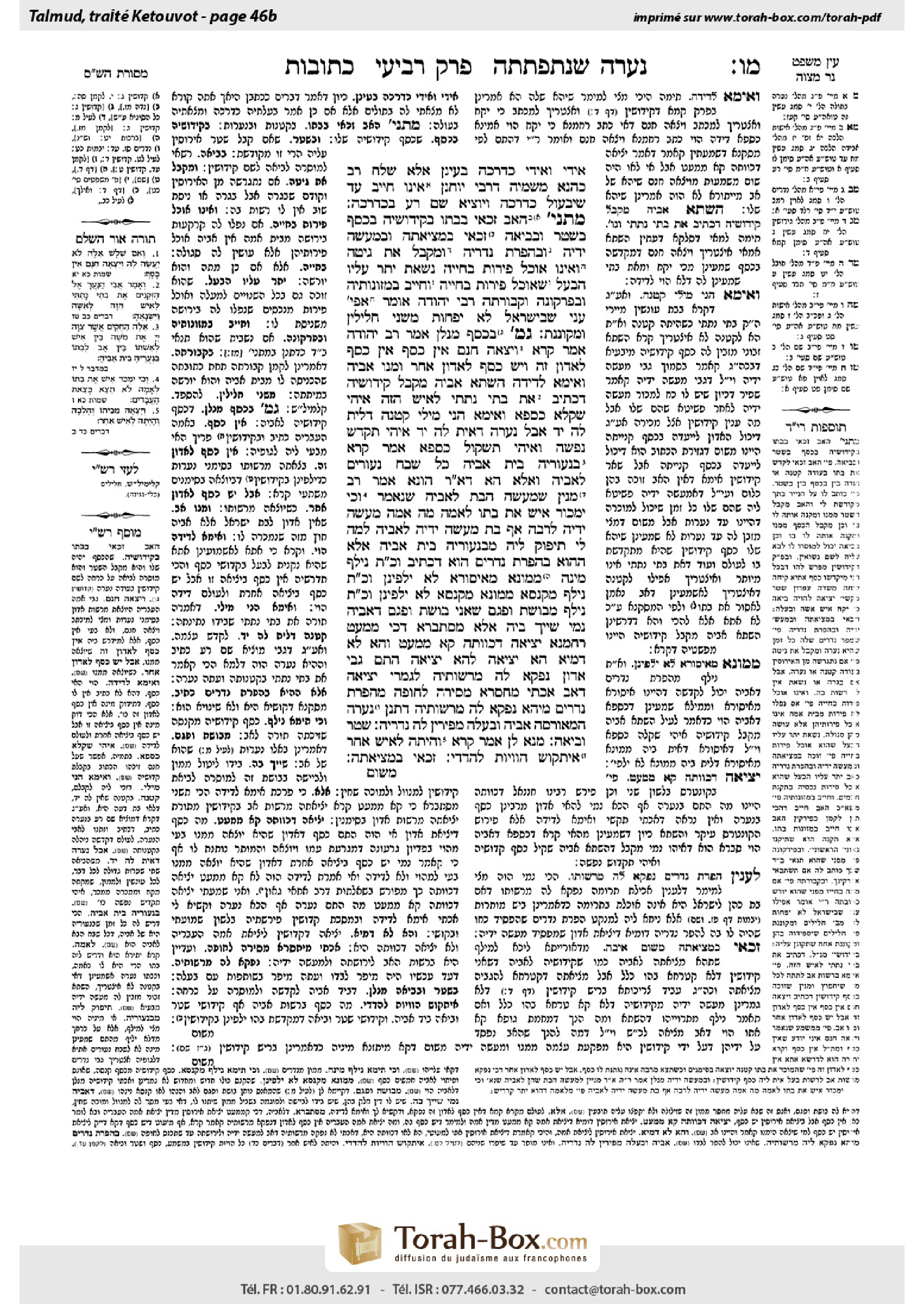
Ketubot 46b: Talmud study for Daf Yomi
Daf Yomi is the daily study of one Talmud folio. Explore 37 tractates with scans, Hebrew text, Sefaria English and AI-generated French translations where annotated.
Passage selection and English or AI-generated French translation are available where the scan has annotations. Daf Study is independent of Torah-Box and Sefaria.
Browse Ketubot · כתובות · All tractatesKetubot 46b text and translations
This page of Ketubot includes the Aramaic text, an English translation and an AI-generated French translation, alongside the scan above.
כתובות מ״ו ב · Aramaic and Hebrew text
אִידֵּי וְאִידֵּי כְּדַרְכָּהּ בָּעֵינַן! אֶלָּא שְׁלַח רַב כָּהֲנָא מִשְּׁמֵיהּ דְּרַבִּי יוֹחָנָן: אֵינוֹ חַיָּיב עַד שֶׁיִּבְעוֹל כְּדַרְכָּהּ, וְיוֹצִיא שֵׁם רַע בִּכְדַרְכָּהּ.
מַתְנִי׳ הָאָב זַכַּאי בְּבִתּוֹ בְּקִידּוּשֶׁיהָ בְּכֶסֶף, בִּשְׁטָר, וּבְבִיאָה. זַכַּאי בִּמְצִיאָתָהּ, וּבְמַעֲשֵׂה יָדֶיהָ, וּבַהֲפָרַת נְדָרֶיהָ, וּמְקַבֵּל אֶת גִּיטָּהּ. וְאֵינוֹ אוֹכֵל פֵּירוֹת בְּחַיֶּיהָ.
נִשֵּׂאת — יָתֵר עָלָיו הַבַּעַל, שֶׁאוֹכֵל פֵּירוֹת בְּחַיֶּיהָ, וְחַיָּיב בִּמְזוֹנוֹתֶיהָ, וּבְפִרְקוֹנָהּ, וּקְבוּרָתָהּ. רַבִּי יְהוּדָה אוֹמֵר: אֲפִילּוּ עָנִי שֶׁבְּיִשְׂרָאֵל לֹא יִפְחוֹת מִשְּׁנֵי חֲלִילִין וּמְקוֹנֶנֶת.
גְּמָ׳ בְּכֶסֶף מְנָלַן? אָמַר רַב יְהוּדָה: אָמַר קְרָא: ״וְיָצְאָה חִנָּם אֵין כָּסֶף״, אֵין כֶּסֶף לְאָדוֹן זֶה, וְיֵשׁ כֶּסֶף לְאָדוֹן אַחֵר, וּמַנּוּ? אָבִיהָ.
וְאֵימָא לְדִידַהּ! הַשְׁתָּא אָבִיהָ מְקַבֵּל קִידּוּשֶׁיהָ, דִּכְתִיב: ״אֶת בִּתִּי נָתַתִּי לָאִישׁ הַזֶּה״, אִיהִי שָׁקְלָא כַּסְפָּא?!
וְאֵימָא הָנֵי מִילֵּי קְטַנָּה, דְּלֵית לַהּ יָד. אֲבָל נַעֲרָה, דְּאִית לַהּ יָד — אִיהִי תְּקַדֵּשׁ נַפְשַׁהּ וְאִיהִי תִּשְׁקוֹל כַּסְפָּא! אָמַר קְרָא: ״בִּנְעוּרֶיהָ בֵּית אָבִיהָ״ — כׇּל שֶׁבַח נְעוּרִים לְאָבִיהָ.
וְאֶלָּא הָא דְּאָמַר רַב הוּנָא אָמַר רַב: מִנַּיִן שֶׁמַּעֲשֵׂה הַבַּת לְאָבִיהָ, שֶׁנֶּאֱמַר: ״וְכִי יִמְכּוֹר אִישׁ אֶת בִּתּוֹ לְאָמָה״, מָה אָמָה מַעֲשֵׂה יָדֶיהָ לְרַבָּהּ — אַף בַּת מַעֲשֵׂה יָדֶיהָ לְאָבִיהָ. לְמָה לִי? תִּיפּוֹק לֵיהּ מִ״בִּנְעוּרֶיהָ בֵּית אָבִיהָ״! אֶלָּא: הָהוּא בַּהֲפָרַת נְדָרִים הוּא דִּכְתִיב.
וְכִי תֵּימָא נֵילַף מִינַּהּ — מָמוֹנָא מֵאִיסּוּרָא לָא יָלְפִינַן. וְכִי תֵּימָא נֵילַף מִקְּנָסָא — מָמוֹנָא מִקְּנָסָא לָא יָלְפִינַן.
וְכִי תֵּימָא נֵילַף מִבּוֹשֶׁת וּפְגָם — שָׁאנֵי בּוֹשֶׁת וּפְגָם דְּאָבִיהָ נָמֵי שָׁיֵיךְ בֵּיהּ.
אֶלָּא, מִסְתַּבְּרָא דְּכִי מְמַעֵט רַחֲמָנָא — יְצִיאָה דִּכְווֹתַהּ קָא מְמַעֵט.
וְהָא לָא דָּמְיָא הָא יְצִיאָה לְהָא יְצִיאָה: הָתָם, גַּבֵּי אָדוֹן, נָפְקָא לַהּ מֵרְשׁוּתֵיהּ לִגְמָרֵי, יְצִיאָה דְּאָב — אַכַּתִּי מְחַסְּרָא מְסִירָה לְחוּפָּה!
מֵהֲפָרַת נְדָרִים מִיהָא נָפְקָא לַהּ מֵרְשׁוּתֵיהּ, דִּתְנַן: נַעֲרָה הַמְאוֹרָסָה אָבִיהָ וּבַעְלָהּ מְפִירִין לָהּ נְדָרֶיהָ.
שְׁטָר וּבִיאָה מְנָא לַן? אָמַר קְרָא: ״וְהָיְתָה לְאִישׁ אַחֵר״, אִיתַּקּוּשׁ הֲווֹיוֹת לַהֲדָדֵי.
זַכַּאי בִּמְצִיאָתָהּ —
Ketubot 46b · English translation
we require both this, i.e., the act of intercourse between the husband and wife, and that, i.e., the woman’s alleged act of intercourse with another man, to be performed in a typical manner in order for the laws of a defamer to apply, as Rabbi Eliezer ben Ya’akov interprets the verses literally, meaning that the husband had intercourse with her and discovered she was not a virgin. Rather, Rav Kahana sent word in the name of Rabbi Yoḥanan that the statement was as follows: He is obligated to pay the fine only if he had intercourse in a typical manner and defamed her with regard to intercourse performed in a typical manner, in accordance with the opinion of Rabbi Eliezer ben Ya’akov.
MISHNA: A father has authority over his daughter with regard to her betrothal through money, through a marriage document, or through intercourse. Likewise, a father is entitled to items she has found, and to her earnings, and to effect the nullification of her vows, i.e., a father may nullify his daughter’s vows. And he accepts her bill of divorce on her behalf if she is divorced from betrothal before she becomes a grown woman. And although he inherits her property when she dies, e.g., property she inherited from her mother’s family, he does not consume the produce of her property during her lifetime.
If the daughter married, the husband has more rights and obligations than her father had before the marriage, as he consumes the produce of her property during her lifetime, and he is obligated to provide her sustenance, her redemption if she is captured, and her burial upon her death. Rabbi Yehuda says: Even the poorest man of the Jewish people may not provide fewer than two flutes and a lamenting woman, which it was customary to hire for a funeral, as these too are included in the duties of burial.
GEMARA: The mishna indicates that a father receives the money of his daughter’s betrothal. The Gemara asks: From where do we derive that the father is entitled to the money of her betrothal? Rav Yehuda said that the verse states, with regard to an emancipated Hebrew maidservant: “Then she shall go out for nothing, without money” (Exodus 21:11), from which it is inferred: There is no money for this master, i.e., her master does not receive money when she leaves him, but there is money for a different master, and who is this? Her father, who also had authority over her, like her master. When she leaves her father’s jurisdiction via betrothal, he is entitled to the betrothal money.
The Gemara asks: But one can say that the betrothal money should go to her, as one can derive from the verse that there is no money for this master but there is money for the woman herself when she leaves her father’s domain. The Gemara refutes this suggestion: Now consider, her father accepts her betrothal, i.e., he can accept the money or document of betrothal from the man of his choice, as it is written: “I gave my daughter to this man” (Deuteronomy 22:16). Can one then say that she takes the money when her father accepts the betrothal on her behalf?
The Gemara raises a difficulty: But one can say that this applies only to a minor, who does not have a hand, i.e., she is not legally competent to carry out transactions on her own behalf. However, in the case of a young woman, who does have a hand, she should betroth herself and she should also take her own betrothal money. The Gemara answers that there is a different exposition in this regard, as the verse states: “Being in her youth, in her father’s house” (Numbers 30:17), which teaches that all gains that a daughter accrues in her youth, i.e., when she is a young woman, belong to her father.
The Gemara asks: But consider that which Rav Huna said that Rav said: From where is it derived that the earnings of a daughter belong to her father? It is as it is stated: “And if a man sell his daughter to be a maidservant” (Exodus 21:7); just as with regard to a maidservant, her earnings belong to her master, so too with regard to a daughter, her earnings belong to her father. Why do I need this exposition? Let him derive it from the phrase “being in her youth, in her father’s house.” Rather, that phrase, “being in her youth, in her father’s house,” is written with regard to the nullification of vows, but it is not referring to monetary matters.
And if you would say: Let us derive from here that just as she is under her father’s authority with regard to vows, the same applies to monetary matters, this is not possible, because there is a principle that we do not derive monetary matters from ritual matters, as these are two separate areas of halakha. And if you would say: Let us derive this halakha from the fine paid by the rapist of a young woman, which the Torah explicitly states goes to her father (Deuteronomy 22:29), there is another principle, that we do not derive monetary matters from fines. Each fine imposed by the Torah is a novel law, from which nothing can be learned with regard to other monetary liabilities.
And if you would say: Let us derive it from the compensation paid by a rapist for his victim’s humiliation and degradation, which is also paid to her father, the compensation for humiliation and degradation is different, as her father also has a share in it, because he too is humiliated and harmed by this unfortunate episode, and therefore one cannot learn the halakhot of other monetary matters from here.
Rather, the Gemara returns to the previous exposition of the verse: “Then she shall go out for nothing, without money” (Exodus 21:11). As for the question of why she does not receive the money herself, the Gemara explains that it is reasonable to assume that when the Merciful One excludes a case by means of this verse, He excludes a case where a girl leaves someone’s authority in the corresponding situation to the case of the Hebrew maidservant.
The Gemara raises a difficulty: But this leaving of her father’s authority is not comparable to that leaving of her master’s authority: There, with regard to a master, when he frees her she leaves his authority entirely, whereas in the case of a girl who goes out from the jurisdiction of her father, she still lacks the process of being brought to the wedding canopy. As long as she is not fully married she remains partially under her father’s authority, as he is her heir and has rights to her earnings.
The Gemara answers: From the perspective of her father’s right to effect the nullification of her vows, at least, she has left his domain via betrothal, as he no longer maintains exclusive rights to nullify her vows. As we learned in a mishna (Nedarim 66b): With regard to a betrothed young woman, her father and her husband nullify her vows together. Since her father cannot nullify her vows on his own, the two types of leaving are indeed comparable.
§ The mishna taught that a father is entitled to accept betrothal of his daughter through a marriage document or through intercourse. The Gemara asks: From where do we derive this? The Gemara answers that the verse states: “And she becomes another man’s wife” (Deuteronomy 24:2). Since the verse does not specify how she becomes his wife, the different ways of becoming a wife are compared to each other, i.e., they are considered equal. Accordingly, the various methods of betrothal are the same with regard to the authority of the father.
The mishna further taught that a father is entitled to items she has found.
Ketubot 46b · Traduction française (IA)
Il faut que les deux actes soient accomplis de manière normale : d’une part, l’acte sexuel entre le mari et sa femme, et d’autre part, l’acte sexuel que l’on prétend que la femme a eu avec un autre homme, pour que les lois relatives au diffamateur s’appliquent. En effet, Rabbi Eliezer ben Ya’akov interprète les versets au sens littéral : le mari a eu des relations avec elle et a découvert qu’elle n’était pas vierge. Rav Kahana a plutôt fait transmettre, au nom de Rabbi Yoḥanan, la formulation suivante : il n’est tenu de payer l’amende que s’il a eu des relations de manière normale et l’a diffamée au sujet de relations accomplies de manière normale, conformément à l’opinion de Rabbi Eliezer ben Ya’akov.
MICHNA : Un père a autorité sur sa fille en ce qui concerne ses fiançailles, qu’elles aient lieu par de l’argent, par un acte de mariage ou par des relations sexuelles. De même, les objets qu’elle trouve et ses gains reviennent à son père, qui peut également annuler ses vœux, c’est-à-dire qu’un père peut annuler les vœux de sa fille. Il reçoit aussi son acte de divorce en son nom si elle est divorcée après ses fiançailles, avant de devenir majeure. Et bien qu’il hérite de ses biens lorsqu’elle meurt, par exemple des biens hérités de la famille de sa mère, il ne perçoit pas les fruits de ses biens de son vivant.
Si la fille se marie, son mari a davantage de droits et d’obligations que son père n’en avait avant le mariage : il perçoit les fruits de ses biens de son vivant, et il est tenu de pourvoir à sa subsistance, de la racheter si elle est capturée et de pourvoir à son enterrement à sa mort. Rabbi Yehuda dit : Même le plus pauvre des membres du peuple juif ne peut fournir moins de deux flûtes et d’une pleureuse, qu’il était d’usage d’engager pour des funérailles, car cela fait également partie des obligations liées à l’enterrement.
GUEMARA : La Michna indique que le père reçoit l’argent des fiançailles de sa fille. La Guemara demande : D’où déduisons-nous que le père a droit à l’argent de ses fiançailles ? Rav Yehuda dit que le verset, au sujet d’une servante hébreue affranchie, déclare : « Alors elle sortira gratuitement, sans argent » (Exode 21:11). On en déduit : il n’y a pas d’argent pour ce maître, c’est-à-dire que son maître ne reçoit pas d’argent lorsqu’elle le quitte, mais il y a de l’argent pour un autre maître. Et qui est-ce ? Son père, qui avait lui aussi autorité sur elle, comme son maître. Lorsqu’elle quitte l’autorité de son père par ses fiançailles, il a droit à l’argent des fiançailles.
La Guemara demande : Mais on pourrait dire que l’argent des fiançailles doit lui revenir, car on peut déduire du verset qu’il n’y a pas d’argent pour ce maître, mais qu’il y a de l’argent pour la femme elle-même lorsqu’elle quitte le domaine de son père. La Guemara réfute cette suggestion : Or, son père accepte ses fiançailles, c’est-à-dire qu’il peut accepter l’argent ou l’acte de fiançailles de l’homme de son choix, comme il est écrit : « J’ai donné ma fille à cet homme » (Deutéronome 22:16). Peut-on alors dire que c’est elle qui reçoit l’argent lorsque son père accepte les fiançailles en son nom ?
La Guemara soulève une difficulté : Mais on pourrait dire que cela ne s’applique qu’à une mineure, qui n’a pas de main, c’est-à-dire qui n’a pas la capacité juridique d’effectuer des transactions en son propre nom. Toutefois, dans le cas d’une jeune fille, qui a une main, elle devrait pouvoir se fiancer elle-même et recevoir également l’argent de ses fiançailles. La Guemara répond qu’une autre déduction s’applique à ce sujet, car le verset déclare : « Dans sa jeunesse, dans la maison de son père » (Nombres 30:17), ce qui enseigne que tous les gains qu’une fille acquiert dans sa jeunesse, c’est-à-dire lorsqu’elle est jeune fille, appartiennent à son père.
La Guemara demande : Mais considérons ce que Rav Huna a dit au nom de Rav : D’où déduit-on que les gains d’une fille appartiennent à son père ? Du verset : « Si un homme vend sa fille comme servante » (Exode 21:7). De même que les gains d’une servante appartiennent à son maître, de même les gains d’une fille appartiennent à son père. Pourquoi faut-il cette déduction ? Qu’on la déduise de l’expression « dans sa jeunesse, dans la maison de son père » ! Cette expression, « dans sa jeunesse, dans la maison de son père », est plutôt écrite au sujet de l’annulation des vœux et ne concerne pas les questions pécuniaires.
Et si tu dis : Déduisons de là que, de même qu’elle est sous l’autorité de son père pour les vœux, il en va de même pour les questions pécuniaires, cela n’est pas possible, car un principe veut qu’on ne déduise pas les questions pécuniaires des questions rituelles, ces deux domaines constituant des domaines distincts de la halakha. Et si tu dis : Déduisons cette halakha de l’amende que le violeur d’une jeune fille doit payer, amende dont la Torah affirme explicitement qu’elle revient à son père (Deutéronome 22:29), un autre principe s’applique : on ne déduit pas les questions pécuniaires des amendes. Chaque amende imposée par la Torah constitue une loi nouvelle, dont on ne peut rien déduire concernant d’autres obligations pécuniaires.
Et si tu dis : Déduisons-le de l’indemnisation due par un violeur pour l’humiliation et l’avilissement de sa victime, indemnisation qui revient également à son père, l’indemnisation pour humiliation et avilissement est différente : son père y a lui aussi une part, car cette triste affaire l’humilie et lui porte également atteinte. On ne peut donc pas en déduire les lois relatives à d’autres questions pécuniaires.
La Guemara revient donc à la déduction précédente du verset : « Alors elle sortira gratuitement, sans argent » (Exode 21:11). Quant à la question de savoir pourquoi elle ne reçoit pas elle-même l’argent, la Guemara explique qu’il est raisonnable de supposer que, lorsque le Miséricordieux exclut un cas au moyen de ce verset, il exclut le cas où une fille quitte l’autorité de quelqu’un dans une situation correspondant à celle de la servante hébreue.
La Guemara soulève une difficulté : Mais le fait qu’elle quitte l’autorité de son père n’est pas comparable au fait qu’elle quitte celle de son maître. Dans le cas du maître, lorsqu’il l’affranchit, elle quitte entièrement son autorité, tandis que, dans le cas d’une fille qui sort de l’autorité de son père, il lui reste encore à passer sous la houppa. Tant qu’elle n’est pas pleinement mariée, elle demeure partiellement sous l’autorité de son père, puisqu’il est son héritier et a des droits sur ses gains.
La Guemara répond : Du point de vue du droit de son père d’annuler ses vœux, du moins, elle a quitté son domaine par ses fiançailles, puisqu’il ne détient plus seul le droit d’annuler ses vœux. En effet, nous avons appris dans une Michna (Nedarim 66b) : Pour une jeune fille fiancée, son père et son mari annulent ensemble ses vœux. Puisque son père ne peut pas annuler ses vœux à lui seul, les deux formes de départ sont bien comparables.
§ La Michna enseigne qu’un père a le droit d’accepter les fiançailles de sa fille au moyen d’un acte de mariage ou de relations sexuelles. La Guemara demande : D’où déduisons-nous cela ? La Guemara répond que le verset déclare : « Elle devient la femme d’un autre homme » (Deutéronome 24:2). Comme le verset ne précise pas de quelle manière elle devient son épouse, les différentes façons de le devenir sont comparées les unes aux autres, c’est-à-dire qu’elles sont considérées comme équivalentes. Par conséquent, les différentes modalités des fiançailles sont équivalentes en ce qui concerne l’autorité du père.
La Michna enseigne également que les objets qu’elle trouve reviennent à son père.
Traduction française générée par IA à partir de l’édition anglaise de Sefaria. Vérifie toujours un passage avec le texte source.
Text from Sefaria: William Davidson Edition - Vocalized Aramaic (CC BY NC); William Davidson Edition - English (CC BY NC).