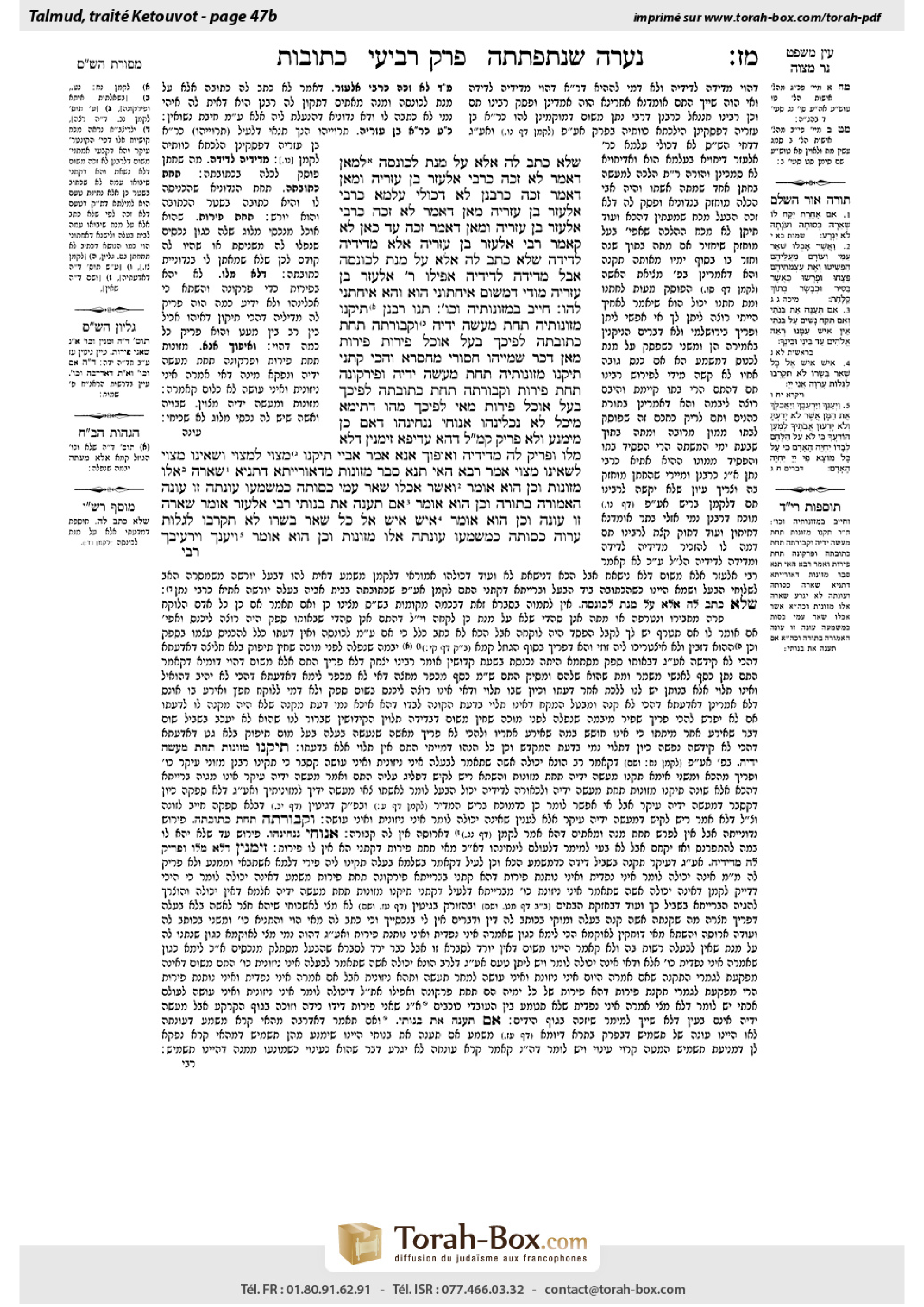
Ketubot 47b: Talmud study for Daf Yomi
Daf Yomi is the daily study of one Talmud folio. Explore 37 tractates with scans, Hebrew text, Sefaria English and AI-generated French translations where annotated.
Passage selection and English or AI-generated French translation are available where the scan has annotations. Daf Study is independent of Torah-Box and Sefaria.
Browse Ketubot · כתובות · All tractatesKetubot 47b text and translations
This page of Ketubot includes the Aramaic text, an English translation and an AI-generated French translation, alongside the scan above.
כתובות מ״ז ב · Aramaic and Hebrew text
שֶׁלֹּא כָּתַב לָהּ אֶלָּא עַל מְנָת לְכוֹנְסָהּ. לְמַאן דְּאָמַר לֹא זָכָה — כְּרַבִּי אֶלְעָזָר בֶּן עֲזַרְיָה. וּמַאן דְּאָמַר זָכָה — כְּרַבָּנַן.
לָא, דְּכוּלֵּי עָלְמָא כְּרַבִּי אֶלְעָזָר בֶּן עֲזַרְיָה. מַאן דְּאָמַר לֹא זָכָה — כְּרַבִּי אֶלְעָזָר בֶּן עֲזַרְיָה, וּמַאן דְּאָמַר זָכָה — עַד כָּאן לָא קָאָמַר רַבִּי אֶלְעָזָר בֶּן עֲזַרְיָה אֶלָּא מִדִּידֵיהּ לְדִידַהּ, שֶׁלֹּא כָּתַב לָהּ אֶלָּא עַל מְנָת לְכוֹנְסָהּ.
אֲבָל מִדִּידַהּ לְדִידֵיהּ אֲפִילּוּ רַבִּי אֶלְעָזָר בֶּן עֲזַרְיָה מוֹדֵי, דְּמִשּׁוּם אִיחַתּוֹנֵי הוּא, וְהָא אִיחַתַּנֻי לְהוּ.
חַיָּיב בִּמְזוֹנוֹתֶיהָ וְכוּ׳. תָּנוּ רַבָּנַן: תִּיקְּנוּ מְזוֹנוֹתֶיהָ תַּחַת מַעֲשֵׂה יָדֶיהָ, וּקְבוּרָתָהּ תַּחַת כְּתוּבָּתָהּ, לְפִיכָךְ בַּעַל אוֹכֵל פֵּירוֹת.
פֵּירוֹת מַאן דְּכַר שְׁמַיְיהוּ?! חַסּוֹרֵי מְחַסְּרָא, וְהָכִי קָתָנֵי: תִּיקְּנוּ מְזוֹנוֹתֶיהָ תַּחַת מַעֲשֵׂה יָדֶיהָ, וּפִירְקוֹנָהּ תַּחַת פֵּירוֹת, וּקְבוּרָתָהּ תַּחַת כְּתוּבָּתָהּ. לְפִיכָךְ בַּעַל אוֹכֵל פֵּירוֹת.
מַאי ״לְפִיכָךְ״?
מַהוּ דְּתֵימָא: מֵיכָל לָא נֵכְלִינְהוּ, אַנּוֹחֵי נַנְּחִינְהוּ. דְּאִם כֵּן, מִימְּנַע וְלָא פָּרֵיק, קָא מַשְׁמַע לַן דְּהָא עֲדִיפָא. זִימְנִין דְּלָא מָלוּ, וּפָרֵיק לַהּ מִדִּידֵיהּ.
וְאֵיפוֹךְ אֲנָא!
אָמַר אַבָּיֵי: תִּיקְּנוּ מָצוּי לְמָצוּי, וְשֶׁאֵינוֹ מָצוּי לְשֶׁאֵינוֹ מָצוּי.
אָמַר רָבָא: הַאי תַּנָּא סָבַר מְזוֹנוֹת מִדְּאוֹרָיְיתָא, דְּתַנְיָא: ״שְׁאֵרָהּ״ — אֵלּוּ מְזוֹנוֹת, וְכֵן הוּא אוֹמֵר: ״וַאֲשֶׁר אָכְלוּ שְׁאֵר עַמִּי״. ״כְּסוּתָהּ״ — כְּמַשְׁמָעוֹ. ״עוֹנָתָהּ״ — זוֹ עוֹנָה הָאֲמוּרָה בַּתּוֹרָה, וְכֵן הוּא אוֹמֵר: ״אִם תְּעַנֶּה אֶת בְּנוֹתַי״.
רַבִּי אֶלְעָזָר אוֹמֵר: ״שְׁאֵרָהּ״ — זוֹ עוֹנָה. וְכֵן הוּא אוֹמֵר: ״אִישׁ אִישׁ אֶל כׇּל שְׁאֵר בְּשָׂרוֹ לֹא תִקְרְבוּ לְגַלּוֹת עֶרְוָה״. ״כְּסוּתָהּ״ — כְּמַשְׁמָעוֹ. ״עוֹנָתָהּ״ — אֵלּוּ מְזוֹנוֹת, וְכֵן הוּא אוֹמֵר: ״וַיְעַנְּךָ וְיַרְעִיבֶךָ״.
Ketubot 47b · English translation
The reason is that he wrote that she would be entitled to the additional amount only on the condition that he would marry her, and since he did not marry her, she is not entitled to the extra amount. The Gemara compares the respective opinions: The one who says that the husband does not have the right to her dowry holds in accordance with the opinion of Rabbi Elazar ben Azarya, and therefore he rules that just as a husband guarantees his wife an extra sum in her marriage contract only if they actually get married, the wife’s father also gives the dowry only on the condition that the couple marries. And the one who said that the husband does have the right to her dowry holds in accordance with the opinion of the Rabbis, because the document is fully in effect even before marriage.
The Gemara refutes this suggestion: No, everyone agrees that the halakha is in accordance with the opinion of Rabbi Elazar ben Azarya, and the explanation is as follows: The one who said that he does not have the right to the dowry clearly holds in accordance with the opinion of Rabbi Elazar ben Azarya, as stated above; and the one who says the husband does have the right to her dowry would distinguish between the two cases: Rabbi Elazar ben Azarya states that the marriage contract is not fully in effect until marriage only with regard to a bestowal from him to her, i.e., the extra sum that the husband adds to her marriage contract, as he wrote it for her only on the condition that he would marry her, and he did not intend to give her anything before she became his wife.
However, with regard to that which is given from her father to him, i.e., the dowry, even Rabbi Elazar ben Azarya concedes that the husband is entitled to this money, as the gift of a father is due to marriage, i.e., he wants the families to be joined in matrimony, and they have already become linked in marriage. The dowry given by the father has nothing to do with the transition from betrothal to actual marriage.
§ The mishna teaches that a husband is obligated to provide his wife with sustenance, redemption from captivity, and burial. The Sages taught in a baraita: The Rabbis instituted that a husband must provide his wife with her sustenance in exchange for his rights to her earnings, and similarly they decreed that a husband must tend to her burial in exchange for the fact that he inherits the dowry that she brought into the marriage and which is written in her marriage contract. Consequently, the husband may consume the produce of her property.
The Gemara expresses surprise at this last statement: Produce, who mentioned anything about that? The baraita did not previously mention produce at all, so how did it arrive at a halakhic conclusion with regard to produce? The Gemara explains that the baraita is incomplete, and this is what it is teaching: They instituted that a husband must provide his wife with her sustenance in exchange for his rights to her earnings; and it is his duty to provide her with redemption from captivity in exchange for his right to consume the produce of her property; and it is his obligation to attend to her burial in exchange for the fact that he inherits the dowry that she brought into the marriage and which is written in her marriage contract. Consequently, a husband may consume the produce of her property.
Although the Gemara has explained how the tanna came to speak about produce, the wording of the baraita remains problematic. What is the significance of the word consequently in this context?
The Gemara explains: Lest you say that the husband should not consume the produce but leave it so that if he requires funds to redeem his wife he will have them available, as, if he is not compelled to do so he will refrain from redeeming her, as he will be unwilling to spend his own money for that purpose; the tanna therefore teaches us that this arrangement is preferable, because sometimes the produce will not amount to the funds necessary to redeem her from captivity, and he would not redeem her if he was expected to use the funds produced by her property. Consequently, the Sages decreed that he consumes the produce immediately and that he must redeem her from his own funds if she is taken into captivity.
After analyzing the language of the baraita, the Gemara turns its attention to the halakha itself. But I can reverse these connections; why does the baraita say that a husband’s obligation to provide his wife with sustenance was instituted in exchange for his right to her earnings, as opposed to another of his rights, e.g., his right to consume the produce of her property?
Abaye said: The Sages instituted a common obligation in exchange for a common right, and they instituted an uncommon obligation in exchange for an uncommon right. In other words, the Sages instituted a husband’s obligation to provide his wife with sustenance, which is relevant on a regular basis, in exchange for his right to her earnings, which also applies regularly. The other obligations and rights of a husband are relevant less frequently.
§ Rava said: This tanna, in the baraita cited below, maintains that the obligation of a husband to provide his wife’s sustenance applies by Torah law, as it is taught with regard to the verse pertaining to a husband’s obligations toward his wife: “If he takes another wife for himself, her food [she’era], her clothing [kesuta], and her conjugal rights [onata], he shall not diminish” (Exodus 21:10). “She’era”; this is sustenance, and it likewise states: “Who also eat the flesh [she’er] of my people” (Micah 3:3). “Kesuta” is understood in its literal sense as referring to clothing. “Onata”; this is her conjugal rights, which is stated in the Torah, and so it says: “If you shall afflict [te’aneh] my daughters” (Genesis 31:50), which indicates that a husband may not deprive his wife of her conjugal rights.
The baraita continues: Rabbi Elazar says: “She’era”; this is her conjugal rights, and so it says: “None of you shall approach to any who is near [she’er] of kin to him, to uncover their nakedness” (Leviticus 18:6), which demonstrates that the word she’er is used in the context of sexual relations. “Kesuta” is understood in its literal sense as referring to clothing. “Onata”; this is sustenance, and so it says: “And He afflicted you [vayanekha], and made you suffer hunger, and fed you with manna” (Deuteronomy 8:3).
Ketubot 47b · Traduction française (IA)
La raison est qu’il a écrit qu’elle ne bénéficierait du supplément qu’à la condition qu’il l’épouse ; puisqu’il ne l’a pas épousée, elle n’a pas droit à ce supplément. La Guemara compare les deux opinions : celui qui dit que le mari n’a pas droit à sa dot suit l’opinion de Rabbi Elazar ben Azarya. Il statue donc que, de même que le mari ne garantit à sa femme une somme supplémentaire dans sa ketouba que s’ils se marient effectivement, le père de la femme ne donne lui aussi la dot qu’à la condition que le couple se marie. Celui qui dit que le mari a droit à sa dot suit l’opinion des Rabbins, car le document prend pleinement effet même avant le mariage.
La Guemara réfute cette proposition : non, tous reconnaissent que la halakha suit l’opinion de Rabbi Elazar ben Azarya, et voici l’explication : celui qui a dit que le mari n’a pas droit à la dot suit clairement l’opinion de Rabbi Elazar ben Azarya, comme indiqué plus haut ; quant à celui qui dit que le mari a droit à sa dot, il distingue les deux cas : Rabbi Elazar ben Azarya affirme que la ketouba ne prend pleinement effet qu’au moment du mariage uniquement pour ce qui est d’un don de lui à elle, c’est-à-dire la somme supplémentaire que le mari ajoute à sa ketouba, car il l’a écrite en sa faveur uniquement à la condition de l’épouser, et il n’avait pas l’intention de lui donner quoi que ce soit avant qu’elle devienne son épouse.
En revanche, s’agissant de ce qui est donné par son père à lui, c’est-à-dire la dot, même Rabbi Elazar ben Azarya reconnaît que le mari a droit à cet argent, car le don du père est lié au mariage : il souhaite que les familles soient unies par le mariage, et elles sont déjà liées par celui-ci. La dot donnée par le père n’a rien à voir avec le passage des fiançailles au mariage proprement dit.
§ La Michna enseigne qu’un mari est tenu de pourvoir aux besoins de sa femme, de la racheter si elle est captive et de pourvoir à son enterrement. Les Sages ont enseigné dans une baraïta : les Rabbins ont institué que le mari doit pourvoir aux besoins de sa femme en contrepartie de ses droits sur les revenus de celle-ci ; de même, ils ont décrété que le mari doit s’occuper de son enterrement en contrepartie du fait qu’il hérite de la dot qu’elle a apportée au mariage et qui est inscrite dans sa ketouba. Par conséquent, le mari peut consommer les fruits de ses biens.
La Guemara s’étonne de cette dernière affirmation : les fruits, qui en a parlé ? La baraïta n’avait encore aucunement mentionné les fruits ; comment en est-elle donc arrivée à une conclusion halakhique à leur sujet ? La Guemara explique que la baraïta est incomplète et qu’elle enseigne ceci : les Sages ont institué que le mari doit pourvoir aux besoins de sa femme en contrepartie de ses droits sur les revenus de celle-ci ; il doit la racheter si elle est captive en contrepartie de son droit de consommer les fruits de ses biens ; et il doit s’occuper de son enterrement en contrepartie du fait qu’il hérite de la dot qu’elle a apportée au mariage et qui est inscrite dans sa ketouba. Par conséquent, le mari peut consommer les fruits de ses biens.
Bien que la Guemara ait expliqué comment le tanna en est venu à parler des fruits, la formulation de la baraïta demeure problématique. Quelle est ici la portée du mot « par conséquent » ?
La Guemara explique : de crainte que tu ne dises que le mari ne devrait pas consommer les fruits, mais les laisser de côté afin de disposer des fonds nécessaires pour racheter sa femme s’il en a besoin, car, s’il n’y est pas contraint, il s’abstiendra de la racheter, ne voulant pas dépenser son propre argent à cette fin, le tanna nous enseigne donc que cette disposition est préférable : il arrive que les fruits ne rapportent pas la somme nécessaire pour la racheter de captivité, et il ne la rachèterait pas s’il était censé utiliser les fonds provenant des biens de celle-ci. Par conséquent, les Sages ont décrété qu’il consomme immédiatement les fruits et qu’il doit la racheter avec ses propres fonds si elle est faite captive.
Après avoir analysé la formulation de la baraïta, la Guemara examine la halakha elle-même. Mais je pourrais inverser ces correspondances : pourquoi la baraïta dit-elle que l’obligation du mari de pourvoir aux besoins de sa femme a été instituée en contrepartie de son droit sur les revenus de celle-ci, plutôt qu’en contrepartie d’un autre de ses droits, par exemple son droit de consommer les fruits des biens de celle-ci ?
Abayé a dit : les Sages ont institué une obligation courante en contrepartie d’un droit courant, et une obligation peu courante en contrepartie d’un droit peu courant. Autrement dit, les Sages ont institué l’obligation du mari de pourvoir aux besoins de sa femme, qui s’applique régulièrement, en contrepartie de son droit sur les revenus de celle-ci, qui s’applique lui aussi régulièrement. Les autres obligations et droits du mari s’appliquent moins fréquemment.
§ Rava a dit : ce tanna, dans la baraïta citée ci-dessous, soutient que l’obligation du mari de pourvoir aux besoins de sa femme relève de la Torah écrite, comme il est enseigné à propos du verset relatif aux obligations du mari envers sa femme : « S’il prend pour lui une autre femme, il ne diminuera ni sa nourriture [she’era], ni son vêtement [kesouta], ni ses droits conjugaux [onata] » (Exode 21:10). « She’era » désigne la nourriture, comme il est également écrit : « eux qui dévorent la chair [she’er] de mon peuple » (Michée 3:3). « Kesuta » s’entend au sens littéral et désigne le vêtement. « Onata » désigne ses droits conjugaux, qui sont énoncés dans la Torah ; ainsi est-il dit : « Si tu maltraites [te’aneh] mes filles » (Genèse 31:50), ce qui indique qu’un mari ne peut priver sa femme de ses droits conjugaux.
La baraïta poursuit : Rabbi Elazar dit : « She’era » désigne ses droits conjugaux ; ainsi est-il dit : « Aucun de vous ne s’approchera d’une proche parente [she’er] pour découvrir sa nudité » (Lévitique 18:6), ce qui montre que le mot she’er est employé dans le contexte des relations sexuelles. « Kesuta » s’entend au sens littéral et désigne le vêtement. « Onata » désigne la nourriture ; ainsi est-il dit : « Il t’a fait souffrir [vayanekha], t’a fait connaître la faim et t’a nourri de la manne » (Deutéronome 8:3).
Traduction française générée par IA à partir de l’édition anglaise de Sefaria. Vérifie toujours un passage avec le texte source.
Text from Sefaria: William Davidson Edition - Vocalized Aramaic (CC BY NC); William Davidson Edition - English (CC BY NC).