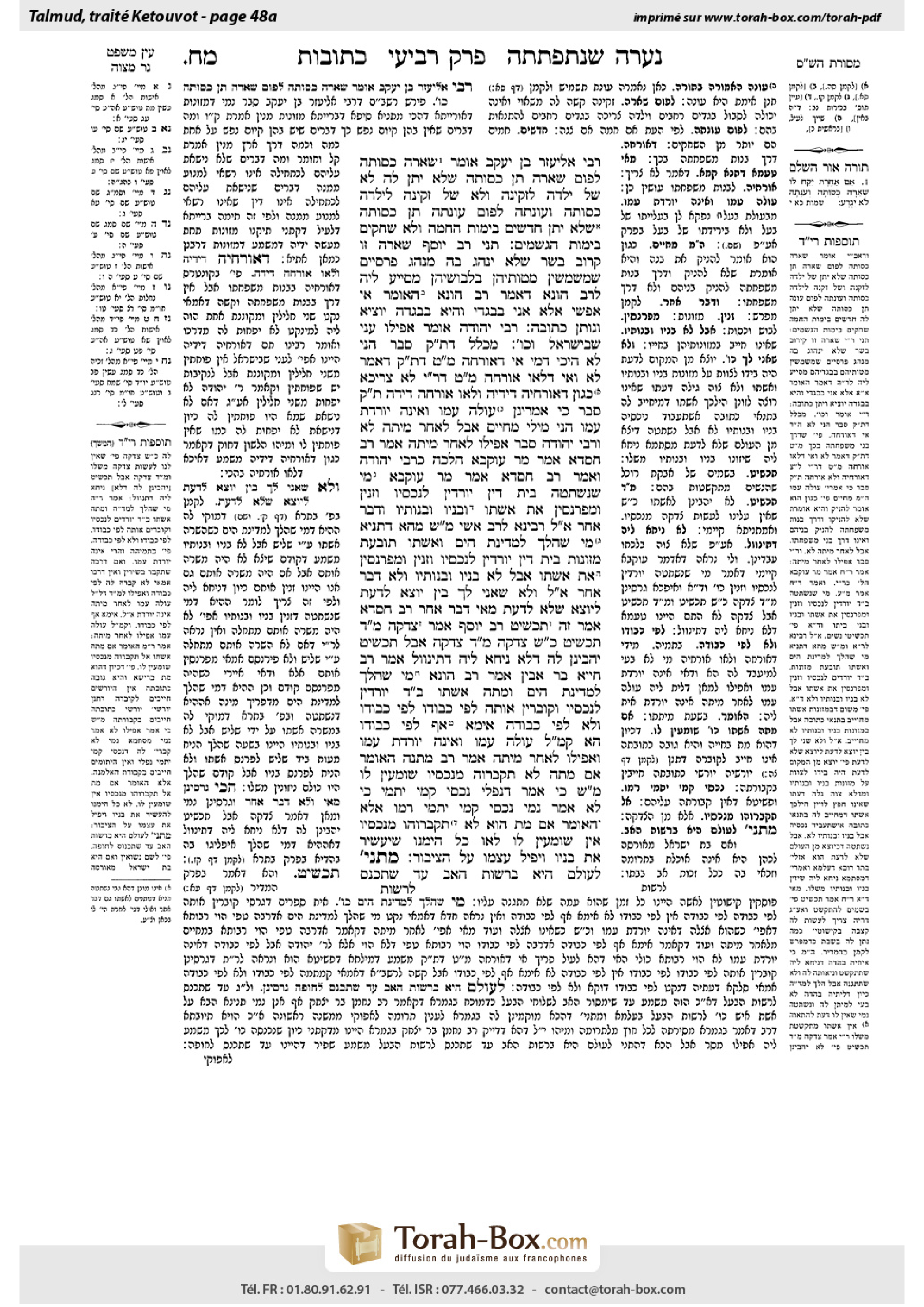
Ketubot 48a: Talmud study for Daf Yomi
Daf Yomi is the daily study of one Talmud folio. Explore 37 tractates with scans, Hebrew text, Sefaria English and AI-generated French translations where annotated.
Passage selection and English or AI-generated French translation are available where the scan has annotations. Daf Study is independent of Torah-Box and Sefaria.
Browse Ketubot · כתובות · All tractatesKetubot 48a text and translations
This page of Ketubot includes the Aramaic text, an English translation and an AI-generated French translation, alongside the scan above.
כתובות מ״ח א · Aramaic and Hebrew text
רַבִּי אֱלִיעֶזֶר בֶּן יַעֲקֹב אוֹמֵר: ״שְׁאֵרָהּ כְּסוּתָהּ״ — לְפוּם שְׁאֵרָהּ תֵּן כְּסוּתָהּ, שֶׁלֹּא יִתֵּן לָהּ לֹא שֶׁל יַלְדָּה לִזְקֵינָהּ, וְלֹא שֶׁל זְקֵינָה לְיַלְדָּה. ״כְּסוּתָהּ וְעוֹנָתָהּ״ — לְפוּם עוֹנָתָהּ תֵּן כְּסוּתָהּ, שֶׁלֹּא יִתֵּן חֲדָשִׁים בִּימוֹת הַחַמָּה, וְלֹא שְׁחָקִים בִּימוֹת הַגְּשָׁמִים.
תָּנֵי רַב יוֹסֵף: ״שְׁאֵרָהּ״ — זוֹ קֵרוּב בָּשָׂר, שֶׁלֹּא יִנְהַג בָּהּ מִנְהַג פָּרְסִיִּים שֶׁמְּשַׁמְּשִׁין מִטּוֹתֵיהֶן בִּלְבוּשֵׁיהֶן. מְסַיַּיע לֵיהּ לְרַב הוּנָא, דְּאָמַר רַב הוּנָא: הָאוֹמֵר ״אִי אֶפְשִׁי אֶלָּא אֲנִי בְּבִגְדִּי וְהִיא בְּבִגְדָּהּ״ — יוֹצִיא וְנוֹתֵן כְּתוּבָּה.
רַבִּי יְהוּדָה אוֹמֵר: אֲפִילּוּ עָנִי שֶׁבְּיִשְׂרָאֵל וְכוּ׳. מִכְּלָל דְּתַנָּא קַמָּא סָבַר הָנֵי לָא. הֵיכִי דָמֵי? אִי דְּאוֹרְחַהּ — מַאי טַעְמָא דְּתַנָּא קַמָּא דְּאָמַר לָא? וְאִי דְּלָאו אוֹרְחַהּ — מַאי טַעְמָא דְּרַבִּי יְהוּדָה?
לָא צְרִיכָא: כְּגוֹן דְּאוֹרְחֵיהּ דִּידֵיהּ וְלָאו אוֹרְחַהּ דִּידַהּ, תַּנָּא קַמָּא סָבַר: כִּי אָמְרִינַן עוֹלָה עִמּוֹ וְאֵינָהּ יוֹרֶדֶת עִמּוֹ — הָנֵי מִילֵּי מֵחַיִּים, אֲבָל לְאַחַר מִיתָה — לֹא.
וְרַבִּי יְהוּדָה סָבַר: אֲפִילּוּ לְאַחַר מִיתָה. אָמַר רַב חִסְדָּא אָמַר מָר עוּקְבָא: הֲלָכָה כְּרַבִּי יְהוּדָה.
וְאָמַר רַב חִסְדָּא אָמַר מָר עוּקְבָא: מִי שֶׁנִּשְׁתַּטָּה — בֵּית דִּין יוֹרְדִין לִנְכָסָיו וְזָנִין וּמְפַרְנְסִין אֶת אִשְׁתּוֹ וּבָנָיו וּבְנוֹתָיו, וְדָבָר אַחֵר. אֲמַר לֵיהּ רָבִינָא לְרַב אָשֵׁי: מַאי שְׁנָא מֵהָא דְּתַנְיָא: מִי שֶׁהָלַךְ לִמְדִינַת הַיָּם וְאִשְׁתּוֹ תּוֹבַעַת מְזוֹנוֹת — בֵּית דִּין יוֹרְדִין לִנְכָסָיו, וְזָנִין וּמְפַרְנְסִין אֶת אִשְׁתּוֹ, אֲבָל לֹא בָּנָיו וּבְנוֹתָיו, וְלֹא דָּבָר אַחֵר?
אֲמַר לֵיהּ: וְלָא שָׁאנֵי לָךְ בֵּין יוֹצֵא לְדַעַת לַיּוֹצֵא שֶׁלֹּא לְדַעַת?
מַאי ״דָּבָר אַחֵר״? רַב חִסְדָּא אָמַר: זֶה תַּכְשִׁיט. רַב יוֹסֵף אָמַר: צְדָקָה. מַאן דְּאָמַר תַּכְשִׁיט, כׇּל שֶׁכֵּן צְדָקָה. מַאן דְּאָמַר צְדָקָה, אֲבָל תַּכְשִׁיט יָהֲבִינַן לַהּ, דְּלָא נִיחָא לֵיהּ דְּתִינַּוַּול.
אָמַר רַב חִיָּיא בַּר אָבִין אָמַר רַב הוּנָא: מִי שֶׁהָלַךְ לִמְדִינַת הַיָּם וּמֵתָה אִשְׁתּוֹ — בֵּית דִּין יוֹרְדִין לִנְכָסָיו, וְקוֹבְרִין אוֹתָהּ לְפִי כְבוֹדוֹ. לְפִי כְבוֹדוֹ וְלֹא לְפִי כְבוֹדָהּ?
אֵימָא: אַף לְפִי כְבוֹדוֹ. הָא קָא מַשְׁמַע לַן: עוֹלָה עִמּוֹ וְאֵינָהּ יוֹרֶדֶת עִמּוֹ, וַאֲפִילּוּ לְאַחַר מִיתָה.
אָמַר רַב מַתְנָה, הָאוֹמֵר: ״אִם מֵתָה, לֹא תִּקְבְּרוּהָ מִנְּכָסָיו״ — שׁוֹמְעִין לוֹ. מַאי שְׁנָא כִּי אָמַר — דְּנָפְלִי נִכְסֵי קַמֵּי יַתְמֵי. כִּי לָא אָמַר נָמֵי, נִכְסֵי קַמֵּי יַתְמֵי רְמוּ?
אֶלָּא: הָאוֹמֵר: ״אִם מֵת הוּא, לֹא תִּקְבְּרוּהוּ מִנְּכָסָיו״ — אֵין שׁוֹמְעִין לוֹ. לָאו כׇּל הֵימֶנּוּ שֶׁיַּעֲשִׁיר אֶת בָּנָיו וְיַפִּיל עַצְמוֹ עַל הַצִּיבּוּר.
מַתְנִי׳ לְעוֹלָם הִיא בִּרְשׁוּת הָאָב עַד שֶׁתִּכָּנֵס
Ketubot 48a · English translation
Rabbi Eliezer ben Ya’akov says that she’era and kesuta should be interpreted as follows: In accordance with her flesh [she’era], i.e., her age, give her clothing [kesuta]. This means that he should not give the garments of a young girl to an elderly woman, nor those of an elderly woman to a young girl. Similarly, kesuta and onata are linked: In accordance with the time of year [onata], give her clothing [kesuta], meaning that he should not give new, heavy clothes in the summer, nor worn-out garments in the rainy season, i.e., the winter, when she requires heavier, warmer clothes. The entire phrase, therefore, refers only to a husband’s obligation to provide clothing for his wife.
Rav Yosef taught the following baraita: “She’era,” this is referring to closeness of flesh during intercourse, which teaches that he should not treat her in the manner of Persians, who have conjugal relations in their clothes. The Gemara comments: This baraita supports the opinion of Rav Huna, as Rav Huna said: With regard to one who says: I do not want to have intercourse with my wife unless I am in my clothes and she is in her clothes, he must divorce his wife and give her the payment for her marriage contract. This is in keeping with the opinion of the tanna of the baraita that the Torah mandates the intimacy of flesh during sexual relations.
§ The mishna teaches that Rabbi Yehuda says: Even the poorest man of the Jewish people may not provide fewer than two flutes and a lamenting woman for his wife’s funeral. The Gemara infers: This proves by inference that the first, anonymous tanna cited in the mishna holds that these are not part of a husband’s obligations. The Gemara asks: What are the circumstances? If this is the common custom in her family at funerals, what is the reason for the opinion of the first tanna who said that he does not have to do so? If he neglected to provide these items he would be treating her with disrespect. And if this is not the common custom in her family, what is the reason for the opinion of Rabbi Yehuda?
The Gemara answers: No, it is necessary to state their dispute in a case where it is the common custom for his family according to its social status, but it is not common for her family according to its social status. The first tanna holds: When we say that a woman who marries a man ascends with him, i.e., she must be treated as equal in status to her husband if his social status is higher than hers, and does not descend with him if he is from a lower social status, this applies only when they are alive, but after death the Sages did not enforce this rule.
And Rabbi Yehuda maintains: Even after death she must be treated in accordance with his status, which means that if those in his family are mourned with flutes and lamenting women, he must provide the same for her funeral. Rav Ḥisda said that Mar Ukva said: The halakha is in accordance with the opinion of Rabbi Yehuda.
Apropos this ruling, the Gemara cites another statement that Rav Ḥisda said that Mar Ukva said: With regard to one who became insane, the court enters his property and feeds and provides a livelihood for his wife, his sons, and his daughters, and it also gives something else, as will be explained. Ravina said to Rav Ashi: In what way is this case different from that which is taught in a baraita: In the case of one who went overseas and his wife claims sustenance, the court descends to his property and feeds and provides a livelihood for his wife, but not for his sons and daughters and does not give something else. If a father is not obligated to sustain his children in his absence, what is different about a situation where he is mad?
Rav Ashi said to Ravina: Is there no difference for you between a man who leaves his responsibilities knowingly and one who leaves them unknowingly? A father who lost his sanity did not do so by his own choice, and therefore it can be assumed that he would want to provide for his children from his possessions, despite the fact that he is not obligated to do so. By contrast, if he went overseas he freely decided to depart, and one would think that he would leave enough for his sons and daughters. If he failed to do so, he has demonstrated that he does not want to provide for them.
The Gemara asks: What is this something else mentioned in the baraita? Rav Ḥisda said: This is a wife’s ornaments, to which she is entitled in addition to her sustenance. Rav Yosef said: It is money for charity. The Gemara comments: According to the one who says that the court does not pay for a woman’s ornaments from her husband’s property if he has gone overseas, all the more so he maintains that the husband’s property is not taken for charity. Conversely, the one who says that the court does not give money for charity holds that this applies only to charity, but it does give her ornaments, as it is assumed that it is not satisfactory for him that his wife be demeaned by a lack of jewelry.
Rav Ḥiyya bar Avin said that Rav Huna said: In the case of one who went overseas and his wife died, the court enters his property and buries her in accordance with his dignity. The Gemara asks: Does the court act in accordance with his dignity and not in accordance with her dignity? What if she came from a more dignified family than her husband?
The Gemara answers: Say that Rav Ḥiyya bar Avin meant: Even in accordance with his dignity, i.e., if his family was more distinguished than hers, he must bury her in accordance with the dignity of his family. The Gemara adds: This comes to teach us that she ascends with him to his social status and does not descend with him, and this principle applies even after her death, in accordance with Rabbi Yehuda’s opinion in the mishna.
Rav Mattana said: In the case of one who says that if his wife dies, they should not bury her using funds from his property, the court listens to him. The Gemara asks: What is different about the case when he says this command that induces the court to comply with his wishes? It is due to the fact that the property has come before the orphans as an inheritance, while the obligation to bury her is not incumbent upon them but is a duty of the inheritors of her marriage contract. However, even if he did not state the above preference, the property is cast before the orphans and it belongs to them. What does it matter whether or not the husband issued a command to this effect?
Rather, the Gemara amends Rav Mattana’s statement: With regard to one who says that if he himself dies, they should not bury him using funds from his property, one does not listen to him, but the court spends his money without resorting to charity. The reason for this is that it is not in his power to enrich his sons by saving them this expense and to cast himself as a burden on the community.
MISHNA: Even after she is betrothed, a daughter is always under her father’s authority until she enters
Ketubot 48a · Traduction française (IA)
Rabbi Eliezer ben Ya’akov dit que she’era et kesuta doivent s’interpréter ainsi : « Selon sa chair » [she’era], c’est-à-dire son âge, donne-lui des vêtements [kesuta]. Cela signifie qu’il ne doit pas donner à une femme âgée les vêtements d’une jeune fille, ni à une jeune fille ceux d’une femme âgée. De même, kesuta et onata sont liés : « Selon la saison » [onata], donne-lui des vêtements [kesuta], ce qui signifie qu’il ne doit pas lui donner des vêtements neufs et lourds en été, ni des vêtements usés pendant la saison des pluies, c’est-à-dire l’hiver, où elle a besoin de vêtements plus chauds et plus épais. Toute cette expression ne concerne donc que l’obligation du mari de fournir des vêtements à son épouse.
Rav Yosef enseigna la baraïta suivante : « She’era » désigne la proximité de la chair durant les rapports sexuels ; cela enseigne qu’il ne doit pas la traiter à la manière des Perses, qui ont des relations conjugales tout habillés. La Guemara commente : Cette baraïta appuie l’opinion de Rav Huna, car Rav Huna a dit : Celui qui dit : « Je ne veux pas avoir de rapports avec mon épouse à moins que je sois habillé et qu’elle soit habillée » doit divorcer de son épouse et lui verser la somme prévue par sa ketouba. Cela correspond à l’opinion du tanna de la baraïta, selon laquelle la Torah impose l’intimité de la chair lors des rapports sexuels.
§ La Michna enseigne que Rabbi Yehuda dit : Même le plus pauvre des Juifs ne peut fournir moins de deux flûtes et d’une pleureuse pour les funérailles de son épouse. La Guemara en déduit que le premier tanna, anonyme, cité dans la Michna estime que cela ne fait pas partie des obligations du mari. La Guemara demande : Dans quelles circonstances ? Si c’est l’usage dans sa famille lors des funérailles, pourquoi le premier tanna estime-t-il qu’il n’a pas à le faire ? S’il néglige de fournir ces éléments, il lui manquerait de respect. Et si ce n’est pas l’usage dans sa famille, pourquoi Rabbi Yehuda estime-t-il qu’il doit le faire ?
La Guemara répond : Non, le désaccord porte sur le cas où c’est l’usage dans sa famille, compte tenu de son rang social, mais pas dans la famille de son épouse, compte tenu de son rang social. Le premier tanna estime que lorsqu’on dit qu’une femme qui épouse un homme s’élève avec lui, c’est-à-dire qu’elle doit être traitée à égalité avec son mari si son rang social est supérieur au sien, et qu’elle ne s’abaisse pas avec lui s’il est d’un rang social inférieur, cela ne s’applique que tant qu’ils sont en vie ; après la mort, les Sages n’ont pas imposé cette règle.
Et Rabbi Yehuda estime que, même après la mort, elle doit être traitée selon le rang de son mari ; autrement dit, si les membres de sa famille sont pleurés avec des flûtes et des pleureuses, il doit prévoir la même chose pour les funérailles de son épouse. Rav Ḥisda a dit au nom de Mar Ukva : La halakha est conforme à l’opinion de Rabbi Yehuda.
À propos de cette décision, la Guemara cite une autre parole de Rav Ḥisda, rapportée au nom de Mar Ukva : Dans le cas d’un homme devenu fou, le tribunal prend possession de ses biens et nourrit et entretient son épouse, ses fils et ses filles ; il leur accorde aussi autre chose, comme cela sera expliqué. Ravina dit à Rav Ashi : En quoi ce cas diffère-t-il de celui enseigné dans une baraïta : lorsqu’un homme est parti outre-mer et que son épouse réclame sa subsistance, le tribunal prend possession de ses biens et nourrit et entretient son épouse, mais pas ses fils et ses filles, et ne lui accorde rien d’autre ? Si un père n’a pas l’obligation de subvenir aux besoins de ses enfants en son absence, en quoi la situation est-elle différente lorsqu’il est fou ?
Rav Ashi dit à Ravina : Ne fais-tu donc aucune différence entre un homme qui abandonne ses responsabilités en connaissance de cause et un homme qui les abandonne sans en avoir conscience ? Un père qui a perdu la raison ne l’a pas fait de son propre gré ; on peut donc supposer qu’il voudrait subvenir aux besoins de ses enfants au moyen de ses biens, bien qu’il n’y soit pas obligé. En revanche, s’il est parti outre-mer, il a décidé librement de partir, et l’on pourrait penser qu’il aurait laissé suffisamment de biens à ses fils et à ses filles. S’il ne l’a pas fait, il a montré qu’il ne voulait pas subvenir à leurs besoins.
La Guemara demande : Quelle est cette autre chose mentionnée dans la baraïta ? Rav Ḥisda dit : Il s’agit des parures de l’épouse, auxquelles elle a droit en plus de sa subsistance. Rav Yosef dit : Il s’agit d’argent destiné à la tsedaka. La Guemara commente : Selon celui qui dit que le tribunal ne paie pas les parures d’une femme sur les biens de son mari lorsque celui-ci est parti outre-mer, à plus forte raison estime-t-il que les biens du mari ne sont pas utilisés pour la tsedaka. À l’inverse, celui qui dit que le tribunal ne donne pas d’argent pour la tsedaka estime que cela ne s’applique qu’à la tsedaka, mais qu’il lui fournit bien des parures, car on suppose qu’il ne serait pas satisfait que son épouse soit humiliée faute de bijoux.
Rav Ḥiyya bar Avin a dit au nom de Rav Huna : Dans le cas d’un homme parti outre-mer dont l’épouse est morte, le tribunal prend possession de ses biens et l’enterre selon le rang de son mari. La Guemara demande : Le tribunal agit-il selon le rang de son mari et non selon le sien ? Et si elle venait d’une famille plus distinguée que celle de son mari ?
La Guemara répond : Comprends que Rav Ḥiyya bar Avin voulait dire : même selon le rang de son mari, c’est-à-dire que si sa famille était plus distinguée que la sienne, il doit l’enterrer selon le rang de sa famille. La Guemara ajoute : Cela vient nous enseigner qu’elle s’élève avec lui au rang social de son mari et ne s’abaisse pas avec lui, et que ce principe s’applique même après sa mort, conformément à l’opinion de Rabbi Yehuda dans la Michna.
Rav Mattana dit : Si un homme déclare qu’à sa mort on ne doit pas enterrer son épouse avec les fonds de ses biens, le tribunal l’écoute. La Guemara demande : Qu’est-ce qui distingue le cas où il donne cet ordre, de sorte que le tribunal se conforme à sa volonté ? C’est parce que les biens sont échus aux orphelins par héritage, tandis que l’obligation de l’enterrer ne leur incombe pas : elle incombe aux héritiers de sa ketouba. Mais même s’il n’avait pas exprimé cette préférence, les biens sont dévolus aux orphelins et leur appartiennent. Quelle importance y a-t-il donc à ce que le mari ait ou non donné un ordre en ce sens ?
La Guemara rectifie plutôt la déclaration de Rav Mattana : si un homme déclare qu’à sa propre mort on ne doit pas l’enterrer avec les fonds de ses biens, on ne l’écoute pas ; le tribunal dépense son argent sans recourir à la tsedaka. La raison en est qu’il n’a pas le pouvoir d’enrichir ses fils en leur épargnant cette dépense et de faire de lui-même une charge pour la communauté.
MICHNA : Même après ses fiançailles, une fille reste toujours sous l’autorité de son père jusqu’à ce qu’elle entre
Traduction française générée par IA à partir de l’édition anglaise de Sefaria. Vérifie toujours un passage avec le texte source.
Text from Sefaria: William Davidson Edition - Vocalized Aramaic (CC BY NC); William Davidson Edition - English (CC BY NC).