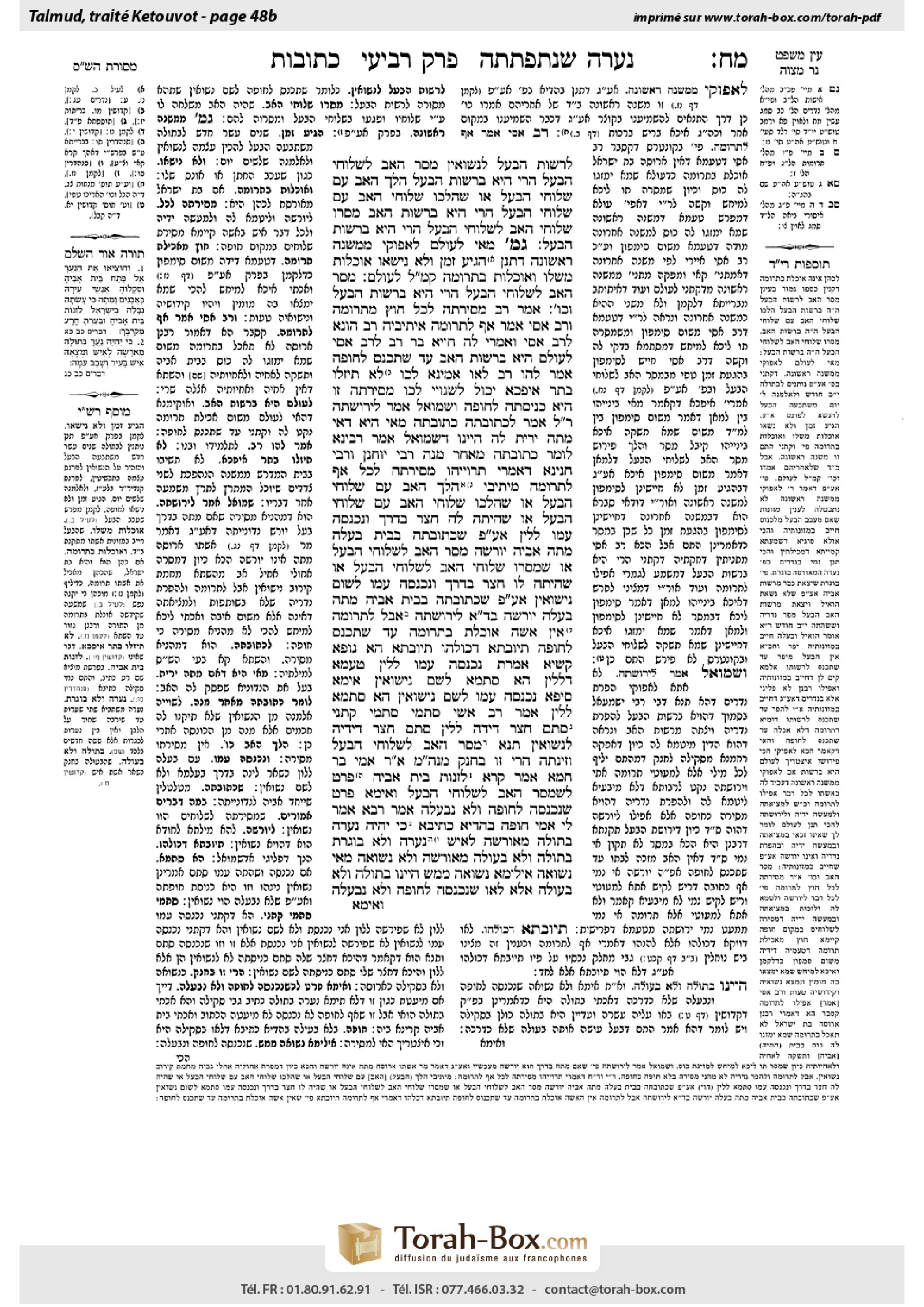
Ketubot 48b: Talmud study for Daf Yomi
Daf Yomi is the daily study of one Talmud folio. Explore 37 tractates with scans, Hebrew text, Sefaria English and AI-generated French translations where annotated.
Passage selection and English or AI-generated French translation are available where the scan has annotations. Daf Study is independent of Torah-Box and Sefaria.
Browse Ketubot · כתובות · All tractatesKetubot 48b text and translations
This page of Ketubot includes the Aramaic text, an English translation and an AI-generated French translation, alongside the scan above.
כתובות מ״ח ב · Aramaic and Hebrew text
לִרְשׁוּת הַבַּעַל לְנִשּׂוּאִין. מָסַר הָאָב לִשְׁלוּחֵי הַבַּעַל — הֲרֵי הִיא בִּרְשׁוּת הַבַּעַל. הָלַךְ הָאָב עִם שְׁלוּחֵי הַבַּעַל, אוֹ שֶׁהָלְכוּ שְׁלוּחֵי הָאָב עִם שְׁלוּחֵי הַבַּעַל — הֲרֵי הִיא בִּרְשׁוּת הָאָב. מָסְרוּ שְׁלוּחֵי הָאָב לִשְׁלוּחֵי הַבַּעַל — הֲרֵי הִיא בִּרְשׁוּת הַבַּעַל.
גְּמָ׳ מַאי לְעוֹלָם? לְאַפּוֹקֵי מִמִּשְׁנָה רִאשׁוֹנָה. דִּתְנַן: הִגִּיעַ זְמַן וְלֹא נִישְּׂאוּ — אוֹכְלוֹת מִשֶּׁלּוֹ וְאוֹכְלוֹת בִּתְרוּמָה. קָא מַשְׁמַע לַן, לְעוֹלָם.
מָסַר הָאָב לִשְׁלוּחֵי הַבַּעַל, הֲרֵי הִיא בִּרְשׁוּת הַבַּעַל וְכוּ׳. אָמַר רַב: מְסִירָתָהּ לַכֹּל, חוּץ מִתְּרוּמָה. וְרַב אַסִּי אָמַר: אַף לִתְרוּמָה.
אֵיתִיבֵיהּ רַב הוּנָא לְרַב אַסִּי, וְאָמְרִי לַהּ חִיָּיא בַּר רַב לְרַב אַסִּי: לְעוֹלָם הִיא בִּרְשׁוּת הָאָב עַד שֶׁתִּכָּנֵס לַחוּפָּה! אֲמַר לְהוּ רַב: לָאו אָמֵינָא לְכוּ לָא תֵּיזְלוּ בָּתַר אִיפְּכָא?! יָכֵול לְשַׁנּוֹיֵי לְכוּ: מְסִירָתָהּ, זוֹ הִיא כְּנִיסָתָהּ לְחוּפָּה.
וּשְׁמוּאֵל אָמַר: לִירוּשָּׁתָהּ.
רֵישׁ לָקִישׁ אָמַר: לִכְתוּבָּתָהּ. כְּתוּבָּתָהּ מַאי הִיא? דְּאִי מֵתָה יָרֵית לַהּ, הַיְינוּ דִּשְׁמוּאֵל! אָמַר רָבִינָא: לוֹמַר כְּתוּבָּתָהּ מֵאַחֵר מָנֶה.
רַבִּי יוֹחָנָן וְרַבִּי חֲנִינָא דְּאָמְרִי תַּרְוַיְיהוּ: מְסִירָתָהּ לַכֹּל, אַף לִתְרוּמָה.
מֵיתִיבִי: הָלַךְ הָאָב עִם שְׁלוּחֵי הַבַּעַל, אוֹ שֶׁהָלְכוּ שְׁלוּחֵי הָאָב עִם שְׁלוּחֵי הַבַּעַל, אוֹ שֶׁהָיְתָה לָהּ חָצֵר בַּדֶּרֶךְ וְנִכְנְסָה עִמּוֹ לָלִין, אַף עַל פִּי שֶׁכְּתוּבָּתָהּ בְּבֵית בַּעְלָהּ, מֵתָה — אָבִיהָ יוֹרְשָׁהּ.
מָסַר הָאָב לִשְׁלוּחֵי הַבַּעַל, אוֹ שֶׁמָּסְרוּ שְׁלוּחֵי הָאָב לִשְׁלוּחֵי הַבַּעַל, אוֹ שֶׁהָיְתָה לוֹ חָצֵר בַּדֶּרֶךְ וְנִכְנְסָה עִמּוֹ לְשׁוּם נִישּׂוּאִין, אַף עַל פִּי שֶׁכְּתוּבָּתָהּ בְּבֵית אָבִיהָ, מֵתָה — בַּעְלָהּ יוֹרְשָׁהּ.
בַּמֶּה דְּבָרִים אֲמוּרִים — לִירוּשָּׁתָהּ, אֲבָל לִתְרוּמָה, אֵין אִשָּׁה אוֹכֶלֶת בִּתְרוּמָה עַד שֶׁתִּכָּנֵס לַחוּפָּה. תְּיוּבְתָּא דְכוּלְּהוּ! תְּיוּבְתָּא.
הָא גוּפָא קַשְׁיָא: אָמְרַתְּ נִכְנְסָה עִמּוֹ לָלִין. טַעְמָא דְּלָלִין, הָא סְתָמָא — לְשֵׁם נִישּׂוּאִין. אֵימָא סֵיפָא: נִכְנְסָה עִמּוֹ לְשֵׁם נִישּׂוּאִין, הָא סְתָמָא, לָלִין.
אָמַר רַב אָשֵׁי: סְתָמֵי סְתָמֵי קָתָנֵי. סְתַם חָצֵר דִּידַהּ — לָלִין. סְתַם חָצֵר דִּידֵיהּ — לְנִשּׂוּאִין.
תַּנָּא: מָסַר הָאָב לִשְׁלוּחֵי הַבַּעַל וְזִינְּתָה — הֲרֵי זוֹ בְּחֶנֶק. מְנָא הָנֵי מִילֵּי? אָמַר רַבִּי אַמֵּי בַּר חָמָא, אָמַר קְרָא: ״לִזְנוֹת בֵּית אָבִיהָ״, פְּרָט לְשֶׁמָּסַר הָאָב לִשְׁלוּחֵי הַבַּעַל.
וְאֵימָא: פְּרָט שֶׁנִּכְנְסָה לַחוּפָּה וְלֹא נִבְעֲלָה!
אָמַר רָבָא: אֲמַר לִי אַמֵּי, חוּפָּה בְּהֶדְיָא כְּתִיבָא: ״כִּי יִהְיֶה נַעֲרָה בְתוּלָה מְאוֹרָשָׂה לְאִישׁ״. ״נַעֲרָה״ — וְלֹא בּוֹגֶרֶת, ״בְּתוּלָה״ — וְלֹא בְּעוּלָה, ״מְאוֹרָשָׂה״ — וְלֹא נְשׂוּאָה.
מַאי ״נְשׂוּאָה״? אִילֵימָא נְשׂוּאָה מַמָּשׁ, הַיְינוּ ״בְּתוּלָה״ וְלֹא בְּעוּלָה! אֶלָּא לָאו, שֶׁנִּכְנְסָה לְחוּפָּה וְלֹא נִבְעֲלָה.
Ketubot 48b · English translation
her husband’s authority in marriage via the wedding canopy. If the father delivered his daughter to the husband’s messengers to bring her to her husband and the wedding canopy, once she has been handed over she is under the husband’s authority. However, if the father went with the husband’s messengers, or if the father’s messengers went with the husband’s messengers, she is still under the father’s authority, as he has not fully delivered her to the husband’s messengers. If her father sent her with his own messengers and the father’s messengers delivered the woman to the husband’s messengers, from that moment onwards she is under her husband’s authority.
GEMARA: The mishna taught that a daughter always remains under her father’s authority until she has fully entered her husband’s jurisdiction. The Gemara asks: What is the significance of the term: Always, in the mishna? The Gemara explains: This comes to exclude the opinion stated in the initial version of the mishna. As we learned in a mishna (57a): If the time that the groom designated for the wedding arrived, and the wedding was postponed, and they were not married, the brides are entitled to eat from his food and, if he is a priest, eat teruma, like married women. The mishna here teaches us that the halakha is not in accordance with this earlier ruling cited in that mishna. Rather, they are always under their father’s authority until they actually enter the wedding canopy.
§ The mishna taught that if the father delivered his daughter to the husband’s messengers, she is under the husband’s authority, unless the father or his messengers accompanied them. Rav said: When her father delivers her she leaves his jurisdiction in all respects, apart from the issue of partaking of teruma. Even if her husband is a priest, if she is not from a family of priests, she may not partake of teruma until she is fully married. And Rav Asi said that once she has been delivered to the husband’s messengers she is under her husband’s authority even with regard to teruma.
Rav Huna raised an objection to the opinion of Rav Asi, and some say that it was Ḥiyya, son of Rav, who raised an objection to the opinion of Rav Asi: The mishna states that she is always under her father’s authority until she enters the wedding canopy. According to Rav Asi, however, as soon as her father delivers her to the husband’s messengers she is no longer under her father’s authority. Rav said to them: Didn’t I tell you not to follow, i.e., attempt to refute rulings, on the basis of sources that can be explained in opposing manners? Rav Asi can answer you that the mishna means that her delivery to the husband’s messengers is equivalent to her entrance to the wedding canopy, and the same halakhot apply in both cases.
And Shmuel said that once a woman’s father has delivered her to the messengers of her husband, she is under her husband’s authority only with regard to her inheritance, i.e., her husband inherits her property upon her death as though she had already entered the wedding canopy.
Reish Lakish said: Her delivery is also effective with regard to her marriage contract. The Gemara asks: What is Reish Lakish referring to when he says that she is under her husband’s authority with regard to her marriage contract? If you say it means that if she dies he inherits all her property, including the dowry specified in her marriage contract, that is the same as the statement of Shmuel, and Reish Lakish has added nothing to his ruling. Ravina said: Reish Lakish is coming to say that if the man dies before marrying her, and she then marries someone else, her marriage contract from the other man is one hundred dinars, as she is considered a widow from marriage rather than a widow from betrothal.
Rabbi Yoḥanan and Rabbi Ḥanina both say that a woman’s delivery to the messengers of her husband causes her to be under his authority for all matters, even including partaking of teruma.
The Gemara raises an objection from the Tosefta (Ketubot 4:4): If the father went with the husband’s messengers, or if the father’s messengers went with the husband’s messengers, or if she owned a courtyard along the way and she entered with her groom to lodge, not for the purpose of marriage but merely to stay overnight until they arrive at his residence, then even if the dowry specified in her marriage contract is already in her husband’s house, if she dies, her father inherits from her, as she is not considered to have entered her husband’s domain.
Conversely, if the father delivered her to the husband’s messengers, or if the father’s messengers delivered her to the husband’s messengers, or if the groom owned a courtyard along the way and she entered with him for the purpose of marriage, then even if the dowry specified in her marriage contract is still in her father’s house and has not yet been given to her husband, if she dies, her husband inherits from her.
The Tosefta concludes: In what case is this statement said? It is stated with regard to the husband’s right to inherit from her. However, with regard to teruma, the halakha is that a woman who marries a priest may not partake of teruma until she actually enters the wedding canopy. This baraita is apparently a refutation of all of them, i.e., all of the opinions cited previously that hold that once the woman is delivered to the husband’s messengers, if the husband is a priest, the woman may partake of teruma. The Gemara concludes: Indeed, this is a conclusive refutation.
The Gemara asks: This matter itself is difficult. You said in the Tosefta that if she entered with him to her courtyard to lodge for one night, and she dies, her father inherits her property. The reason is because it specified that they entered only to lodge there, from which it may be inferred that if they entered without specification it is as though she entered for the sake of marriage. Say the latter clause of the Tosefta: If she entered with him to his courtyard for the purpose of marriage, and she dies, her husband inherits her property. This indicates that if she entered without specification, i.e., without saying that they were doing so for marriage, it is considered as though they entered merely to lodge. The inferences from these two clauses of the Tosefta apparently contradict one another.
Rav Ashi said: This is an incorrect interpretation, as the tanna taught the halakha of entering one type of courtyard without specification and the halakha of entering a different type of courtyard without specification, as follows: If they entered her courtyard without specification it is assumed that they entered merely to lodge, whereas if they entered his courtyard without specification, it is assumed that they did so for the sake of marriage, unless they expressly stated that they had another purpose in mind.
§ A Sage taught in a baraita: If the father delivered his daughter to the husband’s messengers and she subsequently committed adultery, she is sentenced to strangulation, in accordance with the halakha of a married woman who committed adultery, rather than stoning, which is the punishment for a betrothed woman who commits adultery. The Gemara asks: From where are these matters derived? Rabbi Ami bar Ḥama said that the verse states, in the context of the command to stone a young woman who commits adultery during betrothal: “To play the whore in her father’s house” (Deuteronomy 22:21), which excludes a case when the father has delivered her to the husband’s messengers, when she is no longer in her father’s house.
The Gemara raises a difficulty: But one can say that the verse is excluding a case where she has entered the wedding canopy but she has not yet had intercourse, whereas if her father has merely delivered her to the husband’s messengers she is still considered to have sinned in his house and is punishable by stoning like any other betrothed woman.
In answer to this question, Rava said: The verse cannot be excluding that case, as Ami said to me that the case where she already entered the wedding canopy is not derived by inference from that verse; it is explicitly written in the following verse: “If there is a young woman who is a virgin betrothed to a man” (Deuteronomy 22:23). The terminology of the verse indicates that it applies to a “young woman” and not to a grown woman; to a “virgin” and not to a non-virgin; and to a “betrothed” woman and not to a married woman.
The Gemara analyzes this statement: What is the meaning of the term: A married woman, in this context? If we say that she is actually married and has already engaged in intercourse with her husband, this ruling is the same as the previous one, that she must be a virgin and not a non-virgin. Rather, is it not the case that it is referring to a woman who has entered the wedding canopy but has not had intercourse, and yet if she committed adultery at this stage she is sentenced to strangulation, like one who had engaged in relations with her husband? Consequently, the other verse, cited by Rabbi Ami bar Ḥama, cannot be referring to this case.
Ketubot 48b · Traduction française (IA)
l’autorité de son mari dans le mariage, par l’entrée sous le dais nuptial. Si le père a remis sa fille aux émissaires du mari pour qu’ils la conduisent auprès de lui et sous le dais nuptial, dès qu’elle leur a été remise, elle relève de l’autorité de son mari. En revanche, si le père accompagne les émissaires du mari, ou si les émissaires du père accompagnent ceux du mari, elle relève toujours de l’autorité de son père, puisqu’il ne l’a pas entièrement remise aux émissaires du mari. Si son père l’a envoyée avec ses propres émissaires et que ceux-ci l’ont remise aux émissaires du mari, à partir de ce moment, elle relève de l’autorité de son mari.
GUEMARA : La Michna enseigne qu’une fille reste toujours sous l’autorité de son père jusqu’à ce qu’elle entre pleinement dans le domaine de son mari. La Guemara demande : Quelle est la portée du terme « toujours » dans la Michna ? La Guemara explique : Il vient exclure l’opinion formulée dans la première version de la Michna. En effet, nous avons appris dans une Michna (57a) : Si le moment fixé par le fiancé pour le mariage est arrivé, mais que celui-ci a été reporté et que les fiancés ne se sont pas mariés, les fiancées ont le droit de se nourrir à ses frais et, s’il est prêtre, de consommer de la terouma, comme des femmes mariées. La Michna nous enseigne ici que la halakha ne suit pas cette décision antérieure citée dans cette Michna. Au contraire, elles restent toujours sous l’autorité de leur père jusqu’à leur entrée effective sous le dais nuptial.
§ La Michna enseigne que si le père a remis sa fille aux émissaires du mari, elle relève de l’autorité de son mari, à moins que le père ou ses émissaires ne les aient accompagnés. Rav dit : Lorsque son père la remet, elle quitte le domaine de celui-ci à tous égards, sauf en ce qui concerne la consommation de terouma. Même si son mari est prêtre, si elle n’est pas issue d’une famille de prêtres, elle ne peut pas consommer de terouma tant qu’elle n’est pas pleinement mariée. Rav Asi dit, quant à lui, qu’une fois remise aux émissaires du mari, elle relève de l’autorité de celui-ci, même en ce qui concerne la terouma.
Rav Houna souleva une objection contre l’opinion de Rav Asi ; selon certains, ce fut Ḥiyya, fils de Rav, qui la souleva : La Michna affirme qu’elle reste toujours sous l’autorité de son père jusqu’à ce qu’elle entre sous le dais nuptial. Selon Rav Asi, cependant, dès que son père la remet aux émissaires du mari, elle ne relève plus de l’autorité de son père. Rav leur dit : Ne vous ai-je pas dit de ne pas tenter de réfuter des décisions à partir de sources qui peuvent s’interpréter de façons opposées ? Rav Asi peut vous répondre que la Michna signifie que sa remise aux émissaires du mari équivaut à son entrée sous le dais nuptial, et que les mêmes halakhot s’appliquent dans les deux cas.
Et Shmuel dit qu’une fois que le père d’une femme l’a remise aux émissaires de son mari, elle ne relève de l’autorité de celui-ci qu’en ce qui concerne l’héritage : son mari hérite de ses biens à sa mort, comme si elle était déjà entrée sous le dais nuptial.
Reish Lakish dit : Sa remise a également un effet en ce qui concerne son contrat de mariage. La Guemara demande : À quoi Reish Lakish fait-il référence lorsqu’il dit qu’elle relève de l’autorité de son mari en ce qui concerne son contrat de mariage ? Si l’on entend par là que, si elle meurt, son mari hérite de tous ses biens, y compris de la dot stipulée dans son contrat de mariage, cela revient à dire la même chose que Shmuel, et Reish Lakish n’a rien ajouté à son propos. Ravina dit : Reish Lakish veut enseigner que si l’homme meurt avant de l’épouser et qu’elle épouse ensuite quelqu’un d’autre, son contrat de mariage avec cet autre homme s’élève à cent dinars, car elle est considérée comme une veuve ayant été mariée, et non comme une veuve issue de fiançailles.
Rabbi Yoḥanan et Rabbi Ḥanina disent tous deux que la remise d’une femme aux émissaires de son mari la fait relever de l’autorité de celui-ci à tous égards, y compris pour la consommation de terouma.
La Guemara soulève une objection à partir de la Tossefta (Ketoubot 4:4) : Si le père a accompagné les émissaires du mari, ou si les émissaires du père ont accompagné ceux du mari, ou si elle possédait une cour sur le chemin et qu’elle y est entrée avec son fiancé pour y passer la nuit — non pas en vue du mariage, mais simplement pour y séjourner jusqu’à leur arrivée chez lui —, alors, même si la dot stipulée dans son contrat de mariage se trouve déjà dans la maison de son mari, si elle meurt, son père hérite d’elle, car elle n’est pas considérée comme étant entrée dans le domaine de son mari.
À l’inverse, si le père l’a remise aux émissaires du mari, ou si les émissaires du père l’ont remise aux émissaires du mari, ou si le fiancé possédait une cour sur le chemin et qu’elle y est entrée avec lui en vue du mariage, alors, même si la dot stipulée dans son contrat de mariage se trouve encore dans la maison de son père et n’a pas encore été remise à son mari, si elle meurt, son mari hérite d’elle.
La Tossefta conclut : Dans quel cas cette affirmation est-elle formulée ? Elle concerne le droit du mari d’hériter d’elle. Toutefois, en ce qui concerne la terouma, la halakha est qu’une femme qui épouse un prêtre ne peut pas en consommer tant qu’elle n’est pas effectivement entrée sous le dais nuptial. Cette baraïta réfute apparemment toutes les opinions précédentes, selon lesquelles, dès que la femme est remise aux émissaires du mari, elle peut consommer de la terouma si son mari est prêtre. La Guemara conclut : En effet, c’est une réfutation définitive.
La Guemara demande : Cette question elle-même est difficile. Vous avez dit dans la Tossefta que si elle est entrée avec lui dans sa cour pour y passer la nuit, et qu’elle meurt, son père hérite de ses biens. Cela s’explique par le fait que le texte précise qu’ils y sont entrés uniquement pour y passer la nuit ; on peut donc en déduire que, s’ils y étaient entrés sans préciser leur intention, ce serait comme si elle y était entrée en vue du mariage. Considérez la dernière partie de la Tossefta : Si elle est entrée avec lui dans sa cour en vue du mariage, et qu’elle meurt, son mari hérite de ses biens. Cela indique que, s’ils y étaient entrés sans préciser leur intention, c’est-à-dire sans dire qu’ils le faisaient en vue du mariage, on considère qu’ils y sont entrés simplement pour y passer la nuit. Les déductions tirées de ces deux passages de la Tossefta semblent donc se contredire.
Rav Ashi dit : Cette interprétation est erronée, car le tanna a enseigné la halakha relative à l’entrée sans précision dans un type de cour, puis celle relative à l’entrée sans précision dans un autre type de cour, comme suit : S’ils sont entrés sans préciser leur intention dans sa cour à elle, on suppose qu’ils y sont entrés simplement pour y passer la nuit ; tandis que s’ils sont entrés sans préciser leur intention dans sa cour à lui, on suppose qu’ils l’ont fait en vue du mariage, sauf s’ils ont expressément déclaré avoir un autre objectif.
§ Un Sage a enseigné dans une baraïta : Si le père a remis sa fille aux émissaires du mari et qu’elle commet ensuite un adultère, elle est condamnée à la strangulation, conformément à la halakha applicable à une femme mariée qui commet un adultère, et non à la lapidation, qui est le châtiment d’une femme fiancée qui commet un adultère. La Guemara demande : D’où tire-t-on ces règles ? Rabbi Ami bar Ḥama dit que le verset indique, dans le contexte de l’ordre de lapider une jeune femme qui commet un adultère alors qu’elle est fiancée : « Elle s’est prostituée dans la maison de son père » (Deutéronome 22:21). Cela exclut le cas où son père l’a remise aux émissaires du mari, puisqu’elle n’est alors plus dans la maison de son père.
La Guemara soulève une difficulté : Mais on pourrait dire que le verset exclut le cas où elle est entrée sous le dais nuptial sans avoir encore eu de relations sexuelles, tandis que si son père l’a simplement remise aux émissaires du mari, elle est toujours considérée comme ayant commis son péché dans la maison de son père et est passible de lapidation, comme toute autre femme fiancée.
Pour répondre à cette question, Rava dit : Le verset ne peut pas exclure ce cas, car Ami m’a dit que le cas où elle est déjà entrée sous le dais nuptial ne se déduit pas de ce verset ; il est explicitement écrit dans le verset suivant : « S’il se trouve une jeune femme vierge, fiancée à un homme » (Deutéronome 22:23). Les termes du verset indiquent qu’il s’applique à une « jeune femme », et non à une femme adulte ; à une « vierge », et non à une femme qui ne l’est pas ; et à une femme « fiancée », et non à une femme mariée.
La Guemara analyse cette affirmation : Que signifie ici le terme « femme mariée » ? Si l’on dit qu’il s’agit effectivement d’une femme mariée qui a déjà eu des relations avec son mari, cette règle fait double emploi avec la précédente, selon laquelle elle doit être vierge et non déflorée. Ne s’agit-il pas plutôt d’une femme qui est entrée sous le dais nuptial sans avoir eu de relations sexuelles, et qui, pourtant, si elle commet un adultère à ce stade, est condamnée à la strangulation, comme une femme ayant eu des relations avec son mari ? Par conséquent, l’autre verset cité par Rabbi Ami bar Ḥama ne peut pas faire référence à ce cas.
Traduction française générée par IA à partir de l’édition anglaise de Sefaria. Vérifie toujours un passage avec le texte source.
Text from Sefaria: William Davidson Edition - Vocalized Aramaic (CC BY NC); William Davidson Edition - English (CC BY NC).