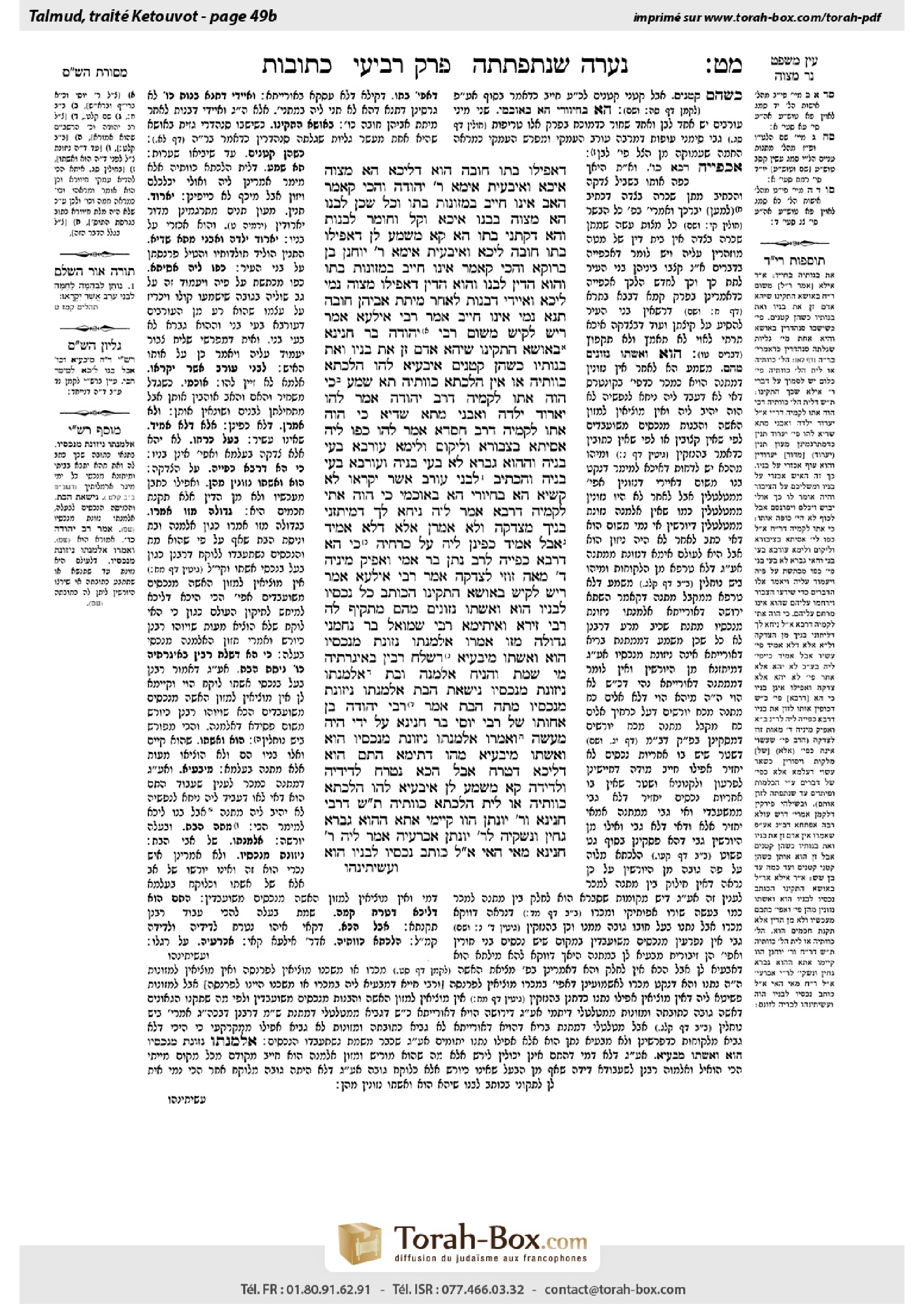
Ketubot 49b: Talmud study for Daf Yomi
Daf Yomi is the daily study of one Talmud folio. Explore 37 tractates with scans, Hebrew text, Sefaria English and AI-generated French translations where annotated.
Passage selection and English or AI-generated French translation are available where the scan has annotations. Daf Study is independent of Torah-Box and Sefaria.
Browse Ketubot · כתובות · All tractatesKetubot 49b text and translations
This page of Ketubot includes the Aramaic text, an English translation and an AI-generated French translation, alongside the scan above.
כתובות מ״ט ב · Aramaic and Hebrew text
דַּאֲפִילּוּ בִּתּוֹ, חוֹבָה הוּא דְּלֵיכָּא, הָא מִצְוָה אִיכָּא.
וְאִיבָּעֵית אֵימָא רַבִּי יְהוּדָה, וְהָכִי קָאָמַר: הָאָב אֵינוֹ חַיָּיב בִּמְזוֹנוֹת בִּתּוֹ, וְכׇל שֶׁכֵּן לִבְנוֹ. הָא מִצְוָה בִּבְנוֹ אִיכָּא, וְקַל וָחוֹמֶר לַבָּנוֹת. וְהָא דְּקָתָנֵי בִּתּוֹ — הָא קָא מַשְׁמַע לַן דַּאֲפִילּוּ בִּתּוֹ חוֹבָה לֵיכָּא.
וְאִיבָּעֵית אֵימָא רַבִּי יוֹחָנָן בֶּן בְּרוֹקָא, וְהָכִי קָאָמַר: אֵינוֹ חַיָּיב בִּמְזוֹנוֹת בִּתּוֹ, וְהוּא הַדִּין לִבְנוֹ. וְהוּא הַדִּין דַּאֲפִילּוּ מִצְוָה נָמֵי לֵיכָּא, וְאַיְּידֵי דְּבָנוֹת לְאַחַר מִיתַת אֲבִיהֶן חוֹבָה, תְּנָא נָמֵי אֵינוֹ חַיָּיב.
אָמַר רַבִּי אִילְעָא אָמַר רֵישׁ לָקִישׁ מִשּׁוּם רַבִּי יְהוּדָה בַּר חֲנִינָא: בְּאוּשָׁא הִתְקִינוּ שֶׁיְּהֵא אָדָם זָן אֶת בָּנָיו וְאֶת בְּנוֹתָיו כְּשֶׁהֵן קְטַנִּים. אִיבַּעְיָא לְהוּ: הִלְכְתָא כְּווֹתֵיהּ אוֹ אֵין הִלְכְתָא כְּווֹתֵיהּ? תָּא שְׁמַע: כִּי הֲוָה אָתוּ לְקַמֵּיהּ דְּרַב יְהוּדָה אֲמַר לְהוּ: יָארוּד יָלְדָה, וְאַבְּנֵי מָתָא שָׁדְיָא?!
כִּי הֲוָה אָתוּ לְקַמֵּיהּ דְּרַב חִסְדָּא, אֲמַר לְהוּ: כְּפוֹ לֵיהּ אֲסִיתָא בְּצִבּוּרָא, וְלֵיקוּם וְלֵימָא: עוֹרְבָא בָּעֵי בְּנֵיהּ וְהָהוּא גַּבְרָא לָא בָּעֵי בְּנֵיהּ?! וְעוֹרְבָא בָּעֵי בְּנֵיהּ? וְהָכְתִיב: ״לִבְנֵי עוֹרֵב אֲשֶׁר יִקְרָאוּ״! לָא קַשְׁיָא, הָא בְּחִיוָּרֵי, הָא בְּאוּכָּמֵי.
כִּי הֲוָה אָתֵי לְקַמֵּיהּ דְּרָבָא, אֲמַר לֵיהּ: נִיחָא לָךְ דְּמִיתַּזְנִי בְּנָיךְ מִצְּדָקָה?
וְלָא אֲמַרַן, אֶלָּא דְּלָא אֲמִיד, אֲבָל אֲמִיד — כָּפֵינַן לֵיהּ עַל כֻּרְחֵיהּ. כִּי הָא דְּרָבָא כַּפְיֵיהּ לְרַב נָתָן בַּר אַמֵּי וְאַפֵּיק מִינֵּיהּ אַרְבַּע מְאָה זוּזֵי לִצְדָקָה.
אָמַר רַבִּי אִילְעָא אָמַר רֵישׁ לָקִישׁ: בְּאוּשָׁא הִתְקִינוּ הַכּוֹתֵב כׇּל נְכָסָיו לְבָנָיו — הוּא וְאִשְׁתּוֹ נִזּוֹנִים מֵהֶם.
מַתְקֵיף לַהּ רַבִּי זֵירָא וְאִיתֵּימָא רַבִּי שְׁמוּאֵל בַּר נַחְמָנִי: גְּדוֹלָה מִזּוֹ אָמְרוּ, אַלְמְנָתוֹ נִזּוֹנֶת מִנְּכָסָיו, הוּא וְאִשְׁתּוֹ מִיבַּעְיָא?!
דִּשְׁלַח רָבִין בְּאִיגַּרְתֵּיהּ: מִי שֶׁמֵּת וְהִנִּיחַ אַלְמָנָה וּבַת — אַלְמְנָתוֹ נִיזּוֹנֶת מִנְּכָסָיו. נִישֵּׂאת הַבַּת — אַלְמְנָתוֹ נִיזּוֹנֶת מִנְּכָסָיו.
מֵתָה הַבַּת, אָמַר רַבִּי יְהוּדָה בֶּן אֲחוֹתוֹ שֶׁל רַבִּי יוֹסֵי בַּר חֲנִינָא: עַל יָדִי הָיָה מַעֲשֶׂה, וְאָמְרוּ: אַלְמְנָתוֹ נִיזּוֹנֶת מִנְּכָסָיו. הוּא וְאִשְׁתּוֹ מִיבַּעְיָא?!
מַהוּ דְּתֵימָא: הָתָם הוּא דְּלֵיכָּא דְּטָרַח, אֲבָל הָכָא — נִטְרַח לְדִידֵיהּ וּלְדִידַהּ, קָא מַשְׁמַע לַן.
אִיבַּעְיָא לְהוּ: הִלְכְתָא כְּווֹתֵיהּ אוֹ לֵית הִלְכְתָא כְּווֹתֵיהּ? תָּא שְׁמַע: דְּרַבִּי חֲנִינָא וְרַבִּי יוֹנָתָן הֲווֹ קָיְימִי, אֲתָא הָהוּא גַּבְרָא גְּחֵין וְנַשְּׁקֵיהּ לְרַבִּי יוֹנָתָן אַכַּרְעֵיהּ, אֲמַר לֵיהּ רַבִּי חֲנִינָא: מַאי הַאי? אֲמַר לֵיהּ: כּוֹתֵב נְכָסָיו לְבָנָיו הוּא,
Ketubot 49b · English translation
That even with regard to his daughter, there is no obligation to provide her sustenance, however, there is a mitzva to do so.
And if you wish, say that the mishna is in accordance with the opinion of Rabbi Yehuda, and this what he said in the mishna: A father is not obligated to provide sustenance for his daughter, and all the more so he is not duty-bound to provide for his son. It may be inferred from here that there is at least a mitzva with regard to a son, and the same applies by a fortiori inference with regard to the daughters. And the reason that the mishna teaches the case of his daughter is because it teaches us this: That even with regard to his daughter there is no obligation, despite the mitzva to guard her from dishonor.
And if you wish, say that the mishna is in accordance with the opinion of Rabbi Yoḥanan ben Beroka, and this is what he said in the mishna: A father is not obligated to provide sustenance for his daughter, and the same is true with regard to providing for his son. And the same is true with regard to a mitzva; there is not even a mitzva to feed either one’s sons or daughters, but since the tanna wanted to say with regard to daughters that after their father’s death there is an obligation to sustain them from his estate, he also taught in a parallel manner that the father is not obligated to provide sustenance for his daughters during his lifetime. Consequently, it is incorrect to infer from here that there is a mitzva to sustain them despite the lack of obligation; rather, the tanna means that there is no obligation and not even a mitzva to do so.
§ Rabbi Ile’a said that Reish Lakish said in the name of Rabbi Yehuda bar Ḥanina: In Usha the Sages instituted that a man should sustain his sons and daughters when they are minors. A dilemma was raised before the Sages: Is the halakha in accordance with his opinion or is the halakha not in accordance with his opinion? Must a man feed his young children in practice or not? The Gemara answers: Come and hear: When they would come before Rav Yehuda to complain about a father who refused to sustain his children, he would say to them: The jackal [yarod] bears offspring and casts the obligation to feed them on the residents of the town? Even a jackal feeds its young, and it is certainly proper for a father to support his children.
When they would come before Rav Ḥisda to register a similar complaint, he would say to them: Turn over a mortar for him in public, as a raised platform, and let that father stand up and say about himself: The raven wants to care for its sons, and yet this man does not want to support his sons. The Gemara questions this statement: And does the raven want to feed its sons? But isn’t it written: “He gives to the beast its food, to the young ravens that cry” (Psalms 147:9)? This verse indicates that the parents of young ravens do not feed them. The Gemara responds: This is not difficult, as in this case it is referring to white ones, and in that case it is referring to black ones. There are different types of ravens, some of which feed their young while others do not.
The Gemara further relates: When an incident of this kind would come before Rava, he would say to the father: Is it satisfactory to you that your sons are sustained through charity? All these incidents prove that the halakha is not in accordance with the enactment of Usha; although these Sages stated forcefully that it is proper for a father to support his children, they did not force him to do so by the authority of the court.
The Gemara adds: And we said this halakha only when he is not wealthy and must toil hard to provide food for his children, but if he is wealthy we coerce him against his will to sustain them. Like this case of Rava, who coerced Rav Natan bar Ami, who was a wealthy man, to donate to charity, and collected from him four hundred dinars for charity. This shows that even in the absence of a particular obligation, the court will compel a person to give charity if he can afford it. The same reasoning certainly applies to a man’s own children.
§ Rabbi Ile’a said that Reish Lakish said: In Usha the Sages instituted that in a case of one who writes a document stating that he is giving all his property as a gift to his sons in his lifetime, he and his wife are sustained from the property until their deaths.
Rabbi Zeira objects to this, and some say this objection was raised by Rabbi Shmuel bar Naḥmani: What is the significance of this ruling? After all, the Sages said a greater novelty than that: A man’s widow is sustained from his property even if his estate was inherited by his daughter and therefore belongs to her husband. Although the property is comparable to property from the estate that was sold to a third party, from which a widow is not entitled to claim her sustenance, in this case the Sages decreed that she can claim her livelihood from her late husband’s estate to prevent her from losing out entirely. With this in mind, is it necessary to state that he and his wife, during his lifetime, receive their sustenance from property he gave as a gift to his sons?
The Gemara provides the background for this ruling: As Ravin sent in his letter to Babylonia: With regard to one who died and left a widow and a daughter, his widow is sustained from his property, as this is a stipulation of the marriage contract. If the daughter, who is her father’s heir, married, the estate is considered usufruct property whose produce belongs to her husband, but even so his widow is sustained from his property.
If the daughter died and her husband inherited from her, Rabbi Yehuda, son of the sister of Rabbi Yosei bar Ḥanina, said: I was involved in an incident of this kind when this very question came before the Sages for a ruling, and they said: Even in this case, his widow is sustained from his property. The Gemara reiterates: With all that said, is it necessary to state that he and his wife are entitled to receive their sustenance from property he gave his son?
The Gemara responds: The ordinance is necessary lest you say that it is in that case there, with regard to a widow, that they instituted this halakha, as there is no one to toil on her behalf, since she is by herself, but here, where the husband is alive, he can toil for himself and for her, i.e., his wife. The ordinance of Usha therefore teaches us that the court does not force him to do so, and they may claim their sustenance from his former property.
A dilemma was raised before the scholars: Is the halakha in accordance with the opinion of Rabbi Ile’a, or is the halakha not in accordance with his opinion? The Gemara answers: Come and hear, as Rabbi Ḥanina and Rabbi Yonatan were standing together, and a certain man approached, bent over, and kissed Rabbi Yonatan on his foot. Rabbi Ḥanina said to Rabbi Yonatan: What is this? Why does he owe you such a mark of gratitude? He said to him: He wrote a document stating that he was giving his property to his sons,
Ketubot 49b · Traduction française (IA)
Même à l’égard de sa fille, il n’est pas tenu de subvenir à ses besoins ; toutefois, il y a une mitsva de le faire.
Et si tu le souhaites, dis que la Michna suit l’opinion de Rabbi Yehuda, et que voici ce qu’il enseigne dans la Michna : Un père n’est pas tenu de subvenir aux besoins de sa fille, et à plus forte raison n’est-il pas tenu de subvenir à ceux de son fils. On peut en déduire qu’il y a au moins une mitsva concernant un fils ; il en va de même, a fortiori, pour les filles. La Michna enseigne le cas de sa fille parce qu’elle nous apprend ceci : même à l’égard de sa fille, il n’y a pas d’obligation, malgré la mitsva de la préserver du déshonneur.
Et si tu le souhaites, dis que la Michna suit l’opinion de Rabbi Yoḥanan ben Beroka, et que voici ce qu’il enseigne dans la Michna : Un père n’est pas tenu de subvenir aux besoins de sa fille, et il en va de même pour son fils. Il en va de même en ce qui concerne une mitsva : il n’y a même pas de mitsva de nourrir ses fils ou ses filles. Cependant, comme le tanna voulait dire, au sujet des filles, qu’après la mort de leur père il y a une obligation de subvenir à leurs besoins sur sa succession, il a également enseigné, en parallèle, que le père n’est pas tenu de subvenir aux besoins de ses filles de son vivant. Par conséquent, il serait erroné d’en déduire qu’il y a une mitsva de subvenir à leurs besoins malgré l’absence d’obligation ; le tanna veut plutôt dire qu’il n’y a pas d’obligation, ni même de mitsva, de le faire.
§ Rabbi Ile’a a dit que Reish Lakish a dit au nom de Rabbi Yehuda bar Ḥanina : À Ousha, les Sages ont institué qu’un homme subvienne aux besoins de ses fils et de ses filles lorsqu’ils sont mineurs. Les Sages se sont demandé : La halakha suit-elle son opinion ou non ? Un homme doit-il, en pratique, nourrir ses jeunes enfants ou non ? La Guemara répond : Viens et entends : Lorsque des gens venaient devant Rav Yehuda se plaindre d’un père qui refusait de subvenir aux besoins de ses enfants, il leur disait : « Le chacal [yarod] a des petits et fait peser sur les habitants de la ville l’obligation de les nourrir ? » Même un chacal nourrit ses petits ; il convient donc à plus forte raison qu’un père subvienne aux besoins de ses enfants.
Lorsque des gens venaient devant Rav Ḥisda pour porter une plainte similaire, il leur disait : « Retournez un mortier en public pour en faire une estrade, et que ce père se lève et dise de lui-même : “Le corbeau veut prendre soin de ses petits, et pourtant cet homme ne veut pas subvenir aux besoins des siens.” » La Guemara met cette affirmation en question : Le corbeau veut-il vraiment nourrir ses petits ? N’est-il pas écrit : « Il donne leur nourriture aux bêtes, aux jeunes corbeaux qui crient » (Psaumes 147,9) ? Ce verset indique que les parents des jeunes corbeaux ne les nourrissent pas. La Guemara répond : Il n’y a pas de contradiction, car dans un cas il s’agit des corbeaux blancs, et dans l’autre, des corbeaux noirs. Il existe différentes sortes de corbeaux, dont certaines nourrissent leurs petits, tandis que d’autres ne le font pas.
La Guemara rapporte en outre : Lorsqu’un cas de ce genre se présentait devant Rava, il disait au père : « Cela te convient-il que tes fils soient entretenus grâce à la charité ? » Tous ces cas prouvent que la halakha ne suit pas le décret d’Ousha ; bien que ces Sages aient affirmé avec insistance qu’il convient qu’un père subvienne aux besoins de ses enfants, ils ne l’y ont pas contraint par l’autorité du tribunal.
La Guemara ajoute : Nous n’avons dit cela que lorsqu’il n’est pas riche et doit peiner pour se procurer de quoi nourrir ses enfants ; mais s’il est riche, nous le contraignons, contre son gré, à subvenir à leurs besoins. C’est ce qui s’est passé dans le cas de Rava, qui a contraint Rav Natan bar Ami, un homme riche, à faire un don à la charité et lui a réclamé quatre cents dinars à cette fin. Cela montre que même en l’absence d’une obligation particulière, le tribunal contraint une personne à faire la charité si elle en a les moyens. Le même raisonnement s’applique à plus forte raison aux propres enfants d’un homme.
§ Rabbi Ile’a a dit que Reish Lakish a dit : À Ousha, les Sages ont institué que, lorsqu’un homme rédige un document déclarant qu’il donne tous ses biens à ses fils de son vivant, lui et sa femme soient entretenus sur ces biens jusqu’à leur mort.
Rabbi Zeira objecte, et certains disent que cette objection a été soulevée par Rabbi Shmuel bar Naḥmani : Quelle nouveauté cette décision apporte-t-elle ? Après tout, les Sages ont énoncé une règle encore plus novatrice : la veuve d’un homme est entretenue sur ses biens même si sa succession a été héritée par sa fille et appartient donc au mari de celle-ci. Bien que ces biens soient comparables à ceux d’une succession vendue à un tiers, sur lesquels une veuve n’a pas le droit de réclamer son entretien, dans ce cas les Sages ont décrété qu’elle pouvait réclamer de quoi vivre sur la succession de son défunt mari, afin qu’elle ne soit pas entièrement lésée. Cela étant, est-il nécessaire de préciser que lui et sa femme, de son vivant, sont entretenus sur les biens qu’il a donnés à ses fils ?
La Guemara donne le contexte de cette décision : Ravin a envoyé ce message dans sa lettre en Babylonie : Si un homme meurt en laissant une veuve et une fille, sa veuve est entretenue sur ses biens, car cela constitue une stipulation du contrat de mariage. Si la fille, héritière de son père, s’est mariée, la succession est considérée comme un bien usufructuaire dont les revenus reviennent à son mari ; pourtant, la veuve de son père est entretenue sur ces biens.
Si la fille est morte et que son mari a hérité d’elle, Rabbi Yehuda, fils de la sœur de Rabbi Yosei bar Ḥanina, a dit : « J’ai pris part à un cas de ce genre, lorsque cette question précise a été soumise aux Sages pour décision, et ils ont dit : “Même dans ce cas, sa veuve est entretenue sur ses biens.” » La Guemara reprend : Tout cela étant dit, est-il nécessaire de préciser que lui et sa femme ont droit à leur entretien sur les biens qu’il a donnés à son fils ?
La Guemara répond : Cette ordonnance est nécessaire, de peur que tu ne dises que les Sages ont institué cette halakha uniquement dans le cas de la veuve, car personne ne peut travailler pour elle puisqu’elle est seule ; mais ici, où le mari est vivant, il peut travailler pour lui-même et pour elle, c’est-à-dire sa femme. L’ordonnance d’Ousha nous apprend donc que le tribunal ne le contraint pas à le faire et que lui et sa femme peuvent réclamer leur entretien sur ses anciens biens.
Les Sages se sont demandé : La halakha suit-elle l’opinion de Rabbi Ile’a ou non ? La Guemara répond : Viens et entends : Rabbi Ḥanina et Rabbi Yonatan se tenaient ensemble lorsqu’un certain homme s’approcha, se pencha et embrassa le pied de Rabbi Yonatan. Rabbi Ḥanina dit à Rabbi Yonatan : « Qu’est-ce que cela ? Pourquoi te doit-il une telle marque de gratitude ? » Il lui répondit : « Il a rédigé un document déclarant qu’il donnait ses biens à ses fils,
Traduction française générée par IA à partir de l’édition anglaise de Sefaria. Vérifie toujours un passage avec le texte source.
Text from Sefaria: William Davidson Edition - Vocalized Aramaic (CC BY NC); William Davidson Edition - English (CC BY NC).