Ketubot 50b: Talmud study for Daf Yomi
Daf Yomi is the daily study of one Talmud folio. Explore 37 tractates with scans, Hebrew text, Sefaria English and AI-generated French translations where annotated.
Passage selection and English or AI-generated French translation are available where the scan has annotations. Daf Study is independent of Torah-Box and Sefaria.
Browse Ketubot · כתובות · All tractatesKetubot 50b text and translations
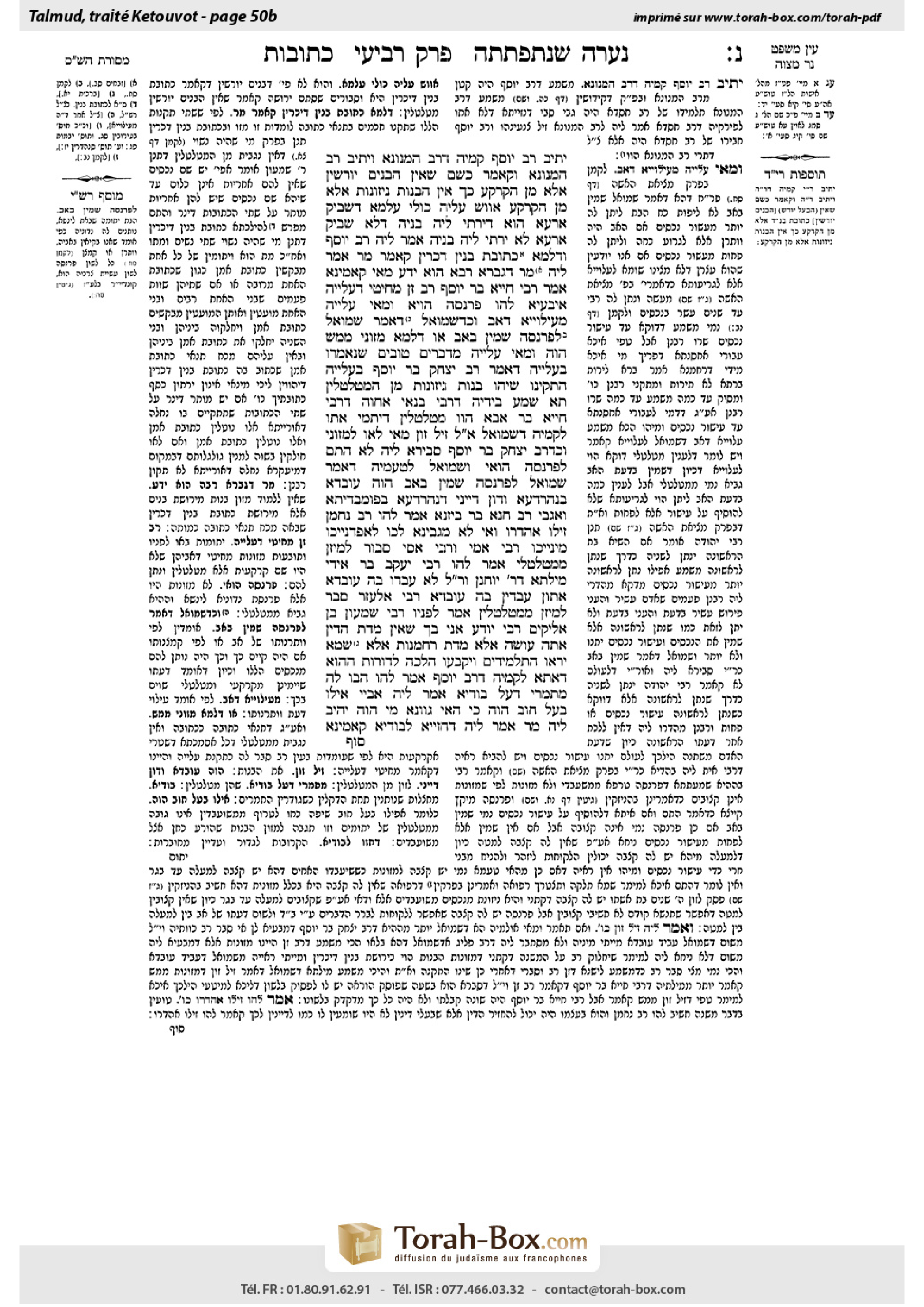
This page of Ketubot includes the Aramaic text, an English translation and an AI-generated French translation, alongside the scan above.
כתובות נ׳ ב · Aramaic and Hebrew text
יָתֵיב רַב יוֹסֵף קַמֵּיהּ דְּרַב הַמְנוּנָא וְיָתֵיב רַב הַמְנוּנָא, וְקָאָמַר: כְּשֵׁם שֶׁאֵין הַבָּנִים יוֹרְשִׁין אֶלָּא מִן הַקַּרְקַע — כָּךְ אֵין הַבָּנוֹת נִיזּוֹנוֹת אֶלָּא מִן הַקַּרְקַע. אֲוַושׁ עֲלֵיהּ כּוּלֵּי עָלְמָא: דְּשָׁבֵיק אַרְעָא — הוּא דְּיָרְתִי לֵיהּ בְּנֵיהּ, דְּלָא שָׁבֵיק אַרְעָא — לָא יָרְתִי לֵיהּ בְּנֵיהּ?!
אֲמַר לֵיהּ רַב יוֹסֵף: וְדִלְמָא כְּתוּבַּת בְּנִין דִּכְרִין קָאָמַר מָר?! אֲמַר לֵיהּ: מָר, דְּגַבְרָא רַבָּא הוּא, יָדַע מַאי קָאָמֵינָא.
אָמַר רַבִּי חִיָּיא בַּר יוֹסֵף: רַב זָן מֵחִיטֵּי דַעֲלִיָּיה. אִיבַּעְיָא לְהוּ: פַּרְנָסָה הֲוַיא, וּמַאי עֲלִיָּיה — מֵעִילּוּיָיא דְאָב, וּכְדִשְׁמוּאֵל. דְּאָמַר שְׁמוּאֵל: לְפַרְנָסָה, שָׁמִין בָּאָב.
אוֹ דִלְמָא מְזוֹנֵי מַמָּשׁ הֲוָה, וּמַאי עֲלִיָּיה — מִדְּבָרִים טוֹבִים שֶׁנֶּאֶמְרוּ בָּעֲלִיָּיה. דְּאָמַר רַב יִצְחָק בַּר יוֹסֵף: בָּעֲלִיָּיה הִתְקִינוּ שֶׁיְּהוּ בָּנוֹת נִיזּוֹנוֹת מִן הַמִּטַּלְטְלִין.
תָּא שְׁמַע: בִּידֵיהּ דְּרַבִּי בַּנַּאי אֲחוּהּ דְּרַבִּי חִיָּיא בַּר אַבָּא הֲווֹ מִטַּלְטְלִין דְּיַתְמֵי. אֲתוֹ לְקַמֵּיהּ דִּשְׁמוּאֵל. אֲמַר לֵיהּ: זִיל זוּן.
מַאי לָאו לִמְזוֹנֵי, וְכִדְרַב יִצְחָק בַּר יוֹסֵף סְבִירָא לֵיהּ? לָא, הָתָם לְפַרְנָסָה הֲוַאי. וּשְׁמוּאֵל לְטַעְמֵיהּ, דְּאָמַר שְׁמוּאֵל: לְפַרְנָסָה שָׁמִין בָּאָב.
הֲוָה עוֹבָדָא בִּנְהַרְדְּעָא, וְדוּן דַּיָּינֵי דִנְהַרְדְּעָא. בְּפוּמְבְּדִיתָא, וְאַגְבִּי רַב חָנָא בַּר בִּיזְנָא. אֲמַר לְהוּ רַב נַחְמָן: זִילוּ אַהְדַּרוּ, וְאִי לָא — מַגְבֵּינָא לְכוּ לְאַפַּדְנַיְיכוּ מִינַּיְיכוּ.
רַבִּי אַמֵּי וְרַבִּי אַסִּי סְבוּר לְמֵיזַן מִמִּטַּלְטְלֵי. אֲמַר לְהוּ רַבִּי יַעֲקֹב בַּר אִידִי: מִילְּתָא דְּרַבִּי יוֹחָנָן וְרֵישׁ לָקִישׁ לָא עֲבַדוּ בָּהּ עוֹבָדָא אַתּוּן עָבְדִין בַּהּ עוֹבָדָא?!
רַבִּי אֶלְעָזָר סָבַר לְמֵיזַן מִמִּטַּלְטְלִין. אָמַר לְפָנָיו רַבִּי שִׁמְעוֹן בֶּן אֶלְיָקִים: רַבִּי, יוֹדֵעַ אֲנִי בְּךָ שֶׁאֵין מִדַּת הַדִּין אַתָּה עוֹשֶׂה, אֶלָּא מִדַּת רַחְמָנוּת. אֶלָּא, שֶׁמָּא יִרְאוּ הַתַּלְמִידִים וְיִקְבְּעוּ הֲלָכָה לְדוֹרוֹת.
הָהוּא דַּאֲתָא לְקַמֵּיהּ דְּרַב יוֹסֵף, אֲמַר לְהוּ: הַבוּ לַהּ מִתַּמְרֵי דְּעַל בּוּדְיָא, אֲמַר לֵיהּ אַבָּיֵי: אִילּוּ בַּעַל חוֹב הֲוָה כִּי הַאי גַּוְונָא, מִי הֲוָה יָהֵיב לֵיהּ מָר?
אֲמַר לֵיהּ: דְּחַזְיָיא לְבוּדְיָא קָאָמֵינָא.
Ketubot 50b · English translation
The Gemara relates: Rav Yosef sat before Rav Hamnuna in the study hall, and Rav Hamnuna sat and said the following halakha: Just as sons inherit only from land, so too, daughters are sustained only from land. When Rav Hamnuna taught this halakha, everyone clamored [avash] against him, i.e., all his listeners whispered their surprise to one another: Is it only one who leaves behind land whose sons inherit from him, whereas in the case of one who does not leave land, his sons do not inherit from him? Rav Hamnuna’s statement indicates that sons inherit only land and nothing else.
Rav Yosef said to Rav Hamnuna: Perhaps the Master was speaking of the marriage document ensuring the inheritance rights of a woman’s male children, i.e., her sons’ right to inherit the sum stipulated in her marriage contract in addition to their share of the father’s estate alongside any other brothers. Rav Hamnuna said to him: The Master, who is a great man, knows what I said, i.e., that was indeed my intention, while the others failed to understand me properly.
Rabbi Ḥiyya bar Yosef said: Rav would sustain orphan girls with wheat according to the aliyya if their fathers did not leave land for them. A dilemma was raised before the scholars: Was this sustenance that Rav provided in the form of livelihood, i.e., a dowry so that they could marry, and what is the meaning of the term aliyya? It means: In keeping with the status [illuyya] of the father, and this is in accordance with the opinion of Shmuel. As Shmuel said: With regard to the daughters’ livelihood, i.e., their dowry, the court assesses the amount they receive from their father’s estate after his death in accordance with the temperament and social and financial status of the father.
Or perhaps it was actual sustenance, i.e., provisions so that they would have food, and what is the meaning of the term aliyya? It indicates that this halakha is one of the good statements said in the upper chamber [aliyya], as Rav Yitzḥak bar Yosef said: When the Sages sat in the upper chamber to rule on certain halakhot, which they could not do in the study hall at that time due to persecution by gentiles, they instituted that daughters should be sustained from movable property in addition to land.
The Gemara suggests: Come and hear a resolution to this dilemma: In the possession of Rabbi Banai, the brother of Rabbi Ḥiyya bar Abba, there was movable property belonging to orphans, deposited with him by their father. The orphan daughters came before Shmuel, who said to Rabbi Banai: Go and sustain the daughters from the property.
What, is it not correct to say that this means he should provide them with sustenance, and this would indicate that Shmuel holds in accordance with the opinion of Rav Yitzḥak bar Yosef, that the Sages instituted an ordinance in the upper chamber that daughters are entitled to their sustenance even from movable property? The Gemara refutes this claim: No, there it is stated in reference to their livelihood, and Shmuel conforms to his standard line of reasoning, as Shmuel said: With regard to livelihood, i.e., the dowry granted to daughters from their father’s estate, the court assesses the amount they receive in accordance with the status of the father.
The Gemara relates: There was an incident of this kind that came before the court in Neharde’a, and the judges of Neharde’a ruled that the daughters must be supported from the movable property that their father had left. Likewise, a case occurred in Pumbedita, and Rav Ḥana bar Bizna collected the sum from movable property. Rav Naḥman said to the judges: Go reverse your decisions, and if not, I will collect your houses [appadnaikhu] from you in order to compensate those you ruled against.
The Gemara further relates: Rabbi Ami and Rabbi Asi thought to issue a ruling requiring a man’s heirs to sustain his daughters from the man’s movable property. Rabbi Ya’akov bar Idi said to them: This is a matter about which Rabbi Yoḥanan and Reish Lakish did not take action, i.e., they did not issue a ruling to this effect; will you take action in this regard? If those great Sages were not sure enough of the halakha to issue a practical ruling, how can you do so?
The Gemara relates that Rabbi Elazar thought to issue a ruling requiring a man’s heirs to sustain his daughters from his movable property. Rabbi Shimon ben Elyakim said before him: My teacher, I know about you that you are not acting according to the letter of the law, but rather out of pity for these daughters, who have no other source of support. However, you should still not do this, lest the students observe and mistakenly establish the halakha accordingly for future generations.
A certain person came before Rav Yosef to inquire about this matter. Rav Yosef said to the sons of the deceased man: Give the daughter her sustenance from the dates that are laid out to dry on the mats [budya]. These fruits are certainly movable property. Abaye said to Rav Yosef: If it was a creditor who came to collect a debt, would the Master give him the right to collect it in this manner? Even a creditor, who may collect his claim by repossessing property that the debtor has sold, cannot take movable property from the possession of orphans. A daughter, who cannot collect her sustenance from property that her father sold, should certainly not have the right to collect her sustenance from movable property that belongs to the male orphans.
Rav Yosef said to Abaye: I did not mean actual dates lying on mats; rather, I spoke of ripe dates ready for plucking, which are fit for mats. Since they are still attached to the ground, they are not considered movable property.
Ketubot 50b · Traduction française (IA)
La Guemara rapporte : Rav Yosef était assis devant Rav Hamnuna dans la maison d’étude, et Rav Hamnuna, assis, enseigna la halakha suivante : de même que les fils n’héritent que des biens fonciers, de même les filles ne sont entretenues qu’au moyen de biens fonciers. Lorsque Rav Hamnuna enseigna cette halakha, tous protestèrent [avash] contre lui, c’est-à-dire que ses auditeurs se chuchotèrent leur étonnement : Cela signifie-t-il que seuls les fils d’un homme qui laisse des biens fonciers héritent de lui, tandis que, si un homme ne laisse aucun bien foncier, ses fils n’héritent pas de lui ? La déclaration de Rav Hamnuna indique que les fils n’héritent que des biens fonciers, et de rien d’autre.
Rav Yosef dit à Rav Hamnuna : Peut-être le Maître parlait-il de l’acte de mariage qui garantit les droits successoraux des enfants mâles d’une femme, c’est-à-dire le droit de ses fils d’hériter de la somme stipulée dans son contrat de mariage, en plus de leur part dans la succession de leur père, aux côtés de leurs frères. Rav Hamnuna lui dit : Le Maître, qui est un grand homme, sait ce que j’ai dit, c’est-à-dire que telle était bien mon intention, tandis que les autres ne m’ont pas bien compris.
Rabbi Ḥiyya bar Yosef dit : Rav entretenait les filles orphelines avec du blé, selon l’aliyya, lorsque leur père ne leur avait pas laissé de biens fonciers. Les Sages soulevèrent un dilemme : cet entretien fourni par Rav était-il destiné à leur subsistance, c’est-à-dire constituait-il une dot leur permettant de se marier ? Et que signifie le terme aliyya ? Il signifie : selon le statut [illuyya] du père, conformément à l’opinion de Shmuel. Car Shmuel dit : en ce qui concerne la subsistance des filles, c’est-à-dire leur dot, le tribunal évalue le montant qu’elles reçoivent de la succession de leur père après sa mort en fonction du caractère et du statut social et financier de celui-ci.
Ou peut-être s’agissait-il de subsistance au sens propre, c’est-à-dire de provisions destinées à leur fournir de quoi manger ? Et que signifie alors le terme aliyya ? Il indique que cette halakha fait partie des bonnes décisions énoncées dans la chambre haute [aliyya], comme l’a dit Rav Yitzḥak bar Yosef : lorsque les Sages siégèrent dans la chambre haute pour statuer sur certaines halakhot, ce qu’ils ne pouvaient pas faire alors dans la maison d’étude en raison des persécutions des non-Juifs, ils instituèrent que les filles seraient entretenues au moyen de biens mobiliers, en plus des biens fonciers.
La Guemara propose : Viens et entends une réponse à ce dilemme. Rabbi Banai, le frère de Rabbi Ḥiyya bar Abba, détenait des biens mobiliers appartenant à des orphelins, que leur père lui avait confiés. Les filles orphelines se présentèrent devant Shmuel, qui dit à Rabbi Banai : Va et assure l’entretien des filles au moyen de ces biens.
Ne faut-il pas comprendre qu’il devait leur fournir de quoi manger ? Cela indiquerait que Shmuel est du même avis que Rav Yitzḥak bar Yosef, selon lequel les Sages instituèrent dans la chambre haute que les filles ont droit à leur entretien même au moyen de biens mobiliers. La Guemara réfute cette affirmation : Non, le terme employé désigne ici leur subsistance, et Shmuel suit sa position habituelle, car il a dit : en ce qui concerne la subsistance, c’est-à-dire la dot accordée aux filles sur la succession de leur père, le tribunal évalue le montant qu’elles reçoivent en fonction du statut du père.
La Guemara rapporte : une affaire de ce genre fut portée devant le tribunal de Neharde’a, et les juges de Neharde’a décidèrent que les filles devaient être entretenues au moyen des biens mobiliers laissés par leur père. Une affaire semblable se produisit à Pumbedita, et Rav Ḥana bar Bizna préleva la somme sur des biens mobiliers. Rav Naḥman dit aux juges : Allez revenir sur vos décisions ; sinon, je vous prendrai vos maisons [appadnaikhu] afin d’indemniser ceux contre lesquels vous avez statué.
La Guemara rapporte encore : Rabbi Ami et Rabbi Asi envisagèrent de statuer que les héritiers d’un homme devraient entretenir ses filles au moyen des biens mobiliers de cet homme. Rabbi Ya’akov bar Idi leur dit : C’est une question sur laquelle Rabbi Yoḥanan et Reish Lakish ne sont pas intervenus, c’est-à-dire qu’ils n’ont pas rendu de décision en ce sens ; et vous, vous interviendriez ? Si ces grands Sages n’étaient pas assez sûrs de la halakha pour rendre une décision pratique, comment pourriez-vous le faire ?
La Guemara rapporte que Rabbi Elazar envisagea de statuer que les héritiers d’un homme devraient entretenir ses filles au moyen de ses biens mobiliers. Rabbi Shimon ben Elyakim lui dit : Mon maître, je sais que vous n’agissez pas selon la stricte loi, mais par compassion pour ces filles, qui n’ont aucune autre source de subsistance. Cependant, vous ne devez tout de même pas le faire, de peur que les élèves ne vous voient agir ainsi et n’établissent par erreur la halakha en ce sens pour les générations futures.
Un homme se présenta devant Rav Yosef pour l’interroger sur cette question. Rav Yosef dit aux fils du défunt : Donnez à sa fille de quoi vivre avec les dattes étalées pour sécher sur les nattes [budya]. Ces fruits sont assurément des biens mobiliers. Abaye dit à Rav Yosef : Si un créancier venait recouvrer une dette, le Maître lui permettrait-il de la recouvrer de cette manière ? Même un créancier, qui peut faire valoir sa créance en saisissant un bien que le débiteur a vendu, ne peut pas prendre des biens mobiliers détenus par des orphelins. Une fille, qui ne peut pas réclamer son entretien sur des biens vendus par son père, ne devrait certainement pas avoir le droit de le réclamer sur des biens mobiliers appartenant aux orphelins mâles.
Rav Yosef dit à Abaye : Je ne parlais pas de dattes posées sur des nattes ; je parlais plutôt de dattes mûres, prêtes à être cueillies et pouvant être étalées sur des nattes. Puisqu’elles sont encore attachées au sol, elles ne sont pas considérées comme des biens mobiliers.
Traduction française générée par IA à partir de l’édition anglaise de Sefaria. Vérifie toujours un passage avec le texte source.
Text from Sefaria: William Davidson Edition - Vocalized Aramaic (CC BY NC); William Davidson Edition - English (CC BY NC).