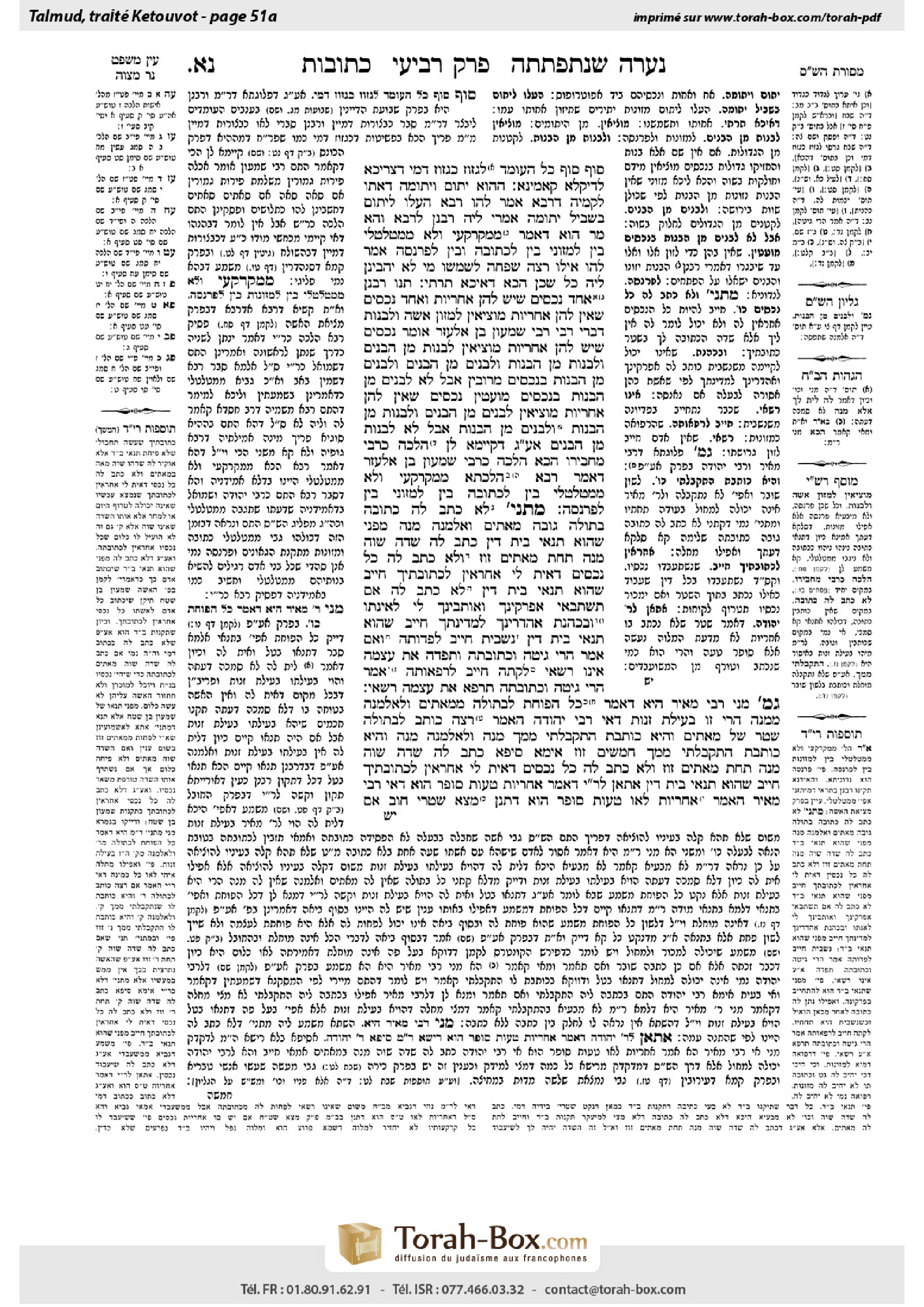
Ketubot 51a: Talmud study for Daf Yomi
Daf Yomi is the daily study of one Talmud folio. Explore 37 tractates with scans, Hebrew text, Sefaria English and AI-generated French translations where annotated.
Passage selection and English or AI-generated French translation are available where the scan has annotations. Daf Study is independent of Torah-Box and Sefaria.
Browse Ketubot · כתובות · All tractatesKetubot 51a text and translations
This page of Ketubot includes the Aramaic text, an English translation and an AI-generated French translation, alongside the scan above.
כתובות נ״א א · Aramaic and Hebrew text
סוֹף סוֹף, כׇּל הָעוֹמֵד לִגְזוֹז כְּגָזוּז דָּמֵי! דִּצְרִיכָא לְדִיקְלָא קָאָמֵינָא.
הָהוּא יָתוֹם וִיתוֹמָה דַּאֲתוֹ לְקַמֵּיהּ דְּרָבָא. אֲמַר לְהוּ רָבָא: הַעֲלוּ לַיָּתוֹם בִּשְׁבִיל יְתוֹמָה. אָמְרִי לֵיהּ רַבָּנַן לְרָבָא: וְהָא מָר הוּא דְּאָמַר מִמְּקַרְקְעֵי וְלָא מִמִּטַּלְטְלִי, בֵּין לִמְזוֹנֵי בֵּין לִכְתוּבָּה וּבֵין לְפַרְנָסָה!
אֲמַר לְהוּ: אִילּוּ רָצָה שִׁפְחָה לְשַׁמְּשׁוֹ, מִי לָא יָהֲבִינַן לֵיהּ? כׇּל שֶׁכֵּן הָכָא דְּאִיכָּא תַּרְתֵּי.
תָּנוּ רַבָּנַן: אֶחָד נְכָסִים שֶׁיֵּשׁ לָהֶן אַחְרָיוּת, וְאֶחָד נְכָסִים שֶׁאֵין לָהֶן אַחְרָיוּת — מוֹצִיאִין לִמְזוֹן אִשָּׁה וּלְבָנוֹת, דִּבְרֵי רַבִּי. רַבִּי שִׁמְעוֹן בֶּן אֶלְעָזָר אוֹמֵר: נְכָסִים שֶׁיֵּשׁ לָהֶן אַחְרָיוּת — מוֹצִיאִין לַבָּנוֹת מִן הַבָּנִים, וְלַבָּנוֹת מִן הַבָּנוֹת, וְלַבָּנִים מִן הַבָּנִים.
וְלַבָּנִים מִן הַבָּנוֹת בִּנְכָסִים מְרוּבִּין, אֲבָל לֹא לַבָּנִים מִן הַבָּנוֹת בִּנְכָסִים מוּעָטִין.
נְכָסִים שֶׁאֵין לָהֶן אַחְרָיוּת מוֹצִיאִין לַבָּנִים מִן הַבָּנִים, וְלַבָּנוֹת מִן הַבָּנוֹת, וְלַבָּנִים מִן הַבָּנוֹת. אֲבָל לֹא לַבָּנוֹת מִן הַבָּנִים.
אַף עַל גַּב דְּקַיְימָא לַן הֲלָכָה כְּרַבִּי מֵחֲבֵירוֹ, הָכָא הֲלָכָה כְּרַבִּי שִׁמְעוֹן בֶּן אֶלְעָזָר. דְּאָמַר רָבָא, הִלְכְתָא: מִמְּקַרְקְעֵי וְלָא מִמְּטַלְטְלִי, בֵּין לִכְתוּבָּה, בֵּין לִמְזוֹנֵי, בֵּין לְפַרְנָסָה.
מַתְנִי׳ לֹא כָּתַב לָהּ כְּתוּבָּה — בְּתוּלָה גּוֹבָה מָאתַיִם, וְאַלְמָנָה מָנֶה, מִפְּנֵי שֶׁהוּא תְּנַאי בֵּית דִּין. כָּתַב לָהּ שָׂדֶה שָׁוֶה מָנֶה תַּחַת מָאתַיִם זוּז, וְלֹא כָּתַב לָהּ ״כֹּל נְכָסִים דְּאִית לִי אַחְרָאִין לִכְתוּבְּתִיךְ״ — חַיָּיב, שֶׁהוּא תְּנַאי בֵּית דִּין.
לֹא כָּתַב לָהּ: ״אִם תִּשְׁתְּבַאי, אֶפְרְקִינִּךְ וְאוֹתְבִינִּךְ לִי לְאִינְתּוּ״, וּבְכֹהֶנֶת: ״אַהְדְּרִינִּךְ לִמְדִינְתִּךָ״ — חַיָּיב, שֶׁהוּא תְּנַאי בֵּית דִּין.
נִשְׁבֵּית — חַיָּיב לִפְדּוֹתָהּ. וְאִם אָמַר: הֲרֵי גִּיטָּהּ וּכְתוּבָּתָהּ, וְתִפְדֶּה אֶת עַצְמָהּ — אֵינוֹ רַשַּׁאי. לָקְתָה — חַיָּיב לְרַפְּאוֹתָהּ. אָמַר: ״הֲרֵי גִּיטָּהּ וּכְתוּבָּתָהּ, תְּרַפֵּא אֶת עַצְמָהּ״ — רַשַּׁאי.
גְּמָ׳ מַנִּי — רַבִּי מֵאִיר הִיא, דְּאָמַר: כׇּל הַפּוֹחֵת לִבְתוּלָה מִמָּאתַיִם וּלְאַלְמָנָה מִמָּנֶה — הֲרֵי זוֹ בְּעִילַת זְנוּת.
דְּאִי רַבִּי יְהוּדָה, הָאָמַר: רָצָה, כּוֹתֵב לִבְתוּלָה שְׁטָר שֶׁל מָאתַיִם, וְהִיא כּוֹתֶבֶת ״הִתְקַבַּלְתִּי מִמְּךָ מָנֶה״. וּלְאַלְמָנָה מָנֶה, וְהִיא כּוֹתֶבֶת: ״הִתְקַבַּלְתִּי מִמְּךָ חֲמִשִּׁים זוּז״.
אֵימָא סֵיפָא: כָּתַב לָהּ שָׂדֶה שָׁוֶה מָנֶה תַּחַת מָאתַיִם זוּז, וְלֹא כָּתַב לָהּ ״כֹּל נְכָסִים דְּאִית לִי אַחְרָאִין לִכְתוּבְּתִיךְ״ — חַיָּיב, שֶׁהוּא תְּנַאי בֵּית דִּין. אֲתָאן לְרַבִּי יְהוּדָה, דְּאָמַר: אַחְרָיוּת טָעוּת סוֹפֵר הוּא.
דְּאִי רַבִּי מֵאִיר, הָאָמַר: אַחְרָיוּת — לָאו טָעוּת סוֹפֵר הוּא. דִּתְנַן: מָצָא שִׁטְרֵי חוֹב — אִם
Ketubot 51a · English translation
Abaye asked him: Ultimately, anything that is about to be sheared is considered sheared, and therefore these dates should already be classified as movable property, from which her sustenance cannot be collected. Rav Yosef replied: I spoke of a case when the fruit is nearly fully ripe, but is still in need of the palm tree. Since they are attached to the ground, they may be used for the daughter’s sustenance.
The Gemara relates: There were a certain minor orphan boy and orphan girl who came before Rava. Rava said to the trustees of the father’s estate: Increase the amount you give to the orphan boy, so that there should be enough for the orphan girl as well. The Sages said to Rava: But it was the Master who said that one may collect from land but not from movable property, whether for sustenance, whether for the marriage contract, or whether for the daughters’ livelihood. In this case only movable property was available.
Rava said to them: If this orphan wanted a maidservant to serve him, would we not give him one? The court would use his father’s property to fund this acquisition. All the more so here, where there are two factors, as she is his sister and she will serve him as well. It is therefore appropriate to act in this manner, which is to the benefit of both the boy and the girl.
§ The Sages taught: With regard to both property that has a guarantee, i.e., real estate, and property that does not have a guarantee, i.e., movable objects, the court removes them from the orphan heirs for the sustenance of the wife and for the daughters. This is the statement of Rabbi Yehuda HaNasi. Rabbi Shimon ben Elazar says: With regard to property that has a guarantee, the court removes it from the possession of the sons, who are the heirs, for the sake of the sustenance of the daughters. If the deceased had only daughters, and the adult daughters have taken possession of the estate, the court takes some of the property from the adult daughters in order to give an equal share to the young daughters. And likewise, one takes some of the property from the adult sons in order to give an equal share to the younger sons.
And in a case where the estate has a large amount of property, so that there is more than enough to provide sustenance for the daughters, the court takes from the daughters the property that is not needed to provide for their sustenance and gives it to the sons, who are the true heirs. However, in a case where the estate has a small amount of property, one does not take it from the daughters in order to give it to the sons.
By contrast, with regard to property that does not have a guarantee, i.e., movable property, the court removes some of it from the possession of the adult sons, if they have taken it, in order to give a fair share to the young sons, and similarly, some property is taken from the adult daughters in order to give a fair share to the young daughters. And if there are both sons and daughters and the daughters have seized the movable property, it is taken from the daughters, who are not entitled to sustenance from movable property, and given to the sons, who are the heirs. However, they do not take any property from the sons in order to give it to the daughters.
The Gemara comments: Even though we maintain in general that the halakha is in accordance with the opinion of Rabbi Yehuda HaNasi in disputes with his colleague, and therefore the halakha should follow his ruling rather than that of Rabbi Shimon ben Elazar, here the halakha is in accordance with the opinion of Rabbi Shimon ben Elazar. As Rava said: The halakha is that a woman can collect her claim from land but not from movable property, whether for the marriage contract, for sustenance, or for her livelihood.
MISHNA: If a husband did not write a marriage contract for his wife, a virgin collects two hundred dinars and a widow one hundred dinars upon divorce or the husband’s death, because it is a stipulation of the court that a wife is entitled to these amounts. If he wrote in her marriage contract that she is entitled to a field worth one hundred dinars instead of the two hundred dinars to which she is actually entitled, and he did not additionally write for her: All property I have shall serve as a guarantee for the payment of your marriage contract, he is nevertheless obligated to pay the full two hundred dinars; and he cannot say that she should take only a mortgaged field for payment of her marriage contract, as it is a stipulation of the court that all his property is held as surety for the entire sum.
Similarly, if he did not write for her in the marriage contract: If you are taken captive I will redeem you and restore you to me as a wife, and in the case of a priestess, i.e., the wife of a priest, who is prohibited to return to her husband if she has intercourse with another man even if she is raped, if he did not write: I will return you to your native province, he is nevertheless obligated to do so, as it is a stipulation of the court.
If a woman was taken captive, her husband is obligated to redeem her. And if he said: I hereby give my wife her bill of divorce and the payment of her marriage contract, and let her redeem herself, he is not permitted to do so, as he already obligated himself to redeem her when he wrote the marriage contract. If his wife was struck with illness, he is obligated to heal her, i.e., to pay for her medical expenses. In this case, however, if he said: I hereby give my wife her bill of divorce and the payment of her marriage contract, and let her heal herself, he is permitted to do so.
GEMARA: The Gemara asks: Who is the author of the mishna? It is Rabbi Meir, who said: Anyone who decreases the sum guaranteed to a virgin in her marriage contract to less than two hundred dinars, or the sum guaranteed to a widow to less than one hundred dinars, and proceeds to live with his wife, this is licentious sexual intercourse. These sums are fixed by the Sages, and a husband is not permitted to pledge less than the established sum.
For if you say the mishna is in accordance with the opinion of Rabbi Yehuda, didn’t he say that if the husband wants, he may write a document as a marriage contract for a virgin in which he pledges two hundred dinars, and she may immediately write: I have received from you one hundred dinars, thereby waiving her rights to half the sum, so that in practice she gets only one hundred dinars? And similarly, he may pledge one hundred dinars in the marriage contract of a widow, and she may write: I have received from you fifty dinars. This is not in accordance with the mishna, which indicates that he cannot give her less than the minimum amount even with her consent.
The Gemara raises a difficulty: But now say the latter clause of the mishna: If he wrote in her marriage contract that she is entitled to a field worth one hundred dinars instead of the two hundred dinars to which she is actually entitled, and he did not additionally write for her: All property I have shall serve as a guarantee for the payment of your marriage contract, he is nevertheless obligated to pay the full two hundred dinars, as it is a stipulation of the court that all his property is held as surety for the entire sum. In this clause, we come to the opinion of Rabbi Yehuda, who said that omission of the guarantee from a document is presumed to be a scribal error, unless the document explicitly states that the property of the individual who wrote the document is not liened to guarantee the transaction.
For if this is the opinion of Rabbi Meir, didn’t he say that omission of the guarantee from a document is not a scribal error, i.e., a lien can be placed on the property to guarantee the transaction only if the document explicitly states this to be the case. The Gemara cites the source of this dispute. As we learned in a mishna (Bava Metzia 12b): With regard to one who found promissory notes, if
Ketubot 51a · Traduction française (IA)
Abaye lui demanda : En définitive, tout ce qui est sur le point d’être cueilli est considéré comme déjà cueilli ; ces dattes devraient donc déjà être classées parmi les biens mobiliers, sur lesquels elle ne peut pas prélever de quoi assurer sa subsistance. Rav Yossef répondit : Je parlais d’un cas où les fruits sont presque mûrs, mais ont encore besoin du palmier. Puisqu’ils sont attachés au sol, on peut les utiliser pour assurer la subsistance de la fille.
La Guemara rapporte : Un orphelin mineur et une orpheline se présentèrent devant Rava. Rava dit aux administrateurs de la succession de leur père : Augmentez la somme que vous donnez à l’orphelin, afin qu’il y en ait aussi assez pour l’orpheline. Les Sages dirent à Rava : Mais c’est toi, Maître, qui as dit qu’on peut prélever sur des biens fonciers, mais non sur des biens mobiliers, que ce soit pour la subsistance, pour la ketouba ou pour l’entretien des filles. Dans ce cas, seuls des biens mobiliers étaient disponibles.
Rava leur dit : Si cet orphelin voulait une servante pour le servir, ne lui en donnerions-nous pas une ? Le tribunal utiliserait les biens de son père pour financer cette acquisition. À plus forte raison ici, où deux considérations entrent en jeu : elle est sa sœur et elle le servira également. Il convient donc d’agir ainsi, dans l’intérêt du garçon comme de la fille.
§ Les Sages ont enseigné : Qu’il s’agisse de biens garantis, c’est-à-dire de biens fonciers, ou de biens non garantis, c’est-à-dire de biens mobiliers, le tribunal les retire aux héritiers orphelins pour assurer la subsistance de l’épouse et celle des filles. Telle est l’opinion de Rabbi Yehouda HaNassi. Rabbi Shimon ben Elazar dit : Pour les biens garantis, le tribunal les retire aux fils, qui sont les héritiers, afin d’assurer la subsistance des filles. Si le défunt n’avait que des filles et que les filles adultes ont pris possession de la succession, le tribunal prélève une partie des biens détenus par les filles adultes pour en donner une part égale aux filles mineures. De même, on prélève une partie des biens détenus par les fils adultes pour en donner une part égale aux fils plus jeunes.
Lorsque la succession comprend une grande quantité de biens, de sorte qu’il y en a plus qu’assez pour assurer la subsistance des filles, le tribunal leur retire les biens dont elles n’ont pas besoin pour leur subsistance et les donne aux fils, qui sont les véritables héritiers. En revanche, lorsque la succession comprend peu de biens, on ne les retire pas aux filles pour les donner aux fils.
En revanche, pour les biens non garantis, c’est-à-dire les biens mobiliers, le tribunal en retire une partie aux fils adultes, s’ils s’en sont emparés, afin d’en donner une part équitable aux fils mineurs ; de même, on prélève une partie des biens détenus par les filles adultes afin d’en donner une part équitable aux filles mineures. S’il y a à la fois des fils et des filles et que les filles se sont emparées des biens mobiliers, on les leur retire, car elles n’ont pas droit à la subsistance sur les biens mobiliers, et on les donne aux fils, qui sont les héritiers. Toutefois, on ne prélève aucun bien aux fils pour le donner aux filles.
La Guemara fait remarquer : Bien que, de manière générale, nous suivions la halakha de Rabbi Yehouda HaNassi lorsqu’il est en désaccord avec un collègue, et que la halakha devrait donc suivre sa décision plutôt que celle de Rabbi Shimon ben Elazar, ici, la halakha suit l’opinion de Rabbi Shimon ben Elazar. Car Rava a dit : La halakha est qu’une femme peut recouvrer sa créance sur des biens fonciers, mais non sur des biens mobiliers, que ce soit pour sa ketouba, sa subsistance ou son entretien.
Michna : Si un mari n’a pas rédigé de ketouba pour sa femme, une vierge perçoit deux cents dinars et une veuve cent dinars en cas de divorce ou de décès du mari, car le tribunal a stipulé qu’une épouse a droit à ces sommes. S’il a inscrit dans sa ketouba qu’elle a droit à un champ d’une valeur de cent dinars au lieu des deux cents dinars auxquels elle a effectivement droit, et qu’il n’a pas ajouté : « Tous mes biens serviront de garantie au paiement de ta ketouba », il est néanmoins tenu de payer la totalité des deux cents dinars. Il ne peut pas prétendre qu’elle ne doit recevoir qu’un champ grevé d’une hypothèque en paiement de sa ketouba, car le tribunal a stipulé que tous ses biens garantissent la somme entière.
De même, s’il n’a pas inscrit dans sa ketouba : « Si tu es faite captive, je te rachèterai et te ramènerai auprès de moi comme épouse », et que, dans le cas d’une épouse de prêtre, c’est-à-dire la femme d’un prêtre, qui ne peut pas retourner auprès de son mari si elle a eu des rapports avec un autre homme, même si elle a été violée, il n’a pas inscrit : « Je te ramènerai dans ta province d’origine », il est néanmoins tenu de le faire, car telle est la stipulation du tribunal.
Si une femme a été faite captive, son mari est tenu de la racheter. S’il dit : « Je donne à mon épouse son acte de divorce et le paiement de sa ketouba ; qu’elle se rachète elle-même », il n’en a pas le droit, car il s’est déjà engagé à la racheter lorsqu’il a rédigé la ketouba. Si son épouse tombe malade, il est tenu de la soigner, c’est-à-dire de payer ses frais médicaux. Dans ce cas, cependant, s’il dit : « Je donne à mon épouse son acte de divorce et le paiement de sa ketouba ; qu’elle se soigne elle-même », il en a le droit.
Guemara : La Guemara demande : De qui est l’opinion de la Michna ? C’est celle de Rabbi Meïr, qui a dit : Quiconque réduit à moins de deux cents dinars la somme garantie à une vierge dans sa ketouba, ou à moins de cent dinars celle garantie à une veuve, puis vit avec sa femme, commet un rapport sexuel illicite. Ces sommes sont fixées par les Sages, et un mari n’est pas autorisé à s’engager à verser moins que le montant établi.
Car si tu dis que la Michna suit l’opinion de Rabbi Yehouda, n’a-t-il pas dit que, si le mari le souhaite, il peut rédiger pour une vierge un acte de mariage dans lequel il s’engage à verser deux cents dinars, puis qu’elle peut aussitôt écrire : « J’ai reçu de toi cent dinars », renonçant ainsi à la moitié de la somme, de sorte qu’en pratique elle ne reçoit que cent dinars ? De même, il peut s’engager à verser cent dinars dans la ketouba d’une veuve, et elle peut écrire : « J’ai reçu de toi cinquante dinars. » Cela ne correspond pas à la Michna, qui indique qu’il ne peut pas lui donner moins que le montant minimal, même avec son consentement.
La Guemara soulève une difficulté : Mais considérons maintenant la clause suivante de la Michna : S’il a inscrit dans sa ketouba qu’elle a droit à un champ d’une valeur de cent dinars au lieu des deux cents dinars auxquels elle a effectivement droit, et qu’il n’a pas ajouté : « Tous mes biens serviront de garantie au paiement de ta ketouba », il est néanmoins tenu de payer la totalité des deux cents dinars, car le tribunal a stipulé que tous ses biens garantissent la somme entière. Dans cette clause, nous en venons à l’opinion de Rabbi Yehouda, qui a dit que l’omission de la garantie dans un document est présumée être une erreur du scribe, à moins que le document ne précise explicitement que les biens de la personne qui l’a rédigé ne sont pas grevés en garantie de l’engagement.
Car, s’il s’agissait de l’opinion de Rabbi Meïr, n’a-t-il pas dit que l’omission de la garantie dans un document n’est pas une erreur du scribe, c’est-à-dire qu’un privilège ne grève les biens en garantie de l’engagement que si le document le stipule explicitement ? La Guemara cite la source de cette controverse. Comme nous l’avons appris dans une Michna (Bava Metsia 12b) : À propos de celui qui a trouvé des reconnaissances de dette, si
Traduction française générée par IA à partir de l’édition anglaise de Sefaria. Vérifie toujours un passage avec le texte source.
Text from Sefaria: William Davidson Edition - Vocalized Aramaic (CC BY NC); William Davidson Edition - English (CC BY NC).