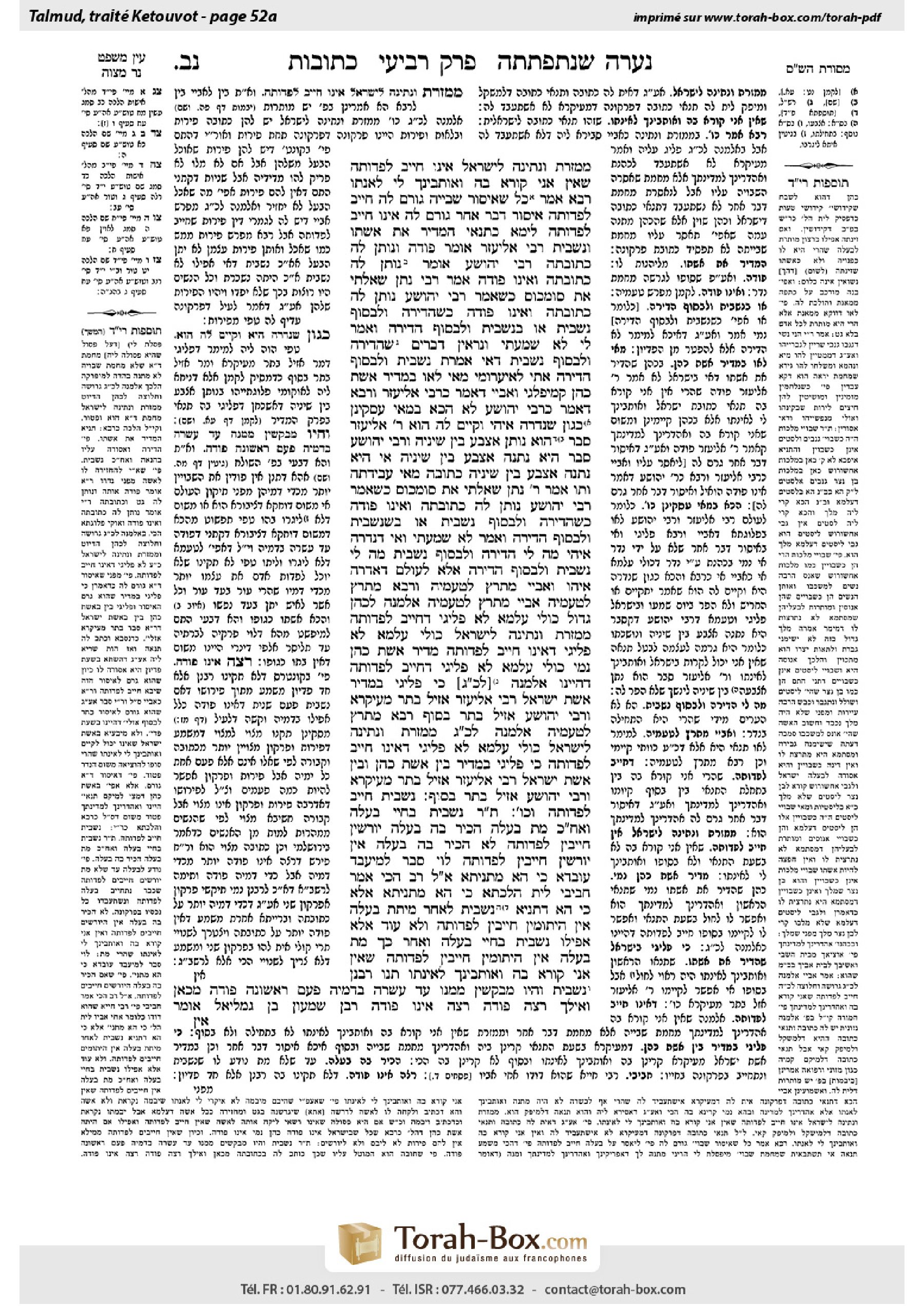
Ketubot 52a: Talmud study for Daf Yomi
Daf Yomi is the daily study of one Talmud folio. Explore 37 tractates with scans, Hebrew text, Sefaria English and AI-generated French translations where annotated.
Passage selection and English or AI-generated French translation are available where the scan has annotations. Daf Study is independent of Torah-Box and Sefaria.
Browse Ketubot · כתובות · All tractatesKetubot 52a text and translations
This page of Ketubot includes the Aramaic text, an English translation and an AI-generated French translation, alongside the scan above.
כתובות נ״ב א · Aramaic and Hebrew text
מַמְזֶרֶת וּנְתִינָה לְיִשְׂרָאֵל — אֵינוֹ חַיָּיב לִפְדּוֹתָהּ, שֶׁאֵין אֲנִי קוֹרֵא בָּהּ ״וְאוֹתְבִינִּךְ לִי לְאִנְתּוּ״. רָבָא אָמַר: כֹּל שֶׁאִיסּוּר שְׁבִיָּיה גּוֹרֵם לָהּ — חַיָּיב לִפְדּוֹתָהּ, אִיסּוּר דָּבָר אַחֵר גּוֹרֵם לָהּ — אֵינוֹ חַיָּיב לִפְדּוֹתָהּ.
לֵימָא כְּתַנָּאֵי: הַמַּדִּיר אֶת אִשְׁתּוֹ וְנִשְׁבֵּית — רַבִּי אֱלִיעֶזֶר אוֹמֵר: פּוֹדָהּ, וְנוֹתֵן לָהּ כְּתוּבָּתָהּ. רַבִּי יְהוֹשֻׁעַ אוֹמֵר: נוֹתֵן לָהּ כְּתוּבָּתָהּ, וְאֵינוֹ פּוֹדָהּ.
אָמַר רַבִּי נָתָן, שָׁאַלְתִּי אֶת סוֹמְכוֹס: כְּשֶׁאָמַר רַבִּי יְהוֹשֻׁעַ נוֹתֵן לָהּ כְּתוּבָּתָהּ וְאֵינוֹ פּוֹדָהּ, כְּשֶׁהִדִּירָהּ וּלְבַסּוֹף נִשְׁבֵּית, אוֹ בְּנִשְׁבֵּית וּלְבַסּוֹף הִדִּירָהּ?
וְאָמַר לִי: לֹא שָׁמַעְתִּי, וְנִרְאִין דְּבָרִים שֶׁהִדִּירָהּ וּלְבַסּוֹף נִשְׁבֵּית. דְּאִי אָמְרַתְּ נִשְׁבֵּית וּלְבַסּוֹף הִדִּירָהּ — אָתֵי לְאִיעָרוֹמֵי.
מַאי לָאו: בְּמַדִּיר אֵשֶׁת כֹּהֵן קָמִיפַּלְגִי, וְאַבָּיֵי דְּאָמַר כְּרַבִּי אֱלִיעֶזֶר, וְרָבָא דְּאָמַר כְּרַבִּי יְהוֹשֻׁעַ?
לָא, הָכָא בְּמַאי עָסְקִינַן? כְּגוֹן שֶׁנָּדְרָה אִיהִי, וְקַיֵּים לַהּ הוּא. רַבִּי אֱלִיעֶזֶר סָבַר: הוּא נוֹתֵן אֶצְבַּע בֵּין שִׁינֶּיהָ. וְרַבִּי יְהוֹשֻׁעַ סָבַר: הִיא נָתְנָה אֶצְבַּע בֵּין שִׁינֶּיהָ.
אִי הִיא נָתְנָה אֶצְבַּע בֵּין שִׁינֶּיהָ — כְּתוּבָּה מַאי עֲבִידְתַּהּ?
וְתוּ, אָמַר רַבִּי נָתָן, שָׁאַלְתִּי אֶת סוֹמְכוֹס: כְּשֶׁאָמַר רַבִּי יְהוֹשֻׁעַ נוֹתֵן לָהּ כְּתוּבָּתָהּ וְאֵינוֹ פּוֹדָהּ, כְּשֶׁהִדִּירָהּ וּלְבַסּוֹף נִשְׁבֵּית, אוֹ בְּשֶׁנִּשְׁבֵּית וּלְבַסּוֹף הִדִּירָהּ? וְאָמַר: לֹא שָׁמַעְתִּי.
וְאִי דִּנְדַרָה אִיהִי, מָה לִי הִדִּירָהּ וּלְבַסּוֹף נִשְׁבֵּית, מָה לִי נִשְׁבֵּית וּלְבַסּוֹף הִדִּירָהּ?
אֶלָּא, לְעוֹלָם דְּאַדְּרַהּ אִיהוּ. וְאַבָּיֵי מְתָרֵץ לְטַעְמֵיהּ, וְרָבָא מְתָרֵץ לְטַעְמֵיהּ. אַבָּיֵי מְתָרֵץ לְטַעְמֵיהּ: אַלְמָנָה לְכֹהֵן גָּדוֹל כּוּלֵּי עָלְמָא לָא פְּלִיגִי דְּחַיָּיב לִפְדּוֹתָהּ, מַמְזֶרֶת וּנְתִינָה לְיִשְׂרָאֵל כּוּלֵּי עָלְמָא לָא פְּלִיגִי דְּאֵינוֹ חַיָּיב לִפְדּוֹתָהּ. מַדִּיר אֵשֶׁת כֹּהֵן נָמֵי, כּוּלֵּי עָלְמָא לָא פְּלִיגִי דְּחַיָּיב לִפְדּוֹתָהּ. דְּהַיְינוּ אַלְמָנָה [לְכֹהֵן גָּדוֹל].
כִּי פְּלִיגִי בְּמַדִּיר אֵשֶׁת יִשְׂרָאֵל. רַבִּי אֱלִיעֶזֶר אָזֵיל בָּתַר מֵעִיקָּרָא, וְרַבִּי יְהוֹשֻׁעַ אָזֵיל בָּתַר בַּסּוֹף.
רָבָא מְתָרֵץ לְטַעְמֵיהּ: אַלְמָנָה לְכֹהֵן גָּדוֹל, מַמְזֶרֶת וּנְתִינָה לְיִשְׂרָאֵל — כּוּלֵּי עָלְמָא לָא פְּלִיגִי דְּאֵינוֹ חַיָּיב לִפְדּוֹתָהּ. כִּי פְּלִיגִי בְּמַדִּיר, בֵּין אֵשֶׁת כֹּהֵן וּבֵין אֵשֶׁת יִשְׂרָאֵל.
רַבִּי אֱלִיעֶזֶר אָזֵיל בָּתַר מֵעִיקָּרָא, וְרַבִּי יְהוֹשֻׁעַ אָזֵיל בָּתַר בַּסּוֹף.
נִשְׁבֵּית חַיָּיב לִפְדּוֹתָהּ וְכוּ׳. תָּנוּ רַבָּנַן: נִשְׁבֵּית בְּחַיֵּי בַּעְלָהּ, וְאַחַר כָּךְ מֵת בַּעְלָהּ. הִכִּיר בָּהּ בַּעֲלָהּ — יוֹרְשִׁין חַיָּיבִין לִפְדּוֹתָהּ. לֹא הִכִּיר בָּהּ בַּעֲלָהּ — אֵין יוֹרְשִׁין חַיָּיבִין לִפְדּוֹתָהּ.
לֵוִי סָבַר לְמִיעְבַּד עוֹבָדָא כִּי הָא מַתְנִיתָא. אֲמַר לֵיהּ רַב, הָכִי אָמַר חַבִּיבִי: לֵית הִלְכְתָא כִּי הָא מַתְנִיתָא, אֶלָּא כִּי הָא דְּתַנְיָא: נִשְׁבֵּית לְאַחַר מִיתַת בַּעְלָהּ — אֵין הַיְּתוֹמִין חַיָּיבִין לִפְדּוֹתָהּ. וְלֹא עוֹד, אֶלָּא אֲפִילּוּ נִשְׁבֵּית בְּחַיֵּי בַּעְלָהּ, וְאַחַר כָּךְ מֵת בַּעְלָהּ — אֵין הַיְּתוֹמִין חַיָּיבִין לִפְדּוֹתָהּ. שֶׁאֵין אֲנִי קוֹרֵא בָּהּ ״וְאוֹתְבִינִּךְ לְאִינְתּוּ״.
תָּנוּ רַבָּנַן: נִשְׁבֵּית, וְהָיוּ מְבַקְּשִׁין מִמֶּנּוּ עַד עֲשָׂרָה בְּדָמֶיהָ, פַּעַם רִאשׁוֹנָה — פּוֹדָהּ. מִכָּאן וְאֵילָךְ: רָצָה פּוֹדָהּ, רָצָה אֵינוֹ פּוֹדָהּ. רַבָּן שִׁמְעוֹן בֶּן גַּמְלִיאֵל אוֹמֵר:
Ketubot 52a · English translation
In the case of a mamzeret or a Gibeonite woman married to an Israelite, who are entitled to a marriage contract despite the fact that the relationship is forbidden and they must get divorced, he is not obligated to redeem her, as I do not apply to her the clause: And I will restore you to me as a wife, as she is forbidden to him. Rava said: In any case where the prohibition of her captivity, i.e., the fact that she was taken captive, causes her to be forbidden to her husband, as in the case of a priest’s wife who was taken captive, he is obligated to redeem her. However, if another prohibition causes her to be forbidden to her husband, e.g., the case of a widow who is married to a High Priest, he is not obligated to redeem her.
The Gemara suggests: Let us say that this is parallel to a dispute between tanna’im. As it is taught in a baraita: In the case of one who vows that his wife may not derive benefit from him, in which case he must divorce her, and she is then taken captive, Rabbi Eliezer says: He redeems her and gives her the payment for her marriage contract. Rabbi Yehoshua says: He gives her the payment for her marriage contract but he does not have to redeem her, as he may not take her back as his wife, due to his vow.
Rabbi Natan said: I asked Sumakhos: When Rabbi Yehoshua said that he gives her the payment for her marriage contract but he does not have to redeem her, was he referring to a case where he vowed that she may not derive benefit from him and she was subsequently taken captive, or was he speaking of one who was taken captive and he subsequently vowed that she may not derive benefit from him?
And he said to me: I have not heard a tradition on this matter, but it would appear that Rabbi Yehoshua does not obligate the husband to redeem her in a situation where he vowed that she may not derive benefit from him and she was subsequently taken captive. As, if you say that the same halakha applies in a case where she was taken captive and he subsequently vowed that she may not derive benefit from him, the husband might come to engage in trickery. If he wants to release himself from the duty to ransom his wife after she is captured, he can simply vow that she may not derive benefit from him, in which case he would be obligated to pay her only the marriage contract.
The Gemara now analyzes the suggested comparison between the opinions cited in this baraita and the dispute between Abaye and Rava. What, is it not the case that the tanna’im disagree about a priest who vows that his wife, i.e., the wife of a priest, may not derive benefit from him? And Abaye spoke in accordance with the opinion of Rabbi Eliezer when he said that the husband must redeem his wife even if she is forbidden to him due to something other than the fact that she was taken captive, and Rava spoke in accordance with the opinion of Rabbi Yehoshua.
The Gemara refutes this suggestion: No; with what are we dealing here? With a case where she vowed not to derive benefit from him, and her husband upheld it for her by neglecting to nullify her vow when he heard it. The Gemara explains: Rabbi Eliezer maintains that he is putting his finger between her teeth, i.e., he causes the vow to be in effect, and therefore he must redeem her and return her to her native province. And Rabbi Yehoshua maintains that she put her finger between her own teeth, i.e., she is responsible for the vow, because she is the one who initially pronounced it.
The Gemara asks: If Rabbi Yehoshua maintains that she put her finger between her own teeth, what is the payment of the marriage contract doing here? Why must he pay her marriage contract if it is her fault that they cannot remain married?
And furthermore, it was stated above that Rabbi Natan said: I asked Sumakhos: When Rabbi Yehoshua said that he gives her the payment for her marriage contract but he does not have to redeem her, was he referring to a case where he vowed that she may not derive benefit from him and she was subsequently taken captive, or was he speaking of one who was taken captive and he subsequently vowed that she may not derive benefit from him? And he said to me: I have not heard a tradition on this matter, but it is reasonable to assume that the case is where he took the vow and she was subsequently taken captive, as otherwise there is a concern that the husband will engage in trickery.
But if this is referring to a case where she was the one who vowed not to derive benefit from him, what is the difference to me whether he upheld her vow and she was subsequently taken captive, and what is the difference to me whether she was taken captive and he subsequently upheld her vow? Either way there is no reason to be concerned that he might engage in trickery, since she was the one who took the vow.
Rather, this is actually referring to a case where he was the one who initially vowed that she may not derive benefit from him. And Abaye explains the baraita according to his line of reasoning, and Rava explains the baraita according to his line of reasoning. Abaye explains the baraita according to his line of reasoning as follows: With regard to a widow who is married to a High Priest, everyone agrees that he is obligated to redeem her. If she was a mamzeret or a Gibeonite woman married to an Israelite, everyone agrees that he is not obligated to redeem her. In the case of a priest who takes a vow prohibiting his wife, i.e., the wife of a priest, from deriving benefit from him, likewise everyone agrees that he is obligated to redeem her, as this is the same as the case of a widow who is married to a High Priest, as he can fulfill the requirement to restore her to her native province.
When they disagree it is in the case of an Israelite who vows that his wife, i.e., the wife of an Israelite, may not derive benefit from him. Rabbi Eliezer follows the status of the woman at the outset, i.e., when the marriage contract was written. Since at that time he could restore her to be his wife, the obligation he took upon himself to redeem her from captivity remains in effect, despite the fact that he can no longer do so due to the vow. And Rabbi Yehoshua follows the status of the woman at the end, and holds that since, in practice, the husband cannot take her back as a wife because of the vow, he is no longer obligated to ransom her.
Similarly, Rava explains the baraita according to his line of reasoning: In the case of a widow married to a High Priest, and a mamzeret or a Gibeonite woman married to an Israelite, everyone agrees that he is not obligated to redeem her, as the prohibition against her remaining married to him results from a cause other than her captivity. When they disagree it is with regard to one who vows that his wife may not derive benefit from him, whether she is the wife of a priest or the wife of an Israelite.
Rabbi Eliezer follows her status at the outset and holds that since he obligated himself to ransom her when he wrote the marriage contract he must act accordingly. And Rabbi Yehoshua follows her status at the end, and holds that since he cannot fulfill his obligation to restore her as his wife due to a factor other than her captivity, he is entirely exempt from redeeming her.
§ The mishna taught that if she was taken captive, her husband is obligated to redeem her. The Sages taught in a baraita: In the case of a wife who was taken captive in her husband’s lifetime and afterward her husband died before he could redeem her, if her husband was aware of her captivity, the heirs are obligated to redeem her, but if her husband was not aware of her captivity, his heirs are not obligated to redeem her.
The Gemara relates: Levi thought to act in accordance with this baraita. Rav said to him: My uncle [ḥavivi], Rabbi Ḥiyya, said as follows: The halakha is not in accordance with this baraita. Rather, it is in accordance with that which is taught in a different baraita: If she was taken captive after the death of her husband, the orphans are not obligated to redeem her. And moreover, even if she was taken captive in her husband’s lifetime and he heard about it, and afterward her husband died, the orphans are not obligated to redeem her, as I cannot apply to her the clause in the marriage contract: And I will restore you to me as a wife. Since this stipulation cannot be fulfilled, the obligation to redeem her does not apply.
§ The Sages taught: If she was taken captive and they were seeking ransom from her husband of up to ten times her value, i.e., far more than the usual ransom for a captive of this kind, on the first occasion she is taken captive he must redeem her. From this point forward, i.e., if she was taken captive a second time, if he wants to, he redeems her, but if he does not want to redeem her, he does not have to redeem her, as the Sages obligated him to redeem her only once. Rabban Shimon ben Gamliel says:
Ketubot 52a · Traduction française (IA)
Dans le cas d’une mamzeret ou d’une femme guibonite mariée à un Israélite, qui ont droit à une ketouba bien que leur union soit interdite et qu’ils doivent divorcer, le mari n’est pas tenu de la racheter, car je ne lui applique pas la clause : « Je te ramènerai auprès de moi comme épouse », puisqu’elle lui est interdite. Rava a dit : Chaque fois que c’est l’interdiction liée à sa captivité, c’est-à-dire le fait qu’elle ait été capturée, qui la rend interdite à son mari, comme dans le cas de l’épouse d’un prêtre capturée, le mari est tenu de la racheter. En revanche, si une autre interdiction la rend interdite à son mari, par exemple dans le cas d’une veuve mariée à un grand prêtre, il n’est pas tenu de la racheter.
La Guemara propose : Disons que cela correspond à une controverse entre tannaïm. En effet, il est enseigné dans une baraïta : Dans le cas d’un homme qui fait le vœu que son épouse ne tire aucun bénéfice de lui, de sorte qu’il doit divorcer, et qu’elle est ensuite capturée, Rabbi Eliézer dit : Il la rachète et lui verse la somme prévue par sa ketouba. Rabbi Yehoshoua dit : Il lui verse la somme prévue par sa ketouba, mais il n’est pas tenu de la racheter, car, en raison de son vœu, il ne peut pas la reprendre comme épouse.
Rabbi Natan a dit : J’ai demandé à Soumakhos : Lorsque Rabbi Yehoshoua a dit qu’il lui verse la somme prévue par sa ketouba, mais qu’il n’est pas tenu de la racheter, parlait-il du cas où il avait fait le vœu qu’elle ne tire aucun bénéfice de lui et où elle avait ensuite été capturée, ou parlait-il du cas où elle avait été capturée et où il avait ensuite fait le vœu qu’elle ne tire aucun bénéfice de lui ?
Il m’a répondu : Je n’ai pas reçu de tradition à ce sujet, mais il semble que Rabbi Yehoshoua ne dispense le mari de la racheter que dans le cas où il a fait le vœu qu’elle ne tire aucun bénéfice de lui et où elle a ensuite été capturée. En effet, si tu dis que la même halakha s’applique aussi lorsqu’elle a été capturée et qu’il a ensuite fait le vœu qu’elle ne tire aucun bénéfice de lui, le mari pourrait en venir à user d’un stratagème. S’il veut se libérer de l’obligation de rançonner son épouse après sa capture, il lui suffit de faire le vœu qu’elle ne tire aucun bénéfice de lui ; il ne serait alors tenu de lui verser que la somme prévue par la ketouba.
La Guemara examine à présent la comparaison proposée entre les opinions citées dans cette baraïta et la controverse entre Abayé et Rava. N’est-ce pas que les tannaïm sont en désaccord au sujet d’un prêtre qui fait le vœu que son épouse, c’est-à-dire l’épouse d’un prêtre, ne tire aucun bénéfice de lui ? Abayé s’est exprimé conformément à l’opinion de Rabbi Eliézer, selon laquelle le mari doit racheter son épouse même si elle lui est interdite pour une raison autre que sa capture ; Rava, lui, s’est exprimé conformément à l’opinion de Rabbi Yehoshoua.
La Guemara réfute cette proposition : Non. De quoi s’agit-il ici ? Du cas où elle a fait le vœu de ne tirer aucun bénéfice de lui et où son mari l’a maintenu en ne l’annulant pas lorsqu’il en a eu connaissance. La Guemara explique : Rabbi Eliézer estime que c’est lui qui met son doigt entre ses dents, c’est-à-dire qu’il fait en sorte que le vœu reste en vigueur ; il doit donc la racheter et la ramener dans sa province d’origine. Rabbi Yehoshoua estime, lui, que c’est elle qui met son doigt entre ses propres dents, c’est-à-dire qu’elle est responsable du vœu, puisqu’elle est celle qui l’a formulé au départ.
La Guemara demande : Si Rabbi Yehoshoua estime que c’est elle qui a mis son doigt entre ses propres dents, que vient faire ici le paiement de la ketouba ? Pourquoi doit-il lui verser la somme prévue par sa ketouba si c’est sa faute s’ils ne peuvent pas rester mariés ?
Et de plus, il a été dit précédemment que Rabbi Natan a dit : J’ai demandé à Soumakhos : Lorsque Rabbi Yehoshoua a dit qu’il lui verse la somme prévue par sa ketouba, mais qu’il n’est pas tenu de la racheter, parlait-il du cas où il avait fait le vœu qu’elle ne tire aucun bénéfice de lui et où elle avait ensuite été capturée, ou parlait-il du cas où elle avait été capturée et où il avait ensuite fait le vœu qu’elle ne tire aucun bénéfice de lui ? Il m’a répondu : Je n’ai pas reçu de tradition à ce sujet, mais il est raisonnable de supposer qu’il s’agit du cas où il a fait le vœu et où elle a ensuite été capturée, car sinon on craindrait que le mari use d’un stratagème.
Mais si cela se rapporte au cas où c’est elle qui a fait le vœu de ne tirer aucun bénéfice de lui, quelle différence cela fait-il qu’il ait maintenu son vœu et qu’elle ait ensuite été capturée, ou qu’elle ait été capturée et qu’il ait ensuite maintenu son vœu ? Dans un cas comme dans l’autre, il n’y a aucune raison de craindre qu’il use d’un stratagème, puisqu’elle est celle qui a fait le vœu.
En réalité, il s’agit du cas où c’est lui qui a initialement fait le vœu qu’elle ne tire aucun bénéfice de lui. Abayé explique la baraïta selon son raisonnement, et Rava l’explique selon le sien. Abayé explique la baraïta comme suit : Dans le cas d’une veuve mariée à un grand prêtre, tous conviennent qu’il est tenu de la racheter. Si une mamzeret ou une femme guibonite est mariée à un Israélite, tous conviennent qu’il n’est pas tenu de la racheter. Quant au cas d’un prêtre qui fait le vœu interdisant à son épouse, c’est-à-dire à l’épouse d’un prêtre, de tirer bénéfice de lui, tous conviennent également qu’il est tenu de la racheter, car ce cas est comparable à celui d’une veuve mariée à un grand prêtre : il peut accomplir l’obligation de la ramener dans sa province d’origine.
Le désaccord porte sur le cas d’un Israélite qui fait le vœu que son épouse, c’est-à-dire l’épouse d’un Israélite, ne tire aucun bénéfice de lui. Rabbi Eliézer tient compte du statut de la femme au départ, c’est-à-dire au moment où la ketouba a été rédigée. Puisqu’à ce moment-là il pouvait la reprendre comme épouse, l’obligation qu’il avait assumée de la racheter de captivité reste en vigueur, bien qu’il ne puisse désormais plus le faire en raison du vœu. Rabbi Yehoshoua tient compte du statut de la femme à la fin et estime que, puisque, en pratique, le mari ne peut pas la reprendre comme épouse à cause du vœu, il n’est plus tenu de la rançonner.
De même, Rava explique la baraïta selon son raisonnement : Dans le cas d’une veuve mariée à un grand prêtre, ainsi que d’une mamzeret ou d’une femme guibonite mariée à un Israélite, tous conviennent que le mari n’est pas tenu de la racheter, puisque l’interdiction de rester mariée à lui résulte d’une cause autre que sa captivité. Le désaccord porte sur le cas d’un homme qui fait le vœu que son épouse ne tire aucun bénéfice de lui, qu’elle soit l’épouse d’un prêtre ou celle d’un Israélite.
Rabbi Eliézer tient compte de son statut au départ et estime que, puisqu’il s’est engagé à la rançonner lorsqu’il a rédigé la ketouba, il doit agir en conséquence. Rabbi Yehoshoua tient compte de son statut à la fin et estime que, puisqu’il ne peut pas accomplir son obligation de la reprendre comme épouse en raison d’un facteur autre que sa captivité, il est entièrement dispensé de la racheter.
§ La Michna a enseigné que si elle a été capturée, son mari est tenu de la racheter. Les Sages ont enseigné dans une baraïta : Dans le cas d’une épouse capturée du vivant de son mari, qui meurt ensuite avant d’avoir pu la racheter, si son mari avait connaissance de sa captivité, les héritiers sont tenus de la racheter ; mais si son mari n’avait pas connaissance de sa captivité, ses héritiers ne sont pas tenus de la racheter.
La Guemara rapporte : Lévi pensa agir conformément à cette baraïta. Rav lui dit : Mon oncle [ḥavivi], Rabbi Ḥiyya, a enseigné comme suit : La halakha n’est pas conforme à cette baraïta. Elle est plutôt conforme à ce qui est enseigné dans une autre baraïta : Si elle a été capturée après la mort de son mari, les orphelins ne sont pas tenus de la racheter. Et de plus, même si elle a été capturée du vivant de son mari, qu’il en a été informé, puis qu’il est mort, les orphelins ne sont pas tenus de la racheter, car je ne peux pas lui appliquer la clause de la ketouba : « Je te ramènerai auprès de moi comme épouse. » Puisque cette stipulation ne peut pas être exécutée, l’obligation de la racheter ne s’applique pas.
§ Les Sages ont enseigné : Si elle a été capturée et que son mari doit payer une rançon pouvant aller jusqu’à dix fois sa valeur, c’est-à-dire bien davantage que la rançon habituelle pour une captive de ce type, la première fois qu’elle est capturée, il doit la racheter. À partir de ce moment, c’est-à-dire si elle est capturée une deuxième fois, s’il le souhaite, il la rachète ; mais s’il ne souhaite pas la racheter, il n’y est pas tenu, car les Sages ne lui ont imposé de la racheter qu’une seule fois. Rabban Shimon ben Gamliel dit :
Traduction française générée par IA à partir de l’édition anglaise de Sefaria. Vérifie toujours un passage avec le texte source.
Text from Sefaria: William Davidson Edition - Vocalized Aramaic (CC BY NC); William Davidson Edition - English (CC BY NC).