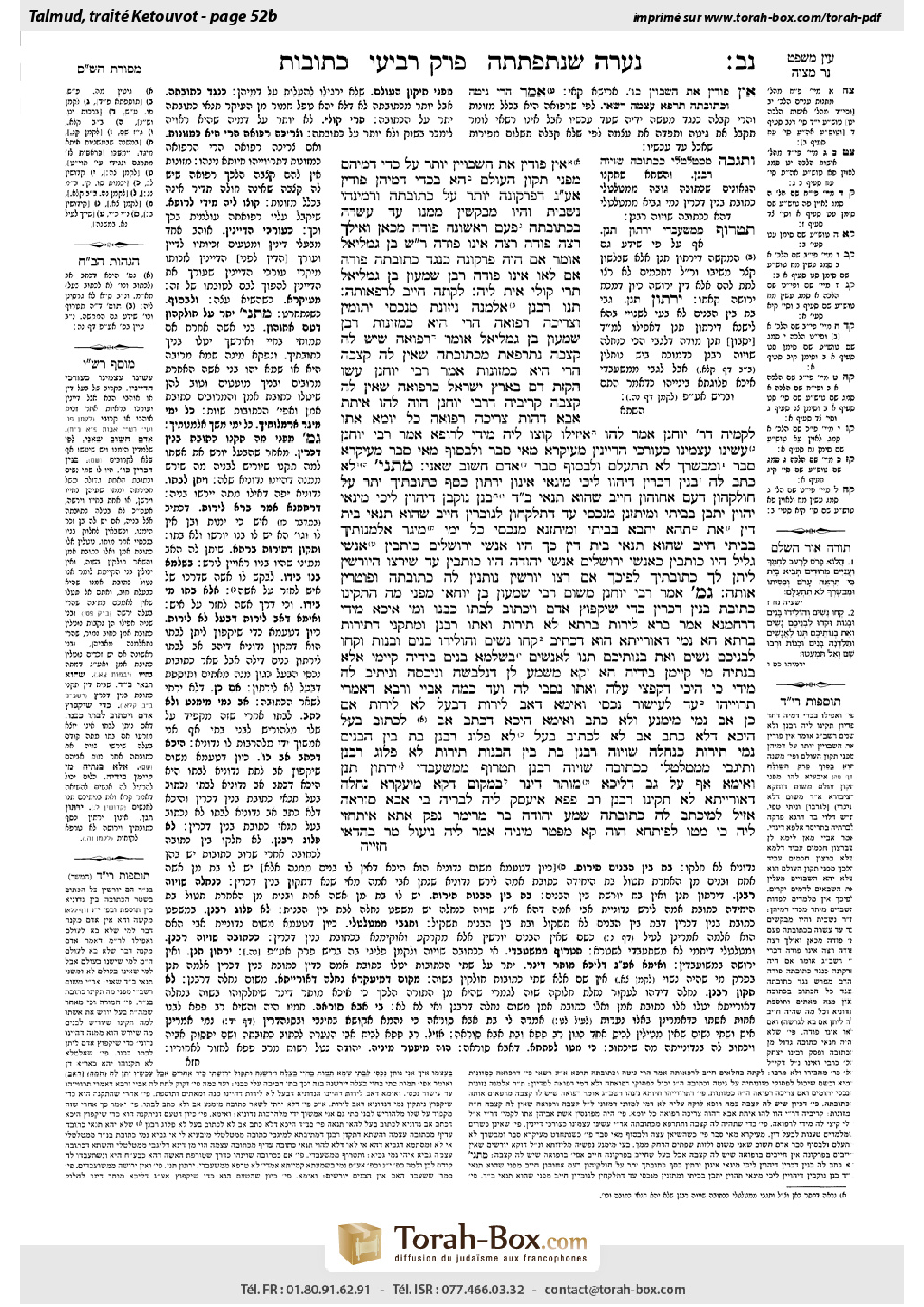
Ketubot 52b: Talmud study for Daf Yomi
Daf Yomi is the daily study of one Talmud folio. Explore 37 tractates with scans, Hebrew text, Sefaria English and AI-generated French translations where annotated.
Passage selection and English or AI-generated French translation are available where the scan has annotations. Daf Study is independent of Torah-Box and Sefaria.
Browse Ketubot · כתובות · All tractatesKetubot 52b text and translations
This page of Ketubot includes the Aramaic text, an English translation and an AI-generated French translation, alongside the scan above.
כתובות נ״ב ב · Aramaic and Hebrew text
אֵין פּוֹדִין אֶת הַשְּׁבוּיִין יוֹתֵר עַל כְּדֵי דְמֵיהֶם, מִפְּנֵי תִּקּוּן הָעוֹלָם. הָא בִּכְדֵי דְמֵיהֶן פּוֹדִין, אַף עַל גַּב דְּפִרְקוֹנָהּ יוֹתֵר עַל כְּתוּבָּתָהּ.
וּרְמִינְהִי: נִשְׁבֵּית, וְהָיוּ מְבַקְּשִׁין מִמֶּנּוּ עַד עֲשָׂרָה בִּכְתוּבָּתָהּ, פַּעַם רִאשׁוֹנָה — פּוֹדָהּ. מִכָּאן וְאֵילָךְ: רָצָה פּוֹדָהּ, רָצָה אֵינוֹ פּוֹדָהּ. רַבִּי שִׁמְעוֹן בֶּן גַּמְלִיאֵל אוֹמֵר: אִם הָיָה פִּרְקוֹנָהּ כְּנֶגֶד כְּתוּבָּתָהּ — פּוֹדָהּ, אִם לָאו אֵינוֹ פּוֹדָהּ!
רַבָּן שִׁמְעוֹן בֶּן גַּמְלִיאֵל תְּרֵי קוּלֵּי אִית לֵיהּ.
לָקְתָה חַיָּיב לְרַפְּאוֹתָהּ. תָּנוּ רַבָּנַן: אַלְמָנָה נִיזּוֹנֶת מִנִּכְסֵי יְתוֹמִין וּצְרִיכָה רְפוּאָה — הֲרֵי הִיא כִּמְזוֹנוֹת. רַבָּן שִׁמְעוֹן בֶּן גַּמְלִיאֵל אוֹמֵר: רְפוּאָה שֶׁיֵּשׁ לָהּ קִצְבָה (נִתְרַפֵּאת) [תִּתְרַפֵּא] — מִכְּתוּבָּתָהּ, שֶׁאֵין לָהּ קִצְבָה — הֲרֵי הִיא כִּמְזוֹנוֹת.
אָמַר רַבִּי יוֹחָנָן: עָשׂוּ הַקָּזַת דָּם בְּאֶרֶץ יִשְׂרָאֵל כִּרְפוּאָה שֶׁאֵין לָהּ קִצְבָה. קָרִיבֵיהּ דְּרַבִּי יוֹחָנָן הֲוָה לְהוּ אִיתַּת אַבָּא דַּהֲוָת צְרִיכָה רְפוּאָה כֹּל יוֹמָא. אֲתוֹ לְקַמֵּיהּ דְּרַבִּי יוֹחָנָן, אֲמַר לְהוּ: אֵיזִילוּ קוּצוּ לֵיהּ מִידֵּי לְרוֹפֵא.
אָמַר רַבִּי יוֹחָנָן: עָשִׂינוּ עַצְמֵינוּ כְּעוֹרְכֵי הַדַּיָּינִין. מֵעִיקָּרָא מַאי סְבַר, וּלְבַסּוֹף מַאי סְבַר? מֵעִיקָּרָא סְבַר: ״וּמִבְּשָׂרְךָ לֹא תִתְעַלָּם״, וּלְבַסּוֹף סְבַר: אָדָם חָשׁוּב שָׁאנֵי.
מַתְנִי׳ לֹא כָּתַב לָהּ ״בְּנִין דִּכְרִין דְּיִהְווֹ לִיכִי מִינַּאי אִינּוּן יִרְתוּן כֶּסֶף כְּתוּבְּתִיךְ יָתֵר עַל חוּלָקְהוֹן דְּעִם אֲחוּהוֹן״ — חַיָּיב, שֶׁהוּא תְּנַאי בֵּית דִּין. ״בְּנָן נוּקְבָן דְּיִהְוֹין לִיכִי מִינַּאי יֶהֶוְיָן יָתְבָן בְּבֵיתִי וּמִיתַּזְנָן מִנִּכְסַי עַד דְּתִלַּקְחָן לְגוּבְרִין״ — חַיָּיב, שֶׁהוּא תְּנַאי בֵּית דִּין.
״אַתְּ תְּהֵא יָתְבָא בְּבֵיתִי וּמִיתַּזְנָא מִנִּכְסַי כֹּל יְמֵי מֵיגַר אַלְמְנוּתִיךְ בְּבֵיתִי״ — חַיָּיב, שֶׁהוּא תְּנַאי בֵּית דִּין. כָּךְ הָיוּ אַנְשֵׁי יְרוּשָׁלַיִם כּוֹתְבִין. אַנְשֵׁי גָלִיל הָיוּ כּוֹתְבִין כְּאַנְשֵׁי יְרוּשָׁלַיִם. אַנְשֵׁי יְהוּדָה הָיוּ כּוֹתְבִין: ״עַד שֶׁיִּרְצוּ הַיּוֹרְשִׁין לִיתֵּן לִךְ כְּתוּבְּתִיךְ״. לְפִיכָךְ אִם רָצוּ יוֹרְשִׁין — נוֹתְנִין לָהּ כְּתוּבָּתָהּ וּפוֹטְרִין אוֹתָהּ.
גְּמָ׳ אָמַר רַבִּי יוֹחָנָן מִשּׁוּם רַבִּי שִׁמְעוֹן בֶּן יוֹחַאי: מִפְּנֵי מָה הִתְקִינוּ כְּתוּבַּת בְּנִין דִּכְרִין — כְּדֵי שֶׁיִּקְפּוֹץ אָדָם וְיִכְתּוֹב לְבִתּוֹ כִּבְנוֹ.
וּמִי אִיכָּא מִידֵּי דְּרַחֲמָנָא אָמַר בְּרָא לֵירוֹת בְּרַתָּא לָא תֵּירוֹת, וַאֲתוֹ רַבָּנַן וּמְתַקְּנִי דְּתֵירוֹת בְּרַתָּא?
הָא נָמֵי דְּאוֹרָיְיתָא הוּא, דִּכְתִיב: ״קְחוּ נָשִׁים וְהוֹלִידוּ בָּנִים וּבָנוֹת וּקְחוּ לִבְנֵיכֶם נָשִׁים וְאֶת בְּנוֹתֵיכֶם תְּנוּ לַאֲנָשִׁים״. בִּשְׁלָמָא בָּנִים — בִּידֵיהּ קָיְימִי. אֶלָּא בְּנָתֵיהּ, מִי קָיְימָן בִּידֵיהּ?
הָא קָא מַשְׁמַע לַן, דְּנַלְבְּשַׁהּ וְנִיכַסְּיַהּ וְנִיתֵּיב לַהּ מִידֵּי, כִּי הֵיכִי דְּקָפְצִי עֲלַהּ וְאָתוּ נָסְבִי לַהּ. וְעַד כַּמָּה? אַבָּיֵי וְרָבָא דְּאָמְרִי תַּרְוַיְיהוּ: עַד לְעִישּׂוּר נִכְסֵי.
וְאֵימָא: דְּאָב לֵירוֹת, דְּבַעַל לָא לֵירוֹת! אִם כֵּן, אָב נָמֵי מִימְּנַע וְלָא כָּתֵב.
וְאֵימָא: הֵיכָא דִּכְתַב אָב — לִכְתּוֹב בַּעַל, הֵיכָא דְּלָא כְּתַב אָב — לָא לִכְתּוֹב בַּעַל! לָא פְּלוּג רַבָּנַן.
בַּת בֵּין הַבָּנִים נָמֵי תֵּירוֹת? כְּנַחֲלָה שַׁוְּיוּהָ רַבָּנַן.
בַּת בֵּין הַבָּנוֹת תֵּירוֹת! לָא פְּלוּג רַבָּנַן. וְתִיגְבֵּי מִמִּטַּלְטְלִי? כִּכְתוּבָּה שַׁוְּיוּהָ רַבָּנַן.
תִּטְרוֹף מִמְּשַׁעְבְּדִי! ״יִרְתוּן״ תְּנַן. וְאֵימָא אַף עַל גַּב דְּלֵיכָּא מוֹתַר דִּינָר! בְּמָקוֹם דְּקָא מִיעַקְרָא נַחֲלָה דְּאוֹרָיְיתָא, לָא תַּקִּינוּ רַבָּנַן.
רַב פָּפָּא אִיעֲסַק לֵיהּ לִבְרֵיהּ בֵּי אַבָּא סוּרָאָה. אָזֵיל לְמִיכְתַּב לַהּ כְּתוּבְּתַהּ. שְׁמַע יְהוּדָה בַּר מָרִימָר, נְפַק אֲתָא אִיתְחֲזִי לֵיהּ. כִּי מְטוֹ לְפִיתְחָא, הֲוָה קָא מִפְּטַר מִינֵּיהּ. אֲמַר לֵיהּ: נֵיעוּל מָר בַּהֲדַאי!
Ketubot 52b · English translation
One does not redeem captives at more than their value. This policy is for the betterment of the world, because if captives are ransomed at exorbitant prices, this will encourage their captors to kidnap more people. The Gemara notes: This implies that if the captors seek a ransom in accordance with their actual value one does redeem captives, even though this includes a case where a woman’s redemption is more than her marriage contract.
And the Gemara raises a contradiction from a different baraita, which states: If she was taken captive and the captors were seeking from her husband a ransom of up to ten times the value of her marriage contract, on the first occasion he must redeem her. From this point forward, if he wants to he redeems her, but if he does not want to redeem her, he does not have to redeem her. Rabban Shimon ben Gamliel says: If the price of her ransom was equal to her marriage contract he redeems her. If not, i.e., the price of her ransom was greater than the sum of money guaranteed to her in her marriage contract upon divorce or the death of her husband, he does not have to redeem her. He can suffice with paying her marriage contract.
The Gemara answers: Rabban Shimon ben Gamliel is of the opinion that there are two leniencies with regard to the halakhot of redemption. First, he maintains that one does not pay more than the general ransom given for such a captive, and second, a husband does not have to pay more than the sum of his wife’s marriage contract.
§ The mishna taught (51a) that if a woman was struck with illness, her husband is obligated to heal her, i.e., to pay for her medical expenses. The Sages taught in a baraita: In the case of a widow who is sustained from the property of the orphans and who requires medical treatment, her medical needs are like her sustenance, and the orphans must bear the costs. Rabban Shimon ben Gamliel disagrees and says: With regard to treatment that has a fixed cost, she is healed from her marriage contract, i.e., the amount is subtracted from her marriage contract. If it is a treatment that does not have a fixed cost, it is considered like sustenance.
Rabbi Yoḥanan said: The Sages established that in Eretz Yisrael, bloodletting is considered like a treatment that does not have a fixed cost, and therefore the heirs must pay for that treatment. The Gemara relates: The relatives of Rabbi Yoḥanan had to take care of the wife of their father, who required treatment every day, and therefore her medical expenses were high. They came before Rabbi Yoḥanan to ask him what to do. He said to them: Go and fix a lump sum with the doctor for his services. The treatment would then be considered as having a fixed cost, which is deducted from the marriage contract.
Later Rabbi Yoḥanan said in regret: We have made ourselves like legal advisors, who help people with their legal claims. The Gemara asks: At the outset, what did he hold and ultimately, what did he hold? The Gemara explains: At the outset he held that one should act in accordance with the verse “and that you do not hide yourself from your own flesh” (Isaiah 58:7), which indicates that one must help his relatives. And ultimately he held that an important person is different. If a man of stature offers assistance to his family in a manner that causes a loss to another individual, it appears as though he were unfairly favoring his relatives.
MISHNA: If the husband did not write for her in her marriage contract: Any male children you will have from me will inherit the money of your marriage contract in addition to their portion of the inheritance that they receive together with their brothers, he is nevertheless obligated as though he had written it, as it is a stipulation of the court and therefore takes effect even if it is not explicitly stated. Likewise, if he omitted from the marriage contract the sentence: Any female children you will have from me will sit in my house and be sustained from my property until they are taken by men, i.e., until they are married, he is nevertheless obligated as though he had written it, as it too is a stipulation of the court.
Similarly, if he omitted from the marriage contract the clause: You will sit in my house and be sustained from my property all the days you live as a widow in my house, he is nevertheless obligated as though he had written it, as it is a stipulation of the court. The mishna comments: The residents of Jerusalem would write in this manner, that a widow may remain in her husband’s house throughout her widowhood, and the residents of the Galilee would write in this manner as well, like the inhabitants of Jerusalem. In contrast, the residents of Judea would write: Until the heirs want to give you your marriage contract. Consequently, if the heirs wish, they may give her marriage contract to her and release her, and she must find her own living arrangements and provide for herself.
GEMARA: Rabbi Yoḥanan said in the name of Rabbi Shimon ben Yoḥai: For what reason did the Sages enact the marriage document concerning male children? It was enacted so that a man will be willing to take the initiative and write an agreement to give his daughter a dowry as large as the portion of his possessions that his son will receive as an inheritance. The marriage document concerning male children ensures that even if one’s daughter dies and her husband inherits her possessions, the dowry will eventually be inherited by her sons when her husband dies. Since the father of the bride knows that his grandchildren will inherit the dowry, he will give a larger dowry.
The Gemara asks: And is there anything that justifies a situation where the Merciful One says that the son inherits and the daughter does not inherit, and yet the Sages came and enacted that the daughter should inherit? The practical effect of their decree is that daughters receive a significant portion of their father’s estate, just like sons.
The Gemara answers: This also applies by Torah law, as it is written: “Take wives for yourselves and bear sons and daughters, and take wives for your sons, and give your daughters to husbands” (Jeremiah 29:6). This verse requires clarification. Granted, sons are in his hands, i.e., a father can select wives for them, but daughters, are they in his power that he can select husbands for them? It is not the manner of a woman or her family to court a man.
Rather, the verse teaches us this, that the father should dress her and cover her and give her something, i.e., property, so that men will take the initiative with her and come to marry her. When the verse instructs fathers to marry off their daughters, it means that they must make efforts to ensure this outcome, including bestowing a dowry. The Gemara asks: And up to how much must a father give his daughters? Abaye and Rava both say: Up to one-tenth of one’s property should be handed over to his daughter for her dowry.
The Gemara asks: But if this is the reason for the institution of the marriage document concerning male children, say that it is only the portion the bride’s father gave as a dowry that her sons should inherit, but the money the husband guarantees to pay his wife, they should not inherit. The Gemara answers: If so, the bride’s father will also refrain from writing a large dowry. If his daughter’s sons will not inherit the husband’s portion of the marriage contract, her father will be reluctant to give generously himself.
The Gemara continues to ask: But if the concern is that the father will not give, say that in a case where the father wrote a large dowry for his daughter, let the husband also write the stipulation in the marriage document concerning male children, and when the father did not write a large dowry, let the husband not write this stipulation. The Gemara replies: The Sages did not distinguish between these cases. Although the main purpose of their enactment was to encourage fathers to provide their daughters with generous dowries, the Sages applied their decree equally to all women, even when the father failed to do so.
The Gemara poses another question: If the aim is to ensure that the money of the marriage contract will remain with the woman’s descendants, in a case when one has a daughter from one woman among his sons from another woman, the daughter should likewise inherit her mother’s dowry. Why do only male children inherit their mother’s dowry? The Gemara responds: The Sages established this enactment as similar to the halakha of inheritance: Just as a regular inheritance belongs to sons and not daughters, the same applies to the marriage document concerning male children.
The Gemara continues to inquire: Why shouldn’t one at least say that a daughter among daughters should inherit? If he had a daughter from this wife, and his other children are also daughters, in which case all the daughters divide the inheritance, the daughters of each wife should receive the portion her maternal grandfather gave to her mother. The Gemara again answers: The Sages did not distinguish between these cases when establishing their decree. The Gemara further asks: And let the marriage document concerning male children be collected even from movable property, if that is all the father possesses. The Gemara replies: The Sages established this enactment as similar to a regular marriage contract, which can be collected only from land.
The Gemara poses yet another question: Let it be collected even from liened property, i.e., property the father sold after he wrote the marriage contract. The Gemara answers that we learned in the mishna: Will inherit, and one’s heirs do not inherit property that he has sold. The Gemara asks: But if this is the reason for this enactment, say that it should apply even though there is no more than a dinar beyond the value of the marriage contract that the father left over in his estate. The Sages stated that if no property is left for the inheritance, all the sons share the inheritance equally, in accordance with Torah law. The Gemara answers: In a case where their decree would entirely uproot the halakha of inheritance by Torah law, the Sages did not enact the marriage document concerning male children.
The Gemara relates: Rav Pappa, having arranged for his son to marry into the family of Abba of Sura, went to supervise the writing of the bride’s marriage contract. Yehuda bar Mareimar heard that Rav Pappa was coming, and came out to present himself before him, in honor of his arrival. When they came to the entrance of Abba of Sura’s house, Yehuda bar Mareimar took his leave of him, as he did not wish to enter. Rav Pappa said to him: Let the Master enter inside with me.
Ketubot 52b · Traduction française (IA)
On ne rachète pas les captifs au-delà de leur valeur. Cette règle vise le bien commun, car si les captifs sont rachetés à des prix exorbitants, cela incitera leurs ravisseurs à enlever davantage de personnes. La Guemara fait remarquer que cela implique que si les ravisseurs réclament une rançon correspondant à leur valeur réelle, on rachète les captifs, même si cela inclut le cas où la rançon d’une femme dépasse le montant de sa ketouba.
La Guemara soulève une contradiction à partir d’une autre baraïta, qui enseigne : Si elle a été capturée et que ses ravisseurs réclament à son mari une rançon pouvant atteindre dix fois le montant de sa ketouba, la première fois, il doit la racheter. Par la suite, s’il le souhaite, il la rachète ; mais s’il ne le souhaite pas, il n’est pas tenu de la racheter. Rabban Shimon ben Gamliel dit : Si le montant de sa rançon est égal à celui de sa ketouba, il la rachète. Sinon, c’est-à-dire si le montant de sa rançon dépasse la somme qui lui est garantie par sa ketouba en cas de divorce ou de décès de son mari, il n’est pas tenu de la racheter. Il peut se contenter de lui verser le montant de sa ketouba.
La Guemara répond : Rabban Shimon ben Gamliel estime qu’il existe deux règles de clémence concernant les lois du rachat. Premièrement, il soutient qu’on ne paie pas davantage que la rançon généralement versée pour une captive de ce type ; deuxièmement, un mari n’est pas tenu de payer davantage que le montant de la ketouba de sa femme.
§ La Michna enseigne (51a) que si une femme tombe malade, son mari est tenu de la soigner, c’est-à-dire de payer ses frais médicaux. Les Sages enseignent dans une baraïta : Dans le cas d’une veuve entretenue sur les biens des orphelins et qui a besoin de soins médicaux, ses soins sont assimilés à son entretien, et les orphelins doivent en assumer les frais. Rabban Shimon ben Gamliel n’est pas d’accord et dit : Pour un traitement dont le coût est fixe, elle est soignée sur la somme de sa ketouba, c’est-à-dire que cette somme est déduite de sa ketouba. Si le traitement n’a pas de coût fixe, il est considéré comme faisant partie de son entretien.
Rabbi Yoḥanan dit : Les Sages ont établi qu’en Eretz Israël, la saignée est considérée comme un traitement dont le coût n’est pas fixe ; les héritiers doivent donc en payer les frais. La Guemara rapporte : Les proches de Rabbi Yoḥanan devaient s’occuper de la femme de leur père, qui avait besoin de soins tous les jours, ce qui entraînait des frais médicaux élevés. Ils vinrent consulter Rabbi Yoḥanan pour lui demander quoi faire. Il leur dit : Allez convenir avec le médecin d’un forfait pour ses services. Le traitement serait alors considéré comme ayant un coût fixe, qui serait déduit de la ketouba.
Plus tard, Rabbi Yoḥanan dit avec regret : Nous nous sommes comportés comme des conseillers juridiques, qui aident les gens à faire valoir leurs droits. La Guemara demande : Quelle était son opinion au début, et quelle fut-elle par la suite ? La Guemara explique : Au début, il pensait qu’il fallait agir conformément au verset : « et ne te dérobe pas à ta propre chair » (Isaïe 58:7), qui indique qu’on doit aider ses proches. Par la suite, il a estimé que le cas d’un personnage important est différent. Si un homme éminent aide sa famille d’une manière qui cause une perte à une autre personne, il semble favoriser injustement ses proches.
MICHNA : Si le mari n’a pas écrit dans sa ketouba : « Tous les garçons que tu auras de moi hériteront de l’argent de ta ketouba, en plus de leur part d’héritage qu’ils recevront avec leurs frères », il y est néanmoins tenu comme s’il l’avait écrit, car c’est une stipulation du tribunal, qui prend donc effet même si elle n’est pas explicitement formulée. De même, s’il a omis de la ketouba la phrase : « Toutes les filles que tu auras de moi demeureront dans ma maison et seront entretenues sur mes biens jusqu’à ce qu’elles soient prises par des hommes », c’est-à-dire jusqu’à leur mariage, il y est néanmoins tenu comme s’il l’avait écrite, car c’est également une stipulation du tribunal.
De même, s’il a omis de la ketouba la clause : « Tu demeureras dans ma maison et seras entretenue sur mes biens tous les jours où tu vivras comme veuve dans ma maison », il y est néanmoins tenu comme s’il l’avait écrite, car c’est une stipulation du tribunal. La Michna précise : Les habitants de Jérusalem écrivaient ainsi, stipulant qu’une veuve pouvait demeurer dans la maison de son mari pendant toute sa vie de veuve ; les habitants de la Galilée écrivaient eux aussi de la même manière. En revanche, les habitants de Judée écrivaient : « Jusqu’à ce que les héritiers veuillent te verser ta ketouba. » Par conséquent, si les héritiers le souhaitent, ils peuvent lui verser sa ketouba et la libérer ; elle doit alors trouver elle-même un logement et subvenir à ses besoins.
GUEMARA : Rabbi Yoḥanan a dit au nom de Rabbi Shimon ben Yoḥai : Pour quelle raison les Sages ont-ils institué la clause de la ketouba concernant les garçons ? Elle a été instituée afin qu’un homme soit disposé à prendre l’initiative et à rédiger un accord par lequel il donne à sa fille une dot aussi importante que la part de ses biens que son fils recevra en héritage. Cette clause garantit que même si une fille meurt et que son mari hérite de ses biens, la dot sera finalement héritée par ses fils à la mort de leur père. Sachant que ses petits-enfants hériteront de la dot, le père de la mariée lui donnera une dot plus importante.
La Guemara demande : Y a-t-il donc quelque chose qui justifie une situation où le Miséricordieux dit que le fils hérite et que la fille n’hérite pas, alors que les Sages viennent décréter que la fille hérite ? En pratique, leur décret fait que les filles reçoivent une part importante de la succession de leur père, tout comme les fils.
La Guemara répond : Cela s’applique également selon la Torah, comme il est écrit : « Prenez des femmes et engendrez des fils et des filles ; prenez des femmes pour vos fils et donnez vos filles à des maris » (Jérémie 29:6). Ce verset doit être éclairci. Il est compréhensible que les fils soient à sa disposition, c’est-à-dire qu’un père puisse leur choisir des épouses ; mais les filles, sont-elles en son pouvoir au point qu’il puisse leur choisir des maris ? Il n’est pas dans les usages d’une femme ou de sa famille de courtiser un homme.
Le verset nous enseigne plutôt ceci : le père doit l’habiller, la couvrir et lui donner quelque chose, c’est-à-dire des biens, afin que des hommes prennent l’initiative et viennent l’épouser. Lorsque le verset enjoint aux pères de marier leurs filles, cela signifie qu’ils doivent faire des efforts pour parvenir à ce résultat, notamment en leur accordant une dot. La Guemara demande : Jusqu’à quel montant un père doit-il donner à ses filles ? Abaye et Rava disent tous deux : Il convient de donner à sa fille jusqu’à un dixième de ses biens pour sa dot.
La Guemara demande : Mais si telle est la raison de l’institution de la clause de la ketouba concernant les garçons, disons que seuls les fils héritent de la part donnée en dot par le père de la mariée, mais pas de la somme que le mari garantit de verser à sa femme. La Guemara répond : Dans ce cas, le père de la mariée s’abstiendrait lui aussi de donner une grosse dot. Si les fils de sa fille n’héritent pas de la part que le mari lui garantit dans la ketouba, son père hésitera à donner lui-même généreusement.
La Guemara poursuit sa question : Mais si l’on craint que le père ne donne pas, disons que lorsque le père a inscrit une grosse dot pour sa fille, le mari inscrive également la clause de la ketouba concernant les garçons, et que lorsque le père n’a pas inscrit une grosse dot, le mari n’inscrive pas cette clause. La Guemara répond : Les Sages n’ont pas distingué entre ces cas. Bien que le but principal de leur décret ait été d’encourager les pères à donner à leurs filles des dots généreuses, les Sages ont appliqué leur décret de la même manière à toutes les femmes, même lorsque leur père n’avait pas agi ainsi.
La Guemara pose une autre question : Si le but est de garantir que l’argent de la ketouba demeure dans la descendance de la femme, dans le cas où un homme a une fille d’une femme et des fils d’une autre, cette fille devrait également hériter de la dot de sa mère. Pourquoi seuls les garçons héritent-ils de la dot de leur mère ? La Guemara répond : Les Sages ont établi cette disposition par analogie avec la halakha de l’héritage : de même qu’en matière d’héritage ordinaire, les fils héritent et non les filles, il en va de même pour la clause de la ketouba concernant les garçons.
La Guemara poursuit son interrogation : Pourquoi ne pas dire au moins qu’une fille parmi les filles hérite ? Si un homme a eu une fille de cette épouse et que ses autres enfants sont également des filles, de sorte que toutes les filles se partagent l’héritage, les filles de chaque épouse devraient recevoir la part que leur grand-père maternel avait donnée à leur mère. La Guemara répond de nouveau : Lorsqu’ils ont établi leur décret, les Sages n’ont pas distingué entre ces cas. La Guemara demande encore : Ne pourrait-on pas recouvrer la clause de la ketouba concernant les garçons même sur des biens mobiliers, si ce sont les seuls biens que possède le père ? La Guemara répond : Les Sages ont établi cette disposition par analogie avec une ketouba ordinaire, qui ne peut être recouvrée que sur des biens fonciers.
La Guemara pose encore une question : Ne pourrait-on pas la recouvrer même sur des biens grevés d’une charge, c’est-à-dire des biens que le père a vendus après avoir rédigé la ketouba ? La Guemara répond que nous avons appris dans la Michna : « hériteront », et que les héritiers d’un homme n’héritent pas des biens qu’il a vendus. La Guemara demande : Mais si telle est la raison de cette disposition, disons qu’elle devrait s’appliquer même lorsqu’il ne reste dans la succession du père qu’un dinar au-delà du montant de la ketouba. Les Sages ont déclaré que si aucun bien ne reste pour l’héritage, tous les fils se partagent l’héritage à parts égales, conformément à la Torah. La Guemara répond : Lorsque leur décret aurait entièrement déraciné la halakha de l’héritage selon la Torah, les Sages n’ont pas institué la clause de la ketouba concernant les garçons.
La Guemara rapporte : Rav Pappa, qui avait arrangé le mariage de son fils dans la famille d’Abba de Soura, se rendit pour superviser la rédaction de la ketouba de la mariée. Yehuda bar Mareimar apprit que Rav Pappa venait et sortit à sa rencontre pour lui faire honneur. Lorsqu’ils arrivèrent à l’entrée de la maison d’Abba de Soura, Yehuda bar Mareimar prit congé de lui, car il ne souhaitait pas entrer. Rav Pappa lui dit : Que le Maître entre avec moi.
Traduction française générée par IA à partir de l’édition anglaise de Sefaria. Vérifie toujours un passage avec le texte source.
Text from Sefaria: William Davidson Edition - Vocalized Aramaic (CC BY NC); William Davidson Edition - English (CC BY NC).