Ketubot 53a: Talmud study for Daf Yomi
Daf Yomi is the daily study of one Talmud folio. Explore 37 tractates with scans, Hebrew text, Sefaria English and AI-generated French translations where annotated.
Passage selection and English or AI-generated French translation are available where the scan has annotations. Daf Study is independent of Torah-Box and Sefaria.
Browse Ketubot · כתובות · All tractatesKetubot 53a text and translations
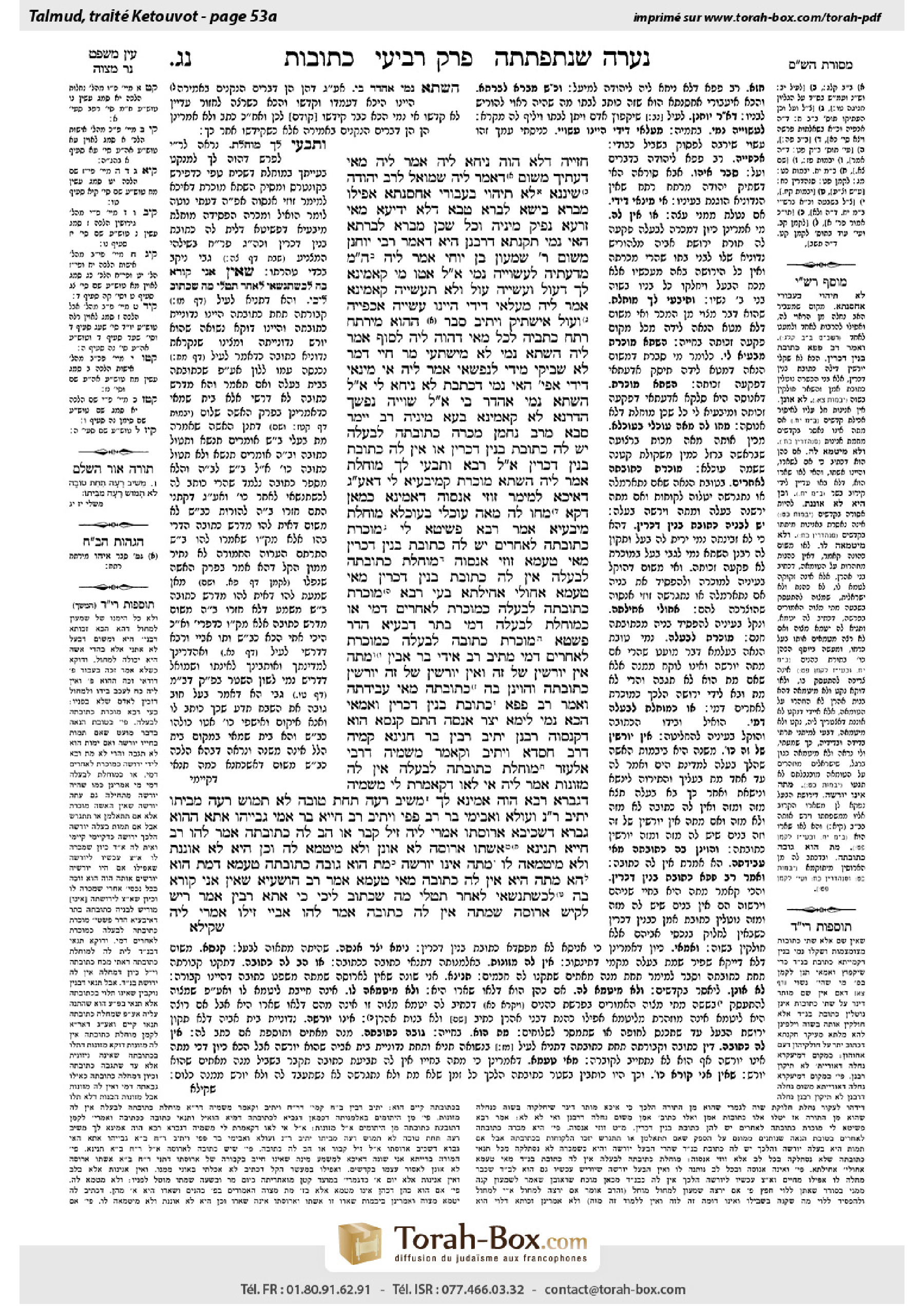
This page of Ketubot includes the Aramaic text, an English translation and an AI-generated French translation, alongside the scan above.
כתובות נ״ג א · Aramaic and Hebrew text
חַזְיֵיהּ דְּלָא הֲוָה נִיחָא לֵיהּ, אֲמַר לֵיהּ: מַאי דַּעְתָּיךְ — מִשּׁוּם דַּאֲמַר לֵיהּ שְׁמוּאֵל לְרַב יְהוּדָה: שִׁינָּנָא, לָא תִּיהְוֵי בְּעַבּוֹרֵי אַחְסָנְתָּא אֲפִילּוּ מִבְּרָא בִּישָׁא לִבְרָא טָבָא — דְּלָא יְדִיעָא מַאי זַרְעָא נָפֵיק מִינֵּיהּ, וְכׇל שֶׁכֵּן מִבְּרָא לִבְרַתָּא,
הַאי נָמֵי תַּקַּנְתָּא דְרַבָּנַן הִיא, דְּאָמַר רַבִּי יוֹחָנָן מִשּׁוּם רַבִּי שִׁמְעוֹן בֶּן יוֹחַי: אֲמַר לֵיהּ: הָנֵי מִילֵּי מִדַּעְתֵּיהּ. לְעַשּׂוֹיֵיהּ נָמֵי? אֲמַר לֵיהּ: אַטּוּ מִי קָאָמֵינָא לָךְ דְּעוּל וְעַשְּׂיֵיהּ? עוּל וְלָא תְּעַשְּׂיֵיהּ קָאָמֵינָא. אֲמַר לֵיהּ: מַעֲלַאי דִּידִי הַיְינוּ עִשֻּׂיֵיהּ.
אַכְפְּיֵיהּ וְעוֹל. אִישְׁתִּיק וִיתֵיב. סְבַר הָהוּא מִירְתָּח רָתַח. כַּתְבֵיהּ לְכֹל מַאי דַּהֲוָה לֵיהּ. לְסוֹף אֲמַר לֵיהּ: הַשְׁתָּא נָמֵי לָא מִישְׁתַּעֵי מָר? חַיֵּי דְּמָר, לָא שְׁבַיקִי מִידֵּי לְנַפְשַׁאי.
אֲמַר לֵיהּ: אִי מִינַּאי דִּידִי — אֲפִילּוּ הַאי נָמֵי דִּכְתַבְתְּ לָא נִיחָא לִי. אֲמַר לֵיהּ: הַשְׁתָּא נָמֵי אֶהְדַּר בִּי. אֲמַר לֵיהּ: שַׁוּוֹיֵי נַפְשָׁךְ הַדְרָנָא — לָא קָאָמֵינָא.
בְּעָא מִינֵּיהּ רַב יֵימַר סָבָא מֵרַב נַחְמָן: מָכְרָה כְּתוּבָּתָהּ לְבַעְלָהּ, יֵשׁ לָהּ כְּתוּבַּת בְּנִין דִּכְרִין אוֹ אֵין לָהּ כְּתוּבַּת בְּנִין דִּכְרִין? אֲמַר לֵיהּ רָבָא: וְתִבְּעֵי לָךְ מוֹחֶלֶת.
אֲמַר לֵיהּ: הַשְׁתָּא, מוֹכֶרֶת קָמִיבַּעְיָא לִי, דְּאַף עַל גַּב דְּאִיכָּא לְמֵימַר זוּזֵי אַנְסוּהָ, דְּאָמֵינָא כְּמַאן דְּקָא מָחוּ לַהּ מְאָה עוּכְלֵי בְּעוּכְלָא, מוֹחֶלֶת מִיבַּעְיָא?!
אָמַר רָבָא, פְּשִׁיטָא לִי: מוֹכֶרֶת כְּתוּבָּתָהּ לַאֲחֵרִים — יֵשׁ לָהּ כְּתוּבַּת בְּנִין דִּכְרִין. מַאי טַעְמָא — זוּזֵי אַנְסוּהָ. מוֹחֶלֶת כְּתוּבָּתָהּ לְבַעְלָהּ — אֵין לָהּ כְּתוּבַּת בְּנִין דִּכְרִין, מַאי טַעְמָא — אַחוֹלֵי אַחֵילְתַּהּ.
בָּעֵי רָבָא: מוֹכֶרֶת כְּתוּבָּתָהּ לְבַעְלָהּ, כְּמוֹכֶרֶת לַאֲחֵרִים דָּמֵי, אוֹ כְּמוֹחֶלֶת לְבַעְלָהּ דָּמֵי? בָּתַר דְּבַעְיַאּ הֲדַר פַּשְׁטַהּ: מוֹכֶרֶת כְּתוּבָּה לְבַעְלָהּ, כְּמוֹכֶרֶת לַאֲחֵרִים דָּמֵי.
מֵתִיב רַב אִידִי בַּר אָבִין: מֵתָה — אֵין יוֹרְשִׁין שֶׁל זֶה וְאֵין יוֹרְשִׁין שֶׁל זֶה יוֹרְשִׁין כְּתוּבָּתָהּ. וְהָוֵינַן בַּהּ: כְּתוּבָּתָהּ מַאי עֲבִידְתַּהּ?!
וְאָמַר רַב פָּפָּא: כְּתוּבַּת בְּנִין דִּכְרִין. וְאַמַּאי? הָכָא נָמֵי לֵימָא יֵצֶר אַנְסַהּ!
הָתָם, קְנָסָא הוּא דְּקַנְסוּהָ רַבָּנַן.
יָתֵיב רָבִין בַּר חֲנִינָא קַמֵּיהּ דְּרַב חִסְדָּא, וְיָתֵיב וְקָאָמַר מִשְּׁמֵיהּ דְּרַבִּי אֶלְעָזָר: מוֹחֶלֶת כְּתוּבָּתָהּ לְבַעְלָהּ — אֵין לָהּ מְזוֹנוֹת. אֲמַר לֵיהּ: אִי לָאו דְּקָאָמְרַתְּ לִי מִשְּׁמֵיהּ דְּגַבְרָא רַבָּא, הֲוָה אָמֵינָא לָךְ: ״מֵשִׁיב רָעָה תַּחַת טוֹבָה לֹא תָמוּשׁ רָעָה מִבֵּיתוֹ״?!
יָתֵיב רַב נַחְמָן וְעוּלָּא וַאֲבִימִי בַּר רַב פַּפֵּי, וְיָתֵיב רַב חִיָּיא בַּר אַמֵּי גַּבַּיְיהוּ. אֲתָא הָהוּא גַּבְרָא דִּשְׁכִיבָא אֲרוּסָתוֹ, אָמְרִי לֵיהּ: זִיל קְבַר, אוֹ הַב לָהּ כְּתוּבְּתַהּ. אֲמַר לְהוּ רַב חִיָּיא, תְּנֵינָא: אִשְׁתּוֹ אֲרוּסָה — לֹא אוֹנֵן וְלֹא מִיטַּמֵּא לַהּ, וְכֵן הִיא — לֹא אוֹנֶנֶת וְלֹא מִיטַּמְּאָה לוֹ. מֵתָה — אֵינוֹ יוֹרְשָׁהּ, מֵת הוּא — גּוֹבָה כְּתוּבָּתָהּ.
טַעְמָא דְּמֵת הוּא, הָא מֵתָה הִיא — אֵין לָהּ כְּתוּבָּה. מַאי טַעְמָא? אָמַר רַב הוֹשַׁעְיָא: שֶׁאֵין אֲנִי קוֹרֵא בָּהּ ״לִכְשֶׁתִּנָּשְׂאִי לְאַחֵר תִּטְּלִי מַה שֶּׁכָּתוּב לִיכִי״.
כִּי אֲתָא רָבִין, אָמַר רֵישׁ לָקִישׁ: אֲרוּסָה שֶׁמֵּתָה — אֵין לָהּ כְּתוּבָּה. אֲמַר לְהוּ אַבָּיֵי, זִילוּ אִמְרוּ לֵיהּ:
Ketubot 53a · English translation
Rav Pappa saw that Yehuda bar Mareimar was not amenable to the idea of entering the house. He said to him: What is on your mind? Do you not wish to enter due to that which Shmuel said to Rav Yehuda: Shinnana, do not be a partner in the transfer of an inheritance even from a bad son to a good son, as it is not known what seed will come from him? Perhaps the bad son will father worthy children. And all the more so, one should not be a partner in the transfer of an inheritance from a son to a daughter.
Rav Pappa continued: Are you worried that your arrival will pressure Abba of Sura to give his daughter a more substantial dowry? But this too is an ordinance of the Sages, that a father must provide a dowry for his daughter. This is as Rabbi Yoḥanan said in the name of Rabbi Shimon ben Yoḥai, as quoted above, that the Sages enacted this matter so that a man should take the initiative and write an agreement to give his daughter a dowry as large as the portion of his possessions that his son will receive as an inheritance. Yehuda bar Mareimar said to him: This applies only if the man gives of his own free will, but should one force him as well? Rav Pappa said to him: Did I say to you that you should enter and force him? I merely said that you should enter, but do not force him. He said to him: My very entrance is an act that will effectively force him, as he will increase her dowry in my honor.
Eventually, Rav Pappa forced Yehuda bar Mareimar and he entered. He was silent, and sat without uttering a word. Abba of Sura thought that Yehuda bar Mareimar was angry with him for his failure to grant his daughter a suitable dowry. He therefore wrote down in the marriage contract all that he had as her dowry, to appease him. Ultimately, when he observed that Yehuda was still silent, Abba of Sura said to him: Even now the Master will not talk? By the Master’s life, I have left nothing for myself.
Yehuda bar Mareimar said to him: If you are acting for my sake, that which you wrote is also not amenable to me. Finally understanding his wishes, Abba of Sura said to Yehuda bar Mareimar: Now too, I will retract, as I acted in error. Yehuda bar Mareimar said to him: I did not speak so that you should turn yourself into the kind of person who retracts once he gives his word. You should uphold your agreement, but the agreement was not to my liking.
§ Rav Yeimar the Elder raised a dilemma before Rav Naḥman: If a wife sold her marriage contract to her husband, i.e., she sold him the right not to have to pay her the marriage contract if they divorce or if she is widowed, does she have the marriage document concerning male children, or does she not have the marriage document concerning male children? Rava said to him: And you can raise the same dilemma with regard to a wife who forgoes her right to her marriage contract. Does she retain the marriage document concerning male children in this case?
Rav Yeimar said to him: Now, the halakha of one who sells her marriage contract is a dilemma for me. As, although there is room to say that the money forced her, and that I say that she is like one who is struck with a hundred strikes [ukelei] of a hammer [ukela], i.e., she needed liquid assets at the time and therefore she sold her marriage contract unwillingly, even so, I am still willing to entertain the possibility that she has sold the marriage document concerning male children. Then, with regard to one who forgoes her marriage contract, is it necessary to raise the dilemma?
Rava said: It is obvious to me that if a wife sells her marriage contract to others, not to her husband but to someone else who is willing to pay at the present time for the chance to collect the money stated in her marriage contract if she is later divorced or widowed, she still has the marriage document concerning male children. What is the reason? The money forced her to sell, and she did not mean to renounce all her rights. It is likewise clear to me that one who forgoes the right to collect her marriage contract from her husband does not have the marriage document concerning male children. What is the reason? She has forgiven it all and has no intention of claiming anything from her husband.
However, Rava raised a dilemma about the following case: With regard to one who sells her marriage contract to her husband, is she considered like one who sells to others, i.e., she has not relinquished the marriage document concerning male children, or is she considered like one who forgoes her right to collect her marriage contract from her husband, i.e., she has forfeited everything? After he raised the dilemma he subsequently resolved it: One who sells her marriage contract to her husband is considered like one who sells to others, as she is assumed to have done so due to financial constraints.
Rav Idi bar Avin raised an objection: We learned in a mishna (Yevamot 87b) that if a woman’s husband went overseas, and after hearing the testimony of one witness that he was dead the woman married again, and then her first husband returned, both husbands must divorce her, and she does not receive payment of her marriage contract from either man. That mishna proceeds to state that if she died, neither the heirs of this one, the first husband, nor the heirs of that one, the second husband, inherit the sum stipulated in her marriage contract. And we discussed the following question: With regard to a marriage contract, what is its purpose? In other words, the mishna just said that she is not entitled to a marriage contract, so how can it even be suggested that the heirs might inherit it?
And Rav Pappa said: This is referring to the marriage document concerning male children. Not only does she forfeit her marriage contract, but she also loses the right to the marriage document concerning male children, as her sons do not inherit from her at all. Rav Idi bar Avin explains his objection. But if, according to the above statement, a wife who sells her marriage contract has not relinquished the marriage document concerning male children, why does the mishna in Yevamot state that none of the woman’s heirs inherit the proceeds of her marriage contract? Here too, in that mishna, let us say that her desire to marry another man forced her to marry her second husband. Why should she forfeit the marriage document concerning male children?
The Gemara answers: There it is a penalty with which the Sages penalized her. In other words, the reason is not that she automatically forfeits the marriage document concerning male children, along with the marriage contract itself. Rather, her loss of the marriage document concerning male children is one of several penalties the Sages imposed upon her for remarrying on the basis of the testimony of a single witness without conducting her own thorough investigation into her husband’s fate. Therefore, one cannot learn from that halakha with regard to the issue at hand.
Ravin bar Ḥanina sat before Rav Ḥisda, and he sat and said the following halakha in the name of Rabbi Elazar: One who forgoes her right to collect her marriage contract from her husband does not receive her sustenance from him. Rav Ḥisda said to him: Had you not said this halakha to me in the name of a great man, I would have said to you that this is an injustice, in accordance with the verse “who rewards evil for good, evil shall not depart from his house” (Proverbs 17:13). After she relinquishes to her husband her right to her marriage contract, which was a favor to her husband, she loses her sustenance as well.
The Gemara relates: Rav Naḥman was sitting, and Ulla and Avimei bar Rav Pappi were sitting as well, and Rav Ḥiyya bar Ami was sitting with them, when a certain man came before them whose betrothed wife had died. They said to him: Go and bury her, or give her heirs the sum stipulated in her marriage contract. Rav Ḥiyya said to them, in surprise at their response: But we learned that with regard to one’s betrothed wife he neither assumes the status of an acute mourner nor becomes ritually impure for her if he is a priest, and similarly, she neither assumes the status of an acute mourner nor becomes ritually impure for him. If she died he does not inherit from her, and if he died she collects payment of her marriage contract.
Rav Ḥiyya infers the following from this statement: The reason for this halakha is that he died, from which it may be inferred that if she died she does not have a marriage contract, nor any of the stipulations of a marriage contract. The Gemara asks: What is the reason that her marriage contract is canceled upon her death? Rav Hoshaya said: The reason is that I do not read with regard to her the condition stated in the marriage contract: When you marry another he may take what is written for you, as she cannot marry another.
The Gemara relates another incident: When Ravin came from Eretz Yisrael to Babylonia he said that Reish Lakish said: A betrothed woman who died does not have a marriage contract. Abaye said to the scholars who recited this halakha in Ravin’s name: Go, and say to Ravin:
Ketubot 53a · Traduction française (IA)
Rav Pappa vit que Yehuda bar Mareimar n’était pas disposé à entrer dans la maison. Il lui dit : « À quoi penses-tu ? Ne veux-tu pas entrer à cause de ce que Shmuel a dit à Rav Yehuda : “Shinnana, ne prends pas part au transfert d’un héritage, même d’un mauvais fils à un bon fils, car on ne sait pas quelle descendance il aura. Peut-être le mauvais fils engendrera-t-il des enfants dignes.” À plus forte raison, il ne faut pas prendre part au transfert d’un héritage d’un fils à une fille. »
Rav Pappa poursuivit : « Crains-tu que ta venue pousse Abba de Sura à accorder à sa fille une dot plus importante ? Mais cela aussi relève d’une ordonnance des Sages : un père doit fournir une dot à sa fille. C’est ce que Rabbi Yoḥanan a dit au nom de Rabbi Shimon ben Yoḥai, comme nous l’avons cité plus haut : les Sages ont institué cette règle afin qu’un homme prenne l’initiative et s’engage par écrit à donner à sa fille une dot égale à la part de ses biens que son fils recevra en héritage. » Yehuda bar Mareimar lui dit : « Cela ne s’applique que si l’homme donne de son plein gré ; faut-il aussi le contraindre ? » Rav Pappa lui dit : « T’ai-je dit d’entrer et de le contraindre ? J’ai seulement dit d’entrer, mais pas de le contraindre. » Il lui dit : « Ma simple entrée le contraindra de fait, puisqu’il augmentera sa dot en mon honneur. »
Finalement, Rav Pappa força Yehuda bar Mareimar à entrer. Celui-ci garda le silence et resta assis sans prononcer un mot. Abba de Sura pensa que Yehuda bar Mareimar lui en voulait de ne pas avoir accordé à sa fille une dot convenable. Il inscrivit donc dans le contrat de mariage tout ce qu’il possédait au titre de sa dot, afin de l’apaiser. Finalement, constatant que Yehuda gardait toujours le silence, Abba de Sura lui dit : « Même maintenant, le Maître ne parlera-t-il pas ? Par la vie du Maître, je ne me suis rien gardé. »
Yehuda bar Mareimar lui dit : « Si tu agis pour moi, ce que tu as écrit ne me convient pas non plus. » Comprenant enfin ce qu’il souhaitait, Abba de Sura dit à Yehuda bar Mareimar : « À présent, je vais aussi revenir sur ma décision, car j’ai agi par erreur. » Yehuda bar Mareimar lui dit : « Je n’ai pas parlé pour que tu deviennes quelqu’un qui revient sur sa parole après s’être engagé. Tu dois respecter ton engagement, mais celui-ci ne me plaisait pas. »
§ Rav Yeimar l’Ancien posa une question à Rav Naḥman : si une épouse a vendu son contrat de mariage à son mari, c’est-à-dire qu’elle lui a vendu le droit de ne pas avoir à lui verser la somme prévue par le contrat en cas de divorce ou de veuvage, conserve-t-elle le document de mariage relatif aux fils, ou non ? Rava lui dit : « Tu peux soulever la même question au sujet d’une épouse qui renonce à son droit au titre de son contrat de mariage. Dans ce cas, conserve-t-elle le document de mariage relatif aux fils ? »
Rav Yeimar lui dit : « Pour l’instant, la halakha concernant celle qui vend son contrat de mariage me pose déjà question. En effet, on pourrait dire que l’argent l’a contrainte, et que je la considère comme quelqu’un qui reçoit cent coups de marteau [ukelei] [ukela], c’est-à-dire qu’elle avait besoin de liquidités à ce moment-là et a donc vendu son contrat de mariage contre son gré. Même ainsi, je suis encore disposé à envisager qu’elle ait vendu le document de mariage relatif aux fils. Alors, concernant celle qui renonce à son contrat de mariage, est-il nécessaire de soulever la question ? »
Rava dit : « Il m’est évident que si une épouse vend son contrat de mariage à d’autres, et non à son mari — à quelqu’un d’autre qui accepte de payer immédiatement pour avoir la possibilité de percevoir la somme prévue par le contrat si elle est ensuite divorcée ou devient veuve —, elle conserve le document de mariage relatif aux fils. Pourquoi ? L’argent l’a contrainte à vendre, et elle n’avait pas l’intention de renoncer à tous ses droits. De même, il m’est évident que celle qui renonce auprès de son mari à son droit de percevoir la somme prévue par son contrat de mariage ne conserve pas le document de mariage relatif aux fils. Pourquoi ? Elle a tout abandonné et n’a pas l’intention de rien réclamer à son mari. »
Cependant, Rava souleva une question au sujet du cas suivant : celle qui vend son contrat de mariage à son mari est-elle considérée comme celle qui le vend à d’autres, c’est-à-dire qu’elle n’a pas renoncé au document de mariage relatif aux fils, ou est-elle considérée comme celle qui renonce auprès de son mari à son droit de percevoir la somme prévue par son contrat de mariage, c’est-à-dire qu’elle a tout abandonné ? Après avoir soulevé cette question, il la résolut : celle qui vend son contrat de mariage à son mari est considérée comme celle qui le vend à d’autres, car on présume qu’elle l’a fait en raison de difficultés financières.
Rav Idi bar Avin souleva une objection : nous avons appris dans une Michna (Yevamot 87b) que si le mari d’une femme était parti outre-mer et qu’après avoir entendu le témoignage d’un seul témoin affirmant qu’il était mort, elle s’était remariée, puis que son premier mari était revenu, les deux maris doivent divorcer d’elle et elle ne reçoit le paiement de son contrat de mariage d’aucun des deux hommes. La Michna poursuit en disant que si elle meurt, ni les héritiers de celui-ci, le premier mari, ni les héritiers de celui-là, le second mari, n’héritent de la somme stipulée dans son contrat de mariage. Nous avons alors examiné la question suivante : à quoi sert le contrat de mariage ? Autrement dit, la Michna vient de dire qu’elle n’a pas droit au paiement de son contrat de mariage ; comment peut-on même envisager que les héritiers puissent en hériter ?
Rav Pappa dit : cela fait référence au document de mariage relatif aux fils. Non seulement elle perd la somme prévue par son contrat de mariage, mais elle perd aussi le droit au document de mariage relatif aux fils, car ses fils n’héritent rien d’elle. Rav Idi bar Avin expose son objection : mais si, d’après l’affirmation précédente, une épouse qui vend son contrat de mariage n’a pas renoncé au document de mariage relatif aux fils, pourquoi la Michna de Yevamot dit-elle qu’aucun des héritiers de cette femme n’hérite du produit de son contrat de mariage ? Ici aussi, dans cette Michna, ne pourrait-on pas dire que son désir d’épouser un autre homme l’a contrainte à épouser son second mari ? Pourquoi devrait-elle perdre le document de mariage relatif aux fils ?
La Guemara répond : dans ce cas, il s’agit d’une pénalité que les Sages lui ont imposée. Autrement dit, la raison n’est pas qu’elle perd automatiquement le document de mariage relatif aux fils en même temps que les droits prévus par son contrat de mariage. Sa perte du document de mariage relatif aux fils est plutôt l’une des différentes pénalités que les Sages lui ont imposées pour s’être remariée sur la foi du témoignage d’un seul témoin, sans mener elle-même une enquête approfondie sur le sort de son mari. On ne peut donc pas tirer de cette halakha une conclusion concernant la question présente.
Ravin bar Ḥanina était assis devant Rav Ḥisda et énonça la halakha suivante au nom de Rabbi Elazar : celle qui renonce auprès de son mari à son droit de percevoir la somme prévue par son contrat de mariage ne reçoit pas de lui sa subsistance. Rav Ḥisda lui dit : « Si tu ne m’avais pas rapporté cette halakha au nom d’un grand homme, je t’aurais dit que c’est une injustice, conformément au verset : “Celui qui rend le mal pour le bien, le mal ne quittera pas sa maison” (Proverbes 17:13). Après avoir cédé à son mari son droit au titre de son contrat de mariage, ce qui était une faveur pour lui, elle perd aussi sa subsistance. »
La Guemara rapporte : Rav Naḥman était assis, de même qu’Ulla et Avimei bar Rav Pappi, et Rav Ḥiyya bar Ami était assis avec eux, lorsqu’un homme dont la fiancée était morte se présenta devant eux. Ils lui dirent : « Va l’enterrer, ou donne à ses héritiers la somme stipulée dans son contrat de mariage. » Rav Ḥiyya leur dit, surpris de leur réponse : « Mais nous avons appris qu’à l’égard de sa fiancée, un homme ne prend pas le statut de personne en deuil avant l’inhumation et ne devient pas rituellement impur à son contact s’il est prêtre ; de même, elle ne prend pas le statut de personne en deuil avant l’inhumation et ne devient pas rituellement impure à son contact. Si elle meurt, il n’hérite pas d’elle ; et s’il meurt, elle perçoit le paiement de son contrat de mariage. »
Rav Ḥiyya déduit de cette affirmation ce qui suit : si cette halakha est formulée ainsi parce que lui est mort, on peut en déduire que si elle meurt, elle n’a pas de contrat de mariage ni aucune des stipulations d’un contrat de mariage. La Guemara demande : pour quelle raison son contrat de mariage est-il annulé à sa mort ? Rav Hoshaya dit : parce que je ne peux pas appliquer à son cas la condition énoncée dans le contrat de mariage : « Quand tu épouseras un autre, il pourra prendre ce qui est stipulé en ta faveur », car elle ne peut pas en épouser un autre.
La Guemara rapporte un autre épisode : lorsque Ravin vint d’Eretz Yisrael en Babylonie, il dit que Reish Lakish avait déclaré : une femme fiancée qui meurt n’a pas de contrat de mariage. Abaye dit aux érudits qui rapportaient cette halakha au nom de Ravin : « Allez dire à Ravin : »
Traduction française générée par IA à partir de l’édition anglaise de Sefaria. Vérifie toujours un passage avec le texte source.
Text from Sefaria: William Davidson Edition - Vocalized Aramaic (CC BY NC); William Davidson Edition - English (CC BY NC).