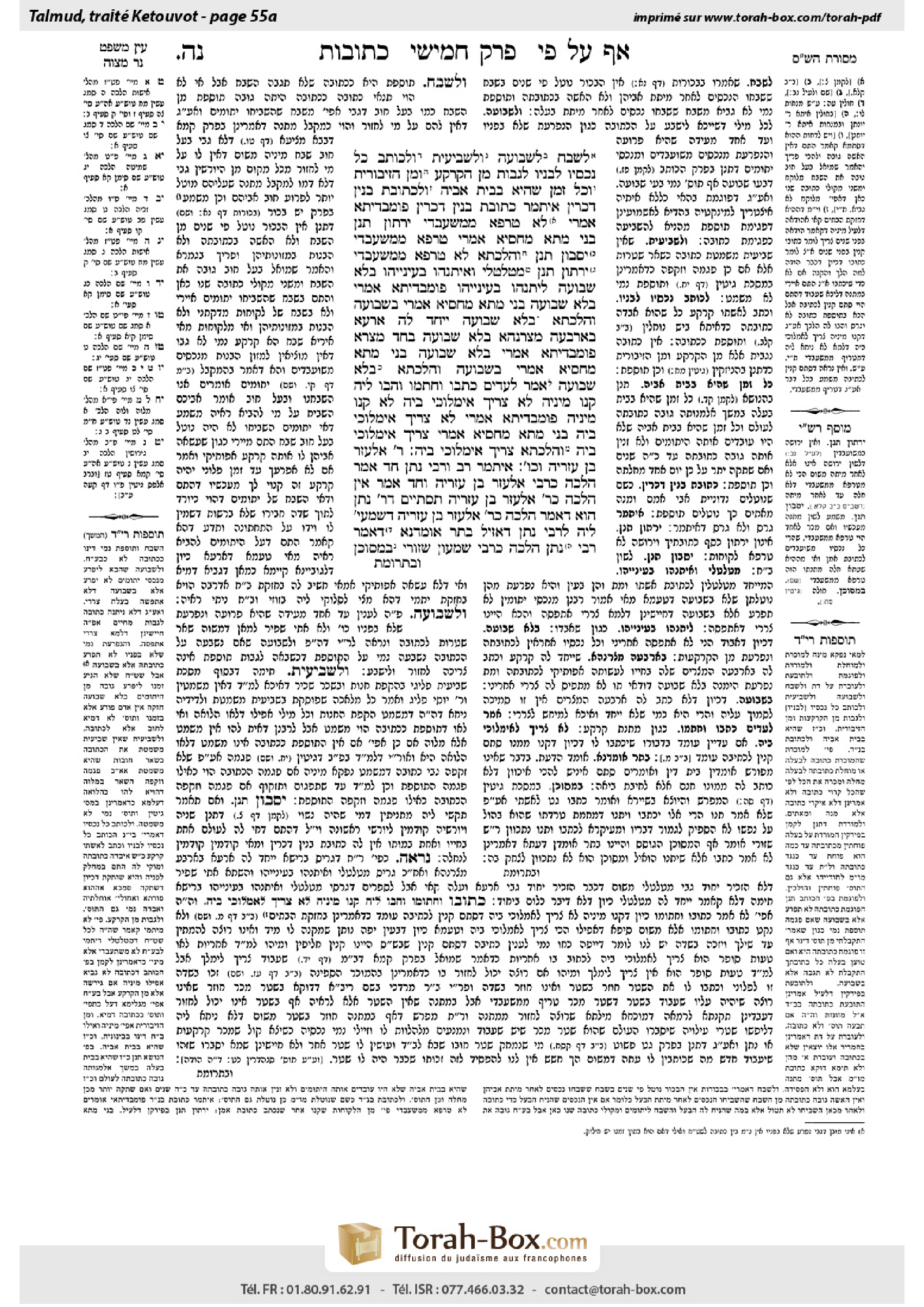
Ketubot 55a: Talmud study for Daf Yomi
Daf Yomi is the daily study of one Talmud folio. Explore 37 tractates with scans, Hebrew text, Sefaria English and AI-generated French translations where annotated.
Passage selection and English or AI-generated French translation are available where the scan has annotations. Daf Study is independent of Torah-Box and Sefaria.
Browse Ketubot · כתובות · All tractatesKetubot 55a text and translations
This page of Ketubot includes the Aramaic text, an English translation and an AI-generated French translation, alongside the scan above.
כתובות נ״ה א · Aramaic and Hebrew text
לְשֶׁבַח; לִשְׁבוּעָה; וְלִשְׁבִיעִית;
וּלְכוֹתֵב כׇּל נְכָסָיו לְבָנָיו; לִגְבּוֹת מִן הַקַּרְקַע וּמִן הַזִּיבּוּרִית; וְכׇל זְמַן שֶׁהִיא בְּבֵית אָבִיהָ; וְלִכְתוּבַּת בְּנִין דִּכְרִין.
אִיתְּמַר. כְּתוּבַּת בְּנִין דִּכְרִין, פּוּמְבְּדִיתָא אָמְרִי: לָא טָרְפָא מִמְּשַׁעְבְּדִי, ״יִרְתוּן״ תְּנַן.
בְּנֵי מָתָא מַחְסֵיָא אָמְרִי: טָרְפָא מִמְּשַׁעְבְּדִי, ״יִסְּבוּן״ תְּנַן. וְהִלְכְתָא: לָא טָרְפָא מִמְּשַׁעְבְּדִי, ״יִרְתוּן״ תְּנַן.
מִטַּלְטְלִי וְאִיתַנְהוּ בְּעֵינַיְיהוּ — בְּלָא שְׁבוּעָה,
לֵיתַנְהוּ בְּעֵינַיְיהוּ — פּוּמְבְּדִיתָא אָמְרִי: בְּלֹא שְׁבוּעָה. בְּנֵי מָתָא מַחְסֵיָא אָמְרִי: בִּשְׁבוּעָה. וְהִלְכְתָא: בְּלֹא שְׁבוּעָה.
יַיחֵד לַהּ אַרְעָא בְּאַרְבְּעָה מִצְרָנֶהָא — בְּלָא שְׁבוּעָה. בְּחַד מִצְרָא — פּוּמְבְּדִיתָא אָמְרִי: בְּלָא שְׁבוּעָה. בְּנֵי מָתָא מַחְסֵיָא אָמְרִי: בִּשְׁבוּעָה. וְהִלְכְתָא: בְּלָא שְׁבוּעָה.
אָמַר לְעֵדִים ״כִּתְבוּ וְחִתְמוּ וְהַבוּ לֵיהּ״, קְנוֹ מִינֵּיהּ — לָא צְרִיךְ אִימְּלוֹכֵי בֵּיהּ. לָא קְנוֹ מִינֵּיהּ — פּוּמְבְּדִיתָא אָמְרִי: לָא צְרִיךְ אִימְּלוֹכֵי בֵּיהּ, בְּנֵי מָתָא מַחְסֵיָא אָמְרִי: צְרִיךְ אִימְּלוֹכֵי בֵּיהּ. וְהִלְכְתָא: צְרִיךְ אִימְּלוֹכֵי בֵּיהּ.
רַבִּי אֶלְעָזָר בֶּן עֲזַרְיָה וְכוּ׳. אִיתְּמַר. רַב וְרַבִּי נָתָן, חַד אָמַר: הֲלָכָה כְּרַבִּי אֶלְעָזָר בֶּן עֲזַרְיָה, וְחַד אָמַר: אֵין הֲלָכָה כְּרַבִּי אֶלְעָזָר בֶּן עֲזַרְיָה.
תִּסְתַּיֵּים דְּרַבִּי נָתָן הוּא דְּאָמַר הֲלָכָה כְּרַבִּי אֶלְעָזָר בֶּן עֲזַרְיָה, דְּשָׁמְעִינַן לֵיהּ לְרַבִּי נָתָן דְּאָזֵיל בָּתַר אוּמְדָּנָא. דְּאָמַר רַבִּי נָתָן: הֲלָכָה כְּרַבִּי שִׁמְעוֹן שֵׁזוּרִי בִּמְסוּכָּן,
Ketubot 55a · English translation
It is also relevant to an increase in value, as she does not collect the main or additional sums from the increased value of the property in a case where the husband’s estate was not sufficient at the time of his death to pay the entire cost of her marriage contract but the heirs later increased the value of the property; to an oath, because if the wife is required to take an oath in order to receive her marriage contract, the additional sum is also included in that oath; and to the Sabbatical Year, as the marriage contract is not annulled with other debts in the Sabbatical Year, and this includes the additional sum as well.
And with regard to one who writes a document transferring all of his property to his sons and leaves his wife a specific plot of land for her marriage contract, this teaches that she receives both the main and the additional sums of her contract only from that land. The aforementioned halakha also teaches that she collects the payment only from land, and specifically from land of inferior quality; and that a widow loses her ability to collect the main and additional sums as long as she is in her father’s home for more than twenty-five years after her husband’s death; and the principle also applies to the stipulation in the marriage contract that the male offspring inherit their mother’s dowry when her husband passes away in addition to the inheritance they receive together with their other brothers. These halakhot apply equally to the additional sum of the marriage contract.
§ It was stated that there was a debate among the Sages with regard to the stipulation in the marriage contract that the male offspring inherit the sum stipulated in their mother’s marriage contract. The Sages of Pumbedita say: It is not seized from liened property that has been sold by the father. This is because we learned in a mishna (52b) that the text of the stipulation is: They will inherit the money set aside for their mother’s marriage contract. From this phrase it is clear that the stipulation follows the halakhot of inheritance, and therefore their inheritance can be taken only from property in the father’s possession at the time of his death, but not from property that he had sold.
The residents of Mata Meḥasya say: It is seized from liened property that has been sold. Their tradition is that the mishna states that the text of the stipulation is: They will take the money set aside for their mother’s marriage contract. It is as if the husband transferred this property to the sons, and as their acquisition precedes those of the other buyers, they may seize the sold property from the buyers. The Gemara concludes that the halakha is that it is not seized from liened property that has been sold, as the mishna states: They will inherit.
There is another dispute between the Sages of Pumbedita and the residents of Mata Meḥasya, with regard to one who set aside payment for his wife’s marriage contract from movable property, and these objects are in their pure, unadulterated state at the time of the execution of the marriage contract after the husband’s death. In this case, all agree that the widow may take them without an oath that confirms that her husband did not leave her any other money for the payment of her marriage contract, as it is clear that he set aside these objects for that purpose.
However, if the movable objects are not in their pure, unadulterated state, e.g., they were lost, the Sages of Pumbedita say that she takes the payment for her marriage contract from other property, as all of the husband’s property is liened to the marriage contract without an oath. The residents of Mata Meḥasya say she takes her payment only with an oath, because of a concern that she may have already received other property as payment for her marriage contract. And the halakha is that she may take it without an oath, in accordance with the opinion of the Sages of Pumbedita.
If he set aside land for her, which he demarcated on all four of its borders, she seizes the land without an oath. If he demarcated it on only one border, which is not as clear an indication, the Sages of Pumbedita say she takes it without an oath, and the residents of Mata Meḥasya say she takes it with an oath. And the halakha is that she takes it without an oath.
Furthermore, they had a dispute in a case where someone told witnesses: Write and sign a deed of gift and give it to the intended recipient of the gift. In such a case, if the witnesses acquired it from him on behalf of the recipient by performing a formal act of acquisition, they do not need to consult with him again, as there can be no retraction after a formal acquisition. But if they did not acquire it from him, the Sages of Pumbedita say they do not need to consult with him again, and the residents of Mata Meḥasya say they must consult with him. And the halakha is that they must consult with him again.
§ The mishna states that Rabbi Elazar ben Azarya says that a woman who collects the payment for her marriage contract after marriage receives the main and additional sums, while one who collects it after betrothal receives only the main sum. It was stated: Rav and Rabbi Natan differed with regard to this issue. One said the halakha is in accordance with the opinion of Rabbi Elazar ben Azarya. And one said the halakha is not in accordance with the opinion of Rabbi Elazar ben Azarya.
It may be concluded that Rabbi Natan is the one who said that the halakha is in accordance with the opinion of Rabbi Elazar ben Azarya, as we have heard that Rabbi Natan follows the principle of assessing intention. Even if one did not make an explicit statement, the court assesses what his intention must have been and decides the halakha based on that assessment. It is clear that he follows this principle, as Rabbi Natan said that the halakha is in accordance with the opinion of Rabbi Shimon Shezuri in the case of an ill person in danger. If this person says: Write a bill of divorce for my wife, that is understood as: Write it and give it to her, as his intention is to absolve her from the requirement of levirate marriage by means of the bill of divorce. Although he did not explicitly state this, Rabbi Natan holds that in such a situation the court assesses that this was the husband’s intent and follows it.
Ketubot 55a · Traduction française (IA)
Cela concerne également l’augmentation de valeur : elle ne perçoit ni la somme principale ni la somme supplémentaire sur l’augmentation de valeur des biens lorsque, au moment de la mort de son mari, la succession ne suffisait pas à payer l’intégralité de sa ketouba, mais que les héritiers ont ensuite accru la valeur des biens ; le serment, car si l’épouse doit prêter serment pour percevoir sa ketouba, la somme supplémentaire est elle aussi comprise dans ce serment ; et l’année sabbatique, car la ketouba, comme les autres dettes, n’est pas annulée pendant l’année sabbatique, et cela vaut également pour la somme supplémentaire.
De même, dans le cas de celui qui rédige un acte transférant tous ses biens à ses fils et réserve à son épouse une parcelle précise pour le paiement de sa ketouba, cela enseigne qu’elle ne perçoit les sommes principale et supplémentaire de sa ketouba que sur cette parcelle. La halakha mentionnée enseigne également qu’elle ne perçoit son paiement que sur des biens-fonds, et précisément sur des biens-fonds de qualité inférieure ; qu’une veuve perd son droit de percevoir les sommes principale et supplémentaire si elle demeure dans la maison de son père plus de vingt-cinq ans après la mort de son mari ; et que ce principe s’applique aussi à la clause de la ketouba selon laquelle, à la mort de leur père, les fils héritent de la dot de leur mère, en plus de la part qu’ils reçoivent dans la succession avec leurs frères. Ces halakhot s’appliquent également à la somme supplémentaire de la ketouba.
§ Un débat entre les Sages a été rapporté au sujet de la clause de la ketouba stipulant que les fils héritent de la somme indiquée dans la ketouba de leur mère. Les Sages de Poumbedita disent que cette somme n’est pas prélevée sur des biens grevés d’un droit de gage que le père a vendus. En effet, nous avons appris dans une Michna (52b) que le texte de la clause est : « Ils hériteront de l’argent réservé à la ketouba de leur mère. » Cette formulation montre clairement que la clause relève des règles de l’héritage ; par conséquent, ils ne peuvent hériter que des biens en possession de leur père au moment de sa mort, et non des biens qu’il a vendus.
Les habitants de Mata Meḥasya disent que cette somme est prélevée sur des biens grevés d’un droit de gage que le père a vendus. Selon leur tradition, la Michna énonce le texte suivant pour la clause : « Ils prendront l’argent réservé à la ketouba de leur mère. » C’est comme si le mari avait transféré ces biens à ses fils ; puisque leur acquisition précède celle des autres acheteurs, ils peuvent reprendre aux acheteurs les biens vendus. La Guemara conclut que la halakha est qu’elle ne peut pas prélever cette somme sur des biens grevés d’un droit de gage qui ont été vendus, puisque la Michna dit : « Ils hériteront. »
Il existe un autre désaccord entre les Sages de Poumbedita et les habitants de Mata Meḥasya au sujet de celui qui a réservé, sur des biens meubles, le paiement de la ketouba de son épouse, et dont les biens sont encore dans leur état intact au moment où la ketouba est exécutée après la mort du mari. Dans ce cas, tous reconnaissent que la veuve peut les prendre sans prêter serment pour attester que son mari ne lui a laissé aucun autre argent destiné au paiement de sa ketouba, puisqu’il est clair qu’il a réservé ces biens à cette fin.
Cependant, si les biens meubles ne sont plus dans leur état intact, par exemple s’ils ont été perdus, les Sages de Poumbedita disent qu’elle perçoit le paiement de sa ketouba sur d’autres biens, car tous les biens du mari sont grevés au profit de la ketouba, sans qu’elle ait à prêter serment. Les habitants de Mata Meḥasya disent qu’elle ne perçoit son paiement qu’en prêtant serment, de crainte qu’elle n’ait déjà reçu d’autres biens en paiement de sa ketouba. La halakha est qu’elle peut le percevoir sans serment, conformément à l’opinion des Sages de Poumbedita.
S’il lui a réservé un terrain dont il a délimité les quatre côtés, elle peut le prendre sans serment. S’il n’en a délimité qu’un seul côté, ce qui constitue une indication moins claire, les Sages de Poumbedita disent qu’elle le prend sans serment, tandis que les habitants de Mata Meḥasya disent qu’elle le prend en prêtant serment. La halakha est qu’elle le prend sans serment.
En outre, ils étaient en désaccord dans le cas où quelqu’un disait à des témoins : « Rédigez et signez un acte de donation, puis remettez-le au bénéficiaire prévu. » Si les témoins avaient acquis le bien de sa part au profit du bénéficiaire en accomplissant un acte formel d’acquisition, ils n’ont pas besoin de le consulter de nouveau, car il ne peut plus se rétracter après cet acte d’acquisition. Mais s’ils n’avaient pas acquis le bien de sa part, les Sages de Poumbedita disent qu’ils n’ont pas besoin de le consulter de nouveau, tandis que les habitants de Mata Meḥasya disent qu’ils doivent le consulter. La halakha est qu’ils doivent le consulter de nouveau.
§ La Michna rapporte que Rabbi Elazar ben Azarya dit qu’une femme qui perçoit le paiement de sa ketouba après le mariage reçoit les sommes principale et supplémentaire, tandis que celle qui le perçoit après les fiançailles ne reçoit que la somme principale. Un débat entre Rav et Rabbi Natan a été rapporté à ce sujet : selon l’un, la halakha est conforme à l’opinion de Rabbi Elazar ben Azarya ; selon l’autre, elle ne l’est pas.
On peut conclure que c’est Rabbi Natan qui a dit que la halakha est conforme à l’opinion de Rabbi Elazar ben Azarya, car nous savons que Rabbi Natan suit le principe de l’évaluation de l’intention. Même si quelqu’un ne s’est pas exprimé explicitement, le tribunal évalue quelle a dû être son intention et détermine la halakha en conséquence. Il est clair qu’il suit ce principe, puisque Rabbi Natan a dit que la halakha est conforme à l’opinion de Rabbi Shimon Shezuri dans le cas d’un malade en danger. Si cet homme dit : « Rédigez un acte de divorce pour mon épouse », il faut comprendre : « Rédigez-le et remettez-le-lui », car son intention est de la dispenser de l’obligation du lévirat au moyen de cet acte de divorce. Bien qu’il ne l’ait pas dit explicitement, Rabbi Natan estime que, dans une telle situation, le tribunal évalue que telle était l’intention du mari et agit en conséquence.
Traduction française générée par IA à partir de l’édition anglaise de Sefaria. Vérifie toujours un passage avec le texte source.
Text from Sefaria: William Davidson Edition - Vocalized Aramaic (CC BY NC); William Davidson Edition - English (CC BY NC).