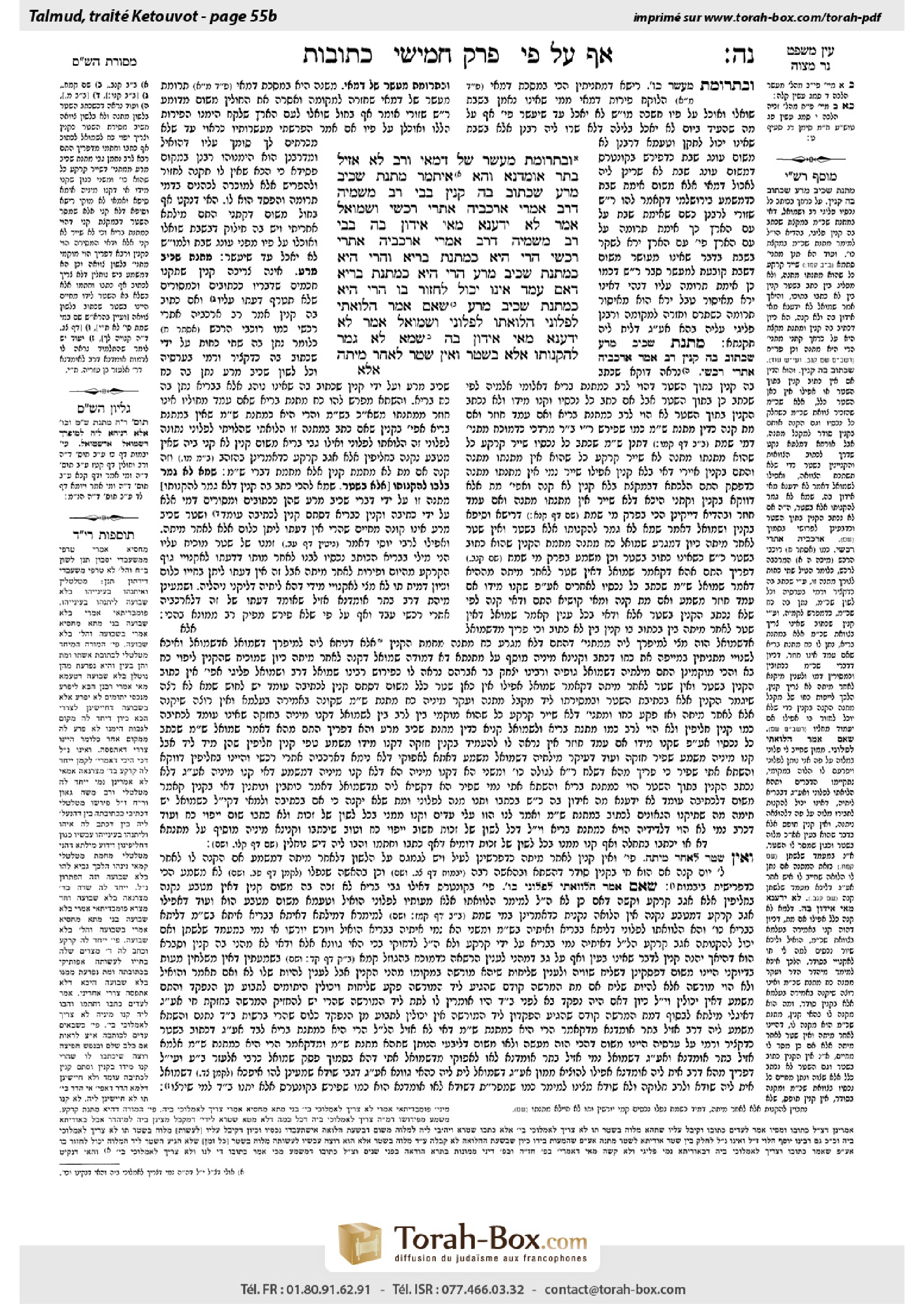
Ketubot 55b: Talmud study for Daf Yomi
Daf Yomi is the daily study of one Talmud folio. Explore 37 tractates with scans, Hebrew text, Sefaria English and AI-generated French translations where annotated.
Passage selection and English or AI-generated French translation are available where the scan has annotations. Daf Study is independent of Torah-Box and Sefaria.
Browse Ketubot · כתובות · All tractatesKetubot 55b text and translations
This page of Ketubot includes the Aramaic text, an English translation and an AI-generated French translation, alongside the scan above.
כתובות נ״ה ב · Aramaic and Hebrew text
וּבִתְרוּמַת מַעֲשֵׂר שֶׁל דְּמַאי.
וְרַב לָא אָזֵיל בָּתַר אוּמְדָּנָא? וְהָא אִיתְּמַר: מַתְּנַת שְׁכִיב מְרַע שֶׁכָּתוּב בָּהּ קִנְיָן, בְּבֵי רַב מִשְּׁמֵיהּ דְּרַב אָמְרִי: אַרְכְּבֵיהּ אַתְּרֵי רִכְשֵׁי. וּשְׁמוּאֵל אָמַר: לָא יָדַעְנָא מַאי אֵידוּן בַּהּ.
בְּבֵי רַב מִשְּׁמֵיהּ דְּרַב אָמְרִי, אַרְכְּבֵיהּ אַתְּרֵי רִכְשֵׁי: הֲרֵי הִיא כְּמַתְּנַת בָּרִיא, וַהֲרֵי הִיא כְּמַתְּנַת שְׁכִיב מְרַע.
הֲרֵי הִיא כְּמַתְּנַת בָּרִיא, דְּאִם עָמַד — אֵינוֹ יָכוֹל לַחֲזוֹר בּוֹ. הֲרֵי הִיא כְּמַתְּנַת שְׁכִיב מְרַע, שֶׁאִם אָמַר ״הַלְוָאָתִי לִפְלוֹנִי״ — הַלְוָאָתוֹ לִפְלוֹנִי.
וּשְׁמוּאֵל אָמַר: לָא יָדַעְנָא מַאי אֵידוּן בַּהּ, שֶׁמָּא לֹא גָּמַר לְהַקְנוֹתוֹ אֶלָּא בִּשְׁטָר, וְאֵין שְׁטָר לְאַחַר מִיתָה.
Ketubot 55b · English translation
And the halakha is also in accordance with his opinion with regard to the teruma of the tithe from doubtfully tithed produce [demai]. Produce purchased from a common, uneducated person [am ha’aretz] is considered demai and by rabbinic law it is regarded as uncertain whether the seller separated tithes and teruma of the tithe from it. Rabbi Natan rules in accordance with Rabbi Shimon Shezuri’s opinion in a case where, after one bought demai and separated teruma of the tithe, this teruma becomes mingled with the produce from which it was separated. If all of the produce were treated as actual teruma, the only solution would be to sell all of the produce to a priest at low cost, as he is the only one who may use it. Rabbi Shimon Shezuri, however, rules that in the case of demai, the owner may ask the fruit seller if he properly separated the tithes. If the seller responds that he did, the owner may rely on that, despite the fact that the seller is an am ha’aretz, as the Sages do not apply their decree in a case where it would cause significant financial loss.
Having established that Rabbi Natan follows the principle of assessment, the Gemara asks: And does Rav not follow this principle of assessing intention? But it was stated that Rav and Shmuel disagreed about a specific case with regard to the gift of a person on his deathbed, in which it was also written that the gift was given with an act of acquisition. There is a rabbinic ordinance that one on his deathbed can effect the transfer of property without the ordinarily required act of acquisition, but in this case such an act was performed anyway. In the school of Rav, they say in the name of Rav: He had him ride on two horses, meaning that he gave him a gift with a document strengthened in two different ways. And Shmuel said: I do not know what to decide about it.
The Gemara explains the two opinions: In the school of Rav, they say in the name of Rav: He had him ride on two horses, meaning that he performed the transfer in a manner that took advantage of two separate halakhot to strengthen its validity. In one aspect, it is similar to the gift of a healthy person, and in a different way it is similar to the gift of a person on his deathbed. Both of these aspects act to strengthen the transfer.
On the one hand, it is similar to the gift of a healthy person in that if he arose from the bed and recovered he cannot retract it, since he performed a proper act of acquisition. On the other hand, it is like the gift of a person on his deathbed in that if he said: My loan, i.e., money owed to me, is transferred to so-and-so as a gift, his loan is in fact transferred to so-and-so. Although ordinarily ownership of a debt cannot be transferred without a formal transference of the promissory note, the verbal statement is sufficient to effect the transfer since this is a gift of a person on his deathbed.
And Shmuel said: I do not know what to decide about it. Perhaps his performance of an act of acquisition indicates that he resolved to transfer it to him only with a bill of sale. And since his intention is that the sale not take effect until he also gives a bill of sale, the transfer does not take effect, as a bill of sale is not effective after the death of the owner.
Ketubot 55b · Traduction française (IA)
La halakha suit également son avis au sujet de la terouma de la dîme provenant de produits dont le prélèvement des dîmes est incertain [demai]. Les produits achetés à un homme du peuple [am ha’aretz], qui ne connaît pas les règles, sont considérés comme du demai et, selon le droit rabbinique, on ne sait pas avec certitude si le vendeur en a prélevé les dîmes et la terouma de la dîme. Rabbi Natan suit l’avis de Rabbi Shimon Shezuri dans le cas où, après avoir acheté du demai et prélevé la terouma de la dîme, celle-ci se mélange aux produits dont elle a été prélevée. Si l’on considérait tous les produits comme de la véritable terouma, la seule solution serait de les vendre à bas prix à un prêtre, qui est le seul à pouvoir les utiliser. Rabbi Shimon Shezuri statue toutefois que, dans le cas du demai, le propriétaire peut demander au vendeur de fruits s’il a correctement prélevé les dîmes. Si le vendeur répond qu’il l’a fait, le propriétaire peut s’y fier, bien que le vendeur soit un am ha’aretz, car les Sages n’appliquent pas leur décret dans un cas où cela entraînerait une perte financière importante.
Ayant établi que Rabbi Natan suit le principe de l’évaluation de l’intention, la Guemara demande : Rav, lui, ne suit-il pas ce principe ? Or, il a été rapporté que Rav et Shmuel étaient en désaccord au sujet d’un cas particulier concernant le don d’un homme sur son lit de mort, dans lequel il était également indiqué que le don avait été effectué au moyen d’un acte d’acquisition. Une ordonnance rabbinique permet à un homme sur son lit de mort de transférer ses biens sans l’acte d’acquisition normalement requis ; pourtant, dans ce cas, un tel acte avait bien été accompli. À l’école de Rav, on dit au nom de Rav : « Il l’a fait monter sur deux chevaux », c’est-à-dire qu’il lui a fait un don au moyen d’un document renforcé de deux façons différentes. Et Shmuel dit : « Je ne sais pas quelle décision prendre à ce sujet. »
La Guemara explique les deux avis : à l’école de Rav, on dit au nom de Rav : « Il l’a fait monter sur deux chevaux », c’est-à-dire qu’il a effectué le transfert en tirant parti de deux halakhot distinctes pour en renforcer la validité. À un égard, le don est semblable à celui d’un homme en bonne santé et, à un autre égard, à celui d’un homme sur son lit de mort. Ces deux aspects contribuent à renforcer le transfert.
D’une part, le don est semblable à celui d’un homme en bonne santé, car si celui-ci se lève de son lit et guérit, il ne peut pas revenir sur sa décision, puisqu’il a accompli un acte d’acquisition valide. D’autre part, il est semblable au don d’un homme sur son lit de mort, car si celui-ci dit : « Ma créance », c’est-à-dire l’argent qui m’est dû, « est transférée à Untel en cadeau », sa créance est effectivement transférée à Untel. Bien qu’en règle générale, la propriété d’une créance ne puisse pas être transférée sans transfert formel du billet à ordre, la déclaration verbale suffit à effectuer le transfert, puisqu’il s’agit du don d’un homme sur son lit de mort.
Et Shmuel dit : « Je ne sais pas quelle décision prendre à ce sujet. » Peut-être le fait d’avoir accompli un acte d’acquisition indique-t-il qu’il avait décidé de ne lui transférer le bien qu’au moyen d’un acte de vente. Puisque son intention était que la vente ne prenne effet qu’une fois qu’il lui aurait également remis un acte de vente, le transfert ne prend pas effet, car un acte de vente n’est pas valable après la mort du propriétaire.
Traduction française générée par IA à partir de l’édition anglaise de Sefaria. Vérifie toujours un passage avec le texte source.
Text from Sefaria: William Davidson Edition - Vocalized Aramaic (CC BY NC); William Davidson Edition - English (CC BY NC).