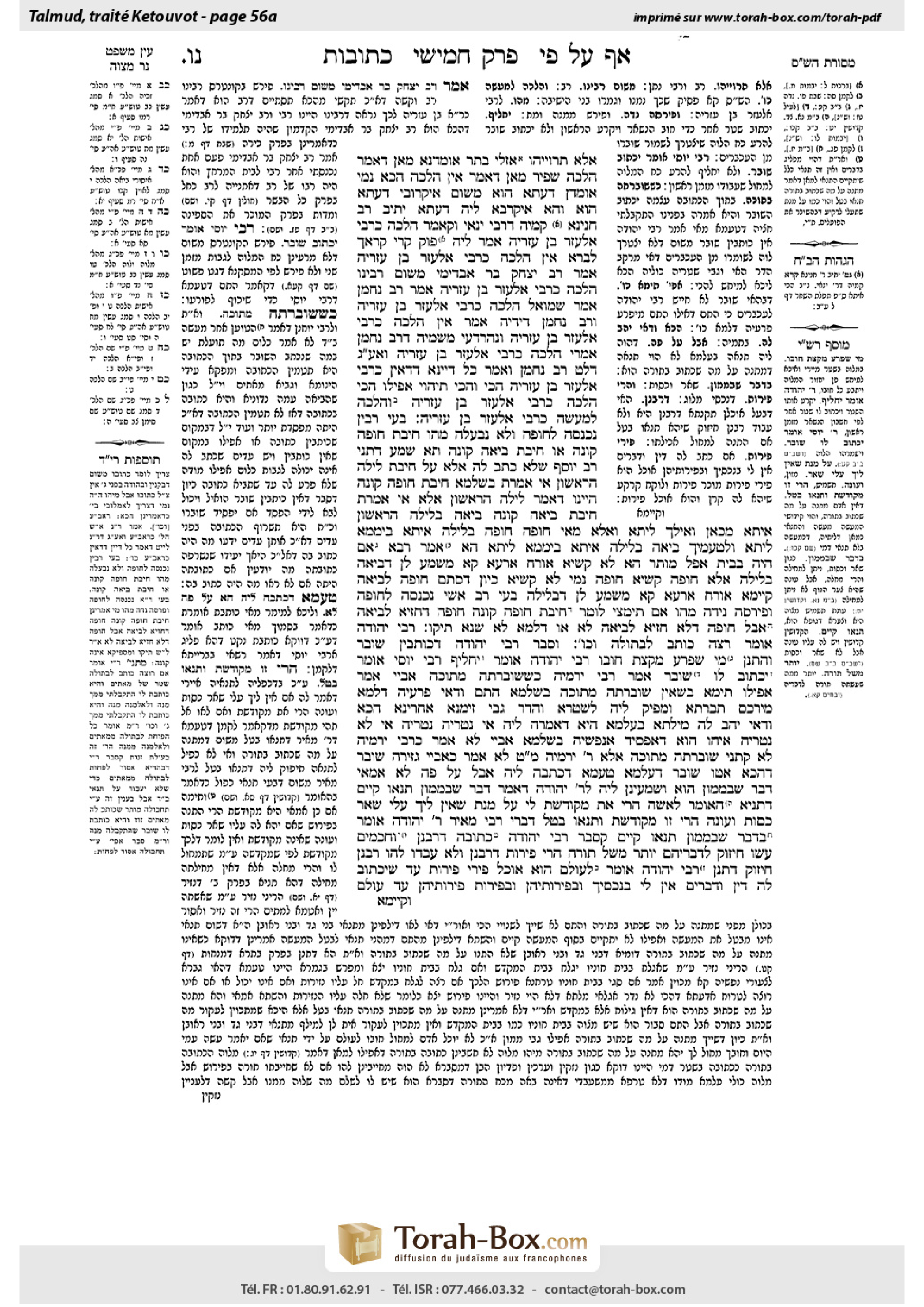
Ketubot 56a: Talmud study for Daf Yomi
Daf Yomi is the daily study of one Talmud folio. Explore 37 tractates with scans, Hebrew text, Sefaria English and AI-generated French translations where annotated.
Passage selection and English or AI-generated French translation are available where the scan has annotations. Daf Study is independent of Torah-Box and Sefaria.
Browse Ketubot · כתובות · All tractatesKetubot 56a text and translations
This page of Ketubot includes the Aramaic text, an English translation and an AI-generated French translation, alongside the scan above.
כתובות נ״ו א · Aramaic and Hebrew text
אֶלָּא: תַּרְוַיְיהוּ אָזְלִי בָּתַר אוּמְדָּנָא.
מַאן דְּאָמַר הֲלָכָה — שַׁפִּיר, מַאן דְּאָמַר אֵין הֲלָכָה — הָכָא נָמֵי אוּמְדַּן דַּעְתָּא הוּא. מִשּׁוּם אִיקָּרוֹבֵי דַּעְתָּא הוּא, וְהָא אִיקָּרַבָא לֵיהּ דַּעְתָּא.
יָתֵיב רַב חֲנִינָא קַמֵּיהּ דְּרַבִּי יַנַּאי וְקָאָמַר: הֲלָכָה כְּרַבִּי אֶלְעָזָר בֶּן עֲזַרְיָה. אֲמַר לֵיהּ: פּוֹק, קְרִי קְרָאָךְ לְבָרָא! אֵין הֲלָכָה כְּרַבִּי אֶלְעָזָר בֶּן עֲזַרְיָה.
אָמַר רַב יִצְחָק בַּר אַבְדִּימִי מִשּׁוּם רַבֵּינוּ: הֲלָכָה כְּרַבִּי אֶלְעָזָר בֶּן עֲזַרְיָה. אָמַר רַב נַחְמָן אָמַר שְׁמוּאֵל: הֲלָכָה כְּרַבִּי אֶלְעָזָר בֶּן עֲזַרְיָה.
וְרַב נַחְמָן דִּידֵיהּ אָמַר: אֵין הֲלָכָה כְּרַבִּי אֶלְעָזָר בֶּן עֲזַרְיָה. וּנְהַרְדָּעֵי מִשְּׁמֵיהּ דְּרַב נַחְמָן אָמְרִי: הֲלָכָה כְּרַבִּי אֶלְעָזָר בֶּן עֲזַרְיָה. וְאַף עַל גַּב דְּלָט רַב נַחְמָן וְאָמַר: כֹּל דַּיָּינָא דְּדָאֵין כְּרַבִּי אֶלְעָזָר בֶּן עֲזַרְיָה הָכִי וְהָכִי תֶּיהְוֵי, אֲפִילּוּ הָכִי — הֲלָכָה כְּרַבִּי אֶלְעָזָר בֶּן עֲזַרְיָה. וַהֲלָכָה לְמַעֲשֶׂה כְּרַבִּי אֶלְעָזָר בֶּן עֲזַרְיָה.
בָּעֵי רָבִין: נִכְנְסָה לְחוּפָּה וְלֹא נִבְעֲלָה, מַהוּ? חִיבַּת חוּפָּה קוֹנָה, אוֹ חִיבַּת בִּיאָה קוֹנָה.
תָּא שְׁמַע, דְּתָנֵי רַב יוֹסֵף: שֶׁלֹּא כָּתַב לָהּ אֶלָּא עַל חִיבַּת לַיְלָה הָרִאשׁוֹן. אִי אָמְרַתְּ בִּשְׁלָמָא חִיבַּת חוּפָּה קוֹנָה — הַיְינוּ דְּאָמַר לַיְלָה הָרִאשׁוֹן, אֶלָּא אִי אָמְרַתְּ חִיבַּת בִּיאָה קוֹנָה, בִּיאָה — בְּלַיְלָה הָרִאשׁוֹן אִיתַהּ, מִכָּאן וְאֵילָךְ לֵיתַהּ?!
וְאֶלָּא מַאי, חוּפָּה? חוּפָּה בְּלֵילְיָא אִיתַהּ, בִּימָמָא לֵיתַהּ? וּלְטַעְמָיךְ — בִּיאָה בְּלֵילְיָא אִיתַהּ, בִּימָמָא לֵיתַהּ? הָא אָמַר רָבָא, אִם הָיָה בְּבַיִת אָפֵל מוּתָּר! הָא לָא קַשְׁיָא: אוֹרַח אַרְעָא קָא מַשְׁמַע לַן, דְּבִיאָה בַּלַּיְלָה.
אֶלָּא חוּפָּה קַשְׁיָא? חוּפָּה נָמֵי לָא קַשְׁיָא: כֵּיוָן דִּסְתַם חוּפָּה לְבִיאָה קָיְימָא, אוֹרַח אַרְעָא קָא מַשְׁמַע לַן דְּבַלַּיְלָה.
בָּעֵי רַב אָשֵׁי: נִכְנְסָה לְחוּפָּה וּפֵירְסָה נִידָּה, מַהוּ? אִם תִּימְצֵי לוֹמַר חִיבַּת חוּפָּה קוֹנָה, חוּפָּה דְּחַזְיָא לְבִיאָה, אֲבָל חוּפָּה דְּלָא חַזְיָא לְבִיאָה — לָא, אוֹ דִלְמָא לָא שְׁנָא? תֵּיקוּ.
רַבִּי יְהוּדָה אוֹמֵר: רָצָה, כּוֹתֵב לִבְתוּלָה וְכוּ׳. וְסָבַר רַבִּי יְהוּדָה דְּכוֹתְבִין שׁוֹבָר? וְהָתְנַן: מִי שֶׁפָּרַע מִקְצָת חוֹבוֹ — רַבִּי יְהוּדָה אוֹמֵר: יַחְלִיף. רַבִּי יוֹסֵי אוֹמֵר: יִכְתּוֹב לוֹ שׁוֹבָר!
אָמַר רַבִּי יִרְמְיָה: כְּשֶׁשּׁוֹבַרְתָּהּ מִתּוֹכָהּ.
אַבָּיֵי אָמַר: אֲפִילּוּ תֵּימָא בְּשֶׁאֵין שׁוֹבַרְתָּהּ מִתּוֹכָהּ, בִּשְׁלָמָא הָתָם, וַדַּאי פַּרְעֵיהּ — דִּלְמָא מִירְכַס תָּבַרְתָּא, וּמַפֵּיק לֵיהּ לִשְׁטָרָא, וַהֲדַר גָּבֵי זִימְנָא אַחֲרִינָא. הָכָא, וַדַּאי יְהַב לַהּ? מִילְּתָא בְּעָלְמָא הִיא דַּאֲמַרָה לֵיהּ, אִי נַטְרֵיהּ — נַטְרֵיהּ, אִי לָא נַטְרֵיהּ — אִיהוּ הוּא דְּאַפְסֵיד אַנַּפְשֵׁיהּ.
בִּשְׁלָמָא אַבָּיֵי לָא אָמַר כְּרַבִּי יִרְמְיָה, לָא קָתָנֵי שׁוֹבַרְתָּהּ מִתּוֹכָהּ. אֶלָּא רַבִּי יִרְמְיָה מַאי טַעְמָא לָא אָמַר כְּאַבַּיֵּי? גְּזֵירָה שׁוֹבָר דְּהָכָא אַטּוּ שׁוֹבָר דְּעָלְמָא.
טַעְמָא — דְּכָתְבָה לֵיהּ, אֲבָל עַל פֶּה — לָא. אַמַּאי? דָּבָר שֶׁבְּמָמוֹן הוּא, וְשָׁמְעִינַן לֵיהּ לְרַבִּי יְהוּדָה דְּאָמַר: דָּבָר שֶׁבְּמָמוֹן — תְּנָאוֹ קַיָּים.
דְּתַנְיָא: הָאוֹמֵר לְאִשָּׁה ״הֲרֵי אַתְּ מְקוּדֶּשֶׁת לִי עַל מְנָת שֶׁאֵין לִיךְ עָלַי שְׁאֵר כְּסוּת וְעוֹנָה״ הֲרֵי זוֹ מְקוּדֶּשֶׁת, וּתְנָאוֹ בָּטֵל, דִּבְרֵי רַבִּי מֵאִיר. רַבִּי יְהוּדָה אוֹמֵר: בְּדָבָר שֶׁבְּמָמוֹן — תְּנָאוֹ קַיָּים!
קָסָבַר רַבִּי יְהוּדָה: כְּתוּבָּה דְּרַבָּנַן, וַחֲכָמִים עָשׂוּ חִיזּוּק לְדִבְרֵיהֶם יוֹתֵר מִשֶּׁל תּוֹרָה.
הֲרֵי פֵּירוֹת דְּרַבָּנַן, וְלָא עֲבַדוּ לְהוּ רַבָּנַן חִיזּוּק! דִּתְנַן, רַבִּי יְהוּדָה אוֹמֵר: לְעוֹלָם הוּא אוֹכֵל פֵּירֵי פֵירוֹת — עַד שֶׁיִּכְתּוֹב לָהּ: ״דִּין וּדְבָרִים אֵין לִי בִּנְכָסַיִךְ, וּבְפֵירוֹתֵיהֶן, וּבְפֵירוֹת פֵּירוֹתֵיהֶן עַד עוֹלָם״.
Ketubot 56a · English translation
In any case, it has been established that Rav also follows the principle of assessing one’s intention, which calls into question the conclusion that Rabbi Natan is the one who said that the halakha is in accordance with the opinion of Rabbi Elazar ben Azarya. Rather, the Gemara concludes: Both Rav and Rabbi Natan follow the principle of assessing intention, and the debate can be explained in a different way.
According to the one who says the halakha is in accordance with the opinion of Rabbi Elazar ben Azarya, this works out well. According to the one who says the halakha is not in accordance with the opinion of Rabbi Elazar ben Azarya, here too, this is an assessment of his intention. Why did he give her the additional sum of the marriage contract? It was due to a sense of intimacy between them, as they were betrothed and were planning to get married. Since he did demonstrate a sense of intimacy with her, the assessment is that he intended to give her the additional sum.
Rav Ḥanina, who was known for teaching biblical verses, sat before Rabbi Yannai and said: The halakha is in accordance with the opinion of Rabbi Elazar ben Azarya. Rabbi Yannai said to him: Go out and read your verses outside. Your area of expertise is biblical verses, not halakha. What you said is incorrect and should not be said in the study hall, as the halakha is actually not in accordance with the opinion of Rabbi Elazar ben Azarya.
Rav Yitzḥak bar Avdimi said in the name of our teacher, Rabbi Yehuda HaNasi: The halakha is in accordance with the opinion of Rabbi Elazar ben Azarya. Rav Naḥman said that Shmuel said: The halakha is in accordance with the opinion of Rabbi Elazar ben Azarya.
And Rav Naḥman also said his own statement: The halakha is not in accordance with the opinion of Rabbi Elazar ben Azarya. And the Sages of Neharde’a say in the name of Rav Naḥman: The halakha is in accordance with the opinion of Rabbi Elazar ben Azarya. The Gemara comments: And although Rav Naḥman cursed them and said: Any judge who rules in accordance with the opinion of Rabbi Elazar ben Azarya, such and such unspecified misfortune will happen to him, even so the halakha is in accordance with the opinion of Rabbi Elazar ben Azarya. Since the Gemara presented a number of different opinions, it concludes: And the practical halakha is in accordance with the opinion of Rabbi Elazar ben Azarya.
§ Since the practical halakha is that a woman who was divorced or widowed after betrothal receives the main sum of her marriage contract but not the additional sum, Ravin asks: What is the halakha with regard to a woman who entered the wedding canopy and is then widowed or divorced without having had sexual intercourse? Does the affection manifest in the wedding effect the marriage, and therefore she receives the additional sum as a married woman? Or, is it the affection manifest in the intercourse that effects the marriage, and consequently this woman is no different than a betrothed woman for the purpose of this halakha?
Come and hear that Rav Yosef taught the following baraita: He wrote the additional sum in the marriage contract for her only on account of the affection characteristic of the first night of the marriage. The Gemara asks: Granted, if you say that the affection manifest in the wedding effects the marriage, this is why it says the affection characteristic of the first night, as the wedding ceremony is performed on the first night only. But if you say that the affection manifest in the intercourse effects the marriage, is there intercourse only on the first night and then from this point forward there is none? Consequently, the baraita implies that the affection manifest in the wedding effects the marriage, and from that point on she is entitled to the additional sum of the marriage contract.
The Gemara rejects this proof: But rather, what is the advantage of interpreting the expression: Affection characteristic of the first night, as a reference to the wedding? Is there a wedding only at night and not during the day? The Gemara responds: And according to your reasoning, is there intercourse only at night and not during the day? Didn’t Rava say that although the Sages generally prohibited engaging in intercourse during the day, if it was in a dark house it is permitted? The Gemara rejects this question: This is not difficult. By employing this phrase, it teaches us the ordinary mode of behavior, i.e., that intercourse generally takes place at night.
Rather, the opinion that the expression is a reference to the wedding is difficult, as a wedding does not have to take place at night. The Gemara responds: The wedding reference is also not difficult, since a reference to a wedding without specification means a wedding that takes place in order to lead directly to intercourse. By using this phrase, it similarly teaches us the ordinary mode of behavior, i.e., that intercourse generally takes place at night. Consequently, this baraita cannot be used as a proof for either possibility.
Rav Ashi asks a question similar to Ravin’s: If the bride entered the wedding canopy and began menstruating, and the husband then died without ever engaging in intercourse with his wife, what is the halakha with regard to the additional sum of the marriage contract? If you say that the affection manifest in the wedding effects the marriage, does this refer specifically to a wedding in which the couple is fit to engage in intercourse, which involves greater affection, and a wedding in which the couple is not fit to engage in intercourse does not effect the marriage? Or, perhaps it is not different. The Sages could not answer this, so the question shall stand unresolved.
§ The mishna states: Rabbi Yehuda says: If he wishes, he may write a marriage contract for a virgin for two hundred dinars, and she may then write a receipt as if he had paid part of that sum. They ask: And did Rabbi Yehuda hold that one writes a receipt for partial payment of a debt? But didn’t we learn in a mishna (Bava Batra 170b): In the case of one who repaid part of his debt, Rabbi Yehuda says: He should exchange the original promissory note for a new one that states the amount still owed, and Rabbi Yosei says: The lender should write him a receipt for the money he received? According to Rabbi Yehuda, a new note is preferable to a receipt because if the borrower loses the receipt, the lender is still in possession of a promissory note for the full amount and can collect a second time.
Rabbi Yirmeya said: In the mishna, Rabbi Yehuda is referring to a case where the receipt is written within the marriage contract itself and not as a separate document. The husband is therefore not required to hold on to a receipt, and consequently Rabbi Yehuda’s restriction against writing a receipt is not necessary.
Abaye said: Even if you say that the mishna is referring to a case where the receipt is not written within it, it is logical that Rabbi Yehuda would make an exception in this case. Granted, there, in an ordinary case of a receipt, it is certain that the borrower repaid part of the loan, and consequently there is concern that perhaps he will lose the receipt and the lender will take out the promissory note and return and collect the entire payment again. But here, in the mishna, did the husband definitely give the wife part of the payment for the marriage contract? The receipt merely amounts to something she said to him in order to waive part of the payment, although she did not actually receive it. If he saved the receipt, he saved it; if he did not save it, it is he himself who will lose. Therefore, in this case, Rabbi Yehuda agrees that one writes a receipt.
They ask: Granted, it is understandable why Abaye did not say his explanation in accordance with the opinion of Rabbi Yirmeya, as the mishna does not teach explicitly that the receipt is written within the marriage contract. However, what is the reason that Rabbi Yirmeya did not say an explanation in accordance with the opinion of Abaye? Why does Rabbi Yirmeya limit the mishna to a case where the receipt was written within the marriage contract? The Gemara responds: Although this is an unusual case, as there is no concern that the receipt may be lost, there is nevertheless a rabbinic decree with regard to this receipt due to the typical case of receipts. Therefore, Rabbi Yehuda would not allow a receipt unless it was written into the marriage contract itself.
With regard to the crux of the issue, the Gemara notes: The reason that Rabbi Yehuda holds that the wife can waive part of the main sum of her marriage contract is specifically because she wrote him a receipt. However, if she said it verbally, no, it is not effective, even according to Rabbi Yehuda. The Gemara asks: Why not? This is a monetary matter, and we have heard that Rabbi Yehuda said: With regard to monetary matters in which someone makes a verbal stipulation, his stipulation stands.
This is as it is taught in the Tosefta (Kiddushin 3:7): In the case of one who says to a woman: You are hereby betrothed to me on the condition that you have no ability to claim from me food, clothing, or conjugal rights, she is betrothed and his stipulation is void; this is the statement of Rabbi Meir. Rabbi Yehuda says: With regard to monetary matters, such as food and clothing, his stipulation stands; therefore, if she verbally waives part of the marriage contract, and thereby makes a stipulation about a monetary matter, it should be effective.
The Gemara answers: Rabbi Yehuda holds: The marriage contract is a rabbinic law, and the Sages reinforced their pronouncements with greater force than Torah law. Therefore, if the wife waives part of the main sum of the marriage contract, Rabbi Yehuda holds that her declaration has no force unless it is written down. However, a Torah obligation, such as food and clothing, does not require this reinforcement, and consequently the wife may waive it with a verbal stipulation.
The Gemara challenges this answer: The husband’s entitlement to the produce of his wife’s property is a rabbinic decree, and nevertheless the Sages did not reinforce his rights to them, as we learned in a mishna (83a): Rabbi Yehuda says: Even if the husband wrote that he waived his rights to the produce of his wife’s property, he may actually consume the produce of the produce of her property, meaning that he could invest the produce in additional property, which would also belong to his wife, but he would consume its produce. This applies unless he explicitly writes to her: I do not have any claim to your property, its produce, or the produce of its produce, forever.
Ketubot 56a · Traduction française (IA)
En tout cas, il a été établi que Rav suit lui aussi le principe de l’évaluation de l’intention, ce qui remet en question la conclusion selon laquelle Rabbi Natan est celui qui a dit que la halakha suit l’opinion de Rabbi Elazar ben Azarya. La Guemara conclut donc autrement : Rav et Rabbi Natan suivent tous deux le principe de l’évaluation de l’intention, et leur désaccord s’explique d’une autre manière.
Selon celui qui dit que la halakha suit l’opinion de Rabbi Elazar ben Azarya, cela s’explique bien. Selon celui qui dit que la halakha ne suit pas l’opinion de Rabbi Elazar ben Azarya, ici aussi, il s’agit d’évaluer son intention. Pourquoi lui a-t-il donné la somme supplémentaire de la ketouba ? C’était par affection pour elle, puisqu’ils étaient fiancés et qu’ils projetaient de se marier. Puisqu’il lui a effectivement témoigné de l’affection, on estime qu’il avait l’intention de lui donner cette somme supplémentaire.
Rav Ḥanina, qui était connu pour enseigner les versets bibliques, était assis devant Rabbi Yannai et dit : « La halakha suit l’opinion de Rabbi Elazar ben Azarya. » Rabbi Yannai lui dit : « Va réciter tes versets dehors. Ton domaine de compétence, ce sont les versets bibliques, pas la halakha. Ce que tu as dit est faux et ne doit pas être dit à la maison d’étude, car en réalité, la halakha ne suit pas l’opinion de Rabbi Elazar ben Azarya. »
Rav Yitzḥak bar Avdimi dit au nom de notre maître, Rabbi Yehuda HaNasi : « La halakha suit l’opinion de Rabbi Elazar ben Azarya. » Rav Naḥman dit que Shmuel a dit : « La halakha suit l’opinion de Rabbi Elazar ben Azarya. »
Rav Naḥman énonça également sa propre opinion : « La halakha ne suit pas l’opinion de Rabbi Elazar ben Azarya. » Et les Sages de Neharde’a disent au nom de Rav Naḥman : « La halakha suit l’opinion de Rabbi Elazar ben Azarya. » La Guemara fait remarquer : bien que Rav Naḥman les ait maudits en disant : « Tout juge qui statue conformément à l’opinion de Rabbi Elazar ben Azarya, qu’un tel malheur lui arrive », la halakha suit tout de même l’opinion de Rabbi Elazar ben Azarya. Comme la Guemara a présenté plusieurs opinions différentes, elle conclut : en pratique, la halakha suit l’opinion de Rabbi Elazar ben Azarya.
§ Puisque, selon la halakha pratique, une femme divorcée ou devenue veuve après les fiançailles reçoit le montant principal de sa ketouba, mais pas la somme supplémentaire, Ravin demande : Quelle est la halakha dans le cas d’une femme qui entre sous la houppa, puis devient veuve ou est divorcée sans avoir eu de relations sexuelles ? L’affection manifestée lors du mariage réalise-t-elle celui-ci, si bien qu’elle reçoit la somme supplémentaire en tant que femme mariée ? Ou bien est-ce l’affection manifestée lors des relations sexuelles qui réalise le mariage, auquel cas cette femme ne diffère pas d’une fiancée au regard de cette halakha ?
Viens et entends : Rav Yosef enseigna la baraïta suivante : « Il ne lui a inscrit la somme supplémentaire dans la ketouba qu’en raison de l’affection propre à la première nuit du mariage. » La Guemara demande : cela se comprend si l’on dit que c’est l’affection manifestée lors du mariage qui réalise celui-ci ; voilà pourquoi la baraïta parle de l’affection propre à la première nuit, puisque la cérémonie du mariage n’a lieu que la première nuit. Mais si l’on dit que c’est l’affection manifestée lors des relations sexuelles qui réalise le mariage, les relations sexuelles n’auraient-elles lieu que la première nuit, puis plus jamais par la suite ? Par conséquent, la baraïta implique que c’est l’affection manifestée lors du mariage qui réalise celui-ci et qu’à partir de ce moment, elle a droit à la somme supplémentaire de la ketouba.
La Guemara rejette cette preuve : mais alors, quel avantage y a-t-il à interpréter l’expression « l’affection propre à la première nuit » comme une référence au mariage ? Le mariage n’a-t-il lieu que la nuit et non le jour ? La Guemara répond : et selon ton raisonnement, les relations sexuelles n’ont-elles lieu que la nuit et non le jour ? Rava n’a-t-il pas dit que, bien que les Sages aient généralement interdit les relations sexuelles pendant la journée, elles sont permises dans une maison obscure ? La Guemara écarte cette objection : il n’y a pas de difficulté. En employant cette expression, la baraïta nous enseigne l’usage courant, à savoir que les relations sexuelles ont généralement lieu la nuit.
Au contraire, c’est l’opinion selon laquelle cette expression fait référence au mariage qui pose problème, car un mariage n’a pas nécessairement lieu la nuit. La Guemara répond : la référence au mariage ne pose pas non plus de difficulté, car une référence non précisée au mariage désigne un mariage célébré dans le but d’être immédiatement suivi de relations sexuelles. En employant cette expression, la baraïta nous enseigne de même l’usage courant, à savoir que les relations sexuelles ont généralement lieu la nuit. Par conséquent, cette baraïta ne peut servir de preuve en faveur de l’une ou l’autre possibilité.
Rav Ashi pose une question similaire à celle de Ravin : si la mariée entre sous la houppa et commence à avoir ses règles, puis que son mari meurt sans jamais avoir eu de relations sexuelles avec elle, quelle est la halakha concernant la somme supplémentaire de la ketouba ? Si l’on dit que l’affection manifestée lors du mariage réalise celui-ci, cela concerne-t-il spécifiquement un mariage où le couple est apte à avoir des relations sexuelles, ce qui témoigne d’une plus grande affection, de sorte qu’un mariage où le couple n’est pas apte à avoir de relations sexuelles ne réalise pas le mariage ? Ou bien n’y a-t-il pas de différence ? Les Sages ne purent répondre à cette question ; elle reste donc sans solution.
§ La Michna enseigne : Rabbi Yehuda dit : « S’il le souhaite, il peut rédiger une ketouba de deux cents dinars pour une vierge, et elle peut ensuite lui rédiger un reçu comme s’il avait versé une partie de cette somme. » On demande : Rabbi Yehuda considérait-il donc qu’on rédige un reçu pour le remboursement partiel d’une dette ? N’avons-nous pas appris dans une Michna (Bava Batra 170b) : « Dans le cas de celui qui a remboursé une partie de sa dette, Rabbi Yehuda dit : Il faut échanger le billet à ordre original contre un nouveau, qui indique le montant restant dû ; Rabbi Yosei dit : Le prêteur doit lui rédiger un reçu pour la somme qu’il a reçue. » Selon Rabbi Yehuda, un nouveau billet est préférable à un reçu, car si l’emprunteur perd le reçu, le prêteur détient toujours un billet à ordre portant sur la somme entière et peut la recouvrer une seconde fois.
Rabbi Yirmeya dit : dans la Michna, Rabbi Yehuda parle d’un cas où le reçu est rédigé dans la ketouba elle-même et non dans un document distinct. Le mari n’a donc pas à conserver de reçu et, par conséquent, la restriction de Rabbi Yehuda interdisant de rédiger un reçu ne s’applique pas.
Abaye dit : même si l’on dit que la Michna parle d’un cas où le reçu n’est pas intégré à la ketouba, il est logique que Rabbi Yehuda fasse une exception dans ce cas. Certes, dans le cas ordinaire d’un reçu, il est certain que l’emprunteur a remboursé une partie du prêt ; on craint donc qu’il perde le reçu, que le prêteur produise le billet à ordre et recouvre de nouveau la totalité de la somme. Mais ici, dans la Michna, le mari a-t-il effectivement versé à sa femme une partie de la somme due au titre de la ketouba ? Le reçu ne fait qu’attester qu’elle lui a dit qu’elle renonçait à une partie de la somme, bien qu’elle ne l’ait pas réellement reçue. S’il a conservé le reçu, il l’a conservé ; s’il ne l’a pas conservé, c’est lui-même qui en subira les conséquences. Par conséquent, dans ce cas, Rabbi Yehuda admet qu’on rédige un reçu.
On demande : il est compréhensible qu’Abaye n’ait pas donné son explication conformément à l’opinion de Rabbi Yirmeya, car la Michna n’enseigne pas explicitement que le reçu est rédigé dans la ketouba. Mais pourquoi Rabbi Yirmeya n’a-t-il pas proposé une explication conforme à l’opinion d’Abaye ? Pourquoi limite-t-il la Michna au cas où le reçu est rédigé dans la ketouba ? La Guemara répond : bien qu’il s’agisse d’un cas inhabituel, puisqu’on ne craint pas que le reçu soit perdu, un décret rabbinique s’applique néanmoins à ce reçu en raison du cas habituel des reçus. Par conséquent, Rabbi Yehuda n’autoriserait un reçu que s’il était intégré à la ketouba elle-même.
Sur le point essentiel, la Guemara fait remarquer : Rabbi Yehuda considère que la femme peut renoncer à une partie du montant principal de sa ketouba précisément parce qu’elle lui a rédigé un reçu. Mais si elle le lui a dit oralement, cela n’est pas valable, même selon Rabbi Yehuda. La Guemara demande : pourquoi ? Il s’agit d’une question pécuniaire, et nous avons entendu Rabbi Yehuda dire : « Dans les questions pécuniaires, lorsqu’une personne formule une stipulation orale, celle-ci est valable. »
C’est ce qui est enseigné dans la Tosefta (Kiddushin 3:7) : « Dans le cas d’un homme qui dit à une femme : “Tu m’es consacrée à la condition que tu n’aies aucun droit de me réclamer nourriture, vêtements ou relations conjugales”, elle est consacrée et sa stipulation est nulle ; telle est la déclaration de Rabbi Meir. Rabbi Yehuda dit : “Pour les questions pécuniaires, telles que la nourriture et les vêtements, sa stipulation est valable.” » Par conséquent, si elle renonce oralement à une partie de sa ketouba, formulant ainsi une stipulation sur une question pécuniaire, celle-ci devrait être valable.
La Guemara répond : Rabbi Yehuda considère que la ketouba relève du droit rabbinique et que les Sages ont renforcé leurs dispositions en leur conférant une force supérieure à celle de la loi de la Torah. Par conséquent, si la femme renonce à une partie du montant principal de la ketouba, Rabbi Yehuda considère que sa déclaration n’a aucun effet tant qu’elle n’est pas consignée par écrit. En revanche, une obligation de la Torah, telle que celle de fournir nourriture et vêtements, n’a pas besoin d’un tel renforcement ; la femme peut donc y renoncer par une stipulation orale.
La Guemara conteste cette réponse : le droit du mari aux produits des biens de sa femme relève d’un décret rabbinique, et pourtant les Sages n’ont pas renforcé ses droits à cet égard, comme nous l’avons appris dans une Michna (83a) : « Rabbi Yehuda dit : même si le mari a écrit qu’il renonçait à ses droits sur les produits des biens de sa femme, il peut effectivement consommer les produits des produits de ses biens. » Cela signifie qu’il peut investir les produits dans d’autres biens, qui appartiendraient eux aussi à sa femme, et consommer les produits de ces biens. Cela vaut à moins qu’il ne lui écrive explicitement : « Je ne revendique aucun droit sur tes biens, sur leurs produits ni sur les produits de leurs produits, pour toujours. »
Traduction française générée par IA à partir de l’édition anglaise de Sefaria. Vérifie toujours un passage avec le texte source.
Text from Sefaria: William Davidson Edition - Vocalized Aramaic (CC BY NC); William Davidson Edition - English (CC BY NC).