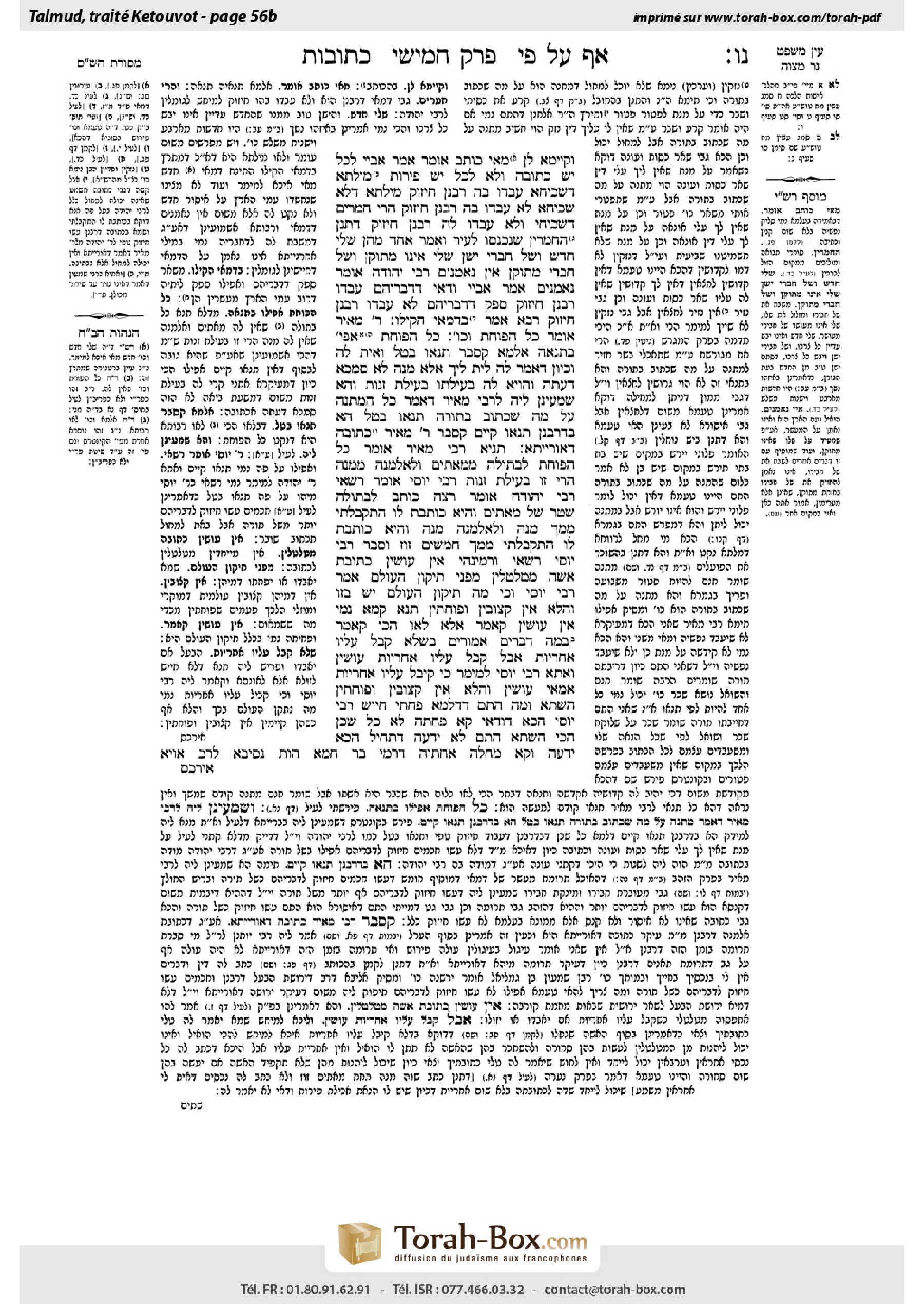
Ketubot 56b: Talmud study for Daf Yomi
Daf Yomi is the daily study of one Talmud folio. Explore 37 tractates with scans, Hebrew text, Sefaria English and AI-generated French translations where annotated.
Passage selection and English or AI-generated French translation are available where the scan has annotations. Daf Study is independent of Torah-Box and Sefaria.
Browse Ketubot · כתובות · All tractatesKetubot 56b text and translations
This page of Ketubot includes the Aramaic text, an English translation and an AI-generated French translation, alongside the scan above.
כתובות נ״ו ב · Aramaic and Hebrew text
וְקַיְימָא לַן: מַאי ״כּוֹתֵב״ — אוֹמֵר!
אָמַר אַבָּיֵי: לַכֹּל יֵשׁ כְּתוּבָּה, וְלֹא לַכֹּל יֵשׁ פֵּירוֹת. מִילְּתָא דִּשְׁכִיחָא — עֲבַדוּ בַּהּ רַבָּנַן חִיזּוּק, מִילְּתָא דְלָא שְׁכִיחָא — לָא עֲבַדוּ בַּהּ רַבָּנַן חִיזּוּק.
הֲרֵי חַמָּרִים, דִּשְׁכִיחִי, וְלָא עֲבַדוּ לַהּ רַבָּנַן חִיזּוּק!
דִּתְנַן: הַחַמָּרִין שֶׁנִּכְנְסוּ לָעִיר, וְאָמַר אֶחָד מֵהֶן: שֶׁלִּי חָדָשׁ, וְשֶׁל חֲבֵרִי יָשָׁן. שֶׁלִּי אֵינוֹ מְתוּקָּן, וְשֶׁל חֲבֵרִי מְתוּקָּן אֵין נֶאֱמָנִים. רַבִּי יְהוּדָה אוֹמֵר: נֶאֱמָנִים.
אָמַר אַבָּיֵי: וַדַּאי דְּדִבְרֵיהֶם — עֲבַדוּ רַבָּנַן חִיזּוּק. סָפֵק דְּדִבְרֵיהֶם, לָא עֲבַדוּ רַבָּנַן חִיזּוּק. רָבָא אָמַר: בִּדְמַאי הֵקֵילּוּ.
רַבִּי מֵאִיר אוֹמֵר: כׇּל הַפּוֹחֵת וְכוּ׳. כׇּל הַפּוֹחֵת אֲפִילּוּ בִּתְנָאָה — אַלְמָא קָסָבַר תְּנָאוֹ בָּטֵל, וְאִית לַהּ. וְכֵיוָן דְּאָמַר לַהּ ״לֵית לִיךְ אֶלָּא מָנֶה״ — לָא סָמְכָא דַּעְתַּהּ, וְהָוְיָא לַהּ בְּעִילָתוֹ בְּעִילַת זְנוּת.
וְהָא שָׁמְעִינַן לֵיהּ לְרַבִּי מֵאִיר דְּאָמַר: כׇּל הַמַּתְנֶה עַל מַה שֶּׁכָּתוּב בַּתּוֹרָה — תְּנָאוֹ בָּטֵל. הָא בִּדְרַבָּנַן — תְּנָאוֹ קַיָּים?! קָסָבַר רַבִּי מֵאִיר כְּתוּבָּה דְּאוֹרָיְיתָא.
תַּנְיָא, רַבִּי מֵאִיר אוֹמֵר: כׇּל הַפּוֹחֵת לִבְתוּלָה מִמָּאתַיִם וּלְאַלְמָנָה מִמָּנֶה — הֲרֵי זוֹ בְּעִילַת זְנוּת. רַבִּי יוֹסֵי אוֹמֵר: רַשַּׁאי. רַבִּי יְהוּדָה אוֹמֵר: רָצָה, כּוֹתֵב לִבְתוּלָה שְׁטָר שֶׁל מָאתַיִם, וְהִיא כּוֹתֶבֶת לוֹ: ״הִתְקַבַּלְתִּי מִמְּךָ מָנֶה״, וּלְאַלְמָנָה מָנֶה, וְהִיא כּוֹתֶבֶת לוֹ: ״הִתְקַבַּלְתִּי מִמְּךָ חֲמִשִּׁים זוּז״.
וְסָבַר רַבִּי יוֹסֵי רַשַּׁאי? וּרְמִינְהִי: אֵין עוֹשִׂין כְּתוּבַּת אִשָּׁה מִטַּלְטְלִין, מִפְּנֵי תִּיקּוּן הָעוֹלָם. אָמַר רַבִּי יוֹסֵי: וְכִי מָה תִּיקּוּן הָעוֹלָם יֵשׁ בְּזוֹ? וַהֲלֹא אֵין קְצוּבִין וּפוֹחֲתִין!
תַּנָּא קַמָּא נָמֵי ״אֵין עוֹשִׂין״ קָאָמַר! אֶלָּא לָאו הָכִי קָאָמַר: בַּמֶּה דְּבָרִים אֲמוּרִים — בְּשֶׁלֹּא קִבֵּל עָלָיו אַחְרָיוּת, אֲבָל קִבֵּל עָלָיו אַחְרָיוּת — עוֹשִׂין. וַאֲתָא רַבִּי יוֹסֵי לְמֵימַר כִּי קִיבֵּל עָלָיו אַחְרָיוּת אַמַּאי עוֹשִׂין? וַהֲלֹא אֵין קְצוּבִין וּפוֹחֲתִין!
הַשְׁתָּא, וּמָה הָתָם דְּדִלְמָא פָּחֲתִי — חָיֵישׁ רַבִּי יוֹסֵי, הָכָא, דְּוַדַּאי קָא פָּחֲתָה — לֹא כׇּל שֶׁכֵּן?! הָכִי הַשְׁתָּא?! הָתָם לָא יָדְעָה דְּתַחֵיל, הָכָא יָדְעָה וְקָא מָחֲלָה.
אֲחָתֵיהּ דְּרָמֵי בַּר חָמָא הֲוָת נְסִיבָא לְרַב אַוְיָא.
Ketubot 56b · English translation
And we maintain on this issue: What is the meaning of: Writes? It means: Says. In order to relinquish one’s claim to produce of the produce of his wife’s property, he does not necessarily need to write this in a document; it is sufficient to say it verbally in front of witnesses. It seems, therefore, that Rabbi Yehuda holds that a verbal stipulation is sufficient for a monetary matter of rabbinic law.
Abaye said: There is a distinction between the two cases. Every married woman has a marriage contract, but not all husbands have the right to produce, as not every woman brings property with her into the marriage. Therefore, in relation to a common matter, such as a marriage contract, the Sages reinforced their pronouncements about it by insisting that any stipulations to change the terms must be in writing. However, with regard to an uncommon matter, such as the produce of property, the Sages did not reinforce their pronouncements about it, and a verbal declaration is sufficient.
The Gemara challenges this answer: But with regard to the halakha of donkey drivers, which is a common matter, Rabbi Yehuda does not hold that the Sages reinforced their pronouncements about it.
This is as we learned in a mishna (Demai 4:7): In the case of donkey drivers who entered a city to sell their wares, and one of them said: My produce is from the new crop and is still moist and not as good, but my associate’s produce is from the old crop, or he said: Mine is not fit for use, i.e., tithes have not been separated, but my associate’s produce is fit for use, the drivers are not afforded credibility. There is a suspicion that they may be lying. They may have an arrangement between them where one will make this statement in one city and in the next city they will alternate, in order to appear credible, so that one will always be able to sell his wares. Rabbi Yehuda says: They are deemed credible. This indicates that Rabbi Yehuda holds that a verbal stipulation is sufficient even for a common monetary matter of rabbinic law.
Abaye said: There is a distinction between the cases. With regard to a certain matter involving a rabbinic decree, such as the main sum of the marriage contract, the Sages reinforced their pronouncements, but with regard to an uncertain matter involving a rabbinic decree, such as the case of the donkey drivers, the Sages did not reinforce their pronouncements. Rava said: The Sages did not reinforce their pronouncements in the case of the donkey drivers because, in general, they were lenient about questions concerning the prohibition of doubtfully tithed produce [demai], since the halakha of demai is itself a stringency, as most amei ha’aretz separate tithes from their produce.
§ The mishna says: Rabbi Meir says: In the case of anyone who reduces the amount of the marriage contract to less than two hundred dinars for a virgin or one hundred dinars for a widow, this marriage amounts to licentious sexual intercourse. The Gemara makes an inference from the language of the mishna: The phrase: Anyone who reduces the amount of the marriage contract, means even if he made a stipulation and she agreed. Apparently, Rabbi Meir held that his stipulation in this case is void and she has the ability to collect the entire amount set by the Sages, but nevertheless since he said to her: You have only one hundred dinars, she does not rely on the marriage contract and does not see it as a true marriage, and therefore the intercourse becomes licentious sexual intercourse.
But we have heard that Rabbi Meir said that anyone who stipulates counter to that which is written in the Torah, his stipulation is void. This implies that if someone makes a stipulation on a rabbinic law his stipulation does stand, and therefore there is still a question as to why the stipulation about the marriage contract is void, as a marriage contract is a rabbinic ordinance. The Gemara responds: Rabbi Meir holds that a marriage contract is a requirement of Torah law. Consequently, if one made a stipulation to reduce the amount of the marriage contract, this is a stipulation counter to that which is written in the Torah, and it is void.
It is taught in a baraita: Rabbi Meir says: In the case of anyone who reduces the amount of the marriage contract to lower than two hundred dinars for a virgin or one hundred dinars for a widow, this marriage amounts to licentious sexual intercourse. Rabbi Yosei says: One is permitted to reduce the amount by making a verbal stipulation, provided the wife agrees. Rabbi Yehuda says: If one wishes, he may write for a virgin a document for two hundred dinars, and she may write him a receipt stating: I received one hundred dinars from you. And similarly, for a widow one may write one hundred dinars and she may write for him: I received fifty dinars from you.
The Gemara asks: And does Rabbi Yosei actually hold that he is permitted to reduce the amount? The Gemara raises a contradiction based on a baraita: Collection of a woman’s marriage contract may not be made dependent upon movable property. This is a rabbinic decree enacted for the betterment of the world. Rabbi Yosei said: What betterment of the world is accomplished by this decree? The price of the movable property is not fixed, and therefore it might become devalued.
The Gemara analyzes the text of the baraita: The first tanna also said: A marriage contract may not be made dependent on movable property. What is Rabbi Yosei’s disagreement with him? Rather, is it not that this is what the first tanna said: In what case is this statement said? In a case where one did not provide a guarantee for the movable property. But if one did provide a guarantee, the marriage contract may be made dependent on it. And Rabbi Yosei comes to say: Even if one provided a guarantee, why can the marriage contract be made dependent on it? The price is not fixed, and it may become devalued.
Now that the meaning of the baraita has been clarified, the Gemara asks: Just as there, in the case of movable property, where perhaps it will be devalued, Rabbi Yosei is concerned that the wife might not receive the full value of her marriage contract, here, where it will definitely be devalued, is it not all the more so clear that he would be concerned? The Gemara responds: How can these cases be compared? There, she does not know if her marriage contract will be devalued, and there is no reason to suppose that she will waive his obligation to her. But here, she knows and she waived it.
The Gemara relates: The sister of Rami bar Ḥama was married to Rav Avya.
Ketubot 56b · Traduction française (IA)
Et nous soutenons à ce sujet : Que signifie « écrit » ? Cela signifie « dit ». Pour renoncer à son droit aux fruits des fruits des biens de son épouse, il n’a pas nécessairement besoin de le consigner dans un document ; il suffit qu’il le dise oralement devant témoins. Il semble donc que Rabbi Yehouda considère qu’une stipulation orale suffit en matière pécuniaire relevant de la loi rabbinique.
Abayé dit : les deux cas se distinguent. Toute femme mariée a une ketouba, mais tous les maris n’ont pas droit aux fruits, car toute femme n’apporte pas de biens dans le mariage. Par conséquent, s’agissant d’une situation courante, comme la ketouba, les Sages ont renforcé leurs décrets en exigeant que toute stipulation visant à en modifier les conditions soit écrite. En revanche, dans un cas peu courant, comme celui des fruits des biens, les Sages n’ont pas renforcé leurs décrets, et une déclaration orale suffit.
La Guemara objecte à cette réponse : mais, concernant la halakha des conducteurs d’ânes, qui est une situation courante, Rabbi Yehouda ne considère pas que les Sages aient renforcé leurs décrets.
C’est ce que nous avons appris dans une Michna (Demai 4:7) : lorsque des conducteurs d’ânes entrent dans une ville pour vendre leurs marchandises et que l’un d’eux dit : « Ma récolte est de la nouvelle récolte, elle est encore humide et de moindre qualité, mais celle de mon associé est de l’ancienne récolte », ou qu’il dit : « La mienne n’est pas propre à la consommation », c’est-à-dire que les dîmes n’en ont pas été prélevées, « mais celle de mon associé est propre à la consommation », on ne les croit pas. On soupçonne qu’ils mentent. Il se peut qu’ils aient convenu que l’un fasse cette déclaration dans une ville, puis qu’ils alternent dans la ville suivante, afin de paraître dignes de confiance et que l’un d’eux puisse toujours vendre sa marchandise. Rabbi Yehouda dit : on les croit. Cela indique que Rabbi Yehouda considère qu’une stipulation orale suffit même dans une situation pécuniaire courante relevant de la loi rabbinique.
Abayé dit : les cas se distinguent. Concernant une question certaine relevant d’un décret rabbinique, comme le montant principal de la ketouba, les Sages ont renforcé leurs décrets ; mais concernant une question incertaine relevant d’un décret rabbinique, comme le cas des conducteurs d’ânes, les Sages n’ont pas renforcé leurs décrets. Rava dit : les Sages n’ont pas renforcé leurs décrets dans le cas des conducteurs d’ânes parce qu’en général, ils se montraient indulgents à l’égard des questions concernant l’interdiction des produits dont le prélèvement des dîmes est douteux [demai], puisque la halakha du demai est elle-même une rigueur, car la plupart des amei ha’aretz prélèvent les dîmes de leur récolte.
§ La Michna dit : Rabbi Meïr dit : lorsqu’un homme réduit le montant de la ketouba à moins de deux cents dinars pour une vierge ou de cent dinars pour une veuve, ce mariage équivaut à des relations sexuelles licencieuses. La Guemara déduit du libellé de la Michna : l’expression « quiconque réduit le montant de la ketouba » signifie que cela vaut même s’il a fait une stipulation et qu’elle y a consenti. Apparemment, Rabbi Meïr considère que sa stipulation est nulle dans ce cas et qu’elle peut percevoir la totalité du montant fixé par les Sages. Pourtant, puisqu’il lui a dit : « Tu n’as droit qu’à cent dinars », elle ne se fie pas à la ketouba et ne considère pas qu’il s’agisse d’un véritable mariage ; les relations deviennent donc des relations sexuelles licencieuses.
Mais nous avons entendu Rabbi Meïr dire que quiconque fait une stipulation contraire à ce qui est écrit dans la Torah, sa stipulation est nulle. Cela implique que si quelqu’un fait une stipulation concernant une loi rabbinique, celle-ci est valable ; il reste donc à comprendre pourquoi la stipulation concernant la ketouba est nulle, puisque la ketouba est une ordonnance rabbinique. La Guemara répond : Rabbi Meïr considère que la ketouba est une exigence de la Torah. Par conséquent, si quelqu’un stipule une réduction du montant de la ketouba, sa stipulation est contraire à ce qui est écrit dans la Torah et elle est nulle.
Il est enseigné dans une baraïta : Rabbi Meïr dit : lorsqu’un homme réduit le montant de la ketouba à moins de deux cents dinars pour une vierge ou de cent dinars pour une veuve, ce mariage équivaut à des relations sexuelles licencieuses. Rabbi Yossi dit : il est permis d’en réduire le montant par une stipulation orale, à condition que l’épouse y consente. Rabbi Yehouda dit : s’il le souhaite, il peut établir pour une vierge un document de deux cents dinars, et elle peut lui rédiger un reçu indiquant : « J’ai reçu de toi cent dinars. » De même, pour une veuve, il peut établir un document de cent dinars, et elle peut lui écrire : « J’ai reçu de toi cinquante dinars. »
La Guemara demande : Rabbi Yossi considère-t-il vraiment qu’il est permis de réduire le montant ? La Guemara soulève une contradiction à partir d’une baraïta : le recouvrement de la ketouba d’une femme ne peut pas être garanti par des biens meubles. Il s’agit d’un décret rabbinique adopté pour le bien de la société. Rabbi Yossi dit : quel bien de la société ce décret apporte-t-il ? Le prix des biens meubles n’est pas fixe et ils risquent donc de se déprécier.
La Guemara analyse le texte de la baraïta : le premier tanna a lui aussi dit que la ketouba ne peut pas être garantie par des biens meubles. En quoi Rabbi Yossi est-il en désaccord avec lui ? N’est-ce pas plutôt que le premier tanna a dit ceci : dans quel cas cette déclaration s’applique-t-elle ? Lorsqu’on n’a pas fourni de garantie pour les biens meubles. Mais si l’on a fourni une garantie, la ketouba peut être garantie par ces biens. Rabbi Yossi vient alors dire : même si l’on a fourni une garantie, pourquoi la ketouba pourrait-elle être garantie par ces biens ? Leur prix n’est pas fixe et ils risquent de se déprécier.
Maintenant que le sens de la baraïta a été éclairci, la Guemara demande : là-bas, dans le cas des biens meubles, puisqu’ils risquent de se déprécier, Rabbi Yossi craint que l’épouse ne reçoive pas la pleine valeur de sa ketouba ; ici, où la valeur se dépréciera certainement, n’est-il pas évident, à plus forte raison, qu’il devrait s’en inquiéter ? La Guemara répond : comment comparer ces cas ? Là-bas, elle ignore si la valeur de sa ketouba se dépréciera, et rien ne permet de supposer qu’elle renoncera à ce qui lui est dû. Mais ici, elle le sait et elle y a renoncé.
La Guemara rapporte : la sœur de Rami bar Ḥama était mariée à Rav Avya.
Traduction française générée par IA à partir de l’édition anglaise de Sefaria. Vérifie toujours un passage avec le texte source.
Text from Sefaria: William Davidson Edition - Vocalized Aramaic (CC BY NC); William Davidson Edition - English (CC BY NC).