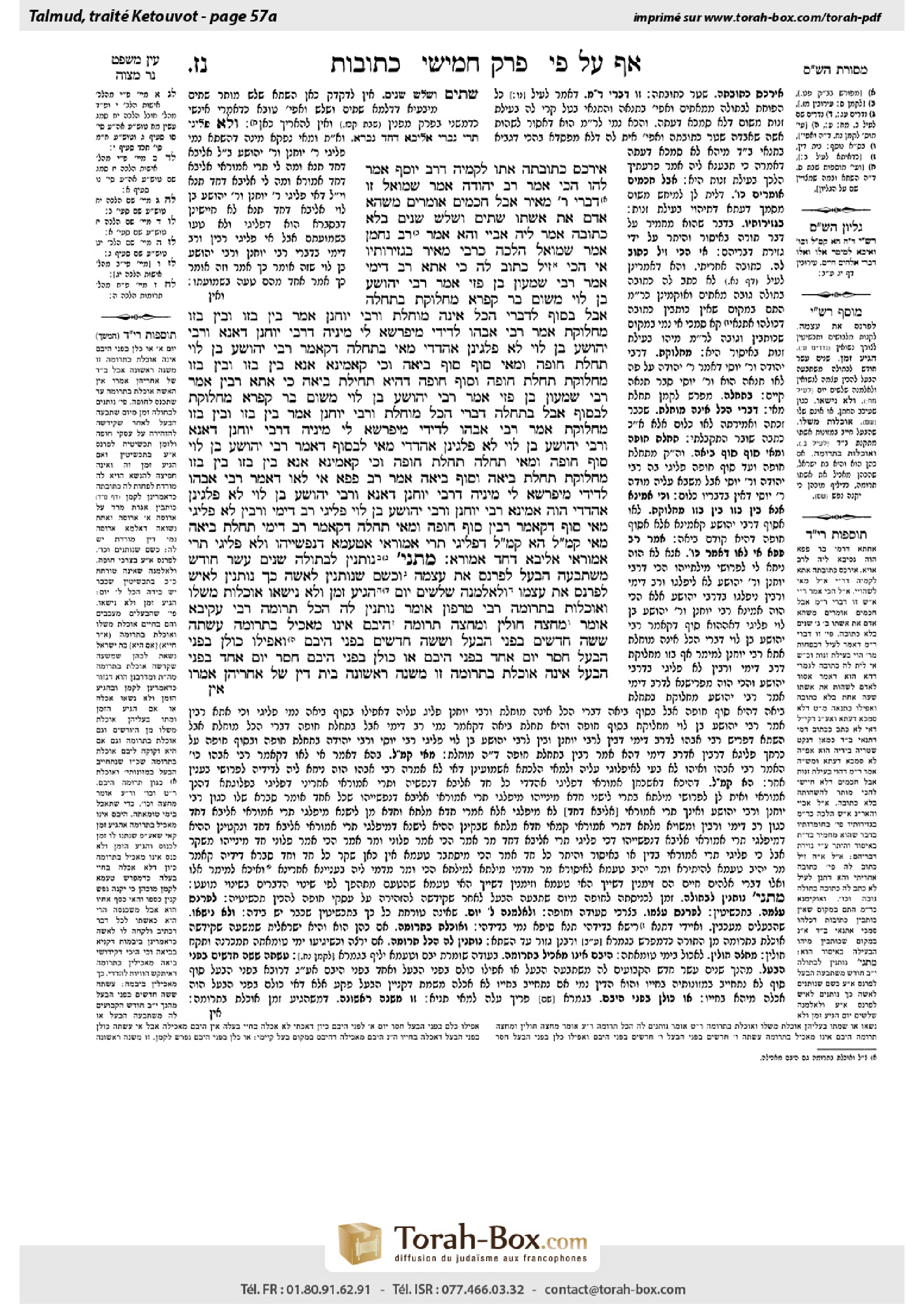
Ketubot 57a: Talmud study for Daf Yomi
Daf Yomi is the daily study of one Talmud folio. Explore 37 tractates with scans, Hebrew text, Sefaria English and AI-generated French translations where annotated.
Passage selection and English or AI-generated French translation are available where the scan has annotations. Daf Study is independent of Torah-Box and Sefaria.
Browse Ketubot · כתובות · All tractatesKetubot 57a text and translations
This page of Ketubot includes the Aramaic text, an English translation and an AI-generated French translation, alongside the scan above.
כתובות נ״ז א · Aramaic and Hebrew text
אִירְכַס כְּתוּבְּתַהּ. אֲתוֹ לְקַמֵּיהּ דְּרַב יוֹסֵף, אֲמַר לְהוּ: הָכִי אָמַר רַב יְהוּדָה אָמַר שְׁמוּאֵל: זוֹ דִּבְרֵי רַבִּי מֵאִיר.
אֲבָל חֲכָמִים אוֹמְרִים: מְשַׁהֶא אָדָם אֶת אִשְׁתּוֹ שְׁתַּיִם וְשָׁלֹשׁ שָׁנִים בְּלֹא כְּתוּבָּה. אֲמַר לֵיהּ אַבָּיֵי: וְהָא אָמַר רַב נַחְמָן אָמַר שְׁמוּאֵל: הֲלָכָה כְּרַבִּי מֵאִיר בִּגְזֵירוֹתָיו! אִי הָכִי, זִיל כְּתוֹב לַהּ.
כִּי אֲתָא רַב דִּימִי, אָמַר רַבִּי שִׁמְעוֹן בֶּן פַּזִּי אָמַר רַבִּי יְהוֹשֻׁעַ בֶּן לֵוִי מִשּׁוּם בַּר קַפָּרָא: מַחְלוֹקֶת בַּתְּחִלָּה, אֲבָל בַּסּוֹף — לְדִבְרֵי הַכֹּל אֵינָהּ מוֹחֶלֶת. וְרַבִּי יוֹחָנָן אָמַר: בֵּין בָּזוֹ וּבֵין בָּזוֹ מַחְלוֹקֶת. אָמַר רַבִּי אֲבָהוּ: לְדִידִי מִיפָּרְשָׁא לִי מִינֵּיהּ דְּרַבִּי יוֹחָנָן דַּאֲנָא וְרַבִּי יְהוֹשֻׁעַ בֶּן לֵוִי לָא פְּלִיגִינַן אַהֲדָדֵי:
מַאי ״בַּתְּחִלָּה״ דְּקָאָמַר רַבִּי יְהוֹשֻׁעַ בֶּן לֵוִי — תְּחִלַּת חוּפָּה, וּמַאי ״סוֹף״ — סוֹף בִּיאָה. וְכִי קָאָמֵינָא אֲנָא בֵּין בָּזוֹ וּבֵין בָּזוֹ מַחְלוֹקֶת, תְּחִלַּת חוּפָּה וְסוֹף חוּפָּה, דְּהִיא תְּחִילַּת בִּיאָה.
כִּי אֲתָא רָבִין, אָמַר רַבִּי שִׁמְעוֹן בֶּן פַּזִּי אָמַר רַבִּי יְהוֹשֻׁעַ בֶּן לֵוִי מִשּׁוּם בַּר קַפָּרָא: מַחְלוֹקֶת לְבַסּוֹף, אֲבָל בַּתְּחִלָּה — דִּבְרֵי הַכֹּל מוֹחֶלֶת, וְרַבִּי יוֹחָנָן אָמַר: בֵּין בָּזוֹ וּבֵין בָּזוֹ מַחְלוֹקֶת. אָמַר רַבִּי אֲבָהוּ: לְדִידִי מִיפָּרְשָׁא לִי מִינֵּיהּ דְּרַבִּי יוֹחָנָן, דַּאֲנָא וְרַבִּי יְהוֹשֻׁעַ בֶּן לֵוִי לָא פְּלִיגִינַן אַהֲדָדֵי: מַאי ״לְבַסּוֹף״ דְּאָמַר רַבִּי יְהוֹשֻׁעַ בֶּן לֵוִי — סוֹף חוּפָּה, וּמַאי ״תְּחִלָּה״ — תְּחִלַּת חוּפָּה. וְכִי קָאָמֵינָא אֲנָא בֵּין בָּזוֹ בֵּין בָּזוֹ מַחְלוֹקֶת — תְּחִלַּת בִּיאָה וְסוֹף בִּיאָה.
אָמַר רַב פָּפָּא: אִי לָאו דְּאָמַר רַבִּי אֲבָהוּ ״לְדִידִי מִיפָּרְשָׁא לִי מִינֵּיהּ דְּרַבִּי יוֹחָנָן דַּאֲנָא וְרַבִּי יְהוֹשֻׁעַ בֶּן לֵוִי לָא פְּלִיגִינַן אַהֲדָדֵי״, הֲוָה אָמֵינָא: רַבִּי יוֹחָנָן וְרַבִּי יְהוֹשֻׁעַ בֶּן לֵוִי פְּלִיגִי, רַב דִּימִי וְרָבִין לָא פְּלִיגִי.
מַאי ״סוֹף״ דְּקָאָמַר רָבִין — סוֹף חוּפָּה, וּמַאי ״תְּחִלָּה״ דְּקָאָמַר רַב דִּימִי — תְּחִלַּת בִּיאָה.
מַאי קָא מַשְׁמַע לַן?
הָא קָא מַשְׁמַע לַן, דִּפְלִיגִי תְּרֵי אָמוֹרָאֵי אַטַּעְמָא דְנַפְשַׁיְיהוּ, וְלָא פְּלִיגִי תְּרֵי אָמוֹרָאֵי אַלִּיבָּא דְּחַד אָמוֹרָא.
מַתְנִי׳ נוֹתְנִין לַבְּתוּלָה שְׁנֵים עָשָׂר חוֹדֶשׁ מִשֶּׁתְּבָעָהּ הַבַּעַל, לְפַרְנֵס אֶת עַצְמָהּ. וּכְשֵׁם שֶׁנּוֹתְנִין לָאִשָּׁה — כָּךְ נוֹתְנִין לָאִישׁ לְפַרְנֵס אֶת עַצְמוֹ. וּלְאַלְמָנָה שְׁלֹשִׁים יוֹם. הִגִּיעַ זְמַן וְלֹא נִישְּׂאוּ — אוֹכְלוֹת מִשֶּׁלּוֹ, וְאוֹכְלוֹת בִּתְרוּמָה.
רַבִּי טַרְפוֹן אוֹמֵר: נוֹתְנִין לָהּ הַכֹּל תְּרוּמָה. רַבִּי עֲקִיבָא אוֹמֵר: מֶחֱצָה חוּלִּין וּמֶחֱצָה תְּרוּמָה.
הַיָּבָם אֵינוֹ מַאֲכִיל בִּתְרוּמָה. עָשְׂתָה שִׁשָּׁה חֳדָשִׁים בִּפְנֵי הַבַּעַל וְשִׁשָּׁה חֳדָשִׁים בִּפְנֵי הַיָּבָם, וַאֲפִילּוּ כּוּלָּן בִּפְנֵי הַבַּעַל חָסֵר יוֹם אֶחָד בִּפְנֵי הַיָּבָם, אוֹ כּוּלָּן בִּפְנֵי הַיָּבָם חָסֵר יוֹם אֶחָד בִּפְנֵי הַבַּעַל — אֵינָהּ אוֹכֶלֶת בִּתְרוּמָה.
זוֹ מִשְׁנָה רִאשׁוֹנָה. בֵּית דִּין שֶׁל אַחֲרֵיהֶן אָמְרוּ:
Ketubot 57a · English translation
Her marriage contract was lost, and the woman and her husband came before Rav Yosef to ask what they should do. He said to them: This is what Rav Yehuda said that Shmuel said: That ruling, that if someone reduces his wife’s marriage contract by even a small amount, their marriage amounts to licentious sexual intercourse, is the statement of Rabbi Meir. According to that opinion, the husband and wife were forbidden to each other because she was not in possession of a valid marriage contract.
But the Rabbis say: Since the woman relies on the fact that she will eventually collect payment for her marriage contract, a man may maintain his wife for as long as two or three years without a written marriage contract. There is no urgent need to write a new one, since the husband’s obligation remains intact. Abaye said to him: But didn’t Rav Naḥman say that Shmuel said that the halakha is in accordance with the opinion of Rabbi Meir with regard to all of his decrees? Since Rabbi Meir’s statement about marriage contracts was a form of decree, the halakha should be in accordance with his opinion. Rav Yosef responded: If so, go and write her a new marriage contract.
§ The Gemara relates that when Rav Dimi came from Eretz Yisrael to Babylonia, he said that Rabbi Shimon ben Pazi said that Rabbi Yehoshua ben Levi said in the name of bar Kappara: This dispute between Rabbi Yehuda and Rabbi Yosei concerning whether one may make a verbal stipulation with a woman to reduce her marriage contract is referring only to the beginning of the process. But with regard to the end, all agree that she cannot waive her rights by verbal confirmation alone, and she must instead write a receipt. And Rabbi Yoḥanan said: Both in this case and in that case there is a dispute. Rabbi Abbahu said: This was explained to me personally by Rabbi Yoḥanan himself, who said: Rabbi Yehoshua ben Levi and I do not actually disagree with one another. We merely used different language to express the same halakha.
What is the meaning of the term: To the beginning, which Rabbi Yehoshua ben Levi said? It is referring to the beginning of the wedding ceremony. And what is meant by the end? It is referring to the end of intercourse; Rabbi Yehoshua ben Levi’s opinion is that after the marriage has been consummated, Rabbi Yehuda and Rabbi Yosei agree that the wife cannot relinquish her rights verbally. And when I said that both in this case and in that case there is a dispute, I was referring to the beginning of the wedding ceremony and the end of the wedding ceremony, which is also the beginning of the time designated for intercourse. Consequently, according to Rav Dimi, Rabbi Yehoshua ben Levi and Rabbi Yoḥanan agree that the dispute between Rabbi Yehuda and Rabbi Yosei applies only until the consummation of the marriage. After that point, all agree that she cannot waive her rights verbally.
When Ravin came from Eretz Yisrael, he reported this matter differently than Rav Dimi did: Rabbi Shimon ben Pazi said that Rabbi Yehoshua ben Levi said in the name of bar Kappara: This dispute is referring only to the end of the process, but with regard to the beginning, all agree that she can waive her rights verbally. And Rabbi Yoḥanan said: Both in this case and in that case there is a dispute. Rabbi Abbahu said: This was explained to me personally by Rabbi Yoḥanan himself, who said: I and Rabbi Yehoshua ben Levi do not disagree with one another. What is the meaning of: The end, which Rabbi Yehoshua ben Levi said? The end of the wedding ceremony. And what is the meaning of the beginning? The beginning of the wedding ceremony. And when I said that both in this case and in that case there is a dispute, I was referring to the beginning of intercourse and the end of intercourse.
Consequently, according to Ravin, Rabbi Yehoshua ben Levi and Rabbi Yoḥanan agree that at the time of the wedding ceremony the wife can verbally waive her rights, and the dispute of the tanna’im is referring to the time after the ceremony, which is also the beginning of the time for consummation of the marriage. Rav Pappa said: Had Rabbi Abbahu not said: This was explained to me personally by Rabbi Yoḥanan himself, that I, i.e. Rabbi Yoḥanan, and Rabbi Yehoshua ben Levi do not disagree with one another, I, i.e., Rav Pappa, would have said that the way to understand the various texts is that Rabbi Yoḥanan and Rabbi Yehoshua ben Levi do disagree with one another, whereas Rav Dimi and Ravin do not disagree with one another, but rather they both cited the same tradition from Eretz Yisrael.
I would have explained it in the following manner: What is the meaning of the word end, which Ravin said? It is referring to the end of the wedding ceremony. And what is the meaning of the word beginning, which Rav Dimi said? It is referring to the beginning of the time designated for intercourse, which begins at the end of the wedding ceremony. It would then follow that Rabbi Yehoshua ben Levi and Rabbi Yoḥanan disagreed about the explanation of the dispute between Rabbi Yehuda and Rabbi Yosei, whereas Rav Dimi and Ravin both said the same thing.
What is Rav Pappa teaching us? Since he accepts Rabbi Abbahu’s statement, he acknowledges that his alternate way of reading the sources is not correct. What, then, is the point of telling us that he would have explained Rabbi Yehoshua ben Levi’s and Rabbi Yoḥanan’s words differently?
The Gemara explains: It teaches us this: If we were discussing the meaning of an amoraic dispute about which we have different traditions, it is better to explain that two amora’im disagree with regard to their own reasons and not that two amora’im disagree according to the opinion of another amora, as it is more plausible to say that there is a dispute about logical reasoning than that there is a dispute about the correct transmission of a halakhic tradition. Consequently, had Rabbi Abbahu not declared that he was told otherwise by Rabbi Yoḥanan, it would have been preferable to explain that there is a logical dispute between Rabbi Yehoshua ben Levi and Rabbi Yoḥanan, rather than saying that the dispute is about the details of the tradition received by Rav Dimi and Ravin.
MISHNA: One gives a virgin twelve months from the time the husband asked to marry her after having betrothed her, in order to prepare herself with clothes and jewelry for the marriage. And just as one gives a woman this amount of time, so too does one give a man an equivalent period of time to prepare himself, as he too needs time to prepare for the marriage. However, in the case of a widow, who already has items available from her previous marriage, she is given only thirty days to prepare. If the appointed time for the wedding arrived and they did not get married due to some delay on the part of the husband, then the woman may partake of his food. And if her husband is a priest, she may partake of teruma, even if she is an Israelite woman.
The tanna’im disagree about the permission granted to a priest to sustain his betrothed with teruma before she is married to him. Rabbi Tarfon says: He may give her all of her required sustenance from teruma. During her periods of impurity, e.g., menstruation, when she cannot partake of teruma, she may sell the teruma to a priest and use the proceeds to buy non-sacred food. Rabbi Akiva says: He must give her half of her needs from non-sacred food and half may be from teruma, so that she can eat from the non-sacred food when she is ritually impure.
The mishna continues: A priest who is a yavam, i.e., his brother died childless after betrothing a woman, does not enable his yevama to partake of teruma by virtue of her relationship with him. If she had completed six months of the twelve-month wait for marriage under the aegis of the husband, and then he died, and she waited six more months under the aegis of the yavam; or even if she completed all of the necessary time under the aegis of the husband except for one day that she was under the aegis of the yavam; or if she completed all of the necessary time under the aegis of the yavam except for one day that she was under the aegis of the husband, she still may not partake of teruma.
This set of rulings, concerning the permission granted a betrothed woman whose wedding date has arrived to partake of teruma, is in accordance with the initial version of the mishna. However, a court that convened after them, in a later generation, said:
Ketubot 57a · Traduction française (IA)
Son acte de mariage avait été perdu, et la femme et son mari se présentèrent devant Rav Yosef pour demander ce qu’ils devaient faire. Il leur dit : Voici ce que Rav Yehuda a dit au nom de Shmuel : cette règle, selon laquelle, si quelqu’un réduit même légèrement le montant de l’acte de mariage de son épouse, leur union équivaut à des relations sexuelles illicites, est l’opinion de Rabbi Meir. Selon cette opinion, le mari et la femme ne pouvaient pas vivre ensemble, puisqu’elle ne disposait pas d’un acte de mariage valable.
Mais les Rabbins disent : puisque la femme compte sur le fait qu’elle finira par percevoir le paiement de son acte de mariage, un homme peut garder son épouse auprès de lui pendant deux ou trois ans sans acte de mariage écrit. Il n’est pas urgent d’en rédiger un nouveau, car l’obligation du mari reste entière. Abaye lui dit : Mais Rav Naḥman n’a-t-il pas dit au nom de Shmuel que la halakha suit l’opinion de Rabbi Meir pour toutes ses mesures de précaution ? Puisque la déclaration de Rabbi Meir au sujet des actes de mariage constituait une mesure de précaution, la halakha devrait suivre son opinion. Rav Yosef lui répondit : Dans ce cas, allez lui rédiger un nouvel acte de mariage.
§ La Guemara rapporte que, lorsque Rav Dimi vint d’Eretz Yisrael en Babylonie, il dit que Rabbi Shimon ben Pazi avait dit que Rabbi Yehoshua ben Levi avait dit au nom de bar Kappara : cette controverse entre Rabbi Yehuda et Rabbi Yosei, concernant la possibilité de convenir verbalement avec une femme de réduire le montant de son acte de mariage, ne porte que sur le début du processus. Mais, pour ce qui est de la fin, tous reconnaissent qu’elle ne peut renoncer à ses droits par une simple confirmation verbale et qu’elle doit plutôt rédiger un reçu. Rabbi Yoḥanan dit : il y a une controverse dans les deux cas. Rabbi Abbahu dit : Rabbi Yoḥanan lui-même m’a expliqué cela personnellement et m’a dit : Rabbi Yehoshua ben Levi et moi ne sommes pas réellement en désaccord. Nous avons simplement exprimé la même halakha différemment.
Que signifie le terme « début » employé par Rabbi Yehoshua ben Levi ? Il désigne le début de la cérémonie de mariage. Et que signifie « fin » ? Cela désigne la fin des rapports sexuels ; selon Rabbi Yehoshua ben Levi, une fois le mariage consommé, Rabbi Yehuda et Rabbi Yosei reconnaissent que l’épouse ne peut renoncer verbalement à ses droits. Et lorsque j’ai dit qu’il y a une controverse dans les deux cas, je parlais du début et de la fin de la cérémonie de mariage, cette fin correspondant également au début de la période prévue pour la consommation du mariage. Par conséquent, selon Rav Dimi, Rabbi Yehoshua ben Levi et Rabbi Yoḥanan s’accordent à dire que la controverse entre Rabbi Yehuda et Rabbi Yosei ne porte que sur la période précédant la consommation du mariage. Après cela, tous reconnaissent qu’elle ne peut renoncer verbalement à ses droits.
Lorsque Ravin vint d’Eretz Yisrael, il rapporta cette question différemment de Rav Dimi : Rabbi Shimon ben Pazi dit que Rabbi Yehoshua ben Levi avait dit au nom de bar Kappara : cette controverse ne porte que sur la fin du processus, mais, pour ce qui est du début, tous reconnaissent qu’elle peut renoncer verbalement à ses droits. Rabbi Yoḥanan dit : il y a une controverse dans les deux cas. Rabbi Abbahu dit : Rabbi Yoḥanan lui-même m’a expliqué cela personnellement et m’a dit : Rabbi Yehoshua ben Levi et moi ne sommes pas en désaccord. Que signifie « fin », terme employé par Rabbi Yehoshua ben Levi ? La fin de la cérémonie de mariage. Et que signifie « début » ? Le début de la cérémonie de mariage. Et lorsque j’ai dit qu’il y a une controverse dans les deux cas, je parlais du début et de la fin des rapports sexuels.
Par conséquent, selon Ravin, Rabbi Yehoshua ben Levi et Rabbi Yoḥanan s’accordent à dire qu’au moment de la cérémonie de mariage, l’épouse peut renoncer verbalement à ses droits ; la controverse entre les tannaïm porte sur la période qui suit la cérémonie, laquelle correspond également au début de la période prévue pour la consommation du mariage. Rav Pappa dit : Si Rabbi Abbahu n’avait pas déclaré que Rabbi Yoḥanan lui-même lui avait expliqué cela personnellement, en disant que moi, c’est-à-dire Rabbi Yoḥanan, et Rabbi Yehoshua ben Levi ne sommes pas en désaccord, j’aurais dit, moi, c’est-à-dire Rav Pappa, qu’il fallait comprendre les différentes sources ainsi : Rabbi Yoḥanan et Rabbi Yehoshua ben Levi sont en désaccord, tandis que Rav Dimi et Ravin ne le sont pas ; ils ont au contraire tous deux rapporté la même tradition d’Eretz Yisrael.
Je l’aurais expliqué de la manière suivante : que signifie le mot « fin » employé par Ravin ? Il désigne la fin de la cérémonie de mariage. Et que signifie le mot « début » employé par Rav Dimi ? Il désigne le début de la période prévue pour les rapports sexuels, qui commence à la fin de la cérémonie de mariage. Il s’ensuivrait que Rabbi Yehoshua ben Levi et Rabbi Yoḥanan étaient en désaccord sur l’explication de la controverse entre Rabbi Yehuda et Rabbi Yosei, tandis que Rav Dimi et Ravin disaient tous deux la même chose.
Que nous enseigne Rav Pappa ? Puisqu’il accepte la déclaration de Rabbi Abbahu, il reconnaît que son autre manière de lire les sources n’est pas correcte. Quel est donc l’intérêt de nous dire qu’il aurait interprété différemment les paroles de Rabbi Yehoshua ben Levi et de Rabbi Yoḥanan ?
La Guemara explique : cela nous enseigne ceci. Si nous examinons le sens d’une controverse entre amoraïm au sujet de laquelle nous avons reçu des traditions différentes, mieux vaut expliquer que deux amoraïm sont en désaccord pour des raisons qui leur sont propres, plutôt que de dire que deux amoraïm divergent en suivant l’opinion d’un autre amora ; il est en effet plus plausible qu’il y ait une controverse sur le raisonnement logique plutôt que sur la transmission correcte d’une tradition halakhique. Par conséquent, si Rabbi Abbahu n’avait pas déclaré que Rabbi Yoḥanan lui avait dit le contraire, il aurait été préférable d’expliquer qu’il existe un désaccord logique entre Rabbi Yehoshua ben Levi et Rabbi Yoḥanan, plutôt que de dire que la controverse porte sur les détails de la tradition reçue par Rav Dimi et Ravin.
MICHNA. On accorde à une vierge douze mois à compter du moment où son mari lui demande de l’épouser, après l’avoir fiancée, afin qu’elle puisse se préparer au mariage en se procurant des vêtements et des bijoux. De même que l’on accorde ce délai à une femme, on accorde aussi à un homme un délai équivalent pour se préparer, car lui aussi a besoin de temps pour les préparatifs du mariage. En revanche, une veuve, qui possède déjà des affaires provenant de son précédent mariage, ne reçoit que trente jours pour se préparer. Si la date fixée pour le mariage est arrivée et qu’ils ne se sont pas mariés en raison d’un retard imputable au mari, alors la femme peut prendre sa nourriture à ses frais. Et si son mari est prêtre, elle peut consommer de la terouma, même si elle est une Israélite.
Les tannaïm divergent sur la permission accordée à un prêtre d’entretenir sa fiancée avec de la terouma avant de l’épouser. Rabbi Tarfon dit : il peut lui fournir toute la nourriture dont elle a besoin sous forme de terouma. Pendant ses périodes d’impureté, par exemple lors de ses règles, lorsqu’elle ne peut pas consommer de terouma, elle peut vendre la terouma à un prêtre et utiliser le produit de la vente pour acheter des aliments profanes. Rabbi Akiva dit : il doit lui fournir la moitié de ses besoins en aliments profanes, et l’autre moitié peut être de la terouma, afin qu’elle puisse manger des aliments profanes lorsqu’elle est en état d’impureté rituelle.
La Michna poursuit : un prêtre qui est yavam, c’est-à-dire dont le frère est mort sans enfant après avoir fiancé une femme, ne permet pas à sa yevama de consommer de la terouma du fait de son lien avec lui. Si elle avait accompli six mois des douze mois d’attente avant le mariage sous l’autorité de son mari, puis que celui-ci est mort, et qu’elle a attendu six mois supplémentaires sous l’autorité du yavam ; ou même si elle avait accompli toute la période nécessaire sous l’autorité de son mari, à l’exception d’un jour passé sous l’autorité du yavam ; ou si elle avait accompli toute la période nécessaire sous l’autorité du yavam, à l’exception d’un jour passé sous l’autorité de son mari, elle ne peut toujours pas consommer de terouma.
Cette série de règles concernant l’autorisation donnée à une femme fiancée, dont la date de mariage est arrivée, de consommer de la terouma, est conforme à la première version de la Michna. Toutefois, un tribunal qui siégea après eux, à une génération ultérieure, dit :
Traduction française générée par IA à partir de l’édition anglaise de Sefaria. Vérifie toujours un passage avec le texte source.
Text from Sefaria: William Davidson Edition - Vocalized Aramaic (CC BY NC); William Davidson Edition - English (CC BY NC).