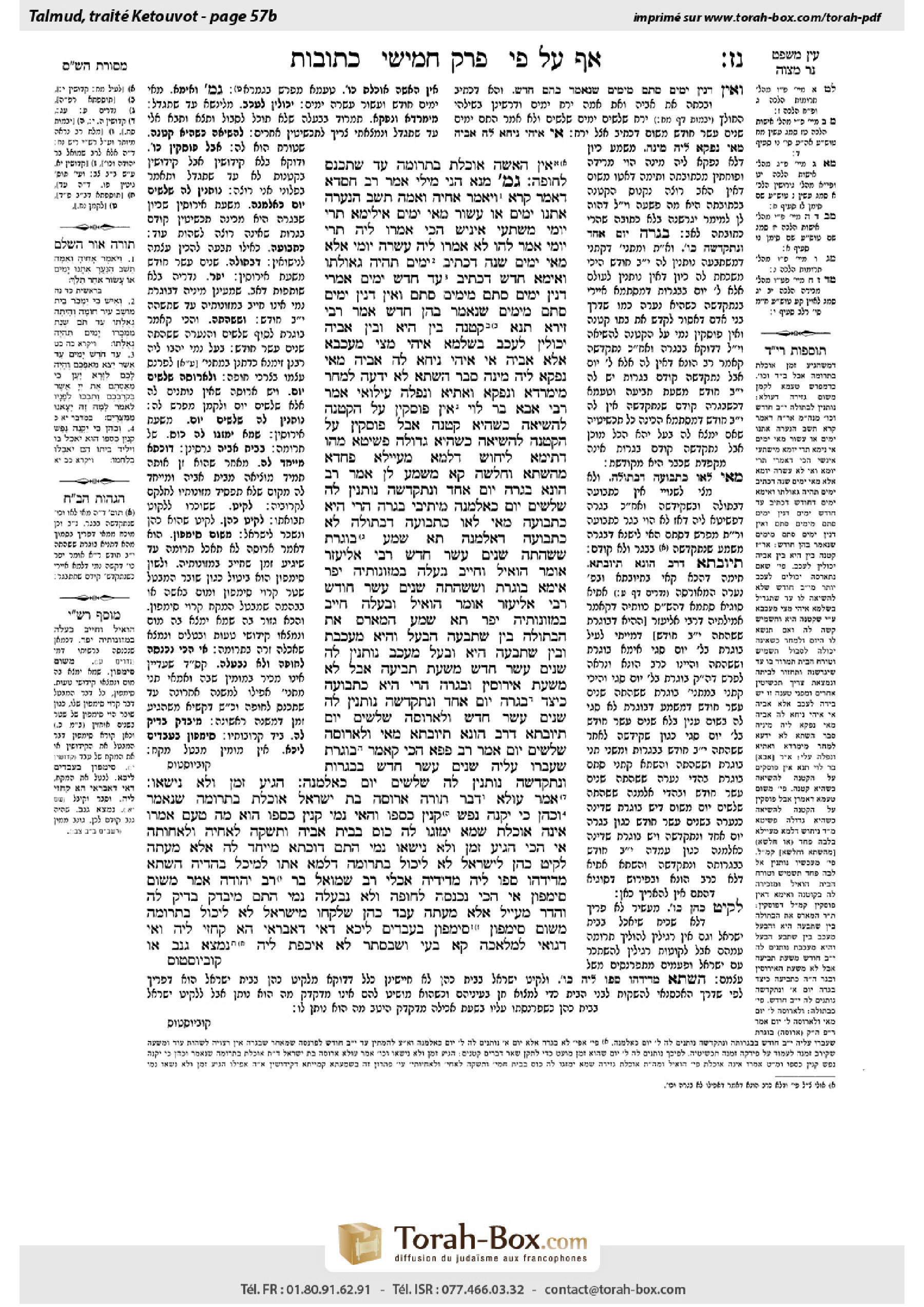
Ketubot 57b: Talmud study for Daf Yomi
Daf Yomi is the daily study of one Talmud folio. Explore 37 tractates with scans, Hebrew text, Sefaria English and AI-generated French translations where annotated.
Passage selection and English or AI-generated French translation are available where the scan has annotations. Daf Study is independent of Torah-Box and Sefaria.
Browse Ketubot · כתובות · All tractatesKetubot 57b text and translations
This page of Ketubot includes the Aramaic text, an English translation and an AI-generated French translation, alongside the scan above.
כתובות נ״ז ב · Aramaic and Hebrew text
אֵין הָאִשָּׁה אוֹכֶלֶת בִּתְרוּמָה עַד שֶׁתִּכָּנֵס לַחוּפָּה.
גְּמָ׳ מְנָא הָנֵי מִילֵּי? אָמַר רַב חִסְדָּא, דְּאָמַר קְרָא: ״וַיֹּאמֶר אָחִיהָ וְאִמָּהּ תֵּשֵׁב הַנַּעֲרָה אִתָּנוּ יָמִים אוֹ עָשׂוֹר״.
מַאי ״יָמִים״? אִילֵּימָא תְּרֵי יוֹמֵי, מִשְׁתַּעֵי אִינִישׁ הָכִי? אֲמַרוּ לֵיהּ: תְּרֵי יוֹמֵי, אֲמַר לְהוּ: לָא. אֲמַרוּ לֵיהּ עַשְׂרָה יוֹמֵי?! אֶלָּא מַאי ״יָמִים״ — שָׁנָה, דִּכְתִיב: ״יָמִים תִּהְיֶה גְּאוּלָּתוֹ״.
וְאֵימָא חֹדֶשׁ, דִּכְתִיב ״עַד חֹדֶשׁ יָמִים״. אָמְרִי: דָּנִין ״יָמִים״ סְתָם מִ״יָּמִים״ סְתָם, וְאֵין דָּנִין ״יָמִים״ סְתָם מִ״יָּמִים״ שֶׁנֶּאֱמַר בָּהֶן חֹדֶשׁ.
אָמַר רַבִּי זֵירָא, תָּנָא: קְטַנָּה, בֵּין הִיא וּבֵין אָבִיהָ יְכוֹלִין לְעַכֵּב. בִּשְׁלָמָא אִיהִי מָצֵי מְעַכְּבָא, אֶלָּא אָבִיהָ — אִי אִיהִי נִיחָא לַהּ, אָבִיהָ מַאי נָפְקָא לֵיהּ מִינַּהּ? סָבַר: הַשְׁתָּא לָא יָדְעָה, לִמְחַר מִימַּרְדָא וְנָפְקָא, וְאָתְיָא וְנָפְלָה עִילָּוַאי.
אָמַר רַבִּי אַבָּא בַּר לֵוִי: אֵין פּוֹסְקִין עַל הַקְּטַנָּה לְהַשִּׂיאָהּ כְּשֶׁהִיא קְטַנָּה, אֲבָל פּוֹסְקִין עַל הַקְּטַנָּה לְהַשִּׂיאָהּ כְּשֶׁהִיא גְּדוֹלָה. פְּשִׁיטָא? מַהוּ דְּתֵימָא: לֵיחוּשׁ דִּלְמָא מְעַיְּילָא פַּחְדָּא מֵהַשְׁתָּא וְחָלְשָׁה, קָא מַשְׁמַע לַן.
אָמַר רַב הוּנָא: בָּגְרָה יוֹם אֶחָד וְנִתְקַדְּשָׁה — נוֹתְנִין לָהּ שְׁלֹשִׁים יוֹם, כְּאַלְמָנָה. מֵיתִיבִי: בָּגְרָה הֲרֵי הִיא כִּתְבוּעָה. מַאי לָאו, כִּתְבוּעָה דִּבְתוּלָה? לָא, כִּתְבוּעָה דְּאַלְמָנָה.
תָּא שְׁמַע: בּוֹגֶרֶת שֶׁשָּׁהֲתָה שְׁנֵים עָשָׂר חֹדֶשׁ, רַבִּי אֱלִיעֶזֶר אוֹמֵר: הוֹאִיל וְחַיָּיב בַּעְלָהּ בִּמְזוֹנוֹתֶיהָ — יָפֵר! אֵימָא: בּוֹגֶרֶת וְשֶׁשָּׁהֲתָה שְׁנֵים עָשָׂר חוֹדֶשׁ, רַבִּי אֱלִיעֶזֶר אוֹמֵר: הוֹאִיל ובַעְלָהּ חַיָּיב בִּמְזוֹנוֹתֶיהָ — יָפֵר.
תָּא שְׁמַע: הַמְאָרֵס אֶת הַבְּתוּלָה, בֵּין שֶׁתְּבָעָהּ הַבַּעַל וְהִיא מְעַכֶּבֶת, וּבֵין שֶׁתָּבְעָה הִיא וּבַעַל מְעַכֵּב — נוֹתְנִין לָהּ שְׁנֵים עָשָׂר חֹדֶשׁ מִשְּׁעַת תְּבִיעָה, אֲבָל לֹא מִשְּׁעַת אֵירוּסִין. וּבָגְרָה, הֲרֵי הִיא כִּתְבוּעָה. כֵּיצַד: בָּגְרָה יוֹם אֶחָד וְנִתְקַדְּשָׁה — נוֹתְנִין לָהּ שְׁנֵים עָשָׂר חֹדֶשׁ, וְלַאֲרוּסָה שְׁלֹשִׁים יוֹם. תְּיוּבְתָּא דְרַב הוּנָא תְּיוּבְתָּא.
מַאי ״וְלַאֲרוּסָה שְׁלֹשִׁים יוֹם״? אָמַר רַב פָּפָּא, הָכִי קָאָמַר: בּוֹגֶרֶת שֶׁעָבְרוּ עָלֶיהָ שְׁנֵים עָשָׂר חֹדֶשׁ בְּבַגְרוּת וְנִתְקַדְּשָׁה — נוֹתְנִין לָהּ שְׁלֹשִׁים יוֹם כְּאַלְמָנָה.
הִגִּיעַ זְמַן וְלֹא נִישְּׂאוּ. אָמַר עוּלָּא: דְּבַר תּוֹרָה, אֲרוּסָה בַּת יִשְׂרָאֵל אוֹכֶלֶת בִּתְרוּמָה, שֶׁנֶּאֱמַר: ״וְכֹהֵן כִּי יִקְנֶה נֶפֶשׁ קִנְיַן כַּסְפּוֹ״, וְהַאי נָמֵי קִנְיַן כַּסְפּוֹ הוּא. מָה טַעַם אָמְרוּ אֵינָהּ אוֹכֶלֶת — שֶׁמָּא יִמְזְגוּ לָהּ כּוֹס בְּבֵית אָבִיהָ, וְתַשְׁקֶה לְאָחִיהָ וְלַאֲחוֹתָהּ.
אִי הָכִי, הִגִּיעַ זְמַן וְלֹא נִישְּׂאוּ נָמֵי! הָתָם, דּוּכְתָּא מְיַיחֵד לַהּ.
אֶלָּא מֵעַתָּה, לָקִיט כֹּהֵן לְיִשְׂרָאֵל לָא לֵיכוֹל בִּתְרוּמָה, דִּלְמָא אָתוּ לְמֵיכַל בַּהֲדֵיהּ! הַשְׁתָּא מִדִּידְהוּ סָפוּ לֵיהּ — מִדִּידֵיהּ אָכְלִי?!
רַב שְׁמוּאֵל בַּר רַב יְהוּדָה אָמַר: מִשּׁוּם סִימְפּוֹן.
אִי הָכִי, נִכְנְסָה לְחוּפָּה וְלֹא נִבְעֲלָה נָמֵי! הָתָם, מִיבְדָּק בָּדֵיק לַהּ וַהֲדַר מְעַיֵּיל.
אֶלָּא מֵעַתָּה, עֶבֶד כֹּהֵן שֶׁלְּקָחוֹ מִיִּשְׂרָאֵל לָא לֵיכוֹל בִּתְרוּמָה, מִשּׁוּם סִימְפּוֹן! סִימְפּוֹן בַּעֲבָדִים לֵיכָּא, דְּאִי דְּאַבָּרַאי — הָא קָחָזֵי לֵיהּ. וְאִי דְּגַוַּאי — לִמְלָאכָה קָא בָּעֵי, וְשֶׁבַּסֵּתֶר לָא אִיכְפַּת לֵיהּ. נִמְצָא גַּנָּב אוֹ
Ketubot 57b · English translation
A woman may not partake of teruma until she has actually entered the wedding canopy.
GEMARA: The Gemara asks: From where are these matters derived, that a virgin is given twelve months to prepare for her wedding? Rav Ḥisda said it is based on the fact that the verse states with regard to Rebecca: “And her brother and mother said: Let the damsel abide with us for days, or ten” (Genesis 24:55).
The Gemara first analyzes the language of the verse: What is the meaning of “days”? If we say two days, the minimum number justifying the use of the plural, does a person really speak like this? Rebecca’s relatives said to Abraham’s servant that they wanted her to stay for two days, after which he said to them no, as he did not want to wait even that long. If so, is it possible that after that they said to him that they wanted her to stay for ten days? Consequently, it is impossible to explain the word “days” as two days and “ten” as ten days. Rather, what is the meaning of “days”? It means: A year, as it is written: “For days he shall have redemption” (Leviticus 25:29), and there it is explained that “days” is referring to a year. Consequently, in the verse “And her brother and mother said: Let the damsel abide with us for days, or ten” (Genesis 24:55), “days” refers to a year, and “ten” refers to a shorter period of similar magnitude, i.e. ten months, in order to prepare for her wedding.
The Gemara asks: And let us say that “days” means a month, as it is written: “But a whole month of days” (Numbers 11:20), and the verse about Rebecca might then have meant that her family wanted to wait for a month, or at least for ten days. They say: One derives the meaning of an unspecified use of the term “days” from another unspecified instance of the term “days,” which means a year. And one does not derive the meaning of an unspecified use of the term “days” from an instance of the term “days,” about which the term “month” is stated. Consequently, it can be derived from the verse that the ordinary amount of time required for a virgin to prepare for marriage is twelve months.
§ Rabbi Zeira said: It was taught in the Tosefta (Ketubot 5:1) with regard to a minor girl: Either she or her father may delay the wedding until she has reached majority. The Gemara asks: Granted, she, the girl herself, may delay the wedding if she feels she is not ready, as she is the one who will be directly affected, but why should her father be allowed to delay her wedding? If it is suitable for her to get married, what difference does it make to her father? The Gemara answers: He thinks: Perhaps she agrees to get married now because she does not fully know what she is doing. But tomorrow, she will realize the marriage was a mistake, rebel, and leave her husband, and then she will come back and become a burden to me. Therefore, her father prefers that she wait until she has reached majority and marry when she is completely aware of what is involved.
Rabbi Abba bar Levi said: One may not finalize an agreement to marry a minor girl in order to marry her while she is still a minor, but one may finalize an agreement to marry a minor girl in order to marry her when she becomes an adult woman. With regard to the latter halakha, the Gemara asks: Isn’t that obvious? If he will marry her when she becomes an adult woman, there is nothing unusual about this case. The Gemara answers: Lest you say that one should be concerned that she might become afraid of marriage from making plans now, and this will cause her resolve to weaken, and then even when she becomes an adult she will maintain reservations about the matter, Rabbi Abba bar Levi therefore teaches us that one need not be concerned about this. One may finalize an agreement to marry her as an adult even when she is a minor girl.
§ Rav Huna said: If she has reached her majority, even for just one day, and then she is betrothed, she is given her thirty days to prepare for her wedding, like a widow, since prior to reaching adulthood she presumably had already prepared everything needed for her marriage. The Gemara raises an objection from a baraita: If she grew up, she is similar to a betrothed woman who has been asked to marry her betrothed. What, is it not that she is similar to a virgin who has been asked to marry, and she has twelve months to prepare? The Gemara answers: No, it means that she is similar to a widow who has been asked to marry her betrothed, who gets only thirty days to prepare. Only young women who have not reached majority and who are virgins get a year to prepare; after majority, all women, regardless of whether they are virgins, get thirty days.
The Gemara attempts another refutation of Rav Huna’s statement: Come and hear a proof from a mishna (Nedarim 73b): If a grown woman waited twelve months since betrothal and is still not married, Rabbi Eliezer says: Since her husband is obligated to provide for her sustenance, he may also nullify her vows (see Numbers, chapter 30). It can be inferred from this that the waiting period for a grown woman is also twelve months. The Gemara responds by emending the text of the mishna: Say that if a grown woman waited thirty days or a young woman waited twelve months, Rabbi Eliezer says: Since her husband is obligated to provide for her sustenance, he may nullify her vows.
The Gemara attempts another refutation of Rav Huna’s statement: Come and hear a baraita: If someone betrothed a virgin, whether the husband asks to marry her and she delays the process because she says that she requires more time or whether she asks to marry him and the husband delays the process because he is not yet ready, she is given twelve months from the time the request was issued but not from the time of the betrothal, even if that was much earlier, and a grown woman is similar to one who has been asked to marry. How is this so? If she has reached her majority for one day, and she is then betrothed, she is given twelve months from the day of her betrothal, because it is the same as the day of her majority. One who was already a betrothed woman when she reached majority is given thirty days. Therefore, the refutation of the opinion of Rav Huna is a conclusive refutation.
The Gemara asks: What is meant by the words: And one who was already a betrothed woman is given thirty days? Rav Pappa said: This is what it is saying: With regard to a grown woman who has been an adult for twelve months and is then betrothed, she is given thirty days, like a widow, and not another twelve months.
§ The mishna states: If the appointed time for the wedding arrived and they did not get married, she may partake of teruma. Ulla said: By Torah law, the daughter of a non-priest betrothed to a priest may partake of teruma immediately, even before the wedding date arrives, as it is stated: “If a priest buy any soul, the acquisition of his money, he may eat of it” (Leviticus 22:11), and this woman is also an acquisition of his money through the betrothal. Therefore, she is entitled to partake of teruma. What, then, is the reason the Sages said that she may not partake? It is lest someone pour her a cup of teruma wine while she is in her father’s house. Although she may drink it as the betrothed of a priest, since she is still living in her father’s house there is a concern that she will give her brother or sister to drink from the wine, which is prohibited, as they are non-priests.
The Gemara asks: If so, then if the time arrived and they did not get married, there should also be concern that she might give it to members of her family, as she is still in her father’s house. Why, then, does the mishna say that she is permitted to partake of teruma at that time? The Gemara answers: There, after the time for the wedding has arrived, he designates a specific place for her. Since her husband is obligated to provide for her sustenance, he will want to ensure that she receives her food in a particular place so that she not use it to feed her family. This mitigates the concern that she may inadvertently give it to her brother or sister to drink.
The Gemara asks: However, if that is so, then the halakha should also be that a gleaner who is a priest and is employed by an Israelite may not partake of teruma, lest the other members of the household come to eat with him from the teruma. The Gemara rejects this: Now, even though the members of the Israelite household feed the priest from their food, as he is their employee, would they eat from his food? They would not. Therefore, there is no reason for concern and no reason to prohibit him from eating teruma. This is Ulla’s opinion.
However, Rav Shmuel bar Rav Yehuda said: The reason for the rabbinic decree is due to abrogation [simfon], cancellation of the contract. It may become known after the betrothal that she has blemishes that can retroactively annul the betrothal, and it would then become apparent that she had partaken of teruma unlawfully.
The Gemara asks: If so, if the rabbinic decree that prohibits a woman betrothed to a priest from partaking of teruma is due to concern for possible abrogation of the marriage, then a woman who entered the wedding canopy but has not yet engaged in sexual intercourse should also be prohibited from partaking of teruma, as the husband does not yet know whether she has blemishes. The Gemara answers: There, in that situation, he investigates her through the agency of his female relatives and only then enters the wedding canopy. Consequently, there is no longer any concern about abrogation.
The Gemara asks: However, if that is so, then according to this rationale, a priest’s slave whom the priest purchased from an Israelite should not partake of teruma, due to concern of abrogation. Perhaps the priest will discover a defect in the slave, resulting in the retroactive cancellation of the acquisition and causing the slave to return to his Israelite master after he had mistakenly eaten teruma. The Gemara answers: There is no abrogation with regard to slaves, since no type of defect could cause the cancellation of the transaction. The reason for this is that if the defect is external, then he sees it at the point of sale and accepts it. And if the defect is internal, since he needs him for labor, concealed defects do not concern him. With regard to other types of defects, e.g., if he was discovered to be a thief or
Ketubot 57b · Traduction française (IA)
Une femme ne peut consommer de terouma qu’après être effectivement entrée sous la houppa.
GUEMARA : La Guemara demande : D’où déduit-on que l’on accorde douze mois à une vierge pour se préparer à son mariage ? Rav Ḥisda répond que cela se déduit du verset concernant Rébecca : « Son frère et sa mère dirent : Que la jeune fille reste avec nous quelques jours, ou dix » (Genèse 24, 55).
La Guemara examine d’abord la formulation du verset : Que signifie « quelques jours » ? Si l’on entend par là deux jours, le nombre minimum qui justifie l’emploi du pluriel, est-ce vraiment une façon de parler ? Les proches de Rébecca dirent au serviteur d’Abraham qu’ils souhaitaient qu’elle reste deux jours ; il leur répondit alors non, car il ne voulait pas attendre même aussi longtemps. Est-il possible qu’ensuite ils lui aient dit qu’ils voulaient qu’elle reste dix jours ? Il est donc impossible d’expliquer « quelques jours » comme deux jours et « dix » comme dix jours. Que signifie donc « quelques jours » ? Cela signifie une année, comme il est écrit : « Il aura un droit de rachat pendant des jours » (Lévitique 25, 29), passage où il est expliqué que « des jours » désigne une année. Par conséquent, dans le verset « Son frère et sa mère dirent : Que la jeune fille reste avec nous quelques jours, ou dix » (Genèse 24, 55), « quelques jours » désigne une année et « dix » une période plus courte, mais d’une durée comparable, c’est-à-dire dix mois, afin qu’elle se prépare à son mariage.
La Guemara demande : Pourquoi ne pas dire que « des jours » désigne un mois, comme il est écrit : « un mois entier de jours » (Nombres 11, 20) ? Le verset concernant Rébecca pourrait alors signifier que sa famille voulait attendre un mois, ou au moins dix jours. La Guemara répond : On déduit le sens d’un emploi non précisé du terme « jours » d’un autre emploi non précisé de ce terme, qui désigne une année. En revanche, on ne le déduit pas d’un emploi du terme « jours » accompagné de la mention du « mois ». On peut donc déduire du verset que le délai habituellement accordé à une vierge pour se préparer au mariage est de douze mois.
§ Rabbi Zeira dit : Il est enseigné dans la Tosefta (Ketoubot 5, 1), au sujet d’une jeune fille mineure, qu’elle-même ou son père peut différer le mariage jusqu’à ce qu’elle atteigne la majorité. La Guemara demande : Il est compréhensible qu’elle-même puisse différer le mariage si elle estime ne pas être prête, puisqu’elle est directement concernée ; mais pourquoi son père serait-il autorisé à différer son mariage ? Si elle est prête à se marier, en quoi cela concerne-t-il son père ? La Guemara répond : Il pense : Peut-être accepte-t-elle de se marier maintenant parce qu’elle ne comprend pas pleinement ce qu’elle fait. Mais demain, elle se rendra compte que ce mariage était une erreur, se rebellera, quittera son mari, puis reviendra et deviendra une charge pour moi. Son père préfère donc qu’elle attende d’avoir atteint la majorité et qu’elle se marie en étant pleinement consciente de ce que cela implique.
Rabbi Abba bar Levi dit : On ne peut conclure un accord en vue d’épouser une jeune fille mineure tant qu’elle est encore mineure, mais on peut conclure un accord en vue de l’épouser lorsqu’elle sera devenue adulte. À propos de cette dernière halakha, la Guemara demande : N’est-ce pas évident ? S’il l’épouse lorsqu’elle sera devenue adulte, il n’y a rien d’inhabituel dans ce cas. La Guemara répond : De peur que tu dises qu’il faut craindre que le fait de prévoir dès maintenant le mariage ne l’effraie, affaiblisse sa détermination et fasse qu’elle garde des réserves à ce sujet même une fois adulte, Rabbi Abba bar Levi nous enseigne qu’il n’y a pas lieu de s’en inquiéter. On peut conclure un accord en vue de l’épouser une fois adulte, même si elle est encore mineure.
§ Rav Houna dit : Si elle a atteint la majorité, ne serait-ce qu’un jour, puis qu’elle est fiancée, elle dispose de trente jours pour se préparer à son mariage, comme une veuve, car on présume qu’avant d’atteindre l’âge adulte, elle avait déjà préparé tout ce qui était nécessaire à son mariage. La Guemara soulève une objection à partir d’une baraïta : Si elle a grandi, elle est comparable à une femme fiancée à qui l’on a demandé d’épouser son fiancé. Cela signifie-t-il qu’elle est comparable à une vierge à qui l’on a demandé de se marier et qui dispose de douze mois pour se préparer ? La Guemara répond : Non, cela signifie qu’elle est comparable à une veuve à qui l’on a demandé d’épouser son fiancé et qui ne dispose que de trente jours pour se préparer. Seules les jeunes filles vierges qui n’ont pas atteint la majorité disposent d’une année pour se préparer ; après la majorité, toutes les femmes, vierges ou non, disposent de trente jours.
La Guemara tente une autre réfutation de l’affirmation de Rav Houna : Viens entendre une preuve tirée d’une Michna (Nedarim 73b) : Si une femme adulte a attendu douze mois depuis ses fiançailles sans être encore mariée, Rabbi Eliezer dit : Puisque son mari est tenu de pourvoir à sa subsistance, il peut également annuler ses vœux (voir Nombres, chapitre 30). On peut en déduire que le délai d’attente d’une femme adulte est lui aussi de douze mois. La Guemara répond en corrigeant le texte de la Michna : Lis plutôt : « Si une femme adulte a attendu trente jours ou si une jeune fille a attendu douze mois, Rabbi Eliezer dit : Puisque son mari est tenu de pourvoir à sa subsistance, il peut annuler ses vœux. »
La Guemara tente une autre réfutation de l’affirmation de Rav Houna : Viens entendre une baraïta : Si quelqu’un a fiancé une vierge, que ce soit lorsque le mari lui demande de l’épouser et qu’elle retarde le mariage en disant qu’elle a besoin de plus de temps, ou lorsqu’elle lui demande de l’épouser et que le mari retarde le mariage parce qu’il n’est pas encore prêt, elle dispose de douze mois à compter de la demande, et non à compter des fiançailles, même si celles-ci ont eu lieu bien plus tôt. Une femme adulte est, quant à elle, comparable à une femme à qui l’on a demandé de se marier. Comment faut-il comprendre cela ? Si elle a atteint la majorité un jour auparavant et qu’elle est ensuite fiancée, elle dispose de douze mois à compter du jour de ses fiançailles, puisque celui-ci coïncide avec le jour où elle a atteint la majorité. Celle qui était déjà fiancée lorsqu’elle a atteint la majorité ne dispose que de trente jours. La réfutation de l’opinion de Rav Houna est donc concluante.
La Guemara demande : Que signifie : « Celle qui était déjà fiancée dispose de trente jours » ? Rav Pappa dit : Voici ce que cela signifie : Une femme adulte depuis douze mois qui est ensuite fiancée dispose de trente jours, comme une veuve, et non de douze mois supplémentaires.
§ La Michna enseigne : Si la date fixée pour le mariage est arrivée et qu’ils ne se sont pas mariés, elle peut consommer de la terouma. Oulla dit : Selon la Torah, la fille d’un non-prêtre fiancée à un prêtre peut consommer de la terouma immédiatement, même avant l’arrivée de la date du mariage, comme il est écrit : « Si un prêtre acquiert une personne, acquisition de son argent, elle pourra en manger » (Lévitique 22, 11). Cette femme aussi est une acquisition de son argent par les fiançailles. Elle a donc le droit de consommer de la terouma. Pourquoi les Sages ont-ils alors interdit qu’elle en consomme ? De peur que quelqu’un ne lui verse une coupe de vin de terouma alors qu’elle se trouve dans la maison de son père. Bien qu’elle puisse en boire en tant que fiancée d’un prêtre, puisqu’elle vit encore dans la maison de son père, on craint qu’elle ne fasse boire ce vin à son frère ou à sa sœur, qui ne sont pas prêtres, ce qui est interdit.
La Guemara demande : Si c’est ainsi, lorsque la date est arrivée et qu’ils ne se sont pas mariés, ne devrait-on pas également craindre qu’elle en donne aux membres de sa famille, puisqu’elle vit encore dans la maison de son père ? Pourquoi la Michna dit-elle alors qu’à ce moment-là, elle est autorisée à consommer de la terouma ? La Guemara répond : Dans ce cas, une fois la date du mariage arrivée, il lui attribue un lieu précis. Puisque son mari est tenu de pourvoir à sa subsistance, il veillera à ce qu’elle reçoive sa nourriture dans un endroit particulier, afin qu’elle ne s’en serve pas pour nourrir sa famille. Cela atténue le risque qu’elle fasse boire par inadvertance son frère ou sa sœur.
La Guemara demande : Cependant, si c’est ainsi, la halakha devrait également être qu’un glaneur prêtre employé par un Israélite ne peut pas consommer de terouma, de peur que les autres membres du foyer ne viennent en manger avec lui. La Guemara rejette cette objection : Même si les membres du foyer israélite donnent au prêtre de leur nourriture parce qu’il travaille pour eux, mangeraient-ils de sa nourriture ? Non. Il n’y a donc aucune raison de s’inquiéter ni d’interdire au prêtre de consommer de la terouma. Telle est l’opinion d’Oulla.
Cependant, Rav Shmuel bar Rav Yehouda dit : La raison du décret rabbinique est le risque d’annulation [simfon], c’est-à-dire la résiliation du contrat. Après les fiançailles, on pourrait découvrir qu’elle présente des défauts susceptibles d’annuler rétroactivement les fiançailles ; il apparaîtrait alors qu’elle a consommé de la terouma illicitement.
La Guemara demande : Si c’est ainsi, si le décret rabbinique interdisant à une femme fiancée à un prêtre de consommer de la terouma est motivé par la crainte d’une éventuelle annulation du mariage, il devrait également être interdit à une femme qui est entrée sous la houppa mais n’a pas encore eu de relations sexuelles de consommer de la terouma, puisque son mari ne sait pas encore si elle présente des défauts. La Guemara répond : Dans ce cas, il la fait examiner par ses parentes, puis elle entre sous la houppa. Il n’y a donc plus lieu de craindre une annulation.
La Guemara demande : Cependant, si c’est ainsi, selon ce raisonnement, l’esclave d’un prêtre que celui-ci a acheté à un Israélite ne devrait pas consommer de terouma, par crainte d’une annulation. Peut-être le prêtre découvrira-t-il un défaut chez l’esclave, ce qui entraînera l’annulation rétroactive de l’acquisition et le retour de l’esclave à son maître israélite, après qu’il aura consommé de la terouma par erreur. La Guemara répond : Il n’y a pas d’annulation dans le cas des esclaves, car aucun défaut ne peut entraîner l’annulation de la transaction. En effet, si le défaut est extérieur, l’acheteur le voit au moment de la vente et l’accepte. Et si le défaut est intérieur, puisqu’il a besoin de lui pour le travail, les défauts cachés ne le préoccupent pas. Quant aux autres types de défauts, par exemple s’il s’avérait qu’il était un voleur ou
Traduction française générée par IA à partir de l’édition anglaise de Sefaria. Vérifie toujours un passage avec le texte source.
Text from Sefaria: William Davidson Edition - Vocalized Aramaic (CC BY NC); William Davidson Edition - English (CC BY NC).