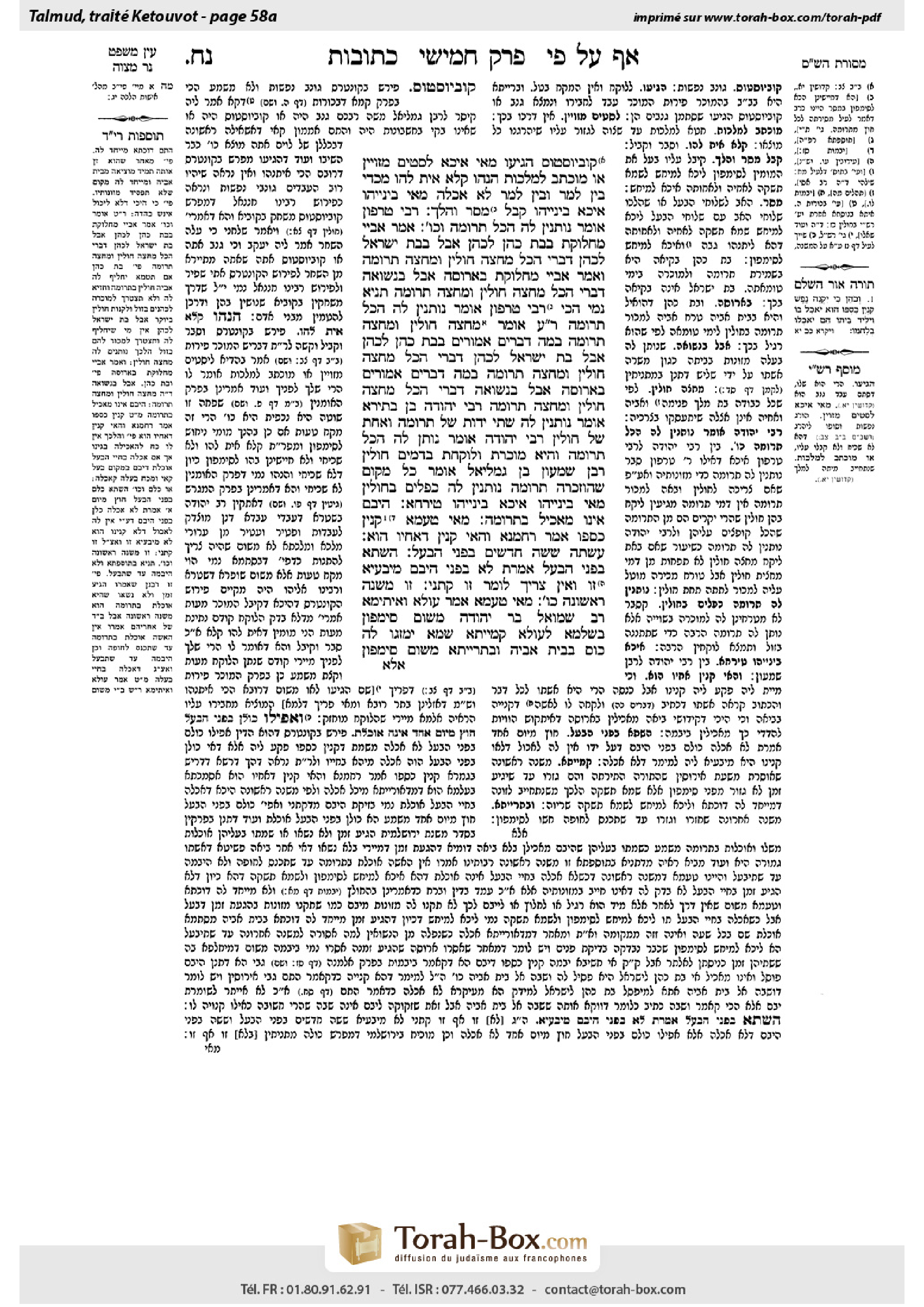
Ketubot 58a: Talmud study for Daf Yomi
Daf Yomi is the daily study of one Talmud folio. Explore 37 tractates with scans, Hebrew text, Sefaria English and AI-generated French translations where annotated.
Passage selection and English or AI-generated French translation are available where the scan has annotations. Daf Study is independent of Torah-Box and Sefaria.
Browse Ketubot · כתובות · All tractatesKetubot 58a text and translations
This page of Ketubot includes the Aramaic text, an English translation and an AI-generated French translation, alongside the scan above.
כתובות נ״ח א · Aramaic and Hebrew text
קוּבְיוּסְטוּס — הִגִּיעוֹ. מַאי אִיכָּא — לִסְטִים מְזוּיָּין אוֹ מוּכְתָּב לַמַּלְכוּת, הָנְהוּ קָלָא אִית לְהוּ.
מִכְּדִי, בֵּין לְמָר וּבֵין לְמָר לָא אָכְלָה, מַאי בֵּינַיְיהוּ? אִיכָּא בֵּינַיְיהוּ קִבֵּל, מָסַר, וְהָלַךְ.
רַבִּי טַרְפוֹן אוֹמֵר: נוֹתְנִין לָהּ הַכֹּל תְּרוּמָה וְכוּ׳. אָמַר אַבָּיֵי: מַחְלוֹקֶת בְּבַת כֹּהֵן לְכֹהֵן, אֲבָל בְּבַת יִשְׂרָאֵל לְכֹהֵן — דִּבְרֵי הַכֹּל מֶחֱצָה חוּלִּין וּמֶחֱצָה תְּרוּמָה.
וְאָמַר אַבָּיֵי: מַחְלוֹקֶת בַּאֲרוּסָה, אֲבָל בִּנְשׂוּאָה — דִּבְרֵי הַכֹּל מֶחֱצָה חוּלִּין וּמֶחֱצָה תְּרוּמָה.
תַּנְיָא נָמֵי הָכִי, רַבִּי טַרְפוֹן אוֹמֵר: נוֹתְנִין לָהּ הַכֹּל תְּרוּמָה. רַבִּי עֲקִיבָא אוֹמֵר: מֶחֱצָה חוּלִּין וּמֶחֱצָה תְּרוּמָה. בַּמֶּה דְּבָרִים אֲמוּרִים — בְּבַת כֹּהֵן לְכֹהֵן, אֲבָל בַּת יִשְׂרָאֵל לְכֹהֵן — דִּבְרֵי הַכֹּל מֶחֱצָה חוּלִּין וּמֶחֱצָה תְּרוּמָה. בַּמֶּה דְּבָרִים אֲמוּרִים — בַּאֲרוּסָה, אֲבָל בִּנְשׂוּאָה — דִּבְרֵי הַכֹּל מֶחֱצָה חוּלִּין וּמֶחֱצָה תְּרוּמָה.
רַבִּי יְהוּדָה בֶּן בְּתִירָא אוֹמֵר: נוֹתְנִין לָהּ שְׁתֵּי יָדוֹת שֶׁל תְּרוּמָה, וְאַחַת שֶׁל חוּלִּין. רַבִּי יְהוּדָה אוֹמֵר: נוֹתֵן לָהּ הַכֹּל תְּרוּמָה, וְהִיא מוֹכֶרֶת וְלוֹקַחַת בַּדָּמִים חוּלִּין. רַבָּן שִׁמְעוֹן בֶּן גַּמְלִיאֵל אוֹמֵר: כׇּל מָקוֹם שֶׁהוּזְכְּרָה תְּרוּמָה — נוֹתְנִין לָהּ כִּפְלַיִם בְּחוּלִּין.
מַאי בֵּינַיְיהוּ? אִיכָּא בֵּינַיְיהוּ טִירְחָא.
הַיָּבָם אֵינוֹ מַאֲכִיל בִּתְרוּמָה. מַאי טַעְמָא? ״קִנְיַן כַּסְפּוֹ״ אָמַר רַחֲמָנָא, וְהַאי קִנְיָן דְּאָחִיו הוּא.
עָשְׂתָה שִׁשָּׁה חֳדָשִׁים בִּפְנֵי הַבַּעַל. הַשְׁתָּא בִּפְנֵי הַבַּעַל אָמְרַתְּ לָא, בִּפְנֵי הַיָּבָם מִיבַּעְיָא?! ״זוֹ וְאֵין צָרִיךְ לוֹמַר זוֹ״ קָתָנֵי.
זוֹ מִשְׁנָה רִאשׁוֹנָה כּוּ׳. מַאי טַעְמָא? אָמַר עוּלָּא, וְאִיתֵּימָא רַב שְׁמוּאֵל בַּר יְהוּדָה: מִשּׁוּם סִימְפּוֹן.
בִּשְׁלָמָא לְעוּלָּא, קַמַּיְיתָא שֶׁמָּא יִמְזְגוּ לָהּ כּוֹס בְּבֵית אָבִיהָ, וּבָתְרָיְיתָא מִשּׁוּם סִימְפּוֹן.
Ketubot 58a · English translation
a gambler [kuvyustus], it has come to him, meaning that the seller has caught the buyer in a binding transaction, and he cannot annul the sale due to this kind of defect, as these characteristics are common in slaves. What is the halakha if it was discovered that the slave was an armed bandit or that the king had signed his death warrant, and there is a danger that the government will catch him and execute him? These are serious and uncommon defects that in principle could invalidate a sale. However, these defects generate publicity. In such unusual and severe circumstances, everyone is aware of them. Therefore, it is assumed that the buyer knew about them as well and nevertheless acquiesced to buy the slave. Consequently, there is no reason to revoke the sale of a slave.
The Gemara asks: After all, according to this Sage, Ulla, and according to that Sage, Rav Shmuel bar Rav Yehuda, she may not partake of teruma, so what is the difference between them? The Gemara answers: The practical difference between them is in cases where he accepted, or he transferred or went. If the husband explicitly accepted her blemishes, there is no concern with regard to abrogation, but there is still a concern that she will give her family members teruma wine. Conversely, if the father transferred his daughter to the agents of the husband and entrusted her to their care, or if the father’s own agents went with the girl and the agents of the husband, there is no longer concern that she might give her family members teruma, as she is not with them, but there is still a concern about abrogation.
§ The mishna states that there is a dispute with regard to how a priest must provide for the sustenance of his betrothed once the appointed time for the marriage arrives. Rabbi Tarfon says: He may give her everything from teruma. Rabbi Akiva says: He must give her half non-sacred food and half may be teruma. Abaye said: This dispute is referring to a daughter of a priest betrothed to a priest. But with regard to an Israelite woman who was betrothed to a priest, all agree that he must give her half non-sacred food and half may be teruma. A priest’s daughter is familiar with the halakhot of teruma and knows how to handle it when she is ritually impure, but when an Israelite woman is not yet familiar with these procedures, there is concern that she might defile the teruma. Consequently, she is given some non-sacred food to use as well.
And Abaye also said that this dispute is referring only to a betrothed woman whose wedding date has arrived, but with regard to a married woman, all agree that her husband must give her half of her needs from non-sacred food and half may be teruma, as it is not appropriate for his wife to have to go to the trouble of selling teruma in order to obtain non-sacred food.
This is also taught in a baraita: Rabbi Tarfon says: He may give her everything from teruma, and Rabbi Akiva says: Half must be non-sacred food and half may be teruma. In what case is this statement said? With regard to a daughter of a priest betrothed to a priest. But with regard to an Israelite woman betrothed to a priest, all agree that she gets half non-sacred food and half may be teruma. In what case is this statement said? With regard to a betrothed woman, but with regard to a married woman, all agree that he must give half non-sacred food and half may be teruma.
Rabbi Yehuda ben Beteira says: He need not give half and half, but rather he may give her two parts teruma and one part non-sacred food. Rabbi Yehuda says: He may give her all of it in teruma, but as the value of teruma is lower than that of non-sacred food, the amount must suffice so that when she sells teruma during the days when she is ritually impure, she can buy a sufficient quantity of non-sacred food with the money. Rabban Shimon ben Gamliel says: Wherever teruma is mentioned, he must give her double the amount that she would receive of non-sacred food, so that she will not have difficulty locating buyers for her teruma. Teruma is less popular and its price is significantly lower, since its use is restricted. But if she receives a large amount of teruma, she will be able to sell it at an even lower price and locate a buyer more easily.
The Gemara asks: What is the difference between the opinions of Rabbi Yehuda and Rabban Shimon ben Gamliel? The Gemara answers: The practical difference between them is with regard to effort. According to Rabbi Yehuda, she must make an effort to find buyers who will provide her with enough non-sacred food for her needs, and consequently, according to him the husband must provide an amount of teruma that is equal in value to the amount of non-sacred food to which she is entitled. In contrast, Rabban Shimon ben Gamliel adds additional teruma to her allotment beyond this amount, so that she will not be forced to go to as much trouble to sell it.
§ The mishna states that a yavam does not enable the yevama to partake of teruma. The Gemara asks: What is the reason for this? The Merciful One states in the Torah: “The acquisition of his money” (Leviticus 22:11) may partake of teruma, but this woman is his brother’s acquisition and not his, since a yavam does not complete his marriage to the yevama until he consummates the marriage.
§ The mishna said that if she completed six months from the time of the request for marriage under the aegis of the husband and another six months under the aegis of the yavam, she may not partake of teruma. It then says that this is also true if she completed most of the year under the aegis of the husband, and then it says that this is also true if she completed most of the time under the aegis of the yavam. The Gemara asks: Now that you say that if she completed most of the time under the aegis of the husband this does not enable her to partake of teruma, is it necessary to say that the same is true if she spent most of the time under the aegis of the yavam? The Gemara answers: The tanna teaches the mishna employing the style: This, and it is unnecessary to say that, meaning that the cases are organized from the less obvious to the more obvious.
§ The mishna states that this ruling, that a woman betrothed to a priest may partake of teruma while she is still in her father’s house if the time for her wedding has arrived, is according to the initial version of the mishna. But that according to the final version, she may not partake of teruma until she has actually entered the wedding canopy. The Gemara asks: What is the reason for this later ruling? Ulla said, and some say that Rav Shmuel bar Yehuda said, that it is due to concern about abrogation, as the woman may have some blemish that will cause the annulment of the marriage, and it will then be clear that she consumed teruma unlawfully.
The Gemara comments: Granted, according to the opinion of Ulla, the first ruling that the Sages taught in the initial version of the mishna, namely that she may not partake of teruma in her father’s house immediately after betrothal, is because Ulla was concerned lest someone pour her a cup of teruma wine while she would be in her father’s house. And the latter ruling, that she may not partake of teruma until she actually enters the wedding canopy, even after the time for marriage arrives, is due to concern about abrogation. Consequently, there are two different reasons for the two different rulings.
Ketubot 58a · Traduction française (IA)
un joueur [kuvyustus], cela lui est arrivé, c’est-à-dire que le vendeur a engagé l’acheteur dans une transaction contraignante, et celui-ci ne peut annuler la vente en raison d’un défaut de ce type, car ces caractéristiques sont courantes chez les esclaves. Quelle est la halakha si l’on découvre que l’esclave était un brigand armé ou que le roi avait signé son arrêt de mort, de sorte qu’il risque d’être arrêté et exécuté par le pouvoir ? Il s’agit de défauts graves et inhabituels qui pourraient en principe invalider la vente. Toutefois, ces défauts font parler d’eux : dans des circonstances aussi exceptionnelles et graves, tout le monde en est informé. On suppose donc que l’acheteur en avait lui aussi connaissance et qu’il a néanmoins accepté d’acheter l’esclave. Par conséquent, rien ne justifie l’annulation de la vente.
La Guemara demande : Après tout, selon ce Sage, Oulla, et selon cet autre Sage, Rav Shmuel bar Rav Yehuda, elle ne peut pas consommer de terouma. Quelle est donc la différence entre eux ? La Guemara répond : La différence pratique entre eux concerne les cas où le mari a accepté, ou bien où le père l’a confiée aux émissaires du mari ou s’est mis en route avec elle. Si le mari a explicitement accepté ses défauts, il n’y a pas lieu de craindre une annulation, mais il reste à craindre qu’elle ne donne du vin de terouma aux membres de sa famille. À l’inverse, si le père a confié sa fille aux émissaires du mari et l’a placée sous leur responsabilité, ou si les émissaires du père sont partis avec la jeune fille et les émissaires du mari, il n’y a plus lieu de craindre qu’elle donne de la terouma aux membres de sa famille, puisqu’elle n’est pas avec eux, mais il reste à craindre une annulation.
§ La Michna rapporte un désaccord sur la manière dont un prêtre doit assurer la subsistance de sa fiancée lorsque le délai fixé pour le mariage est arrivé. Rabbi Tarfon dit : Il peut lui donner tout en terouma. Rabbi Akiva dit : Il doit lui donner pour moitié des aliments profanes, et l’autre moitié peut être en terouma. Abayé dit : Ce désaccord concerne la fille d’un prêtre fiancée à un prêtre. En revanche, pour une Israélite fiancée à un prêtre, tous conviennent qu’il doit lui donner pour moitié des aliments profanes, et l’autre moitié peut être en terouma. La fille d’un prêtre connaît les halakhot de la terouma et sait comment la traiter lorsqu’elle est en état d’impureté rituelle. Mais une Israélite, qui ne connaît pas encore ces règles, risque de rendre la terouma impure. C’est pourquoi on lui donne aussi des aliments profanes.
Abayé a également dit que ce désaccord concerne uniquement une fiancée dont la date du mariage est arrivée. En revanche, pour une femme mariée, tous conviennent que son mari doit lui fournir la moitié de ses besoins en aliments profanes, et l’autre moitié peut être en terouma, car il ne convient pas que son épouse ait à se donner la peine de vendre la terouma pour se procurer des aliments profanes.
Cela est également enseigné dans une baraïta : Rabbi Tarfon dit : Il peut lui donner tout en terouma ; Rabbi Akiva dit : la moitié doit être constituée d’aliments profanes et l’autre moitié peut être en terouma. Dans quel cas cette règle a-t-elle été énoncée ? Pour la fille d’un prêtre fiancée à un prêtre. Mais pour une Israélite fiancée à un prêtre, tous conviennent qu’elle reçoit pour moitié des aliments profanes, et l’autre moitié peut être en terouma. Dans quel cas cette règle a-t-elle été énoncée ? Pour une fiancée ; mais pour une femme mariée, tous conviennent qu’il doit lui donner pour moitié des aliments profanes, et l’autre moitié peut être en terouma.
Rabbi Yehuda ben Beteira dit : Il n’est pas nécessaire de lui donner moitié-moitié ; il peut plutôt lui donner deux parts de terouma et une part d’aliments profanes. Rabbi Yehuda dit : Il peut tout lui donner en terouma, mais, comme la valeur de la terouma est inférieure à celle des aliments profanes, la quantité doit être suffisante pour que, lorsqu’elle vendra la terouma les jours où elle sera en état d’impureté rituelle, elle puisse acheter avec l’argent une quantité suffisante d’aliments profanes. Rabban Shimon ben Gamliel dit : Chaque fois qu’il est question de terouma, il doit lui en donner le double de la quantité d’aliments profanes qu’elle recevrait, afin qu’elle n’ait pas de difficulté à trouver des acheteurs pour sa terouma. La terouma est moins recherchée et son prix est nettement inférieur, car son usage est limité. Mais si elle en reçoit une grande quantité, elle pourra la vendre à un prix encore plus bas et trouver plus facilement un acheteur.
La Guemara demande : Quelle est la différence entre les opinions de Rabbi Yehuda et de Rabban Shimon ben Gamliel ? La Guemara répond : La différence pratique entre eux concerne l’effort à fournir. Selon Rabbi Yehuda, elle doit faire l’effort de trouver des acheteurs qui lui fourniront assez d’aliments profanes pour ses besoins ; par conséquent, selon lui, le mari doit lui fournir une quantité de terouma dont la valeur équivaut à celle des aliments profanes auxquels elle a droit. En revanche, Rabban Shimon ben Gamliel ajoute à sa ration une quantité supplémentaire de terouma, afin qu’elle ne soit pas obligée de se donner autant de peine pour la vendre.
§ La Michna enseigne qu’un yavam ne permet pas à la yevama de consommer de terouma. La Guemara demande : Quelle en est la raison ? Le Miséricordieux dit dans la Torah : « L’acquisition de son argent » (Lévitique 22, 11) peut consommer de la terouma ; mais cette femme est l’acquisition de son frère, et non la sienne, car le yavam ne conclut son mariage avec la yevama qu’après avoir consommé le mariage.
§ La Michna a dit que si elle a passé six mois à partir de la demande en mariage sous la responsabilité du mari, puis six autres mois sous celle du yavam, elle ne peut pas consommer de terouma. Elle dit ensuite qu’il en va de même si elle a passé la majeure partie de l’année sous la responsabilité du mari, puis qu’il en va également ainsi si elle a passé la majeure partie de la période sous la responsabilité du yavam. La Guemara demande : Puisque tu dis que le fait qu’elle ait passé la majeure partie de la période sous la responsabilité du mari ne lui permet pas de consommer de terouma, est-il nécessaire de dire qu’il en va de même si elle a passé la majeure partie de la période sous la responsabilité du yavam ? La Guemara répond : Le tanna enseigne la Michna selon la formule « ceci, et il est inutile de dire cela », c’est-à-dire que les cas sont présentés du moins évident au plus évident.
§ La Michna enseigne que cette décision, selon laquelle une femme fiancée à un prêtre peut consommer de la terouma dans la maison de son père si le moment de son mariage est arrivé, suit la première version de la Michna. Mais, selon la version finale, elle ne peut pas consommer de terouma avant d’être effectivement entrée sous la houppa. La Guemara demande : Quelle est la raison de cette décision ultérieure ? Oulla a dit — et certains disent que c’est Rav Shmuel bar Yehuda qui l’a dit — qu’elle est due à la crainte d’une annulation : la femme peut avoir un défaut susceptible d’entraîner l’annulation du mariage, et il apparaîtrait alors qu’elle a consommé de la terouma illicitement.
La Guemara commente : Il est compréhensible que, selon l’opinion d’Oulla, la première décision enseignée par les Sages dans la première version de la Michna — à savoir qu’elle ne peut pas consommer de terouma dans la maison de son père immédiatement après les fiançailles — s’explique par la crainte d’Oulla qu’on lui serve une coupe de vin de terouma alors qu’elle se trouverait dans la maison de son père. Et la décision ultérieure, selon laquelle elle ne peut pas consommer de terouma avant d’être effectivement entrée sous la houppa, même après l’arrivée du moment fixé pour le mariage, s’explique par la crainte d’une annulation. Il y a donc deux raisons différentes à ces deux décisions.
Traduction française générée par IA à partir de l’édition anglaise de Sefaria. Vérifie toujours un passage avec le texte source.
Text from Sefaria: William Davidson Edition - Vocalized Aramaic (CC BY NC); William Davidson Edition - English (CC BY NC).