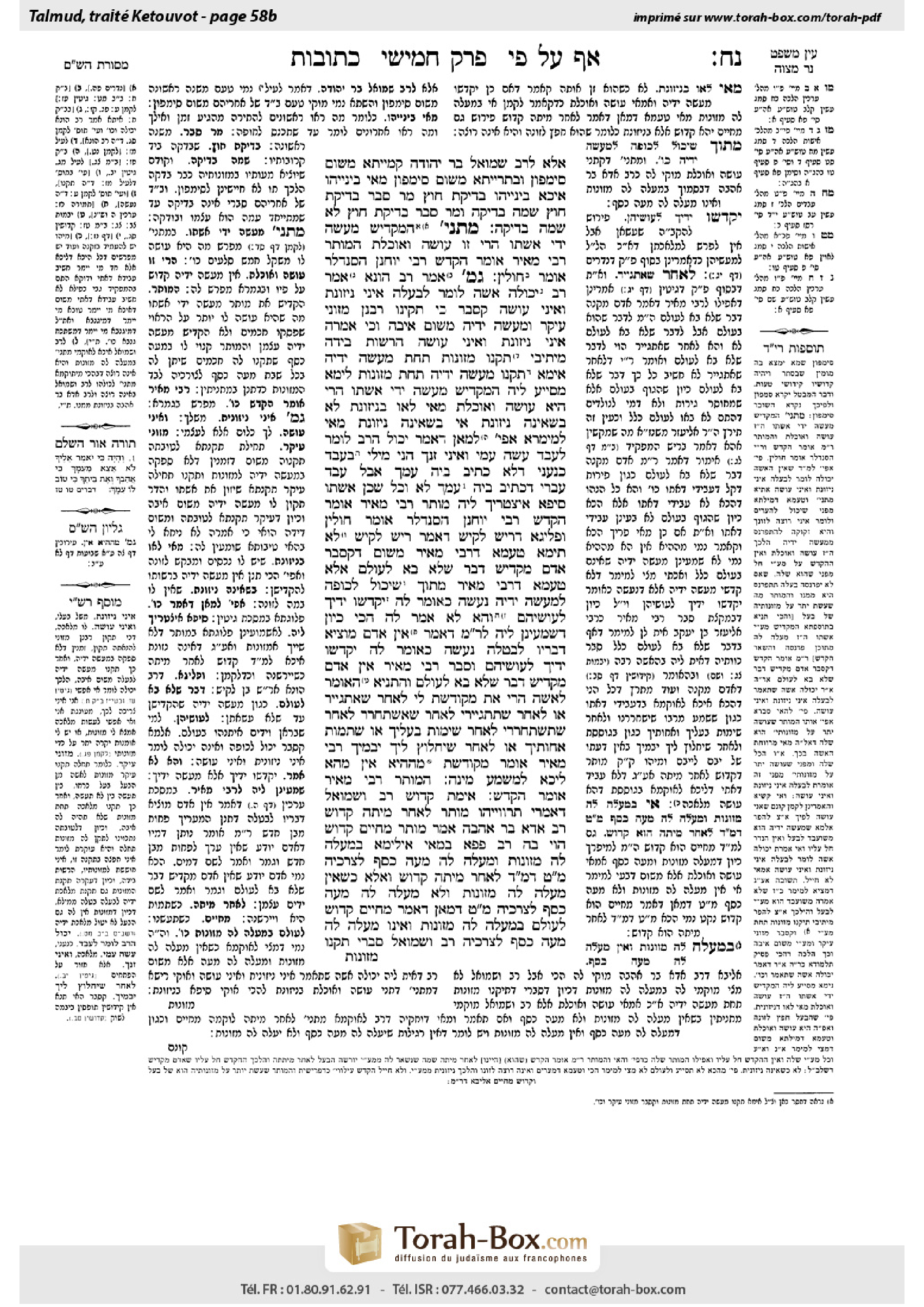
Ketubot 58b: Talmud study for Daf Yomi
Daf Yomi is the daily study of one Talmud folio. Explore 37 tractates with scans, Hebrew text, Sefaria English and AI-generated French translations where annotated.
Passage selection and English or AI-generated French translation are available where the scan has annotations. Daf Study is independent of Torah-Box and Sefaria.
Browse Ketubot · כתובות · All tractatesKetubot 58b text and translations
This page of Ketubot includes the Aramaic text, an English translation and an AI-generated French translation, alongside the scan above.
כתובות נ״ח ב · Aramaic and Hebrew text
אֶלָּא לְרַב שְׁמוּאֵל בַּר יְהוּדָה, קַמַּיְיתָא מִשּׁוּם סִימְפּוֹן וּבָתְרָיְיתָא מִשּׁוּם סִימְפּוֹן, מַאי בֵּינַיְיהוּ?
אִיכָּא בֵּינַיְיהוּ בְּדִיקַת חוּץ. מָר סָבַר: בְּדִיקַת חוּץ — שְׁמָהּ בְּדִיקָה. וּמָר סָבַר: בְּדִיקַת חוּץ — לֹא שְׁמָהּ בְּדִיקָה.
מַתְנִי׳ הַמַּקְדִּישׁ מַעֲשֵׂה יְדֵי אִשְׁתּוֹ — הֲרֵי זוֹ עוֹשָׂה וְאוֹכֶלֶת. הַמּוֹתָר, רַבִּי מֵאִיר אוֹמֵר: הֶקְדֵּשׁ, רַבִּי יוֹחָנָן הַסַּנְדְּלָר אוֹמֵר: חוּלִּין.
גְּמָ׳ אָמַר רַב הוּנָא אָמַר רַב: יְכוֹלָה אִשָּׁה לוֹמַר לְבַעְלָהּ ״אֵינִי נִיזּוֹנֶת וְאֵינִי עוֹשָׂה״. קָסָבַר: כִּי תַּקִּינוּ רַבָּנַן מְזוֹנֵי — עִיקָּר, וּמַעֲשֵׂה יָדֶיהָ מִשּׁוּם אֵיבָה. וְכִי אָמְרָה ״אֵינִי נִיזּוֹנֶת וְאֵינִי עוֹשָׂה״ — הָרְשׁוּת בְּיָדָהּ.
מֵיתִיבִי: תִּקְּנוּ מְזוֹנוֹת תַּחַת מַעֲשֵׂה יָדֶיהָ! אֵימָא: תִּקְּנוּ מַעֲשֵׂה יָדֶיהָ תַּחַת מְזוֹנוֹת.
לֵימָא מְסַיַּיע לֵיהּ: הַמַּקְדִּישׁ מַעֲשֵׂה יְדֵי אִשְׁתּוֹ — הֲרֵי הִיא עוֹשָׂה וְאוֹכֶלֶת. מַאי לָאו, בְּנִיזּוֹנֶת? לָא, בְּשֶׁאֵינָהּ נִיזּוֹנֶת.
אִי בְּשֶׁאֵינָהּ נִיזּוֹנֶת, מַאי לְמֵימְרָא? אֲפִילּוּ לְמַאן דְּאָמַר יָכוֹל הָרַב לוֹמַר לָעֶבֶד ״עֲשֵׂה עִמִּי וְאֵינִי זָנָךְ״ — הָנֵי מִילֵּי בְּעֶבֶד כְּנַעֲנִי, דְּלָא כְּתִיב בֵּיהּ ״עִמָּךְ״, אֲבָל עֶבֶד עִבְרִי, דִּכְתִיב בֵּיהּ ״עִמָּךְ״ — לָא, וְכׇל שֶׁכֵּן אִשְׁתּוֹ!
סֵיפָא אִיצְטְרִיךְ לֵיהּ: מוֹתָר, רַבִּי מֵאִיר אוֹמֵר: הֶקְדֵּשׁ, רַבִּי יוֹחָנָן הַסַּנְדְּלָר אוֹמֵר: חוּלִּין.
וּפְלִיגָא דְּרֵישׁ לָקִישׁ. דְּאָמַר רֵישׁ לָקִישׁ: לָא תֵּימָא טַעְמָא דְּרַבִּי מֵאִיר מִשּׁוּם דְּקָסָבַר אָדָם מַקְדִּישׁ דָּבָר שֶׁלֹּא בָּא לָעוֹלָם. אֶלָּא טַעְמָא דְּרַבִּי מֵאִיר, מִתּוֹךְ שֶׁיָּכוֹל לְכוּפָּהּ לְמַעֲשֵׂה יָדֶיהָ — נַעֲשָׂה כְּאוֹמֵר לָהּ ״יִקְדְּשׁוּ יָדַיִךְ לְעוֹשֵׂיהֶם״.
וְהָא לָא אֲמַר לַהּ הָכִי! כֵּיוָן דְּשָׁמְעִינַן לֵיהּ לְרַבִּי מֵאִיר דְּאָמַר: אֵין אָדָם מוֹצִיא דְּבָרָיו לְבַטָּלָה — נַעֲשֶׂה כְּאוֹמֵר לָהּ ״יִקְדְּשׁוּ יָדַיִךְ לְעוֹשֵׂיהֶם״.
וְסָבַר רַבִּי מֵאִיר אֵין אָדָם מַקְדִּישׁ דָּבָר שֶׁלֹּא בָּא לָעוֹלָם? וְהָתַנְיָא, הָאוֹמֵר לְאִשָּׁה: ״הֲרֵי אַתְּ מְקוּדֶּשֶׁת לִי לְאַחַר שֶׁאֶתְגַּיֵּיר״, אוֹ: ״לְאַחַר שֶׁתִּתְגַּיְּירִי״, ״לְאַחַר שֶׁאֶשְׁתַּחְרֵר״, ״לְאַחַר שֶׁתִּשְׁתַּחְרְרִי״, ״לְאַחַר שֶׁיָּמוּת בַּעְלִיךְ״, אוֹ ״שֶׁתָּמוּת אֲחוֹתִיךְ״, אוֹ: ״לְאַחַר שֶׁיַּחְלוֹץ לִיךְ יְבָמִיךְ״, רַבִּי מֵאִיר אוֹמֵר: מְקוּדֶּשֶׁת.
מֵהַהִיא — אִין, מֵהָא לֵיכָּא לְמִשְׁמַע מִינַּהּ.
הַמּוֹתָר, רַבִּי מֵאִיר אוֹמֵר הֶקְדֵּשׁ. אֵימַת קָדוֹשׁ? רַב וּשְׁמוּאֵל דְּאָמְרִי תַּרְוַויְיהוּ: מוֹתָר לְאַחַר מִיתָה קָדוֹשׁ. רַב אַדָּא בַּר אַהֲבָה אָמַר: מוֹתָר מֵחַיִּים קָדוֹשׁ.
הָוֵי בַּהּ רַב פָּפָּא: בְּמַאי? אִילֵימָא בְּמַעֲלֶה לָהּ מְזוֹנוֹת וּמַעֲלֶה לָהּ מָעָה כֶּסֶף לִצְרָכֶיהָ — מַאי טַעְמָא דְּמַאן דְּאָמַר לְאַחַר מִיתָה קָדוֹשׁ?
וְאֶלָּא כְּשֶׁאֵין מַעֲלֶה לָהּ מְזוֹנוֹת וְלֹא מַעֲלֶה לָהּ מָעָה כֶּסֶף לִצְרָכֶיהָ — מַאי טַעְמָא דְּמַאן דְּאָמַר מֵחַיִּים קָדוֹשׁ?
לְעוֹלָם בְּמַעֲלֶה לָהּ מְזוֹנוֹת וְאֵינוֹ מַעֲלֶה לָהּ מָעָה כֶּסֶף לִצְרָכֶיהָ. רַב וּשְׁמוּאֵל סָבְרִי: תִּקְּנוּ
Ketubot 58b · English translation
However, according to Rav Shmuel bar Yehuda, the first ruling was due to abrogation and the latter ruling was also due to abrogation. If so, what is the difference between the reasoning of the initial version of the mishna and the decision of the court that convened after them?
The Gemara answers: The practical difference between them is with regard to superficial investigation, i.e., the investigation that could have been conducted on his behalf by his female relatives, which could have been only a superficial investigation. One Sage holds that superficial investigation is considered a valid investigation, and therefore once he requested to marry her and the marriage date arrived, there is no concern of a later abrogation, and one Sage holds that superficial investigation is not considered a valid investigation, and consequently there is still concern that when he consummates the marriage he will find some blemish on her and abrogate the marriage.
MISHNA: If one consecrates his wife’s earnings, meaning anything she produces, such as thread that she spins from wool, which, according to the Sages’ ordinance, belongs to her husband, she may work and sustain herself from her earnings, as the consecration is ineffective. However, there is a dispute with regard to the surplus, meaning any earnings she produces in excess of the amount she is required to produce for her husband. Rabbi Meir says: The surplus is consecrated property, and Rabbi Yoḥanan the Cobbler says: The surplus is also non-sacred.
GEMARA: Rav Huna said that Rav said: A woman may say to her husband: I will not be sustained by you and, in turn, I will not work, i.e., you will not keep my earnings. He holds that when the Sages instituted the various obligations and rights of a husband and wife, the husband’s obligation to provide for the wife’s sustenance was the primary one, and they then decreed that her earnings belong to him in return, due to concern about animosity. If he would be obligated to provide for her sustenance but she would be allowed to work and keep her earnings, he would resent her. Since her right to sustenance is the primary one, if she says: I will not be sustained by you and, in turn, I will not work, i.e., you will not keep my earnings, she has permission to do so. As the arrangement was established for her benefit, she may cancel it if it is not suitable for her.
The Gemara raises an objection from a baraita: They instituted the husband’s responsibility for her sustenance in exchange for his right to her earnings. This indicates that the primary enactment is the husband’s right to his wife’s earnings, and the ordinance that requires him to provide her with sustenance comes as a result. According to this, the wife would not be allowed to waive the arrangement, contrary to Rav Huna’s statement. The Gemara responds: Emend the text of the baraita and say instead: They instituted her earnings in exchange for the husband’s responsibility for her sustenance.
The Gemara raises an objection: Let us say that the mishna supports Rav Huna’s opinion, as it is taught: If one consecrates his wife’s earnings, she may work and sustain herself from her earnings. What, is it not discussing a woman who is sustained by her husband, meaning that he is willing to sustain her, although she relinquishes her right to sustenance in accordance with Rav Huna’s principle? Therefore, her earnings do not belong to him to consecrate. The Gemara answers: No, it is discussing a woman who is not sustained by her husband, as he does not have sufficient funds to sustain her. Consequently, there is no proof with regard to Rav Huna’s statement.
The Gemara asks: If it is discussing a woman who is not sustained, what is the purpose of stating that he may not consecrate her earnings? Even according to the one who says that a master can say to his slave: Work for me but I will not sustain you, this applies only to a Canaanite slave, about whom it is not written: “With you.” But with regard to a Hebrew slave about whom it is written: “It is good for him with you” (Deuteronomy 15:16), this does not apply, and the master must sustain him just as he sustains the members of his own household. And this is true all the more so with regard to his wife, as there is a specific obligation of sustenance. Consequently, if he does not do so, he certainly has no right to her earnings.
The Gemara answers: This halakha did not need to be stated, but the latter clause was necessary, as it contains a novelty with regard to the surplus: Rabbi Meir says that the surplus is consecrated property, and Rabbi Yoḥanan the Cobbler says it is non-sacred.
The Gemara comments: This opinion of Rav Huna disputes that of Reish Lakish, as Reish Lakish said: Do not say that the reason for the opinion of Rabbi Meir is that since he maintains that a person may consecrate an object that has not yet come into the world, the consecration can take effect even on her future earnings. Rather, say that the reason for the opinion of Rabbi Meir is that since he can compel her to produce her earnings for him, it is as if he had a certain legal claim to the products of her hands, i.e., her earnings. Consequently, he is considered as if he had said to her: Your hands are consecrated to the One Who made them, and the consecration can therefore take effect on something that already exists. Since Reish Lakish said that he may compel her to produce earnings for him, the implication is that she may not say: I will not be sustained and I will not work.
With regard to Reish Lakish’s statement, the Gemara asks: But he did not say this to her; rather, he said that he was consecrating her earnings. The Gemara answers: Since we heard that Rabbi Meir said: A person does not say things for naught, and according to this principle, when one says something that has no halakhic meaning, it is interpreted as if he had said something that does have halakhic relevance, he is considered as if he had said to her: Your hands are consecrated to the One Who made them.
The Gemara asks: Does Rabbi Meir hold that a person may not consecrate an object that has not yet come into the world? Isn’t it taught in a baraita that if a gentile says to a woman: You are hereby betrothed to me after I convert; or if she was a gentile and he said to her: You are hereby betrothed to me after you convert; or if he was a slave and said to her: After I am emancipated; or if she was a maidservant and he said to her: After you are emancipated; or if she was married and he said to her: After your husband dies; or if he was married to her sister and he said: After your sister dies, as at that point the betrothal could take effect; or if she was a widow waiting for her yavam and he said to her: After your yavam performs ḥalitza with you, Rabbi Meir says: If any of these cases occurred, she is betrothed. Apparently Rabbi Meir maintains that betrothal can take effect even on something that has not yet come into being.
The Gemara answers: Actually, from that baraita, one can learn that this is Rabbi Meir’s opinion, but Reish Lakish merely wanted to say that no inference is to be learned from this mishna, as it is possible to explain Rabbi Meir’s words in another way, based on the principle that a person does not say things for naught.
§ The mishna states that with regard to the surplus, Rabbi Meir says: It is consecrated property. The Gemara asks: According to this opinion, when does the surplus amount become consecrated? Rav and Shmuel both said: The surplus is consecrated only after the woman’s death. Rav Adda bar Ahava said: The surplus is consecrated while she is still alive.
Rav Pappa discussed it, as he was perplexed by this dispute: With regard to what do they argue? If we say that the husband provides for her sustenance and additionally provides her with a silver ma’a coin every week for the rest of her needs, as he is obligated to do (see 64b), then what is the reason for the opinion of the one who said it is consecrated only after her death? As the husband has fulfilled all of his obligations and is consequently the owner of his wife’s earnings, he should be capable of consecrating them.
And if we rather say that he does not provide for her sustenance and does not provide her with a silver ma’a for her needs, and she must consequently support herself entirely, then what is the reason for the opinion of the one who said that it is consecrated in her lifetime? It is possible that at some point she will not find sufficient employment, and since her husband does not provide for her sustenance or her other needs, she will need the money for herself and there will not be any surplus at all.
The Gemara answers: Actually, one must explain that they are discussing a situation where he provides for her sustenance, but does not provide her with a silver ma’a for her needs, and this is their dispute: Rav and Shmuel maintain that the main enactment was that they established
Ketubot 58b · Traduction française (IA)
Toutefois, selon Rav Shmuel bar Yehuda, la première décision était due à une abrogation, et la décision ultérieure l’était elle aussi. Si tel est le cas, quelle différence y a-t-il entre le raisonnement de la version initiale de la Michna et la décision du tribunal qui s’est réuni après eux ?
La Guemara répond : La différence pratique entre les deux concerne l’examen superficiel, c’est-à-dire l’examen que ses parentes auraient pu effectuer pour lui et qui n’aurait pu être que superficiel. Un Sage estime qu’un examen superficiel est considéré comme valable ; par conséquent, dès lors qu’il a demandé à l’épouser et que la date du mariage est arrivée, on ne craint pas une abrogation ultérieure. Un autre Sage estime qu’un examen superficiel n’est pas considéré comme valable ; il reste donc à craindre qu’au moment de consommer le mariage, il découvre chez elle un défaut et abroge le mariage.
Michna : Si un homme consacre les gains de sa femme, c’est-à-dire tout ce qu’elle produit, par exemple le fil qu’elle file à partir de laine et qui, selon l’ordonnance des Sages, revient à son mari, elle peut travailler et subvenir à ses besoins avec ses gains, car cette consécration est sans effet. Il existe toutefois une controverse concernant le surplus, c’est-à-dire tout ce qu’elle gagne au-delà de ce qu’elle est tenue de produire pour son mari. Rabbi Meïr dit : Le surplus est un bien consacré. Rabbi Yoḥanan le Cordonnier dit : Le surplus est lui aussi profane.
Guemara : Rav Houna a dit au nom de Rav : Une femme peut dire à son mari : « Je ne veux pas être entretenue par toi et, en contrepartie, je ne travaillerai pas », c’est-à-dire que tu ne garderas pas mes gains. Il estime que lorsque les Sages ont institué les différentes obligations et les différents droits du mari et de la femme, l’obligation du mari de pourvoir à l’entretien de sa femme était première ; ils ont ensuite décrété que ses gains lui reviendraient en contrepartie, afin d’éviter les tensions. Si le mari était tenu de pourvoir à son entretien tandis qu’elle pouvait travailler et garder ses gains, il lui en voudrait. Puisque son droit à l’entretien est premier, si elle dit : « Je ne veux pas être entretenue par toi et, en contrepartie, je ne travaillerai pas », c’est-à-dire que tu ne garderas pas mes gains, elle en a le droit. Puisque cet arrangement a été institué dans son intérêt, elle peut y renoncer s’il ne lui convient pas.
La Guemara soulève une objection à partir d’une baraïta : Ils ont institué l’obligation du mari de pourvoir à son entretien en contrepartie de son droit à ses gains. Cela indique que l’institution première est le droit du mari aux gains de sa femme, et que l’ordonnance l’obligeant à pourvoir à son entretien en découle. Selon cette interprétation, la femme ne serait pas autorisée à renoncer à cet arrangement, contrairement à ce qu’affirme Rav Houna. La Guemara répond : Corrigeons le texte de la baraïta et lisons plutôt : Ils ont institué le droit aux gains en contrepartie de l’obligation du mari de pourvoir à son entretien.
La Guemara soulève une objection : Ne peut-on pas dire que la Michna appuie l’avis de Rav Houna, puisqu’il est enseigné : Si un homme consacre les gains de sa femme, elle peut travailler et subvenir à ses besoins avec ses gains. Ne s’agit-il pas d’une femme que son mari entretient, c’est-à-dire qu’il est disposé à l’entretenir, bien qu’elle renonce à son droit à l’entretien conformément au principe de Rav Houna ? Ses gains ne lui reviennent donc pas à consacrer. La Guemara répond : Non, il s’agit d’une femme que son mari n’entretient pas, car il ne dispose pas de fonds suffisants pour cela. On ne peut donc pas tirer de preuve au sujet de la déclaration de Rav Houna.
La Guemara demande : S’il s’agit d’une femme qui n’est pas entretenue, pourquoi préciser qu’il ne peut pas consacrer ses gains ? Même selon celui qui affirme qu’un maître peut dire à son esclave : « Travaille pour moi, mais je ne pourvoirai pas à ton entretien », cela ne s’applique qu’à un esclave cananéen, au sujet duquel il n’est pas écrit : « avec toi ». En revanche, cela ne s’applique pas à un esclave hébreu, au sujet duquel il est écrit : « Il sera heureux avec toi » (Deutéronome 15, 16) : le maître doit pourvoir à son entretien comme il le fait pour les membres de sa propre maisonnée. À plus forte raison en va-t-il ainsi pour sa femme, puisque son entretien fait l’objet d’une obligation spécifique. Par conséquent, s’il ne s’acquitte pas de cette obligation, il n’a certainement aucun droit sur ses gains.
La Guemara répond : Cette halakha n’avait pas besoin d’être énoncée ; en revanche, la clause ultérieure était nécessaire, car elle apporte un enseignement nouveau concernant le surplus : Rabbi Meïr dit que le surplus est un bien consacré, et Rabbi Yoḥanan le Cordonnier dit qu’il est profane.
La Guemara fait remarquer : L’avis de Rav Houna contredit celui de Reish Lakish. En effet, Reish Lakish a dit : Ne dis pas que, selon Rabbi Meïr, le surplus est consacré parce qu’il estime qu’une personne peut consacrer un objet qui n’est pas encore venu au monde, de sorte que la consécration peut prendre effet sur ses gains futurs. Dis plutôt que, selon Rabbi Meïr, le surplus est consacré parce que le mari peut la contraindre à produire ses gains pour lui ; il détient donc, en quelque sorte, un droit légal sur les produits de son travail, c’est-à-dire ses gains. Par conséquent, c’est comme s’il lui avait dit : « Tes mains sont consacrées à Celui qui les a créées », et la consécration peut donc prendre effet sur quelque chose qui existe déjà. Puisque Reish Lakish a dit qu’il peut la contraindre à produire des gains pour lui, il s’ensuit qu’elle ne peut pas dire : « Je ne veux pas être entretenue et je ne travaillerai pas. »
À propos de la déclaration de Reish Lakish, la Guemara demande : Mais il ne lui a pas dit cela ; il a dit qu’il consacrait ses gains. La Guemara répond : Puisque nous avons appris que Rabbi Meïr dit : « Une personne ne prononce pas des paroles en vain », conformément à ce principe, lorsqu’on dit quelque chose qui n’a pas de portée halakhique, on l’interprète comme si l’on avait dit quelque chose qui en a une. On le considère donc comme s’il lui avait dit : « Tes mains sont consacrées à Celui qui les a créées. »
La Guemara demande : Rabbi Meïr estime-t-il qu’on ne peut pas consacrer un objet qui n’est pas encore venu au monde ? N’est-il pas enseigné dans une baraïta que si un non-Juif dit à une femme : « Tu m’es dès à présent consacrée après ma conversion », ou si elle était non-Juive et qu’il lui dit : « Tu m’es dès à présent consacrée après ta conversion », ou s’il était esclave et lui dit : « Après mon affranchissement », ou si elle était servante et qu’il lui dit : « Après ton affranchissement », ou si elle était mariée et qu’il lui dit : « Après la mort de ton mari », ou s’il était marié à sa sœur et qu’il lui dit : « Après la mort de ta sœur », car alors les épousailles pourraient prendre effet, ou si elle était une veuve attendant son yavam et qu’il lui dit : « Après que ton yavam aura accompli la ḥalitsa avec toi », Rabbi Meïr dit : Dans tous ces cas, elle est fiancée. Il semble donc que, selon Rabbi Meïr, les épousailles puissent prendre effet même sur quelque chose qui n’est pas encore advenu.
La Guemara répond : En réalité, on peut déduire de cette baraïta que tel est l’avis de Rabbi Meïr, mais Reish Lakish voulait simplement dire qu’on ne peut tirer aucune déduction de cette Michna, car il est possible d’expliquer autrement les paroles de Rabbi Meïr, en s’appuyant sur le principe selon lequel une personne ne prononce pas des paroles en vain.
§ La Michna enseigne qu’au sujet du surplus, Rabbi Meïr dit : « C’est un bien consacré. » La Guemara demande : Selon cet avis, à quel moment le surplus devient-il consacré ? Rav et Shmuel ont tous deux dit : Le surplus n’est consacré qu’après la mort de la femme. Rav Adda bar Ahava a dit : Le surplus est consacré de son vivant.
Rav Pappa examina la question, perplexe devant cette controverse : Sur quoi porte leur désaccord ? Si l’on dit que le mari pourvoit à son entretien et lui donne en outre chaque semaine une pièce d’un ma’a d’argent pour couvrir ses autres besoins, comme il en a l’obligation (voir 64b), quelle est alors la raison de l’avis selon lequel le surplus n’est consacré qu’après sa mort ? Puisque le mari s’est acquitté de toutes ses obligations et qu’il est par conséquent propriétaire des gains de sa femme, il devrait pouvoir les consacrer.
Si, au contraire, l’on dit qu’il ne pourvoit pas à son entretien et ne lui donne pas de pièce d’un ma’a d’argent pour ses besoins, de sorte qu’elle doit subvenir entièrement à ses propres besoins, quelle est alors la raison de l’avis selon lequel le surplus est consacré de son vivant ? Il se peut qu’à un moment donné elle ne trouve pas suffisamment de travail et, puisque son mari ne pourvoit ni à son entretien ni à ses autres besoins, elle aura besoin de cet argent pour elle-même, de sorte qu’il n’y aura aucun surplus.
La Guemara répond : En réalité, il faut expliquer qu’ils parlent d’une situation où le mari pourvoit à son entretien, mais ne lui donne pas de pièce d’un ma’a d’argent pour ses besoins. Leur désaccord est le suivant : Rav et Shmuel estiment que l’institution principale consistait à établir que
Traduction française générée par IA à partir de l’édition anglaise de Sefaria. Vérifie toujours un passage avec le texte source.
Text from Sefaria: William Davidson Edition - Vocalized Aramaic (CC BY NC); William Davidson Edition - English (CC BY NC).