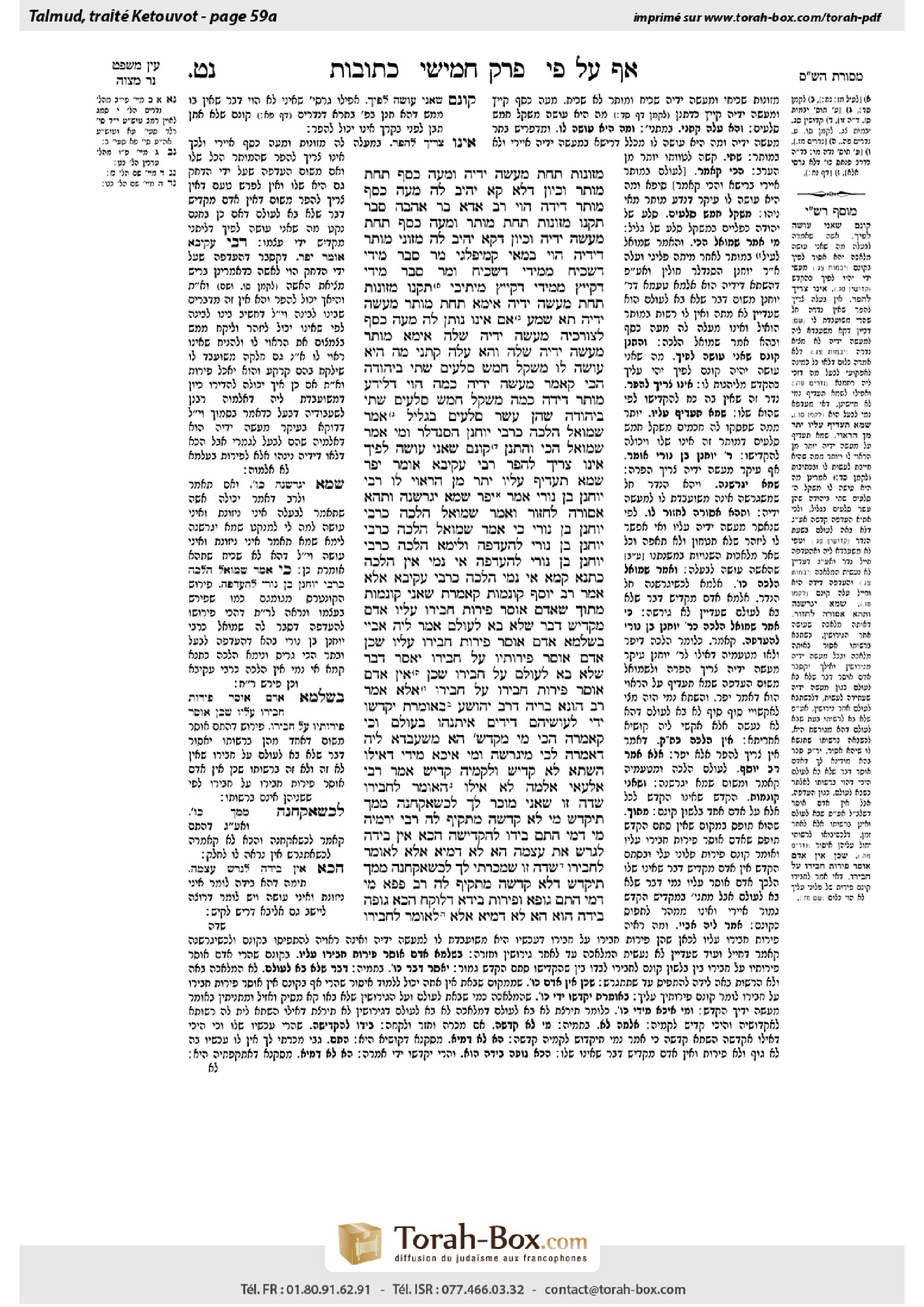
Ketubot 59a: Talmud study for Daf Yomi
Daf Yomi is the daily study of one Talmud folio. Explore 37 tractates with scans, Hebrew text, Sefaria English and AI-generated French translations where annotated.
Passage selection and English or AI-generated French translation are available where the scan has annotations. Daf Study is independent of Torah-Box and Sefaria.
Browse Ketubot · כתובות · All tractatesKetubot 59a text and translations
This page of Ketubot includes the Aramaic text, an English translation and an AI-generated French translation, alongside the scan above.
כתובות נ״ט א · Aramaic and Hebrew text
מְזוֹנוֹת תַּחַת מַעֲשֵׂה יָדֶיהָ, וּמָעָה כֶּסֶף תַּחַת מוֹתָר, וְכֵיוָן דְּלָא קָא יָהֵיב לַהּ מָעָה כֶּסֶף — מוֹתָר דִּידַהּ הָוֵי. רַב אַדָּא בַּר אַהֲבָה סָבַר: תִּקְּנוּ מְזוֹנוֹת תַּחַת מוֹתָר, וּמָעָה כֶּסֶף תַּחַת מַעֲשֵׂה יָדֶיהָ, וְכֵיוָן דְּקָא יָהֵיב לַהּ מְזוֹנֵי, מוֹתָר דִּידֵיהּ הָוֵי.
בְּמַאי קָמִיפַּלְגִי? מָר סָבַר: מִידֵּי דִּשְׁכִיחַ מִמִּידֵּי דִּשְׁכִיחַ. וּמָר סָבַר: מִידֵּי דְּקִייץ מִמִּידֵּי דְּקִייץ.
מֵיתִיבִי: תִּקְּנוּ מְזוֹנוֹת תַּחַת מַעֲשֵׂה יָדֶיהָ! אֵימָא: תַּחַת מוֹתַר מַעֲשֵׂה יָדֶיהָ.
תָּא שְׁמַע: אִם אֵינוֹ נוֹתֵן לָהּ מָעָה כֶּסֶף לִצְרָכֶיהָ — מַעֲשֵׂה יָדֶיהָ שֶׁלָּהּ. אֵימָא: מוֹתַר מַעֲשֵׂה יָדֶיהָ שֶׁלָּהּ. וְהָא עֲלַהּ קָתָנֵי: מָה הִיא עוֹשָׂה לוֹ — מִשְׁקַל חָמֵשׁ סְלָעִים שְׁתִי בִּיהוּדָה!
הָכִי קָאָמַר: מַעֲשֵׂה יָדֶיהָ כַּמָּה הָוֵי, דְּלִידַּע מוֹתָר דִּידַהּ כַּמָּה — מִשְׁקַל חָמֵשׁ סְלָעִים שְׁתִי בִּיהוּדָה, שֶׁהֵן עֶשֶׂר סְלָעִים בַּגָּלִיל.
אָמַר שְׁמוּאֵל: הֲלָכָה כְּרַבִּי יוֹחָנָן הַסַּנְדְּלָר.
וּמִי אָמַר שְׁמוּאֵל הָכִי? וְהָתְנַן: ״קֻוֽנָּם שֶׁאֲנִי עוֹשָׂה לְפִיךָ״ — אֵינוֹ צָרִיךְ לְהָפֵר. רַבִּי עֲקִיבָא אוֹמֵר: יָפֵר, שֶׁמָּא תַּעֲדִיף עָלָיו יָתֵר מִן הָרָאוּי לוֹ. רַבִּי יוֹחָנָן בֶּן נוּרִי אָמַר: יָפֵר, שֶׁמָּא יְגָרְשֶׁנָּה וּתְהֵא אֲסוּרָה לַחֲזוֹר.
וְאָמַר שְׁמוּאֵל: הֲלָכָה כְּרַבִּי יוֹחָנָן בֶּן נוּרִי. כִּי אָמַר שְׁמוּאֵל הֲלָכָה כְּרַבִּי יוֹחָנָן בֶּן נוּרִי, לְהַעְדָּפָה.
וְלֵימָא: הֲלָכָה כְּרַבִּי יוֹחָנָן בֶּן נוּרִי לְהַעְדָּפָה! אִי נָמֵי: אֵין הֲלָכָה כְּתַנָּא קַמָּא! אִי נָמֵי: הֲלָכָה כְּרַבִּי עֲקִיבָא!
אֶלָּא, אָמַר רַב יוֹסֵף: קֻוֽנָּמוֹת קָאָמְרַתְּ? שָׁאנֵי קֻוֽנָּמוֹת, מִתּוֹךְ שֶׁאָדָם אוֹסֵר פֵּירוֹת חֲבֵירוֹ עָלָיו, אָדָם מַקְדִּישׁ דָּבָר שֶׁלֹּא בָּא לָעוֹלָם.
אֲמַר לֵיהּ אַבָּיֵי: בִּשְׁלָמָא אָדָם אוֹסֵר פֵּירוֹת חֲבֵירוֹ עָלָיו — שֶׁכֵּן אָדָם אוֹסֵר פֵּירוֹתָיו עַל חֲבֵירוֹ. יֶאֱסֹר דָּבָר שֶׁלֹּא בָּא לְעוֹלָם עַל חֲבֵירוֹ, שֶׁכֵּן אֵין אָדָם אוֹסֵר פֵּירוֹת חֲבֵירוֹ עַל חֲבֵירוֹ?
אֶלָּא אָמַר רַב הוּנָא בְּרֵיהּ דְּרַב יְהוֹשֻׁעַ: בְּאוֹמֶרֶת ״יִקְדְּשׁוּ יָדַי לְעוֹשֵׂיהֶם״, דְּיָדַיִם אִיתַנְהוּ בָּעוֹלָם.
וְכִי קָאָמְרָה הָכִי מִי מַקְדְּשָׁה? הָא מְשַׁעְבְּדָא לֵיהּ! דְּאָמְרָה לְכִי מִיגָּרְשָׁה.
וּמִי אִיכָּא מִידֵּי דְּאִילּוּ הַשְׁתָּא לָא קַדִּישׁ וּלְקַמֵּיהּ קַדִּישׁ? אָמַר רַבִּי אִלְעַאי: אַלְּמָה לָא? אִילּוּ הָאוֹמֵר לַחֲבֵירוֹ ״שָׂדֶה זוֹ שֶׁאֲנִי מוֹכֵר לְךָ לִכְשֶׁאֶקָּחֶנָּה מִמְּךָ תִּיקְדַּשׁ״, מִי לָא קָדְשָׁה?
מַתְקֵיף לַהּ רַבִּי יִרְמְיָה: מִי דָּמֵי? הָתָם, בְּיָדוֹ לְהַקְדִּישָׁהּ. הָכָא, אֵין בְּיָדָהּ לְגָרֵשׁ אֶת עַצְמָהּ. הָא לָא דָּמְיָא אֶלָּא לָאוֹמֵר לַחֲבֵירוֹ ״שָׂדֶה זוֹ שֶׁמָּכַרְתִּי לְךָ, לִכְשֶׁאֶקָּחֶנָּה מִמְּךָ — תִּיקְדַּשׁ״, דְּלָא קָדְשָׁה.
מַתְקֵיף לַהּ רַב פָּפָּא: מִי דָּמֵי? הָתָם, גּוּפָא וּפֵירוֹת בִּידָא דְלוֹקֵחַ. הָכָא, גּוּפַהּ בִּידַהּ הוּא. הָא לָא דָּמְיָא אֶלָּא לָאוֹמֵר לַחֲבֵירוֹ
Ketubot 59a · English translation
sustenance in exchange for her earnings, and the silver ma’a coin that he must give her in exchange for the surplus that she continues to make beyond her quota. And since he does not give her a silver ma’a the surplus is hers, unless some of it is left after her death, in which case the husband inherits it. Rav Adda bar Ahava maintains that they established sustenance in exchange for the surplus, and a silver ma’a in exchange for her earnings. And since he provides her with sustenance, the surplus is his, and therefore the sanctity takes effect on it immediately when she produces the surplus.
The Gemara asks: With regard to what do they disagree? The Gemara explains: One Sage, i.e., Rav and Shmuel, holds that they established something common in exchange for something common. Consequently, they established sustenance, which is common, in exchange for earnings, which are also common. And one Sage, Rav Adda bar Ahava, holds that they established something with a fixed amount in exchange for something with a fixed amount. Consequently, since a silver ma’a is a fixed amount and the quota of a woman’s earnings is also fixed, they established one in exchange for the other.
The Gemara raises an objection to Rav Adda bar Ahava’s opinion from a baraita: They established sustenance in exchange for her earnings. Apparently, sustenance is not in exchange for the surplus. The Gemara answers by emending the text of the baraita: Say: They established sustenance in exchange for the surplus of her earnings.
The Gemara attempts another proof from a mishna (64b): Come and hear: If he does not give her a silver ma’a for her needs, her earnings belong to her. This indicates that the earnings were established in exchange for the silver ma’a, as Rav Adda bar Ahava contended. The Gemara rejects this by emending the text of the mishna: Say: The surplus of her earnings belongs to her. The Gemara challenges the emendation: But it is taught in the continuation of this mishna: What is the fixed amount that she must earn for him? She must spin the weight of five sela of threads of the warp in Judea, which is the equivalent of ten sela according to the measurements of the Galilee. This clause implies that the mishna is not discussing the surplus but rather the quota of her required earnings.
The Gemara answers: This is what it is saying: How much is the required amount of her earnings, so that one can know how much of what she produces constitutes the surplus, and to this the mishna replied: The weight of five sela of threads of the warp in Judea, which is the equivalent of ten sela according to the measurements of the Galilee.
§ Shmuel said: The halakha is in accordance with the opinion of Rabbi Yoḥanan the Cobbler. A husband may not consecrate his wife’s earnings at all, as they have not yet come into being.
The Gemara asks: And did Shmuel actually say this? But didn’t we learn in a mishna (Nedarim 85a): If a woman said: What I make to feed you, i.e., what I earn for you, is forbidden like an offering [konam], the husband does not need to nullify this vow. She has a prior obligation to work for him, and therefore the konam cannot take effect on something that does not belong to her. Rabbi Akiva says: Even so, the husband should nullify the vow, lest she produce more earnings than is appropriate for him, and the konam will then take effect on the surplus amount. Rabbi Yoḥanan ben Nuri said: He should nullify the vow for a different reason, lest he divorce her. Since she rendered her earnings forbidden to him, she will be prohibited from remarrying him after her divorce, as it would then be impossible for him to avoid benefiting from his wife’s earnings.
And Shmuel said: The halakha is in accordance with the opinion of Rabbi Yoḥanan ben Nuri, who maintains that the wife can render her future earnings prohibited to her husband before these earnings have come into being, with the prohibition to go into effect after she divorces. This would imply that Shmuel holds that it is possible to consecrate an object that has not yet come into the world, contrary to what Rabbi Yoḥanan the Cobbler said. The Gemara answers: When Shmuel said that the halakha is in accordance with the opinion of Rabbi Yoḥanan ben Nuri, he was referring only to the surplus.
The Gemara asks: If so, let him say explicitly that the halakha is in accordance with the opinion of Rabbi Yoḥanan ben Nuri with regard to the surplus, or alternatively, he should say that the halakha is not in accordance with the first tanna, or alternatively, he should simply say: The halakha is in accordance with Rabbi Akiva, who is concerned about the surplus amount.
Rather, explain it differently, as Rav Yosef said: Did you speak about konamot to prove your contention that one can consecrate objects that have not yet come into the world? Konamot are different, as they have a special status, since a person can prohibit another’s produce to himself. If one says to another: Your produce is konam to me, it is prohibited for him to eat that produce, although it does not belong to him and the prohibition will apply to it only when it reaches his domain. This indicates that a konam has unique power that enables a person to consecrate an object that has not yet come into the world, which according to Rabbi Yoḥanan the Cobbler is an exception to the principle. Consequently, Shmuel’s ruling in accordance with Rabbi Yoḥanan ben Nuri with regard to konamot is not relevant to his opinion on the issue of a wife’s earnings.
Abaye said to him: This analogy cannot serve as a proof. Granted, a person can prohibit another’s produce to himself, but this is possible because a person can prohibit his own produce to another. In both cases there is at least one aspect of the prohibition that is in his domain, either when he forbids another’s produce to himself, or when he forbids produce in his own possession to others. However, one cannot prohibit an object that has not yet come into the world to another, since a person cannot prohibit another’s produce to another. Just as he cannot make a konam and render prohibited to another person produce that is not in his possession, he also cannot render prohibited to another person produce that has not yet come into the world. If so, how can a woman render her earnings prohibited to her husband by a konam if those earnings have not yet come into the world?
Rather, the Gemara rejects that explanation and instead explains as Rav Huna, son of Rav Yehoshua, said: The mishna does not refer to a case where she said: My earnings are konam to you, but rather to one when she says: My hands are consecrated to the One Who made them, and this konam can take effect because the hands do exist in the world.
The Gemara asks: When she says this in such terms does it become consecrated? She is subjugated to her husband with regard to her earnings, so how can she consecrate that which is not hers? The Gemara answers: She says that the consecration will take effect when she will get divorced from her husband.
The Gemara asks: Is there anything one would do that if done at present, the consecration could not take effect and in the future the consecration could take effect? Rabbi Elai said: Why not? If one told another: This field that I am selling to you will be consecrated when I buy it back from you, doesn’t that field become consecrated when he buys it back? It appears that one can cause an item to become consecrated in the future although at present he cannot consecrate it.
Rabbi Yirmeya objects to this: Are these cases comparable? There, with regard to a field, since the field that he is selling belongs to him at the time of the sale, it is in his power to consecrate it now. Therefore, he can effect sanctity on it at a later point as well. But here, it is not in her power to divorce herself. Consequently, the analogy is invalid. Rather, this is comparable only to a different case, when one says to another: This field that I already sold to you will be consecrated when I buy it back from you. In that case the field is not consecrated, as, when he said this the field was not in his possession, and one cannot consecrate an object that has not yet come into the world.
Rav Pappa objects to this: Is Rav Yirmeya’s analogy comparable? There, the field itself and its produce are in the possession of the buyer, and therefore the seller cannot consecrate them. Here, her body is in her possession, as she owns her hands. Rather, this is comparable only to a case where one says to another:
Ketubot 59a · Traduction française (IA)
la subsistance en échange de ses gains, et la pièce d’argent d’un ma’a qu’il doit lui donner en échange du surplus qu’elle continue de produire au-delà de son quota. Puisqu’il ne lui donne pas un ma’a d’argent, le surplus lui appartient, sauf si une partie en reste après sa mort, auquel cas son mari en hérite. Rav Adda bar Ahava soutient qu’ils ont établi la subsistance en échange du surplus, et un ma’a d’argent en échange de ses gains. Puisqu’il assure sa subsistance, le surplus lui appartient ; la sainteté s’y applique donc immédiatement, dès qu’elle le produit.
La Guemara demande : Sur quoi porte leur désaccord ? La Guemara explique : Un Sage, c’est-à-dire Rav et Shmuel, estime qu’ils ont établi un élément courant en échange d’un autre élément courant. Par conséquent, ils ont établi la subsistance, qui est courante, en échange des gains, qui le sont également. Un autre Sage, Rav Adda bar Ahava, estime qu’ils ont établi un élément dont la quantité est fixe en échange d’un autre élément dont la quantité est fixe. Par conséquent, puisqu’un ma’a d’argent est une quantité fixe et que le quota des gains d’une femme est lui aussi fixe, ils ont établi l’un en échange de l’autre.
La Guemara soulève une objection contre l’opinion de Rav Adda bar Ahava à partir d’une baraïta : Ils ont établi la subsistance en échange de ses gains. Il semble donc que la subsistance ne soit pas en échange du surplus. La Guemara répond en corrigeant le texte de la baraïta : Lis plutôt : Ils ont établi la subsistance en échange du surplus de ses gains.
La Guemara tente d’apporter une autre preuve à partir d’une Michna (64b) : Viens et écoute : S’il ne lui donne pas un ma’a d’argent pour ses besoins, ses gains lui appartiennent. Cela indique que les gains ont été établis en échange du ma’a d’argent, comme le soutenait Rav Adda bar Ahava. La Guemara rejette cette preuve en corrigeant le texte de la Michna : Lis plutôt : Le surplus de ses gains lui appartient. La Guemara conteste cette correction : Mais la suite de cette Michna enseigne : Quelle est la quantité fixe qu’elle doit gagner pour lui ? Elle doit filer un poids de cinq séla de fils de chaîne en Judée, ce qui équivaut à dix séla selon les mesures de la Galilée. Cette clause implique que la Michna ne parle pas du surplus, mais du quota de gains qu’elle est tenue de produire.
La Guemara répond : Voici ce qu’elle dit : Quelle est la quantité requise de ses gains, afin que l’on puisse savoir quelle part de sa production constitue le surplus ? À cela, la Michna répond : un poids de cinq séla de fils de chaîne en Judée, ce qui équivaut à dix séla selon les mesures de la Galilée.
§ Shmuel a dit : La halakha suit l’opinion de Rabbi Yoḥanan le Cordonnier. Un mari ne peut absolument pas consacrer les gains de sa femme, car ils ne sont pas encore advenus.
La Guemara demande : Shmuel a-t-il vraiment dit cela ? Pourtant, n’avons-nous pas appris dans une Michna (Nedarim 85a) : Si une femme dit : « Ce que je gagne pour te nourrir t’est interdit comme une offrande [konam] », le mari n’a pas besoin d’annuler ce vœu. Elle a l’obligation préalable de travailler pour lui ; le konam ne peut donc pas s’appliquer à quelque chose qui ne lui appartient pas. Rabbi Akiva dit : Malgré cela, le mari doit annuler le vœu, de peur qu’elle ne gagne plus que le montant qui lui est dû et que le konam ne s’applique alors au surplus. Rabbi Yoḥanan ben Nuri dit : Il doit annuler le vœu pour une autre raison, de peur qu’il ne la divorce. Puisqu’elle a rendu ses gains interdits à son mari, elle ne pourra pas se remarier avec lui après leur divorce, car il lui serait alors impossible d’éviter de tirer profit des gains de sa femme.
Et Shmuel a dit : La halakha suit l’opinion de Rabbi Yoḥanan ben Nuri, qui estime que la femme peut rendre ses gains futurs interdits à son mari avant qu’ils ne soient advenus, l’interdiction prenant effet après son divorce. Cela implique que Shmuel estime qu’il est possible de consacrer un objet qui n’est pas encore advenu, contrairement à l’avis de Rabbi Yoḥanan le Cordonnier. La Guemara répond : Lorsque Shmuel a dit que la halakha suit l’opinion de Rabbi Yoḥanan ben Nuri, il faisait référence uniquement au surplus.
La Guemara demande : Dans ce cas, qu’il dise explicitement que la halakha suit l’opinion de Rabbi Yoḥanan ben Nuri au sujet du surplus ; ou bien qu’il dise que la halakha ne suit pas l’avis du premier tanna ; ou encore, qu’il dise simplement : « La halakha suit l’opinion de Rabbi Akiva », qui tient compte du surplus.
Il faut plutôt expliquer les choses autrement, comme l’a dit Rav Yosef : As-tu invoqué les konamot pour prouver que l’on peut consacrer des objets qui ne sont pas encore advenus ? Les konamot sont différents, car ils ont un statut particulier : une personne peut s’interdire les produits d’autrui. Si quelqu’un dit à un autre : « Tes produits me sont interdits comme konam », il lui est interdit de les manger, bien qu’ils ne lui appartiennent pas et que l’interdiction ne s’applique à eux que lorsqu’ils entreront dans son domaine. Cela indique que le konam possède une force particulière qui permet à une personne de consacrer un objet qui n’est pas encore advenu, ce qui constitue une exception au principe selon Rabbi Yoḥanan le Cordonnier. Par conséquent, la décision de Shmuel de suivre Rabbi Yoḥanan ben Nuri au sujet des konamot n’a aucun rapport avec son opinion sur la question des gains d’une femme.
Abaye lui dit : Cette analogie ne peut pas servir de preuve. Certes, une personne peut s’interdire les produits d’autrui, mais cela est possible parce qu’elle peut interdire ses propres produits à autrui. Dans les deux cas, au moins un aspect de l’interdiction relève de son domaine : soit lorsqu’elle s’interdit les produits d’autrui, soit lorsqu’elle interdit à autrui des produits en sa possession. Cependant, on ne peut pas interdire à autrui un objet qui n’est pas encore advenu, puisqu’une personne ne peut pas interdire à autrui les produits d’une autre personne. De même qu’elle ne peut pas faire un konam et rendre interdits à autrui des produits qui ne sont pas en sa possession, elle ne peut pas non plus rendre interdits à autrui des produits qui ne sont pas encore advenus. Dès lors, comment une femme peut-elle rendre ses gains interdits à son mari par un konam, si ces gains ne sont pas encore advenus ?
La Guemara rejette plutôt cette explication et présente celle de Rav Huna, fils de Rav Yehoshua : La Michna ne parle pas d’un cas où elle aurait dit : « Mes gains te sont interdits comme konam », mais d’un cas où elle dit : « Mes mains sont consacrées à Celui qui les a faites. » Ce konam peut prendre effet, car ses mains existent déjà dans le monde.
La Guemara demande : Lorsqu’elle le formule ainsi, ses mains deviennent-elles consacrées ? Elle est soumise à son mari en ce qui concerne ses gains ; comment peut-elle donc consacrer ce qui ne lui appartient pas ? La Guemara répond : Elle dit que la consécration prendra effet lorsqu’elle divorcera de son mari.
La Guemara demande : Existe-t-il un acte qui, s’il était accompli maintenant, ne permettrait pas à la consécration de prendre effet, mais le permettrait à l’avenir ? Rabbi Elai a dit : Pourquoi pas ? Si quelqu’un dit à un autre : « Ce champ que je te vends sera consacré lorsque je te le rachèterai », ce champ ne devient-il pas consacré lorsqu’il le rachète ? Il semble donc qu’on puisse faire en sorte qu’un objet soit consacré à l’avenir, même si on ne peut pas le consacrer maintenant.
Rabbi Yirmeya objecte : Ces cas sont-ils comparables ? Dans le cas du champ, puisque celui qu’il vend lui appartient au moment de la vente, il a le pouvoir de le consacrer maintenant. Il peut donc également faire en sorte que la sainteté s’y applique ultérieurement. Mais ici, elle n’a pas le pouvoir de divorcer d’elle-même. L’analogie n’est donc pas valable. Cela ne peut se comparer qu’à un autre cas, où quelqu’un dit à un autre : « Ce champ que je t’ai déjà vendu sera consacré lorsque je te le rachèterai. » Dans ce cas, le champ n’est pas consacré, car, lorsqu’il a dit cela, il n’était pas en sa possession ; or, on ne peut pas consacrer un objet qui n’est pas encore advenu.
Rav Pappa objecte : L’analogie de Rav Yirmeya est-elle valable ? Dans ce cas, le champ lui-même et ses produits sont en possession de l’acheteur ; le vendeur ne peut donc pas les consacrer. Ici, son corps est en sa possession, puisqu’elle est propriétaire de ses mains. Cela ne peut donc se comparer qu’à un cas où quelqu’un dit à un autre :
Traduction française générée par IA à partir de l’édition anglaise de Sefaria. Vérifie toujours un passage avec le texte source.
Text from Sefaria: William Davidson Edition - Vocalized Aramaic (CC BY NC); William Davidson Edition - English (CC BY NC).