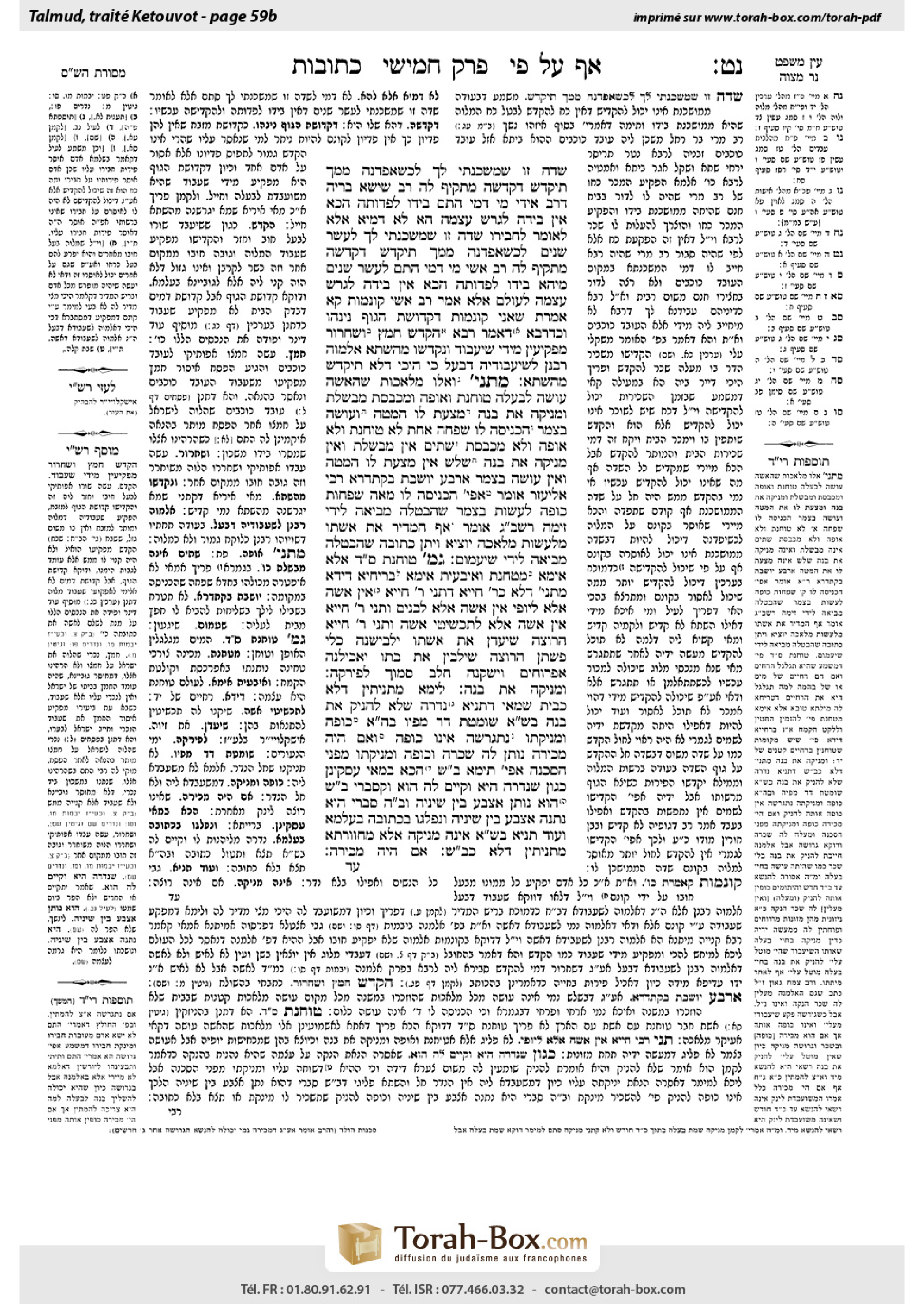
Ketubot 59b: Talmud study for Daf Yomi
Daf Yomi is the daily study of one Talmud folio. Explore 37 tractates with scans, Hebrew text, Sefaria English and AI-generated French translations where annotated.
Passage selection and English or AI-generated French translation are available where the scan has annotations. Daf Study is independent of Torah-Box and Sefaria.
Browse Ketubot · כתובות · All tractatesKetubot 59b text and translations
This page of Ketubot includes the Aramaic text, an English translation and an AI-generated French translation, alongside the scan above.
כתובות נ״ט ב · Aramaic and Hebrew text
״שָׂדֶה זוֹ שֶׁמִּשְׁכַּנְתִּי לְךָ, לִכְשֶׁאֶפְדֶּנָּה מִמְּךָ — תִּיקְדַּשׁ״, דְּקָדְשָׁה.
מַתְקֵיף לַהּ רַב שִׁישָׁא בְּרֵיהּ דְּרַב אִידִי: מִי דָּמֵי? הָתָם, בְּיָדוֹ לִפְדּוֹתָהּ. הָכָא, אֵין בְּיָדָהּ לְגָרֵשׁ עַצְמָהּ! הָא לָא דָּמְיָא אֶלָּא לָאוֹמֵר לַחֲבֵירוֹ ״שָׂדֶה זוֹ שֶׁמִּשְׁכַּנְתִּי לְךָ לְעֶשֶׂר שָׁנִים, לִכְשֶׁאֶפְדֶּנָּה מִמְּךָ — תִּיקְדַּשׁ״, דְּקָדְשָׁה.
מַתְקֵיף לַהּ רַב אָשֵׁי: מִי דָּמֵי? הָתָם, לְעֶשֶׂר שָׁנִים מִיהָא בְּיָדוֹ לִפְדּוֹתָהּ. הָכָא, אֵין בְּיָדָהּ לְגָרֵשׁ עַצְמָהּ לְעוֹלָם.
אֶלָּא, אָמַר רַב אָשֵׁי: קוּנָּמוֹת קָא אָמְרַתְּ? שָׁאנֵי קוּנָּמוֹת, דִּקְדוּשַּׁת הַגּוּף נִינְהוּ, וְכִדְרָבָא. דְּאָמַר רָבָא: הֶקְדֵּשׁ, חָמֵץ וְשִׁחְרוּר — מַפְקִיעִין מִידֵי שִׁיעְבּוּד.
וְנִקְדְּשׁוּ מֵהַשְׁתָּא? אַלְּמוּהָ רַבָּנַן לְשִׁיעְבּוּדֵיהּ דְּבַעַל, כִּי הֵיכִי דְּלָא תִּיקְדַּשׁ מֵהַשְׁתָּא.
מַתְנִי׳ וְאֵלּוּ מְלָאכוֹת שֶׁהָאִשָּׁה עוֹשָׂה לְבַעְלָהּ: טוֹחֶנֶת, וְאוֹפָה, וּמְכַבֶּסֶת, מְבַשֶּׁלֶת, וּמְנִיקָה אֶת בְּנָהּ, מַצַּעַת לוֹ הַמִּטָּה, וְעוֹשָׂה בַּצֶּמֶר. הִכְנִיסָה לוֹ שִׁפְחָה אַחַת — לֹא טוֹחֶנֶת וְלֹא אוֹפָה וְלֹא מְכַבֶּסֶת. שְׁתַּיִם — אֵין מְבַשֶּׁלֶת, וְאֵין מְנִיקָה אֶת בְּנָהּ. שָׁלֹשׁ — אֵין מַצַּעַת לוֹ הַמִּטָּה, וְאֵין עוֹשָׂה בַּצֶּמֶר. אַרְבַּע — יוֹשֶׁבֶת בְּקָתֶדְרָא.
רַבִּי אֱלִיעֶזֶר אוֹמֵר: אֲפִילּוּ הִכְנִיסָה לוֹ מֵאָה שְׁפָחוֹת — כּוֹפָהּ לַעֲשׂוֹת בַּצֶּמֶר, שֶׁהַבַּטָּלָה מְבִיאָה לִידֵי זִימָּה. רַבָּן שִׁמְעוֹן בֶּן גַּמְלִיאֵל אוֹמֵר: אַף הַמַּדִּיר אֶת אִשְׁתּוֹ מִלַּעֲשׂוֹת מְלָאכָה — יוֹצִיא וְיִתֵּן כְּתוּבָּה, שֶׁהַבַּטָּלָה מְבִיאָה לִידֵי שִׁיעֲמוּם.
גְּמָ׳ טוֹחֶנֶת סָלְקָא דַּעְתָּךְ?! אֶלָּא אֵימָא: מַטְחֶנֶת. וְאִיבָּעֵית אֵימָא: בְּרִיחְיָא דִּידָא.
מַתְנִיתִין דְּלָא כְּרַבִּי חִיָּיא, דְּתָנֵי רַבִּי חִיָּיא: אֵין אִשָּׁה אֶלָּא לְיוֹפִי, אֵין אִשָּׁה אֶלָּא לְבָנִים. וְתָנֵי רַבִּי חִיָּיא: אֵין אִשָּׁה אֶלָּא לְתַכְשִׁיטֵי אִשָּׁה. וְתָנֵי רַבִּי חִיָּיא: הָרוֹצֶה שֶׁיְּעַדֵּן אֶת אִשְׁתּוֹ — יַלְבִּישֶׁנָּה כְּלֵי פִשְׁתָּן. הָרוֹצֶה שֶׁיַּלְבִּין אֶת בִּתּוֹ — יַאֲכִילֶנָּה אֶפְרוֹחִים וְיַשְׁקֶנָּה חָלָב סָמוּךְ לְפִירְקָהּ.
וּמְנִיקָה אֶת בְּנָהּ. לֵימָא מַתְנִיתִין דְּלָא כְּבֵית שַׁמַּאי. דְּתַנְיָא: נָדְרָה שֶׁלֹּא לְהָנִיק אֶת בְּנָהּ, בֵּית שַׁמַּאי אוֹמְרִים: שׁוֹמֶטֶת דַּד מִפִּיו. בֵּית הִלֵּל אוֹמְרִים: כּוֹפָהּ וּמְנִיקָתוֹ. נִתְגָּרְשָׁה — אֵינוֹ כּוֹפָהּ. וְאִם הָיָה מַכִּירָהּ — נוֹתֵן לָהּ שְׂכָרָהּ וְכוֹפָהּ, וּמְנִיקָתוֹ מִפְּנֵי הַסַּכָּנָה.
אֲפִילּוּ תֵּימָא בֵּית שַׁמַּאי, הָכָא בְּמַאי עָסְקִינַן: כְּגוֹן שֶׁנָּדְרָה הִיא, וְקִיֵּים לַהּ הוּא. וְקָסָבְרִי בֵּית שַׁמַּאי: הוּא נוֹתֵן אֶצְבַּע בֵּין שִׁינֶּיהָ, וּבֵית הִלֵּל סָבְרִי: הִיא נָתְנָה אֶצְבַּע בֵּין שִׁינֶּיהָ.
וְנִפְלְגוּ בִּכְתוּבָּה בְּעָלְמָא. וְעוֹד: תַּנְיָא, בֵּית שַׁמַּאי אוֹמְרִים: אֵינָהּ מְנִיקָה! אֶלָּא מְחַוַּורְתָּא מַתְנִיתִין דְּלָא כְּבֵית שַׁמַּאי.
אִם הָיָה מַכִּירָהּ.
Ketubot 59b · English translation
This field that I mortgaged to you and from whose produce you are benefiting will be consecrated when I redeem it from you. The halakha is that it is consecrated, since the field itself was not transferred to another’s ownership.
Rav Sheisha, son of Rav Idi, objects to this: Is it comparable? There, in the case where he mortgaged the field, it is in his power to redeem it, whereas here, with regard to a woman who renders her earnings prohibited to her husband, it is not in her power to divorce herself from her husband. This is only comparable to one who says to another: This field that I have mortgaged to you for ten years will be consecrated when I redeem it from you. The halakha is that it is consecrated. Similarly, in this case, despite the fact that her earnings belong to her husband, when she will be divorced they will revert to her, and since her hands have always belonged to her, she can consecrate her earnings.
Rav Ashi objects to this: Is it comparable? There, after ten years in any case it will be in his power to redeem it, whereas here, with regard to a woman, it is never in her power to divorce herself from her husband. Consequently, there is no way for her to consecrate her future earnings.
Rather, the contradiction between the two rulings of Shmuel must be resolved in a different manner. Rav Ashi said: Did you speak about konamot? Konamot are different, since they are a type of inherent sanctity, and therefore the konam can take effect on an item that is subjugated to another person, in accordance with the halakha articulated by Rava. As Rava said: Consecration, the prohibition of leavened bread on Passover, and the liberation of a slave can all abrogate a lien on property. If property was mortgaged to another person, and then the owner consecrated it, or if leavened bread was mortgaged and Passover arrived and it became prohibited to benefit from it, or if a slave was mortgaged and then liberated by his owner, the lien is abrogated. Since konam is a form of consecration, it can take effect on an item even when it is subjugated to another when the owner prohibited it, similar to the case of mortgaged property.
The Gemara asks: If it is so, that a konam can remove the lien on property, let her earnings become consecrated from now, even before her husband divorces her. The Gemara answers: The Sages reinforced the husband’s lien in order that it not become consecrated now. However, since in general a konam can take effect on mortgaged items, it can take effect on her earnings after she leaves her husband’s jurisdiction.
MISHNA: And these are tasks that a wife must perform for her husband: She grinds wheat into flour, and bakes, and washes clothes, cooks, and nurses her child, makes her husband’s bed, and makes thread from wool by spinning it. If she brought him one maidservant, i.e., brought the maidservant with her into the marriage, the maidservant will perform some of these tasks. Consequently, the wife does not need to grind, and does not need to bake, and does not need to wash clothes. If she brought him two maidservants, she does not need to cook and does not need to nurse her child if she does not want to, but instead may give the child to a wet nurse. If she brought him three maidservants, she does not need to make his bed and does not need to make thread from wool. If she brought him four maidservants, she may sit in a chair [katedra] like a queen and not do anything, as her maidservants do all of her work for her.
Rabbi Eliezer says: Even if she brought him a hundred maidservants, he can compel her to make thread from wool, since idleness leads to licentiousness. Consequently, it is better for a woman to be doing some kind of work. Rabban Shimon ben Gamliel says: Even one who vows that his wife is prohibited from doing any work must divorce her and give her the payment for her marriage contract, since idleness leads to idiocy.
GEMARA: With regard to the mishna’s choice of terminology the Gemara asks: Could it enter your mind that she grinds the wheat into flour? Ordinarily, grinding is performed in a mill using millstones that are rotated by water or by animals, so the woman herself does not actually grind the wheat. The Gemara answers: Rather, say that she supervises the grinding by bringing wheat to the mill and ensuring that it is ground properly. Alternatively, if you wish, say instead: She can grind the wheat herself with a hand mill.
The Gemara comments: The mishna is not in accordance with the opinion of Rabbi Ḥiyya, as Rabbi Ḥiyya teaches: A wife is only for beauty, and a wife is only for children, but not for household tasks. And Rabbi Ḥiyya teaches: A wife is only for wearing a woman’s finery. And Rabbi Ḥiyya similarly teaches: One who wishes to beautify his wife should clothe her in linen garments, and one who wishes to whiten his daughter so that she will have a fair complexion, should feed her young chickens, and should give her milk to drink toward the time of her maturity.
§ The mishna mentions among a wife’s obligations that she nurses her child. The Gemara suggests: Let us say that the mishna is not in accordance with the opinion of Beit Shammai, as it is taught in a baraita: If a woman took a vow not to nurse her child, Beit Shammai say: Since she vowed, she must remove her nipple from his mouth and not nurse him. Beit Hillel say: Her husband can compel her, and she must nurse the child even against her will. However, if she was divorced and therefore had no further obligations to her husband, he cannot compel her. Nevertheless, if the baby recognized her, then even after the divorce, her husband may pay her a salary as a wet nurse and compel her to nurse due to the danger that the child will starve if he refuses to nurse from another woman. This baraita indicates that according to Beit Shammai a woman has no obligation to nurse her child. If she had a prior obligation to her husband to nurse the child, the vow would not take effect.
The Gemara rejects this suggestion: Even if you say that the mishna is also in accordance with the opinion of Beit Shammai, here we are dealing with a case where she made this vow and her husband ratified it for her by refraining from nullifying it. Beit Shammai maintain that in that case it is considered as if he had placed his finger between her teeth, i.e., he caused the vow to be in effect, meaning that in that case the responsibility lies with him. Since he declined the opportunity to nullify the vow, her obligation to nurse is canceled. Beit Hillel maintain that in that case she put her finger between her own teeth, i.e., she caused the vow to remain in effect. Consequently, although he ratified her vow, the responsibility rests on her, and for this reason her obligation is not annulled.
The Gemara asks: If so, that the dispute is about who is responsible when a woman vows and her husband ratifies the vow, and it is not specifically about her obligation to nurse her child, then let them dispute about a marriage contract in general, with regard to whether or not a woman is entitled to payment for her marriage contract if she vows to prohibit her husband from deriving benefit from her. And furthermore, it is taught in a baraita that Beit Shammai explicitly say with regard to all women, not specifically in the context of vows: She does not need to nurse if she does not want to. Rather, it is clear that the mishna is not in accordance with the opinion of Beit Shammai.
The Gemara above quotes a baraita where it is taught that if the baby recognized her, her husband can compel her to continue nursing even after she is divorced, but he must pay her for nursing.
Ketubot 59b · Traduction française (IA)
Ce champ que je t’ai donné en garantie et dont tu perçois les récoltes sera consacré lorsque je te le rachèterai. La halakha est qu’il est consacré, car le champ lui-même n’a pas été transféré à la propriété d’un autre.
Rav Sheisha, fils de Rav Idi, objecte : Est-ce comparable ? Dans le cas où il a donné le champ en garantie, il est en mesure de le racheter, tandis qu’ici, s’agissant d’une femme qui interdit ses revenus à son mari, elle n’est pas en mesure de divorcer elle-même de lui. Cela n’est comparable qu’au cas d’un homme qui dit à un autre : « Ce champ que je t’ai donné en garantie pour dix ans sera consacré lorsque je te le rachèterai. » La halakha est qu’il est consacré. De même ici, bien que ses revenus appartiennent à son mari, ils lui reviendront lorsqu’elle sera divorcée ; et puisque ses mains lui ont toujours appartenu, elle peut consacrer ses revenus.
Rav Ashi objecte : Est-ce comparable ? Dans le premier cas, au bout de dix ans, il sera de toute façon en mesure de le racheter, tandis qu’ici, s’agissant d’une femme, elle n’est jamais en mesure de divorcer elle-même de son mari. Par conséquent, elle ne peut en aucune façon consacrer ses revenus futurs.
Il faut plutôt résoudre autrement la contradiction entre les deux décisions de Shmuel. Rav Ashi dit : Parliez-vous de konamot ? Les konamot sont différents, car ils relèvent d’une sainteté intrinsèque ; le konam peut donc prendre effet sur un objet grevé d’un droit au profit d’un autre, conformément à la halakha énoncée par Rava. En effet, Rava a dit : La consécration, l’interdiction du hamets à Pessa’h et l’affranchissement d’un esclave peuvent tous abroger un droit de gage sur un bien. Si un bien a été donné en garantie à une autre personne, puis que son propriétaire l’a consacré ; ou si du hamets a été donné en garantie et que Pessa’h est arrivé, le rendant interdit à la consommation ; ou si un esclave a été donné en garantie, puis affranchi par son maître, le droit de gage est abrogé. Puisque le konam est une forme de consécration, il peut prendre effet sur un objet même lorsque celui-ci est grevé d’un droit au profit d’un autre, dès lors que son propriétaire l’a interdit, comme dans le cas d’un bien donné en garantie.
La Guemara demande : Si tel est le cas, puisqu’un konam peut abroger le droit de gage sur un bien, que ses revenus soient consacrés dès maintenant, avant même que son mari ne la divorce ! La Guemara répond : Les Sages ont renforcé le droit de gage du mari afin que les revenus ne soient pas consacrés dès maintenant. Cependant, puisqu’en règle générale un konam peut prendre effet sur des biens donnés en garantie, il peut prendre effet sur ses revenus après qu’elle est sortie de l’autorité de son mari.
MICHNA : Voici les tâches qu’une épouse doit accomplir pour son mari : elle moud le blé pour en faire de la farine, cuit le pain, lave le linge, cuisine, allaite son enfant, prépare le lit de son mari et file la laine. Si elle lui a apporté une servante, c’est-à-dire si elle l’a amenée avec elle dans le mariage, celle-ci accomplira une partie de ces tâches. Par conséquent, l’épouse n’a pas besoin de moudre, de cuire le pain ni de laver le linge. Si elle lui a apporté deux servantes, elle n’a pas besoin de cuisiner ni d’allaiter son enfant si elle ne le souhaite pas ; elle peut plutôt confier l’enfant à une nourrice. Si elle lui a apporté trois servantes, elle n’a pas besoin de préparer son lit ni de filer la laine. Si elle lui a apporté quatre servantes, elle peut s’asseoir sur un siège [katedra], comme une reine, et ne rien faire, puisque ses servantes accomplissent toutes ses tâches à sa place.
Rabbi Eliezer dit : Même si elle lui a apporté cent servantes, il peut la contraindre à filer la laine, car l’oisiveté mène à la débauche. Il vaut donc mieux qu’une femme accomplisse une forme de travail. Rabban Shimon ben Gamliel dit : Même si un homme fait vœu d’interdire à son épouse tout travail, il doit divorcer d’elle et lui verser le montant de sa ketouba, car l’oisiveté mène à l’idiotie.
GUEMARA : À propos du choix des termes de la Michna, la Guemara demande : Peut-on imaginer qu’elle moud le blé pour en faire de la farine ? D’ordinaire, la mouture se fait dans un moulin, à l’aide de meules actionnées par l’eau ou par des animaux ; la femme ne moud donc pas elle-même le blé. La Guemara répond : Il faut plutôt dire qu’elle supervise la mouture en apportant le blé au moulin et en veillant à ce qu’il soit correctement moulu. Ou bien, si tu préfères, dis plutôt qu’elle peut moudre elle-même le blé avec un moulin à main.
La Guemara fait remarquer : La Michna ne suit pas l’opinion de Rabbi Ḥiyya, car Rabbi Ḥiyya enseigne : Une épouse n’est destinée qu’à la beauté et aux enfants, et non aux tâches ménagères. Rabbi Ḥiyya enseigne également : Une épouse n’est destinée qu’à porter des parures féminines. Et Rabbi Ḥiyya enseigne aussi : Celui qui souhaite embellir son épouse doit la vêtir de vêtements de lin ; et celui qui souhaite éclaircir le teint de sa fille doit lui donner à manger de jeunes poulets et à boire du lait à l’approche de sa maturité.
§ La Michna mentionne, parmi les obligations de l’épouse, qu’elle allaite son enfant. La Guemara suggère : Disons que la Michna ne suit pas l’opinion de Beit Shammaï, car il est enseigné dans une baraïta : Si une femme fait vœu de ne pas allaiter son enfant, Beit Shammaï disent : Puisqu’elle a fait vœu, elle doit retirer son mamelon de la bouche de l’enfant et ne pas l’allaiter. Beit Hillel disent : Son mari peut la contraindre et elle doit allaiter l’enfant, même contre son gré. Toutefois, si elle a été divorcée et n’a donc plus d’obligations envers son mari, celui-ci ne peut pas la contraindre. Néanmoins, si le bébé l’a reconnue, son mari peut, même après le divorce, lui verser un salaire de nourrice et la contraindre à l’allaiter, car l’enfant risque de mourir de faim s’il refuse de téter une autre femme. Cette baraïta indique que, selon Beit Shammaï, une femme n’a pas l’obligation d’allaiter son enfant. Si elle avait eu auparavant l’obligation envers son mari de l’allaiter, le vœu n’aurait pas pris effet.
La Guemara rejette cette suggestion : Même si tu dis que la Michna suit également l’opinion de Beit Shammaï, il s’agit ici d’un cas où elle a fait ce vœu et où son mari l’a ratifié en s’abstenant de l’annuler. Beit Shammaï soutiennent que, dans ce cas, c’est comme s’il avait placé son doigt entre ses dents, c’est-à-dire qu’il a fait en sorte que le vœu reste en vigueur ; la responsabilité lui incombe donc. Puisqu’il a renoncé à la possibilité d’annuler le vœu, son obligation d’allaiter est annulée. Beit Hillel soutiennent que, dans ce cas, c’est elle qui a placé son doigt entre ses propres dents, c’est-à-dire qu’elle a fait en sorte que le vœu reste en vigueur. Par conséquent, bien qu’il ait ratifié son vœu, la responsabilité lui incombe, et son obligation n’est donc pas annulée.
La Guemara demande : Si tel est le cas, et que la controverse porte sur la personne qui est responsable lorsqu’une femme fait un vœu et que son mari le ratifie, et non spécifiquement sur son obligation d’allaiter son enfant, qu’ils discutent donc de la ketouba en général : une femme a-t-elle droit ou non au paiement de sa ketouba lorsqu’elle fait vœu d’interdire à son mari de tirer profit d’elle ? En outre, il est enseigné dans une baraïta que Beit Shammaï disent explicitement, à propos de toutes les femmes et non pas seulement dans le contexte des vœux : Elle n’a pas besoin d’allaiter si elle ne le souhaite pas. Il est donc clair que la Michna ne suit pas l’opinion de Beit Shammaï.
La Guemara a cité plus haut une baraïta qui enseigne que, si le bébé l’a reconnue, son mari peut la contraindre à continuer de l’allaiter même après son divorce, mais qu’il doit la rémunérer pour l’allaitement.
Traduction française générée par IA à partir de l’édition anglaise de Sefaria. Vérifie toujours un passage avec le texte source.
Text from Sefaria: William Davidson Edition - Vocalized Aramaic (CC BY NC); William Davidson Edition - English (CC BY NC).