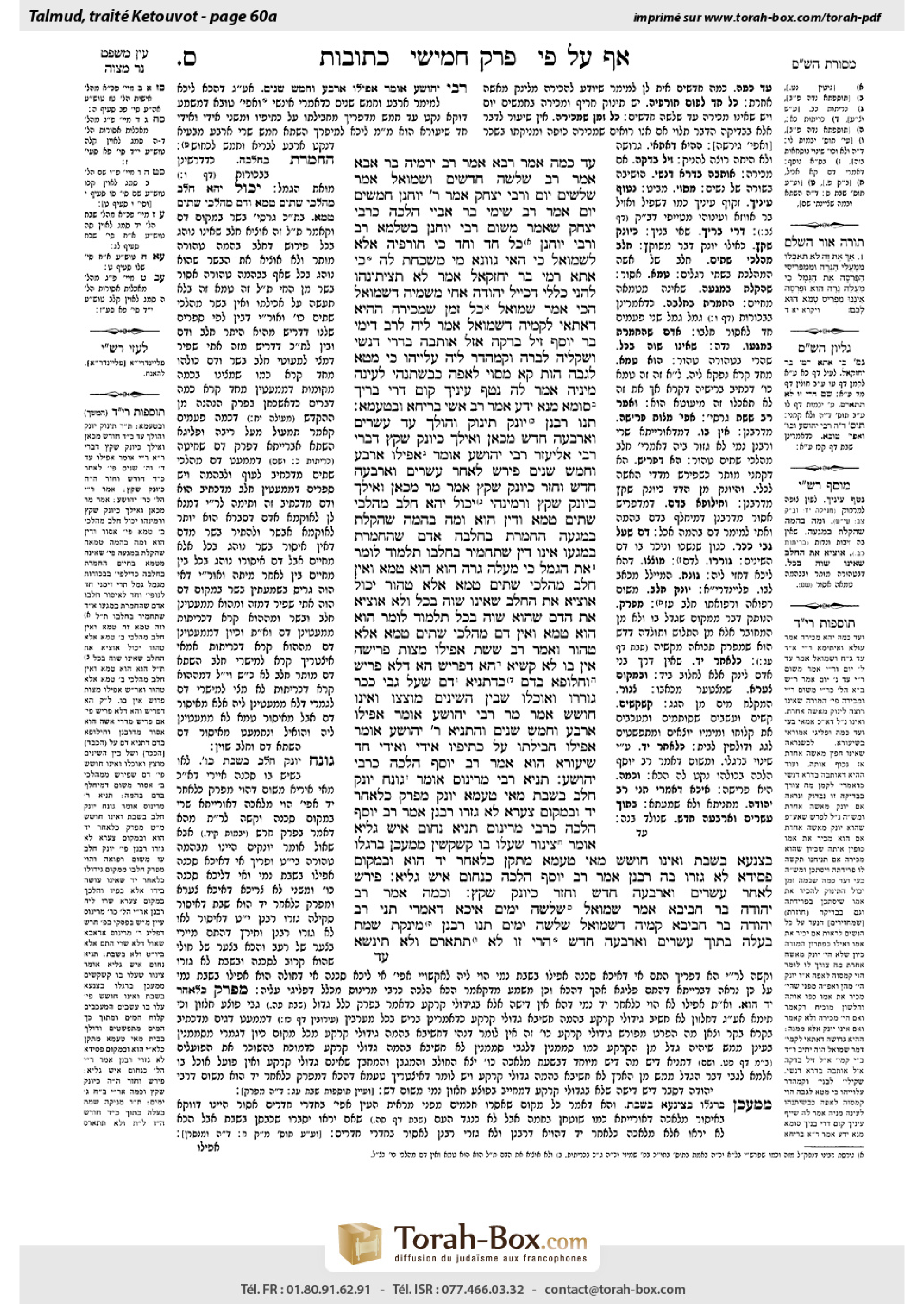
Ketubot 60a: Talmud study for Daf Yomi
Daf Yomi is the daily study of one Talmud folio. Explore 37 tractates with scans, Hebrew text, Sefaria English and AI-generated French translations where annotated.
Passage selection and English or AI-generated French translation are available where the scan has annotations. Daf Study is independent of Torah-Box and Sefaria.
Browse Ketubot · כתובות · All tractatesKetubot 60a text and translations
This page of Ketubot includes the Aramaic text, an English translation and an AI-generated French translation, alongside the scan above.
כתובות ס׳ א · Aramaic and Hebrew text
עַד כַּמָּה? אָמַר רָבָא אָמַר רַב יִרְמְיָה בַּר אַבָּא אָמַר רַב: שְׁלֹשָׁה חֳדָשִׁים, וּשְׁמוּאֵל אָמַר: שְׁלֹשִׁים יוֹם. וְרַבִּי יִצְחָק אָמַר רַבִּי יוֹחָנָן: חֲמִשִּׁים יוֹם. אָמַר רַב שִׁימִי בַּר אַבָּיֵי: הֲלָכָה כְּרַבִּי יִצְחָק שֶׁאָמַר מִשּׁוּם רַבִּי יוֹחָנָן. בִּשְׁלָמָא רַב וְרַבִּי יוֹחָנָן — כׇּל חַד וְחַד כִּי חוּרְפֵּיהּ. אֶלָּא לִשְׁמוּאֵל, כִּי הַאי גַּוְונָא מִי מַשְׁכַּחַתְּ לַהּ?
כִּי אֲתָא רָמֵי בַּר יְחֶזְקֵאל, אָמַר: לָא תְּצִיתִינְהוּ לְהָנֵי כְּלָלֵי דְּכָיֵיל יְהוּדָה אֲחִי מִשְּׁמֵיהּ דִּשְׁמוּאֵל. הָכִי אָמַר שְׁמוּאֵל: כׇּל זְמַן שֶׁמַּכִּירָהּ.
הָהִיא דַּאֲתַאי לְקַמֵּיהּ דִּשְׁמוּאֵל. אֲמַר לֵיהּ לְרַב דִּימִי בַּר יוֹסֵף: זִיל בִּדְקֵהּ. אֲזַל אוֹתְבַהּ בְּדָרֵי דִנְשֵׁי, וְשַׁקְלֵיהּ לִבְרַהּ וְקָמְהַדַּר לֵיהּ עֲלַיְיהוּ. כִּי מְטָא לְגַבַּהּ, הֲוָת קָא מְסַוֵּי לְאַפַּהּ כְּבַשְׁתִּנְהִי לְעֵינַהּ מִינֵּיהּ. אֲמַר לַהּ: נְטֹף עֵינִיךְ, קוּם דְּרַי בְּרִיךְ. סוֹמֵא מְנָא יָדַע? אָמַר רַב אָשֵׁי: בְּרֵיחָא וּבְטַעְמָא.
תָּנוּ רַבָּנַן: יוֹנֵק תִּינוֹק וְהוֹלֵךְ עַד עֶשְׂרִים וְאַרְבָּעָה חֹדֶשׁ, מִכָּאן וְאֵילָךְ — כְּיוֹנֵק שֶׁקֶץ, דִּבְרֵי רַבִּי אֱלִיעֶזֶר. רַבִּי יְהוֹשֻׁעַ אוֹמֵר: אֲפִילּוּ אַרְבַּע וְחָמֵשׁ שָׁנִים. פֵּירַשׁ לְאַחַר עֶשְׂרִים וְאַרְבָּעָה חֹדֶשׁ וְחָזַר — כְּיוֹנֵק שֶׁקֶץ.
אָמַר מָר: מִכָּאן וְאֵילָךְ כְּיוֹנֵק שֶׁקֶץ. וּרְמִינְהִי: יָכוֹל יְהֵא חֲלֵב מְהַלְּכֵי שְׁתַּיִם טָמֵא. וְדִין הוּא: וּמָה בְּהֵמָה שֶׁהֵקַלְתָּ בְּמַגָּעָהּ — הֶחְמַרְתָּ בַּחֲלָבָהּ, אָדָם שֶׁהֶחְמַרְתָּ בְּמַגָּעוֹ — אֵינוֹ דִּין שֶׁתַּחְמִיר בַּחֲלָבוֹ?
תַּלְמוּד לוֹמַר: ״אֶת הַגָּמָל כִּי מַעֲלֵה גֵרָה הוּא״, הוּא טָמֵא, וְאֵין חֲלֵב מְהַלְּכֵי שְׁתַּיִם טָמֵא, אֶלָּא טָהוֹר. יָכוֹל אוֹצִיא אֶת הֶחָלָב, שֶׁאֵינוֹ שָׁוֶה בַּכֹּל, וְלֹא אוֹצִיא אֶת הַדָּם שֶׁהוּא שָׁוֶה בַּכֹּל — תַּלְמוּד לוֹמַר ״הוּא״ — הוּא טָמֵא, וְאֵין דַּם מְהַלְּכֵי שְׁתַּיִם טָמֵא, אֶלָּא טָהוֹר.
וְאָמַר רַב שֵׁשֶׁת: אֲפִילּוּ מִצְוַת פְּרִישָׁה אֵין בּוֹ.
לָא קַשְׁיָא: הָא דְּפָרֵישׁ, הָא דְּלָא פָּרֵישׁ.
וְחִילּוּפַהּ בְּדָם. כִּדְתַנְיָא: דָּם שֶׁעַל גַּבֵּי כִּכָּר — גּוֹרְרוֹ וְאוֹכְלוֹ. שֶׁבֵּין הַשִּׁינַּיִם — מוֹצְצוֹ וְאֵינוֹ חוֹשֵׁשׁ.
אָמַר מָר, רַבִּי יְהוֹשֻׁעַ אוֹמֵר: אֲפִילּוּ אַרְבַּע וְחָמֵשׁ שָׁנִים. וְהָתַנְיָא, רַבִּי יְהוֹשֻׁעַ אוֹמֵר: אֲפִילּוּ חֲבִילָתוֹ עַל כְּתֵיפָיו! אִידֵּי וְאִידֵּי חַד שִׁיעוּרָא הוּא. אָמַר רַב יוֹסֵף: הֲלָכָה כְּרַבִּי יְהוֹשֻׁעַ.
תַּנְיָא, רַבִּי מָרִינוּס אוֹמֵר: גּוֹנֵחַ — יוֹנֵק חָלָב בְּשַׁבָּת. מַאי טַעְמָא: יוֹנֵק מְפָרֵק כִּלְאַחַר יָד, וּבִמְקוֹם צַעֲרָא לָא גְּזַרוּ רַבָּנַן. אָמַר רַב יוֹסֵף: הֲלָכָה כְּרַבִּי מָרִינוּס.
תַּנְיָא, נַחוּם אִישׁ גַּלְיָא אוֹמֵר: צִינּוֹר שֶׁעָלוּ בּוֹ קַשְׁקַשִּׁין — מְמַעֲכָן בְּרַגְלוֹ בְּצִנְעָא בְּשַׁבָּת, וְאֵינוֹ חוֹשֵׁשׁ. מַאי טַעְמָא — מְתַקֵּן כִּלְאַחַר יָד הוּא, וּבִמְקוֹם פְּסֵידָא לָא גְּזַרוּ בַּהּ רַבָּנַן. אָמַר רַב יוֹסֵף: הֲלָכָה כְּנַחוּם אִישׁ גַּלְיָא.
פֵּירַשׁ לְאַחַר עֶשְׂרִים וְאַרְבָּעָה חֹדֶשׁ וְחָזַר — כְּיוֹנֵק שֶׁקֶץ. וְכַמָּה? אָמַר רַב יְהוּדָה בַּר חֲבִיבָא אָמַר שְׁמוּאֵל: שְׁלֹשָׁה יָמִים. אִיכָּא דְּאָמְרִי, תָּנֵי רַב יְהוּדָה בַּר חֲבִיבָא קַמֵּיהּ דִּשְׁמוּאֵל: שְׁלֹשָׁה יָמִים.
תָּנוּ רַבָּנַן: מֵינֶקֶת שֶׁמֵּת בַּעְלָהּ בְּתוֹךְ עֶשְׂרִים וְאַרְבָּעָה חֹדֶשׁ — הֲרֵי זוֹ לֹא תִּתְאָרֵס וְלֹא תִּינָּשֵׂא
Ketubot 60a · English translation
The Gemara asks: How old does the child have to be so that one can assume that he already recognizes his mother? Rava said that Rav Yirmeya bar Abba said that Rav said: Three months, and Shmuel said: Thirty days, and Rabbi Yitzḥak said that Rabbi Yoḥanan said: Fifty days. Rav Shimi bar Abaye said: The halakha is in accordance with what Rabbi Yitzḥak said in the name of Rabbi Yoḥanan. The Gemara asks: Granted, Rav and Rabbi Yoḥanan are in dispute with regard to the difference between fifty days and three months, as it is possible that each baby varies according to its intelligence, as one baby is sufficiently developed at fifty days, while another knows his mother at only three months. However, according to Shmuel, can you find a case like this, a one-month-old baby who recognizes his mother?
The Gemara relates: When Rami bar Yeḥezkel came from Eretz Yisrael, he said: Do not listen to, i.e., do not accept, those principles that my brother Yehuda said in the name of Shmuel, as Shmuel did not establish a particular time with regard to this matter. Rather, this is what Shmuel said: Whenever he recognizes her, i.e., there is no fixed age at which this occurs. One must check each baby to see whether he recognizes his mother.
The Gemara relates: A certain divorcée came before Shmuel, as she did not wish to nurse her son. He said to Rav Dimi bar Yosef: Go and check her, i.e., verify whether the child recognizes his mother. He went, placed her in a row of women, and took her son in his arms and passed him near them to see how the child would react. When the child reached her, he looked at her face with joy, and she averted her eyes from him, as she did not want to look at him. He said to her: Lift up your eyes, get up and take your son, as it is obvious that he knows you. The Gemara asks: If this is so, then how does a blind baby know and recognize his mother? Rav Ashi said: Through smell and through the taste of her milk.
§ Apropos the period of time during which a child nurses, the Gemara continues to debate different aspects of this matter. The Sages taught in a baraita: A child may continue to nurse until the age of twenty-four months, and from this point forward, if he continues to nurse, he is like one who nurses from a non-kosher animal, as a woman’s milk is forbidden to anyone other than a small child; this is the statement of Rabbi Eliezer. Rabbi Yehoshua says: A child may continue to nurse even for four or five years, and this is permitted. However, if he ceased, i.e., was weaned, after twenty-four months and then resumed nursing, he is like one who nurses from a non-kosher animal.
The Master said in the baraita: From this point forward he is like one who nurses from a non-kosher animal. The Gemara raises a contradiction from a baraita: One might have thought that the milk of bipeds, i.e., humans, would be non-kosher like that of a non-kosher animal, based on a logical derivation: Just as with regard to a non-kosher animal, where you were lenient with regard to its contact, meaning that it does not render people or items impure through contact when it is alive, you were stringent with regard to its milk, which is prohibited, even more so should this be true with regard to a person. An a fortiori inference would indicate that with regard to a person, where you were stringent about contact, as people can render other people and objects impure even when they are alive, one should be stricter. So isn’t it logical that you should be stringent with regard to his milk?
This is as the verse states: “But this you shall not eat, of those that only chew the cud, or of those that only part the hoof; the camel, because it chews the cud but does not part the hoof, it is impure for you” (Leviticus 11:4). The somewhat superfluous word “it” teaches that it alone is impure, but the milk of bipeds is not impure; rather, it is kosher. Furthermore, one might have thought that I should exclude the milk of humans from the prohibition against consumption, as this issue does not apply equally to everyone, since only women produce milk, but I should not exclude from the prohibition human blood, which does apply equally to everyone. Consequently, the verse states “it” with regard to a camel, to say that it alone is impure, whereas the blood of bipeds is not impure, but rather is kosher.
And Rav Sheshet said about this ruling: There is not even a rabbinic command to refrain from consuming human milk. Therefore, this presents a contradiction to the statement that a child who nurses beyond a certain age is like one who nurses from a non-kosher animal.
The Gemara answers: This is not difficult, as this statement that the milk is permitted is referring to when it has been removed from the woman’s body, and that statement, that the milk is forbidden, is referring to when it has not been removed. Fundamentally, human milk is a permitted substance. However, it is prohibited by rabbinic law for anyone other than a very young child to nurse directly from a woman’s breasts, and one who does so is considered like one who consumes milk from a non-kosher animal.
And the opposite applies to blood: Human blood that has been removed from the body is forbidden, but if it has not yet been removed, it is permitted. As it is taught in a baraita: If some human blood was on a loaf of bread, one scrapes off the blood and then he may eat the bread. Since the blood was detached from the body, it is forbidden by rabbinic law, but if blood was between the teeth, he may suck it and swallow it without concern, as the blood is permitted if it has not been removed from the body.
The Master said in the aforementioned baraita: Rabbi Yehoshua says: A child may continue to nurse even for four or five years. But isn’t it taught in a different baraita: Rabbi Yehoshua says: Even if he can carry his package on his shoulder he can continue to nurse? The Gemara answers: This is not a contradiction, since both this and that are one, the same, measure, and the difference between them is only semantic. Rav Yosef said: The halakha is in accordance with the opinion of Rabbi Yehoshua.
On the same topic it is taught in a baraita: Rabbi Marinos says: One who is coughing due to an illness that requires milk but did not have milk available may suck milk directly from an animal’s udders on Shabbat, although milking is a prohibited labor on Shabbat. What is the reason? Sucking the milk in this way constitutes an act of extracting in an unusual manner. Although milking is an example of the labor of extracting, a subcategory of the primary category of threshing, it is prohibited by Torah law only when the labor is performed in its typical manner. One who nurses from an animal is extracting the milk in an unusual manner. Such labor is prohibited by rabbinic law, but in a situation involving pain, like one who is coughing, the Sages did not issue a decree. Rabbi Yosef said: The halakha is in accordance with the opinion of Rabbi Marinos.
A ruling similar to the previous halakha is taught in a baraita: Naḥum of Galia says: If a drainage pipe is blocked by weeds [kashkashin] and grass, preventing water from running through the pipe, one may crush them with his foot in private on Shabbat without concern that he is performing the labor of preparing a vessel. The Gemara explains: What is the reason for this leniency? This is an example of repairing a vessel in an unusual manner, since it is uncommon to fix an item without using a tool or one’s hands. Performing labor in an unusual manner is ordinarily prohibited by rabbinic decree, but in a situation involving financial loss, the Sages did not issue a decree. Rabbi Yosef said: The halakha is in accordance with the opinion of Naḥum of Galia.
The Gemara continues discussing the aforementioned baraita, which states: If the child ceased nursing after twenty-four months and then resumed, he is like one who nurses from a non-kosher animal. The Gemara asks: How long must he cease nursing to be considered weaned? Rav Yehuda bar Ḥaviva said that Shmuel said: Three days. There are those who say that this was not an amoraic statement, but rather a baraita that is taught by Rav Yehuda bar Ḥaviva before Shmuel: Weaning takes effect after three days.
§ The Gemara discusses other halakhot relating to nursing. The Sages taught: A nursing woman whose husband died within twenty-four months of her child’s birth may not be betrothed and may not get married
Ketubot 60a · Traduction française (IA)
La Guemara demande : Quel âge doit avoir l’enfant pour que l’on puisse supposer qu’il reconnaît déjà sa mère ? Rava a dit que Rav Yirmeya bar Abba a dit au nom de Rav : Trois mois. Shmuel a dit : Trente jours. Rabbi Yitzḥak a dit au nom de Rabbi Yoḥanan : Cinquante jours. Rav Shimi bar Abaye a dit : La halakha suit l’avis de Rabbi Yitzḥak au nom de Rabbi Yoḥanan. La Guemara demande : Certes, Rav et Rabbi Yoḥanan sont en désaccord sur la différence entre cinquante jours et trois mois, puisqu’il est possible que cela varie selon le développement de chaque nourrisson : l’un est suffisamment développé à cinquante jours, tandis qu’un autre ne reconnaît sa mère qu’à trois mois. Mais, selon Shmuel, peut-on trouver un cas semblable, celui d’un nourrisson d’un mois qui reconnaît sa mère ?
La Guemara rapporte : Lorsque Rami bar Yeḥezkel revint d’Eretz Israël, il dit : N’écoutez pas, c’est-à-dire n’acceptez pas, les enseignements que mon frère Yehuda a rapportés au nom de Shmuel, car Shmuel n’a pas fixé de délai précis à ce sujet. Voici plutôt ce que Shmuel a dit : dès que l’enfant la reconnaît ; autrement dit, il n’y a pas d’âge fixe auquel cela se produit. Il faut vérifier pour chaque nourrisson s’il reconnaît sa mère.
La Guemara rapporte : Une femme divorcée se présenta devant Shmuel, car elle ne voulait pas allaiter son fils. Il dit à Rav Dimi bar Yosef : Va la mettre à l’épreuve, c’est-à-dire vérifie si l’enfant reconnaît sa mère. Rav Dimi s’y rendit, plaça la femme dans une rangée de femmes, prit son fils dans ses bras et le fit passer près d’elles pour voir comment l’enfant réagirait. Lorsqu’il arriva auprès d’elle, l’enfant contempla son visage avec joie, mais elle détourna les yeux, car elle ne voulait pas le regarder. Il lui dit : Lève les yeux, lève-toi et prends ton fils, car il est évident qu’il te reconnaît. La Guemara demande : Si tel est le cas, comment un nourrisson aveugle connaît-il et reconnaît-il sa mère ? Rav Ashi dit : Par l’odorat et par le goût de son lait.
§ À propos de la durée pendant laquelle un enfant tète, la Guemara poursuit l’examen des différents aspects de la question. Les Sages ont enseigné dans une baraïta : Un enfant peut continuer à téter jusqu’à l’âge de vingt-quatre mois ; au-delà, s’il continue à téter, il est comme quelqu’un qui tète un animal non casher, car le lait d’une femme est interdit à toute personne autre qu’un jeune enfant. Telle est l’opinion de Rabbi Eliezer. Rabbi Yehoshua dit : Un enfant peut continuer à téter même pendant quatre ou cinq ans, et cela est permis. Toutefois, s’il a cessé de téter — c’est-à-dire s’il a été sevré — après vingt-quatre mois, puis a repris, il est comme quelqu’un qui tète un animal non casher.
Le maître a dit dans la baraïta : Au-delà de ce délai, il est comme quelqu’un qui tète un animal non casher. La Guemara soulève une contradiction à partir d’une baraïta : On aurait pu penser que le lait des bipèdes, c’est-à-dire des êtres humains, est non casher comme celui d’un animal non casher, selon le raisonnement suivant : tout comme, au sujet d’un animal non casher, vous avez été indulgents quant au contact — c’est-à-dire qu’il ne rend pas les personnes ou les objets impurs par contact tant qu’il est vivant —, mais rigoureux quant à son lait, qui est interdit, à plus forte raison cela devrait-il être le cas pour un être humain. Un raisonnement a fortiori indique que, pour un être humain, à l’égard duquel vous avez été rigoureux en matière de contact, puisqu’une personne peut rendre impurs d’autres êtres humains et des objets même de son vivant, il faudrait être encore plus rigoureux. N’est-il donc pas logique d’être rigoureux à l’égard de son lait ?
C’est ce que dit le verset : « Mais voici ce que vous ne mangerez pas parmi ceux qui ruminent seulement ou qui ont seulement le sabot fendu : le chameau, parce qu’il rumine mais n’a pas le sabot fendu ; il est impur pour vous » (Lévitique 11:4). Le mot quelque peu superflu « il » enseigne que lui seul est impur, mais que le lait des bipèdes ne l’est pas ; il est au contraire casher. En outre, on aurait pu penser qu’il fallait exclure le lait humain de l’interdiction de consommation, puisque cette question ne concerne pas tout le monde, seules les femmes produisant du lait, mais qu’il ne fallait pas en exclure le sang humain, puisque celui-ci concerne tout le monde. Par conséquent, le verset emploie le mot « il » à propos du chameau pour enseigner que lui seul est impur, tandis que le sang des bipèdes ne l’est pas, mais est casher.
Rav Sheshet a dit au sujet de cette décision : Il n’existe même pas d’interdiction rabbinique de consommer du lait humain. Cela contredit donc l’affirmation selon laquelle un enfant qui tète au-delà d’un certain âge est comme quelqu’un qui tète un animal non casher.
La Guemara répond : Il n’y a pas de difficulté, car cette affirmation selon laquelle le lait est permis concerne le lait qui a été extrait du corps de la femme, tandis que l’affirmation selon laquelle il est interdit concerne le lait qui n’en a pas été extrait. Fondamentalement, le lait humain est une substance permise. Toutefois, la loi rabbinique interdit à toute personne autre qu’un très jeune enfant de téter directement le sein d’une femme ; celui qui le fait est considéré comme quelqu’un qui consomme le lait d’un animal non casher.
Pour le sang, c’est l’inverse : le sang humain qui a été extrait du corps est interdit, mais celui qui n’en a pas encore été extrait est permis. Comme il est enseigné dans une baraïta : Si du sang humain se trouve sur un morceau de pain, on gratte le sang, puis on peut manger le pain. Puisque le sang a été séparé du corps, il est interdit par décret rabbinique ; mais si du sang se trouve entre les dents, on peut le sucer et l’avaler sans inquiétude, car le sang est permis tant qu’il n’a pas été extrait du corps.
Le maître a dit dans la baraïta mentionnée précédemment : Rabbi Yehoshua dit qu’un enfant peut continuer à téter même pendant quatre ou cinq ans. Mais n’est-il pas enseigné dans une autre baraïta : Rabbi Yehoshua dit qu’il peut continuer à téter même s’il est capable de porter son paquet sur l’épaule ? La Guemara répond : Il n’y a pas de contradiction, car les deux indications désignent une seule et même durée, et la différence entre elles est uniquement sémantique. Rav Yosef a dit : La halakha suit l’avis de Rabbi Yehoshua.
Sur le même sujet, il est enseigné dans une baraïta : Rabbi Marinos dit : Celui qui tousse en raison d’une maladie nécessitant du lait, mais qui n’en a pas à sa disposition, peut téter directement les mamelles d’un animal pendant Chabbat, bien que la traite soit un travail interdit pendant Chabbat. Pour quelle raison ? Téter le lait de cette manière constitue une extraction effectuée de façon inhabituelle. Bien que la traite relève du travail d’extraction, sous-catégorie de la catégorie principale du battage, elle n’est interdite par la Torah que lorsque le travail est effectué de la manière habituelle. Celui qui tète un animal extrait le lait de manière inhabituelle. Un tel travail est interdit par décret rabbinique, mais dans une situation de souffrance, comme celle d’une personne qui tousse, les Sages n’ont pas prononcé d’interdiction. Rabbi Yosef a dit : La halakha suit l’avis de Rabbi Marinos.
Une décision semblable à la halakha précédente est enseignée dans une baraïta : Naḥum de Galia dit : Si un tuyau d’évacuation est bouché par des mauvaises herbes [kashkashin] et de l’herbe, empêchant l’eau de s’écouler, on peut les écraser du pied, en privé, pendant Chabbat, sans craindre d’accomplir le travail de confection d’un ustensile. La Guemara explique : Pourquoi cette indulgence ? Il s’agit de réparer un ustensile de manière inhabituelle, car il est rare de réparer un objet sans utiliser un outil ou ses mains. Accomplir un travail de manière inhabituelle est normalement interdit par décret rabbinique, mais dans une situation entraînant une perte financière, les Sages n’ont pas prononcé d’interdiction. Rabbi Yosef a dit : La halakha suit l’avis de Naḥum de Galia.
La Guemara poursuit l’examen de la baraïta mentionnée précédemment, qui dit : Si l’enfant a cessé de téter après vingt-quatre mois, puis a repris, il est comme quelqu’un qui tète un animal non casher. La Guemara demande : Combien de temps doit-il cesser de téter pour être considéré comme sevré ? Rav Yehuda bar Ḥaviva a dit au nom de Shmuel : Trois jours. Certains disent qu’il ne s’agissait pas d’une déclaration d’un amora, mais d’une baraïta que Rav Yehuda bar Ḥaviva enseigna devant Shmuel : Le sevrage prend effet au bout de trois jours.
§ La Guemara examine d’autres halakhot relatives à l’allaitement. Les Sages ont enseigné : Une femme qui allaite et dont le mari est mort dans les vingt-quatre mois suivant la naissance de son enfant ne peut être fiancée ni se marier.
Traduction française générée par IA à partir de l’édition anglaise de Sefaria. Vérifie toujours un passage avec le texte source.
Text from Sefaria: William Davidson Edition - Vocalized Aramaic (CC BY NC); William Davidson Edition - English (CC BY NC).