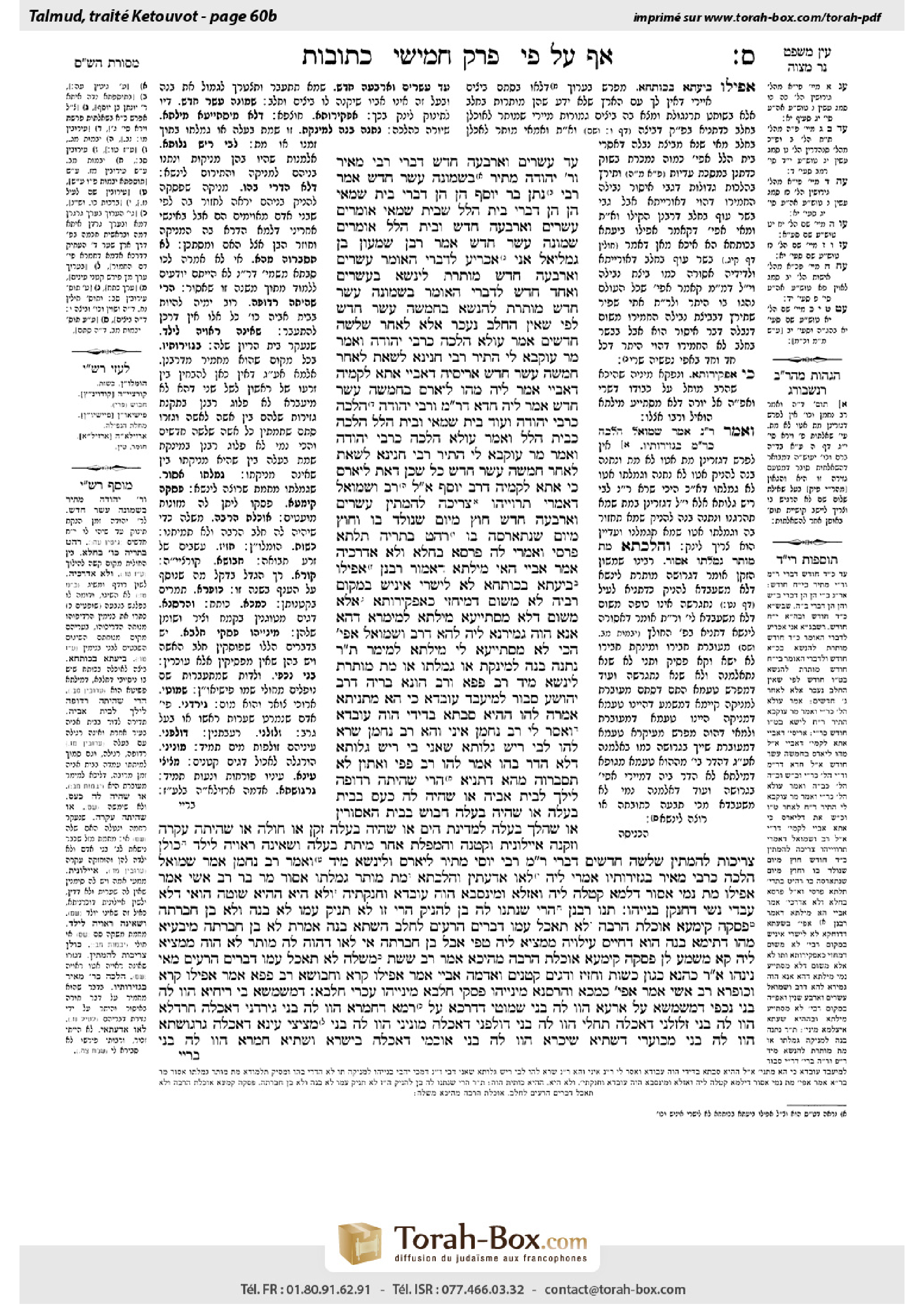
Ketubot 60b: Talmud study for Daf Yomi
Daf Yomi is the daily study of one Talmud folio. Explore 37 tractates with scans, Hebrew text, Sefaria English and AI-generated French translations where annotated.
Passage selection and English or AI-generated French translation are available where the scan has annotations. Daf Study is independent of Torah-Box and Sefaria.
Browse Ketubot · כתובות · All tractatesKetubot 60b text and translations
This page of Ketubot includes the Aramaic text, an English translation and an AI-generated French translation, alongside the scan above.
כתובות ס׳ ב · Aramaic and Hebrew text
עַד עֶשְׂרִים וְאַרְבָּעָה חֹדֶשׁ, דִּבְרֵי רַבִּי מֵאִיר. וְרַבִּי יְהוּדָה מַתִּיר בִּשְׁמוֹנָה עָשָׂר חֹדֶשׁ. אָמַר רַבִּי נָתָן בַּר יוֹסֵף: הֵן הֵן דִּבְרֵי בֵּית שַׁמַּאי, הֵן הֵן דִּבְרֵי בֵּית הִלֵּל. שֶׁבֵּית שַׁמַּאי אוֹמְרִים: עֶשְׂרִים וְאַרְבָּעָה חֹדֶשׁ, וּבֵית הִלֵּל אוֹמְרִים: שְׁמוֹנָה עָשָׂר חֹדֶשׁ.
אָמַר רַבָּן שִׁמְעוֹן בֶּן גַּמְלִיאֵל: אֲנִי אַכְרִיעַ. לְדִבְרֵי הָאוֹמֵר עֶשְׂרִים וְאַרְבָּעָה חֹדֶשׁ — מוּתֶּרֶת לִינָּשֵׂא בְּעֶשְׂרִים וְאֶחָד חֹדֶשׁ. לְדִבְרֵי הָאוֹמֵר בִּשְׁמוֹנָה עָשָׂר חֹדֶשׁ — מוּתֶּרֶת לְהִנָּשֵׂא בַּחֲמִשָּׁה עָשָׂר חֹדֶשׁ, לְפִי שֶׁאֵין הֶחָלָב נֶעְכָּר אֶלָּא לְאַחַר שְׁלֹשָׁה חֳדָשִׁים.
אָמַר עוּלָּא: הֲלָכָה כְּרַבִּי יְהוּדָה. וְאָמַר מָר עוּקְבָא: לִי הִתִּיר רַבִּי חֲנִינָא לָשֵׂאת לְאַחַר חֲמִשָּׁה עָשָׂר חֹדֶשׁ. אֲרִיסֵיהּ דְּאַבָּיֵי אֲתָא לְקַמֵּיהּ דְּאַבָּיֵי, אֲמַר לֵיהּ: מַהוּ לֵיאָרֵס בַּחֲמִשָּׁה עָשָׂר חֹדֶשׁ? אֲמַר לֵיהּ: חֲדָא, דְּרַבִּי מֵאִיר וְרַבִּי יְהוּדָה — הֲלָכָה כְּרַבִּי יְהוּדָה. וְעוֹד: בֵּית שַׁמַּאי וּבֵית הִלֵּל — הֲלָכָה כְּבֵית הִלֵּל. וְאָמַר עוּלָּא: הֲלָכָה כְּרַבִּי יְהוּדָה, וְאָמַר מָר עוּקְבָא: לִי הִתִּיר רַבִּי חֲנִינָא לָשֵׂאת לְאַחַר חֲמִשָּׁה עָשָׂר חֹדֶשׁ, כׇּל שֶׁכֵּן דְּאַתְּ לֵיאָרֵס.
כִּי אֲתָא לְקַמֵּיהּ דְּרַב יוֹסֵף, אֲמַר לֵיהּ: רַב וּשְׁמוּאֵל דְּאָמְרִי תַּרְוַיְיהוּ: צְרִיכָה לְהַמְתִּין עֶשְׂרִים וְאַרְבָּעָה חֹדֶשׁ, חוּץ מִיּוֹם שֶׁנּוֹלַד בּוֹ וְחוּץ מִיּוֹם שֶׁנִּתְאָרְסָה בּוֹ. רְהַט בָּתְרֵיהּ תְּלָתָא פַּרְסֵי וְאָמְרִי לַהּ פַּרְסָא בְּחָלָא, וְלָא אַדְרְכֵיהּ.
אָמַר אַבָּיֵי: הַאי מִילְּתָא דַאֲמוּר רַבָּנַן אֲפִילּוּ בֵּיעֲתָא בְּכוּתָּחָא לָא לִישְׁרֵי אִינִישׁ בִּמְקוֹם רַבֵּיהּ, לָא מִשּׁוּם דְּמִיחֲזֵי כְּאַפְקִירוּתָא, אֶלָּא מִשּׁוּם דְּלָא מִסְתַּיְּיעָא מִילְּתָא לְמֵימְרָא. דְּהָא אֲנָא הֲוָה גְּמִירְנָא לֵיהּ לְהָא דְּרַב וּשְׁמוּאֵל, אֲפִילּוּ הָכִי לָא מִסְתַּיְּיעָא לִי מִילְּתָא לְמֵימַר.
תָּנוּ רַבָּנַן: נָתְנָה בְּנָהּ לְמֵינֶקֶת, אוֹ גְּמָלַתּוּ, אוֹ מֵת — מוּתֶּרֶת לִינָּשֵׂא מִיָּד. רַב פָּפָּא וְרַב הוּנָא בְּרֵיהּ דְּרַב יְהוֹשֻׁעַ סְבוּר לְמִיעְבַּד עוֹבָדָא כִּי הָא מַתְנִיתָא. אֲמַרָה לְהוּ הָהִיא סָבְתָּא: בְּדִידִי הֲוָה עוֹבָדָא, וַאֲסַר לִי רַב נַחְמָן.
אִינִי?! וְהָא רַב נַחְמָן שְׁרָא לְהוּ לְבֵי רֵישׁ גָּלוּתָא! שָׁאנֵי בֵּי רֵישׁ גָּלוּתָא דְּלָא הָדְרִי בְּהוּ.
אֲמַר לְהוּ רַב פַּפֵּי: וְאַתּוּן לָא תִּסְבְּרוּהָ — מֵהָא דְּתַנְיָא: הֲרֵי שֶׁהָיְתָה רְדוּפָה לֵילֵךְ לְבֵית אָבִיהָ, אוֹ שֶׁהָיָה לָהּ כַּעַס בְּבֵית בַּעְלָהּ, אוֹ שֶׁהָיָה בַּעְלָהּ חָבוּשׁ בְּבֵית הָאֲסוּרִין, אוֹ שֶׁהָלַךְ בַּעְלָהּ לִמְדִינַת הַיָּם, אוֹ שֶׁהָיָה בַּעְלָהּ זָקֵן, אוֹ חוֹלֶה, אוֹ שֶׁהָיְתָה עֲקָרָה וּזְקֵנָה אַיְילוֹנִית וּקְטַנָּה, וְהַמַּפֶּלֶת אַחַר מִיתַת בַּעְלָהּ, וְשֶׁאֵינָהּ רְאוּיָה לֵילֵד — כּוּלָּן צְרִיכוֹת לְהַמְתִּין שְׁלֹשָׁה חֳדָשִׁים, דִּבְרֵי רַבִּי מֵאִיר.
רַבִּי יוֹסֵי מַתִּיר לֵיאָרֵס וְלִינָּשֵׂא מִיָּד. וְאָמַר רַב נַחְמָן אָמַר שְׁמוּאֵל: הֲלָכָה כְּרַבִּי מֵאִיר בִּגְזֵירוֹתָיו.
אָמְרִי לֵיהּ: לָאו אַדַּעְתִּין. וְהִלְכְתָא: מֵת — מוּתָּר, גְּמָלַתּוּ — אָסוּר. מָר בַּר רַב אָשֵׁי אָמַר: אֲפִילּוּ מֵת נָמֵי אָסוּר, דִּלְמָא קָטְלָה לֵיהּ וְאָזְלָא וּמִינַּסְבָא. הֲוָה עוֹבָדָא וַחֲנַקְתֵּיהּ. וְלָא הִיא, הָהִיא שׁוֹטָה הֲוַאי, דְּלָא עָבְדִי נְשֵׁי דְּחָנְקָן בְּנַיְיהוּ.
תָּנוּ רַבָּנַן: הֲרֵי שֶׁנָּתְנוּ לָהּ בֵּן לְהָנִיק — הֲרֵי זוֹ לֹא תָּנִיק עִמּוֹ לֹא בְּנָהּ וְלֹא בֶּן חֲבֶרְתָּהּ. פָּסְקָה קִימְעָא — אוֹכֶלֶת הַרְבֵּה. לֹא תֹּאכַל עִמּוֹ דְּבָרִים הָרָעִים לְחָלָב.
הַשְׁתָּא בְּנָהּ אָמְרַתְּ לָא, בֶּן חֲבֶרְתָּהּ מִיבַּעְיָא?! מַהוּ דְּתֵימָא: בְּנָהּ הוּא דְּחָיְיסָ[א] עִילָּוֵיהּ מַמְצְיָא לֵיהּ טְפֵי. אֲבָל בֶּן חֲבֶרְתָּהּ, אִי לָאו דַּהֲוָה לַהּ מוֹתָר לָא הֲוָה מַמְצְיָא לֵיהּ, קָא מַשְׁמַע לַן.
פָּסְקָה קִימְעָא — אוֹכֶלֶת הַרְבֵּה. מֵהֵיכָא? אָמַר רַב שֵׁשֶׁת: מִשֶּׁלָּהּ.
לֹא תֹּאכַל עִמּוֹ דְּבָרִים הָרָעִים. מַאי נִינְהוּ? אָמַר רַב כָּהֲנָא: כְּגוֹן כְּשׁוּת וַחֲזִיז וְדָגִים קְטַנִּים וַאֲדָמָה. אַבָּיֵי אָמַר: אֲפִילּוּ קָרָא וַחֲבוּשָׁא. רַב פָּפָּא אָמַר: אֲפִילּוּ קוֹרָא וְכוּפְרָא. רַב אָשֵׁי אָמַר: אֲפִילּוּ כַּמְכָּא וְהַרְסָנָא. מִינַּיְיהוּ פָּסְקִי חֲלָבָא, מִינַּיְיהוּ עָכְרִי חֲלָבָא.
דִּמְשַׁמְּשָׁא בֵּי רִיחְיָא — הָווּ לַהּ בְּנֵי נִכְפֵּי. דִּמְשַׁמְּשָׁא עַל אַרְעָא — הָווּ לַהּ בְּנֵי שְׁמוּטֵי. דְּדָרְכָא עַל (רְמָא) [דְּמָא] דַּחֲמָרָא — הָווּ לַהּ בְּנֵי גִּירְדָּנֵי. דְּאָכְלָה חַרְדְּלָא — הָווּ לַהּ בְּנֵי זַלְזְלָנֵי. דְּאָכְלָה תַּחְלֵי — הָווּ לַהּ בְּנֵי דּוּלְפָנֵי. דְּאָכְלָה מוֹנִינֵי — הָווּ לַהּ בְּנֵי מְצִיצֵי עֵינָא. דְּאָכְלָה גַּרְגּוּשְׁתָּא — הָווּ לַהּ בְּנֵי מְכוֹעָרֵי. דְּשָׁתְיָא שִׁיכְרָא — הָווּ לַהּ בְּנֵי אוּכָּמֵי. דְּאָכְלָה בִּישְׂרָא וְשָׁתְיָא חַמְרָא — הָווּ לַהּ בְּנֵי
Ketubot 60b · English translation
until twenty-four months from the day the child was born. The reason for this decree is to protect the child. If she remarries she may become pregnant and may not be able to continue nursing, but her second husband will not be obligated to support the child who is not his son. This is the statement of Rabbi Meir. And Rabbi Yehuda permits getting married after eighteen months. Rabbi Natan bar Yosef said: These words are the same as the statement of Beit Shammai, and those words are the same as the statement of Beit Hillel, i.e., this is an ancient dispute, as Beit Shammai say: Twenty-four months, and Beit Hillel say: Eighteen months.
Rabban Shimon ben Gamliel said: I will decide. According to the one who says twenty-four months, she may marry after twenty-one months, since even if she gets pregnant, for the first three months of pregnancy she can still continue to nurse. According to the one who says eighteen months, she may marry after fifteen months, since the milk becomes spoiled due to pregnancy only after three months.
Ulla said: The halakha is in accordance with the opinion of Rabbi Yehuda. And Mar Ukva said: Rabbi Ḥanina allowed me to marry a nursing woman after fifteen months. It is related that Abaye’s tenant farmer came before Abaye to ask a question. He said to him: What is the halakha with regard to betrothing a nursing woman after fifteen months? Abaye said to him: One reason it is permitted is that in disputes between Rabbi Meir and Rabbi Yehuda, the halakha is in accordance with Rabbi Yehuda. And furthermore, this is actually a dispute between earlier tanna’im, and when Beit Shammai and Beit Hillel dispute, the halakha is in accordance with Beit Hillel. And in addition, Ulla said: The halakha is in accordance with Rabbi Yehuda. And Mar Ukva said: Rabbi Ḥanina allowed me to marry after fifteen months, and therefore all the more so you are permitted to betroth her, as you are only betrothing and not marrying her.
When Abaye came before Rav Yosef and told him of the incident, Rav Yosef said to him in response: Rav and Shmuel both say: She must wait twenty-four months before even becoming betrothed, excluding the day that the child was born and excluding the day she became betrothed. When Abaye heard this, he ran three parasangs after his tenant farmer, and some say that he ran one parasang [parsa] through sand. He wanted to inform him that he should not rely on the leniency, but rather he should act in accordance with Rav and Shmuel, who prohibited the betrothal, but he did not succeed in catching up to him.
Abaye said that he learned from this situation that which the Sages said: A person should not permit even eating an egg in kutaḥ, a dish made with milk, in his teacher’s vicinity. This is a very simple ruling, as an egg is not meat and may unquestionably be eaten with milk. There are no stringencies that apply to this case, but nevertheless one should not rule even on such a halakha in his teacher’s vicinity. Abaye explained that this is not because it appears disrespectful to teach halakha in one’s teacher’s vicinity, as this is a simple matter that does not require great knowledge of halakha, rather because he will not be successful in saying the matter correctly. An illustration of this principle is what just happened, since I had learned this halakha of Rav and Shmuel, and even so I was unsuccessful in saying it correctly, as I ruled in the vicinity of my teacher, Rav Yosef.
§ The Sages taught: If a woman gave her child to a wet nurse during the waiting period, or weaned him, or the child died, she is permitted to marry immediately. It is related that Rav Pappa and Rav Huna, son of Rav Yehoshua, thought to act in accordance with this baraita. However, a certain old woman said to them: There was an incident in which I was involved with regard to this issue and Rav Naḥman prohibited it for me.
The Gemara asks: Is that so? Didn’t Rav Naḥman permit this for the members of the Exilarch’s household? The Gemara answers: The Exilarch’s household is different, since people employed by them do not renege out of fear of the consequences. Consequently, if a woman from that household arranges a wet nurse for her child, it is certain that the wet nurse will keep her commitment, whereas with other people there is a danger that if the mother remarries the child might be left without anyone to feed him.
Rav Pappi said to Rav Pappa and Rav Huna, son of Rav Yehoshua: And do you not maintain that such a marriage is prohibited from that which is taught in a baraita: If a woman frequently went to her father’s house and had been there for a long time; or she had been angry with her husband and separated from him while still in his house; or her husband had been incarcerated in prison; or her husband had gone overseas; or her husband had been old or ill; or if she was a barren woman, or elderly, or a sexually underdeveloped woman, or a minor girl; or if she had miscarried after the death of her husband; or if she was unfit to give birth for any other reason, although in any of these cases there is no concern that she might be pregnant, they must all wait at least three months. The Sages said that a woman must wait for three months between marriages, so there would be no doubt as to who is the father of any child she may give birth to, and they did not distinguish between different women with regard to this decree. This is the statement of Rabbi Meir.
However, Rabbi Yosei permits all the aforementioned women to be betrothed and to marry immediately, since there is no concern that they may be pregnant. And Rav Naḥman said that Shmuel said: The halakha is in accordance with the opinion of Rabbi Meir with regard to all of his decrees. In every place where Rabbi Meir was stringent so as to avoid possibility of error, the halakha is in accordance with his opinion. Consequently, this ruling should apply also to a nursing mother who wishes to remarry; the restriction should apply equally to a woman who had given her child to a wet nurse, or who had weaned him, or whose child had died.
They answered him: The matter was not in our mind, meaning that we had forgotten this principle. Nevertheless, the Gemara concludes: The halakha is that if a nursing mother’s child died, the mother is permitted to marry immediately, but if she had weaned him, she is prohibited from marrying, lest she forcibly wean him prematurely. Mar bar Rav Ashi said: Even if the child died, she is also prohibited from marrying, because if it were permitted when the child dies, there would be concern that she might kill him and then go and get married. It is related that there was an incident where a woman strangled her child for this reason. The Gemara concludes that that is not so, i.e., this incident does not affect the halakha. That woman was insane, and since women do not ordinarily strangle their children, one need not be concerned about this happening.
§ The Sages taught: If someone gave a child to a wet nurse, and she agreed to nurse him for payment, she may not nurse her own child or another woman’s child together with him, in order that she not take away milk from the child she is being paid to nurse. Even if she fixed a small allowance for food with the payment for nursing, she must nevertheless eat large quantities so that she will have enough milk. And she may not eat together with him, i.e., while she is nursing the child, things that are bad for her milk.
The Gemara asks about this baraita: Now that you said that she may not nurse her own child together with her client’s child, is it necessary to say that she cannot nurse another woman’s child? The Gemara answers: Lest you say that the prohibition is limited to her child, as there is a concern that since she favors him, she will feed him more milk than the other child, but with regard to another woman’s child, if she did not have surplus milk she would not feed him, and therefore it should be permitted, the baraita therefore teaches us not to distinguish between the cases.
The baraita said that even if she fixed a small allowance for food, she must eat large quantities. The Gemara asks: From where should she get this food if the allowance cannot cover it? Rav Sheshet said: From her own funds. Because she accepted an obligation to nurse the child, she must take the necessary steps to fulfill her obligation.
The baraita said: She may not eat together with him things that are bad for her milk. The Gemara asks: What are these foods that are detrimental for milk? Rav Kahana said: For example, hops; and young, green grain sprouts; small fish; and soil. Abaye said: Even pumpkin and quince. Rav Pappa said: Even pumpkin and palm branches with small, unripe dates. Rav Ashi said: Even kutaḥ [kamka] and small fried fish. All these items are bad, as some cause milk to dry up and some cause milk to spoil.
The Gemara cites other possible consequences of a mother’s behavior that could affect her children: A woman who engages in intercourse in a mill will have epileptic children; one who engages in intercourse on the ground will have long-necked children; one who steps on a donkey’s dung when pregnant will have bald children; one who eats mustard during pregnancy will have gluttonous children; one who eats garden cress [taḥlei] will have tearful children; one who eats fish brine [moninei] will have children with blinking eyes; one who eats soil will have ugly children; one who drinks intoxicating liquor will have black children; one who eats meat and drinks wine during pregnancy will have children who are
Ketubot 60b · Traduction française (IA)
jusqu’à vingt-quatre mois à compter du jour de la naissance de l’enfant. Cette ordonnance vise à protéger l’enfant. Si elle se remarie, elle peut tomber enceinte et ne plus être en mesure de continuer à allaiter ; son second mari ne sera toutefois pas tenu d’entretenir un enfant qui n’est pas son fils. Telle est l’opinion de Rabbi Meïr. Rabbi Yehouda, lui, permet de se marier après dix-huit mois. Rabbi Natan bar Yossef dit : « Ces paroles correspondent à l’opinion de Beit Chammaï, et ces autres paroles à celle de Beit Hillel », autrement dit, il s’agit d’une ancienne controverse, car Beit Chammaï disent : « Vingt-quatre mois », et Beit Hillel disent : « Dix-huit mois ».
Rabban Shimon ben Gamliel dit : « Je trancherai. » Selon celui qui dit vingt-quatre mois, elle peut se marier après vingt et un mois, car, même si elle tombe enceinte, elle peut continuer à allaiter pendant les trois premiers mois de sa grossesse. Selon celui qui dit dix-huit mois, elle peut se marier après quinze mois, car le lait ne s’altère du fait de la grossesse qu’au bout de trois mois.
Oulla dit : « La halakha suit l’opinion de Rabbi Yehouda. » Mar Oukva dit : « Rabbi Ḥanina m’a autorisé à épouser une femme qui allaite après quinze mois. » Il est rapporté que le métayer d’Abayé vint poser une question à Abayé. Il lui demanda : « Quelle est la halakha concernant les fiançailles avec une femme qui allaite après quinze mois ? » Abayé lui répondit : « L’une des raisons de le permettre est que, dans les controverses entre Rabbi Meïr et Rabbi Yehouda, la halakha suit Rabbi Yehouda. De plus, il s’agit en réalité d’une controverse entre des tannaïm antérieurs, et, lorsque Beit Chammaï et Beit Hillel sont en désaccord, la halakha suit Beit Hillel. En outre, Oulla a dit que la halakha suit Rabbi Yehouda, et Mar Oukva a dit que Rabbi Ḥanina l’a autorisé à épouser une femme après quinze mois. À plus forte raison, tu es donc autorisé à te fiancer avec elle, puisque tu ne fais que te fiancer et non l’épouser. »
Quand Abayé se présenta devant Rav Yossef et lui raconta l’incident, Rav Yossef lui répondit : « Rav et Shmouel disent tous deux qu’elle doit attendre vingt-quatre mois avant même de se fiancer, sans compter le jour de la naissance de l’enfant ni celui des fiançailles. » En entendant cela, Abayé courut trois parasanges à la poursuite de son métayer ; selon certains, il courut une parasange [parsa] dans le sable. Il voulait l’informer qu’il ne devait pas se fier à cette permission, mais agir plutôt conformément à l’avis de Rav et Shmouel, qui interdisaient les fiançailles, mais il ne parvint pas à le rattraper.
Abayé dit avoir tiré de cet épisode la leçon de ce que les Sages ont dit : « Une personne ne doit pas autoriser, même en présence de son maître, la consommation d’un œuf dans du kutaḥ », un plat à base de lait. C’est une décision très simple, car un œuf n’est pas de la viande et peut assurément être consommé avec du lait. Aucune rigueur ne s’applique à ce cas ; néanmoins, on ne doit pas statuer même sur une telle halakha en présence de son maître. Abayé expliqua que ce n’est pas parce qu’il serait irrespectueux d’enseigner la halakha en présence de son maître, car il s’agit d’une question simple qui ne requiert pas une grande connaissance de la halakha, mais parce qu’on ne réussira pas à formuler correctement la chose. Ce principe est illustré par ce qui vient de se produire : j’avais appris cette halakha de Rav et Shmouel et, malgré cela, je n’ai pas réussi à la formuler correctement, car j’ai statué en présence de mon maître, Rav Yossef.
§ Les Sages ont enseigné : Si une femme confie son enfant à une nourrice pendant la période d’attente, le sèvre, ou si l’enfant meurt, elle est autorisée à se marier immédiatement. Il est rapporté que Rav Pappa et Rav Houna, fils de Rav Yehoshoua, envisageaient d’agir conformément à cette baraïta. Cependant, une certaine vieille femme leur dit : « J’ai été impliquée dans une affaire portant sur cette question, et Rav Naḥman me l’a interdit. »
La Guemara demande : « En est-il ainsi ? Rav Naḥman n’a-t-il pas autorisé cela pour les membres de la maison de l’Exilarque ? » La Guemara répond : « Le cas de la maison de l’Exilarque est différent, car les personnes qui travaillent pour eux ne reviennent pas sur leurs engagements, par crainte des conséquences. » Par conséquent, si une femme de cette maison trouve une nourrice pour son enfant, il est certain que la nourrice respectera son engagement ; chez les autres, en revanche, il existe un risque que, si la mère se remarie, l’enfant se retrouve sans personne pour le nourrir.
Rav Pappi dit à Rav Pappa et à Rav Houna, fils de Rav Yehoshoua : « Ne considérez-vous pas, vous aussi, qu’un tel mariage est interdit, d’après ce qui est enseigné dans une baraïta : Si une femme se rendait souvent chez son père et y séjournait longtemps ; ou si elle s’était querellée avec son mari et s’était séparée de lui tout en restant dans sa maison ; ou si son mari avait été emprisonné ; ou s’il était parti outre-mer ; ou s’il était âgé ou malade ; ou si elle était stérile, âgée, sexuellement sous-développée ou mineure ; ou si elle avait fait une fausse couche après la mort de son mari ; ou si, pour toute autre raison, elle était incapable d’enfanter — bien que, dans chacun de ces cas, il n’y ait aucune crainte qu’elle soit enceinte, toutes doivent attendre au moins trois mois. Les Sages ont dit qu’une femme doit attendre trois mois entre deux mariages, afin qu’il n’y ait aucun doute sur l’identité du père d’un enfant qu’elle pourrait mettre au monde ; ils n’ont pas distingué les femmes les unes des autres au sujet de cette ordonnance. Telle est l’opinion de Rabbi Meïr. »
Rabbi Yossi, cependant, permet à toutes les femmes mentionnées plus haut de se fiancer et de se marier immédiatement, puisqu’il n’y a pas lieu de craindre qu’elles soient enceintes. Rav Naḥman a dit au nom de Shmouel : « La halakha suit l’opinion de Rabbi Meïr pour toutes ses ordonnances. » Partout où Rabbi Meïr a été rigoureux afin d’éviter toute possibilité d’erreur, la halakha suit son opinion. Cette décision devrait donc également s’appliquer à une mère qui allaite et souhaite se remarier : la restriction devrait s’appliquer tout autant à une femme qui a confié son enfant à une nourrice, qui l’a sevré ou dont l’enfant est mort.
Ils lui répondirent : « Cela ne nous était pas venu à l’esprit », c’est-à-dire que nous avions oublié ce principe. La Guemara conclut néanmoins : la halakha est que, si l’enfant d’une mère qui allaite est mort, celle-ci est autorisée à se marier immédiatement ; mais si elle l’a sevré, il lui est interdit de se marier, de peur qu’elle ne l’ait sevré prématurément par la force. Mar bar Rav Ashi dit : « Même si l’enfant est mort, elle ne peut pas se marier, car, si cela était permis lorsque l’enfant meurt, on craindrait qu’elle ne le tue, puis ne parte se marier. » Il est rapporté qu’une femme étrangla son enfant pour cette raison. La Guemara conclut que ce n’est pas le cas, autrement dit, que cet incident ne modifie pas la halakha. Cette femme était folle et, puisque les femmes n’étranglent pas habituellement leurs enfants, il n’y a pas lieu de craindre que cela se produise.
§ Les Sages ont enseigné : Si quelqu’un confie un enfant à une nourrice et que celle-ci accepte de l’allaiter contre rémunération, elle ne peut pas allaiter en même temps son propre enfant ni celui d’une autre femme, afin de ne pas détourner le lait de l’enfant qu’elle est payée pour allaiter. Même si elle a convenu d’une faible allocation de nourriture en plus de sa rémunération pour l’allaitement, elle doit néanmoins manger en grande quantité afin d’avoir suffisamment de lait. Elle ne peut pas non plus manger, pendant qu’elle allaite l’enfant, des aliments qui nuisent à son lait.
La Guemara interroge cette baraïta : « Maintenant que tu as dit qu’elle ne peut pas allaiter en même temps son propre enfant et celui de sa cliente, est-il nécessaire de préciser qu’elle ne peut pas allaiter celui d’une autre femme ? » La Guemara répond : « On aurait pu croire que l’interdiction ne concerne que son propre enfant, car on craint que, puisqu’elle le préfère, elle lui donne plus de lait qu’à l’autre enfant. Mais, pour l’enfant d’une autre femme, s’il ne lui restait pas de lait en surplus, elle ne l’allaiterait pas ; cela devrait donc être permis. La baraïta nous enseigne donc qu’il ne faut pas distinguer entre ces cas. »
La baraïta dit que, même si elle a convenu d’une faible allocation de nourriture, elle doit manger en grande quantité. La Guemara demande : « D’où se procurera-t-elle cette nourriture si l’allocation ne suffit pas à la couvrir ? » Rav Sheshet dit : « Sur ses propres fonds. » Puisqu’elle s’est engagée à allaiter l’enfant, elle doit prendre les mesures nécessaires pour remplir son obligation.
La baraïta dit : « Elle ne peut pas manger, pendant qu’elle allaite l’enfant, des aliments qui nuisent à son lait. » La Guemara demande : « Quels sont ces aliments qui nuisent au lait ? » Rav Kahana dit : « Par exemple, le houblon, les jeunes pousses de céréales vertes, les petits poissons et la terre. » Abayé dit : « Même la citrouille et le coing. » Rav Pappa dit : « Même la citrouille et les branches de palmier portant de petites dattes encore vertes. » Rav Ashi dit : « Même le kutaḥ [kamka] et les petits poissons frits. » Tous ces aliments sont nocifs : certains tarissent le lait et d’autres l’altèrent.
La Guemara évoque d’autres conséquences possibles du comportement d’une mère susceptibles d’affecter ses enfants : une femme qui a des rapports sexuels dans un moulin aura des enfants épileptiques ; celle qui a des rapports sexuels à même le sol aura des enfants au long cou ; celle qui marche sur des excréments d’âne pendant sa grossesse aura des enfants chauves ; celle qui mange de la moutarde pendant sa grossesse aura des enfants gloutons ; celle qui mange du cresson [taḥlei] aura des enfants pleurnicheurs ; celle qui mange de la saumure de poisson [moninei] aura des enfants aux yeux qui clignent ; celle qui mange de la terre aura des enfants laids ; celle qui boit des boissons enivrantes aura des enfants noirs ; celle qui mange de la viande et boit du vin pendant sa grossesse aura des enfants qui sont
Traduction française générée par IA à partir de l’édition anglaise de Sefaria. Vérifie toujours un passage avec le texte source.
Text from Sefaria: William Davidson Edition - Vocalized Aramaic (CC BY NC); William Davidson Edition - English (CC BY NC).